Introduction
The use of parasiticides for the control of parasites in domestic animals constitutes a major sector of the global animal health effort. Infections of livestock by parasites can affect the overall health of dairy cattle (Bos taurus Linnaeus; Mammalia: Bovidae) by causing weight loss and reducing milk yield, and consequently profitability. The macrocyclic lactone ivermectin (IVM) is the most widely used pharmaceutical worldwide (Lumaret et al. Reference Lumaret, Errouissi, Floate, Römbke and Wardhaugh2012). Its use in livestock has direct toxic effects on dung-breeding insects, with implications for the functioning of pasture ecosystems. Regardless of the administration route, ivermectin is excreted almost entirely via the faeces. Treated cattle thus excrete residues that are toxic to dung-inhabiting insects, including the dung beetles (Coleoptera: Scarabaeidae) that provide valuable ecosystem services such as biological pest control and soil fertilisation (Nichols et al. Reference Nichols, Spector, Louzada, Larsen, Amezquita and Favila2008; Beynon et al. Reference Beynon, Wainwright and Christie2015). Concerns have been raised that the use of macrocyclic lactones may reduce insect diversity and cause the accumulation of dung on pastures (Floate et al. Reference Floate, Wardhaugh, Boxall and Sherratt2005; Lumaret et al. Reference Lumaret, Errouissi, Floate, Römbke and Wardhaugh2012). Beynon et al. (Reference Beynon, Peck, Mann and Lewis2012) estimated that, if it is not broken down, dung accumulation could reduce the total area of a permanent pasture by up to 4.8% each year.
The key behavioural trait of tunnelling dung beetles is to excavate tunnels underneath droppings and provide dung for offspring in the form of brood balls. The female lays an egg in a cavity within each individual brood ball that nourishes the larva when it hatches (Halffter and Edmonds Reference Halffter and Edmonds1982). Beetle tunnelling reduces the survival of dung-breeding pest flies and gastrointestinal parasites of livestock, returns nutrients to the soil, and physically moves manure from the fouled forage (Anderson et al. Reference Anderson, Merritt and Loomis1984). Tunnelling and dung burial also result in increased grass root growth and biological activity in soils under and adjacent to dung pats. Economic and ecological benefits from dung beetles have led to the introduction of several species into pasture habitats around the world and their use for applied studies in biodiversity (Halffter and Favila Reference Halffter and Favila1993; Spector Reference Spector2006). Thus, Euoniticellus intermedius (Reiche) (Coleoptera: Scarabaeidae) was first introduced from Africa to Australia between 1971 and 1984 to reduce cattle dung accumulation on pastures resulting from the inability of the native dung beetles to cope with the large moist dung pats produced by the introduced cattle. The second objective of the introduction was to control dung-breeding buffalo flies (Haematobia exigua Meijere; Diptera: Muscidae) and bush flies (Musca vetustissima Walker; Diptera: Muscidae) (Waterhouse Reference Waterhouse1974; Edwards Reference Edwards2007). Euoniticellus intermedius was introduced from Australia into the southern of the United States of America where it established (Fincher Reference Fincher1986). Since the 1980s, the species has spread to Mexico (Montes de Oca and Halffter Reference Montes de Oca and Halffter1998) and from there, southward to Costa Rica (Solís and Kohlmann Reference Solís and Kohlmann2012). Today this invasive species is considered one of the most common dung beetles in the grazed pastures of primarily tropical Mexico where its burial activity is substantial (Flota-Bañuelos et al. Reference Flota-Bañuelos, López-Collado, Vargas-Mendoza, Fajersson, González-Hernández and Martínez-M.2012).
Previous studies on the unintended effects of ivermectin (lethal and sublethal effects) on E. intermedius mainly focussed on the rate of adult emergence and brood ball production following the treatment of livestock, without measuring the precise concentration of ivermectin in the dung given as food to adults and their larvae (Fincher Reference Fincher1996; Krüger and Scholtz Reference Krüger and Scholtz1997). In these studies, the injection of cattle with ivermectin (200 µg/kg body weight) prevented adult emergence of E. intermedius from dung collected two to seven days after treatment. The number of eggs laid by females, which corresponded to the number of brood balls constructed, was similar for both treatment and control groups, except during the peak of ivermectin faecal elimination in the first three days after treatment. Recently, Cruz-Rosales et al. (Reference Cruz Rosales, Martínez, López-Collado, Vargas-Mendoza, González-Hernández and Fajersson2012) evaluated the effects of three concentrations of ivermectin directly added to the fresh dung (spiked dung; 0.01, 1.0, and 100 ppm) on the reproduction and larval development of E. intermedius. At 0.01 ppm (10 µg IVM/kg dung fresh weight) the fecundity of adults was not affected, in contrast to 1.0 ppm (1000 µg/kg dung fresh weight), which drastically reduced fecundity and larval emergence and 100 ppm and killed all parent beetles. In that experiment, the small number and wide range of concentrations did not allow for the calculation of important parameters such as lethal concentration at which 50% individuals die (LC50), no observed effect concentration (NOEC), or lowest observed effect concentration (LOEC), and this made it impossible to come to a definitive conclusion about the effects of ivermectin on female fecundity and larval mortality. Cruz-Rosales et al. (Reference Cruz Rosales, Martínez, López-Collado, Vargas-Mendoza, González-Hernández and Fajersson2012) suggested that more detailed analyses using concentrations ranging from 0.01 to 1.0 ppm were necessary to establish the harmful and lethal concentrations for E. intermedius larvae.
The effects of ivermectin in dung beetles depend on its concentration in the dung, but we are far from completely understanding how this macrocyclic lactone modifies the physiology of female ovaries in E. intermedius. Furthermore, the way in that ivermectin reduces the fecundity and increases the length of pre-imaginal development has not yet been clarified. Recently, Verdú et al. (Reference Verdú, Cortez, Ortiz, González-Rodríguez, Pinna and Lumaret2015) showed that low ivermectin concentrations paralyses the muscles of adult dung beetles, as it does in nematodes where ivermectin inhibits pharyngeal muscle contraction, leading to paralysis (Turner and Schaeffer Reference Turner and Schaeffer1989; Brownlee et al. Reference Brownlee, Holden-Dye and Walker1997). These findings have led us to examine the preliminary results of Cruz-Rosales et al. (Reference Cruz Rosales, Martínez, López-Collado, Vargas-Mendoza, González-Hernández and Fajersson2012) more closely and investigate the possibility that the ingestion of ivermectin by mature E. intermedius females induces a decrease in the contraction force of muscles surrounding the ovary, extending the period between the expulsion of successive eggs, and leading to the premature resorption of oocytes and a decrease in fecundity. Similarly, in larvae, an increase in the flaccidness of their muscles may slow down their consumption of the dung reserves buried in the pedotrophic nest and lead to protracted juvenile development.
In the present study, we investigated the effects of exposure to ivermectin, specifically at low concentrations, on E. intermedius females and their offspring. The objectives were: (i) to evaluate female fecundity as a function of ivermectin concentration in dung; (ii) to assess the effects of ivermectin on ovarian morphology and physiology; and (iii) to determine the relationship between larval mortality and ivermectin concentration and then estimate the NOEC, LOEC, and LC50 values.
Materials and methods
Study species and laboratory rearing
A laboratory colony of E. intermedius was established from beetles collected from Zapoapan Ranch, close to Santiago Tuxtla, Veracruz, Mexico (18°27'N, 95°18'W; 166 m). The cattle had not been treated with ivermectin for six months before beetle collection. The first generation of E. intermedius reared in the laboratory was used exclusively for the experiments. Beetles were reared and all experiments were conducted in an insectary at 26–27 °C, 14 hour photoperiod and ~70% relative humidity. Beetles for breeding were placed in plastic terraria (57×30×37 cm) half filled with moist and sterilised sandy soil. For bioassays, pairs of beetles (an individual of each sex together) were placed in a 1-L, gauze-covered plastic container (140 mm in height; 100 mm in diameter). The soil was moistened to a crumbly but compact consistency favourable for nesting. Humidity was maintained constant throughout the reproductive period. Dung used for cultures and all tests was obtained from cattle that had not been treated with any parasiticide for at least three months. The dung was collected fresh from the field and frozen at −18 °C for at least 48 hours before use, then thawed and mixed mechanically for 10 minutes to homogenise moisture (83.6±0.9%), pH (6.40), and nitrogen content. Beetles were supplied with cattle dung ad libitum. Beetles used in bioassays were first separated by sex and not fed for 24 hours, and later paired up and placed in the containers (female age at the start of treatment: 7–15 days).
Bioassay
The tests were performed with technical grade ivermectin (CAS-Number: 70288-86-7) with a purity of ⩾90% ivermectin B1a and ⩽5% ivermectin B1b (Batch number: SLBG8734V, Sigma-18898; Sigma-Aldrich, Toluca, Mexico). As ivermectin is poorly soluble in water, it was first dissolved in acetone (CAS-Number: 1567-89-1; Sigma purity >99.8%) to obtain the desired concentrations by serial dilution. The acetone/ivermectin solution was then thoroughly mixed into the cattle dung (spiked dung), and kept for at least eight hours at 25 °C to allow the solvent to evaporate (13 mL acetone/2.5 kg dung fresh weight. A protocol derived from standardised bioassays and guidance developed for dung beetles to test the lethal and sublethal toxicity of parasiticide residues in livestock dung was employed (Organisation for Economic Co-operation and Development 2010; Römbke et al. Reference Römbke, Barrett, Blanckenhorn, Hargreaves, Kadiri and Knäbe2010). The bioassay comprised eight treatments, including a water control, a solvent (acetone) control, and six increasing ivermectin concentrations). Ivermectin concentrations, treatments C1–C6, were 3.16, 10.0, 31.6, 63.2, 100, and 316 µg IVM/kg dung fresh weight. Seven mating pairs (one male and one female) of E. intermedius were used as replicates for each concentration/treatment. Adults were fed three times per week. After 10 days of exposure, the beetles were removed, the females were dissected (reproductive system, fat body, gut content) and the brood balls counted. Each brood ball formed from dung stored by adults during days 1–10 contained an egg, which was used to calculate the relationship between female fecundity and ivermectin concentration. The brood balls were opened 15 days later and live larvae were counted to estimate larval mortality. Larvae at different stages of development were killed and fixed in Peterson’s KAAD fixative (8 mL toluene, 70 mL 95% ethyl alcohol, 14 mL glacial acetic acid, and 8 mL dioxane), and then stored in 95% ethyl alcohol (Carne Reference Carne1951).
Morphology and physiology of the ovary
The females of true dung beetles (Coleoptera: Scarabaeidae: Scarabaeinae) have only one ovary (the left one), with a single ovariole (Robertson Reference Robertson1961). The ovary consists of a coiled germarium and a vitellarium containing differentiated oocytes in sequential stages of development. The ovary is connected to an oviduct leading to the vagina, with the spermatheca also joining the vagina (Robertson Reference Robertson1961). The reproductive system is surrounded by muscles whose contractions push the basal oocyte into the ovary during oviposition and move it through the oviduct and vagina during egg laying. In the present study, the reproductive system of each female was removed by dissection in Ringer’s solution, then fixed in AFATD (75 mL ethyl alcohol 96%, 10 mL formaldehyde, 5 mL acetic acid, 10 mL dimethylsulphoxide, and 1 g trichloroacetic acid) (Martínez Reference Martínez2002). The ovary was drawn to scale using a stereo-microscope with a camera lucida. The physiological state was defined by using the morpho-physiological techniques described by Martínez (Reference Martínez2002) that take into account the size and the number of oocytes per ovary and their colour and morphology. During the dissection of fresh females, body fat quality was evaluated under a stereo-microscope, considering its colour, abundance, and morphological appearance. The quantity of food inside the gut was evaluated by observation through the transparent intestinal wall.
Statistical analysis of fecundity and larval mortality
The statistical analysis of female fecundity, oocyte number per ovary, and larval mortality was run in ToxRat® software version 3.2.1 (Toxrat Solutions 2015). The pair-wise comparison of the two controls (water and solvent) was performed with the Student’s t-test for homogeneous variances, with α=0.05, two-sided, and with P(t)=probability of sample t for Ho: μ1=μ2. Female fecundity and larval mortality were corrected with Abbott’s formula (Abbott Reference Abbott1925). The comparison of treatments with pooled controls (no significant differences between water and solvent) was also performed with a t-test procedure following Williams (Reference Williams1971) (significance α=0.05). The Shapiro–Wilk’s test was used to test the distribution of the treatment for normality, in association with a Levene’s test on the homogeneity of the variance of the data (Levene Reference Levene1960; Shapiro and Wilk Reference Shapiro and Wilk1965). The critical effect and threshold concentrations were calculated at the end of the experiment. The LOEC and NOEC values were determined using Fisher’s exact test with the Bonferroni–Holm adjustment. The effective concentration (EC) and lethal concentration (LC) values with 95% confidence limits were assessed using a probit analysis with a linear maximum likelihood regression. The valid test for brood ball production (fecundity) required a minimum of 20 offspring in the controls and a coefficient of variation not exceeding 15% (Toxrat Solutions 2015). Similarly, a valid test required that the control mortality of offspring not exceed 10%, and the coefficient of variation not exceed 15%, while for oocyte numbers the minimum detectable difference between the two controls was required to be less than 10%. The fecundity and larval mortality values are reported as mean±standard deviation.
Results
Female fecundity in relation to ivermectin concentration in dung
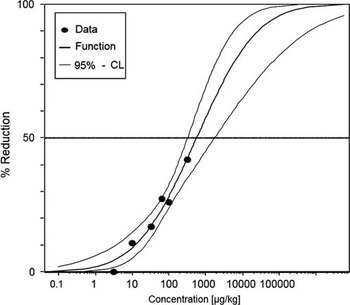
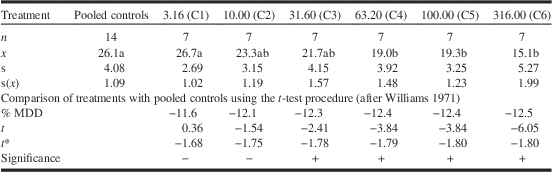
Under our experimental conditions, female fecundity (estimated by the number of brood balls, which corresponds to egg production, produced during days 1–10) varied significantly (F=6.74; P<0.001) as a function of ivermectin concentration levels in the diet (Table 1). The largest decrease in brood ball production occurred at treatment C6 (mean 15.1±5.3 brood balls), whereas the number of brood balls was 26.7±3.7 and 25.4±4.6 for the water and solvent controls, respectively. There was no significant difference between the control and solvent (df=12; t=−0.57; P(t)=0.577; P(F)=−0.309), so the two controls were pooled. The results of the Shapiro–Wilk’s test (W=0.984; P(W)=0.844; number of residues=40) indicate that the data did not deviate significantly from a normal distribution (P(W)>0.05). Variance homogeneity was confirmed at the 0.05 confidence level (df=6; F=0.725; P(F)=0.632). The comparison of treatments (C1–C6) with pooled controls using the t-test procedure (after Williams Reference Williams1971) gave a NOEC value of 10.0 μg IVM/kg dung fresh weight (i.e., concentration C2) and a LOEC of 31.6 μg IVM/kg dung fresh weight for the production of brood balls (Table 1), while the results of the probit analysis gave an EC30 value of 115.9 μg IVM/kg, with lower and upper 95% limits of 78.0 and 183.3 μg IVM/kg dung fresh weight, respectively (Fig. 1). In the probit analysis, the precise EC50 must be obtained when responses are distributed between 25% and 75% (Robertson et al. Reference Robertson, Russell, Preisler and Savin2007). In this study, the maximum concentration evaluated (316 μg IVM/kg dung fresh weight) produced less than a 50% response. Therefore, we chose LC30 instead of LC50.
Effect of increasing ivermectin concentrations (treatments C1–C6) (μg/kg dung fresh weight) on the fecundity of Euoniticellus intermedius females. 95% CL, lower and upper 95% confidence limits.

Mean number (x) of brood balls (corresponding to the number of eggs deposited) produced by the females of Euoniticellus intermedius for a range of ivermectin (IVM) concentrations in fresh dung (μg IVM/kg) and comparison of treatments (C1–C6) with pooled controls.

Notes: Means followed by the same letter in row x are not statistically different (α=0.05).
n, number of replicates; s, standard deviation; s(x), standard error; % MDD, minimum detectable difference to pooled controls (in per cent of pooled controls); t, t-test value; t*, critical t for Ho: μ1=μ2=…=μk; the differences are significant when |t|>|t*| (the residual variance of an analysis of variance was applied).
Effects of ivermectin on ovary morphology and physiology and on gut content
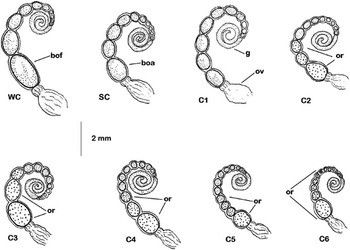
The number of oocytes per ovary varied significantly (F=28.82; P<0.001) with ivermectin concentration, increasing progressively as ivermectin concentration increased (Table 2). In contrast, the size of the ovary diminished (Fig. 2). The normal distribution and variance homogeneity of data requirements were fulfilled (W=0.980; P(W)=0.947), and there was no significant difference between control and solvent (F=0.26; P=0.619), so they were pooled.
Morpho-physiological changes in female Euoniticellus intermedius ovaries when fed for 10 days with dung without ivermectin (water control=WC) and solvent control (SC) and with increasing ivermectin concentrations from treatment C1 to C6 (3.16, 10.0, 31.6, 63.2, 100, and 316 μg IVM/kg dung fresh weight. boa, basal oocyte after egg laying; bof, basal oocyte before egg laying; g, germarium; or, oocytes resorption; ov, oviduct.

Mean number (x) of oocytes in Euoniticellus intermedius female ovary for a range of ivermectin (IVM) concentrations in fresh dung (μg IVM/kg).

Notes: Means followed by the same letter in a column are not statistically different.
n, number of replicates; s, standard deviation; % increase compared with pooled controls.
In the absence of ivermectin in dung (pooled controls) and at the lowest dose of ivermectin (treatment C1), the number of oocytes in the ovary did not significantly differ (F=3.39; P=0.080); the last (basal) oocyte (white colour) was ready to be expelled, or there was a small white basal oocyte when females had recently oviposited (Fig. 1). In all cases the gut of the females contained food in abundance, their body fat was abundant and white in colour, and their oviduct was distended due to oocyte oviposition. At treatment C2 (corresponding to the NOEC value calculated for fecundity), the early degeneration of the basal oocyte (colour ranging from yellow to orange) was evident in most females, up to three oocytes were under reabsorption per ovary, and there were significantly more oocytes throughout the ovary than at the lowest ivermectin concentration, treatment C1 (F=6.42; P=0.024). The body fat remained abundant but slightly pale yellow and the gut contained much less food than in the controls. At treatment C3, which corresponds to the value, the number of oocytes had increased significantly compared with C2 (F=6.81; P=0.021). The ovary and basal oocyte were smaller than in the controls, the basal oocyte and also the following oocytes (up to three) were being resorbed. The oviduct was not as distended as observed in the controls, treatment C1, and treatment C2. The body fat (yellow in colour) was still abundant but the gut contained little food. No significant difference in oocyte numbers was detected among treatment C3–C6 (F=2.01; P=0.182), though anatomical differences were detected. At concentration treatment C4, up to three oocytes were being resorbed and the body fat was dark yellow, small in quantity, and the gut was almost empty. It was difficult to dissect the females because the tissues were all very weak. At concentration treatment C5, the ovary contained a high number of small yellow or orange coloured oocytes, most of them undeveloped, and up to three oocytes in resorption on average. The body fat (orange in colour) was in short supply and the gut contained little food. At the highest ivermectin concentration (treatment C6), the oocytes were very small and for all the females, the basal oocyte was in resorption, with up to seven oocytes being resorbed simultaneously in the ovary, and the oviduct was never distended. Body fat was almost absent and the gut was empty.
Mortality of larvae in relation to ivermectin concentration in dung
For the water and solvent controls, after 10 days, 26.7±3.7 and 25.0±4.9 live larvae were recovered from the brood balls, respectively. There was no significant difference between the control and solvent (df=12; t=−0.74; P(t)=0.475; P(F)=−0.262) so they were pooled. The results of the Shapiro–Wilk’s test (W=0.979; P(W)=0.634; number of residues=42) show that the data did not significantly deviate from a normal distribution (P(W)>0.05). Variance homogeneity was confirmed at the 0.05 confidence level (df=6; F=0.894; P(F)=0.507).
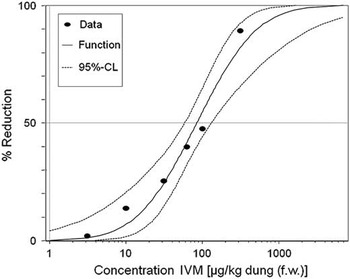
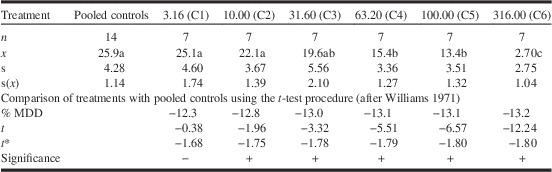
When the brood balls were opened, it was observed that the movements of the larvae in controls were normal and vigorous. Gradually, as the concentration increased, movement became slower to the point of the complete absence of movement at the highest concentration. Table 3 gives the mean number of live E. intermedius offspring, ranging from 25.9 to 2.7 brood balls for the pooled controls and treatment C6, respectively (Table 3). The proportion of variance explained by the dose/response parameters corresponded to a coefficient of determination r 2=0.904, with F=37.74 and χ2=0.101. Results of the probit analysis gave effective concentrations effective concentration for x% effect of the test items and their 95% confidence limits, the computation of variances and confidence limits adjusted to metric data (Christensen and Nyholm Reference Christensen and Nyholm1984) (Fig. 3). The calculated LC50 value was 85.5 μg IVM/kg dung fresh weight, with lower and upper 95% confidence limits of 58.9 and 132.9 μg/kg dung fresh weight, respectively. The Williams multiple sequential t-test procedure gave NOEC and LOEC values of 3.16 and 10.0 µg IVM/kg dung fresh weight, respectively, corresponding to concentrations of treatments C1 and C2 (Table 3).
Effect of increasing ivermectin concentration (treatments C1–C6) (μg IVM/kg dung fresh weight) on larval mortality of Euoniticellus intermedius females. 95% CL, lower and upper 95% confidence limits.

Mean number (x) of live offspring of Euoniticellus intermedius at day 25 for a range of ivermectin (IVM) concentrations in fresh dung (μg IVM/kg) and comparison of treatments C1–C6 with pooled controls.

Notes: Means followed by the same letter in row x are not statistically different (α=0.05).
n, number of replicates; s, standard deviation; s(x), standard error; n, sum of treatment replicates n(i); k, number of treatments; % MDD, minimum detectable difference to pooled controls (in per cent of pooled controls); t, sample t; t*, critical t for Ho: μ1=μ2=…=μk; the differences are significant when |t|>|t*| (the residual variance of an analysis of variance was applied).
Discussion
Effect of ivermectin on female fecundity and ovary morphology
Without ivermectin in dung, the fecundity of E. intermedius is high and, under laboratory conditions, each female may produce ~140 eggs during her life (I.M.M., unpublished data). Under our experimental conditions, no significant effect (NOEC) on female fecundity was detected at 10.0 μg IVM/kg dung fresh weight but this was significantly lower than the LOEC value (31.6 μg IVM/kg dung), with a 30% decrease (EC30) in brood ball production (i.e., eggs) at 115.9 μg IVM/kg dung fresh weight. These results can be compared with ivermectin concentrations in the droppings of animals after veterinary treatment. Following a topical treatment of cattle (500 μg IVM/kg body weight), Wohde et al. (Reference Wohde, Blanckenhorn, Floate, Lahr, Lumaret and Römbke2016) reported concentrations of 2845–5029; 2480–7675, and 692–341 μg IVM/kg dung fresh weight in dung excreted three, seven, and 14 days after treatment, respectively. These values correspond to 969–1006, 496–1535, and 138–68 μg IVM/kg dung fresh weight for comparison with fresh weight values used in the present study. They far exceed the thresholds determined for E. intermedius in our study, which means that the droppings of animals can significantly affect female fecundity for at least two weeks after cattle treatment.
Ovarian morphology and gut content followed the same concentration thresholds. However, the first signs appeared very early, at treatment C2 (i.e., 10.0 μg IVM/kg dung fresh weight), before fecundity was significantly affected. At the LOEC threshold, the ovary was visibly smaller and multiple oocytes had been resorbed.
Usually females start to oviposition five to seven days after their emergence, with two to three eggs laid every 24 hours, which means that yolk synthesis is rapid and that the females need to feed throughout the oviposition period. The changes observed in the gut content indicate that the females gradually stopped feeding, with a consequent reduction in body fat reserves and the cessation of yolk synthesis in the oocytes. During this metabolic phase, the highly lipophilic ivermectin present in the dung can migrate to the fat body and the ovary, to be incorporated into the yolk. In dung beetles, ivermectin may act on the ovary by stopping vitellogenesis and inducing the resorption of oocytes. Our results can be explained in part by the mechanisms that control reproduction in insects. Ovulation and oviposition are both triggered by environmental factors (nutrition, temperature, photoperiod, and chemical products) and by internal factors (neurohormonal and hormonal regulation) (Martínez and Caussanel Reference Martínez and Caussanel1984; Martínez Reference Martínez1995; Martínez and Huerta Reference Martínez and Huerta1997; Martínez and Cruz Reference Martínez and Cruz1998).
In the present study, the detailed effects of a low concentration of ivermectin on beetle vitellogenesis were assessed for the first time, revealing the different states of oocyte resorption. We show the progressive cessation of oocyte expulsion and their resorption, specifically the successive blocking of the oocytes that accumulate behind. The action of ivermectin should not be generalised, and further investigations are needed to determine more precisely how this parasiticide affects the neuroendocrine organs and the ovary, and stops vitellogenesis.
It is known that the muscular system of beetles is affected by ivermectin (Verdú et al. Reference Verdú, Cortez, Ortiz, González-Rodríguez, Pinna and Lumaret2015) so females have trouble moving, preparing brood balls and ovipositing; in the extreme, they cannot move and eventually die (Cruz Rosales et al. Reference Cruz Rosales, Martínez, López-Collado, Vargas-Mendoza, González-Hernández and Fajersson2012). Ivermectine was indeed shown to paralyse the muscles of the dung beetle Scarabaeus cicatricosus Lucas (Coleoptera: Scarabaeidae) (Verdú et al. Reference Verdú, Cortez, Ortiz, González-Rodríguez, Pinna and Lumaret2015), and in nematodes where it inhibits pharyngeal muscle contractions (Turner and Schaeffer Reference Turner and Schaeffer1989; Brownlee et al. Reference Brownlee, Holden-Dye and Walker1997). In S. cicatricosus, ivermectin decreased the olfactory and locomotor capacity of adults, preventing beetles from performing basic biological activities (Verdú et al. Reference Verdú, Cortez, Ortiz, González-Rodríguez, Pinna and Lumaret2015). These authors reported significant effects of ivermectin at doses close to the LOEC value identified in our study. Therefore, the increasing difficulty of movement in adults and larvae, and the gradual decrease in egg production in E. intermedius females were most likely due to the action of ivermectin. Under natural conditions, once reproductive activity ends, females stop burying dung and preparing brood balls, and their ovary enters a resorption stage (Halffter and Edmonds Reference Halffter and Edmonds1982). The remaining oocytes are broken down, with some having internal clusters of follicular cells that form a resorption body. The ovary is surrounded by contracting muscles that push oocytes through the ovariole, causing the expulsion of the terminal oocyte during oviposition. The oviduct and especially the vagina have thick muscle layers, which operate during copulation, oviposition, and fertilisation. With a decrease in muscular contraction, the females would be unable to produce more eggs due to the slow progress of oocytes. While not analysed in detail, the behaviour of males was also affected (I.M.M., unpublished data). Wardhaugh et al. (Reference Wardhaugh, Holter and Longstaff2001) demonstrated that newly emerged adults of the dung beetle Onthophagus taurus (Schreber) (Coleoptera: Scarabaeidae) were also sensitive to ivermectin residues, with signs of delayed sexual maturation in the adults that did not die. Our results are also consistent with those obtained for the dung beetle Onthophagus landolti Harold (Coleoptera: Scarabaeidae), for which fecundity at 100 µg IVM/kg dung μg IVM/kg dung fresh weight decreased to only 2% in comparison with the controls, and to zero at higher concentrations (Pérez-Cogollo et al. Reference Pérez-Cogollo, Rodríguez-Vivas, Delfín-González, Reyes-Novelo and Ojeda-Chi2015).
Effect of ivermectin on larval mortality
Regarding larval mortality, the NOEC and LOEC ivermectin concentrations in dung were lower than those obtained for female mortality, and the LC50 was much lower (85.5 μg IVM/kg dung fresh weight) than the value of 50% calculated for female fecundity (560 μg). As pointed out earlier for female fecundity, the ivermectin concentrations in the dung excreted by treated animals far exceed the lethal threshold values for larvae (Wohde et al. Reference Wohde, Blanckenhorn, Floate, Lahr, Lumaret and Römbke2016).
In the present experiment, surviving larvae continued to feed on dung containing ivermectin, but an increase in the flaccidness of their muscles may have slowed down their consumption of dung and led either to death, or to protracted juvenile development as reported by Cruz Rosales et al. (Reference Cruz Rosales, Martínez, López-Collado, Vargas-Mendoza, González-Hernández and Fajersson2012) and Pérez-Cogollo et al. (Reference Pérez-Cogollo, Rodríguez-Vivas, Delfín-González, Reyes-Novelo and Ojeda-Chi2015). Ivermectin blocks nerve signals by interfering with the glutamate-gated chloride channel receptors and this affects membrane stability: the target species is paralysed and dies as a result of the inhibition of inter-neural and neuromuscular transmission (Martin et al. Reference Martin, Robertson and Wolstenholme2002). This was also demonstrated in mosquitoes where ivermectin causes paralysis and mortality (Gardner et al. Reference Gardner, Meish, Meek and Bivin1993). In a specific case, the larvae of Culex quinquefasciatus Say (Diptera: Culicidae) suffered from ataxia (dysfunction of the part of the nervous system which coordinates muscle movements), followed by death when exposed to ivermectin (Nunes Alves et al. Reference Nunes Alves, Serrão, Mocelin and Lane de Melo2004).
General outcomes and conclusion
Our results are relevant at a time when the Society of Environmental Toxicology and Chemistry Expert Group, Dung Organism Toxicity Testing Standardisation has started working on the development of a new Organisation for Economic Co-operation and Development guideline covering the testing of the tunnelling dung beetle Onthophagus taurus (Schreber) to complement the guidance document on the determination of the toxicity of chemicals to dweller dung beetles (Organisation for Economic Co-operation and Development 2010). It is becoming increasingly evident that adult and offspring mortality rates cannot be the main criteria in understanding the role of stressors in the environment. Results from the present study clearly reveal the relevance of considering the sublethal effects on dung organisms. In the international ring test performed in the context of this guideline preparation, it became clear that such an endpoint is more sensitive, and provides a more comprehensive understanding of toxic effects, than mortality does.
Moreover, our results may be useful for modelling the effects of cattle treatments on dung beetle populations. Many authors did not take into account the decline in adult fecundity at low doses of parasiticides when larvae exhibited no apparent developmental problems. For instance, in models and experiments using pyrethroids in flies, direct toxicity effects were mostly studied disregarding possible decreases in fecundity, so it was assumed that toxicity would be negligible for adults, delaying the effects on populations of dung-breeding insects by only one or two days (Vale and Grant Reference Vale and Grant2002). However, a model taking into account the effect of deltamethrin on the breeding success of dung beetles in the field suggested that a single treatment may cause a reduction of up to 75% in beetle activity by the end of the season (Wardhaugh et al. Reference Wardhaugh, Longstaff and Lacey1998).
Ivermectin is the most widely used pharmaceutical worldwide. Very little has been reported on the sublethal toxicity of ivermectin residues, such that their adverse effects are being underestimated in current models. More serious concerns are the uncertainties regarding the level of the toxicity decline in successive droppings produced by animals after the peak of elimination of veterinary medical products (Vale and Grant Reference Vale and Grant2002; Beynon et al. Reference Beynon, Wainwright and Christie2015; Wohde et al. Reference Wohde, Blanckenhorn, Floate, Lahr, Lumaret and Römbke2016). The results of the current study are therefore timely in that they may be used to model the total impact of veterinary medical products on dung beetle populations more accurately. More generally, taking both lethal and sublethal effects into account should lead to a refinement of the existing and future models, and a better overall estimation of the impact of veterinary residues on the natural environment.
Acknowledgements
The authors are grateful to Bulmaro and Alfredo Castellanos who gave us access to their ranches to collect the cattle dung and beetles used in the study. They thank Magdalena Cruz-Rosales for her assistance collecting the beetles and breeding them in the laboratory, and Ricardo J. Madrigal for his technical support in the field, laboratory, and insectary. The authors are grateful to Kevin Floate (Lethbridge Research and Development Centre, Canada), Jörg Rombke (ECT Oekotoxikologie, Germany), and Wolf U. Blanckenhorn (University of Zurich, Switzerland) for suggestions that greatly improved the manuscript. They thank Gregory T. Sullivan (University of Queensland, Australia) and Bianca Delfosse (Xalapa, Veracruz, Mexico) who checked an earlier version of the English version of the manuscript. The authors also thank the anonymous reviewers for helpful comments on the manuscript.