1. Introduction
Transfer of properties of one of the languages of a bilingual into the other is a common but formally selective process (e.g., Zobl, Reference Zobl1980). One influential and controversial hypothesis (Hulk & Müller, Reference Hulk and Müller2000) sets two conditions on transfer: that it involves structures relevant to the syntax–pragmatics interface, and areas of formal overlap between two languages. This approach aims to capture the general insight that grammatical transfer extends the pragmatic/discourse properties of existing available structures rather than introduce new grammatical forms (e.g., Müller & Hulk, Reference Müller and Hulk2001; Silva-Corvalán, Reference Silva-Corvalán, Schwegler, Tranel and Uribe Etxebarria1998; Sorace, Reference Sorace, Howell, Fish and Keith-Lucas2000, Reference Sorace, Cornips and Corrigan2005; Tsimpli, Sorace, Heycock & Filiaci, Reference Tsimpli, Sorace, Heycock and Filiaci2004).
We aim to examine these assumptions further and to integrate current notions about bilingual lexical and syntactic processing into our current understanding of syntactic transfer in child bilingual acquisition. Our study examines transfer in Spanish/English bilingual children by means of an elicited imitation study of clitic-climbing contexts, where variable word order is believed to be independent of pragmatic effects.
(1)

(2)

We propose that the minimalist notion that syntactic variation lies in the lexicon, together with some basic assumptions about bilingual lexical processing, provides a natural account for word order transfer.
2. Transfer across grammatical domains
2.1 Vulnerability to transfer in bilingual development
Approaches to the selectivity of transfer can be grouped into two broad categories that cut across research trends and theoretical approaches. Language-based approaches and modular approaches are complementary rather than exclusive views (e.g., Argyri & Sorace, Reference Argyri and Sorace2007). The former posit that transfer is determined by some inherent comparison between the two languages across a given dimension: (i) language markedness, with more marked languages being more difficult to acquire and unmarked settings more likely to transfer (e.g., Hopp, Reference Hopp, Belikova, Meroni and Umeda2002; Jarvis & Pavlenko, Reference Jarvis and Pavlenko2008; Müller & Hulk, Reference Müller and Hulk2001; Phinney, Reference Phinney, Roeper and Williams1987; White, Reference White1987); (ii) statistical frequency of a construction across the two languages (see discussion in Jarvis & Pavlenko, Reference Jarvis and Pavlenko2008; Nicoladis, Reference Nicoladis2002); or (iii) relative dominance of the speaker, so that the properties of the stronger language appear in the other language (e.g., Paradis, Reference Paradis2001; Yip & Matthews, Reference Yip and Matthews2000).
Alternatively, domain-based approaches see transfer as restricted to specific linguistic domains. One example is Montrul's (Reference Montrul1997) modular view of transfer as involving morphology but not argument structure. A common claim nowadays is that phenomena at the interface of syntax and pragmatics are especially vulnerable to transfer. The relevant empirical observation predates modularist approaches. For instance, Silva-Corvalán (Reference Silva-Corvalán, Ashby, Mithun, Perissinotto and Raposo1993) proposes that structural compatibility (understood as superficially parallel structures) is required for an area of the language to be permeable to linguistic transfer. Syntax itself is not what transfers: “What is borrowed across languages is not syntax, but lexicon and pragmatics” (Silva-Corvalán, Reference Silva-Corvalán, Schwegler, Tranel and Uribe Etxebarria1998, p. 226). Her data point at syntactic calques or at pragmatic shifts or extensions of existing given structures.
The role of structural overlap in transfer has been emphasized in studies on bilingual child syntax (e.g., Döpke, Reference Döpke1998; Gawlitzek-Maiwald & Tracy, Reference Gawlitzek-Maiwald and Tracy1996). Hulk and Müller (Reference Hulk and Müller2000) and Müller and Hulk (Reference Müller and Hulk2001) identified higher rates of occurrence of illicit null objects in bilingual children who spoke a Germanic and a Romance language. They attributed the bilingual increase in the rates of object drop to a “mapping-induced influence” following Platzack's (Reference Platzack2001) hypothesis of the vulnerability of the C-Domain. Müller and Hulk (Reference Müller and Hulk2001) propose that cross-linguistic influence can occur under two conditions: (i) the two languages overlap in surface structure, and there is structural ambiguity in one of the languages; and (ii) the phenomena involve mapping to a pragmatic interface. Several components of the hypothesis have been questioned, specifically the issue of defining structural overlap and the relative vulnerability of higher components of the clause (the C-domain) (Unsworth, Reference Unsworth2003). Bohnacker (Reference Bohnacker2007) shows that German and Swedish L2 learners acquired V2 constraints (where verb placement involves the C-domain) very early, but had difficulties with verb placement in transitive verb–particle constructions (where verb position involves lower projections).
Subsequent work in transfer in language attrition and L2 acquisition has found support for pragmatic effects. Greek and Italian near-native speakers of English overproduce overt preverbal subjects in contexts where null or postverbal subjects would be preferred by monolinguals (Tsimpli et al., Reference Tsimpli, Sorace, Heycock and Filiaci2004). This indicates a shift of the topic/focus contrasts and the definiteness effects of these subject alternations. The basic syntactic options remain intact, but their semantic extension is affected by cross-language influence.
Presumably, domains where syntax interfaces with external systems such as semantics or pragmatics are more complex than core syntactic knowledge and therefore more vulnerable to L1 attrition and L2 transfer (e.g., Serratrice, Sorace & Paoli, Reference Serratrice, Sorace and Paoli2004; Sorace, Reference Sorace, Howell, Fish and Keith-Lucas2000, Reference Sorace, Cornips and Corrigan2005; Sorace, Serratrice, Filiaci & Baldo, Reference Sorace, Serratrice, Filiaci and Baldo2009; Tsimpli et al., Reference Tsimpli, Sorace, Heycock and Filiaci2004). Sorace (Reference Sorace, Cornips and Corrigan2005, pp. 55–56) proposes:
In all these cases, it is the same features that present instability and variation: constructions that belong to the syntax proper are fully acquired in L2 acquisition and are retained in L1 attrition. In contrast, constructions that require the integration of syntactic knowledge with knowledge from other domains present residual optionality in L2 and exhibit emergent optionality in L1 attrition.
Despite the wide acceptance of this view, there is no clear sense of the status of syntax with respect to transfer, or how to define interface phenomena. Some, as Montrul (Reference Montrul2008, p. 337), define it in wide terms: “grammatical areas which require the integration of different levels of linguistic knowledge (syntax–discourse, syntax–morphology, morphology–semantics, etc.) for processing, production or interpretation, show developmental delays and instability in monolingual and bilingual acquisition”. Others concentrate on feature types, suggesting uninterpretable (formal) features should remain unaffected by L1 attrition and only transferred at the initial stage in L2 acquisition, whereas interpretable phenomena should be affected by optionality in both L1 attrition and highly developed end-state L2 acquisition (Sorace, Reference Sorace, Howell, Fish and Keith-Lucas2000).Footnote 1
Moderate positions assume that pragmatic interface phenomena are generally, but not exclusively, vulnerable to transfer. Tsimpli et al.'s (Reference Tsimpli, Sorace, Heycock and Filiaci2004) attrition study tested transfer in adults that had achieved near-native status in the L2, but still used their L1 regularly. Otherwise, these authors point, insufficient L1 use would introduce lexical attrition, which in turn would impact grammatical production. The implication was that word retrieval difficulties lead to additional grammatical restructuring, beyond the semantic restructuring targeted in their study.
To conclude, there is no consensus on how to study selectivity in transfer. On the pragmatic interface approach, core syntax, if not involving interpretive effects, might be viewed as immune to transfer. To tease apart the two elements in the interface approach, structural overlap and pragmatic shifts, we propose to concentrate on a linguistic domain where word order variability exists in the absence of pragmatic effects.
3. Clitic climbing in Spanish
3.1 Restructuring and the question of clitic placement
Object clitic placement in restructuring contexts is a case of word order variability without identifiable semantic or pragmatic consequences. These contexts include infinitival complements to volitional, semi-aspectual, true auxiliaries and certain epistemic verbs that allow an object pronoun complement of the verb in the subordinate clause to appear attached to the matrix verb. In languages like Spanish or Italian, object clitics sometimes surface beyond the domain of selecting verb (e.g., Bok-Bennema, Reference Bok-Bennema, Everarert and van Riemskijk2006).
The postverbal order (enclisis) is described as the original (subordinate clause) configuration and the preverbal order (proclisis) as the result of syntactic movement, made possible by clausal transparency effects. The structure of examples (1) and (2) above is sketched out here with labeled brackets marking the relevant configurations:
(1)′ [CP Subject [VP V1] [CP V2 la]]
(2)′ [CP Subject [VPla V1 V2]]
Structural constraints provide support for movement analyses; intervenors such as negation block clitic climbing, as shown in (3), for a context where Pedro would like/prefer to not write a letter.
(3)
Various studies of Italian and Spanish corpus data have established that the positioning of pronominal clitics in infinitival constructions is truly optional, but that the optionality is associated with the different frequencies of the matrix verbs (Davies, Reference Davies1992; Myhill, Reference Myhill1988; Napoli, Reference Napoli1981). Davies (Reference Davies1992) provides evidence that clitic climbing is more common in Spanish spoken registers than in written registers, but no evidence of cross-dialectal variation.
Earlier analyses proposed that clitic-climbing optionality was due to selectional properties of the main verb (e.g., Strozer, Reference Strozer1976) or to an optional rule applying between deep and surface syntax, leading to restructuring of the original, bi-clausal structure (e.g., Aissen & Perlmutter, Reference Aissen, Perlmutter and Perlmutter1976; Rizzi, Reference Rizzi and Keyser1978). Recent views suggest that restructuring effects are functional. Infinitival expressions that allow preverbal clitics are monoclausal (i.e., the matrix verb works as an extended projection of the main infinitival verb) independently from the surface position of pronominal clitics (e.g., Cardinaletti & Shlonsky, Reference Cardinaletti and Shlonsky2004; Cinque, Reference Cinque and Belletti2004; Wurmbrand, Reference Wurmbrand2001). Cinque (Reference Cinque and Belletti2004) suggests that variable placement of the clitic is a transparency effect of functional restructuring, proposing that the actual surface position is unrelated to the invariable underlying clause structure. This intriguing proposal faces important challenges; restructuring verbs are also lexical verbs, including intransitives (ir “to go”) and transitives, such as volitional and epistemic verbs. It seems difficult to reduce these lexical verbs to functional extensions of the lower verb to maintain monosemy. Cinque (Reference Cinque and Belletti2004) has to analyze the simple transitive verb querer “to want” as having a null lexical transitive VP as the main verb, as in (4).
(4)
To avoid these difficulties, Masullo (Reference Masullo2004) proposes a minimalist alternative where the position of the pronominal clitic is determined by the structure on the basis of (i) an order of merge operations and (ii) properties of the lexical interface. First, a subset of infinitival-selecting verbs (i.e., control and raising verbs) in Spanish (and Italian) has a Complex Predicate Formation (CPF) feature. If a pronominal argument is selected as part of the numeration of an utterance employing a control or raising construction marked for this feature, then a first order of merge operation may occur between the two verbs before the pronominal clitic merges to the construction, forming a complex predicate. When the utterance is not marked for CPF, or when direct merge of these two verbs is blocked by an intervenor such as negation, then the clitic merges first, blocking formation of a complex predicate. When CPF applies, the pronominal clitic appears in preverbal position, as is shown in (5) (representing (2) above). Conversely, when CPF does not apply, the pronominal clitic appears in postverbal position, as in (6) (representing (1)). In both cases, the pronominal clitic merges to a ‘simple’ clause, but the position varies based on the status of that clause – finite versus nonfinite. Crucially, in Masullo's analysis, clitic linearization is not itself a syntactic phenomenon, but a process at phonetic form (PF). The order of merge yields different configurations that determine which syntactic domain the clitic is merged into, and when it is sent to spell-out. At spell-out, finiteness determines clitic linear order. The diagrams in (5) and (6) represent constituency. Selectional relations between constituents are treated as agreement, and checked as part of an agree operation. These indicated as features in brackets.
(5) La [quiere [escribir]]
(6) Pedro [quiere [escribirla]]
Limiting variability in the ordering of merge operations allows the lexical inventory to remain simple. Given that CPF is a variable lexical property of a subset of control and raising verbs, other components of the system can interact in determining the order of merge. This provides a natural characterization of the tendencies observed in Davies (Reference Davies1992).
We adopt this ‘order of merge’ analysis for clarity. However, our assumptions are shared by most analyses of clitic climbing: (i) there is no apparent semantic consequence to the choice of structure (climbed vs. in-situ), and (ii) the optionality of the two configurations is based on the lexical characteristics of matrix verbs. These assumptions, along with some evidence on how children acquire the clitic-climbing construction and of syntactic priming on bilingual adults, serve as the basis for our transfer hypothesis.
3.2 L1 acquisition of clitic climbing in Spanish
Data from Spanish corpora of spontaneous speech show that children acquire clitic climbing at a young age. Rodríguez-Mondoñedo, Snyder and Sugisaki (Reference Rodríguez-Mondoñedo, Snyder, Sugisaki, Deen, Nomura, Schulz and Schwartz2006) examined the transcripts for four Spanish monolingual children in CHILDES. To test for the existence of a stage where a child can produce complex structures, but has no clitic climbing, they analyzed all restructuring verbs appearing with a non-finite complement. Children produced clitic-climbing contexts very early, between ages 1;7 and 2;5, as shown in (7) with examples from Thomas (Reference Thomas2007). Clitic climbing appeared either concurrently or shortly after the emergence of the contexts, and the differences in age of emergence of the complex predicates and the clitic-climbing structure were not significant. Rodriguez-Mondoñedo et al. (Reference Rodríguez-Mondoñedo, Snyder, Sugisaki, Deen, Nomura, Schulz and Schwartz2006) conclude that by the time clitics appear with complex infinitival constructions, both positions are available.
(7)
Thomas (Reference Thomas2007) notes that once the child María acquires clitics, her patterns of use directly reflect her input, including a tendency for proclisis with the most frequent restructuring verbs (ir a “to go to”, tener que “to have to”). Additionally, she notes an effect of morphological type; enclitics are mostly third person non-reflexive pronouns. However, compared to her parents, María appears to over-generate proclisis during the period analyzed (2;1–3;7).
To investigate continuity in production patterns in clitic-climbing contexts Eisenchlas (Reference Eisenchlas2003) tested 71 Spanish monolingual children aged between three and six. Children were asked to imitate sentences with preverbal clitics and postverbal clitics. At all ages, children produced less repetition errors with preverbal object pronouns than those with postverbal object pronouns. For the youngest groups of children, accurate responses ranged from 45–47% for preverbal clitics to 0–26% for postverbal clitics. By age 4;8, accuracy rates reached 85–100% for preverbal clitics, and 40–65% for postverbal clitics. Repetition errors are reported for all children as a group, without an indication of whether error patterns exhibited developmental changes. Most non-target repetitions (73%) involved the clitic itself. Half of all errors were of clitic order, but these errors were not random. The predominant repetition error consisted of fronting a postverbal clitic to the preverbal position (46% of the total repetition errors). The opposite pattern, of shifting the preverbal clitic to a postverbal position, was extremely rare (about 3%), and there were no instances of ungrammatical word orders. Other repetition errors included clitic omissions (~6% for preverbal, ~10% for postverbal), errors with phi-features (7%) and with clitic doubling (4%). Since Eisenchlas's study targets a narrow range of verbs with high frequency of proclisis, it is possible that the observed word order bias may be lexical.
In sum, preschool-aged children have already mastered the clitic-climbing construction, but may have a preference for proclisis over enclisis, at least for the predicates involved in these elicited imitation results and in early child production. Given that there is no account for children's proclisis bias, these data merely signal adult–child differences in preferences, rather than a discontinuity in child development.
3.3 Transfer and processing in bilingual adults
Is there cross-language interaction between a language with clitic-climbing construction and a language without? English and French L2 learners of Spanish had difficulty accepting clitic-climbing structures, a fact that Duffield and White (Reference Duffield and White1999) attribute to transfer. However, there is no evidence of transfer leading to attrition of the L1 clitic-climbing grammar. In general, research identifies no loss of clitic syntax in heritage populations or reports of atypical word order for clitics in adult attrition or heritage speakers (Montrul, Reference Montrul2004; Silva-Corvalán, Reference Silva-Corvalán1994). Montrul (Reference Montrul2004) finds that even low-proficiency heritage speakers produce object clitics at rates comparable to monolinguals.
However, there is evidence of processing effects in bilingual production of clitic-climbing sentences. Meijer and Fox Tree (Reference Meijer and Fox Tree2003) targeted these contexts with a syntactic priming paradigm. Syntactic priming, the process by which the structure of one sentence facilitates the structure of a second sentence in the absence of specific pragmatic, thematic or lexical support, can occur across languages, so that a structure presented in one of the bilingual's languages can facilitate production of its structural equivalent in the other (e.g., Loebell & Bock, Reference Loebell and Bock2003; McDonough & Mackey, Reference McDonough and Mackey2008). Meijier and Fox Tree (Reference Meijer and Fox Tree2003) asked participants to recall a Spanish sentence with a preverbal clitic, followed by either an English sentence prime with a comparable verbal complex with a postverbal pronoun or a no-pronoun control condition. Instances of repositioning the clitic to the postverbal position were interpreted as evidence for cross-language syntactic priming. These repetition errors increased from 5% of responses in the control condition to 25% in the critical condition, suggesting that the English object pronoun was able to prime the postverbal clitic position in Spanish (Meijer & Fox Tree, Reference Meijer and Fox Tree2003, p. 194). These results leave open the question of specific target of priming: the linear overlap in pronoun position (V + Pronoun) or the congruence between the English derivation and the Spanish (non-restructuring) option, where merge first applies to embedded verb and pronoun, as in (8):
(8) [CP Subject [VP V1] [CP V2 pronoun]]
3.4 Hypotheses
Complex infinitival clauses provide a syntactic context with structural surface overlap (postverbal clitics, and English object pronouns), but with no detectable semantic effects. Theoretically, the question of structural congruence between the two language structures is simplified by Masullo's order of merge analysis, where the alternation depends on whether (i) the non-finite verb is merged first to its direct object (congruent to the English configuration) or (ii) the non-finite verb merges first to the matrix verb. The different categorial status of the pronouns (clitic vs. full pronouns) does not determine the question of transfer, since the target of transfer applies at the level of the structural configuration, not to the clitic itself. In other words, transfer can affect clitic climbing without affecting other aspects of clitic syntax.
Spanish-speaking children acquire clitic climbing early and appear to have a (non-adult) preference towards the preverbal position. At the same time presentation of an English pronoun can prime Spanish clitic order in bilingual adults. The question is, can these cross-language processing effects (observed in adults) lead to long-term shift in word order preferences (when operating in bilingual children)? Will bilingual children transfer the structure-building process from English into Spanish, with the relevant consequences for clitic placement? The study of transfer in optional constructions where linearization differences do not affect semantics or pragmatics allows us to assess the restrictive version of the interface hypothesis:
Semantic hypothesis. If, as argued, syntactic transfer is limited to interpretable phenomena, English–Spanish bilingual children will not show cross-language interactions. In other words, syntactic priming might occur in children as it does in adults, but experience with English will have no lasting effect in their patterns of clitic placement, since no pragmatic or semantic effects are involved.
Syntactic hypothesis. Word order can be affected in the absence of semantic/pragmatic shifts or extensions, by means of cross-language activation of selectional features of lexical entries, possibly as a learning effect of syntactic processing (Chang, Dell, Bock & Griffin, Reference Chang, Dell, Bock and Griffin2000, p. 214). English–Spanish bilingual children may show a preference towards the English-congruent postverbal syntax. Length and degree of exposure to English might determine degree of the bilingual effect.
4. Study
4.1 Methods
Parents completed a child language history questionnaire (adapted from Paradis, Nicoladis & Crago, Reference Paradis, Nicoladis, Crago, Caunt-Nulton, Kulatilake and Woo2007) on language experience, level of education, age of onset of acquisition of English, length of residence in Canada or the U.S.A., and present degree of contact with Spanish and English. Parents also responded to a bilingual assessment questionnaire for themselves and their children, based on scalar ratings of fluency for each language from “not fluent” to “completely fluent”. Dominance scores were calculated by subtracting the numerical values of fluency ratings in English from the Spanish ratings.
An elicited imitation task served the dual purpose of testing the syntactic hypothesis and validating parental reports of language fluency. School-aged L2 English learners have significantly lower scores in non-word repetition tasks than monolingual peers (e.g., Lipka, Siegel & Vukovic, Reference Lipka, Siegel and Vukovic2005). Sentence repetition tasks are commonly used in language assessment instruments (Sturner, Kunze, Funk & Green, Reference Sturner, Kunze, Funk and Green1993; Wiig, Secord & Memeh, Reference Wiig, Secord and Memeh2009), where they are considered excellent clinical tools to measure development. However, to date, repetition success has not been used as a measure of bilingual fluency. To test its usefulness as a measure of language ability, we can compare repetition scores with parental reports, the independent measure most generally used in studies of child bilingualism.
Elicited imitation also offers a controlled approach for testing restructuring contexts. Elicited imitation is a traditional method for assessing children's syntax, considered optimal for the study of linear order (e.g., Lust, Chien & Flynn, Reference Lust, Chien, Flynn and Lust1987; Menyuk, Reference Menyuk1963). The rationale for the linguistic use of imitation tasks is that sentence recall does not produce a passive copy of the stimulus. Instead, it entails a reconstructive process where the child's grammatical competence ‘filters’ the utterance. Repetitions are likely to be successful when the structure is in the speaker's grammar, but systematic deviations may reveal properties of the underlying system. Design should avoid syntactic complexity unrelated to the experimental hypotheses, but sentence length should be calibrated at the right level of difficulty, so that the working memory demands are not so challenging for the child that the task cannot be completed, or so easy that it elicits perfect performance (Lust, Flynn & Foley, Reference Lust, Flynn, Foley, McDaniel, McKee and Smith Cairns1996).
Eisenchlas’ (Reference Eisenchlas2003) Spanish study successfully applied the imitation method to the problem of clitic placement, and her data yield a robust child L1 baseline. To test the hypothesis that word order influences would persist in bilingual children, we replicated her test with simultaneous and sequential children. Items were 8–10 words in lengths, and included eight clitic sentences (four proclitic and fur enclitic) and six additional distractors, all of which were of comparable complexity, as shown in (9):
(9)
Children were asked to repeat as much as they could recall and were given several practice sentences. A native interviewer read the stimuli, twice if necessary.
4.2 Participants
Twenty-three children, including six sibling pairs, were recruited through Hispanic community networks in Toronto, Canada, an urban, multilingual environment. Their parents are immigrant Spanish speakers who are clearly dominant in Spanish, but also fluent in English. All parents had completed high school and some had additional education. They characterized themselves as lower-middle class. One family emigrated from Argentina, one from El Salvador, two from Colombia, and thirteen others from Mexico.
Children, aged between three and eight years, were classified as simultaneous or sequential bilinguals according to standard criteria (Genesee, Paradis & Crago, Reference Genesee, Paradis and Crago2004). The families of the simultaneous bilingual group had immigrated between five and twenty years before, and the children were born either in Canada or in the U.S.A., or arrived before the age of 3;0 (N = 13). Children in the sequential bilingual group were born in Latin America and initiated contact with English after 3;0 (N = 10), and had lived in Canada or the U.S.A. for between one and two years.
Three of the youngest simultaneous bilingual children had difficulty with the repetition task, and either did not respond or answered in English. Two were English-dominant, the third one Spanish-dominant. Data for the remaining 20 children were transcribed and analyzed.
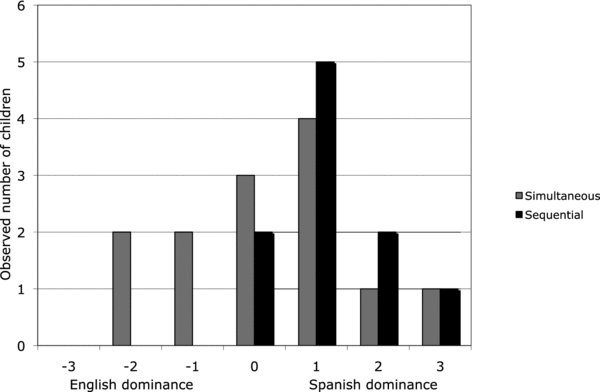
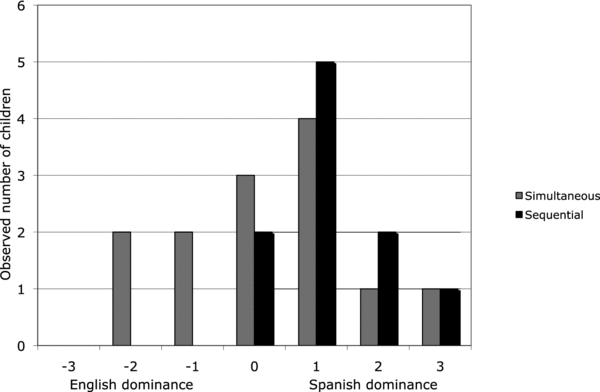
On average, the simultaneous bilinguals were younger than the sequential bilinguals. Many were balanced bilinguals, and the rest split across English and Spanish dominance. The sequential bilinguals were primarily Spanish-dominant, with two children described as equally balanced in the two languages. Figure 1 reports the observed number of children classified as balanced (dominance = 0), or English-dominant (negative portion of scale), or Spanish-dominant (positive side of scale, with 3 = highly Spanish-dominant).
Observed counts of children in the simultaneous and sequential group classified according to their language dominance score.
To test whether elicited imitation is a useful measure of Spanish language fluency, we calculated the correlation between the dominance scores and the proportion of words correctly imitated (i.e., number of words successfully repeated over target words). Words (functional and lexical) were counted as correct independently of changes to word order or morphological errors. Thus, clitics were counted as correct even if repositioned, as in (10), or if the target root had gender and case feature errors, as in (11). Word omissions and substitutions in general, as in (12), including article or preposition substitution, reduced the score. Additional lexical material by virtue of paraphrases or insertions was ignored. One interesting pattern attested, shown in (13), was the over-insertion of a dummy preposition with infinitives, suggestive of influence from the English infinitival marker to. Three of the children produced this pattern, and one additional child produced four of these instances (13). There were various other instances of lexical expansions, exemplified in (14).
(10) Word order repositioning
(11) Case/person/gender errors
(12) Lexical omission
(13) Preposition insertion
(14) Lexical expansion
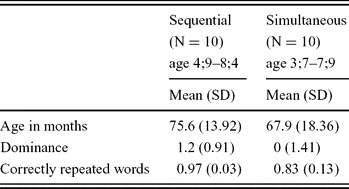
Children's ability to repeat the words in the target sentence was unrelated to age (r = .115, p = .629). This is unsurprising for these relatively older children, given Eisenchlas's previous findings that repetition performance stabilizes after the age of four-and-a-half. In contrast, Spanish language experience and relative dominance clearly determine bilingual children's ability to repeat sentences in Spanish. Sequential bilingual children had excellent imitation skills overall, but the simultaneous bilingual children exhibited substantial difficulties, being able to produce roughly four in five of the target words, as shown in Table 1 below.
Description of children in the simultaneous and sequential groups.

A one-way ANOVA on the proportion of words correctly repeated found the difference between groups to be significant (F1,18 = 11.342, p = .003). There was a strong, significant correlation between individual dominance score and the proportion of words correctly repeated (r = .556, p = .013). This confirms that the parental reports are capable of predicting performance in language tasks. It also suggests that sentence imitation tasks are potentially useful tools for the assessment of bilingual fluency.
4.3 Results on clitic order
Next, we analyzed the children's success at imitating the clitic pronoun in place. Target responses with overt clitics were classified as enclitic or proclitic, as in (15)–(16), or as null, if the clitic was omitted, as in (17). Occasionally, the verbal group was modified so that the utterance no longer contained a restructuring context. This was classified as “other” and grouped with other irrelevant responses. We found no instances of productions with atypical word orders for clitics.
(15) Accurate proclisis
(16) Accurate enclisis
(17) Null
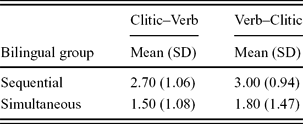
Sequential bilinguals were generally more accurate than simultaneous bilinguals in their repetitions, producing the correct clitic sequence more frequently for both word orders. A repeated measures ANOVA on the number of target responses to both conditions showed a significant effect of group (F 1,18 = 10.327, p = .005), but no significant effect of context type, nor interaction (F 1,18 = .701, p = .413 and F 1,18 = .001, p = .999, respectively).
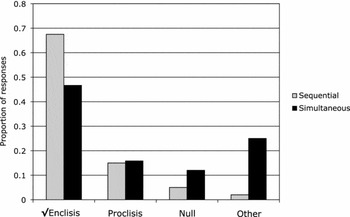
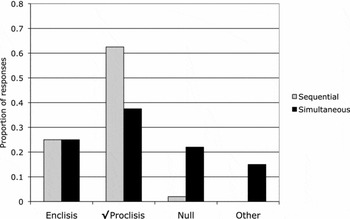
Were the patterns of pronoun position comparable to what has been described in the literature for monolingual children? Figures 2 and 3 suggest that there are both common trends and differences between our bilinguals and the monolinguals in Eisenchlas’ study. Recall that the primary error in monolingual data was forward repositioning (about half the non-target repetitions). Also, there was a very small percentage of omissions and almost no backward repositioning errors.
Proportion of different response types for sentences with postverbal clitics (V V Cl) in simultaneous and sequential bilinguals.

Proportion of different response types for sentences with preverbal clitics (Cl V V) in simultaneous and sequential bilinguals.

Means and standard deviations for target repetitions per group.
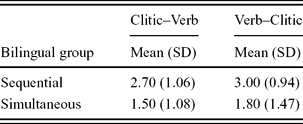
Our two bilingual groups had similar proportions of fronting errors (around 15%) to the preverbal position when asked to repeat sentences with postverbal clitics, as shown in Figure 2. This appears less prevalently than in the monolingual data from Eisenchlas summarized in Section 3.2 above. Figure 3 demonstrates the opposite repositioning pattern, of repeating a preverbal clitic as postverbal. This pattern is virtually absent from the monolingual data in Eisenchlas, but represents a quarter of the bilinguals’ responses to proclitic sentences. A repeated measures ANOVA on the proportion of proclitic utterances per condition shows a highly significant effect of context (F1,18 = 58.674, p < .000), a non-significant effect of group (F1,18 = 2.854, p = .108) and significant group by context interaction (F1,18 = 8.442, p = .009). This suggests differences in the ability to correctly imitate proclitic sentences between the simultaneous children and the sequential children. Simultaneous children performed worse, responding with more non-target enclitic responses and with substantial proportions of clitic omissions (about 22% omissions for preverbal sentences, and 12% for postverbal sentences). The correlation between omission errors and reported dominance was both strong and significant (r = –.521, p = .019). This suggests that while both groups of bilingual children were willing to reposition preverbal clitics to a postverbal position, the less fluent, less dominant children showed additional difficulty with this syntactic template, as exhibited by omission patterns.
4.4 Discussion
Results on the elicited imitation task reveal areas of similarities and differences between our bilingual children and the monolingual children in Eisenchlas's study. Like monolinguals, children in our study fronted postverbal clitic targets and did not produce clitics in ungrammatical positions. However, their proclisis errors happen at lower rates than those found in the monolingual baselines. There were also qualitative differences from monolinguals, but in the preverbal clitic condition. For both bilingual groups, a quarter of the responses to preverbal clitics consisted of repositioning to the postverbal position (i.e., an enclisis bias), a pattern unattested in monolingual children. Simultaneous bilinguals had particularly poor performance, producing more of other error types as well as object clitic omissions. Clitic omissions have been observed in production in bilinguals but not in monolinguals at this age (e.g., Müller & Hulk, Reference Müller and Hulk2001; Pérez-Leroux, Pirvulescu & Roberge, Reference Pérez-Leroux, Pirvulescu and Roberge2009).
What explains the differences between our groups? A reviewer suggests that recent and long-time immigrant families may provide different input. However, these children were living in the same community, similar family environments and language practices, and conditions (Pérez-Leroux, Cuza & Thomas, in press). Thus, while we have no direct data on attrition in restructuring contexts, we argue that age of onset of exposure to English might be a more salient factor. The small age difference between groups might not explain the performance differences either, since these children are of an age where monolinguals perform at ceiling. Furthermore, we found clear group differences in overall repetition success, but no correlation between this variable and age. Age of onset of exposure has many consequences for a bilingual child, including the amount of input in each language over the course of childhood. For us, the crucial difference is whether a relatively full-fledged grammar of the home language is attained before exposure to the majority language.
Could these overall repetition patterns have been predicted? Clearly, this prediction would not have originated in a hypothesis that restricted vulnerability to the semantic or pragmatics interface. Previous evidence on language production in adult bilinguals had shown that an English object pronoun can prime a Spanish postverbal clitic. Assuming continuity in bilingual language processing across the lifespan, we can attribute identical processes in children. However, our test was conducted in a Spanish setting, at home, with a Spanish tester, and the task used contained no English prime. Thus, children's preference to place preverbal clitic sentences in postverbal positions in sentence repetitions suggests a more stable filtering effect of grammar.
The null hypothesis about transfer in bilingual speech is that transfer should originate in the normal mechanisms of language production, processing and learning. We propose that the lexicon is the optimal space for language interaction between the two grammars of a bilingual. In current minimalist theories of syntax, syntactic processes are minimal and invariant across languages, consisting only of merge and agree, the operations used in building tree configurations (Chomsky, Reference Chomsky1995). Linguistic variation is encoded in the lexical elements that enter the grammar, which in a given language instantiate a subset of a universal inventory of potential linguistic features. The wide range of linguistic diversity is the result of the limitless interactions between these basic elements (e.g., Harbour, Adger & Béjar, Reference Harbour, Adger and Béjar2008).
Lexical activation is not language-selective; in bilinguals, both lexicons remain active in word recognition and production (e.g., Costa, La Heij & Navarrete Reference Costa, La Heij and Navarrete2006; Finkbeiner, Gollan & Caramazza, Reference Finkbeiner, Gollan and Caramazza2006; Kroll, Bobb & Wodniecka Reference Kroll, Bobb and Wodniecka2006; Kroll, Sumutka & Schwartz Reference Kroll, Sumutka and Schwartz2005), and cross-language syntactic priming is also possible. Another reasonable assumption is that structural priming is also linked to lexical activation (e.g., Pickering, Holly, Branigan, Cleland & Steward, Reference Pickering, Holly, Branigan, Cleland and Stewart2000). Lemmas (the formal and conceptual representations of a word) include combinatorial nodes, which encode the different frames words associate with: subcategorization patterns of verbs, argument alternations, passive/active constructions, etc. Processing and production mechanisms are constantly refined during language use, leading to an implicit form of learning (e.g., Chang et al., Reference Chang, Dell, Bock and Griffin2000). In learnability terms, parsing success supports grammatical learning, understood as selecting from a number of structural (“parametric”) choices (e.g., Fodor, Reference Fodor1998; Yang, Reference Yang2002). Cross-language syntactic priming reinforces one of the optional configurations, triggering syntactic learning.
5. Conclusion
Our results show that word order preferences are affected by length and timing of exposure to English in bilingual children. We conclude that syntactic transfer should be defined in lexical terms (in the broader, minimalist sense that includes open and closed-class lexicon) as the result of activation changes in the selectional features associated with a lexical item, resulting from processing and production activities. Monolingual children showed a preference towards proclisis that is possibly driven by lexical preferences. However, this preference is diminished in bilinguals. We argue that the source of this bilingual effect is cross-language lexical activation of one of the two available structural templates for merging objects.
Thus, shifts in feature activation can generally have syntactic or semantic effects. Semantic features in a functional node can be reinterpreted as in Sánchez (Reference Sánchez2004). In the present case, shifts in feature activation affect the selection of the structural templates behind word order variants. Syntactic priming starts as a processing effect, but it can eventually lead to grammatical changes in bilinguals.
Syntactic transfer should not be defined in more restrictive terms than lexical processing and syntactic priming. The theoretical task remains of how to formalize the notion of structural overlap correctly (Yip & Matthews, Reference Yip and Matthews2009). In our case, congruent structural representations or “treelets” (Fodor, Reference Fodor1998) are accessed by both languages, and preferences for the template associated with restructuring and clitic climbing are reduced by virtue of bilingual access to a non-restructuring language. In Tsimpli et al. (Reference Tsimpli, Sorace, Heycock and Filiaci2004), the association between topichood and SVO in Greek and Italian decreases with extensive contact with English, where such mappings are absent. Their data could arise from a link between a treelet and a feature in information structure. Our findings of decreasing rates of clitic-climbing in bilinguals show that transfer can have a quantitative impact not only on word order relevant to pragmatic phenomena, but also on non-interpretable linearizations. We conclude by noting two syntactic consequences of the analysis adopted. One, we predict loss or reduction of clitic climbing, even if some degree of restructuring is deemed possible in languages like English (Wurmbrandt, Reference Wurmbrand2001), since restructuring would still be less frequent, and less transparent. Two, the proposed bilingual effect can target clitic climbing (as a selectional effect involving order of merge) without involving other aspects of clitic order, such as sensitivity to finiteness, which is a PF linearization phenomenon. In other words, we argue for transfer of lexical selection in the absence of interface transfer.
Appendix. List of test tokens for repetition task
IO = indirect object; DO = direct object
1. Franklin toma un vaso de leche cada día. (distracter)
“Franklin drinks a glass of milk every day.”
2. Por la tarde Aladín quiere darme un caramelo. (IO enclitic)
“In the afternoon, Aladin wants to give me a candy.”
3. Dora juega con sus amigas en el parque. (distracter)
“Dora plays with her friends in the park.”
4. La princesa Jasmín lo puede ver esta noche. (DO proclitic)
“Princess Jasmin can see him tonight.”
5. Natasha va a la escuela todos los días. (distracter)
“Natasha goes to school every day.”
6. Hércules le quiere dar un regalo esta noche. (IO proclitic)
“Hercules wants to give him a present tonight.”
7. Dora va a la casa de Dolly para jugar. (distracter)
“Dora is going to Dolly's house to play.”
8. Después de jugar Mickey puede verlo en el parque. (DO enclitic)
“After playing Mickey can see him in the park.”
9. Aladin le puede contar un secreto esta tarde. (IO proclitic)
“Aladin can tell him a secret this afternoon.”
10. Natasha cierra la puerta al salir de la casa. (distracter)
“Natasha closes the door when she leaves the house.”
11. La linda sirenita la quiere invitar esta noche. (DO proclitic)
“The beautiful mermaid wants to invite her tonight.”
12. Mickey duerme en la cama de su amigo. (distracter)
“Mickey sleeps in his friend's bed.”
13. Por la noche la princesa puede cantarme una canción. (IO enclitic)
“In the evening the princess can sing me a song.”
14. Después de comer Donald quiere invitarla a su casa. (DO enclitic)
“After eating Donald wants to invite her to his house.”