Introduction
When people express support for democracy, they do not necessarily refer to the same thing. Citizens may hold different views on what form of democracy should be realized. The present paper sets out to advance the literature dealing with citizens’ conceptions of democracy by studying support for democracy as liberal democracy together with support for several of its deformations. It sheds light on the prevalence, including the simultaneous presence, of these attitudes as well as their correlates. This analysis builds on insights from previous work which points to the importance of studying conceptions of democracy jointly and within a coherent framework.
Existing research has shown that citizens may favor democracy in different guises. There is evidence of overwhelming support for democracy as liberal democracy (Kriesi et al., Reference Kriesi, Saris, Moncagatta, Ferrín and Kriesi2016). Yet, a substantial part of the population seems to hold a stealth-democratic orientation marked by a demand for delegating decision-making to experts who efficiently and effectively act in the interest of the people (Hibbing and Theiss-Morse, Reference Hibbing and Theiss-Morse2002; Bengtsson and Mattila, Reference Bengtsson and Mattila2009; Webb, Reference Webb2013; VanderMolen, Reference VanderMolen2017; Fernández-Martínez and Font, Reference Fernández-Martínez and Font2018; Medvic, Reference Medvic2019; see also Bertsou and Pastorella, Reference Bertsou and Pastorella2017). We also know from a wave of research on populist attitudes that a considerable portion of citizens seem to favor a kind of democracy which realizes a presumed true and unitary will of the people (e.g. Akkerman et al., Reference Akkerman, Mudde and Zaslove2014; Castanho Silva et al., Reference Castanho Silva, Andreadis, Anduiza, Blanuša, Morlet Corti, Delfino, Rico, Ruth-Lovell, Spruyt, Steenbergen, Littvay, Hawkins, Carlin, Littvay and Kaltwasser2018; Van Hauwaert et al., Reference Van Hauwaert, Schimpf and Azevedo2019).
Work along these lines has accumulated a mountain of empirical evidence which, however, remains largely disparate and hard to integrate into a coherent picture (see also Hibbing et al., Reference Hibbing, Theiss-Morse, Hibbing and Fortunato2021; König et al., Reference König, Siewert and Ackermann2021). Individual conceptions of democracy, especially stealth democracy and a populist understanding of democracy, have regularly been studied individually, without also registering other conceptions. However, several contributions suggest that populism may well co-occur with other notions of democracy, such as a pluralist understanding of politics (Akkerman et al., Reference Akkerman, Mudde and Zaslove2014; Ellenbroek et al., 2021; Spruyt et al., Reference Ellenbroek, Meijers and Krouwel2021), a demand for direct democracy through referenda (Jacobs et al., Reference Jacobs, Akkerman and Zaslove2018; Mohrenberg et al., Reference Mohrenberg, Huber and Freyburg2019), or a technocratic attitude (Bertsou and Caramani, Reference Bertsou and Caramani2020; Fernández-Vázquez et al., Reference Fernández-Vázquez, Lavezzolo and Ramiro2022). Furthermore, other work has expressly studied up to three notions of democracy together (e.g. Coffé and Michels, Reference Coffé and Michels2014; Font et al., Reference Font, Wojcieszak and Navarro2015; Rapeli, Reference Rapeli2016; Gherghina and Geissel, Reference Gherghina and Geissel2017), and has often done so relying on bipolar rating or ranking questions. While this approach produces variables that indicate a clear preference for one form of democracy over others, these questions usually are more narrowly about the preferred political decision-makers. Bipolar rating questions also quickly become untenable when studying more than three conceptions of democracy, and the nature of bipolar rating questions forces respondents to make trade-offs between forms of democracy. They, therefore, cannot detect citizens who simultaneously endorse two or more forms of democracy.
The approach taken in the comprehensive analysis by Kriesi et al. (Reference Kriesi, Saris, Moncagatta, Ferrín and Kriesi2016) avoids this issue by combining support for liberal, direct, and social democracy into types. However, this approach looks at preferences that are not quite on the same conceptual level – they refer to a full-blown conception of democracy, a form of decision-making, and the importance of political outcomes, respectively. Also, through studying only positively connotated forms of democratic politics, this said approach cannot detect inconsistent configurations and instances in which people simultaneously support liberal democracy and one or more of its disfigurations. Yet, a commitment to liberal democracy may often be accompanied with, for example, stealth-democratic, technocratic or even partly authoritarian preferences (e.g. Schedler and Sarsfield, Reference Schedler and Sarsfield2007; Bengtsson, Reference Bengtsson2012; Welzel and Alvarez, Reference Welzel, Moreno Alvarez, Dalton and Welzel2014; Bertsou and Caramani, Reference Bertsou and Caramani2020). This means that people may often embrace liberal democracy while also showing an affinity to forms of politics that threaten to subvert democracy. Studying such an overlap is important because, for instance, stealth democrats who are also strongly committed to the liberal-democratic model are arguably a different breed than stealth democrats without this liberal-democratic commitment.
It is against this backdrop that the present study contributes to existing research in three ways. First, it studies citizens’ conceptions of democracy by focusing on support for a liberal-democratic conception in relation to four subversions of liberal democracy. Second, the examined set of overall five conceptions of democracy is more comprehensive than in previous work and comprises forms that have been theorized, but not studied empirically on the level of citizen attitudes, namely a post-democratic and majoritarian-relativist conception. Third, the analysis uses an analytical footing that locates these conceptions of democracy as distinct yet systematically interrelated forms within a single conceptual space. This provides a benchmark against which to study how citizens perceive the relative affinities between conceptions of democracy and how consistent these perceptions are. It also allows for registering mutually exclusive attitudinal types while making room for the existence of inconsistent attitudes. In doing so, the analysis accounts for potentially complex and multifaceted democratic preferences and adds important insights that matter for understanding what kind of democracy citizens want. To this end, the analysis uses original survey data from respondents recruited from a representative German online panel. It examines the prevalence of support for the five examined conceptions of democracy, probes how clear-cut and conceptually consistent citizens’ preference profiles are and investigates their correlates.
The paper is structured as follows. The second section outlines the conceptual framework. Section three motivates the study of several correlates of citizens’ conceptions of democracy based on existing research. Section four translates the conceptual basis into measures and describes the data used in the analysis. The fifth section presents the empirical findings before the paper closes with a discussion and summary of the findings.
Conceptions of democracy as interrelated types
The starting point of the analysis is a framework that locates conceptions of democracy in a single conceptual space and points to systematic interrelations between them. This framework is rooted in a procedural account of liberal democracy. It thus foregrounds other aspects than the dominant way of defining and conceptualizing liberal democracy, which refers to constituent parts, that is, institutions and rights, such as free and fair elections, rule of law, division of power, constraints on government, and minority rights (e.g. Dahl, Reference Dahl1998; Merkel, Reference Merkel2004; Landman, Reference Landman2014). By capturing how much importance citizens attribute to such individual components, one can probe their support for liberal democracy (e.g. Gibson, Reference Gibson2001; Carlin and Singer, Reference Carlin and Singer2011; Kriesi et al., Reference Kriesi, Saris, Moncagatta, Ferrín and Kriesi2016). A procedural view differs from this as it places emphasis on the kind and shape of the process that is realized in politics. It thus lies at a higher level of abstraction, focusing on the principles and values that express themselves in this process rather than on the rights and institutions that make possible and sustain a certain kind of politics – as in Dahl’s (Reference Dahl1998) argument that certain institutional guarantees are the foundation of competition and inclusive participation in pluralist democratic politics.
In the following, the procedural understanding of liberal democracy and several of its disfigurations is based on a core thought from democratic theory: that liberal democracy requires the balancing of certain principles that cannot be realized to the fullest without undermining democracy (Urbinati, Reference Urbinati2014; Mounk, Reference Mounk2018). Only then does liberal democracy establish the continued equal freedom of all citizens to participate in public will formation and to influence and possibly revise political decisions (Urbinati, Reference Urbinati2014). If liberal democracy is to guarantee such revisability, it will have to be marked by a process that is based on the ongoing contestation of political decisions through which the status quo and previous decisions can be challenged as well as pluralist competition between different views, marked by at least a certain degree of public deliberation.
These conditions imply achieving a middle ground between countervailing principles that are compatible with democracy but threaten to undermine it when realized excessively. First, ongoing contestation requires a dynamic relationship between politicians and citizens as a middle ground between complete immediacy and complete decoupling regarding this relationship. Second, pluralism in democratic politics means striking a balance between a monistic stance that posits a best or true political course and a relativistic stance without convictions or commitments to political views, making engagement and exchange pointless (Novak, Reference Novak1997). Unlike relativism, pluralism emphasizes the value of engaging other views rather than simply presuming that all views are equally valid, whether they are the result of deliberation or not (Ish-Shalom, Reference Ish-Shalom, Hobson and Kurki2016).
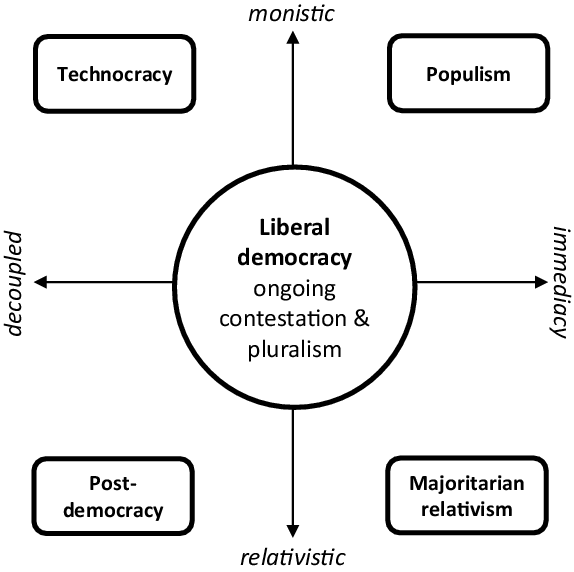
Based on these assumptions, liberal democracy can be understood as lying at the center of two fundamental dimensions that structure the conceptual space (see also König and Siewert, Reference König and Siewert2021). This space, which is shown in Figure 1, describes different ways in which the idea of the rule of the people is put into practice. Based on the preceding considerations, the more one moves away from the center of this space, the more liberal democracy becomes disfigured, and the combinations of the axis endpoints constitute four ideal-typical deformations of liberal democracy. One should note that these are all still tied to the democratic idea of the rule of the people, but they realize this idea in a way that threatens to undermine ongoing contestation and pluralism.
Conceptual space of liberal democracy and four of its deformations.

We find two such subversive forms of democratic politics at the top in Figure 1 that correspond to the well-known variants of populist and technocratic politics. Both are marked by a monistic epistemic orientation, meaning they adhere to the idea that there is a single best or correct political course that should be realized with political decisions, and they thus, in the extreme, deny other positions their legitimacy. Whereas populism clings to a presumed true and unitary will of the people (Mudde, Reference Mudde2004; Abts and Rummens, Reference Abts and Rummens2007), technocracy is based on the purported superior knowledge and wisdom of expert decision-makers (Pappas, Reference Pappas2016; Bickerton and Accetti, Reference Bickerton and Accetti2017; Caramani, Reference Caramani2017). While these two conceptions share a monistic outlook, they are nonetheless clearly different on the representational dimension. Whereas populism stresses immediacy, that is, translating the popular will as directly as possible into political decisions, technocracy is based on decoupled representation, with decision-makers being detached from citizens, while they are still supposed to make decisions in the interest of the people (see also Caramani, Reference Caramani2017).
Two further types populate the lower part of the two-dimensional space. These can be called post-democracy and majoritarian relativism. They are both characterized by relativism in the sense that all views and interests count as equally valid, often by just being instrumental in attaining other goals. Post-democracy combines such a relativist outlook with decoupled representation. There is no need for citizen involvement beyond regular elections while political elites remain among themselves and negotiate decisions in closed circles (Crouch, Reference Crouch2004). Political parties and their positions under these circumstances essentially become the means or vehicles for attaining power, and political elites are expected to act in the interest of the people outside of their own career interests (Katz and Mair, Reference Katz and Mair1995).
The second conception in the bottom half of Figure 1, in contrast, realizes immediacy. Politicians are supposed to fulfill citizens’ demands as directly as possible, whatever these may be. Importantly, it differs from populism through expressly not adhering to the notion of a true and unitary popular will. Rather, it brings a sort of consumer attitude to democratic politics: citizens’ preferences are simply to be accommodated as best and as directly as possible. This relativism implies a lack of a political compass. What matters is what citizens think and feel at a given time – which may change from week to week. This conception corresponds to a majoritarian relativism in which ‘the determinant of truth [is] the majority’s political will’ (Tsesis, Reference Tsesis2021: 36), a will that emerges from a marketplace of ideas but is not an outcome that follows from debate and argument. This majoritarian relativism is closely related to a majoritarian understanding of democracy that places little value on consensus and sees political decisions justified through being backed by a majority alone (Heyne, Reference Heyne2019; Ferrín and Hernández, Reference Ferrín and Hernández2021; Grossman et al., Reference Grossman, Kronick, Levendusky and Meredith2022), even if this directly goes against minority rights (Landwehr and Steiner, Reference Landwehr and Steiner2017). However, within the larger framework illustrated in Figure 1, the majoritarian-relativist conception of democracy is more explicitly characterized by an emphasis on relativism that distinguishes it from a populist conception with its monist outlook.
Importantly, the two dimensions in Figure 1 identify different conceptions of democracy that are located on the same conceptual level. They all refer to ways of organizing the process of democratic politics in terms of how citizens’ views are exchanged in a process of public will formation and become translated into political decisions. Focusing on this procedural aspect of the shape of democratic politics also means keeping these conceptions analytically distinct from other attitudes, such as distrust in political elites. As will be detailed below, political distrust will be measured separately to study how it relates to the various conceptions of democracy among citizens. This can be presumed to matter when studying correlates of these conceptions since common measures of stealth democracy and populism incorporate anti-elite sentimentFootnote 1 – leading stealth democracy items to load on two dimensions rather than one (Ackermann et al., Reference Ackermann, Ackermann and Freitag2019) – whereas, for example, measures of liberal democracy do not. This may well be one reason for inconsistent findings on how individual characteristics relate to different notions of democracy as reported by Hibbing et al. (Reference Hibbing, Theiss-Morse, Hibbing and Fortunato2021: 3).
It should be noted that while the formulated conceptual framework is intended to study conceptions of democracy within a systematic and analytically coherent account, this does not mean that citizens’ attitudes will show similar coherence. Indeed, the idea is precisely that citizens may well support several conceptions of democracy at the same time, and citizens may see the relative affinities between these conceptions differently than shown in Figure 1. It is an open question how much citizens are clearly distinguishable in terms of which conception(s) of democracy they support. Further, when probing the extent to which there exist different and distinct conceptions of democracy in the population, it is also of interest to see whether these can be distinguished from each other in terms of their correlates. To answer this question, the analysis will focus on several characteristics that have been especially relevant in previous research on conceptions of democracy. Besides political support (Easton, Reference Easton1975) as an attitude that entails evaluations of the political regime and political status quo, education, political interest, and ideology, have been highlighted as variables that are of particular interest when studying the correlates of different notions of democracy (Hibbing et al., Reference Hibbing, Theiss-Morse, Hibbing and Fortunato2021). The potential relevance of these characteristics will be discussed in the following based on a review of related work.
Correlates of democratic preferences
Political support
Turning first to the role of political support, it has been argued that dissatisfaction with the political status quo leads citizens to have a stronger desire for change not merely on the level of policies, but on the process level, that is, the very rules of politics (Allen and Birch, Reference Allen and Birch2015). One would therefore expect that the more a person is disenchanted with politics and the political system, the more she demands radical change to it. Existing evidence, indeed, indicates that lower political trust is associated with a broader populist attitude (Castanho Silva et al., Reference Castanho Silva, Vegetti and Littvay2017; Bertsou and Caramani, Reference Bertsou and Caramani2020). The same may hold for a more narrowly conceptualized populist conception of democracy and, in a similar vein, for majoritarian relativism, which are both characterized by immediacy and thus differ the most from the common realization of democracy as representative democracy. For technocracy, findings are mixed. While not directly comparable because of different measures, the findings by Bertsou and Pastorella (Reference Bertsou and Pastorella2017) as well as by Rapeli (Reference Rapeli2016) suggest that technocratically minded citizens exhibit lower political trust, whereas Bertsou and Caramani (Reference Bertsou and Caramani2020) find them to be more politically trustful at least compared to populist citizens. Studies on stealth democracy, in turn, have uncovered negative associations between a stealth-democratic attitude and various aspects of political support (Bengtsson and Mattila, Reference Bengtsson and Mattila2009; Coffé and Michels, Reference Coffé and Michels2014; Stoker and Hay, Reference Stoker and Hay2017).
One should note, however, that common measures of a stealth-democratic and a populist attitude inherently comprise anti-elite sentiment and are thus directly related to political support. When measuring them in ways that more narrowly capture support for a specific shape of democratic politics, as conceptualized above, the pattern might be different. Also, stealth democracy shows a certain overlap with technocracy, such that distinguishing between support for a post-democratic and a technocratic conception of democracy may lead to sharper differences regarding how political support relates to these two elite-centered forms of democratic politics.
Regarding support for democracy as liberal democracy, different facets of political support may also show different associations with support for this conception of democracy. While committed democrats are generally supportive of democratic regimes and trust its core political institutions they may, nonetheless, be more dissatisfied with the working of democratic politics due to their demanding understanding of democracy (Norris, Reference Norris2011). Discontent with politics can thus be associated to support for democracy as liberal democracy precisely because this implies an ideal notion of democratic politics (Neblo et al. Reference Neblo, Esterling, Kennedy, Lazer and Sokhey2010; Webb, Reference Webb2013).
Cognitive mobilization: education and political interest
Education and political interest are likely to show different associations with support for the various conceptions of democracy as well. They are central indicators of cognitive mobilization (Dalton, Reference Dalton1984: 267) and can be presumed to foster a greater awareness and appreciation of the complexity of politics and, thus, a stronger commitment to democratic values like pluralism (Dalton, Reference Dalton2008) and self-expression values that are tied to the realization of liberal democracy (Inglehart and Welzel, Reference Inglehart and Welzel2005). Furthermore, formal education socializes citizens with values that sustain the political regime (Österman and Robinson, Reference Österman and Robinson2022) and high formal education is also an indicator of privileged social status, which tends to go along with a preference for the existing social order (Ceka and Magalhães, Reference Ceka and Magalhães2020). For all these reasons, higher education as well as political interest are likely correlates of support for liberal democracy – which is also corroborated by empirical evidence on support for representative and liberal democracy (e.g. Coffé and Michels, Reference Coffé and Michels2014; Ceka and Magalhães, Reference Ceka and Magalhães2020; Rapeli and von Schoultz, Reference Rapeli and von Schoultz2021) as well as sunshine democracy as a variant of representative democracy (Webb, Reference Webb2013).
Education has also consistently shown a negative association with a populist attitude (Spruyt et al., Reference Spruyt, Keppens and Van Droogenbroeck2016; Rico et al., Reference Rico, Guinjoan and Anduiza2017; Bernhard and Hänggli, Reference Bernhard and Hänggli2018; Tsatsanis et al., Reference Tsatsanis, Andreadis and Teperoglou2018; Fatke, Reference Fatke2019; Rovira Kaltwasser and Van Hauwaert, Reference Rovira Kaltwasser and Van Hauwaert2020). To the extent that this is because populism entails a simplistic notion of democracy that underestimates or ignores the complexity and difficulty of translating citizens’ views into political decisions, a similarly negative association with education might also emerge for majoritarian relativism. Political interest, in turn, has rarely been examined together with populism on the citizen level, and existing evidence is inconclusive (Spruyt et al., Reference Spruyt, Keppens and Van Droogenbroeck2016; Bernhard and Hänggli, Reference Bernhard and Hänggli2018).
For a technocratic attitude (Bertsou and Caramani, Reference Bertsou and Caramani2020) and support for experts (Fernández-Martínez and Font, Reference Fernández-Martínez and Font2018), a positive association with education seems to hold true. A likely reason for this is that technocracy incorporates the idea of complexity in politics through emphasizing the importance of expertise (Fernández-Martínez and Font, Reference Fernández-Martínez and Font2018: 9). There is mixed evidence, however, on whether citizens with a technocratic attitude are more politically interested (Bertsou and Pastorella, Reference Bertsou and Pastorella2017; Bertsou and Caramani, Reference Bertsou and Caramani2020) whereas stealth democracy, which also entails support for detached expert decision-makers as one element, seem to be more prevalent among the less politically interested and formally less educated citizens (Bengtsson and Mattila, Reference Bengtsson and Mattila2009; Atkinson et al., Reference Atkinson, White, Berdahl and McGrane2016; Stoker and Hay, Reference Stoker and Hay2017; Webb, Reference Webb2013; see also Rapeli and von Schoultz, Reference Rapeli and von Schoultz2021). Given the overlap between stealth democracy and a technocratic attitude, distinguishing between a technocratic and post-democratic conception might serve to shed further light on whether observed associations with education and political interest are due to the role of experts in decision-making or, instead, mainly due to the detached role of decision-makers.
Ideology and extremism
Existing evidence also suggests that citizens’ support for certain conceptions of democracy can be related to their positions in an ideological space. It has been argued that citizens further on the political right tend to support political arrangements that are marked by weaker accountability and a more decoupled relationship between citizens and political elites (Bengtsson and Mattila, Reference Bengtsson and Mattila2009; Webb, Reference Webb2013; see also Fernández-Martínez and Font, Reference Fernández-Martínez and Font2018). In line with this expectation, a technocratic attitude seems to be more prevalent in the right ideological spectrum (Bertsou and Pastorella, Reference Bertsou and Pastorella2017; Bertsou and Caramani, Reference Bertsou and Caramani2020), as is a stealth-democratic attitude (Hibbing and Theiss-Morse, Reference Hibbing and Theiss-Morse2002; Bengtsson and Mattila, Reference Bengtsson and Mattila2009; VanderMolen, Reference VanderMolen2017; but see Medvic, Reference Medvic2019). It remains to be seen whether this is equally the case regarding support for a post-democratic conception, which, too, is based on a more detached political leadership.
Further, there is some evidence that ideology is not linearly related to certain conceptions of democracy. Rather, political extremism, that is, positions toward the endpoints of a left-right continuum have been registered to be associated with a stronger populist attitude (Tsatsanis et al., Reference Tsatsanis, Andreadis and Teperoglou2018; Bertsou and Caramani, Reference Bertsou and Caramani2020) and less demand for representative democracy (Wojcieszak, Reference Wojcieszak2014). This is in line with the idea of populism as a thin ideology that needs to be combined and charged with a host ideology that can sustain a strong exclusive notion of the true people (Mudde, Reference Mudde2004) – which is more likely to be found at the ideological extremes. It is therefore important to also consider a non-linear relationship between ideology and support for different conceptions of democracy.
Measures and data
The five posited conceptions of democracy are measured with 20 items overall. The populist, technocratic, post-democratic, and majoritarian-relativist conceptions of democracy are based on three items each that have been carefully phrased to closely reflect the descriptions in the section on conceptualization. The item wording not only accounts for the distinctive nature of each of the four deformations but also their commonalities and differences based on the underlying analytical dimensions. To measure the liberal-democratic conception, eight items have been formulated, with four on the importance of pluralism and engaging other views in public debate and four on the importance of ongoing contestation in politics and political decision-making. If the conceptual assumptions hold, these two subscales should be characteristic of only liberal democracy and it should thus be possible to recover them as separable constructs distinct from the four deformations of liberal democracy (for item wording and sources, see online Appendix A1).
Additional questions in the survey were included to measure three aspects of political support. Lack of external efficacy, first, is based on five items taken from the German Longitudinal Election study 2017 (Roßteutscher et al., Reference Roßteutscher2018) that measure the extent to which citizens feel that politicians and their actions do not represent their interests (see online Appendix A2 for details) – which forms a central part of a broader political disenchantment or disaffection. The second variable is satisfaction with democracy as a generalized evaluation of the working of politics (1 = not at all satisfied to 7 = very satisfied). The survey contains, third, standard items on political trust as a more basic and stable aspect of political support. The items asked about trust in the five institutions: parliament, justice system, federal government, parties, and public administration (1 = do not trust at all to 7 = trust completely). Ideology is based on a seven-point item asking about respondents’ left-right position. Following previous studies, this variable will also be entered in squared form in the analysis to capture the influence of positions at the extremes. Also, to get a more detailed picture about citizens’ location in the ideological space, two items capturing policy positions on the two main political conflict dimensions have been chosen: an economic policy preference (more welfare and higher taxes vs. lower taxes and less welfare), and a policy preference about accepting more vs. less foreigners in the country (both seven-point items). These are also standard items taken from the German Longitudinal Election Study (see Appendices A3 and A4), in which the anti-immigration stance is also commonly used more broadly as a measure of a liberal vs. authoritarian stance. Finally, the survey included a question for education, age, gender (diverse, female, male), and a 5-point scale for political interest.
The survey furthermore featured an attention check and a control question on the last page of the survey asking whether responses were honest and usable in the analysis. These questions were applied as a filter together with a speeding check, leaving 925 of 1115 observations in the analysis. The study participants have been recruited by the certified panel provider respondi AG Footnote 2 from an online panel representative of the German population aged 18 to 74. Respondents have been selected using quotas for age, gender, and region (see Appendix A5 for the composition and comparison with German election survey data). The survey was fielded in August 2021.
Before turning to the description of citizens’ democratic preferences, it is first necessary to ascertain whether the posited constructs can be recovered from the survey responses. To test whether this is the case, exploratory factor analyses have been run that extracted the posited constructs as separable factors. Confirmatory factor analysis also indicates an acceptable fit (see Appendices A6 to A8 for details). Based on these analyses, the items have been averaged to create variables representing the conceptualized constructs. As noted above, several preferences for democracy realized in different forms could go along with each other. It is therefore important to not simply inspect the absolute support for a given conception of democracy, but also to support relative to the other conceptions. Only if we register associations between the correlates in the preceding section and both an absolute and relative support of a conception of democracy, can we speak of a characteristic being associated with a preference for a conception of democracy in a stronger sense.
Empirical analysis
Description of the main variables
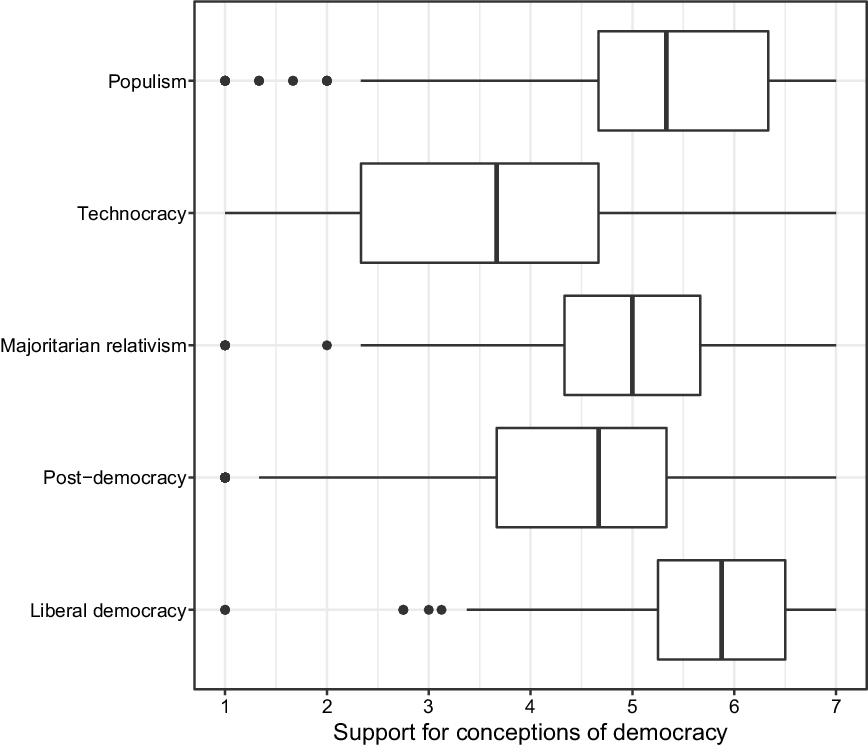
Figure 2 reports the scores for each of the measured constructs. Importantly, while the items in the analysis are intended to capture people’s conceptions of democracy, the depicted scores should not already be read as types since citizens may simultaneously score high on several variables. For instance, a technocratic understanding of democracy could go along with a populist orientation at least for a part of the population. Or we might find that committed liberal democrats are often also populists or technocrats. Bearing these considerations in mind, the scores for the individual constructs indicate that post-democracy is the least favored realization of democratic politics. The majoritarian-relativist conception and especially a populist and a technocratic conception of democracy have much higher support among citizens. Support for these latter two conceptions is close to the high level of support for democracy as liberal democracy (combining contestation and pluralism).
Distribution of the variables for measuring conceptions of democracy.

This descriptive evidence is already telling. If one were to look only at individual conceptions alone, one would conclude that support for, for example, a populist or technocratic realization of democratic rule is quite high: Measuring only populism would lead one to believe that the people are on average rather populist. However, citizens clearly have on average strong sympathies for several conceptions of democracy. The question is whether this also holds on the individual level and how many citizens have clearly defined preference profiles, that is, clearly prefer one conception of democracy over others, or instead show diffuse or inconsistent preferences.
The prevalence of attitudinal types
To gauge how clear-cut people’s democratic preferences are, the next step of the analysis examines those citizens who score high on a given conception of democracy but not on others. When looking at the individual-level ordering, one can determine who places a certain conception, such as populism, above all the others. The resulting frequency distribution mirrors the means of the variables shown in Figure 2 further above: A priority of liberal democracy is clearly the most prevalent with almost 40%, followed by a populist conception with about 25%. A priority of technocracy is present among about 10% of citizens, and majoritarian relativism and post-democracy are very rare with 5 and 2% respectively. These scores essentially mirror the ordering of average support for the conceptions of democracy as shown above in Figure 2: Since liberal democracy is endorsed strongly overall, it is very likely that this preference will dominate the others for a given person. However, someone may favor liberal democracy the most even though she has a relatively low score on this variable and is simultaneously above average on, for example, post-democracy.
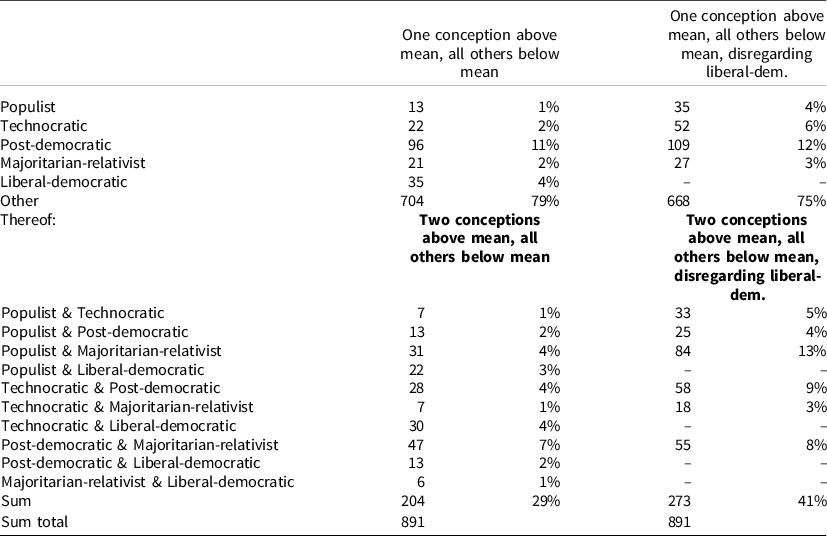
An alternative way of looking at the scores accounts for the commonly achieved levels on the examined variables: it identifies types based on a person being above average on a given conception of democracy while being below average on all others. Table 1 shows the resulting frequencies when using these criteria. Since support for liberal democracy is highly prevalent and thus the least discriminating, the table also shows frequencies for types that disregard how respondents scored on the variable for liberal democracy (last two columns). When considering all five conceptions of democracy, the highest share attained by a type which is above average on only one variable is about 10%: for post-democracy. This is remarkable as overall support for post-democracy is the lowest and indicates that this conception of democracy is the most distinct one with regard to people’s preferences – citizens who score higher on this variable tend to score higher only on this variable. All other types show shares between 1 and 4%, and a whopping 80% (704 cases) fall under ‘other’, that is, are simultaneously above average on two or more of the variables or below average on all (note that only 58 cases are simultaneously below the mean on all five variables). When looking more closely at this category ‘other’, we see that it is common to find mixed types. Overall, however, less than a third of respondents falling in the category ‘other’ exhibit above-average support for exactly two of the five conceptions (204 cases), which means that many respondents show above-average scores on even more than two conceptions.
Frequencies of registered attitudinal types

In sum, most citizens have vaguely defined preferences and it appears they can arrange themselves with rather different forms of democracy. Yet, the findings also indicate that some conceptions are more mutually compatible than others. Especially when looking at the last two columns of Table 1 (the frequencies of types disregarding how citizens score on the liberal-democratic conception), it is notable that the conceptions posited as polar opposites further above go along with each other the least: technocratic and majoritarian-relativist as well as populist and post-democratic citizens are comparatively rare types. Yet, populism and technocracy are also a comparatively rare combination, whereas support for a post-democratic and a majoritarian-relativist conception is more common. Hence, although citizens’ preferences may not be very clearly defined, the results also suggest that in people’s perceptions, there are incompatibilities between different realizations of democratic politics. These perceived incompatibilities are, however, mainly a question of degree than of kind.
Citizens’ perceptual space regarding conceptions of democracy
To probe further whether citizens’ democratic preferences – despite their apparent diffuse nature – generally show the kinds of relative affinities among the different forms of democracy in line with the conceptual assumptions further above, one can inspect the correlations between the measured constructs. These correlations are depicted in Figure 3 (note that only the correlation between the post-democratic and populist conception is not statistically significant under P < 0.05). Similar to what has been found with regard to a populist attitude and pluralism (Akkerman et al., Reference Akkerman, Mudde and Zaslove2014; Dekeyser and Roose, Reference Dekeyser and Roose2021; Ellenbroek et al., Reference Ellenbroek, Meijers and Krouwel2021; Spruyt et al., Reference Spruyt, Rooduijn and Zaslove2021), the populist and the liberal-democratic conceptions are not opposites but instead show a weak positive association (r = 0.34, P < 0.01). The findings also add to evidence reported by Bertsou and Caramani (Reference Bertsou and Caramani2020) as well as Fernández-Vázquez et al. (Reference Fernández-Vázquez, Lavezzolo and Ramiro2022) that it is not unusual to find citizens with a populist and a technocratic attitude. The evidence reported so far suggest an even greater complexity regarding citizen’s conceptions of democracy than in previous studies: Figure 3 contains no clear negative correlations, which means that expressing support for one conception of democracy does not exclude expressing support for any of the other conceptions.
Correlations between variables for measuring conceptions of democracy.

Although citizens’ democratic preferences are altogether rather diffuse, the pattern of correlations does indicate different relative affinities between the constructs that are in line with the conceptual assumptions: Whereas technocracy is more strongly related to post-democracy than to both populism and majoritarian relativism, these latter two are more strongly correlated with each other than with technocracy and post-democracy. It is furthermore notable that liberal democracy, according to citizens’ survey responses, is very much compatible with technocracy and a populist notion of democracy – which is especially striking given that the measures for liberal democracy expressly capture pluralism and ongoing contestation, attributes that are hard to reconcile with the monistic forms of translating citizens’ views into political decisions characteristic of populism and technocracy.
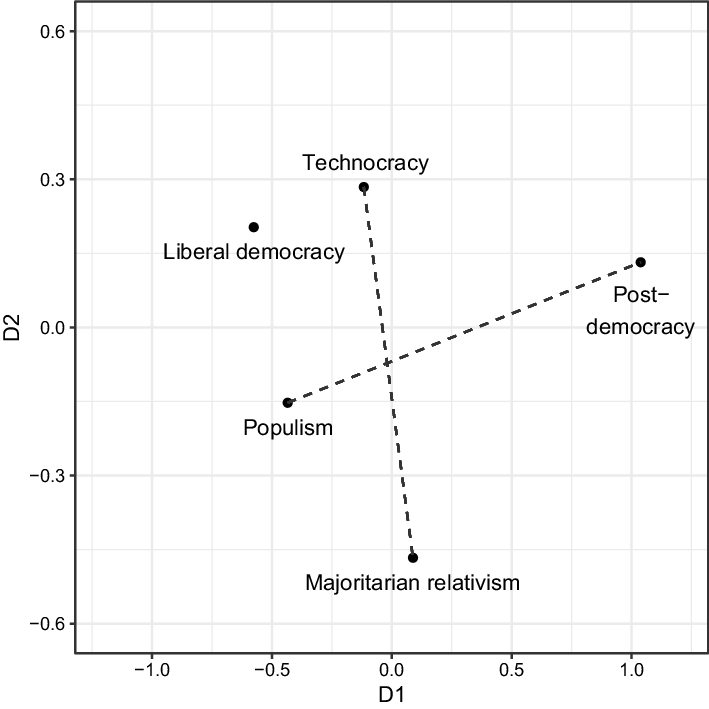
A more illustrative way of uncovering the relative affinities between the constructs lies in estimating and visualizing respondents’ perceptual space regarding the examined constructs based on their survey responses. This is done by means of multidimensional scaling (Borg et al., Reference Borg, Groenen and Mair2013), which serves to translate the observed similarities between the variables over all respondents into a structure of spatial distances that can be visualized.Footnote 3 Multidimensional scaling locates all five conceptions of democracy in a common space that is shown in Figure 4 (the Stress value of 0.008 indicates that a two-dimensional solution is adequate).
Citizens’ perceptual space regarding conceptions of democracy.
Notes: Iterative interval-scale multidimensional scaling based on Euclidean distance as the proximity measure between the variables. Stress value = 0.008. The five variables have been ipsatized before running the scaling procedure. The dimensions have no apriori meaning and are statistically generated to capture the largest share of variation in the data. Dashed lines inserted to highlight diametrically opposed conceptions of democracy.

The analysis yields the posited configuration of relative similarities and dissimilarities for the four deformations of liberal democracy. While post-democracy and populism are diametrically opposed to each other, the same holds for technocracy and majoritarian relativism (contrasts highlighted with dashed lines). This conceptualized structure would have been disconfirmed if any of these deformations had been located between two others or if they had been located along a continuum. With regard to these deformations, citizens apparently do perceive the conceptualized relative affinities between them. Yet, Figure 4 also shows one clear deviation from the formulated conceptual space: Rather than being located at the center, as posited in the conceptual framework above, liberal democracy lies in the top-left of the figure. While liberal democracy has been conceptualized and measured as a middle ground between the four examined disfigurations, this is not how citizens perceive it. Rather, they see, by and large, liberal democracy as more compatible with technocratic and populist democracy than with post-democracy and majoritarian relativism. This does not necessarily mean that the notion of liberal democracy as a form of politics that balances different countervailing principles is wrong. The findings do imply, however, that citizens’ perceptions of liberal democracy deviate from this conceptualization of liberal democracy rooted in political thought.
This is not too surprising as citizens are not political theorists. In any case, Figure 4 provides evidence on the relative affinities between different forms of democracy that citizens perceive, and these uncovered perceptions indicate that citizens see liberal democracy more closely related to disfigurations that emphasize a monistic orientation. It thus seems that citizens more easily reconcile liberal democracy with the idea of a single right or best political course than with a relativist outlook. The findings presented thus far sit well with the assumption by Hibbing et al. (Reference Hibbing, Theiss-Morse, Hibbing and Fortunato2021) that people do want elected politicians to govern, but they also want politicians to be closer to people’s real-world problems while at the same time showing appreciation for the role of expertise in politics. The presented results also underscore a key dilemma of political actors identified by Mair (Reference Mair2009), as citizens appear to demand both responsive and responsible government expressed in rather different forms of democracy.
Correlates of the five conceptions of democracy
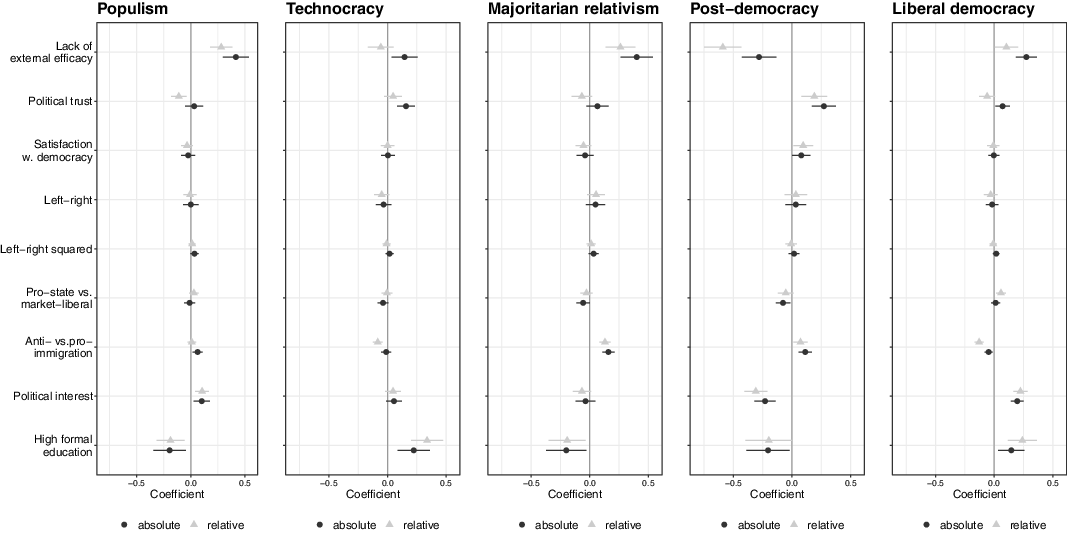
As a final step, the analysis looks at how the conceptions of democracy are related to several characteristic identified as particularly relevant above. This part of the analysis looks at preferences for conceptions of democracy not only in terms of absolute, but also relative support scores, that is, measuring the support for a given conception in relation to all others.Footnote 4 When regressing democratic preferences in these two variants on the independent variables, we obtain the results depicted in Figure 5 (see Appendix A9 for full regression tables).
Results from OLS regressions with conceptions of democracy as dependent variables.
Notes: Ninety-five-percent confidence intervals shown. Control variables and constant not depicted in the graphs.

Political support
Of the variables for political support, a lack of external efficacy is clearly the most relevant and differently related to the various conceptions of democracy. The coefficients indicate that with a greater perceived lack of external efficacy both absolute and relative support for populism and for majoritarian relativism increase markedly whereas support for post-democracy decreases. Post-democracy is also the only conception of democracy that shows a clear association with political trust: The coefficients are positive both for absolute and relative support, which altogether suggests that citizens supporting this conception are content with the status quo. Regarding a liberal-democratic conception, we find significant positive coefficients of a lack of external efficacy. This can be interpreted as being in line with the idea of disaffected democrats (Webb, Reference Webb2013) and critical citizens (Norris, Reference Norris2011) who are dissatisfied with the current state of politics but embrace democratic ideals. Only technocracy shows no clear pattern with regard to the variables measuring aspects of political support, which suggests that low political support might cut both ways: leading some to desire more, others to desire less technocracy.
All in all, it follows that those conceptions which emphasize immediacy in the relationship between citizens’ views and political decisions are most clearly linked to lower political support. While this finding can be interpreted as low political support leading to a demand for more radical change, regarding the political process it could also be read as a larger gap between expectations and reality leading to political discontent (Landwehr and Steiner, Reference Landwehr and Steiner2017).Footnote 5
Education and political interest
Both higher formal education and political interest are associated with greater support for liberal democracy as a more demanding notion of democratic politics with its emphasis on pluralism and ongoing contestation under representative-democratic institutions. This finding conforms to the assumptions about the relationship between cognitive mobilization and support for liberal democracy and adds to previous findings pointing in the same direction (e.g. Webb, Reference Webb2013; Coffé and Michels, Reference Coffé and Michels2014; Ceka and Magalhães, Reference Ceka and Magalhães2020). For the disfigurations of liberal democracy, we find different patterns. Support for a populist form of democratic politics goes along with lower formal education, but higher political interest. This parallels the finding that citizens supporting populist parties are more politically interested (Van Hauwaert and Van Kessel, Reference Van Hauwaert and Van Kessel2018).
Interestingly, this differs from the models for majoritarian relativism, in which education has a significant and negative coefficient while political interest is not significant. Political interest is equally irrelevant in the model for the technocratic conception of democracy. Higher formal education, however, is significantly and positively associated with this conception, which conforms to the idea that higher education translates into a greater appreciation of knowledge and expertise in politics, as has been similarly registered regarding support for expert decision-makers (Fernández-Martínez and Font, Reference Fernández-Martínez and Font2018) and a broader technocratic attitude (Bertsou and Caramani, Reference Bertsou and Caramani2020).
Looking finally at the model for the post-democratic conception, the coefficients for education indicate that higher support for this conception is more prevalent among those with lower formal education. The finding for political interest is even more pronounced and indicates that support for a post-democratic conception is stronger among the politically less interested. Together with the negative coefficient for a lack of external efficacy, this finding suggests that support for post-democracy is an expression of passivism and contentment with the status quo – which is very much in line with what post-democracy represents (Crouch, Reference Crouch2004). It also mirrors findings from several studies on a stealth-democratic attitude (Bengtsson and Mattila, Reference Bengtsson and Mattila2009; Webb, Reference Webb2013; Coffé and Michels, Reference Coffé and Michels2014; Atkinson et al., Reference Atkinson, White, Berdahl and McGrane2016; Stoker and Hay, Reference Stoker and Hay2017).
Ideology
Turning to the ideological variables, the general left-right self-positioning plays no role for the support of the various conceptions. While the squared left-right position is not significant in any of the models,Footnote 6 additional analyses show that when leaving away the two variables for policy preferences, the general left-right position becomes significant in several models: there is a consistent positive association between left-right position and support for the post-democratic and the majoritarian-relativist conceptions, and a consistent negative association with support for the liberal-democratic conception (see Appendix A11). This is in line with the idea that less accountable political structures are accepted more in the right political spectrum. Yet, the findings also indicate that the anti-immigration stance (higher scores represent a desire for stricter immigration rules) is a better predictor. It, too, exhibits a negative association with absolute and relative scores of liberal democracy and positive associations with absolute and relative support for post-democracy – as a form of democracy that encapsulates the idea of political acquiescence and simply letting politicians go about their business. We also find a clear positive relationship with majoritarian relativism. The reason for this could be that majoritarian relativism indeed reflects a consumer attitude brought to politics, and thus implies not caring about accountable and/or responsive political structures but instead primarily about outputs being delivered by political elites, regardless of how this happens.
Looking, finally, at the model fit, several of the regression models have respectable adjusted R2-values between 0.15 and 0.26. The explained variance is notably higher for post-democracy and majoritarian relativism (0.19 to 0.25) and much lower for technocracy (around 0.09). It seems that a technocratic notion of democratic politics is similarly popular in different segments of society, whereas this is much less the case for the other conceptions of democracy.
Conclusion
The present paper has studied citizens’ preferences for five conceptions of democracy based on an analytical framework that locates these conceptions in a single conceptual space. Using Germany as a case, the analysis of people’s preferences for different forms of democratic politics has yielded a complex picture in which citizens have no clear-cut preferences for the studied conceptions of democracy. The evidence underscores previous findings on the vagueness and inconsistencies in citizens’ democratic preferences (e.g. Schedler and Sarsfield, Reference Schedler and Sarsfield2007; Bengtsson and Mattila, Reference Bengtsson and Mattila2009; Webb, Reference Webb2013; Font et al., Reference Font, Wojcieszak and Navarro2015; Fernández-Vázquez et al., Reference Fernández-Vázquez, Lavezzolo and Ramiro2022) while providing a more comprehensive picture on the diffuseness of these preferences based on more and different conceptions of democracy than have been studied together thus far. The results also show that the multifaceted democratic preferences that Kriesi et al. (Reference Kriesi, Saris, Moncagatta, Ferrín and Kriesi2016) found for positively connotated conceptions of democracy, notably, also holds for disfigurations of liberal democracy. By expressly studying liberal democracy together with four of its disfigurations, the analysis has shown that citizens often support democracy as liberal democracy while also sympathizing with at least one of the studied deformations.
Yet these forms of overlap are not arbitrary. They correspond to conceptually posited relative affinities between the democratic deformations. The studied conceptions of democracy also differ, as the analysis has shown, with regard to various correlates. Liberal democracy is favored more, ceteris paribus, among those who have higher formal education, greater political interest and are in the political left and progressive spectrum. Post-democracy seems to reflect political acquiescence as it is more popular among the politically content and the less politically interested besides being more prevalent in more right-wing segments of society. Technocracy is appreciated more among those with higher formal education but seems to be otherwise similarly popular in different societal segments. Support for conceptions of democracy that emphasize immediacy in realizing citizens’ preferences – populism and what has been conceptualized as majoritarian relativism – are linked to lower perceived external efficacy and lower formal education. In contrast to majoritarian relativism, a populist conception of democracy seems to go along with higher political interest.
In view of these findings, it seems justified to make a distinction between support for a post-democratic and a technocratic conception of democracy and thus to avoid an overlap between the two that results with a stealth-democratic attitude, which comprises support for experts. One can also conclude from the findings that a populist conception of democracy co-exists with a majoritarian relativism and that these are partly related to each other both conceptually and in terms of their correlates, while also showing notable differences.
The above results have been obtained for Germany. In view of Germany showing clear similarities to other countries in continental Europe in terms societal values and political culture (Inglehart and Welzel, Reference Inglehart and Welzel2005; Schwartz, Reference Schwartz2006), we may well obtain similar results at least in some other parts of Europe. However, further research is needed to corroborate to what extent they also hold true elsewhere. In any case, the above findings have implications for measuring conceptions of democracy. First, it is common practice in research on conceptions of democracy to scale items and combine them into the additive measures, such as for populism. While this is methodologically rigorous and helps to bolster the reliability and validity of the measures, it yields distinguishable statistical dimensions, such as for pluralism or elitism. It therefore does not tell us what combinations of these dimensions – for example, pluralism and elitism – exist among citizens and how prevalent these combinations are – an issue already emphasized in previous work (e.g. Schedler and Sarsfield, Reference Schedler and Sarsfield2007: 643–644; Carlin and Singer, Reference Carlin and Singer2011: 1507–1508). Second, such combinations will also remain hidden with measures that ask citizens to express a preference for one conception instead of or over others, either by letting respondents pick what they deem most important features of democracy from a list or by using bipolar rating questions.
In the same vein, third, studying only a single construct, such as demand for populist or expert-led politics will necessarily conceal a possible overlap in different democratic preferences. If the present study had included a measure only for populism or only for technocracy, it would have come to similar conclusions as previous work on the prevalence of a populist attitude and on stealth or expert-led democracy – that each of them is widespread in the population. The above results indicate, however, that when additionally considering what other preferences for democracy citizens simultaneously hold, it is hard to find citizens who, for example, show strong support for only populist or technocratic politics. Many of them will also be strongly committed to liberal-democratic principles, and there are even citizens who support both populism and technocracy. By the same token, a preference for democracy as liberal democracy frequently goes along with support for deformations of democracy. Distinctions of these sort matter because a certain degree of support for deformations of liberal democracy may well be productive and beneficial for democracy if they go along with a desire for a reflexive democratic process based on pluralism and ongoing contestation (Wood, Reference Wood2021). It is most likely strong or pure types that present a danger for democracy – yet these appear to be rare.
Supplementary material
To view supplementary material for this article, please visit https://doi.org/10.1017/S1755773922000194. Replication files can be found at https://doi.org/10.7910/DVN/XH7SGP.
Acknowledgements
I would like to thank the anonymous reviewers and the editors of European Political Science Review for their valuable comments and suggestions. I also owe thanks to Markus B. Siewert and Georg Wenzelburger for their feedback and to Louisa Prien for assisting with the preparation of the survey.
Funding
This research has been supported with funding from the ‘TU-Nachwuchsring’ of the TU Kaiserslautern.
Conflicting interests
The author declares that there are no conflicting interests.