Significant outcomes
• Korsakoff’s syndrome (KS) patients have impairments in cognitive and affective Theory of Mind (ToM) irrespective of executive functioning.
• The cognitive and affective impairments in ToM are severe in KS, resulting in permanent disability.
• ToM testing should be a central aspect of neuropsychological assessments in patients with chronic alcoholism or suspected KS.
Limitations
• In this study, Korsakoff patients had low levels of education, possibly increasing the social cognitive problems.
• The power of the study was limited based on small available sample of KS patients.
• ToM dysfunctioning in KS is related to executive dysfunctioning.
Introduction
Patients with KS, a neuropsychiatric disorder caused by chronic alcohol abuse and thiamine (vitamin B1) deficiency, suffer from severe declarative amnaesia (Reference Arts, Walvoort and Kessels1–Reference Squire4). Moreover, executive dysfunctions are commonly present in KS, including deficits in behaviour regulation, abstract thinking, and cognitive flexibility (Reference Kopelman, Thomson, Guerrini and Marshall3,Reference Arnsten and Li5–Reference Oscar-Berman, Shagrin, Evert and Epstein8). Central to the neurocognitive deficits in KS are atrophy in the dorsomedial thalamus, the mammillary bodies and the frontal cortex (Reference Kril and Harper9,Reference Pitel, Chételat, Le Berre, Desgranges, Eustache and Beaunieux10). KS patients also show various neuropsychiatric symptoms such as apathy (Reference Stuss, Winocur and Robertson11), confabulations (Reference Gilboa and Verfaellie12), decreased social desirability (Reference Egger, Wester, De Mey and Derksen13), impaired social inference ability (Reference Corcoran14), and emotional flatness (Reference Oscar-Berman7).
One crucial aspect of higher-order mental functioning is ToM. ToM is the capacity to represent others’ mental states such as their knowledge, thoughts, feelings, beliefs, and intentions in order to explain and predict their behaviour (Reference Frith and Frith15,Reference Premack and Woodruff16). ToM can be divided into a cognitive component, which refers to the ability to make inference concerning others’ beliefs and knowledge, and an affective component, which refers to the ability to make inference regarding others’ emotions (Reference Kalbe, Grabenhorst, Brand, Kessler, Hilker and Markowitsch17–Reference Shamay-Tsoory, Harari, Aharon-Peretz and Levkovitz19). The integrity of cognitive ToM is typically investigated by cognitive perspective taking tests and false belief tasks (Reference Hynes, Baird and Grafton20,Reference Shamay-Tsoory and Aharon-Peretz21). Cognitive perspective taking tests require participants to make a cognitive attribution to a character in a scenario with no necessity for emotional understanding (Reference Hynes, Baird and Grafton20). Affective ToM has been indexed by the Faux Pas and emotion recognition tasks (Reference Kalbe, Grabenhorst, Brand, Kessler, Hilker and Markowitsch17,Reference Baron-Cohen, Jolliffe, Mortimore and Robertson22–Reference Shamay-Tsoory, Tomer, Berger, Goldsher and Aharon-Peretz24). A Faux Pas can be described as a situation in which a speaker says something without considering if it is something that the listener might not want to hear (Reference Baron-Cohen, O’Riordan, Stone, Jones and Plaisted23). Detection of a Faux Pas requires an appreciation of the emotional impact of a statement on the listener (Reference Baron-Cohen, O’Riordan, Stone, Jones and Plaisted23). Recognition of facial emotions is associated with affective ToM because of its focus on affective aspects of social cognition and emotional abilities (Reference Shamay-Tsoory and Aharon-Peretz21,Reference Buitelaar, van der Wees and Swaab-Barneveld25).
It has been debated in the literature whether ToM functions are fully discrepant from other cognitive problems. For example, Henry et al. (Reference Henry, Phillips, Crawford, Ietswaart and Summers26) found a clear association between executive demands and ToM impairments in Traumatic Brain Injury patients, suggesting that both functions are mediated by common mental processes. In contrast, other studies with brain lesions patients or high-functioning autistic people do suggest that ToM dysfunctions are not necessarily related to executive functioning (Reference Baron-Cohen, O’Riordan, Stone, Jones and Plaisted23,Reference Fine, Lumsden and Blair27).
The inability to represent others’ mental states has been linked to difficulties in spatially taking other persons perspective (Reference Pearson, Ropar, de and Hamilton28). Both functions require individuals to consider that other persons have a different representation of the world than oneself, either a different visual viewpoint or a different belief. Communicating with other people, whether it concerns speaking to others, understanding others or reacting to others, requires comprehension of what the world look like to them (Reference Hiatt, Trafton, Harrison and Schultz29,Reference Tversky and Hard30). As such spatial perspective taking therefore could possibly be an essential requirement for a well-functioning ToM (Reference Pearson, Ropar, de and Hamilton28).
Although some studies have investigated selective aspects of ToM in KS, to our knowledge no full ToM investigation has yet been done, taking into account third person perspectives on both a cognitive and affective level. This is remarkable because ToM is considered as one of the central cognitive concepts relevant for everyday functioning in both literature and diagnostic guidelines for neurocognitive problems (Reference Bertoux, Delavest, de Souza, Funkiewiez, Lépine, Fossati, Dubois and Sarazin31,32). Earlier research on emotion recognition, one of the components of ToM, in KS indicated that patients suffer from impairments in the recognition of multiple facial emotional expressions (Reference Montagne, Kessels, Wester and de Haan33). Moreover, Oosterman et al. (Reference Oosterman, de Goede, Wester, van Zandvoort and Kessels34) investigated perspective taking in patients with KS and reported that patients showed pronounced problems in social perspective taking in complex situations. Importantly, both studies indexed only a single component of ToM and did not look into the full concept of emotional and cognitive ToM. In light of the foregoing the aim of the present study was to investigate whether and to what extent multiple aspects of cognitive and affective ToM are deficient in patients with KS. A battery of tasks, including cognitive and affective ToM tests, emotion recognition, and spatial perspective tests were presented to KS patients and matched controls. Based on prior results in KS we suspected problems in both cognitive and affective ToM.
Methods
Participants
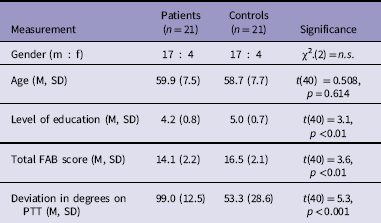
Twenty-one patients (17 male) diagnosed with KS participated in this study (see Table 1). They were all inpatients of the Korsakoff Center ‘Slingedael’ in Rotterdam, the Netherlands and fulfilled the DSM-V criteria for the alcohol-induced major neurocognitive disorder, Amnaestic Confabulatory type (code: 291.1) (32), and the characteristics of KS described by Kopelman (Reference Kopelman2). At the time of testing the patients were in the chronic, amnaestic stage of the Wernicke–Korsakoff Syndrome and not in a Wernicke psychosis. All patients were abstinent of alcohol for at least 1 year. Other exclusion criteria were illiteracy, presence of additional neurological disorders (traumatic brain injury, epilepsy, stroke, or brain tumour), acute psychiatric conditions (psychosis, major depression, etc.), and physical conditions interfering with the testing procedure. Twenty-one healthy participants (17 male) matched on age and gender were included as a reference group (see Table 1). The project was conducted according to the declaration of Helsinki and written informed consent was obtained for all participants. The study was approved by the faculty review board of Utrecht University. Controls were recruited by online advertisement.
Demographic variables and performance on background tests for executive functioning (Frontal Assessment Battery) and perspective taking

f, female; FAB, Frontal Assesment Battery; m, male; M, Mean; PTT, Perspective Taking Test.
Tasks
Sally–Anne Test
The Sally–Anne Test is a psychological false belief test to measure the social cognitive ability to attribute false beliefs to others (Reference Hurtado-Pomares, Carmen Terol-Cantero, Sánchez-Pérez, Peral-Gómez, Valera-Gran and Navarrete-Muñoz35). Although a serious limitation of binary score range, the false belief test is a well-known and commonly used methodology to examine ToM in children (Reference Wimmer and Perner36–Reference Flavell38). Moreover, the test is short, simple, and therefore endurable for the patients. In this current study a paper and pencil version of the Sally–Anne Test of Baron-Cohen, Leslie and Frith (Reference Baron-Cohen, Leslie and Frith39) was applied. In the test a story is verbally presented to the participant and accompanied by three pictures explaining the story. In this story the characters Sally and Anne are first introduced. In the second picture Sally puts a ball in a basket and leaves the room. After Sally left the room, Anne moves the ball to a box. Sally enters the room and the participants were asked: ‘where will Sally look for the ball’? To overcome problems regarding severe amnesia, the pictures were present during the entire test. Moreover, in the current version of the Sally–Anne Test, we added two control questions (‘where is the ball?’ and ‘ where was the ball at the beginning of the story?’) to check whether the patients understood and remembered the storyline, to minimise the effects of severe amnaesia in KS on task performance.
Mini-Social Cognition and Emotional Assessment (mini-SEA)
The mini-SEA is a short neuropsychological battery developed by Bertoux et al. (Reference Bertoux, Delavest, de Souza, Funkiewiez, Lépine, Fossati, Dubois and Sarazin31) to evaluate the impairment of the social and emotional cognition. It contains a specialised version of the Faux Pas Test and a Facial Emotions Recognition Test. For the current study the two subtests of the mini-SEA was considered as two separate outcome measures to index affective ToM. The Faux Pas test contains five embarrassing and five non-embarrassing situations. After each story the participants were asked whether the situation they read about was embarrassing or not embarrassing. By choosing the first option several additional questions such as: ‘which character said something embarrassing?’, were asked. Concerning the non-embarrassing stories, participants could get a score of 0 or 2. In case of an embarrassing story they could get a score from 0 to 6. To ensure that the amnesia of the patients had minimal impact on the results, the participants were allowed to read the stories as much as they wanted, even after asking the questions. Moreover, two neutral control questions for each story, to check if the participants had understood the situation, were asked. The Facial Emotion Recognition Test contains 35 pictures of facial emotion in which participants must identify which emotion is expressed: happy, sad, angry, surprised, scared, disgusted, or neutral. For each correct item the participants could get 1 point resulting in a total score with a minimum of 0 and a maximum of 35.
Education level
Education level was scored using 7 categories: 1 = lowest (less than primary school), 7 = highest (university degree) (Reference Duits and Kessels40).
Perspective Taking Task
A (Spatial) Perspective Taking Task was designed according to the example of Hegarty and Waller (Reference Hegarty and Waller41). Participants had to imagine being at the position of one of the pictured objects, facing a second object and point into the direction of a third object by drawing an arrow in the circle. The scores on the 12 items of the test were calculated by measuring the number of degrees deviated from the correct answer. For each item there was a minimum of 0° and a maximum of 180°.
Frontal Assessment Battery (FAB)
The FAB is a short screening test for frontal executive dysfunction (Reference Hurtado-Pomares, Carmen Terol-Cantero, Sánchez-Pérez, Peral-Gómez, Valera-Gran and Navarrete-Muñoz35). It consists six subcomponents: conceptualisation, mental flexibility, motor programming, sensitivity to interference, inhibitory control, and environmental autonomy. Each component has a minimum score of 0 and a maximum score of 3. The composite global score of the several subtests evaluates the severity of the dysexecutive syndrome and suggests a descriptive pattern of executive functioning (Reference Van Loo, Wiebrands and Van Laar42). There is no clear cut-off to distinguish frontal pathologies (Reference Van Loo, Wiebrands and Van Laar42).
Data analyses
Total scores on the three ToM subtests (Sally–Anne Test, Emotion Recognition Test, Faux Pas Test) were statistically analysed with independent sample T-tests comparing performance in controls and KS patients. For items that violated the assumption of normality or had a binary or ordinal scale, nonparametric U tests were applied. All effect sizes were calculated and valued by using the classifications of Cohen (Reference Cohen43). Cohen’s D was calculated by subtracting the means of both groups, divided by the pooled standard deviation. The effect size of the Mann–Whitney U test was calculated by dividing the Z value by the root of the total number of participants.
In posthoc analysis, the total number of hits and correct rejections on the Faux Pas were investigated with the Signal Detection Theory, to further elaborate on possible deficiencies in interpreting Faux Pas stories.
All patients and controls successfully completed testing. Sessions took ∼30 min. Table 1 shows a summary of demographic variables and the performance on background variables for both KS patients and the controls. The KS patients and the controls were similar in gender ratio and age, but it was difficult to match education. The patients were significantly lower educated than the controls (see Table 1 for statistics). Therefore, for all test results the level of education, and also executive functioning scores were added as a covariate Analysis of Covariance (ANCOVA) or correlated in Spearman’s ρ correlation in case of a non-parametric testing of the Sally–Anne Test. The results of this additional analysis are explained in more detail per testFootnote 1.
Results
Demographic and background variables
As expected, KS patients scored significantly lower on the FAB and Perspective Taking Test than controls, indicating more problems regarding executive functioning and perspective taking in the patients (see Table 1). The scores on the Spatial Perspective Taking Test were on chance level (90°) in KS patients (t 20 = 0.86, p = 0.40), suggesting that KS patients were not able to perform this task better than chance level. It is plausible that the patients did not fully understand the instruction and the goal of the Spatial Perspective Taking Test. Therefore, we did not perform further statistical analyses concerning ToM abilities and spatial perspective taking.
Cognitive ToM: Sally–Anne Test
Both patients and controls were able to understand and remember the storyline of the Sally–Anne Test, as indicated by correct responses on the control questions. Importantly, results indicated that the KS patients (Mean Rank = 17.0, N = 21) scored significantly lower on the Sally–Anne test than the controls (Mean Rank = 26.0, N = 21) (U = 126.0, z = −3.3, p < 0.001). This effect can be described as ‘large’ (r = 0.5) based on the classification by Cohen (Reference Cohen43).
All controls and only 57.1% of the patients performed the Sally–Anne Test correctly. The remaining 42.9% of the patients all provided the incorrect answer. Spearman’s ρ correlation suggested that level of education (r s21 = 0.35, p = 0.115), or executive functioning (r s21 = 0.17, p = 0.445), did not significantly relate to task performance on the Sally–Anne Test. Spearman’s ρ correlation could not be calculated for the scores in healthy controls, because of a ceiling effect. These results suggest that KS patients have more difficulties in understanding the beliefs and cognitive perspectives from others than healthy controls, despite their ability to remember the storyline of the Sally–Anne Test, their level of education, or executive abilities.
Affective ToM: Faux Pas Test
Both patients and controls were able to understand the storyline of the Faux Pas Test, as indicated by a near to maximum score on the control questions in patients and controls.
Importantly, patients had significantly lower scores (M = 24.1, SD = 7.1) on the Faux Pas Test than the controls (M = 33.3, SD = 5.8), (t 40 = 4.6, p < 0.001). This effect can be described as ‘large’ (d = 1.4), suggesting that KS patients have large difficulties in judging whether a situation was embarrassing despite their ability to understand the story.
To further scrutinise the effects of education and executive functioning, posthoc analysis were carried out. This analysis suggests that the that level of education did significantly influence task performance, on the Faux Pas Test [F(1,38) = 5.8, p < 0.05, η p2 = 0.13], although the main effect was still very prominent [F(1,38) = 9.9, p < 0.001, η p2 = 0.21]. Moreover, executive functioning did not have a significant effect on task performance [F(1,38) = 0.17, p = n.s.], suggesting that the large effect on the Faux Pas Test could not be explained by dysexecutive functioning in patients. Results are further elaborated on in our discussion section.
Affective ToM: Emotion Recognition Test
Both patients and controls were able to understand the instructions of the Emotion Recognition Test, since both groups did respond by naming emotions for all stimuli. KS patients had significantly lower scores on the Facial Emotion Recognition Test than the controls (t 40 = 3.4, p < 0.001). This effect can be described as ‘large’ (d = 1.1) suggesting that KS patients had more difficulties in judging someone’s facial expression correctly than healthy controls. Importantly, a posthoc ANCOVA suggests that this main effect can be largely explained by discrepancies in executive functioning [F(1,38) = 5.5, p < 0.05, η p2 = 0.13], reducing the main effect to a non-significant level [F(1,38) = 2.0, p = 0.170, η p2 = 0.05]. This suggests that the difficulty in the judgement of facial expressions was strongly associated with the executive problems in KS patients. Moreover, level of education did not influence task performance on the Faux Pas test [F(1,38) = 1.5, p > 0.05], suggesting that level of education did not cause impaired performance of the KS patients on the emotion recognition task.
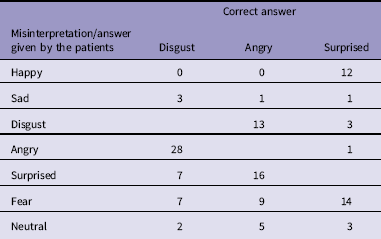
Posthoc U tests indicated that there were no significant differences between controls and patients in judging ‘happy’, ‘sad’, ‘fearful’, and ‘neutral’ faces correctly (p > 0.10). Patients had lower accuracy than controls on the judgement of ‘disgust’ (U = 119.0, z = 2.7, p < 0.01), ‘angry’ (U = 115.5, z = 2.7, p < 0.01), and ‘surprised’ emotional faces (U = 125.5, z = −2.5, p < 0.05). The effect sizes were medium for all three emotions (r = 0.41 for disgust, r = 0.39 for angry, and r = 0.39 for ‘surprised’). Together, these results indicate that the KS patients were able to recognise neutral faces and facial expressions of happiness, sadness, and fear to a comparable extent as healthy subjects. However, KS patients showed difficulties in recognising facial expressions of disgust, anger and surprise compared to healthy controls. Posthoc analyses indicated that patients often exchanged certain emotions in their responses with other emotions. Specifically, disgust was mostly seen as anger, anger was mostly seen as surprised and disgust, surprised was mostly seen as fear and happiness in patients with KS (see Table 2 for an overview).
Total number of the items that were misinterpreted for in Korsakoff’s syndrome patients (n = 21) in the Emotion Recognition Test

On the vertical axis the incorrect answer given by the patient is represented, while on the horizontal axis the correct answer is represented.
Affective and cognitive ToM in KS
To further elaborate on the relationship between affective and cognitive ToM functioning in KS an additional analysis was performed. KS patients who made an inaccurate response on the Sally–Anne Test did not make more errors on the affective ToM tests for Emotion Recognition (t 19 = 0.4, p = 0.727) or the Faux pas Test (t 19 = 0.1, p = 0.891), suggesting no direct functional relationship between cognitive and affective ToM functioning in KS.
Discussion
The aim of this study was to investigate whether and to what extent cognitive and affective ToM are deficient in patients with KS (KS). The results indicate that compared to the results of an age- and gender-matched control group, KS patients showed impaired performance on all indices of cognitive and affective ToM, with large effect sizes, highlighting the severity of the ToM symptoms in KS. Importantly, to control for the role of memory impairment on ToM performance, several additional measures were collected, such as the ability to read the stories again, and control questions to check whether the storyline was remembered. Both patients and controls were able to read and remember the storyline correctly, but patients failed to indicate the correct answer to the cognitive ToM question. Surprisingly, there was no clear relationship between deficiencies in cognitive and affective ToM performance in KS patients, highlighting the functional discrepancy between both domains. Posthoc analyses indicated that executive problems in KS could explain reduced emotion recognition abilities, but not other affective and cognitive ToM abilities. These results suggest that difficulties in cognitive and affective ToM form a separate functional deficit in KS patients that should require additional attention in neuropsychological assessments.
One of the most notable findings of the current study is that the Sally–Anne Test showed serious cognitive ToM impairment in the KS patients. This is particularly remarkable in light of earlier observations that even young, healthy children of only 5 years old tend to perform highly accurately on this test (Reference Gopnik and Astington44). As such this is illustrative of the severity of cognitive ToM problems in KS. Based on earlier research it could be expected that KS patients would show at least some impairment in cognitive ToM tests, because of the shared neurocognitive basis with executive functioning (Reference Oscar-Berman7,Reference Shamay-Tsoory and Aharon-Peretz21). Nevertheless, no such relationship was found in the present study, highlighting that cognitive ToM deficits are a central problem in KS.
Moreover, the results regarding the Faux Pas Test are noteworthy because of the large difference between scores of KS patients and controls, indicating serious affective ToM impairment in KS. Faux pas impairments in KS are in line with earlier research on affective ToM and lesion studies in patients with Traumatic Brain Injury (TBI). According to Shamay-Tsoory and Aharon-Peretz (Reference Shamay-Tsoory and Aharon-Peretz21) and Lee et al. (Reference Lee, Ip, Wang, Xi, Hu, Mak, Han and Chan45) impaired affective ToM is associated with ventromedial cortex (VMPC) lesions in TBI patients. Although several neurobehavioural and neuroimaging studies have revealed frontal system dysfunctions in KS, the relative contribution of subcomponents to the various domains of impairment, is not clear yet (Reference Oscar-Berman7). Our study provides some clarification and suggests that Faux Pas impairment in KS could be related to VMPC damage, because of the evident relationship between this specific brain area and Faux Pas difficulties in lesion studies. Of interest, we replicated the finding of Li et al. (Reference Li, Wang, Wang, Tao, Xie and Cheng46) that the level of education is of influence in Faux Pas test performance. Their research already indicated a protective effect of education on the ability to interpret Faux Pas tests correctly. Our results show that education could prevent deterioration of Faux Pas performance in KS patients to some extent, but still difficulties are present in KS.
In the present study, we also replicated the finding that emotion recognition ability is impaired in KS patients (Reference Montagne, Kessels, Wester and de Haan33). We observed that KS patients had difficulties in recognising disgust, angry and surprised facial emotions but not in happy, sad, neutral, and fearful facial emotions. This contrasts to some extent with the results of Montagne et al. (Reference Montagne, Kessels, Wester and de Haan33), regarding preserved fear recognition in our study, and preserved disgust recognition in their study. Possibly those small discrepancies between the present study and the study by Montagne et al. (Reference Montagne, Kessels, Wester and de Haan33) could the difference, amongst other different emotional faces were applied in both studies, and the paradigm in the Montagne study consisted of dynamic instead of static presentation of faces. Our results extend the earlier findings by showing that the emotional faces of disgust were often recognised as anger in KS patients. Moreover, emotional faces of anger were recognised as surprise and disgust. An important finding of interest in the present study was that executive dysfunction could explain diminished emotion recognition to a vast degree. No such relationship was clear in KS, but recent research in schizophrenia already suggested a direct relationship between executive problems and the ability to recognise emotions correctly (Reference Lee, Lee, Kweon, Lee and Lee47,Reference Yang, Zhang, Li, Heeramun-Aubeeluck, Liu, Huang, Zhang, He, Li, Tang, Chen, Liu, Wang and Lu48). Recently, in the study of Brion et al. (Reference Brion, D’Hondt, Lannoy, Pitel, Davidoff and Maurage49), KS patients were able to compensate their deficit when several sources (visual and auditory) of congruent information were available, supporting a role of executive demands on emotion recognition.
The functional relationship between ToM and executive functioning is currently unclear. Some lesion studies have demonstrated a clear association, while others claim the opposite (Reference Henry, Phillips, Crawford, Ietswaart and Summers26,Reference Fine, Lumsden and Blair27). In our study we found no relationship between executive functioning and the Sally–Anne Test or the Faux Pas Test, but the relationship with emotion recognition was evident. While the cognitive ToM results are not in line with the study of Oosterman et al. (Reference Oosterman, de Goede, Wester, van Zandvoort and Kessels34), they largely seem to resemble results by Bodden et al. (Reference Bodden, Mollenhauer, Trenkwalder, Cabanel, Eggert, Unger, Oertel, Kessler, Dodel and Kalbe50) who found that executive functions were significantly decreased in patients with Parkinson’s disease but they were not correlated with cognitive as well as affective ToM performance. From the point of view of contrasting findings, it would be relevant to more thoroughly investigate the relationship between executive dysfunctioning and ToM in multiple neurocognitive disorders.
Although spatial perspective taking is essential to interacting with other people because it requires comprehension of what the world look like to them (Reference Hiatt, Trafton, Harrison and Schultz29,Reference Tversky and Hard30), in our study we found chance level performance on the spatial perspective taking test in KS patients, suggesting they were not able to understand the instructions and purpose of the test. Aichhorn et al. (Reference Aichhorn, Perner, Kronbichler, Staffen and Ladurner51) claimed that spatial perspective taking and false belief tasks, such as the Sally–Anne Test, do have a strong relationship. Based on our results it is not possible to support the notion of Aichhorn et al., since the scores in healthy controls on the false belief task reached a maximum score. In future research easier paradigms to investigate spatial perspective taking could be incorporated.
One of the tasks we used to investigate ToM abilities was the mini-SEA (Reference Bertoux, Delavest, de Souza, Funkiewiez, Lépine, Fossati, Dubois and Sarazin31). In our study we observed extensive impairment in KS patients on the two subtests of the mini-SEA, the Faux Pas Test, and the Facial Emotion Recognition Test. Interestingly, earlier research claimed that also patients with Frontotemporal Dementia (FTD) showed abnormal scores on these tasks (Reference Bertoux, Delavest, de Souza, Funkiewiez, Lépine, Fossati, Dubois and Sarazin31). Dysfunctional social cognition is considered to be part of the core symptoms of FTD (Reference Rascovsky, Hodges, Knopman, Mendez, Kramer, Neuhaus, van Swieten, Seelaar, Dopper, Onyike, Hillis, Josephs, Boeve, Kertesz, Seeley, Rankin, Johnson, Gorno-Tempini, Rosen, Prioleau-Latham, Lee, Kipps, Lillo, Piguet, Rohrer, Rossor, Warren, Fox, Galasko, Salmon, Black, Mesulam, Weintraub, Dickerson, Diehl-Schmid, Pasquier, Deramecourt, Lebert, Pijnenburg, Chow, Manes, Grafman, Cappa, Freedman, Grossman and Miller52). Concerning KS, impairments in social cognition have thus far not been listed as main symptoms of the disease (Reference Kopelman2,Reference Kopelman, Thomson, Guerrini and Marshall3), but could be regarded as such.
The large decrease in social and emotional ToM abilities in KS forms a challenge for clinicians working with KS patients. Recently, Gerridzen et al. (Reference Gerridzen, Moerman – van den Brink, Depla, Verschuur, Veenhuizen, van der Wouden, Hertogh and Joling53) concluded that KS patients are particularly prone to behavioural problems such as depression, aggression, and apathy. The present study shows that both in the social perceptual domain as in the social behavioural domain KS patients show problems, possibly significantly contributing to the severe behavioural issues in KS. Flattening of affect, and other forms of apathy could be related to those social behavioural issues. In future research it would be relevant to get a better understanding of To get a better of this complex interplay between neuropsychiatric aspects and behavioural symptoms.
Three possible limitations of the present study need further consideration. We matched patients with the controls in gender and age, but did not reach a full match on level of education. In our study we controlled for this limitation by adding level of education to posthoc covariate analyses. Results showed that level of education was not significantly related to the performance on the Facial Emotion Recognition Test and the Sally–Anne Test, but did influence Faux Pas Test performance to some extent. Importantly, a strong main effect of KS remained, suggesting that the lower level of education was not the central cause of hampered task performance in KS. To overcome possible difficulties regarding education and general cognitive functioning, additional control questions were added to the tasks to increase the understanding of the task instructions. To our knowledge, the general understanding of the task instructions was good, and we minimised the influence of possible executive and memory deficits on ToM tasks correctly. A second limitation is the nonparametric nature of the Sally–Anne Test (Reference Bertoux, Delavest, de Souza, Funkiewiez, Lépine, Fossati, Dubois and Sarazin31), and that we applied only this test to investigate cognitive ToM. Since the data structure of the Sally–Anne Test is different from the other tests in the present study, we were not able to directly compare all tests in hierarchical regression testing. The rationale to test with the non-parametric test is that this well-known task has a long history in developmental testing. Since the task is short and simple, and no parametric alternative is readily available, we adopted this paradigm in the present study. It would be relevant to develop a parametric Sally–Anne Test in future investigations on ToM functioning, allowing for a better comparison with other ToM tasks, and a stronger representation of cognitive ToM tests. A third limitation of our study is that we used the FAB as an index for executive functioning, while there have been more elaborate comprehensive tests developed for executive functioning, such as the Behavioural Assessment of Dysexecutive Syndrome (Reference Norris and Tate54). An important reason to apply the FAB in the present study was that this test is relatively short, and the task load is relatively mild, reducing the burden of the test protocol.
In conclusion, the results of the current study indicate that KS patients have severe cognitive and affective ToM impairments on all tasks. We wish to emphasise that the impairments in KS are broader than currently assumed and are not restricted to cognitive disorders (Reference Kopelman, Thomson, Guerrini and Marshall3), but also extend to the domain of ToM. These findings offer new insights in the neurocognitive architecture of KS disease as well provide most valuable suggestions for dealing with patients in a clinical setting.
Acknowledgements
The authors thank Dr. Maxime Bertoux for providing the Dutch version of the Mini-Sea, and his help in the conceptual work on this manuscript. The authors declare no conflicts of interest. No funding was provided.