

Early adulthood as a developmental stage is typically associated with positive health and functioning. However, the rates of poor health among young adults are unexpectedly higher. Recent health statistics show that 37% of young adults are obese, 20% have mental health or substance use problems, and the rates of risky behaviour such as unprotected sex, violence, binge drinking, and poor nutrition increase the risk of mortality in this population (Institute of Medicine and National Research Council, 2015). Since the formation of intimate relationships is an important developmental task during this period (Conger, Cui, Bryant, & Elder, Reference Conger, Cui, Bryant and Elder2000), social relationships play a significant role in their health and behaviour outcomes. Decades of research have shown that supportive close relationships are vital to overall adjustment and wellbeing throughout the lifespan (Cassidy & Shaver, Reference Cassidy and Shaver2008; Feeney & Collins, Reference Feeney and Collins2014, Reference Feeney and Collins2015; Uchino, Reference Uchino2009). Individuals in healthy relationships tend to be happier, show better physical and mental health, and have lower mortality (Feeney & Collins, Reference Feeney and Collins2015). However, the pathways through which relationships may explain health are not well understood (Pietromonaco & Powers, Reference Pietromonaco and Powers2015; Pietromonaco, Uchino, & Dunkel Schetter, Reference Pietromonaco, Uchino and Dunkel Schetter2013). Therefore, the primary goal of the current study was to examine the mechanisms in the crucial link between romantic relationship attachment and health outcomes among young adults. A secondary goal of this study was to explore whether secure and insecure attachment styles are differentially associated with sleep and emotion regulatory mechanisms. A review of this literature emphasises theoretical models and empirical studies that demonstrate strengths as well as gaps in the existing literature on mechanisms of relationship patterns and health outcomes.
The Role of Relationship Factors on Health
Recent theoretical frameworks show that close relationships help individuals thrive in the face of adversity. For instance, Feeney and Collins (Reference Feeney and Collins2015) emphasise the role of relationships in helping individuals acquire goals, achieve success, and maintain a sense of purpose. Furthermore, the support within the relationship context may enable individuals to self-regulate. Research on the adult attachment literature (Bowlby, Reference Bowlby1983) has shown that attachment styles predict physical and mental health (Diamond & Hicks, Reference Diamond, Hicks, Rholes and Simpson2004). Insecure attachment styles have been linked to a variety of physical health conditions. Specifically, individuals with avoidant attachment styles have shown more symptoms of pain (i.e., chronic pain, arthritis), whereas those who displayed anxious attachment styles have shown various health conditions such as hypertension, heart attack, and stroke (McWilliams & Bailey, Reference McWilliams and Bailey2010).
Additionally, committed romantic relationships have been robustly associated with mental health (Ryff, Singer, Wing, & Love, Reference Ryff, Singer, Wing, Love, Ryff and Singer2001). For example, individuals who showed security within the romantic relationship had lower rates of psychopathology, a healthy self-image, adequate regulation of negative affect, greater support seeking (Mikulincer & Shaver, Reference Mikulincer and Shaver2012), higher self-esteem, and more preventive health behaviours than those who were insecure (Huntsinger & Luecken, Reference Huntsinger and Luecken2004). As expected, attachment insecurity was related to poor mental health and adjustment; individuals with anxious attachment styles were more likely to have psychotic and affective symptoms of psychosis, and those with avoidant attachment styles were more likely to have paranoia and hallucinations (Korver-Nieberg, Berry, Meijer, de Haan, & Ponizowsky, Reference Korver-Nieberg, Berry, Meijer, de Haan and Ponizovsky2015). Although a vast body of this research has emphasised these links between relationships and health (Feeney & Collins, Reference Feeney and Collins2015), the mechanisms, specifically biological and physiological mechanisms that may play a major role, have been vastly underexplored.
Mechanisms of the Links Between Attachment Patterns and Health Outcomes
One reason to explore the role of biological and physiological mechanistic processes in the attachment-health pathway is that relationships serve a stress regulatory function (Pietromonaco & Powers, Reference Pietromonaco and Powers2015). Physiological systems of the stress response such as the endocrine system, the autonomic nervous system, and the immune system may explain the pathway from relational styles to health outcomes. For instance, Pietromonaco and colleagues (Pietromonaco & Powers, Reference Pietromonaco and Powers2015; Pietromonaco et al., Reference Pietromonaco, Uchino and Dunkel Schetter2013) outlined a theoretical model to emphasise the processes in the associations between attachment styles and health-related outcomes. They postulated that attachment behaviours would predict physiological responses of stress by serving as a means of regulating emotions (Mikulincer & Shaver, Reference Mikulincer and Shaver2007). Specifically, styles of attachment allowed individuals to adopt strategies to regulate affect within the relational context and thereby determined the physiological stress response. Much of this research on the stress regulatory role of attachment styles has focused on the differences between attachment styles. For instance, both anxious and avoidant individuals showed elevated levels of cortisol in the context of relational stress (Powers, Pietromonaco, Gunlicks, & Sayer, Reference Powers, Pietromonaco, Gunlicks and Sayer2006). Additionally, avoidant individuals displayed higher autonomic nervous system activity in the form of increased electrodermal activity, although their subjective reports did not show greater stress, consistent with the notion of deactivating affect regulation style (Pietromonaco & Beck, Reference Pietromonaco, Beck, Mikulincer, Shaver, Simpson and Dovidio2015). Furthermore, an avoidant attachment style was linked to poor immune function, as indicated by the cytokine interleukin 6 (Gouin et al., Reference Gouin, Glaser, Loving, Malarkey, Stowell, Houts and Kiecolt-Glaser2009). Thus, an important feature of the attachment theory is the role of the attachment system in regulating emotions during a threatening situation. The literature on the attachment theory has shown support for emotion regulatory processes that may explain the connections between attachment styles and overall adjustment.
The role of emotion regulation as a mediating factor
Within adult attachment relationships, as with child attachment systems, individuals with a secure style experience an arousal of positive emotions associated with their attachment partner and thereby rely on them to provide comfort and reassurance. Secure individuals can effectively regulate their negative feelings during the threat through the use of effective emotion regulation strategies. For insecure individuals, threat produces negative and painful emotions such as betrayal or rejection (Mikulincer & Shaver, Reference Mikulincer, Shaver, Cassidy and Shaver2008). People with avoidant attachment utilise deactivating emotion regulation strategies that restrict their negative feelings such as anger or distress due to prior experiences with rejection from their attachment partner and thereby avoid support from their significant other. Anxious individuals, however, emphasise hyperactivating emotion regulation strategies in ways that serve to draw the attention of their partner to their fears and needs, often resulting in increased vulnerability (Feeney & Noller, Reference Feeney and Noller1996; Mikulincer & Shaver, Reference Mikulincer, Shaver, Cassidy and Shaver2008). Additionally, emotion-regulation strategies of insecure individuals contribute to lower stress resilience, and poor adjustment and mental health problems (Mikulincer & Shaver, Reference Mikulincer, Shaver, Cassidy and Shaver2008). As noted above, emotional dysregulation may play a crucial role in adjustment and health. Additionally, another underexplored biological factor that serves an important regulatory function for health and has connections with both emotion regulation (Gruber & Cassoff, Reference Gruber and Cassoff2014) and relationship quality (Troxel, Cyranowski, Hall, Frank, & Buysse, Reference Troxel, Cyranowski, Hall, Frank and Buysse2007) is sleep.
The role of sleep as a mediating factor
Biological factors such as sleep may offer insights into the role of relationship factors, since sleep, similar to attachment styles, serves a self-regulatory function and predicts health and wellbeing (Troxel et al., Reference Troxel, Cyranowski, Hall, Frank and Buysse2007). The literature on the impact of sleep on health has focused on its effects on physical health, mental health, and performance and safety (National Institutes of Health [NIH], 2012). Sleep deprivation accounts for impaired cognitive functioning, industrial accidents, motor vehicle accidents, and lower productivity (Institute of Medicine Committee on Sleep Medicine and Research, Colten, & Altevogt, Reference Colten and Altevogt2006). Sleep deprivation and disruption are also associated with an increased risk of physical health outcomes (Ohayon, Reference Ohayon2002). Specifically, sleep plays a role in cardiovascular health and is linked to a greater risk of hypertension, heart disease, stroke, and diabetes (NIH, 2012).
Additionally, sleep and mental health illnesses are also intricately linked. However, an exploration of the relationship of sleep with mental health is complex since disrupted sleep is both a symptom and an outcome of these mental health conditions (Weich, Reference Weich, Cappuccio, Miller and Locklet2010). Individuals who report sleep disruptions may experience higher levels of stress (Hall et al., Reference Hall, Casement, Troxel, Matthews, Bromberger, Kravitz and Buysse2015), which increases their risk for psychiatric problems. Recent research has shown that individuals with an array of mental disorders (such as anxiety, depression, and bipolar disorder) have shown disrupted sleep patterns, including greater variability of sleep onset times and offset times, and lower efficiency. Specifically, individuals with anxiety have less desirable sleep-related performance (Robillard et al., Reference Robillard, Hermens, Naismith, White, Rogers, Ip and Hickie2015). Despite the prevalence of sleep disruptions among mental health illnesses, the associations between sleep and adult attachment styles have not been widely explored (Adams, Stoops, & Skomro, Reference Adams, Stoops and Skomro2014; Maunder, Hunter, & Lancee, Reference Maunder, Hunter and Lancee2011).
Few studies on the attachment-sleep links have found that attachment security predicts less disrupted sleep quality and quantity, whereas fearful styles were related to greater sleep problems among those in committed relationships (Scharfe & Eldredge, Reference Scharfe and Eldredge2001). Consistent with prior research, attachment anxiety was linked to worse sleep quality (Carmichael & Reis, Reference Carmichael and Reis2005; Hsaio et al., Reference Hsiao, Chang, Kuo, Huang, Liu, Lai and Chan2013) and increased activity during sleep (Escolas, Hildebrandt, Maiers, Baker, & Mason, Reference Escolas, Hildebrandt, Maiers, Baker and Mason2013). However, some research on avoidant attachment and sleep has reported mixed findings. For instance, Carmichael and Reis (Reference Carmichael and Reis2005) did not find an avoidant attachment to be associated with sleep, and Sloan, Maunder, Hunter, and Moldofsky (Reference Sloan, Maunder, Hunter and Moldofsky2007) found that attachment anxiety (not avoidance) was associated with α-EEG anomaly. Additionally, recent research has shown that attachment styles have been linked to indicators of objective but not subjective sleep patterns, including duration, quality, and efficiency of sleep (Adams et al., Reference Adams, Stoops and Skomro2014; Troxel et al., Reference Troxel, Cyranowski, Hall, Frank and Buysse2007; Troxel & Germain, Reference Troxel and Germain2011). Given the mixed findings for attachment styles within the sleep literature, the current study examines multiple indicators of sleep quality and quantity that are associated with variations in attachment styles. Since sleep patterns determine mental and physical health outcomes, and attachment styles have been shown to play a role in sleep quality and quantity, it is expected that sleep processes would serve as a mediator in the pathway from attachment behaviours to health outcomes.
However, research specifically focused on the mediating role of sleep patterns in the relationship to health pathway has been limited and has emphasised sleep quality. For instance, Quickert (Reference Quickert2016) explored sleep quality as a mediator of the links between attachment anxiety and perceived impact of health on life as well as physical symptoms of illness. Poor sleep quality mediated the relation between anxious attachment and disease symptoms. However, Quickert (Reference Quickert2016) focused on attachment anxiety and physical health symptoms. Likewise, Maunder and colleagues (Reference Maunder, Hunter and Lancee2011) also found support for a partial mediation of sleep quality in the links between attachment anxiety and physical health, as indicated by physical symptoms and sick days. Furthermore, Nordin, Knutsson, and Sundbom (Reference Nordin, Knutsson and Sundbom2008) found that relational factors such as social support predicted health conditions such as myocardial infarction through the pathway of disturbed sleep. Hence, there are several gaps in the literature on sleep factors as mechanisms in the associations between relationships and health outcomes.
First, only two of the three studies on sleep as a mediator focused on attachment styles; specifically, attachment anxiety. There is a need to explore the mediating role of both attachment anxiety as well as indicators of security, that is, closeness with and dependence on the romantic partner. Second, past studies have only emphasised specific indicators of physical health (i.e., illness symptoms and sick days). Prior links between attachment and sleep have shown mixed findings for avoidant attachment. Additionally, attachment styles have been inconsistently linked to specific sleep patterns, that is, links between attachment and sleep quality have been widely explored, although fewer studies have established links with sleep quantity. Another reason to explore the mechanistic links between attachment styles and health is that links between attachment insecurity and poor adjustment have been more consistent with individuals who showed anxious attachment than those with avoidant attachment. Across multiple age groups and samples, attachment anxiety has been associated with anxiety, depression, distress, eating disorders, and personality disorders, and negatively linked with subjective wellbeing (Mikulincer & Shaver, Reference Mikulincer and Shaver2007). In contrast, studies on links between avoidant attachment styles and adjustment have shown mixed results, similar to the links between attachment and sleep. Although some studies do not demonstrate any connections between avoidant attachment and adjustment, other studies show associations with personality disorders and somatic complaints (Mikulincer & Shaver, Reference Mikulincer, Shaver, Cassidy and Shaver2008). Given the mixed findings of different styles of attachment with health and adjustment outcomes, there is an interest in the health psychology literature to examine pathways through which multiple indicators of relational factors may play a role in health and adjustment.
Current Study
Although young adults are believed to be in a healthy developmental stage, they are at risk for poor physical health, mental health, and risky behaviour that affects their health and functioning. A large body of relationship research has shown connections between supportive relationships and physical and psychological health. However, the specific biological mechanisms have remained vastly underexplored, despite the emphasis of theoretical models on the need for processes to explain these pathways (Pietromonaco & Powers, Reference Pietromonaco and Powers2015). Supportive romantic relationships (especially secure attachment styles) serve an important stress-regulatory function (Pietromonaco & Beck, Reference Pietromonaco, Beck, Mikulincer, Shaver, Simpson and Dovidio2015; Powers et al., Reference Powers, Pietromonaco, Gunlicks and Sayer2006) via the endocrine, autonomic nervous, and immune systems of physiological function. In fact, the attachment system serves an important regulatory function such that individuals who show insecure styles of attachment may use ineffective strategies of emotion regulation that include deactivating or hyperactive regulation as compared to those who display a secure attachment style. Sleep patterns constitute another underemphasised biological mechanism that may explain links between attachment and health due to the self-regulatory function of sleep quality and quantity on health. Furthermore, sleep deprivation has been closely linked to affect and emotion dysregulation. Studies have shown that disruptions in sleep are closely connected to processes of executive function such as impulsivity, inhibition, and decision making (Gruber & Cassoff, Reference Gruber and Cassoff2014; Palmer & Alfano, Reference Palmer and Alfano2017).
Given the links between physiological factors such as sleep and affect with health outcomes, there is a need for additional research to explore the mechanisms through which specific biological and affective factors account for the links between relationship styles and health. Therefore, the primary goal of the current study was to explore the mediating role of emotion dysregulation and sleep quality and quantity in the associations of adult romantic attachment styles with physical and mental health outcomes. A secondary goal of the present research was to explore differences in the fourfold attachment styles (i.e., secure, preoccupied, dismissive, and fearful) across indicators of sleep and emotion regulatory strategies.
H1
The first hypothesis was that emotion regulation would mediate the links between insecure attachment and poor health in a two-path mediation test. It was also predicted that sleep patterns would mediate the links between insecure attachment patterns and poor health in a two-path mediation.
H2
Alternatively, the second hypothesis was that sleep patterns and emotion regulation would mediate the links between insecure attachment and poor health in a three-path mediation test.
H3
The third hypothesis was that sleep quality and quantity would vary across attachment styles. It was expected that individuals with insecure attachment styles would show greater disruptions in sleep patterns.
H4
The fourth hypothesis was that there would be differences in emotions and emotion regulatory strategies across individuals with differing attachment styles. Specifically, individuals with insecure attachment styles would be more likely to show ineffective emotion regulatory and coping strategies.
Method
Participants
The study sampled 172 undergraduate students from a public midwestern U.S. university. The sample was recruited from a participant pool in the psychology department. Participants received course credit for their participation in the study. Participants were between 17 to 30 years of age. Around 69% were females, and 31% were males. The sample was predominantly Caucasian American (95%), and 5% belonged to other ethnic backgrounds (Asian, Hispanic, and multiracial). Most of the participants were freshmen students (79%), followed by sophomores (12%), juniors (5%), and seniors (4%).
Procedure
Participants chose to participate in a study or complete a paper to receive course credit. The study was approved by the Institutional Review Board at the university. Students who chose to participate were provided a link to an online Qualtrics-based survey. The online survey assessed overall sleep quantity (sleep time), sleep quality (overall quality, daytime sleepiness, sleep-wake problems), and sleep disruptions (insomnia, bedtime, waketime, wake episodes). They reported on their health (overall health, chronic health conditions, and mental health), attachment patterns (anxiety, closeness, and dependence), emotions and emotion regulatory skills (emotional awareness, impulse control, limited access to emotion regulation strategies, affect, reappraisal, suppression, and coping strategies), as well as demographic information.
Measures
Attachment
The Revised Adult Attachment Scale by Collins (Reference Collins1996) assessed the participants’ attachment style within romantic relationships. The scale consisted of 18 items on a scale from 1 to 5. The measure consisted of three subscales, which included anxiety, closeness, and dependence. The anxiety subscale indicated their likelihood of feeling that they were abandoned within the romantic relationship. Closeness measured their comfort with intimacy, and dependence assessed the extent to which they trusted and depended on a romantic partner. An average composite was created for each subscale. As specified in Collins (Reference Collins1996), a new variable was created to assess four attachment categories, that is, 1 = secure (i.e., high closeness and dependence and low anxiety), 2 = preoccupied (i.e., high closeness/dependence and high anxiety), 3 = dismissive (i.e., low closeness/dependence and low anxiety), and 4 = fearful (i.e., low closeness/dependence and high anxiety) attachment. The measure reported reliability and validity in prior research (Collins, Reference Collins1996), and excellent reliability in the current study for the anxiety subscale (α = .91). Although the closeness measure had a slightly lower reliability, the closeness and dependence subscales had good reliability when combined (α = .80). The anxiety, closeness, and dependence subscales were used as indicators of attachment style in hypotheses 1 and 2, whereas the four attachment categories of secure, preoccupied, dismissive, and fearful were used for hypotheses 3 and 4.
Health
Participants reported on their health based on three measures from the Behavioral Risk Factor Surveillance System by the Centers for Disease Control and Prevention (CDC, 2013). They reported on their overall health by responding to the question: ‘Compared to other people would you say your health is 1 = poor, 2 = fair, 3 = good, or 4 = excellent?’ The item was then reverse scored and used as an index of overall health. To assess their overall mental health, they were asked to respond to the following question: ‘Now thinking about your mental health, which includes stress, depression, and problems with emotions, for how many days during the past 30 days was your mental health not good?’ The number of days that participants reported being unwell for mental health reasons was used as a proxy for poor mental health. Finally, to assess total health conditions, participants were asked the following question: ‘Have you ever been told by a doctor, nurse, or health care professional that you have the following?’ The health conditions included high blood pressure, cholesterol, heart attack or myocardial infarction, coronary heart disease, stroke, angina, skin cancer, other types of cancer, chronic obstructive pulmonary disease or COPD, emphysema or chronic bronchitis, arthritis, gout, lupus, fibromyalgia, depressive disorder or its variations, kidney disease, and diabetes. The responses scored as 1 were added for a measure of total health conditions.
Emotion and emotions regulation
Participants reported on their emotions and emotion regulatory strategies using a variety of measures. Emotion regulation was assessed by the Difficulty in Emotion Regulation Scale (Gratz & Roemer, Reference Gratz and Roemer2004), a self-report measure that assesses multiple aspects of emotion regulation and dysregulation. The emotional awareness, poor impulse control, and limited access to emotion regulation strategies subscales of the measure were used in the current study. Participants reported on the extent to which they agreed with the items on a 5-point scale, where 1 indicated almost never and 5 indicated almost always. The first subscale was the emotion awareness scale (α = .92), which included six items. An example item of the emotion awareness scale was as follows: ‘When I'm upset, I believe my feelings are valid and important.’ The six-item impulse subscale (α = .88) indicated impulse control difficulties, and an example item was as follows: ‘When I'm upset, I lose control over my behaviours.’ The five-item strategies subscale (α = .92) was a measure of limited access to emotion regulation strategies. An example item was ‘When I'm upset, I believe that I'll end up feeling very depressed.’ The DERS has demonstrated good concurrent and convergent validity as well as excellent test–retest and internal consistency reliability in prior research and the current study.
Another measure of emotion was the Positive and Negative Affect Schedule (PANAS) by Watson, Clark, and Tellegen (Reference Watson, Clark and Tellegen1988). The measure consisted of words that described different emotions and feelings indicating positive and negative affect. Participants were asked to indicate the extent to which they felt that way in the past week on a 5-point scale. The negative affect subscale had items such as ‘distressed’, ‘scared’, or ‘irritable’ and the positive affect subscale had items such as ‘interested’, ‘inspired’, and ‘active.’ The average score was used and reported excellent internal consistency for positive (α = .92) and negative (α = .88) affect.
The Emotion Regulation Questionnaire (ERQ) by Gross and John (Reference Gross and John2003) measured strategies for emotion regulation with two subscales, that is, cognitive reappraisal and expressive suppression. Each item was reported on a 7-point Likert scale where 1 = strongly disagree, and 7 = strongly agree. Cognitive reappraisal refers to the tendency to cognitively change the meaning of emotional stimuli, whereas expressive suppression refers to the tendency to suppress their emotional stimuli. Both subscales showed good reliability in the current study (reappraisal α = .85 and suppression α = .77).
The Brief COPE scale by Carver (Reference Carver1997) was used to assess two strategies of coping, namely problem-focused coping and emotion-focused coping. The measure has 28 items on a 4-point scale. The problem-focused coping subscale included subscales from the original scale such as acceptance, religion, planning, positive reframing, instrumental support, active coping, emotional support, and humour. An example item from the problem-focused subscale is ‘I've been trying to come up with a strategy about what to do.’ The emotion-focused coping subscale included subscales from the original measure such as self-distraction, venting, self-blame, behavioural disengagement, denial, and substance use. An example from the emotion-focused subscale is ‘I've been giving up trying to deal with it.’ Both subscales have very good to excellent reliability in the current study (problem-focused coping α = .91 and emotion-focused coping α = .87).
Sleep patterns
The participants reported on their sleep using multiple indicators of sleep quantity and quality. Participants reported on their perceived sleep quantity and quality using the Pittsburg Sleep Quality Index (PSQI; Buysse, Reynolds, Monk, Berman, & Kupfer, Reference Buysse, Reynolds, Monk, Berman and Kupfer1989). Sleep quantity was recorded by asking participants how many hours of actual sleep they got at night rather than the total time in bed. Additionally, they reported on their sleep quality by answering the question, ‘During the past month how do you rate your sleep quality overall?’ They recorded their sleep quality on a 4-point scale from 1 = very good to 4 = very bad. The PSQI has shown good test–retest and internal consistency in prior research (Buysse et al., Reference Buysse, Reynolds, Monk, Berman and Kupfer1989).
Two indicators of sleep quality were sleep-wake problems and daytime sleepiness, assessed by The Sleep Habits Survey (SHS) by Carskadon, Seifer, and Acebo (Reference Carskadon, Seifer and Acebo1991). The daytime sleepiness subscale (α = .81) of the SHS is a 10-item measure on a 4-point scale; participants reported whether they had struggled to stay awake (i.e., fought sleep) or fallen asleep in specific situations during the past 2 weeks. For example, participants were asked whether they had struggled to stay awake or fallen asleep in a face-to-face conversation with another person in the past 2 weeks. The sleep-wake problems subscale (α = .80) consisted of 15-items on a 5-point scale, wherein participants were asked to report whether they had any specific sleep disruptions during the past 2 weeks. For instance, participants were asked whether they awakened too early in the morning and could not go back to sleep in the past 2 weeks (Carskadon et al., Reference Carskadon, Seifer and Acebo1991).
Insomnia was measured by an eight-item measure from the SLEEP-50 Questionnaire (α = .85), which assessed the intensity of an individual's perceived sleep complaints and sleep disorders on a 4-point scale (Spoormaker, Verbeek, van den Bout, & Klip, Reference Spoormaker, Verbeek, van den Bout and Klip2005) based on the DSM-IV criteria for various sleep disorders. Participants were asked: ‘Please respond to what extent a statement (item) has been applicable to you during the past 4 weeks.’ An example item is: ‘I have difficulty falling asleep.’
Additionally, participants were also asked about their tentative bedtime and wake time in hours on school days. For example, bedtime was measured by asking, ‘What time (in hours) do you usually go to bed on school days?’ Wake time was measured by asking participants to report in hours to the following question: ‘What time do you usually wake up on school days?’ Sleep onset latency, which indexes the time in bed before sleep onset, was reported by asking participants the following question: ‘On School days, after you go to bed at night, about how long does it usually take to fall asleep (in minutes)?’ Additionally, participants reported on their wake episodes during the night with three questions. In the first question, participants were asked: ‘After falling asleep, how many times do you typically wake up during the night?’ This measure was an indicator of the total number of wake episodes that they had on an average night. The second question was: ‘What is the average time (in minutes) that you are awake during each of these wake episodes?’ This was a measure of the average length of their wake episodes. Finally, they were asked: ‘What is the total time (in minutes) that you are awake during an average night during these wake episodes?’ This was a measure of the total time that they were awake during an average night after going to sleep.
Analytic Plan
Data were collected using an online survey with the Qualtrics program. Structural equation modelling (SEM) was used with the AMOS software to test hypotheses 1 and 2. Latent variables of attachment, emotion regulation, sleep patterns, and health were estimated using an overall confirmatory factor analysis. For each hypothesis, estimates of structural pathways and indicators were estimated for significance. Model fit indicators were examined to test the overall fit of each model. Before testing for mediation, direct effects pathways and correlations between the main study variables were estimated. To test for a two-step and three-step mediation, bootstrapping was used to test the significance of the indirect effect. Bootstrapping is a resampling method to estimate bias corrected standard errors and confidence interval of indirect effects. To assess hypotheses 3 and 4, one-way analyses of variance (ANOVAs) were tested to examine differences in the four styles of attachment across sleep and emotion variables.
Results
Preliminary Analyses for Hypotheses 1 and 2
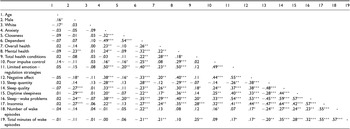
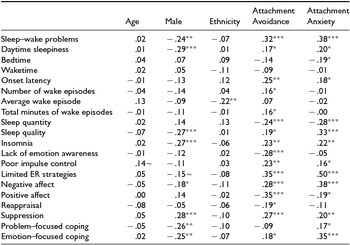
Bivariate associations among the key study variables are reported in Table 1. On average, age and ethnicity were not associated with key study constructs. As seen in Table 1, females were more likely to report mental health problems and have a higher negative affect than males. Males were less likely to have poor sleep quality, daytime sleepiness, sleep-wake problems, and insomnia as compared to females. All key measures of constructs were correlated with each other in the expected direction. Specifically, attachment anxiety, closeness, and dependence had moderate to high associations (p < .001) and all health measures (overall health, mental health, and total health conditions) had modest correlations with each other (p values ranged from <.05 to <.001). Measures of emotion regulation (impulse control, lack of emotion regulation, and negative affect) had moderate to high positive associations with each other (p < .001). Finally, all indicators of sleep quality and quantity had modest to high associations with each other in the expected direction (p < .01 to p < .001).
Bivariate Correlations Among Study Variables for Hypotheses 1 and 2

Note: ~p < .10, *p < .05, **p < .01, ***p < .001.
Measurement Model Analyses
Before fitting the structural model for each hypothesis, a confirmatory factor analysis was computed. Within the confirmatory factor model, covariances of latent variables of attachment, emotion regulation, sleep, and health were tested. To determine model fit for all study models, indicators of model fit such as CMIN/DF (minimum discrepancy divided by its degrees of freedom), Comparative Fit Index (CFI), Tucker Lewis Index (TLI), Incremental Fit Index (IFI), and root mean square error of approximation (RMSEA) were used. To indicate good fit, the CMIN/DF must be less than 3 and RMSEA should be less than .08. However, some sources show that the RMSEA should be less than .10 for an acceptable fit. Additionally, TLI, CFI, and IFI must be greater than .90 (Hu & Bentler, Reference Hu, Bentler and Hoyle1995; McDonald & Ho, Reference McDonald and Ho2002). The confirmatory factor model displayed good fit to the data as indicated by the fit indices: χ2(94) = 181.73, p = .000, CMIN/DF = 1.93, CFI = .91, TLI = .88, IFI = .91, RMSEA = .07, PCLOSE = .009. All indicators in the model had standardised factor loadings > .30.
Hypothesis 1: Two-Path Mediation Model for Emotion Regulation and Sleep as Mediators of Attachment and Health
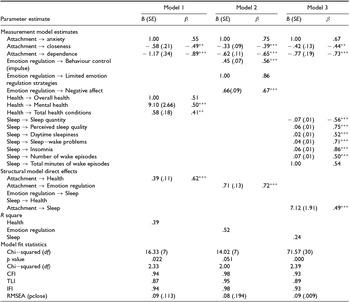
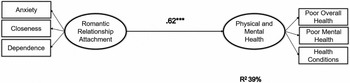
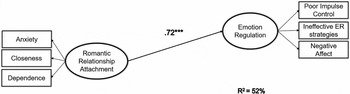
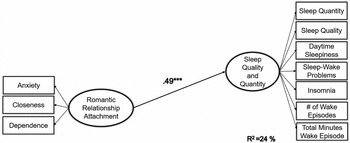
The first hypothesis was that emotion regulation and sleep would independently mediate the association between attachment and health in a two-path mediation; the results are presented in Tables 2 and 3, and Figure 4. Before a test of mediation, the direct association between attachment and health was examined (see Table 2). The structural model for the direct association (see Figure 1) had a reasonable fit to the data. Consistent with the hypothesis, there was a positive significant association between insecure relationship attachment and poor physical and mental health (β = .62, p < .001, R 2 = 39%). Additionally, direct associations of attachment with emotion regulation and health were also explored. The structural model for the attachment to emotion dysregulation link (Table 2 and Figure 2) showed excellent fit to the data. As predicted, there was a positive significant association between insecure romantic attachment and emotion dysregulation (β = .72, p < .001, R2 = 52%). The direct association between attachment style and sleep patterns (Table 2 and Figure 3) showed a good fit to the data. The findings show a positive association between insecure attachment and poor sleep patterns (β = .49, p < .001, R2 = 24%).
Unstandardised, Standardised, and Significance Levels for Models in Hypothesis 1 (Standard Errors in Parentheses; N = 172)

Note: ~p < .10, *p < .05, **p < .01, ***p < .001.
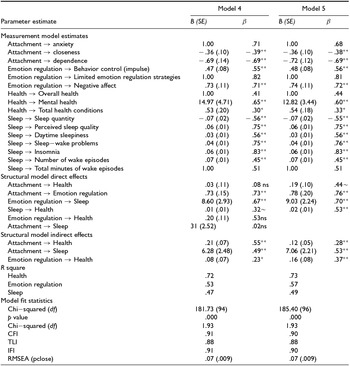
Unstandardised, Standardised, and Significance Levels for Models for Models in Hypotheses 1 and 2 (Standard Errors in Parentheses; N = 172)

Note: ~p < .10, *p < .05, **p < .01, ***p < .001.
Direct effect model from attachment insecurity to health. Model fit χ2 = 16.33, df = 7, p = .022, χ2/df =2.33, CFI = .94, TLI = .87, IFI = .94, RMSEA = .09, p = .11.

Direct effect model from attachment insecurity to emotion regulation. Model fit good, χ2 = 14.02, df = 7 p = .05, χ2/df = 2.00, CFI = .98, TLI = .95, IFI = .98, RMSEA = .08, p = .19.

Direct effect model from attachment insecurity to sleep quality and quantity. Model fit χ2 = 71.57, df = 30, p = .000, χ2/df = 2.39, CFI = .93, TLI = .89, IFI = .93, RMSEA = .09, p = .01.

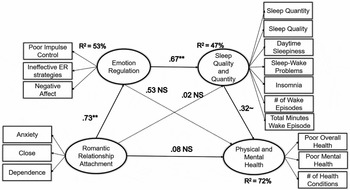
The structural model for the two-path mediation model had an acceptable fit to the data, χ2(94) = 181.73, p = .000, CMIN/DF = 1.93, CFI = .91, TLI = .88, IFI = .91, RMSEA = .07, PCLOSE = .009. Although attachment insecurity was related to emotion dysregulation (β = .73, p < .01), there was no association between emotion dysregulation and health (β = .53, p < .05). Additionally, attachment insecurity was not associated with sleep patterns (β = .02, p < .05) and poor sleep was marginally linked to poor health (β = .32, p < .10). Therefore, the criteria for mediation were not met due to the nonsignificant pathways from emotion dysregulation to health, attachment to sleep, and sleep to health. Hence, the findings did not show support for a two-path mediation for emotion regulation and sleep as independent mediators of attachment and health (Figure 4).
Two-path mediation model for emotion regulation and sleep patterns as mediators of attachment insecurity and health. Model fit χ2 = 181.73, df = 94, p = .00, χ2/df =1.96, CFI = .90, TLI = .88, IFI = .91, RMSEA = .07, p = .01.

Hypothesis 2: Three-Path Mediation Model for Emotion Regulation and Sleep as Mediators of Attachment and Health
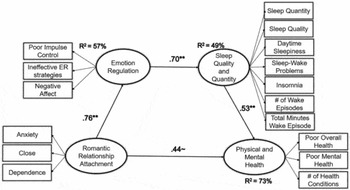
The second hypothesis was that both emotion dysregulation and sleep would mediate the link between attachment insecurity and health in a three-path mediation model (see Table 3 and Figure 5). A nested model with pathways from emotion regulation to health and attachment to sleep was constrained to zero, χ2(96) = 185.40, p = .000, was compared to the unconstrained model with the pathways free to vary, χ2(94) = 181.73, p = .000. The nonsignificant delta chi-square test, Δχ2 = 3.67, Δdf = 2, showed that the model with the unconstrained model with the additional pathways did not significantly improve the fit of the model since the Δχ2 was not greater than the critical value at .05 level. Therefore, the pathways were eliminated in the model, and the parsimonious model 5 was accepted over the less parsimonious model 4 (Table 3).
The final structural model had a good fit to the data, χ2(96) = 185.40, p = .000, CMIN/DF = 1.93, CFI = .90, TLI = .88, IFI = .90, RMSEA = .07, PCLOSE = .009. When emotion dysregulation and sleep were added in the model, the direct association between attachment and health became marginally significant (β = .44, p < .10). To test the significance of the indirect effects, bootstrapping was used; around 2,000 bootstrapped samples were used with 95% bias-corrected confidence intervals using the maximum likelihood function. As expected, there was a significant indirect association between insecure attachment and health (β = .28, p < .01). Direct effects show support for a significant pathway from attachment insecurity to emotion dysregulation (β = .76, p < .01), emotion dysregulation to sleep (β = .70, p < .01), and from poor sleep to poor health (β = .53, p < .01). Additionally, there were significant indirect associations between insecure attachment and poor sleep (β = .53, p < .01) and emotion dysregulation and poor health (β = .37, p < .01). Attachment insecurity, emotion dysregulation, and sleep accounted for 73% of the variance in health. Attachment insecurity explained 57% of the variance in emotion dysregulation, and insecure attachment and emotion dysregulation explained 49% of the variance in poor sleep.
Three-path mediation model for emotion regulation and sleep patterns as mediators of attachment insecurity and health. Model fit χ2 = 185.40, df = 96, p = .00, χ2/df = 1.93, CFI = .90, TLI = .88, IFI = .90, RMSEA = .07, p = .01.

Preliminary Analyses for Hypotheses 3 and 4
Bivariate correlations among key study variables are shown in Table 4. Females were more likely to have poor sleep quality, as indicated by sleep-wake problems, daytime sleepiness, poor overall self-reported sleep quality, and insomnia. As noted in Table 4, females were also more likely to report greater negative affect, greater suppression, and use both problem- and emotion-based coping for dealing with stress. Around 42.4% of the sample were securely attached (n = 73), 29.1% were preoccupied (n = 50), 11.6% were dismissive (n = 20), and 16.9% had a fearful attachment style (n = 29).
Bivariate Correlations Among Key Study Variables for Hypotheses 3 and 4

Note: ~p < .10, *p < .05, **p < .01, ***p < .001.
Hypothesis 3: Differences in Sleep Patterns Across Attachment Styles
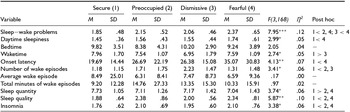
Results for differences in sleep patterns across attachment styles showed that there was a significant difference in sleep-wake problems, daytime sleepiness, wake time, onset latency, number of wake episodes, sleep quantity, sleep quality, and insomnia across the attachment styles (see Table 5). Post hoc tests showed that individuals with a secure attachment pattern (M = 1.85, SD = .48) had significantly lower sleep-wake problems than preoccupied (M = 2.15, SD = .52) or fearful (M = 2.37, SD = .65) individuals. Fearful individuals also had more sleep-wake problems than individuals with a dismissive style (M = 2.06, SD = .46). Daytime sleepiness was different across attachment styles; only fearful individuals (M = 1.74, SD = .61) had higher daytime sleepiness than secure individuals (M = 1.45, SD = .36). Wake time was significantly different across styles of attachment: dismissive individuals (M = 6.95, SD = 1.79) had earlier wake times than securely attached participants (M = 7.96, SD = 1.70).
Descriptive Statistics and One-Way ANOVA for Sleep Across the Four Attachment Styles for Hypothesis 3

Note: ~p < .10, *p < .05, **p < .01, ***p < .001.
There was a significant difference in sleep onset latency across romantic attachment styles. Findings show that those with a fearful attachment style took around 30.83 minutes to fall asleep whereas individuals who were securely attached spend less time in bed (19.69 minutes) before sleep onset. Individuals differed in their number of wake episodes. Specifically, secure individuals had fewer wake episodes at night than preoccupied or dismissive individuals. Sleep quantity was different across attachment styles. Secure individuals reported a higher average sleep time of 7.73 hours (SD = 1.05) than preoccupied (M = 7.11, SD = 1.26) or fearful (M = 7.04, SD = 1.43) individuals. Similarly, securely attached individuals reported significantly lower disrupted sleep quality (M = 1.88, SD = .64) than preoccupied (M = 2.38, SD = .86) or fearful (M = 2.34, SD = .81) individuals. Consistent with the earlier findings, there was a significant difference in the likelihood of insomnia. Similar to the results for sleep time and sleep quality, securely attached participants (M = 1.76, SD = .62) showed a lower likelihood of insomnia than preoccupied (M = 2.10, SD = .69) or fearful (M = 2.10, SD = .76) participants.
Hypothesis 4: Differences in Emotion-Related Factors Across Attachment Styles
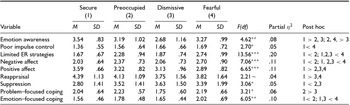
Consistent with the study hypotheses, there were differences in emotion awareness, impulse control, limited access to emotion-regulation strategies, positive and negative affect, emotional suppression, problem-focused coping, and emotion-focused coping across individuals with different romantic attachment styles (see Table 6). Findings indicated that securely attached individuals (M = 3.54, SD = .83) reported higher emotion awareness than preoccupied (M = 3.19, SD = 1.02) or dismissive (M = 2.68, SD = 1.16) persons, whereas dismissive individuals (M = 2.68, SD = 1.16) reported lower emotional awareness than preoccupied (M = 3.19, SD = 1.02) or fearful (M = 3.27, SD = .99) individuals. Securely attached individuals (M = 1.36, SD = .55) had better impulse control than fearful (M = 1.69, SD = .72) participants. Additionally, limited access to emotion-regulation strategies significantly differed across attachment styles. Specifically, preoccupied individuals (M = 2.28, SD = .94) showed more disrupted emotion regulatory strategies than those who were securely attached (M = 1.67, SD = .67). Furthermore, individuals with a fearful attachment style (M = 2.74, SD = .99) demonstrated more disrupted emotion regulatory strategies than individuals who were secure (M = 1.67, SD = .67), preoccupied (M = 2.28, SD = .94), and dismissive (M = 1.87, SD = .74).
Descriptive Statistics and One-way ANOVA for Emotion Variables Across the Four Attachment Styles for Hypothesis 4

Note: ~p < .10, *p < .05, **p < .01, ***p < .001.
Individuals who had a fearful attachment style (M = 2.70, SD = .90) had significantly higher negative affect than the other three attachment styles (i.e., secure, M = 2.03, SD = .64; preoccupied, M = 2.37, SD = .73; and dismissive, M = 2.06, SD = .73). Additionally, individuals with a secure attachment style displayed lower negative affect than those who were preoccupied. While individuals who were insecurely attached did not differ from each other in the levels of positive affect, participants who had a secure attachment style (M = 3.59, SD = .66) had significantly higher positive affect than individuals who belonged to the other three insecure styles (i.e., preoccupied, M = 3.22, SD = .82; dismissive, M = 3.13, SD = .96; and fearful, M = 2.89, SD = .82). Emotional suppression differed significantly across the attachment styles; securely attached individuals (M = 2.80, SD = 1.41) had lower levels of suppression than individuals who were preoccupied (M = 3.52, SD = 1.41) or dismissive (M = 3.63, SD = 1.50). Finally, problem-focused coping differed across attachment styles; preoccupied individuals (M = 2.23, SD = .57) used more problem-focused coping strategies than dismissive individuals (M = 1.75, SD = .60). Emotion-focused coping was also significantly different. Preoccupied individuals (M = 1.78, SD = .48) were more likely to use emotion-focused coping strategies than those who were securely attached (M = 1.56, SD = .46). Additionally, fearful individuals (M = 2.02, SD = .69) were more likely to use emotion-focused coping than those who were secure (M = 1.56, SD = .46) or dismissive (M = 1.65, SD = .44).
Discussion
The current study was a novel exploration of both affective and physiological mechanisms through which adult attachment styles (both secure and insecure) predict physical and mental health outcomes. The purpose of the current study was to investigate the hypothesis that emotional regulation and biological factors such as sleep patterns would mediate the relationship between insecure attachment styles and poor physical and mental health. Specifically, it was expected that emotion regulation and sleep patterns would independently mediate the links between attachment and health in a two-path mediation. Additionally, it was also hypothesised that emotion regulation and sleep would mediate the attachment-health links in a three-path mediation. The current study also examined differences in sleep patterns and emotion regulatory strategies across the romantic relationship attachment styles. It was hypothesised that sleep disruptions and dysregulated emotion regulatory strategies would be more prevalent among individuals with insecure attachment styles.
Summary of Findings
Consistent with the hypothesis, attachment insecurity (as indicated by high anxious attachment, low levels of closeness and dependence on the partner) was associated with poor health (as indicated by poor overall health, poor mental health, and total health conditions). Insecure attachment was also directly linked to emotion dysregulation (i.e., poor impulse control, ineffective emotion regulation strategies, and negative affect), and indirectly with poor sleep patterns (indicated by poor sleep quantity, poor perceived sleep quality, daytime sleepiness, sleep-wake problems, insomnia, number of wake episodes, and total minutes of wake episodes). Findings did not show support for a two-path mediation for emotion dysregulation and sleep in the relation between sleep and health. However, results of the study provide evidence for a three-path mediation between attachment styles and health outcomes via emotion regulation and sleep. Specifically, high levels of anxious-ambivalence and low levels of security were linked to poor impulse control, ineffective strategies of regulating emotions, and negative affect. Disrupted emotion regulation increased the risk for sleep disruptions, and sleep disruptions were associated with worse physical and mental health.
The findings of the current study are consistent with a recent study by Quickert (Reference Quickert2016), which found that sleep quality was a mediator of the relationship between attachment anxiety and impact of health on life as well as physical symptoms of illness. Quickert found that poor sleep quality was an important factor that explained why high levels of anxious attachment were linked to greater illness symptoms. However, this study focused more specifically on attachment anxiety with indicators of physical health. Additionally, these pathways were explored in the context of relationship conflict. Another study by Maunder and colleagues (Reference Maunder, Hunter and Lancee2011) also found support for sleep quality as a partial mediator of the links between attachment anxiety and physical health as indicated by physical symptoms and sick days. The physical health measures used in the current study are similar to those employed by Maunder and colleagues (Reference Maunder, Hunter and Lancee2011). However, in the current study both attachment anxiety as well as indicators of security, that is, closeness with and dependence on the romantic partner, were examined. Additionally, Maunder et al. (Reference Maunder, Hunter and Lancee2011) explored a sample of female health workers, whereas both male and female college students were examined in the current study. The findings of the study are also consistent with other research that shows that social support predicts health conditions such as myocardial infarction through the pathway of disturbed sleep (Nordin et al., Reference Nordin, Knutsson and Sundbom2008). Although they did not specifically examine romantic relationship attachment, their study does emphasise the role of social support as a protective factor and the role of sleep as an indirect factor in the social support to health link.
The findings on the mediating role of emotion regulation in the link between attachment and health are also consistent with prior research. For instance, in a review article, Malik, Wells, and Wittkowski (Reference Malik, Wells and Wittkowski2015) outline that research on adult populations show support for the hyperactivating strategies linked with dysregulation of emotion as a mediator of anxious attachment and depressive symptoms. However, there is mixed support for deactivating strategies of regulating negative emotions as a mediator of links between avoidant attachment and depressive symptoms. Nevertheless, the attachment system serves to enhance behaviours that protect individuals from harm and enables them to regulate negative emotions. When faced with a threat, the care and reassurance sought from the attachment figure serve to regulate their behaviour (Mikulincer & Shaver, Reference Mikulincer and Shaver2007).
The study findings are consistent with a theoretical model by Pietromonaco and colleagues (Pietromonaco & Beck, Reference Pietromonaco, Beck, Mikulincer, Shaver, Simpson and Dovidio2015; Pietromonaco et al., Reference Pietromonaco, Uchino and Dunkel Schetter2013) on dyadic relationship processes and health outcomes. Although there is a large body of literature on the attachment theory, the mechanisms between attachment processes and health outcomes have been underexplored within the field of health psychology. Drawing from the basic tenets of the attachment theory, Pietromonaco and colleagues (Pietromonaco & Beck, Reference Pietromonaco, Beck, Mikulincer, Shaver, Simpson and Dovidio2015; Pietromonaco et al., Reference Pietromonaco, Uchino and Dunkel Schetter2013) stipulate that attachment styles within romantic relationships shape relationship processes such as support and caregiving. Relational processes can both directly and indirectly influence health and disease outcomes through physiological processes, affect, and health behaviours. The current study found support for their theoretical model; consistent with their model, the findings of the current study indicated that relationship styles served as predictors of health via physiological factors, such as sleep, and affective factors, such as negative affect and emotion regulation.
Additionally, there was support for differences in attachment styles among eight out of eleven indicators of sleep. Specifically, individuals with attachment security demonstrated fewer sleep-wake problems, insomnia, greater sleep quantity, and better sleep quality than those who were preoccupied or fearful. Furthermore, fearful individuals had greater onset latency and daytime sleepiness than secure individuals and greater sleep-wake problems than dismissive individuals. Finally, a secure attachment was linked with a later wake time than dismissive individuals, and fewer wake episodes than preoccupied or dismissive individuals. Consistent with the literature on attachment and sleep relations (Carmichael & Reis, Reference Carmichael and Reis2005; Sloan et al., Reference Sloan, Maunder, Hunter and Moldofsky2007), it was found that sleep disruptions were more strongly associated with the attachment styles characterised by higher anxiety (i.e., preoccupied and fearful styles) as compared to secure or dismissive styles.
There was robust support for differences in attachment styles across indicators of emotion and emotion regulation; eight out of nine indicators of emotion variables showed differences across attachment styles. Individuals with higher attachment security showed better emotion awareness, impulse control, effective access to emotion regulation strategies, lower negative affect, higher positive affect, low suppression of emotions, and lower use of emotion-focused coping methods than individuals with insecure patterns of attachment. Interestingly, preoccupied individuals showed greater emotion awareness and higher use of problem-based coping strategies than dismissive individuals. This finding is consistent with earlier work on the attachment styles of avoidant individuals that show that their deactivating methods of regulating emotions serve to restrict their emotions, which may explain their poor awareness of emotions and the use of lower problem-focused coping (Feeney & Noller, Reference Feeney and Noller1996; Mikulincer & Shaver, Reference Mikulincer, Shaver, Cassidy and Shaver2008).
Strengths and Limitations
The study examined the biological and emotional mechanisms that have not been widely explored in the adult attachment to health pathway. Other strengths of the study include the methodology. Results were analysed using SEM with multiple measures of constructs to rule out common method bias. Multiple indicators of sleep, emotion regulation, and health factors showed robust support for the study questions. SEM-based modelling techniques have a few advantages over path-analytic or regression-based techniques as they reduce measurement error and provide a true score of the constructs. Additionally, the mediation analyses were examined using bootstrapping to test the significance of indirect effects. Bootstrapping is superior to the Sobel test for mediation as it does not require assumptions of distributions of parametric procedures and performs better in terms of statistical power and effect size in small to moderate sample sizes (Mallinckrodt, Abraham, Wei, & Russell, Reference Mallinckrodt, Abraham, Wei and Russell2006).
The current study is not without limitations. Although there were multiple measures of sleep quality and quantity, the measures were based on subjective reports. Future research could examine objective measures of sleep via actigraphy or polysomnography methods. Furthermore, a larger sample could have provided more power to test study hypotheses. Additionally, the current study used a cross-sectional approach; there is a need for longitudinal methods to examine the mediating effect of sleep and emotion regulation in the links between attachment and health over the course of the relationship. The current study emphasised romantic attachment styles of participants. However, an examination of the romantic partner's attachment style would be helpful to understand the dyadic process in the relationship context that predicts sleep and health outcomes.
Implications and Future Research
Findings of the study contribute to the existing literature on attachment, sleep, and health outcomes, and provide a more complex theoretical model to explain the pathways from relationship functioning to health outcomes and the role of emotion regulation and sleep factors as mechanisms in this link. Findings also have implications for sleep disorder intervention programs; specifically, these interventions could focus on effective emotion regulatory skills, particularly focused on the maladaptive deactivating strategies associated with avoidant attachment and the hyperactivating strategies linked with anxious attachment style. Findings showed that preoccupied and fearful individuals who experienced greater anxiety reported more sleep disruptions, possibly because of their hyperactivating strategies. Therefore, interventions could focus on effective emotion-regulation strategies that focus on active problem solving and coping strategies as compared to emotion-focused coping strategies. Sleep and health behaviour interventions could target effective conflict resolution skills with emphasis on emotional awareness and effective use of emotion-regulation strategies during a relationship conflict. Intervention programs may also target healthy sleep habits, with an emphasis on behaviour-based techniques for disorders such as insomnia that include healthy sleep hygiene, dietary changes, as well as relaxation strategies such as meditation, breathing techniques, visual imagery, and progressive muscle relaxation.
Although some research emphasises the trait-like characteristics of attachment patterns, recent research shows support for a context-specific explanation of attachment which suggests that individuals may display varying attachment styles across relationships (Caron, Lafontaine, Bureau, Levesque, & Johnson, Reference Caron, Lafontaine, Bureau, Levesque and Johnson2012). This suggests that characteristics of the relationship may determine attachment styles. Thus, findings of the study have implications for couples and family therapy. The principles of the attachment perspective can be translated to therapeutic techniques for couples and families and shed light on a holistic focus on reaction to stress and trauma. Instead of focusing on micro-level factors such as disengagement or anger of one member of the dyad, the theory emphasises a family systems approach that focuses on the larger problem of emotional unavailability. Future research could focus on the role of therapy in reducing conflict, increasing responsiveness, and changing patterns of attachment within the relationship (Johnson, Reference Johnson, Cassidy and Shaver2008).
Future research could examine the dyadic processes of secure versus insecure members and the role of emotion regulation and healthy sleep patterns on long-term adjustment. Future research could also emphasise differences in health behaviours, health outcomes, and emotion regulatory styles for individuals with varied patterns of attachment insecurity. Additionally, there is a need for research on attachment styles of married couples versus couples in dating relationships. There is a need for research on physiological processes and buffers in the complex links between attachment security, affect regulation, sleep, and health outcomes.
Conflict of Interest
The author has no conflicts of interest to report.
Ethical Standards
The author asserts that all procedures contributing to this work comply with the ethical standards of the Institutional Review Board (IRB) for ethical research at the University of Northern Iowa.