The purpose of professional discipline-specific associations such as the American Political Science Association (APSA) is to represent the interests of the entirety of the members of the discipline. Academic research into the politics of presence reveals that who is represented matters. Footnote 1 For example, we know that when women and minorities hold political office, they generally advocate for women and minorities, respectively (Bratton, Haynie, and Reingold Reference Bratton, Haynie and Reingold2006; Brown and Banks Reference Brown and Banks2014). In the business world, research shows that more diverse corporate boards deliver stronger firm governance and performance (Matsa and Miller Reference Matsa and Miller2013; Post, Rahman, and Rubow Reference Post, Rahman and Rubow2011). Given that the presence of diverse members matters in both politics and industry, it stands to reason that who is represented also matters to governance outcomes in academic professional associations such as the APSA.
Whereas most political science and corporate research uses a relatively narrow definition of diversity (i.e., race and gender), the APSA’s governing documentation defines diversity not only as gender and race but also as a wide range of personal characteristics:
In selecting the nominees, the Nominating Committee shall make recommendations with due regard for geographic distribution, field of professional interest, methodological orientation, types of institutions where members are employed, race, ethnicity, gender and gender identity, sexuality, disability, and other important forms of diversity. (APSA 2016, emphasis added).
This research note explores the extent to which APSA governance bodies represent the diversity of institution types in higher education. Institution type matters because it is a key dividing line in the academic profession. Higher-education institutions often are broadly characterized as research or non-research institutions. These categories then play a role in the relative prestige of an institution within the discipline (Brewer, Gates, and Goldman Reference Brewer, Gates and Goldman2004). Institution type also is an indicator of faculty members’ research versus teaching load, and it often is a rough proxy for access to research resources including travel funds, graduate assistants, and library materials.
The APSA Council and committee compositions indicate that the association has made a concerted effort to increase representation of many of the groups and characteristics noted in the by-laws. More women and minorities now serve on the APSA Council and committees monitor the status of multiple groups in the profession, including Asian Americans, blacks, community colleges, first-generation scholars, Latinos and Latinas, LGBTI scholars, and women. However, there has not been a similar effort to ensure proportional representation of different institution types in APSA Council and committee nominations—with the notable exception of the newly created APSA Committee on the Status of Community Colleges in the Profession. Footnote 2 The concern in this article is that if some institution types are largely missing from the council and committees, there is likely to be an effect on how well the APSA acts to protect the interests of all of the members of the profession.
I begin by explaining the general purposes of professional associations in higher education. I then briefly discuss the extant literature on the substantive representation of women and minorities in politics and the effects of diverse boards on corporate governance. Together, these explain why the composition of the APSA’s governing body matters. I then examine the share of institution types in the composition of the APSA Council from 2011–12 to 2015–16 compared to the composition of the APSA’s membership and the professoriate more broadly. I conclude with potential ramifications and suggestions for future research.
THE ROLE OF DISCIPLINARY ASSOCIATIONS IN HIGHER EDUCATION
As academia became more specialized during the twentieth century, there was a proliferation of discipline-specific professional associations in the United States (Clark Reference Clark, Alexander, Marx and Williams2004). The purpose of these disciplinary associations has traditionally been to aggregate the interests of academics in a particular field. Put differently, academics use their disciplinary associations both to solve problems within the discipline and as “a way of furthering [disciplines] without regard to institutional boundaries” (Clark Reference Clark1987, 233). Associations provide a range of services to their members, including (but not limited to) the following:
-
• facilitating connections and communications among scholars (Clark Reference Clark1987)
-
• lobbying Congress on behalf of the discipline (Clark Reference Clark, Alexander, Marx and Williams2004)
-
• setting disciplinary ethical standards (Dill Reference Dill1982)
-
• determining guidelines for assessment of scholarly work in the field (Rice 2002)
-
• being a central repository for resources that benefit members (Mendoza and Berger Reference Mendoza and Berger2008; Scott Reference Scott2013)
-
• facilitating the dissemination of research through association-sponsored academic journals (Bray and Major Reference Bray and Major2011)
-
• acting as a clearinghouse for jobs and jobseekers in the field (Clark Reference Clark1987)
Despite their potential to benefit all levels of the academy, much of the literature regarding disciplinary associations lauds their importance to academics at top-tier institutions. As Scott (2013, 72) noted, disciplinary associations and the quality-control work they do are “particularly salient for the upper tiers of the field,” given the place of those institutions in the hierarchy of the discipline. The literature also points out that membership in larger governing bodies in academia (e.g., the American Association of University Professors) is largely composed of faculty in top-ranked institutions—primarily because those faculty have the resources with which to join. Furthermore, they may also join governance structures from a sense of duty, as Clark (1987, 252) stated “in the nature of noblesse oblige, done with a sense that less fortunate colleagues in other places need a defense league to protect them against the batterings [sic] of politicians, trustees, and administrators.”
The dominance of top-tier institutions, which Whitley (Reference Whitley2011) conceived of as an “academic oligarchy,” can prove detrimental to governance within a disciplinary association such as the APSA.
The dominance of top-tier institutions, which Whitley (Reference Whitley2011) conceived of as an “academic oligarchy,” can prove detrimental to governance within a disciplinary association such as the APSA. Footnote 3 As Whitley (2011, 368) stated, “academic oligarchies…dominate disciplinary associations and communication media.” As a result of this dominance, academic oligarchies unintentionally may drown out the voices of lower-tier institutions, all the while thinking—if Clark is correct—that they (i.e., scholars from top-tier institutions) are actually representing the interests of “less fortunate colleagues.” Footnote 4,Footnote 5
In the social sciences, the extant literature indicates that the American Economic Association is clearly led by an academic oligarchy, with 72% of its board members coming from only five top departments (Fourcade, Ollion, and Algan Reference Fourcade, Ollion and Algan2015, 26). Evidence presented by Fourcade et al. (Reference Fourcade, Ollion and Algan2015) seems to indicate that the APSA is less elite-driven, given that only 12% of its council members come from top-five departments. Footnote 6 Their analysis, however, is limited to the top-five departments, which is a narrow view of the “elite” in a field. If expanded to include the top-10 or top-25 programs, it is likely that the APSA leadership is not overly pluralistic. APSA’s leadership-selection process also suggests that there may be a lack of pluralism. The APSA Council and officers are not a product of competitive elections; instead, they are the product of the APSA Nominating Committee—which is comprised of six APSA members appointed by the APSA president (APSA 2016; Schwartz-Shea and Yanow Reference Schwartz-Shea and Yanow2016). Footnote 7 The committee method of leadership selection has strong potential to become self-reinforcing because people are likely to mine their professional networks for nominees. Footnote 8
If the APSA’s leadership is elite-driven, this has serious implications for (1) which issues are likely to be on the agenda, and (2) the solutions put forth for solving them. This matters because the lived experiences of professors in elite institutions are quite different than those of faculty at non-elite institutions. Furthermore, because of misconceptions about workload and working conditions, it would be difficult for the former—no matter how well intentioned—to accurately represent the interests of the latter (and vice versa, for that matter). An example of these misconceptions is from Southern Methodist University (SMU) professor Michael Harris. As an associate professor of higher education and as the director of SMU’s Center for Teaching Excellence—an institute that specializes in teaching in higher education—it is reasonable to expect that Harris has a solid understanding of academic teaching loads. Yet, in his explanation of teaching loads, he wrote, “A 4-4 load indicates an exclusively teaching assignment and would be most common for instructors, lecturers, and other non-tenure earning positions. There would be little to no expectation for research or service for anyone teaching a 4-4” (Harris Reference Harris2015). In an ideal world, this might be true; however, the reality for many tenured and tenure-track professors at so-called teaching schools is that they teach a 4-4 and are expected to publish and do service. The same is true for people who teach a 4-3. Harris (Reference Harris2015) noted also that for those teaching a 3-3, “the expectations for research are typically pretty minimal…while some evidence of research might be expected for earning tenure, the primary criteria for tenure is teaching competence and excellence.” That assessment would likely come as a surprise to many faculty who, like me, teach a 3-3 and are expected to publish relatively regularly in order to obtain tenure or promotion.
Given the misconceptions about life at smaller institutions, it might be difficult for faculty at large institutions to see why the policy solutions that work well at their institutions do not travel well to smaller institutions. For example, the parental-leave policies adopted by large universities often are made possible by the fact that these institutions have larger faculties and more capacity to offer classes (APSA CSWP 2016). Those solutions are unworkable for smaller institutions. Because APSA makes recommendations about the best practices around professional issues (e.g., leave), Footnote 9 it is important to ensure that smaller institutions and those with fewer resources have an opportunity to weigh in on both issue definition and the solutions that APSA ultimately recommends.
REPRESENTATION MATTERS
In this section, I review the relevant literature on representation from political science and business. I use those literatures to put forth a series of propositions related to APSA governance.
In Politics
Political science indicates that who represents us matters. Our discipline’s research tells us that women and minorities have different policy preferences than their white male counterparts (Beckwith and Cowell-Meyers Reference Beckwith and Cowell-Meyers2007; Bratton et al. Reference Bratton, Haynie and Reingold2006; Shapiro and Mahajan Reference Shapiro and Mahajan1986). It also indicates that when women and minorities are elected to office, they advocate for policies that are particularly salient to women and minorities, respectively (Brown and Banks Reference Brown and Banks2014; Wängnerud Reference Wängnerud2000). Although the outcomes of this advocacy may not be as clear (Preuhs Reference Preuhs2006), research shows that minority, female, and female-minority representation matters in agenda setting (Bratton et al. Reference Bratton, Haynie and Reingold2006); policy formulation and sponsorship (Brown and Banks Reference Brown and Banks2014; Gamble Reference Gamble2007); and legislative debate (Franceschet and Piscopo Reference Franceschet and Piscopo2008; Htun and Jones Reference Htun, Jones, Craske and Molyneux2002).
In Industry
It is not only in politics that representation matters. A growing body of management literature draws connections between board diversity and corporate outcomes. The general argument is that by increasing diversity, firms can maximize the pool of talent and expertise in order to succeed (Villiers Reference Villiers2010). Although the results are mixed, studies tend to show that more diverse boards lead to better return on invested capital and assets (Erhardt, Werbel, and Shrader Reference Erhardt, Werbel and Shrader2003; Lückerath-Rovers Reference Lückerath-Rovers2013) and that diverse boards are more stringent in their oversight of corporate activities (Adams and Ferreira Reference Adams and Ferreira2009). Studies of gender and board composition suggest that women may tend to have more care-centric goals on corporate boards (Matsa and Miller Reference Matsa and Miller2013) and are likely to spend more on environmental protection and corporate social responsibility (Marquis and Lee Reference Marquis and Lee2013; Post et al. Reference Post, Rahman and Rubow2011).
The association has increased inclusion of women and minorities in both the APSA Council and APSA committees, and it has had notable success including women and minorities on the APSA Council and as APSA presidents. No such broad initiative exists relative to institution type.
In APSA Governance
Applying the findings from political science and corporate boards to governance at the APSA indicates that the level of inclusivity on the APSA Council should have an effect on the association’s governance outcomes. The association has increased inclusion of women and minorities in both the APSA Council and APSA committees, and it has notable success including women and minorities on the APSA Council and as APSA presidents. No such broad initiative exists relative to institution type. Thus, it is important to understand how well APSA’s leadership embodies the diversity of institution types in the profession. First, I propose that due to the dominance of research universities in disciplinary associations, it is logical to expect that the proportion of APSA Council members from doctoral-granting institutions will be larger than:
-
• Proposition 1a: the proportion of doctoral-granting institutions in the United States
-
• Proposition 1b: their share of APSA membership
-
• Proposition 1c: their share of the full-time professoriate in American higher education
Additionally, as noted previously, extant research indicates that leadership in academic professional associations is dominated by those with the greatest resources (Burawoy Reference Burawoy2015; Fourcade et al. Reference Fourcade, Ollion and Algan2015). In this case, the pertinent resources are time/flexible schedules and money. Based on teaching schedules and grant funding, full-time faculty members at research institutions are likely to have more of both.
First, a professor who teaches two classes is in the classroom for fewer hours per week and has more flexibility to travel to conferences than a professor who teaches four classes. Conventional wisdom indicates that the teaching load at doctoral-granting institutions typically is a 2-2. Footnote 10 Teaching loads are a tricky metric, however Footnote 11 ; they can vary from the standard and are not good indicators of workload. Nevertheless, our basic understanding of teaching loads indicates that faculty at doctoral-granting institutions are physically in the classroom fewer hours per week than many of their colleagues at nondoctoral-granting institutions. Additionally, their course loads are unlikely to increase but often decrease based on course releases for administration or research. Footnote 12 In addition, if course releases are not possible, faculty may be able to use grant funding to buy themselves out of part of their course load.
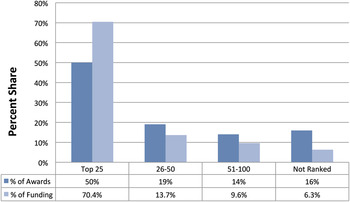
In that it can pay for travel to conferences, grant funding plays a role in the ability of faculty from larger institutions to participate in the APSA and its governance. Footnote 13 Conventional wisdom indicates that larger institutions tend to obtain more grant funding and the more elite the institution, the greater is the pressure to bring in grant money to publish research. Although National Science Foundation (NSF) data do not address the pressures at elite institutions, they do indicate that elite institutions (i.e., the top-25 political science graduate departments) receive the bulk of NSF political science funding. As shown in figure 1, this was about 70.4% between 2010 and 2016 (NSF 2016). In addition to grant funding, elite institutions typically have larger endowments than non-elite institutions, and endowments are an indicator of the institution’s resources.
NSF Awards and Funding by Department Rank, 2010–2016
The NSF lists 120 awards from the NSF Political Science program.

Finally, other than time/flexibility and money, it seems that some top departments simply expect that their faculty will actively contribute service to the profession at high levels. In conversations with current and past APSA Council members, this expectation was variously described as being built-in to the lower teaching load; as evidence of international engagement with and/or of prominence in the profession (such evidence is necessary for promotion); and simply as the “right thing to do.” Given the likelihood of access to resources and the expectation of professional service, I further propose the following:
-
• Proposition 2: higher-ranked doctoral-granting institutions will comprise a disproportionate share of the membership in the APSA Council
The next section explains the data and analyses used to analyze the evidence related to these propositions.
DATA AND ANALYSIS
In the following, I use Carnegie Classifications, data from the Integrated Postsecondary Education Data System, and data gleaned from APSA records to examine each of the propositions stated above.
Investigating the Diversity of Institution Types in APSA Governance
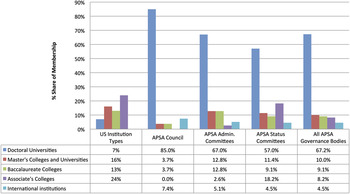
Considering Proposition 1a, I compared the diversity of institution types among the APSA leadership with the diversity of institution types in the American higher-education system. First, I examined the 2015–16 APSA Council and committees versus the diversity of institution types in the American higher-education system. To gather these data, I first searched the APSA website, which provided data on the 2015–16 APSA Council and committees (“APSA Leadership and Governance” 2016). Footnote 14 I then searched The Carnegie Classification of Institutions of Higher Education (n.d) to determine classifications for the institutions affiliated with each 2015–16 APSA Council or committee member. Footnote 15 I compared these data with the percentages of higher-education institutions by type, according to the Carnegie Classifications (figure 2).
APSA Governance Body Membership, by Institution Type 2015–2016

Figure 2 provides support for Proposition 1a: it indicates that whereas only 7% of degree-granting institutions in the United States are doctoral universities, 67% of the total members of APSA’s 2015–16 governing bodies are from doctoral universities. That number increases to 85% if we look solely at the APSA Council. Given that women and minorities are disproportionately concentrated in lower-ranked institutions (Grant and Ward Reference Grant, Ward, Dubeck and Borman2013; Tuan et al. 2013), it is unsurprising that the percentage of doctoral-granting institutions (57%) is lowest—but still a majority—in APSA’s status committees.
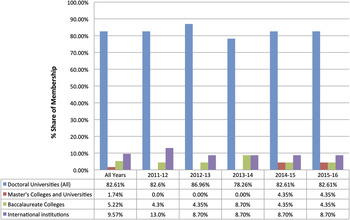
It could be, however, that the 2015–16 APSA Council was an aberration and that previous councils have better represented the diversity of institution types in which political scientists are employed. Thus, I used APSA’s annual reporting in PS: Political Science & Politics to determine the composition of all APSA Councils between 2011–12 and 2015–16, and I again classified members’ institutions using Carnegie Classifications Footnote 16 (figure 3).
APSA Council Membership, by Year and Institution Type

These data also provide support for Proposition 1a, indicating that the overrepresentation of doctoral-granting universities is not limited to the membership of the 2015–16 APSA Council. Most notable in figure 3 is that for three of the five years presented, there is not a single member of a master’s-granting institution on the APSA Council; for the remaining two years, faculty master’s-granting institutions comprise only 4.35% (i.e., one person per year) of the council members. Footnote 17 From the 2011–12 council through the 2015–16 council, 95 of the 115 APSA Council seats Footnote 18 were filled by scholars from doctoral universities (about 83%), whereas only six (5.2%) were filled by scholars from baccalaureate colleges, two (1.7%) from master’s colleges and universities, and 11 (9.5%) from international universities.
Because doctoral universities are only 7% of American academic institutions, the percentages presented in figure 3 indicate that doctoral universities comprise about 12 times more of the membership of APSA governance bodies than they should if the intent of APSA’s by-laws is to ensure that the council composition is reflective of the different institution types at which political scientists are found. However, departments at doctoral-granting institutions have more people than those at nondoctoral-granting institutions. Therefore, the percentage of doctoral-granting institutions (7%) may not be indicative of their share of APSA’s membership or their share of the broader political science professoriate. For example, a small institution might have just six faculty members in its political science department or three political scientists in a social sciences department and no graduate students. In contrast, a doctoral-granting institution might have 20-plus faculty and dozens of graduate students.
Because doctoral universities are only 7% of American academic institutions, the percentages presented in figure 3 indicate that doctoral universities comprise about 12 times more of the membership of APSA governance bodies than they should if the intent of APSA’s by-laws is to ensure that the council composition is reflective of the different institution types at which political scientists are found.
Does APSA’s Leadership Reflect Its Constituent Groups?
To determine how reflective APSA’s leadership is of its constituents, it is also important to examine the composition of its membership (Proposition 1b) and the composition of the professoriate more broadly (Proposition 1c). I used the 2016 APSA Annual Meeting data to determine how well the APSA leadership reflects the composition of its membership (Proposition 1b). I used Annual Meeting data because the APSA Research unit classifies members’ institutions by the highest degree granted by the department rather than by the institutions’ Carnegie Classifications, which are the standard in higher-education data and reporting. Department-level classification is useful for the APSA’s purposes because it indicates the highest degree granted by the department rather than by the institution—but this makes external comparison difficult. Thus, rather than using APSA’s membership data, the APSA Research unit provided attendee data (with names and identifying features removed) for the 2016 APSA Annual Meeting. This allowed me to add Carnegie Classifications to the data and facilitated comparison with other higher-education data. Although this is a crude proxy for APSA membership and it likely masks a degree of bias because research-focused scholars are the most likely to attend, it does indicate the levels at which different institution types are engaging with the APSA. Footnote 19
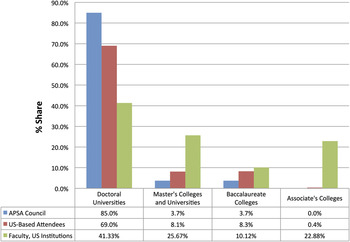
The attendee list included 6,607 records. After removing records for which a higher-education institution was not listed (658 records), the dataset included 5,949 records. I searched The Carnegie Classification of Institutions of Higher Education (n.d) to determine the classification for the institution affiliated with each record. To determine how characteristic APSA Annual Meeting attendance is of the US professoriate (Proposition 1c), I used Integrated Postsecondary Education Data System (IPEDS) data (NCES, 2016) to determine the number and percentage of full-time faculty at US doctoral-, master’s-, baccalaureate-, and associate’s-granting institutions. Footnote 20 The composition of the APSA Council (2015–16) and 2016 APSA Annual Meeting attendees are contrasted with faculty at US-based institutions in figure 4. Footnote 21
Comparison of the APSA Council, Attendees, and Faculty at US-Based Institutions

Figure 4 supports Proposition 1b, showing that the APSA Council is not indicative of the diversity of institution types found among the membership (as measured by Annual Meeting attendance). The data also show that, as indicated by Proposition 1c, APSA’s membership may not be reflective of political scientists in the professoriate.
Investigating Institution Rank in APSA Governance
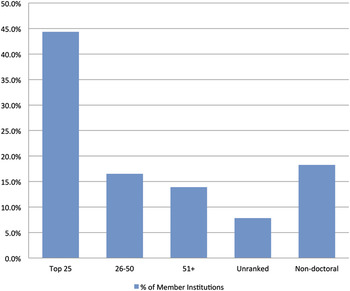
To test Proposition 2, I matched the US-based institutions of APSA Council members (2011–12 through 2015–16) Footnote 22 to their institutional rankings in the 2017 US News & World Report Rankings (US News 2016). Footnote 23 These results are shown in figure 5.
APSA Council Member Institutions by Rank, 201–12 through 2015–16

These data support Proposition 2: higher-ranked doctoral institutions will comprise a disproportionate share of APSA’s leadership. During the period included in this study, top-25 political science graduate programs comprised nearly 45% of the association’s leadership. Also noteworthy is that of the baccalaureate institutions in the dataset, three of the four are top-15 national liberal arts colleges and three of the six international institutions are ranked in the global top 50 (QS 2015; US News 2016). This indicates that elite institutions of all types heavily dominate APSA governance.
SUGGESTIONS FOR FURTHER RESEARCH
The dominance of elite doctoral-granting institutions in APSA governance may be a function of higher visibility, more research output, greater access to financial resources that facilitate travel and APSA participation, and perhaps more time to engage with the profession. Footnote 24 As a discipline, however, we do not know this for certain. We also do not know why master’s, baccalaureate, and associate’s institutions are underrepresented in APSA governance. Is it analogous to citations, wherein people cite (i.e., nominate) the scholars they know? Alternatively, are scholars from smaller institutions being nominated but decline to serve, perhaps as a result of time and resource constraints? Furthermore, when baccalaureate institutions are represented, are they from elite small liberal arts colleges (SLACs) or from both elite and lower-ranked SLACs? At some elite SLACs, the teaching load and research expectations are in line with expectations at doctoral-granting institutions, thereby making elite SLACs’ concerns far different than those of lower-ranked “teaching” SLACs.
Arguably more troubling is the indication that APSA’s membership is not reflective of the full-time professoriate more broadly. If, as noted previously, the disciplinary association is meant to aggregate the concerns of all members of the profession, why are more members of the profession—particularly those from smaller institutions—not joining APSA in larger numbers? Fourcade et al. (Reference Fourcade, Ollion and Algan2015) indicated that the APSA’s membership fees are among the highest in the social sciences; is the financial barrier to joining too high? Is it that the nonmembers do not see their lived experiences reflected in the work that the association does? If the answer to the latter question is “yes,” then it may be that leadership and membership combine to form a negative feedback loop in which lack of participation by faculty at smaller institutions reinforces the perception that APSA is concerned only with faculty at larger institutions. Again, we simply do not have data on the question of why some scholars do not join APSA (or join only if they are presenting at the Annual Meeting). Both the dearth of leaders and members from smaller institutions are questions that the APSA and its leadership should explore. Furthermore, this research note examined institution types only among full-time faculty, yet we know that adjunct professors make up an increasingly large portion of the professoriate (Stenerson et al. Reference Stenerson, Blanchard, Fassiotto, Hernandez and Muth2010). Given the debates about adjunct labor in higher education, Footnote 25 future research should address at what rate adjuncts join the APSA and how well the association addresses the issues that are specific to the precarious nature of adjunct employment.
Finally, the role of top-tier doctoral-grating universities in APSA governance is another avenue for future research. First, it must be noted that the dominance of top-tier programs in APSA’s governance is likely larger than it appears due to the fact that top-tier graduate programs are responsible for a large share of job placements in the discipline (Oprisko Reference Oprisko2012). More important, however, is to determine the extent to which these institutions’ outsized presence has an effect on the services and functions performed by the APSA.
For example, one key area of concern is the APSA/APSA Council’s role in the conception and promotion of the Data Access and Research Transparency (DA-RT) policy. In their recent review of the DA-RT initiative, Schwartz-Shea and Yanow (Reference Schwartz-Shea and Yanow2016) alluded to the representation issues described previously: elite dominance in decision making, wherein top-tier scholars believe they are appropriately representing the wider membership:
From DA-RT’s leaders’ account, they sought out various views, with few results…But what may seem inclusive from one perspective can appear quite exclusive from another. That DA-RT proponents saw only consensus before the 2015 meeting might be understood as resulting from a networking effect: reaching out through one’s own networks likely yields participants with similar views.
Schwartz-Shea and Yanow (Reference Schwartz-Shea and Yanow2016) further questioned the legitimacy of APSA’s leadership on this issue, asking if DA-RT would have progressed this far had the association’s leadership been elected and truly representative of the membership. I extend that question, asking “Is the association’s approach to DA-RT unique, or is it symptomatic of broader practices in the association’s governance?”
In summary, research is clear that who is represented matters—for instance, we know that representatives from marginalized groups are more likely to put their groups’ issues on the agenda than non-group-member counterparts (Bratton Reference Bratton2002). We also know that more diversity brings new ideas and different perspectives that widen the scope of a board’s discussions and provides a broader base of expertise on which to base decisions (Erhardt et al. Reference Erhardt, Werbel and Shrader2003). By increasing the diversity of institution types included on the APSA Council, we will not only more closely align the leadership with the spirit of APSA’s by-laws but we also will potentially increase the efficacy and even the legitimacy of APSA’s governance.
ACKNOWLEDGMENTS
The author thanks the current and former APSA Council members who provided input for this article and to Betsy Super for providing annual meeting attendance data. Thanks also to Stefanie Chambers, Sue Tolleson-Rinehart, Denise Walsh, and the Brain Trust for providing suggestions and support for this project. Finally, many thanks to the reviewers for their feedback. All errors in this article are my own.