INTRODUCTION
Babesia caballi and Babesia equi, in which B. equi is also described as Theileria equi (Mehlhorn and Schein, 1998), are the causative agents of equine babesiosis in tropical and subtropical regions, including Central and South America, Africa, Asia, and Southern Europe, leading to enormous losses in the horse industry (Schein, 1988). Babesia parasites invade, replicate in, and rupture erythrocytes (RBC) to repeat the asexual growth cycle, thereby causing severe clinical symptoms, such as haemolytic anaemia, icterus, fever, oedema, loss of body weight, and poor performance in the infected horses (Kuttler, 1988; Schein, 1988). Effective strategies for eradicating babesiosis should be performed on the basis of the biological mechanism of the asexual growth cycle of Babesia parasites.
Ethylene glycol bis (β-aminoethylether)-N,N,N,N-tetraacetic acid (EGTA) is a chelating agent capable of binding to positively-charged metal ions of various heavy elements, including Ca2+ and Zn2+ (Bers, 1982; Tatsumi and Fliss, 1994). In particular, the EGTA is known to chelate the Ca2+ more effectively than ethylenediaminetetraacetic acid (EDTA) (Schmid and Reilley, 1957). EGTA can not permeate the biological membrane of cells (Simons, 1991), so that it chelates only the extracellular ions. The Ca2+ functions as a major vital molecule in host cell infections by several protozoa. The attachment and invasion by Plasmodium knowlesi were greatly reduced or abolished by the presence of 2·5 mM EDTA or EGTA (Johnson et al. 1980). In Toxoplasma gondii, oscillations in the intracellular Ca2+ level of the parasite influence microneme secretion and prevent the parasite's gliding motility (Wetzel et al. 2004). In the bovine Babesia parasite, Babesia bovis, extracellular Ca2+ (1 mM) had a slight positive effect on their invasion (Franssen et al. 2003). However, no reports about B. caballi and B. equi in relation to Ca2+ chelation have been published. In this study, we investigated the inhibitory effect of EGTA on the in vitro cultures of B. caballi and B. equi and evaluated the invasion ability of B. caballi in the presence of EGTA by using high-voltage pulsing (Franssen et al. 2003). We discuss the vital role of extracellular Ca2+ in erythrocyte invasion by the parasites.
MATERIALS AND METHODS
Parasites
U. S. Department of Agriculture (USDA) strains of B. caballi and B. equi were maintained in equine RBC in a microaerophilic stationary-phase culture system (Avarzed et al. 1997). The equine RBC were obtained from a healthy donor horse as previously described (Bork et al. 2003a). The culture media for B. caballi and B. equi were RPMI 1640 and M199 (Sigma-Aldrich, Tokyo, Japan), respectively, both of which were supplemented with 40% normal equine serum, 60 units/ml penicillin G, 60 μg/ml streptomycin, and 0·15 μg/ml amphotericin B (Sigma, St Louis, MO, USA). For B. equi only, 13·6 μg/ml hypoxanthine (ICN Biomedical, Solon, OH, USA) was added to the medium (Nagai et al. 2003; Bork et al. 2003a; Ikadai et al. 2001). Infected RBC were mixed with freshly prepared RBC and then suspended in the culture medium at 10% packed cell volume in 24-well culture plates (Nunc A/S, Roskilde, Denmark). The B. caballi culture was incubated at 37 °C in 5% CO2 in air, while the B. equi were cultured at 37 °C in 5% CO2, 5% O2, and 90% N2. The overlaying growth medium was replaced daily with a fresh medium, and the infected RBC were subcultured every 3 days or when parasitaemia reached 5% (Bork et al. 2003a).
Chemicals
An EGTA stock solution of 1 M was prepared by dissolving 190·17 g of EGTA (WAKO Pure Chemical Industries, Osaka, Japan) with 500 ml of deionized distilled water (DDW) and subsequently adjusting the pH to 8·0 with 10 M NaOH. The stock solution was then sterilized by autoclaving and kept at room temperature until use. Working media containing the indicated concentrations of EGTA were prepared by diluting the stock solution with the culture medium and then adjusting the pH to 8·0 with 10 M NaOH again. A Ca2+ stock solution of 1 M was prepared by dissolving 73·5 g of CaCl2·2H2O (WAKO Pure Chemical Industries) with 500 ml of DDW. The solution was sterilized by filtrating with a 0·25 μm filter (Toyo Roshi, Tochigi, Japan). Working media containing the indicated concentrations of Ca2+ were prepared by diluting the stock solution with the culture medium.
In vitro growth-inhibition test of EGTA
The growth-inhibition test for EGTA followed the methods used for measuring drug activity as previously described (Bork et al. 2003a,b), with some modifications. Briefly, infected RBC were diluted with non-infected RBC to obtain 1% parasitaemia. The 50 μl of RBC mixture was subsequently suspended in 450 μl of the culture medium supplemented with EGTA, Ca2+, or EGTA+Ca2+ at the indicated concentrations. The suspension was added into a 48-well culture plate (Nunc A/S) and then incubated in humidified multigas water-jacketed incubators at 37 °C for 3 days. In parallel, normal cultures, which were supplemented with the same volume of DDW instead of the chemical stock solution, were prepared as the control. All experiments were carried out in triplicate for each chemical. The culture medium was replaced daily with 450 μl of fresh medium containing the appropriate concentration of the chemical(s). The percentage of extracellular merozoites was calculated on day 1 of cultivation as the ratio of extracellular merozoites to the entire parasite population in approximately 1000 parasites.
In vitro invasion test using high voltage pulsing
The inhibitory effect of EGTA on erythrocyte invasion by B. caballi was evaluated by the invasion test using high voltage pulsing as described previously (Franssen et al. 2003) with some modifications. Briefly, B. caballi-infected RBC were suspended in an equal volume of B. caballi medium. The mixture of 400 μl was subjected to 5 intermittent (10 sec, 0 °C) high voltage pulses (1·5 kV, 400 O, 25 μF) in a Bio-Rad Gene Pulser II (Hercules, CA, USA) using a 0·2 cm pulser cuvette (Bio-Rad). The samples were then suspended with B. caballi medium or the media supplemented with EGTA at the indicated concentrations. After low centrifugation (700 g, 18 °C, 5 min), the pellet was resuspended with B. caballi medium or the indicated medium supplemented with EGTA, transferred to a 96-well plate (Nunc A/S) with non-infected RBC at 10% packed cell volume, and then incubated at 37 °C for 1 h. After this incubation, the numbers of infected RBC were counted in a total of 5000 RBC in Giemsa-stained smears, and the invasion efficiency was calculated as the percentage parasitaemia in the culture with EGTA compared to that in the normal medium control (100%). This experiment was performed in triplicate.
Statistical analyses
The values of a 50% inhibitory concentration (IC50) of EGTA for both parasites were calculated on day 3 of cultivation after determination of curve fitting (Bork et al. 2003a,b). Differences in the percentage of parasitaemia and the percentage of extracellular merozoites were statistically analysed by use of an independent Student's t-test with P<0·05 representing a significant difference.
RESULTS
Inhibitory effect of EGTA on the growth of B. caballi
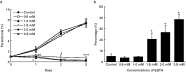
Inhibitory effects of EGTA were significant for the in vitro growth of B. caballi at concentrations of 1·5, 2 and 2·5 mM (P<0·05) as compared to the control growth, whereas concentrations of 0·5 and 1 mM did not show any effect (Fig. 1A). The IC50 value of EGTA was determined as 1·27 mM. Under microscopical observation, high percentages of extracellular merozoites were detected in the total parasites on day 1 of cultivation in the presence of 1·5, 2, and 2·5 mM EGTA (Fig. 1B). These percentages were significantly higher (P<0·05) than that of the control. Any morphological changes were not found in the EGTA-treated parasites.

Fig. 1. Inhibitory effect of different concentrations of EGTA on asexual growth of Babesia caballi (A) and percentage of extracellular merozoites on day 1 of cultivation (B). Each value represents the mean±standard deviation (S.D.) in 3 separate trials. The asterisks indicate significant differences (P<0·05) between the chemical-treated and control groups.
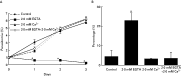
Although the growth of B. caballi was completely inhibited in the presence of 2 mM EGTA, addition of 2 mM Ca2+ recovered the normal growth pattern even in the presence of 2 mM EGTA (Fig. 2A). No difference in growth pattern was detected between the culture containing 2 mM Ca2+ without EGTA and the control culture. Although an abnormally high percentage of extracellular merozoites was produced in the culture containing 2 mM EGTA, the addition of 2 mM Ca2+ reduced their percentages to the same levels seen in the control culture (Fig. 2B). The percentage of extracellular merozoites in the culture containing 2 mM Ca2+ without EGTA showed almost the same value as that of the control culture (Fig. 2B).

Fig. 2. Effect of addition of Ca2+ into the EGTA-treated Babesia caballi culture on the parasite growth (A) and percentage of extracellular merozoites on day 1 of cultivation (B). Each value represents the mean±S.D. in 3 separate trials. The asterisks indicate significant differences (P<0·05) between the chemical-treated and control groups.
Inhibitory effect of EGTA on the growth of B. equi
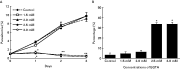
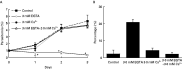
The in vitro growth of B. equi was significantly inhibited in the presence of EGTA at concentrations of 2·5 and 3 mM (P<0·05) as compared to the control growth (Fig. 3A). The IC50 value was determined as 2·25 mM. The percentages of extracellular merozoites were also increased in the cultures of B. equi which contained 2·5 and 3 mM EGTA (Fig. 3B). Although the growth of B. equi was completely inhibited in the presence of 3 mM EGTA, the culture combined with 3 mM Ca2+ showed a normal growth pattern (Fig. 4A) and normal percentage of extracellular merozoites (Fig. 4B) even in the presence of 3 mM EGTA. The percentage in the culture containing 3 mM Ca2+ without EGTA showed almost the same value as that of the control culture (Fig. 4B). Morphological changes were not observed in the EGTA-treated parasites.

Fig. 3. Inhibitory effect of different concentrations of EGTA on asexual growth of Babesia equi (A) and percentage extracellular merozoites on day 1 of cultivation (B). Each value represents the mean±standard deviation (S.D.) in 3 separate trials. The asterisk indicates significant differences (P<0·05) between the chemical-treated and control groups.

Fig. 4. Effect of addition of Ca2+ into the EGTA-treated Babesia equi culture on the parasite growth (A) and percentage of extracellular merozoites on day 1 of cultivation (B). Each value represents the mean±S.D. in 3 separate wells. The asterisk indicates significant differences (P<0·05) between the chemical-treated and control groups.
Inhibitory effect of EGTA on the erythrocyte invasion by B. caballi
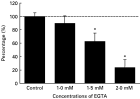
In the in vitro invasion test with B. caballi, erythrocyte invasion was significantly inhibited in the presence of EGTA at concentrations of 1·5 and 2 mM (P<0·05) as compared to control invasion (Fig. 5). In contrast, a concentration of 1 mM EGTA did not show significant inhibition.

Fig. 5. Inhibitory effect of EGTA on the erythrocyte invasion by Babesia caballi. Relative values are expressed as the percentage of parasitaemia in the culture with EGTA to that with normal medium control (100%). Each value represents the mean±S.D. in 3 separate trials. The asterisk indicates significant differences (P<0·05) between the chemical-treated and control groups.
DISCUSSION
In the present study we demonstrated that supplementation of EGTA into the culture medium inhibited the in vitro growth of B. caballi and B. equi and that further addition of Ca2+ to the cultures negated the inhibitory effect of EGTA. These results indicate that EGTA has an inhibitory effect on the asexual growth of B. caballi and B. equi. Moreover, we observed abnormally increased numbers of extracellular merozoites in the cultures treated with high concentrations of EGTA in both parasites. These findings encouraged us to examine the possible consequences of inhibiting erythrocyte invasion by the parasites. Thus, an erythrocyte invasion test was carried out according to a recently established procedure (Franssen et al. 2003). For B. caballi, we confirmed that the EGTA had an inhibitory effect on erythrocyte invasion by the parasite. Therefore, we concluded that the level of Ca2+ is critical for erythrocyte invasion of B. caballi merozoites. We could not confirm whether Ca2+ plays an important role in the invasion of B. equi into erythrocytes using the same assay as for B. caballi since, despite several trials, we failed to collect undamaged free merozoites. Although the possibility of a harmful effect on the intracellular development of B. equi could not be completely excluded, we speculate that Ca2+ might also be important for the invasion of B. equi since an increase in extracellular parasites was found and no morphological changes were observed in the intracellular parasites of the EGTA-treated B. equi culture. Further study on the precise role that Ca2+ plays in the invasion of the B. equi parasite will be required in the future.
B. caballi was more sensitive to EGTA than B. equi. The IC50 values for B. caballi and B. equi were 1·27 mM and 2·25 mM, respectively. This might be due to the different components of RPMI 1640 and M199 used for B. caballi and B. equi, respectively. According to the data sheets (Sigma-Aldrich), M199 contains a higher concentration of Ca2+ (about 1·8 mM) than RPMI 1640 (about 0·5 mM). To completely chelate Ca2+, the B. equi medium (M199) required a higher concentration of EGTA than the B. caballi (RPMI 1640) medium.
Several possible mechanisms for the role of Ca2+ in the erythrocyte invasion by B. caballi and, possibly, B. equi can be considered. The first possibility is that Ca2+ might be required for the specific molecular interaction between the protozoan ligands and the corresponding erythrocyte receptors that are essential for parasite invasion. In B. bovis, Ca2+ was reported to accentuate the binding affinity of the rhoptry-associated protein-1 (RAP-1) against bovine RBC (Yokoyama et al. 2002). The second possibility is that Ca2+ might play an important role in the vital signalling for the secretion of invasion-related molecules from the rhoptry or microneme organelle of Babesia parasites. Ca2+ is well established as a cellular messenger in many eukaryotic signal-transducing pathways (Moreno and DoCampo, 2003). In these pathways, Ca2+ functionally binds to the target proteins that play various roles as a second messenger in many biological reactions (Caroppo et al. 2004). In T. gondii, the secretion of a protozoan protein that relates to host cell invasion requires the release of Ca2+ from intracellular stores and the influx of Ca2+ from the extracellular milieu (Wetzel et al. 2004). Further study will be required to identify the relationship between erythrocyte invasion by the equine Babesia parasite and extracellular Ca2+.
In conclusion, extracellular Ca2+ is suggested to be involved in erythrocyte invasion by equine Babesia parasites in the present study. These findings provide a deeper understanding of the invasion mechanism of equine Babesia into erythrocytes and could make a significant contribution to the development of culture systems for the discovery of anti-babesial drugs in the future.
This work was supported by Grants-in-Aid for Scientific Research from the Japan Society for the Promotion of Science, by grants from the Special Coordination Funds for Science and Technology from the Science and Technology Agency and from The 21st Century COE Program (A-1), Ministry of Education, Culture, Sports, Science, and Technology, Japan, and by the Japan International Cooperation Agency (JICA), F.Y. 2003.