1. Introduction
Sanitary and phytosanitary (SPS) measures protect human, animal, and plant health. The hazards to be controlled are numerous: parasites, bacteria, viruses, prions, heavy metals, and residues from pesticides and veterinary drugs – among others. SPS measures can therefore serve important purposes. But they are also a challenge for the world trading system as they may impede trade and provoke intricate disputes.
This tension between health and trade objectives must not engender a confrontational perspective where one objective is bluntly pursued at the cost of the other. Instead, SPS measures should be designed to be as trade-friendly as possible without impinging on their health objectives, and an adequate balance should be found where trade-offs are unavoidable. Health is one of the most valuable goods to society, but marginal health benefits must not lead to excessive economic costs.
This balancing act is routinely undertaken within countries. Business federations and ministries of the economy tend to resist tighter regulation. The outcome of this political tug-of-war does not constitute a rational, optimizing solution, but it is a reasonable approximation: higher benefits of regulation motivate health promoters to strive harder, while higher costs trigger stronger resistance from businesses. By the same token, countries should care about the effects of SPS measures on trade. These include higher costs for domestic consumers, the economic costs of SPS measures abroad, tit-for-tat retaliation from harmed trading partners, and potential systemic damages to the trading system. Such costs are less visible and more spread-out, affecting individuals and companies who face higher barriers to effective lobbying. As a result, they tend to be insufficiently reflected in policy outcomes.
This paper examines how the WTO's Trade Policy Review Mechanism (TPRM) could help to defuse SPS-related trade barriers and conflicts. The basic idea is that the TPRM will enhance transparency of countries' SPS measures and policy-making processes; that is, it will explain how countries arrive at what policies. This in turn will help countries to learn about how they fare in international comparison and which best practices of SPS policy-making can be identified worldwide. Transparency also allows domestic and international stakeholders to exercise pressure on governments to improve unnecessarily trade-restrictive SPS measures and to reform policy-making processes. The result will be SPS policies that are more effective in attaining health and trade objectives.
The treatment of SPS regulation in current trade policy reviews (TPRs) is superficial and largely uncritical.Footnote 1 Unsurprisingly, the TPRM is widely deemed to have no effect on SPS regulation. This paper therefore develops several proposals for making the TPRM more relevant.
The quantitative description of SPS measures and the analysis of trade and welfare effects should be improved. But the scope for changing SPS measures in this way is limited. Their complexity largely immunizes SPS measures against such traditional transparency instruments: it is difficult to aggregate SPS measures, to calculate their effects, and to reveal their protectionist origins. Somewhat more promising is a summarized presentation of specific trade concerns raised in the WTO's SPS Committee. This can serve as a rough indicator of whether and where a country is mismanaging its SPS regulation.
The main thrust of TPRs should not be to evaluate SPS measures directly but to analyze how SPS regulation is being made. How do countries conduct their risk assessment? Which provisions do they have for attaining consistent levels of protection across hazards? How do they proceed to recognize pest/disease-free areas? Making such policy-making processes transparent and comparing them to best-practice benchmarks will contribute to improve processes and outcomes.
Such in-depth analysis and evaluation of domestic policy-making raises concerns over sovereignty and the nature of the WTO as a member-driven organization. However, transparency is a softer approach to improve SPS policies and strengthen compliance with the SPS agreement than litigation. It is a preventive measure to avoid the technically complex and politically sensitive second-guessing of SPS measures through dispute settlement bodies.
The detailed analysis necessary to give a meaningful picture of a country's SPS regulation and policy-making processes warrants publication in a separate, issue-specific TPR. Such a move could serve as a model for establishing further issue-specific reviews that address technical barriers to trade, trade in services, and other complex regulatory challenges. Alternatively, several of these regulatory trade issues could be grouped into one report that is published in addition to a report on more traditional barriers, such as tariffs, subsidies, and trade defense instruments.
Some limitations of the paper need mentioning. First, the paper addresses only binding standards set by governments, although private standards, established for instance by retailers, are increasingly important.Footnote 2 It may be desirable to use TPRs to also give an overview of the private SPS standards prevalent in a country. This might help exporters and traders to cope with private standards, and it could lead the organizations in charge of these standards to reflect on ways to reduce compliance costs. It might also encourage governments to undertake greater efforts to streamline private standards and to avoid subsidizing superfluous or excessively trade-restrictive private standards.Footnote 3
Second, the paper examines exclusively the potential for reviewing SPS measures in the narrow, substantive sense, but not control, inspection, and approval procedures that are employed to enforce these SPS measures. This does not preclude the idea of tackling such procedures in TPRs.
Third, it might be propitious to include food-related standards covered by the Agreement on Technical Barriers to Trade (TBT) when reviewing SPS policies. Some measures can be reasonably claimed to fall into both categories, and even some unambiguous TBT measures, such as nutrition labeling, have more in common with SPS policies than with classical TBT issues, such as safety requirements for cars.
Fourth, where the paper looks beyond the WTO, it favors the Codex Alimentarius as a source without listing comparable work of other international organizations for completeness. Finally, to the extent the paper refers to country cases, the focus is on the EU and the US as the world's biggest agricultural importers. This should not leave the impression that trade-restrictive SPS regulation is an issue in these two countries primarily.
The remainder is organized as follows. Section 2 gives an overview of SPS measures in the world trade system and their treatment in TPRs. Section 3 examines how SPS measures could be better addressed in TPRs. Section 4 considers how TPRs could monitor the policy-making processes behind SPS measures. Section 5 asks whether the WTO should indeed take on reviews of policy-making processes in the SPS realm. Section 6 looks at the challenge of implementing TPRs of SPS regulation. Section 7 considers whether a thorough review of SPS regulation through the WTO is politically feasible and how first steps could be made in that direction. Section 8 concludes.
2. SPS measures and the TPRM
This section takes a closer look at how SPS issues affect the world trade system and how they are currently being treated in TPRs.
2.1 SPS measures and trade
On the one hand, SPS measures can impede trade. The costs of complying with SPS measures are especially problematic for small-scale producers in least developed countries – provided they do not face an outright ban. On the other hand, SPS standards can create trade. Since consumers cannot fully assess the safety of the foods they buy, they prefer products in which they trust. Without sound regulatory systems to guarantee food safety, consumers refrain from buying imported products that may appear less reliable.Footnote 4 Overall, the trade-restricting effect of SPS standards appears to dominate.Footnote 5 But whatever the net effect on trade, the task remains to ensure that countries consider trade effects in their SPS policy-making.
SPS measures may well become more troublesome in the future as countries gear up their food safety laws. Around the world, SPS requirements have been tightened in recent years.Footnote 6 Positive lists for pesticides that can be used in production have been established, Maximum Residue Levels have been lowered, and traceability requirements have been introduced. In addition, requirements on production processes and SPS regulation in exporting countries have been imposed: food safety authorities in importing countries are no longer satisfied with border controls, but tackle hazards further up the production chain.
This trend will probably continue in the future. Protectionist interest groups lobby for offsetting the partial loss of tariff protection in the case of a successful conclusion of the Doha Round with trade-restrictive SPS regulation. Consumer concerns over the dangers stemming from imported foods put additional political pressure on governments. Both the EU and the US are currently considering how to improve the safety of food imports.Footnote 7
There is little systematic evidence as to what extent governments set overly trade-restrictive SPS measures in order to shield domestic producers from competition or to avoid political pressure from consumers and other stakeholders, such as environmentalists. However, the view is broadly shared that such ‘political’ considerations frequently play a role in countries' choices of SPS measures.Footnote 8 Further strains on trade result simply from negligence and resource constraints. Often, it is impossible to distinguish the role of several interacting factors – for example, when public decision-makers neglect to verify the potentially biased studies they received from interested parties because they prefer to save resources and avoid conflict.
What can be done to promote trade-friendly and avoid excessively trade-restrictive SPS measures? The SPS agreement, which came into force in 1995 after the Uruguay Round, has led to improvements, such as greater transparency of SPS measures and other enforceable disciplines on SPS measures and policy-making procedures. But the gap between WTO norms and members' practice remains wide. The Doha negotiations fail to address this issue. Adapting the SPS agreement has not been put on the negotiating agenda. After the painful experiences of the bogged-down Doha Round, policymakers will, for the foreseeable future, not embark on another round of multilateral trade talks that could, this time, include the SPS agreement.
But problems run deeper than the political deadlock. Even if the SPS agreement could be upgraded, the fundamental problem with enforcing these rules through the dispute settlement system would remain.Footnote 9 First, WTO panels and the Appellate Body are overwhelmed with the technical complexity of SPS cases. Second, rulings that find SPS procedures or measures in contravention of WTO law tend to be perceived as an infringement on sovereignty and an unbalanced prioritization of trade over non-trade values. Third, governments encounter difficulties in complying with rulings on SPS measures that enjoy strong public support. Delayed compliance or non-compliance, in turn, undermines the authority of the dispute settlement system.Footnote 10
These problems came to the fore during the few but high-profile disputes on SPS measures with which the WTO has had to deal so far. The cases brought by the US against the EU over import restrictions on hormone-treated beef and genetically modified plants triggered public outrage, and harsh criticism at the highest political level on both sides of the Atlantic. A similar case, filed by the Bush administration just before leaving office, targets the EU ban on poultry carcasses that have been decontaminated with chlorine.
Therefore, the multilateral system will have to rely on persuasion and other ‘soft’ approaches as a complement to the deterrence of binding SPS disciplines and quasi-judicial enforcement. Much of this work happens outside the WTO.Footnote 11 This network of international cooperation between experts helps to develop shared standards and methods, and it strengthens the role of independent experts in countries' domestic policy-making practices. Another soft approach adopted by these international institutions is technical assistance that improves capacities of public administrations and private businesses in developing countries. This can make developing countries' SPS policies more efficient and less trade distorting, and it can enable developing countries' exporters to meet more demanding foreign standards. Besides for the discussions in the SPS Committee, the WTO could contribute to this soft approach through its TRPM.
2.2 The TPRM
The TPRM was provisionally established in 1989 and made definitive by the 1995 Marrakesh Agreement. The four countries with the largest share of world trade are to be reviewed every two years, the next 16 every four years, and the rest every six years. The Secretariat drafts a report based on questionnaires and information collected from various sources (the country's official web pages, reports by other international institutions, NGOs, academic work) and travels to the country under review. The report is sent to the country under review for verification before being discussed at a meeting open only to WTO members. All documents, including the minutes of the meeting, are subsequently made public.Footnote 12
For more than a decade, the Secretariat's reports have been abiding by the same main structure. The summary observations are followed by four sections. First, the economic environment of the country under review is discussed, looking at output, trade, investment, employment, public finances, exchange rates, and related macroeconomic issues. Second, the trade policy regime is characterized by describing the institutional framework for trade policy-making, trade policy objectives, preferential trade agreements, and non-reciprocal preference schemes, among others. Third, trade policies and practices are examined by measure. This includes measures directly affecting imports (customs procedures, rules of origin, tariffs, technical and SPS regulations, etc.), measures directly affecting exports (documentation, restrictions, taxes, subsidies, etc.), and other measures affecting production and trade (competition policy, government procurement, intellectual property rights, state-owned enterprises, etc.). Fourth, trade policies are addressed by sector, typically with extensive coverage of agriculture and services where trade-restrictive measures are frequent and complex.
2.3 SPS regulation in TPRs of the EU and the US
This section looks at the TPRs that have been conducted for the EU and the US since 2000. It is reasonable to assume that the WTO Secretariat attaches special importance to the reviews of these two members, and the SPS discussion concerning the EU and the US is indeed relatively extensive. Several characteristics common to these TPRs can be established. Most simply, they are short. The EU 2004 TPR dedicates three and a half pages and the EU 2007 TPR only slightly more than two pages to SPS issues (with one page mostly filled with the reproduction of the EU's emergency SPS measure notifications). The EU 2009 TPR devotes five pages to SPS regulation. In the US TPRs, SPS issues occupy three to four pages (including a section on bioterrorism law).Footnote 13
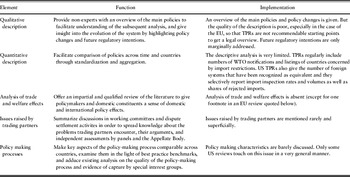
What content do TPRs deliver in such a limited space? Table 1 gives an overview of the elements that could reasonably be covered by a TPR of SPS measures (or any other trade policy). It looks at the function of each element and the implementation in TPRs.
Assessment of TPRs

Perusing the TPRs for potentially critical notes produces scant results. The EU 2009 TPR mentions three issues raised by trading partners: one on maximum residue levels, one on developing country complaints about the trade-restrictive effects of the EU's ‘novel food’ legislation that is not adapted to traditional/ethnic food, and one complaint about the EU's notification of the novel food legislation as a TBT rather than an SPS measure. In addition, the review states that ‘there appear to be considerable delays in reaching final decisions on GMO approvals’ – which is the least one can say after the corresponding dispute case.
The EU 2007 TPR contains not a single such element. The EU 2004 TPR observes that EU legislation:
provides risk managers (decision takers) with the option of pursuing the ‘Precautionary Principle’ when decisions have to be made to protect health but scientific information concerning the risk is inconclusive or incomplete. Furthermore, the regulation allows for risk management actions not only based on scientific assessment, but also on other factors ‘legitimate’ to the matter under consideration. This provision has attracted some criticism, however, as the definition of ‘other factors’ is not clearly defined.
It also notes that some regulations ‘have been the subject of several criticisms from third countries, including that they are much stricter than international regulations (e.g. Codex Alimentarius and OIE), and there are high administrative costs in meeting them’. A footnote surprisingly dares to add: ‘Otsuki, Sewadeh, and Wilson (2000) estimate that the implementation of EC standards on aflatoxin levels in food compared with regulations based on international standards, would reduce health risk by approximately 1.4 deaths per billion a year and could decrease African exports by more than US$670 million.’ Finally, the TPR mentions the hormones case, which the EU had lost in WTO dispute settlement. The EU 2002 TPR, after taking account of the WTO hormones ruling, adds that the EU's aflatoxin regulation is also a ‘controversial issue’. Otherwise, it is again perfectly polite.
The US TPRs always deal with specific trade concerns raised by other WTO members. The 2006 review even contains a table with all the concerns submitted since the last review. The 2006 TPR also complains that the Secretariat was not able to ascertain the trade effects of the US Bioterrorism Act because no information was made available (a rather amusing complaint because trade effects are almost never reported). These are all the potentially critical notes contained in the four reviews of the US.
In sum, TPRs of SPS regulation are excessively short for dealing with such a complex issue, they mix up very general and specific information, they are hard to compare across countries and time, and, rare exceptions aside, they are uncritical. Excerpts from the 2007 TPR of SPS regulation in the EU, which can be found in Appendix 1, illustrate this judgment. It is unsurprising that TPR readers are skeptical of how the mechanism addresses SPS issues and believe that TPRs have virtually no effect on SPS regulation.
3. Review of SPS measures
This section discusses whether TPRs could deal more effectively with SPS measures. It addresses the potential of qualitative and quantitative description, analysis of trade and welfare effects, and the issues raised by trading partners. The treatment of SPS policy-making processes will be taken up in the subsequent section.
3.1 Qualitative description
The description of the main policies, recent policy changes, key drivers of SPS measures, and future regulatory intentions should be expanded and enhanced. TPRs should put special emphasis on future regulatory intentions. WTO notifications that announce new regulations come shortly before the regulation is passed (if they come at all) and do not leave sufficient time for commenting. Gaining an overview of future regulation through other forms of publicly accessible information (even where such information is available) is cumbersome. Different agencies are involved in standard setting, any product is affected by a range of SPS regulation, and most information is available only in the national language. A succinct summary in TPRs can thus make life easier for exporting countries and industries.
3.2 Quantitative description
Several aspects of SPS regulation could be selected for a systematic descriptive analysis, for instance the quality and quantity of SPS measures, the extent to which SPS measures conform with or are based on international standards, and the degree to which standards of other countries are recognized as equivalent. The problem with such variables is that they cannot be reasonably interpreted as measuring protectionism; other factors without protectionist roots also influence SPS regulation, and their impact varies across countries. This can best be seen by looking at some possible measurement approaches for the quality and quantity of SPS measures.
The simplest approach is to count the number of WTO notifications or the number of SPS regulations (frequency measures) or, slightly more sophisticated, to add up the number of tariff lines or the size of trade flows affected by SPS regulation (coverage measures). However, different levels of health protection that countries deem appropriate can be responsible for country variation in frequency and coverage measures. Furthermore, such measures say nothing about how trade-restrictive SPS measures are. Where coverage measures are based on trade flows, the additional problem of endogeneity of trade volumes to SPS regulation arises (in the extreme case of a ban, trade falls to zero and so does the weight of the SPS measure in the coverage measure).
Another option is to report the number, and possibly the importance for trade flows, of those countries and establishments from which imports are permitted or banned. Yet, such measures depend on more than the strictness of standards and the administrative capacity of the certifying country. The capacity of exporting countries and establishments to provide documentation and their interest in certification to access a given market also matter.
A more promising approach could be to list key SPS standards, such as maximum residue levels, that fulfill three criteria: high trade volumes, strong effects on trade, and unusual trade restrictiveness. The latter could be determined by comparing standards to those of other countries that are known to have similar or even higher levels of appropriate protection in general. Again, this is not a proof of protectionist intentions, nor even of excessive trade restrictiveness. Nonetheless, it could help to identify outlier measures that merit the renewed attention of risk analysts.
Yet another indicator of the trade friendliness of SPS regulation could be the share of notified measures that conforms to international standards. This indicator could be easily constructed since notification formulae ask members to identify whether a relevant international standard exists for their measure and whether they conform to it. The Secretariat could also give an overview of the reasons the country under review has provided in its notifications for not observing international standards.
In brief, the potential of quantitative description is moderate to weak. It is relatively easy to calculate average tariffs, to add up subsidies, and to count antidumping measures. In those cases, the protectionist intent and the harmful effects for the economy are understood by many readers. By contrast, aggregates for SPS measures are more complicated to construct, and they cannot be readily interpreted as warning signals for the existence of excessive trade barriers. Nevertheless, some indicators (lists of all outstandingly strict measures, conformity with international standards) would usefully enhance transparency.
It could also be useful to increase the transparency of SPS measures in ways that are not likely to directly affect policy choices but help to develop a better understanding of the issue. The number of SPS measures could be reported according to product groups concerned, health threats addressed, and the type of measure taken.
3.3 Analysis of trade and welfare effects
Whereas the interpretation of quantitative descriptions of SPS measures is difficult, analysis of their trade and welfare effects may offer a single, easy-to-use metric. This facilitates comparison across SPS measures. It also enables the comparison of costs and benefits of SPS regulation with those in other policy areas. Such comparisons work towards greater cost–benefit coherence of countries' policies. Furthermore, numbers can be compared across time, to identify trends, and across countries, to ‘name and shame’. Another advantage is that such numbers are effective in motivating politicians, bureaucrats, and domestic constituents to act, and they can be forcefully used in the domestic policy-making arena.
Two main approaches to assessing the trade and welfare effects of SPS regulation exist.Footnote 14 One is to use econometric gravity models that regress actual trade flows against several natural variables (e.g. geographic and cultural proximity) and policy variables (such as tariffs and SPS regulation). SPS regulation is measured through frequency and coverage ratios or through maximum residue levels. The resulting estimate for the SPS variable shows the direction and size of its trade effect. Another approach is to build an equilibrium model that specifies producer supply and consumer demand functions. By combining the estimated impact of SPS regulation on supply (based on compliance costs) and demand (resulting from changes in consumer information), trade and certain welfare effects can be calculated.
Regrettably, several problems surface when taking a closer look at the available analysis. First, gravity models estimate only trade effects, and equilibrium models only account for the effects of supply and demand changes. The health benefits of SPS regulation are mostly ignored. Studies of the overall welfare effects of SPS regulation, which incorporate health benefits, are rare and underdeveloped. To the extent that they exist, they concentrate on the economic damage caused by animal and plant pests and diseases, while avoiding the sensitive valuation of human health and life.Footnote 15
Second, quantitative analysis of trade and welfare effects is infrequent. There are not sufficient scientific studies on the country under review in order to get a representative picture of the trade and welfare effects of its SPS regulation. Moreover, a sufficient body of comparative scientific studies is missing, even when taking all countries together, in order to assess the reliability of methods and findings of a specific piece of analysis and to interpret it in comparison to findings on other measures and countries.
Third, the trade distorting effects (even when assuming that they attain identical levels of health protection) and the welfare effects of SPS measures are not straightforward criteria for how ‘reasonable’ the SPS measures are. First, the total compliance costs are influenced by the volumes and origins of trade: countries will look bad for importing large quantities of SPS sensitive products from poor trading partners. Second, the compliance costs with one standard depend on all the other standards globally in force. For instance, a country that develops a standard, which will be less trade-restrictive once other countries have followed, may create relatively strong trade distortions as long as it stands alone with its new regulation. Third, analysis usually chooses one point in time for its assessment, while effects change over time as producers, traders, and retailers adapt.
In sum, studies of trade and welfare effects are insufficiently comprehensive and numerous as well as hard to interpret. They can therefore not assume a key role in TPRs for the foreseeable future.
3.4 Issues raised by trading partners
Panel and Appellate Body rulings offer a detailed and impartial analysis of a specific SPS measure. A summary of the cases brought against the country since its last review, and particularly of the courts' criticism, should be included in TPRs. However, decisions in SPS cases are rare. So far, there have been only two rulings against the EU and Japan and one against Australia. All cases revealed weaknesses in SPS measures and policy-making processes.
Many more complaints are raised in the SPS Committee. Criticism brought forward by interested parties does not carry the same weight as dispute settlement decisions, but it can serve as an indicator of whether and where a country is mismanaging its SPS regulation. This is because exporters will rarely raise an issue where trade restrictions inevitably result from the consistent application of a high appropriate level of protection. What they usually target is poor risk assessment, overly trade-restrictive measures, and levels of protection that are well above the implementing country's average level as well as above international standards.
The WTO Secretariat already compiles lists of the specific trade concerns discussed in the SPS Committee, together with short descriptions of each case.Footnote 16 It would be easy to synthesize these lists to give a succinct picture of the most contested products and measures, the suggestions for improvements submitted by trading partners, and developments over time (issues resolved, number of new specific trade concerns). Such an integrated presentation would add value above and beyond the long and overlapping laundry lists of complaints brought forward in the context of the TPR meeting.
4. Review of policy-making processes
Above, it has been argued that the potential to influence SPS regulation by reviewing SPS measures directly – through qualitative and quantitative description, examination of trade and welfare effects, and summaries of issues raised by trading partners – is limited. An alternative avenue should be explored now: reviewing the policy-making processes through which SPS measures are taken.
Such policy-making processes tend to be considered as internal affairs that are ‘none of the WTO's business’. But some provisions that regulate domestic policy-making exist in WTO law, and TPRs have entire sections dedicated to describing policy-making procedures for trade policy. Subjecting policy-making processes to greater scrutiny in TPRs is especially valid in the case of SPS regulation because the SPS agreement is the most far-reaching example of WTO involvement with domestic policy-making procedures.
At the most general level, TPRs should offer a clear description of how countries arrive at SPS measures – which agencies are involved with which type of measures, which are the agencies' respective tasks for each type of measure, and which framework legislation directs agencies' work. In addition to such a general description, TPRs should ask a set of specific questions that facilitate comparison of policy-making processes across countries and with best practices. Suitable specific questions are pointed out with regard to the following issues: risk assessment, consideration of trade effects in SPS policy-making, definition of an appropriate level of protection, recognition of pest/disease-free areas, transparency, and special and differential treatment. This section considers only which questions could be covered in TPRs of SPS regulation, whether and how the WTO should take on this task is discussed at a later point.
4.1 Risk assessment
Scientific risk assessment is mandated in Article 2.2, requiring that any SPS measure ‘is based on scientific principles and is not maintained without sufficient scientific evidence’, and in Article 5.1, stipulating that ‘Members shall ensure that their sanitary or phytosanitary measures are based on an assessment, as appropriate to the circumstances, of the risks to human, animal or plant life or health, taking into account risk assessment techniques developed by the relevant international organizations.’
Risk assessment is defined as a science-based process consisting of (1) hazard identification (what kinds of hazards exist), (2) hazard characterization (which dose of a hazard provokes which response in humans, animals, or plants), (3) exposure assessment (to which doses are different population subgroups typically exposed), and (4) risk characterization (estimating the probability of occurrence and severity of adverse health effects). It is distinct from risk management that weighs policy alternatives, in consultation with all interested parties, considers risk assessment and other relevant factors, and selects appropriate SPS measures.Footnote 17
Within risk assessment, one can further distinguish between three aspects: substance, interpretation, and procedure.Footnote 18 Substantive aspects deal with the kind of effects and evidence that are to be considered. For instance, should approval of GMO crops require examination of long-term effects on soil micro-organisms? This is mostly a domestic matter of appreciating whether the time and money for analyzing more remote hazards is well spent. It would be hard to defend a benchmark in a TPR suggesting that countries should not analyze a certain hazard because this analysis unduly delays approval or increases costs for applicants.
A further issue is how data should be interpreted. For example, how should risk assessors set upper thresholds for hazards at levels that are harmless to humans by inferring from strong doses for which evidence of harmful effects exists? This is, first, a highly technical area where experts disagree and where knowledge is constantly evolving. Second, best practices vary from one hazard to another. Third, countries' formal guidelines for risk assessors still say little about interpretative standards, so that TPRs would have to look mostly on risk assessment practice that is inherently heterogeneous and hard to evaluate. Data interpretation is thus not a suitable domain for assessing countries' practices in a TPR.
Procedural aspects – such as the relationship between risk assessment and risk management, the transparency of risk assessment, and the independence and qualification of risk assessors – are better suited for TPRs. They are more formalized, so that reliable information is easier to collect. They are less technical and thus simpler to communicate to TPR readers who are not SPS experts. And they are politically less sensitive for the WTO because promotion of certain procedures is less likely to be misunderstood as imposing trade interests on democratically legitimized health regulation – instead, sound procedures are conducive to democratic deliberation.
When searching for best practices in risk assessment that might be taken up in TPRs, remaining primarily in the procedural domain is thus to be recommended. Guidance on risk assessment (and its integration into risk analysis) can be found in publications from international bodies intended to guide international and national risk analysis committees,Footnote 19 national institutions,Footnote 20 and academic literature. The topics considered below are chosen because they are important for reducing trade barriers and resolving trade disputes, and because they constitute the common ground of most guidelines.
Appropriate co-operation between risk assessment and risk management
In an ideal world, risk assessment and risk management should be fully separated. Since risk managers need to make value judgments, they need political legitimization – which means that they have political interests. Therefore, risk assessors should be left undisturbed in order to obtain a scientifically sound, unbiased risk assessment. In reality, such a design cannot work for the simple reason that human beings are limited in their capacity to process and communicate information.Footnote 21
First, risk assessors cannot produce ‘the comprehensive risk assessment’ but they need to chose which hazards to analyze, which methods to apply, which assumptions to make (for instance with regard to compliance with SPS regulation or farmers' take-up of a certain crop if approved), and on which vulnerable sub-populations to focus, etc. They therefore need guidance from risk managers who formulate the problem, define the objectives of the risk assessment, and establish its scope.
Second, risk assessment should not only characterize the hazard, but also evaluate risk management options. This requires a balancing act. On the one hand, risk assessors should not make value-laden risk management decisions. On the other hand, risk managers will find it difficult, at least in more complex cases and notably for biological hazards, to select suitable health protection strategies if the risk assessment does not already examine the health effects of alternative strategies. As a result, risk managers need to cooperate with risk assessors to identify relevant risk management options.
Third, even if risk assessors are fully transparent about their choices, these choices influence outcomes. Risk managers do not have the time or analytic capacity to interpret the risk assessment in the light of all the uncertainties involved throughout the risk assessment process, and risk assessors can neither explain all these uncertainties nor justify their choices in an executive summary. As a consequence, it is reasonable that risk managers prescribe certain standards (in collaboration with risk assessors) that should be applied in risk assessment, so that risk managers can more easily interpret risk assessment documents. Coherence across risk assessments also facilitates prioritization and trade-offs across risks by risk managers.
In the light of these considerations, TPRs could reasonably consider several best practices for the cooperation between risk assessors and risk managers:
• Risk assessment and risk management should be clearly separated.
• The most important risk assessment principles should be set out in a risk assessment policy decided by risk managers. More detailed principles should be developed by risk assessors themselves.Footnote 22
• Risk managers, risk assessors, and stakeholders should cooperate to define a clear mandate for each risk assessment. This mandate should, if reasonable, determine several risk management options to be examined.
Transparency of risk assessment
The TPR could scrutinize several dimensions of transparency.Footnote 23 First, risk assessment reports should explain:
• which choices risk assessors made (which data, which assumptions/inferences/models, and which studies they used; what importance they attached to different pieces of evidence, to different health threats, and to population subgroups),
• the reasons why these choices were made and whether minority opinions disapproved of them,
• the degree of uncertainty attached to the data and the interpretative choices,
• what the conclusions are for different health threats and population subgroups,
• and how the conclusions would be affected by changes in parameters.
Second, related material should be released that explains how the decision was attained (a so-called audit trail), permitting replication of the risk assessment. This includes minutes of risk assessors' meetings and the studies to which they refer, except for strictly confidential business information. Claims to confidentiality should be critically examined and active steps should be taken to reduce the need for confidentiality (such as presenting data anonymously or in aggregated form, or at least publishing the information once its confidentiality has expired).
Third, a draft risk assessment, together with the related material, should be made available for public comment and, in important cases, formal peer review should be commissioned. The final report should comprise responses to pertinent comments.
Fourth, the risk assessment procedures should be favorable to stakeholder participation. Meetings of risk assessors could be open to the public. A forward work plan should be published to allow stakeholders to plan and prepare.
Independence and qualification of risk assessors
The Codex Alimentarius Commission (2007) advises:
Experts responsible for risk assessment should be selected in a transparent manner on the basis of their expertise, experience, and their independence with regard to the interests involved. The procedures used to select these experts should be documented including a public declaration of any potential conflict of interest. This declaration should also identify and detail their individual expertise, experience and independence.
TPRs could tackle some straightforward yet important topics along those lines. For some of them, best practices could be defined (such as the obligatory declaration of conflict of interests or the exclusion of candidates with strong and current ties to industry or NGOs). For others, it may be preferable to demand only that explicit and publicly available guidelines exist (such as the selection process of experts).
4.2 Trade effects
Several articles in the SPS agreement require members to take into account trade distortions. The most general requirement can be found in Article 2.2: ‘Members shall ensure that any sanitary or phytosanitary measure is applied only to the extent necessary to protect human, animal or plant life or health.’ This is further specified in Article 5.4 (‘Members should, when determining the appropriate level of sanitary or phytosanitary protection, take into account the objective of minimizing negative trade effects.’) and Article 5.6 (‘Members shall ensure that such measures are not more trade-restrictive than required to achieve their appropriate level of sanitary or phytosanitary protection.’). TPRs could examine the procedures members put in place in order to fulfill these obligations. Best practices may include conducting a trade impact assessment before taking major SPS measures as well as routine consideration of trade-friendly SPS measures in risk assessment.Footnote 24
4.3 Appropriate level of protection
Article 5.5 of the SPS agreement requires that countries avoid arbitrary or unjustifiable distinctions in the levels of protection it considers to be appropriate in different situations. The guideline set by the SPS Committee exhorts members to quantify their levels of protection but it wisely focuses on more realistic options for attaining coherence through comparison of concrete measures.Footnote 25 A basic provision is that members ‘should establish clear and effective communication and information flows within and between the authorities responsible for the determination of appropriate levels of protection’. More specifically, ‘a Member should compare any proposed decision on the level of protection in a particular situation with the level it has previously considered or is considering to be appropriate in situations which contain sufficient common elements so as to render them comparable’. To facilitate the comparison of levels of protection, ‘Members may wish to categorize the various risks they are examining into groups of what they consider to be similar.’ Finally, they are invited to make ‘comparisons with the level of protection other Members have considered appropriate when addressing similar risks and situations’. These are highly reasonable and concrete recommendations that could well be addressed in TPRs.
4.4 Pest/disease-free area
Article 6.2 of the SPS agreement says that members shall ‘recognize the concepts of pest- or disease-free areas and areas of low pest or disease prevalence. Determination of such areas shall be based on factors such as geography, ecosystems, epidemiological surveillance, and the effectiveness of sanitary or phytosanitary controls.’ The commercial logic behind this norm is that countries should limit their SPS measures to imports from those areas within the country where the hazard is actually prevalent instead of applying them at the country level. The guidelines developed by the SPS Committee asks members to ‘publish the basis for recognition of pest- or disease-free areas and areas of low pest or disease prevalence and a description of the general process used, including the information generally required to evaluate such requests’.Footnote 26 Responses to such questions (together with pertinent information from other sources) could be summarized in a standardized form and included in the TPR.
4.5 Transparency and consultation
Annex B of the SPS agreement details the transparency requirements of Article 7.Footnote 27 Countries are obliged to: publish a notice in the early stages of a proposal to introduce an SPS regulation that deviates from an international standard and may have a significant effect on trade; identify the products to be covered by the regulation together with a brief indication of the objective and rationale of the proposed regulation; and allow reasonable time for other members to make comments in writing, discuss these comments upon request, and take the comments and the results of the discussions into account.
Moreover, countries shall publish SPS regulations promptly and accessibly, and generally allow a reasonable interval between the publication of an SPS regulation and its entry into force. Finally, they need to establish an enquiry point that provides information on issues such as adopted or proposed SPS regulation, control and inspection procedures, risk assessment procedures, and factors in the determination of the appropriate level of sanitary or phytosanitary protection.
TPRs could report on adherence to these obligations, both by describing members' implementation mechanisms and evidence of non-compliance. For instance, TPRs should mention the number of notifications made by the country under review and give a summary assessment of the completeness and usefulness of these notifications. It could also list evidence, where available, on whether countries have taken comments on their regulatory projects into consideration.
The main problems exporters encounter with these information and consultation procedures differ with the nature of the SPS regulation. Major legislative changes are relatively easy to notice in advance and the decision-making processes are relatively transparent, with a public debate revealing the arguments and positions of the key stakeholders and decision-makers. In these cases, enhanced opportunities for exporters to voice their concerns will be of little effect: strong domestic forces override their influence. At best, a formal appreciation of exporters' role (e.g. with an obligation for all decision-making bodies to summarize and respond to foreign input) could make a small difference.
Minor, specific SPS measures are more difficult to foresee. Members' WTO notification practice is unreliable, and the reasonably accessible sources of information of the regulating agencies (notably web pages) are generally insufficient. Many exporters therefore learn about problematic SPS measures only when trade flows are interrupted. These specific measures are significantly harder to change ex post than ex ante. The main potential of improved transparency and consultation procedures is therefore to alert affected parties in time for exercising diplomatic pressure before the adoption of SPS measures.Footnote 28
4.6 Special and differential treatment
Article 10 of the SPS agreement sets out vague obligations for special and differential treatment. Best practices that would spell out these obligations in detail and that could serve as a benchmark in TPRs are missing.Footnote 29 Nevertheless, TPRs could explain the mechanisms countries have implemented in order to take account of developing countries' needs and grant longer time-frames for compliance. One particular issue of examination could be whether importing countries respect the recommended six-month period between notification of a proposed SPS regulation that affects developing countries and its final decision, as well as between its publication and entry into force.Footnote 30
5. Advantages of reviewing policy-making processes
There are ample opportunities to review countries' SPS-related policy-making processes. As argued above, the WTO Secretariat could scrutinize how countries conduct risk assessments, account for trade effects, manage appropriate levels of protection, recognize pest/disease-free areas, ensure transparency, and guarantee special and differential treatment. Further aspects, such as mutual recognition and equivalence of SPS measures and risk management, could be added to this list. The question remains whether the WTO should engage in such a monitoring exercise.
The straightforward benefit would be to prevent excessively trade-restrictive SPS measures and empower diplomatic and judicial dispute resolution by actually changing how countries take their SPS measures. More broadly, the TPR could bring more reason to an often misguided debate that musters precaution, democracy, and sovereignty against trade interests.
5.1 Improving policy-making processes
Enhanced information on policy-making processes has a good chance of changing practices. First, it would help to clarify what best practices look like on the ground. It would create a rich, structured database of practices on which decision-makers could draw if they want to do better.
Second, likely users of such information exist who indeed have an interest in ratcheting up policy-making processes. The most evident candidates are trading partners that would have easier access to more detailed information, so that they could insist more effectively on procedural improvements. Regulators who attempt to resist political encroachment on SPS decisions and to obtain the necessary resources for transparent and scientifically sound risk analysis could refer more effectively to WTO norms whose visibility would be enhanced through TPRs. Civil society actors could be mobilized by TPRs and use TPR information for their campaigning. In this context, it is crucial that most of the best practices proposed to reduce trade distortions lead to better health policies. For instance, the quality of the risk assessment improves if it is subject to peer review, and risk managers are in a better position to adapt their decisions to the uncertainties inherent in any risk assessment if those uncertainties are clearly communicated.Footnote 31
A third reason for why a TPR of SPS regulation stands to have an impact is that it will focus the attention of decision-makers, key stakeholders, and the media on SPS issues at the moment when the review is released.Footnote 32
If countries improve their policy-making processes, this will help to prevent excessively trade-restrictive SPS measures from being adopted. For instance, it becomes more difficult for risk assessors who are exposed to external pressure to come up with politically desirable but scientifically unfounded conclusions if their procedures are transparent and guided by explicit principles.
If excessively trade-restrictive SPS measures are adopted, greater transparency of how countries implement the various obligations of the SPS agreement would allow trading partners to better identify when their interests are harmed and where the points of disagreement lie. They can then contact the risk assessors and managers concerned and attempt to convince them on factual grounds. This already potent diplomatic channel for defusing trade conflicts could become even more effective if more reliable and mutually accepted information was available.
And if diplomatic channels fail to resolve the issue, implementation of the best practices would still facilitate the legal work of the WTO panels and the Appellate Body.
• If countries conduct their risk analysis more transparently, dispute settlement bodies will be in a better position to judge questions such as whether sufficient knowledge for a scientific risk assessment has been available or whether a member can resort to provisional measures in the face of overwhelming uncertainty according to Article 5.7 of the SPS Agreement, and whether a country benefiting from Article 5.7 undertakes the mandatory efforts to improve its knowledge base.
• If risk analysis is tightly guided by explicit principles laying down best practices, excessively trade-restrictive policies are likely to occur in breach of these principles. This, in turn, will make it easier for dispute settlement bodies to condemn the measure, pointing to its incongruence with domestic principles.
• If risk assessors analyze a menu of risk management options, this further facilitates the task of the dispute settlement bodies.Footnote 33 In this case, the dispute settlement bodies can take the defending country's own risk assessment and turn it against governments that have not implemented least trade-restrictive measures. Otherwise, the dispute settlement bodies are forced to engage in technically demanding and politically sensitive second-guessing as to whether alternative measures that would achieve the appropriate level of health protection would be less trade restrictive or whether international standards would suffice for the chosen level of health protection.
5.2 Bringing reason to the SPS debate
An in-depth treatment of SPS regulation in TPRs would have a further benefit that is independent of the reviews' actual effects on SPS measures: it could help to bring reason to the SPS debate. SPS disputes, particularly between the US and the EU, have become symbols of presumably irreconcilable regulatory models. Similarly, they epitomize the loss of national sovereignty and the predominance of trade interests decried by the WTO critics.
Further clarification of the SPS agreement through best-practice guidelines and their monitoring in TPRs would be an antidote to both concerns. As far as regulatory differences between countries go, TPRs would draw a more differentiated picture. They would, for instance, show that the US and the EU are using similar instruments but applying them differently across products (and that it is by no means always the EU that is more precautionary/trade-restrictive than the US).Footnote 34
As regards the purported loss of regulatory space, best practices and TPR monitoring are well suited to demonstrate the synergies between trade and health objectives. The abstract debate about the precautionary principle is prone to generating views that posit a fundamental divide between a neoliberal agenda driven by multinational profits and the sustainability agenda inspired by the care for human well-being.Footnote 35 The more nuanced the analysis, the clearer the synergies come out.Footnote 36 A desirable side effect is that it will cast a good light on the WTO if the organization is seen to promote sound policy-making rather than just tackling trade barriers that are defended in the name of health objectives.
5.3 The institutional aptitude of the WTO for reviewing policy-making processes
Even if one agrees with the advantages such a review would have for the world trading system, one may object that doing this job does not correspond to the institution's comparative advantage. One may argue that this should better be left to organizations with more manpower and a tradition of giving policy advice (namely the World Bank or the OECD) or to specialized agencies with greater expertise in SPS policies (such as the Codex Alimentarius).
But there are convincing reasons to house SPS reviews at the WTO.
• The WTO attracts strong attention among the media and the public and especially among decision-makers and influential business stakeholders. This is crucial for an instrument that relies on persuasion and the power of ‘naming and shaming’.
• The WTO already has in place the TPRM to which a review of SPS policy-making processes could connect. Furthermore, the WTO's SPS Committee is the centerpiece of trade-related discussion of SPS measures. Expanding the SPS transparency instrument within the WTO would thus leverage existing structures and knowledge and avoid duplication of work.
• Having the review in the WTO would allow it to be tailored to the needs of the trading system. The selection of issues and their presentation could be designed to facilitate trade, and the review cycle could match countries' share in imports.
6. Technical feasibility of TPRs of SPS regulation
Many trade-distorting policies reduce national welfare bluntly and consistently. This includes tariffs, many subsidies, and most antidumping and safeguard measures. As governments nevertheless adopt such measures in order to obtain political support from special interests, they prefer policy-making to be designed in ways that obscure the social welfare costs. Consequently, trade policy-making processes can be identified in many countries that blatantly contradict any ‘decent practice standards’. An excellent example is antidumping where consumer interests are relegated to the backseat, where economy-wide analysis is not undertaken, and where the calculations of dumping margins are kept secret.Footnote 37 Another case in point is governments' silence about the recipients of agricultural subsidies and their deliberate ignorance of subsidies' efficiency and distributional effects.
The situation is very different in the case of SPS policies. Here, framework legislation, at least in developed countries, is very much concerned with promoting sound policy-making.Footnote 38 TPRs will therefore have to go into some detail in order to identify weaknesses. Moreover, risk analysis is often dispersed across institutions that pursue diverse approaches or it differs even within one institution across health hazards. A further complicating factor is that actual practice may differ significantly from written guidelines. Finally, many SPS documents are published exclusively in the national language, even if this is not a WTO language.
How can the WTO confront this task? TPRs of SPS regulation would have to be many times longer than the few pages traditionally devoted to this issue. The ideal length depends on the country under review, on the scope of the TPR and the detail of its analysis, and on the amount of tables that are included. It could be anything between 30 and 150 pages – clearly too much for a regular TPR. A separate, specialized report would be required.
SPS TPRs would not necessarily have to follow the same cycle as regular TPRs. Twenty countries (a number that could be adapted but seems about reasonable) could be set on a priority cycle for SPS TPRs. Their identity should be determined by their agricultural rather than total imports.Footnote 39 Since the review of policy-making processes would constitute the main part of SPS TPRs, a four-year cycle would be sufficient (once two years have elapsed since the last review, an early TPR could be undertaken for a country that has made important changes in its SPS regime). For all other countries, a six-year cycle could be introduced.
The resources of the WTO Secretariat would have to be substantially beefed up. The report should be written under the responsibility of the SPS experts at the WTO with the support of the Trade Policy Review Division. A research institute in the country under review should be contracted as partner (especially where language problems arise). Sufficient resources would have to be made available to cross-check countries' responses to the Secretariat's questionnaire – only a critical and reliable report is worth the effort.
Special meetings in Geneva to discuss SPS TPRs are not practical, especially because many experts that follow SPS issues for the members are based in capitals. SPS TPRs could be set on the agenda of the regular SPS Committee meetings. Furthermore, a workshop with stakeholders and a representative from the WTO could be held in the capital of the country under review once the report is published.
7. Political feasibility of TPRs of SPS regulation
Several factors can explain the weakness of current TPRs and, in particular, the deficient treatment of SPS in TPRs.Footnote 40 These are also the obstacles that have to be overcome to enhance TPRs in the future. First, analytically sophisticated and normatively outspoken TPRs would run afoul to the long-standing culture of the WTO as a member-driven organization with a weak Secretariat (regardless of the level of scrutiny members are willing to accept in other international organizations, notably the World Bank and the IMF but also regional integration agreements). Second, members are concerned about sovereignty and the creeping loss of policy space. Third, governments want to avoid the embarrassment of international criticism and its domestic uptake. Fourth, enhanced WTO monitoring of SPS measures would require additional resources and greater discipline within members' administration – especially with regard to notifications. Many institutions in charge of SPS measures feel overburdened and are unwilling to integrate trade aspects into their working routines. Fifth, the political resistance against rigorous reports especially during the first years of the TPRM, and the subsequent decline in interest in more deferential TPRs, lowered the importance attached to this issue within the WTO Secretariat. As a consequence, no major initiative was undertaken to come to grasps with the regulatory trade agenda.
More recently, however, Pascal Lamy, the WTO's Director General, and the Secretariat have been successfully pushing transparency mechanisms as a complement to negotiations and dispute settlement. They introduced a new review mechanism of preferential trade agreements,Footnote 41 and they started reporting to the Trade Policy Review Body on recent trade developments associated with the financial crisis.Footnote 42 The current political and economic constellation plays into the hands of the reformers. The financial and economic crisis created momentum for fundamental re-thinking and reform of international institutions. In particular, it sparked concerns about insufficient monitoring of trade policies.
Improvements in the treatment of SPS measures could thus be achieved in the context of a general improvement of TPRs. Such a broader reform process could reinforce itself gradually: Just as greater political attention and support under current circumstances can facilitate ‘technical’ improvements of the mechanism, a more effective TPRM will attract greater attention and support over time. Much of the resistance against the TPRM appears to be not principled insistence on sovereignty but bad administrative habits. This can gradually be overcome if the higher administrative hierarchies and political decision-makers engage more with the TPRM.
Priority for improvements of SPS transparency should be given to the qualitative description (see Section 3.1), a small set of quantitative indicators (see Section 3.2) that are explicitly used without any intention to create assumptions of protectionism, and a comprehensive discussion of issues raised by trading partners (see Section 3.4). In the next step, the more contentious issue of policy-making processes could be added. In this regard, it will be crucial not to expand the number of questions on policy-making processes as quickly as possible but to ensure that questions contain clear references to best practices (e.g. by citing international guidelines) and that the responses are checked carefully for accuracy and completeness. Otherwise, the transparency exercise could degenerate into an idiosyncratic description of each member's policy-making details. Analysis of trade and welfare effects should be kept out of TPRs for the foreseeable future in order to prevent criticism that could undermine progress on other elements.
To facilitate the move towards the enhanced review of SPS measures in TPRs, members could start asking the questions they would like to see in the TPRs.Footnote 43 Like-minded countries could agree on a set of questions which they will regularly table in the SPS Committee and the Trade Policy Review Body. In this way, they could already make small steps towards improving the transparency of their trading partners. Over time, these questions would become the norm on which a formal SPS TPR could build.
It would also be possible to send questionnaires to the members to ask the questions proposed for the SPS TPR. But past experience suggests that not all countries would respond and that responses would be far from complete. If, by contrast, a country is scheduled for an SPS TPR, its cooperation is unavoidable, and the Secretariat will be more actively involved in supporting the country with its responses. In addition, the Secretariat could double-check responses, ask for clarifications and corrections, and add information from other sources.
Finally, it should be noted that enhanced transparency could be pioneered by a coalition-of-the-willing, with a limited number of members accepting to be reviewed according to stricter standards. This would facilitate a gradual spread of enhanced TPRs, driven by international herd behavior and peer pressure. Also, if liberal governments accepted enhanced TPRs, their successors would have difficulty in reversing these WTO commitments. Such a gradual process sits well with the idea that international mechanisms for transparency and good governance serve countries' own interests as much as those of their trading partners. Countries can do without the old mantra of concession trading and reciprocity.
8. Conclusion
SPS measures can affect trade and lead to awkward trade disputes. A thorough review of members' SPS regulations through the WTO's TPRM could help to ease these problems. The few pages of superficial and uncritical description of SPS regulation that can be found in TPRs so far fail to realize this potential. What would be needed is a separate SPS TPR that focuses on countries' policy-making processes. This would contribute to preventing excessively trade-distorting SPS measures, enhancing diplomatic and judicial dispute resolution, and bringing reason to the polarized public debate on SPS issues. It cannot be denied, however, that such an instrument would require substantial resources – the Secretariat should be able to cross-check countries' responses to its questionnaire and cooperate with local research partners.
Importantly, SPS regulation is not the only issue that would deserve more in-depth treatment in TPRs. This is most evident with technical barriers to trade (TBTs), which resemble SPS measures, and regulatory barriers to trade in services. If the WTO moves towards taking transparency seriously, an SPS TPR would not stand alone as an anomaly but would find itself among comparable specialized reviews.
Appendix 1: A TPR of EU SPS regulation
The EU 2007 TPR will be taken as an example, citing more than half of the text that can be found in the TPR (TPRs of other countries show similar weaknesses). The first paragraph jumps from the legal framework (competences and objectives, with a flattering stress on the EU's desire to be internationally responsible), to noting its participation in international standard setting bodies (something every developed country does), to mentioning one potential future policy change.
54. EC legislation on SPS issues is implemented by Member States in coordination with the Commission. The common SPS regime aims to provide EC exporters with technical support in SPS-related issues in third countries; provide technical assistance to developing countries in institutional capacity-building on SPS matters; comply with WTO rules and rulings; and maintain EC SPS legislation in line with international guidelines. The EC and its Member States participate in most committees and task forces in the Codex Alimentarius Commission and other international organizations in the SPS field (World Organisation for Animal Health, International Plant Protection Convention). An EC-wide Community Animal Health Policy was envisaged for 2007; as at October 2006 a review of the policy was still in progress.
The third section delves into the details – details that appear to have little trade relevance and are hard to understand for non-experts (without giving any information about why those details have been selected and whether they are representative of anything else).
56. Several regulations were enacted to implement SPS legislation. An extension of the transitional period to allow for the implementation of collection systems for animal by-products was granted to Cyprus until 1 January 2007; in the meantime, on-site burning of animal by-products is permitted. Another transitional measure was enacted to allow Member States to collect, transport, treat, use and dispose of some foodstuffs as long as these do not come into contact with any animal by-product; the measure is to be in place from 1 January 2006 to 31 July 2007. The use of organic fertilizer and soil improvers (other than manure) was regulated to, inter alia, eliminate the possible use of animal tissues that might contain transmissible spongiform encephalopathy agents.
The following section introduces EU efforts to help its exporters to cope with foreign SPS measures (leaving the reader to wonder how this sheds light on EU SPS policies),Footnote 44 before suddenly shifting to the EU's SPS notifications to the WTO.
57. In order to help its exporters, the EC established data base on “trade-distorting” SPS measures in third countries. These trade-distorting SPS measures relate to, inter alia, bovine spongiform encephalopathy, highly pathogenic avian influenza, certification, foot-and-mouth disease, food additives, classical swine fever, and listing of establishments. Under Article 7 of the Annex B to the WTO SPS Agreement, the EC and its Member States (EC-25) made 107 notifications in 2004, 44 in 2005 and eleven in 2006 (up to October 2006). Of these, eight (including addendums) were emergency SPS measures (Table III.11).
The section that comes last but one focuses on SPS measures that do indeed have trade relevance. This is as good as it gets in this TPR: a brief list of measures without further characterization, and no information about those measures that are not selected in this short list.
59. The prohibition on certain substances having hormonal action for growth promotion has remained into force. An amendment was introduced to the legislation on plastic materials and articles intended to come into contact with food. Certain monomers were added to the Community list of permitted substances, as were some additives to the list monitored by EFSA after new information on their safety was made available. Also, the specific migration limit was reduced for PVC gaskets containing epoxidised soybean oil (ESBO), which are used to seal glass jars containing baby-food.
It is striking that this kind of information cannot contribute to an informed public debate about the virtues and vices of countries' SPS regulations.