Introduction
Notothenia coriiceps (Richardson) is the dominant shallow water fish species along the western Antarctic Peninsula (Gon & Heemstra Reference Gon and Heemstra1990, Iken et al. Reference Iken, Barrera-Oro, Quartino, Casaux and Brey1997). It is numerous, cryptic, and employs a benthic ambush predatory strategy with occasional opportunistic forays into the water column (Casaux et al. Reference Casaux, Mazzotta and Barrera-Oro1990). Diets of these generalist predators can vary greatly. Stomach contents studies have highlighted the importance of dietary items such as amphipods (Bone Reference Bone1972, Richardson Reference Richardson1975, Daniels Reference Daniels1982, Barrera-Oro & Casaux Reference Barrera-Oro and Casaux1990), algae (Blankley Reference Blankley1982, Daniels Reference Daniels1982, Barrera-Oro & Casaux Reference Barrera-Oro and Casaux1990, Iken et al. Reference Iken, Barrera-Oro, Quartino, Casaux and Brey1997), krill (Moreno & Zamorano Reference Moreno and Zamorano1980), limpets (Blankley Reference Blankley1982), isopods (Daniels Reference Daniels1982, Burchett et al. Reference Burchett, Sayers, North and White1983) and fish (Daniels Reference Daniels1982, Linkowski et al. Reference Linkowski, Presler and Zukowski1983). In studies that recorded crustacean taxa frequency of occurrence, the large and easily identified amphipod Bovallia gigantea Pfeffer was found in stomach contents with a frequency of 0% (Richardson Reference Richardson1975), 83% (Bellan-Santini Reference Bellan-Santini1972, Moreno & Zamorano Reference Moreno and Zamorano1980), 12 and 57% (samples collected by Everson and Bone at similar sites and times of year, both analyzed by Bone Reference Bone1972). Daniels (Reference Daniels1982) found that N. coriiceps shifted from functioning as omnivores in the spring and summer to a carnivorous diet in autumn and winter, and also found ontogenetic differences in diet composition.
The high variability of previous gut content studies suggests that microhabitat may play a role in the feeding ecology of N. coriiceps. A recent tracking study demonstrated that N. coriiceps show high site fidelity to an area of 5–10 m2 (Campbell et al. Reference Campbell, Fraser, Bishop, Peck and Egginton2008). From March to May, N. coriiceps home ranges (i.e. the entire area covered by fish during the three months) averaged 180 m2, and on 147 of 546 tracking days, fish showed no activity whatsoever. Such site fidelity also suggests that microhabitat may play a role in the feeding ecology of N. coriiceps.
Large beds of macroalgae, which contribute to both diet and habitat, dominate shallow benthic communities with hard substrates along the entire Antarctic Peninsula. The standing biomass of macroalgae in these communities ranges up to 6.34 kg m-2 (Amsler et al. Reference Amsler, Rowley, Laur, Quetin and Ross1995), comparable to temperate kelp forests, and algae can cover well over 80% of the bottom (Amsler et al. Reference Amsler, Rowley, Laur, Quetin and Ross1995, Brouwer et al. Reference Brouwer, Geilen, Gremmen and van Lent1995, Quartino et al. Reference Quartino, Klöser, Schloss and Wiencke2001). Many of these algae are chemically defended, rendered unpalatable to predators by chemical deterrents contained within their tissues (Amsler et al. Reference Amsler, Iken, McClintock, Amsler, Peters, Hubbard, Furrow and Baker2005). In the area around Palmer Station on Anvers Island, brown algae are extremely prevalent: Desmarestia menziesii J. Agardh and Desmarestia anceps Montagne, two chemically defended species with similar, finely-branched morphologies, dominate in waters down to 10–15 m or deeper. Other species are rarer, but can sometimes occur in dense patches, such as the simply structured, blade-like Palmaria decipiens (Reinsch) Ricker, a palatable pseudoperennial alga that primarily occurs in relatively protected shallow subtidal or intertidal zones.
Amphipods are ubiquitous and conspicuous members of macroalgal communities along the western Antarctic Peninsula, and amphipod densities can vary substantially between algal species. On the dominant Desmarestia menziesii, amphipod abundances can reach 308 000 per square meter of benthos (Amsler et al. Reference Amsler, McClintock and Baker2008), with an average of 2005 amphipods 100 g-1 algae (Huang et al. Reference Huang, Amsler, McClintock, Amsler and Baker2007). Conversely, on Palmaria decipiens there were only 26 individuals 100 g-1 (Huang et al. Reference Huang, Amsler, McClintock, Amsler and Baker2007). On average, 12 species of amphipod were found on a single D. menziesii, whereas only three species were found on an individual P. decipiens (Huang et al. Reference Huang, Amsler, McClintock, Amsler and Baker2007).
There is a strong inverse correlation between amphipod abundance on an alga (Huang et al. Reference Huang, Amsler, McClintock, Amsler and Baker2007) and the amphipod’s feeding preference for that alga (Huang et al. Reference Huang, McClintock, Amsler, Peters and Baker2006). Simply put, amphipods were most abundant on algal species that they did not prefer to eat. Extracts of Desmarestia menziesii strongly deter amphipods, sea stars, and fish grazing (Amsler et al. Reference Amsler, Iken, McClintock, Amsler, Peters, Hubbard, Furrow and Baker2005). In contrast, Palmaria decipiens does not produce metabolites capable of deterring amphipod feeding (Huang et al. Reference Huang, McClintock, Amsler, Peters and Baker2006, Amsler et al. Reference Amsler, Amsler, McClintock and Baker2009, Aumack et al. Reference Aumack, Amsler, McClintock and Baker2010), and is also a preferred food item of Notothenia coriiceps (Barrera-Oro & Casaux Reference Barrera-Oro and Casaux1990, Iken et al. Reference Iken, Barrera-Oro, Quartino, Casaux and Brey1997, Iken et al. Reference Iken, Quartino and Wiencke1999, Amsler et al. Reference Amsler, Iken, McClintock, Amsler, Peters, Hubbard, Furrow and Baker2005). This observed pattern of amphipod abundance, thus, could be explained as top-down forcing: the amphipods may be displaying predator avoidance behaviour by seeking highly structured, chemically defended refugia.
We selectively trapped Notothenia coriiceps in three microhabitats near Palmer Station, Antarctica to investigate dietary preferences by enumeration of gut contents and stable isotope chemistry. Two of these sites were dominated by Desmarestia menziesii, and one by Palmaria decipiens. We were interested in the following questions: Does diet vary between sites, on a scale of hundreds of metres? Does diet correlate with the dominant algal species in the area of capture? Do fish feed on amphipods more successfully in P. decipiens, as it is not chemically defended, or do fish eat more amphipods at D. menziesii sites, as they have much higher amphipod abundance? How do instantaneous feeding patterns, as observed by gut contents, compare to prey choice over a longer time frame, as reflected by isotopic signatures in muscle tissue?
Methods
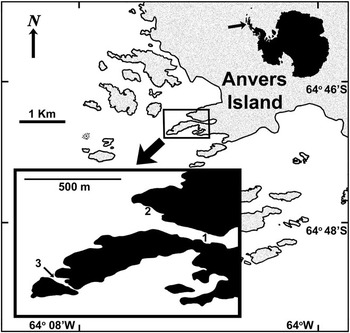
Sixty Notothenia coriiceps were collected between March and May 2008 from three sites adjacent to Palmer Station, Anvers Island, off the western Antarctic Peninsula (64°46′S, 64°04′W, Fig. 1). All fish were caught using a baited trap which was positioned in the appropriate macroalgal habitat type by SCUBA divers. Bait (chopped mackerel and cod liver oil) was placed in a mesh bag to preclude ingestion by captured fish. The three sites were Hero Inlet Desmarestia menziesii (HID, n = 21), Hero Inlet Palmaria decipiens (HIP, n = 21) and Bonaparte Point Desmarestia menziesii (BPD, n = 18, Fig. 1). For Antarctic fishes, an average sample size of 17 fish has been shown to be sufficient to resolve differences in gut contents (Daniels Reference Daniels1982).
Map of the study area, showing trap locations. Site 1 is Hero Inlet Palmaria decipiens (HIP), 2 is Hero Inlet Desmarestia menziesii (HID), and 3 is Bonaparte Point D. menziesii (BPD). The arrow and silhouette of the continent of Antarctica in the upper right indicate the location of Anvers Island off the western Antarctic Peninsula.

The Hero Inlet Palmaria decipiens site, site 1, was 6–7 m deep, very sheltered, and was comprised of glacial till with a silty, rubble-strewn bottom. The P. decipiens patch covered approximately 180 m2, and the surrounding area was dominated by P. decipiens, along with Iridaea cordata (Turner) Bory de Saint Vincent and occasional, isolated D. menziesii and Plocamium cartilagineum (Linn.) Dixon. Both Desmarestia menziesii sites were expansive, > 200 m2 in size. The Hero Inlet D. menziesii site, site 2, was 6–7 m deep, silty and rubble-strewn, and sheltered from most weather by the extension of Bonaparte Point. Site 3, Bonaparte Point D. menziesii, was located in a small cove near the tip of the point. This location, due to its exposure at the tip of the point, probably experienced somewhat higher overall water motion than the more sheltered Hero Inlet sites, and was not as silty. The trap depth was 3–4 m, but topography at the mouth of the cove quickly drops off to over 30 m. The trap remained in the water for a maximum of six hours at any site, and average soak time at each site was five hours.
Trapped fish were immediately euthanized in seawater containing 1 g l-1 tricaine methanesulphonate (Finquel MS-222, Argent Labs, WA) and transported to Palmer Station. Each fish was measured (total length, TL), weighed (W), sexed, dissected for removal of the stomach and intestinal tract, and muscle tissue was sampled for isotope analysis (below). Fulton’s condition factor, K (Ricker Reference Ricker1975) was calculated for each fish as:

Fulton’s condition factor is a measurement intended to reflect the body condition, or “plumpness”, of the fish.
Amphipod bait attraction experiment
In order to assess whether amphipods were attracted to the fish trap bait, and thus may have been eaten by trapped fish, we conducted an experiment. Amphipod funnel traps were created from 4 l Nalgene bottles, each with a single funnel at one end, and most of the plastic of the bottle was replaced with window screening. For three days in April 2010, amphipod traps were deployed in pairs: one trap within a baited fish trap (with fish entrances blocked so as to exclude fish), with the amphipod trap entrance directly adjacent to the bait bag, and a second trap approximately 8 m away, without bait. Both amphipod traps were at 7 m depth and positioned at the edge of a Desmarestia menziesii patch to ensure they encountered maximal amphipod populations. Amphipod traps contained small amounts of D. menziesii as habitat for any captured amphipods, and traps were soaked for 6–7.5 hr. Trapped amphipods were enumerated and bait bags inspected for the presence of additional, un-trapped amphipods.
Gut contents analyses
Digestive tracts were fixed in 10% formalin seawater for three to five days before being transferred to 90% ethanol. Stomachs were later opened and the contents flushed into petri dishes for enumeration and identification. Prey items were identified to species or taxon, counted, blotted dry on paper towelling and weighed. Amphipods were identified to species whenever possible. We calculated the relative fullness of each fish as (mg gut mass per g fish mass). The effects of site and sex on K and relative fullness were analyzed by ANOVA (SAS v9.2 for Windows). No significant interaction between site and sex was detected in either analysis, so the final analyses did not include an interaction term.
We calculated the dietary coefficient, Q:

where %N is the number of prey items belonging to a given class relative to the total number of prey items and %M is the wet weight (g) of prey items belonging to a given class relative to the total wet weight of prey items (Hureau Reference Hureau1970). Due to the difficulty in assigning a numeric value to algal fragments, we set the number of algae equal to one for each gut in which it was found. This will result in an underestimation of the importance of algae in the diet. The dietary coefficient estimates the importance of prey items in the diet of a fish as follows: Q ≥ 200 = preferred prey, 200 > Q>20 = secondary prey, and Q < 0 = accidental prey. We also calculated the % Index of Relative Importance (%IRI) (Pinkas et al. Reference Pinkas, Oliphant and Iverson1971) for each prey class. This index provides a balanced general assessment of the importance of prey taxa in the diets of predators (Liao et al. Reference Liao, Pierce and Larscheid2001). We substituted %M for a volumetric percentage, thus,

where %O is the percentage frequency of occurrence of a prey item. %IRI is the IRI of a given prey taxa relative to the total IRI of all prey taxa.
Isotope analyses
While gut contents analyses offer a short-term observation of dietary preferences, stable isotopes reflect diet on a timescale of over a year or more (Hesslein et al. Reference Hesslein, Hallard and Ramal1993). Furthermore, as we know that in waters surrounding the western Antarctic Peninsula, δ15N increases by c. 3.2‰ per trophic level (Dunton Reference Dunton2001), isotope analyses can reveal potential trophic differences in fish diets between microhabitats. Thus, isotope analyses were performed on the fish, amphipods, and their host algae in an attempt to determine longer-term feeding preferences. Amphipods and algae were collected in the field and left submerged in buckets of seawater for transport back to the laboratory. In the lab, macroalgae samples were repeatedly “dunked” in seawater to remove any amphipods and then sectioned into smaller pieces. Algae sections were scraped to remove any epiphytes, weighed, and finally placed into a drying oven. Amphipods, once removed from their host alga, were sorted and placed into separate vials by species rather than individuals, to ensure ample material was collected, and dried. A plug of tissue (c. 1 cm3) was sampled from the forward dorsal musculature of each fish. All tissue samples were continually dried in an oven at 60°C for a minimum of 40 days. At the University of Texas Marine Science Institute, all isotope samples except algae and fish were acidified with 10% HCl to remove carbonates. All samples were then rinsed with deionized H2O, redried at 60°C, and pulverized with either a Wig-L-Bug (Rinn Corp, Elgin, IL) or mortar and pestle. Tissue δ15N, δ13C, and %C and %N were determined with a Carlo Erba 2500 elemental analyser coupled to a Finnegan MAT Delta+ isotope ratio mass spectrometer (CE Instruments, NC). All isotope ratios are offered as δ15N relative to atmospheric N2 and δ13C relative to a carbon standard of citrus leaves and bovine liver, where:

and R = either 15N/14N or 13C/12C. Elemental content of samples were calculated using the dry weight, and molar C:N ratios determined.
Results
Fish communities
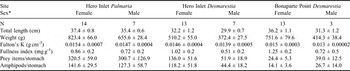
Forty females, 17 males, and one immature Notothenia coriiceps were captured and individuals ranged in size from 24–43 cm (Table I). The immature fish was excluded from analyses including gender as a factor. Two fish (one from BPD, one from HID) had empty stomachs and were not included in the analyses. Female fish were larger than male fish (ANOVA, Tukey HSD: F (1,53) = 8.25, P < 0.01). Fish from HID were smaller than those from HIP and BPD, which could not be distinguished from each other (ANOVA, Tukey HSD: F (2,53) = 13.79, P < 0.0001). Fulton’s condition factor was higher for females than for males (Table I) (ANOVA, Tukey HSD: F (1,53) = 5.73, P < 0.01), and was lower for HID fish than for the other two sites (ANOVA, Tukey HSD: F (2,53) = 8.53, P < 0.001). The fullness index of trapped fish, however, did not vary between sites or sexes (Site F (2,53) = 0.30, P > 0.05; Sex F (1,53) = 1.90, P > 0.05). Average fullness of all fish was 0.91 ± 0.1 (mean ± SE).
Summary statistics for Notothenia coriiceps by sex and site.

*One fish from Bonaparte Point could not be identified to sex and is not included in these data.
Amphipod traps
Over the course of the three days, a total of 144 amphipods of five species were captured in the un-baited trap, whereas seven amphipods of three species were present in the amphipod trap adjacent to the bait. An additional 15 amphipods were estimated to be present on the bait bag over the three days. All species found in the amphipod trap near the bait were species found in the un-baited amphipod trap community.
Gut contents
The number of prey items in the stomachs varied by site, but not by sex (Site F (2,53) = 12.81, P < 0.0001; Sex F (1,53) = 0.5, P > 0.05). Fish from HID and BPD had lower numbers of prey items in the gut than fish from HIP. Similarly, the number of amphipods in the stomachs varied by site and not by sex (Site F (2,53) = 4.95, P = 0.01; Sex F (1,53) = 0.83, P > 0.05). The number of amphipods in stomachs from HID could not be distinguished from any other site, but stomachs from HIP had higher numbers of amphipods than stomachs from BPD. As there were no gender differences in terms of numbers of prey items or fullness, we did not separate sexes in the gut content data tables.
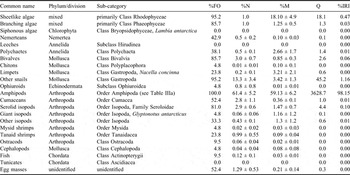
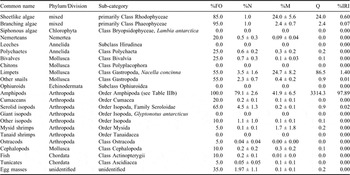
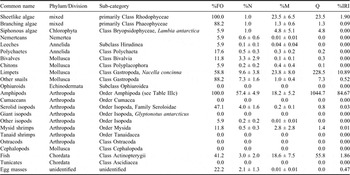
The most abundant and frequently occurring prey item at all three sites was amphipods (Table II). By percent of gut mass, more amphipods were found in stomachs at HIP than at the other two sites (ANOVA: F 2,55 = 11.49, P < 0.0001). Other important prey classes included snails, limpets, algal blades, and for BPD, fishes (Table II). Bivalve molluscs and serolid isopods also occurred quite frequently, but accounted for very little mass in the guts. At HIP, amphipods and algae constituted almost the entirety of gut contents, although due to their high numbers, snails were included in the secondary food category. At HID, amphipods were the primary food source, and algal blades and the limpet Nacella concinna (Strebel) were secondary food sources. Again, it should be noted that Q underestimates the importance of algae in the diet; if we had been able to enumerate algal thalli rather than arbitrarily assigning a numeric value of one, algae probably would have fallen into the primary food category. Fish from BPD had the most varied diet, with amphipods and N. concinna as primary food sources, and algal blades and fish as secondary food sources. By mass, however, N. concinna, algal blades, and fish all occupied a higher percentage of the diet than amphipods.
Gut contents of N. coriiceps from Hero Inlet Palmaria.
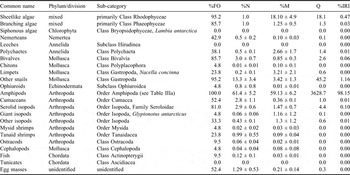
Gut contents of N. coriiceps from Hero Inlet Desmarestia.

Gut contents of N. coriiceps from Bonaparte Point Desmarestia.

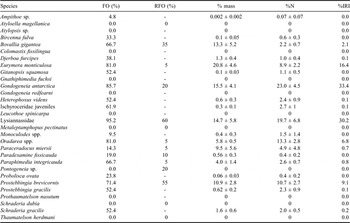
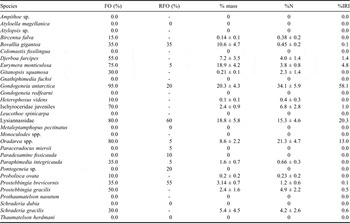
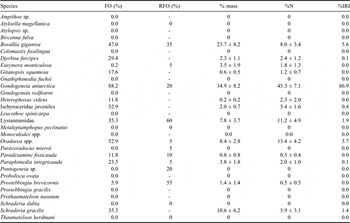
Of the 19 species of amphipods found in fish stomachs, only six were present at levels of ≥ 5% IRI at one or more sites. Four species had relatively high %IRI at all sites: Gondogeneia antarctica Chevreux, Oradarea spp., Family Lysianassidae, and Eurymera monticulosa Pfeffer (Table III). The other two species, Bovallia gigantea and Prostebbingia brevicornis Chevreux, were abundant in stomachs at BPD and HIP, respectively. Bovallia gigantea was a fairly high percentage, by mass, of the amphipod composition of the gut at all three sites.
Breakdown of amphipods in N. coriiceps gut contents to lowest identifiable taxa for Hero Inlet Palmaria.

Breakdown of amphipods in N. coriiceps gut contents to lowest identifiable taxa for Hero Inlet Desmarestia.

Breakdown of amphipod gut contents to lowest identifiable taxa for Bonaparte Point Desmarestia.

Isotope analyses
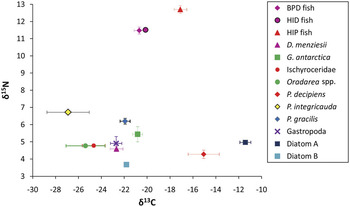
Neither δ15N nor δ13C correlated with C:N ratio (Pearson correlations, P > 0.1), indicating that both measures were valid for determining dietary and trophic differences among species and fish groups. Site of capture had a significant effect on Notothenia coriiceps δ15N (ANOVA: F 2,55 = 13.44, P < 0.0001), but sex did not (ANOVA: F 1,55 = 0.07, P = 0.8). Site also had a significant effect on N. coriiceps δ13C (ANOVA: F 2,55 = 18.29, P < 0.0001), and again, sex did not (ANOVA: F 1,55 = 0.06, P = 0.8). Fish from HIP had higher values of δ15N and δ13C (means of 12.7 and -17.1, respectively) than fish from HID (means of 11.5 and -20.1) and BPD (means of 11.5 and -20.7), which could not be distinguished from one another (Fig. 2, Tukey HSD). The interaction between sex and site was not significant in either case, and was excluded from the final model.
δ13C and δ15N isotope values for species sampled around Palmer Station, Antarctica. Data points are averages with standard error bars. BPD is Bonaparte Point Desmarestia menziesii, HID is Hero Inlet Desmarestia menziesii, and HIP is Hero Inlet Palmaria decipiens. Full species names for amphipods may be found in Tables IIIa-c.

Palmaria decipiens had much higher δ13C values (mean of -15.1‰) than did Desmarestia menziesii (mean of -22.8‰, Fig. 2). The amphipods sampled ranged in mean δ13C values from -26.9‰ for Pariphimedia integricauda Chevreux to -20.8‰ for Gondogeneia antarctica. All amphipods were sampled from Desmarestia spp., and amphipod δ13C values were closer to δ13C values for D. menziesii than P. decipiens (Fig. 2).
Discussion
Female Notothenia coriiceps were larger than their male counterparts, as had been found previously (Burchett et al. Reference Burchett, Sayers, North and White1983). Our fish, however, differed on average by 2.9 cm while fish from South Georgia differed by 5.4 cm. Fish from King George Island, South Shetlands, had a fullness index (gut mass/body mass) of 0.88 in winter and 1.55 in summer (Linkowski et al. Reference Linkowski, Presler and Zukowski1983). Our fish, trapped in autumn, were closer to the winter fullness value (Table I). Fish from HID were smaller and in poorer condition than for the other two sites. There were, however, no obvious differences in diet or isotopic composition to explain this.
Differences in gut contents found between sites were much greater than those between macroalgal communities. Fish from Bonaparte Point had a more varied diet than those from Hero Inlet, despite the fact that these two sites were only about 600 m apart from one another (Fig. 1). Amphipods were clearly a primary prey component for all sites and algal habitats, but dietary coefficients for the two Hero Inlet sites were three times that of the Bonaparte Point site. By mass, amphipods were more abundant in stomachs from the Palmaria decipiens site than from the two Desmarestia menziesii sites. This supports the hypothesis that amphipods would be easier to catch among the simply structured, palatable P. decipiens. In aquarium experiments, Notothenia coriiceps was much more efficient at capturing prey on P. decipiens or a simply-structured plastic analogue than it was at capturing prey on D. menziesii or a complexly structured plastic analogue (Zamzow et al. Reference Zamzow, Amsler, McClintock and Baker2010). Surprisingly, there were no differences between capture rates on real algae vs their plastic structural analogues. In the field, the sheer abundance of the finely-branching D. menziesii is likely to exacerbate the difficulty of prey capture in comparison with small-scale laboratory experiments. In any case, the hypothesis that fish might capture more amphipods in D. menziesii habitats due to their orders-of-magnitude higher abundances has been disproven.
Fish from both Desmarestia menziesii sites contained high percentages by mass of limpets in the diet, and at Bonaparte Point these were a primary food item. Sheet-like algae, predominantly Palmaria decipiens and Iridaea cordata, were about twenty percent of the diet by mass at every site. Both these species are known to be palatable to N. coriiceps (Amsler et al. Reference Amsler, Iken, McClintock, Amsler, Peters, Hubbard, Furrow and Baker2005). Previous work at King George Island demonstrated that N. coriiceps grazes selectively on macroalgae (Barrera-Oro & Casaux Reference Barrera-Oro and Casaux1990, Iken et al. Reference Iken, Barrera-Oro, Quartino, Casaux and Brey1997), and our results support this finding. Branching algae, primarily Desmarestia spp., were found in 85–95% of guts, but only in very small quantities. In feeding experiments, N. coriiceps reject D. menziesii (Amsler et al. Reference Amsler, Iken, McClintock, Amsler, Peters, Hubbard, Furrow and Baker2005). This suggests that the chemically defended D. menziesii is not a targeted food item, rather is ingested incidental to other prey, such as the abundant amphipods that live in close association with the alga. One fish from Bonaparte Point contained the siphonous alga Lambia antarctica (Skottsberg) Delépine, which is only found in deeper, moderate- to high-energy habitats, including at 30 m or more depth outside the cove at Bonaparte Point (Amsler, personal observations). This indicates that, despite their small home ranges (Campbell et al. Reference Campbell, Fraser, Bishop, Peck and Egginton2008), fish from Bonaparte Point must be leaving the shallow waters of the cove at least occasionally, and foraging in the deeper neighbouring waters.
Amphipods were found in every gut examined, usually in great numbers. Our frequency of occurrence values for most species are higher than those found by Richardson (Reference Richardson1975) at South Orkney. In terms of species abundance and percentage by mass, the two Hero Inlet sites resemble each other, despite their differences in location and macroalgal cover. Gondogeneia antarctica, Oradarea spp., and Family Lysianassidae are important components of the diet at all three sites. Two other amphipod species that comprised 5% or more of the IRI at some sites, Eurymera monticulosa and Bovallia gigantea, were not particularly numerous in the guts, but are large amphipod species that contributed considerable mass relative to other species (Table III). The final species that comprised 5% of the IRI at HIP, Prostebbingia brevicornis, did so via relatively equal contributions of numbers and mass. Amphipod distributions are likely to vary between the three communities on both spatial and temporal bases, so because we did not simultaneously sample amphipods, it is impossible to determine whether the species distributions in fish stomachs match environmental availability. Diurnal changes in amphipod communities are well documented (e.g. Taylor Reference Taylor1998), but because observations suggest Notothenia coriiceps is primarily a visual hunter (Zamzow et al. Reference Zamzow, Amsler, McClintock and Baker2010), we believe that the majority of amphipods in the guts would have been captured during daylight hours. Given that so few amphipods were attracted to the bait in our amphipod trapping experiment, we believe that the gut contents data presented here are an accurate instantaneous reflection of fish diets in the three microhabitats.
Isotope analyses
Despite the similarity in gut contents between the two Hero Inlet sites, fish from HIP had significantly more enriched δ15N and δ13C values than fish from the two D. menziesii sites, indicating that HIP fish are potentially feeding at a higher trophic level than BPD or HID fish. Of course, while gut contents analyses offer a “snapshot in time”, stable isotopes reflect diet over a year or more (Hesslein et al. Reference Hesslein, Hallard and Ramal1993). Furthermore, isotopic composition of muscle tissue reflects what was assimilated by the fish, not simply what was eaten.
Previous isotope work with Antarctic Peninsular fauna estimated a δ15N increase of 3.2‰ per trophic level (Dunton Reference Dunton2001). While amphipods were the primary prey items in the guts, the δ15N for fish muscle were at least 5‰ greater than that of any amphipod species measured, indicating that fish must also feed on prey with higher δ15N than the amphipods we measured. We did not measure δ15N nor δ13C for Bovallia gigantea, which was found in up to 67% of the guts. These amphipods are predators on copepods and other amphipods (Bone Reference Bone1972), thus they should have higher δ15N levels than the omnivorous amphipods we measured, and may explain some of the elevated δ15N found in fish tissue. Clearly, predation on fish, which was demonstrated in our gut contents, would also elevate δ15N values. It was surprising to us that the BPD fish, which had other fish in 42% of guts, did not have higher δ15N values than fish from the other two sites where fish were found in only 9.5–10% of guts. This leads us to believe that there may have been a transitory abundance of fish prey at Bonaparte Point, resulting in high representation in gut contents which was not confirmed by isotopic data. Another possible explanation for the high trophic status of N. coriiceps is the ingestion of polychaetes, the remains of which were found in around a quarter of the guts analyzed. Dunton (Reference Dunton2001) measured δ15N levels of the omnivorous Antarctic Peninsular polychaete Harmothoe spinosa Kinberg as 9.8‰. This study, and previous work (Iken et al. Reference Iken, Barrera-Oro, Quartino, Casaux and Brey1997), have found a high percentage by mass of macroalgae in fish gut contents. The high trophic status of N. coriiceps indicated by the δ15N levels we found makes us believe that, in terms of assimilation into muscle tissue, algae must not be as important as the dietary coefficient would predict. Notothenia coriiceps is an omnivore, and does not possess the long, specialized digestive tract of an herbivore. As digestive tract length is directly related to the efficacy of algal assimilation (Benavides et al. Reference Benavides, Cancino and Ojeda1994), fish may simply not be able to absorb much of the algae that passes through their digestive tract.
Palmaria decipiens had much more enriched δ13C levels than did D. menziesii, and P. decipiens fish had significantly higher δ13C levels than the fish from D. menziesii habitats. This may indicate that fish from the P. decipiens site are ultimately deriving their nutrition from a mixture of P. decipiens and animals that feed on P. decipiens. Palmaria decipiens is a food item highly preferred by Gondogeneia antarctica (Huang et al. Reference Huang, McClintock, Amsler, Peters and Baker2006, Aumack et al. Reference Aumack, Amsler, McClintock and Baker2010), the most numerous amphipod species found in HIP fish guts. Unfortunately, we only looked at isotopic signatures for Gondogeneia antarctica from D. menziesii, so we are unable to determine whether P. decipiens in the guts of amphipod prey is driving the enriched δ13C levels found in HIP fish.
While fish were never found to have Desmarestia menziesii in the gut in significant amounts, the tight coupling in δ13C values between D. menziesii and the HID and BPD fish may reflect D. menziesii as the ultimate nutrition source for their prey. Dunton (Reference Dunton2001) noted the trophic importance of benthic brown algae near Palmer Station, and offered evidence that most algal carbon may be channelled through the detrital food web and transferred to higher trophic levels. Alternatively, some epiphytic diatom δ13C values are very close to those of HID and BPD fish. Given the insignificant amounts of D. menziesii found in fish guts, combined with the extensive amounts of diatoms found in amphipod guts (Aumack, personal observations), we believe it is also possible that N. coriiceps are ultimately deriving their carbon from benthic diatoms despite no direct grazing by fish.
Acknowledgements
The authors gratefully acknowledge field assistance from G. Koplovitz, P. Bucolo, J. Cuce and the Raytheon Polar Services staff at Palmer Station, Antarctica. We are indebted to P. Bucolo and K. Jackson for assistance processing isotope samples, and to K. Kasanagottu for assistance in enumerating amphipods. This work was supported by National Science Foundation grants ANT-0631328 (JPZ), OPP-0442769 (CDA and JBM) and OPP-0442857 (BJB). The constructive comments of the reviewers are also gratefully acknowledged.