Introduction
Aging of the world's population is a phenomenon that affects developed and developing countries alike (Cohen, Reference Cohen2003). This process has led to a rapid increase in the number of people living with dementia worldwide, particularly in low- and middle-income countries (LAMIC) where most older people now live (Murray and Lopez, Reference Murray and Lopez1997; Ferri et al., Reference Ferri2005). Consequently, there is a pressing need for the introduction of interventions targeted at common causes of dementia that could effectively reduce its prevalence and incidence (Brookmeyer et al., Reference Brookmeyer, Johnson, Ziegler-Graham and Arrighi2007; Borysiewicz, Reference Borysiewicz2010).
The findings from recent observational studies suggest that socieconomic adversities across the lifespan increase the risk of dementia (Whalley et al., Reference Whalley, Dick and McNeill2006; Fratiglioni and Wang, Reference Fratiglioni and Wang2007). Lower educational attainment is consistently associated with increased risk of dementia (Caamano-Isorna et al., Reference Caamano-Isorna, Corral, Montes-Martinez and Takkouche2006; Ngandu et al., Reference Ngandu2007). Low educational attainment earlier in life generally triggers a cascade of socioeconomic circumstances later in life, such as poorly paid unskilled occupations and lower income. Occupation attainment and income have also been associated with dementia (Qiu et al., Reference Qiu, Karp, von, Winblad, Fratiglioni and Bellander2003; Andel et al., Reference Andel2005; Karp et al., Reference Karp, Andel, Parker, Wang, Winblad and Fratiglioni2009). These are potentially modifiable risk factors for dementia that can be addressed through the introduction of appropriate public policies, although no LAMIC governments seem to have had the foresight to address this issue in a purposeful and systematic way to date. If we draw a parallel between primary preventive measures for dementia with those for preventing cardiovascular disease by reducing the average population salt intake, with consequent decrease of mean blood pressure levels and hypertension, we predict that such measures may have a greater impact than preventive strategies targeted at high-risk individuals, and that such impact is likely to be stronger in LAMIC, where educational achievement is still low, than in wealthy countries (Bibbins-Domingo et al., Reference Bibbins-Domingo2010).
In our study focusing on an underprivileged population of older adults in São Paulo, we showed that being born in a rural setting triggered a cascade of social adversities that increased the risk of dementia later in life (Scazufca et al., Reference Scazufca2008a). Older adults born in rural areas were approximately 3.5 times more likely to be illiterate than those born in cities, 2.4 times more likely to have non-skilled occupations and 1.4 more likely to have low incomes. Occupation and income were associated with education, and those who were illiterate also had more non-skilled occupations and lower incomes than those who had received some formal education. Therefore, these social adversities are all interconnected across the life course, and importantly, they are also associated with other lifestyle factors that modulate the risk of dementia, such as diet, smoking, and physical activity. In fact, in this population, the prevalence of dementia was approximately twice as high amongst older adults without education, in non-skilled occupations and with lower incomes, compared with those with some degree of education, in more skilled occupations and with higher incomes.
We designed the present study to estimate the proportion of cases of dementia that can be attributed to social adversity along the lifespan. In other words, we assessed the proportion of the prevalence of dementia in this population that might be avoided if some distal, intermediate and proximal risk factors for dementia (illiteracy, non-skilled occupations and low income, respectively) in this population were eliminated through public policies.
Methods
This report is based on data from the São Paulo Ageing & Health Study (SPAH). Details about the study have been described elsewhere (Scazufca et al., Reference Scazufca2008b). Briefly, between 2003 and 2005, all persons aged 65 years and older resident in 66 predefined census sectors of the borough of Butantã, located in the west side of the city of São Paulo, Brazil, were contacted and invited to participate in the study. They were recruited through door knocking of 21,727 households within the census sectors boundaries. In total, 2,266 eligible persons were contacted and invited to participate, and 2,072 (91.4%) were assessed. For each participant, an informant familiar with the life history of the participant was invited to provide collateral information. Informants were aged 16 years or over, generally living with the participant.
The study received ethics approval from the Brazilian National Committee for Ethics and Research (CONEP-Brazil) and all participants provided written informed consent.
Data collection and assessments
Data were collected by a team of trained mental health professionals. Training took approximately one month and consisted of direct teaching and discussions about all aspects of the study protocol, including its procedures and application of all instruments. The assessment of participants and informants took place at their homes and, whenever possible, participants and informants were interviewed simultaneously by two different research assistants.
Primary outcome
We used the harmonized one-phase dementia diagnostic procedure developed by the 10/66 Dementia Research Group (DRG) to establish the diagnosis of dementia (Prince et al., Reference Prince, Acosta, Chiu, Scazufca and Varghese2003). This procedure was validated for use in LAMIC in a multicenter study that included the geographic area of our study (Scazufca et al., Reference Scazufca2002). The 10/66 DRG procedures include the direct assessment of participants’ cognitive function with the Community Screening Instrument for Dementia (CSI-D; Hall et al., Reference Hall, Gao, Unverzagt and Hendrie2000), an adapted version of the CERAD ten word list learning task with delayed recall and animal verbal fluency (Welsh et al., Reference Welsh1994), a structured clinical mental state interview with the Geriatric Mental State (GMS; Copeland et al., Reference Copeland, Dewey and Griffiths-Jones1986; Prince et al., Reference Prince2004), and a structured neurological assessment of localizing signs, parkinsonism, ataxia, apraxia and primitive “release” reflexes. As part of the 10/66 DRG diagnostic procedure, informants are asked about participants’ activities of daily living and general health with the CSI-D (Hall et al., Reference Hall, Gao, Unverzagt and Hendrie2000), and about family history with the History and Aetiology Schedule Dementia Diagnosis and Subtype (HAS-DDS; Dewey and Copeland, Reference Dewey and Copeland2001). An algorithm combines data from all assessments carried out with participants and informants and classifies participants as having dementia or not. The diagnosis of dementia followed DSM-IV criteria (American Psychiatric Association, 1994).
Exposures
We gathered data on socioeconomic position (SEP) from direct interview with participants and their informal carers. We established participants’ ability to read and write (early SEP indicator), and recorded their occupational history. The job history was elicited and the highest occupation throughout life was used as an indicator of adult SEP. Monthly personal income (including salary, government benefits, family donation and money received from other sources) at the time of the interview was used as an indicator of proximal SEP.
Binary variables were created for all exposures. Participants were grouped as illiterate when they were not able to read and write, and as literate when they were able to read and/or write. Occupation was dichotomized into non-skilled (such as non-skilled labourer, agricultural worker and housework) and skilled or semi-skilled occupations (such as clerical, shop keeper, skilled and semi-skilled laborer, professionals). Participants with a total personal monthly income lower than the official minimum wage in Brazil at the time of the study (less than US$85 per month) were classified as low income and the rest as high income.
Statistical analysis
We restricted our analysis to participants born in Brazil, as the meaning of SEP indicators may vary according to place of birth and culture. We also excluded from the analysis two participants with incomplete SEP data. The association of dementia with sociodemographic and clinical characteristics of participants was examined using χ2 tests (categorical variables) and t-student tests (continuous variables). We used the “aflogit” command of the Stata software package to calculate the population attributable fraction (PAF) of dementia associated with the SEP exposures. PAF assumes the exposures (i.e. SEP indicators) cause the outcome (i.e. dementia) and provide an estimate of the proportion of people in the population that would not develop the outcome (i.e. dementia) if the exposures (i.e. SEP indicators) were no longer present (Greenland and Robins, Reference Greenland and Robins1988). We first calculated the age- and gender- adjusted PAFs for each SEP indicator. These analyses estimated the proportion of prevalent dementia that would be prevented if each SEP indicator (illiteracy, non-skilled occupations and low income) was eliminated without changing the other ones. We also estimated the proportion of dementia that would be prevented if two or more SEP indicators were eliminated concomitantly (illiteracy and non-skilled occupations, non-skilled occupations and low income, or illiteracy, non-skilled occupations and low income). Sample size was calculated on the basis of the precision of the prevalence estimate, as reported in detail elsewhere (Scazufca et al., Reference Scazufca2008b).
Results
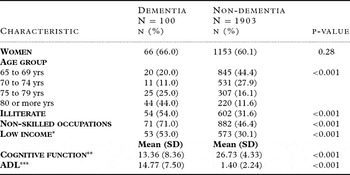
Among the 2072 participants included in the SPAH, 2005 (96.8%) were born in Brazil. Two participants had missing information for occupation and were excluded from the analysis. The mean age of the 2003 individuals included in the analysis was 72.2 years (SD 6.3; range 65 to 101 years old); 1219 (60.9%) were women; 656 (32.8%) were illiterate; 953 (47.6%) had non-skilled occupations; and 626 (31.3%) had a monthly personal income lower than US$85, the official minimum Brazilian wage at the time of data collection. Women and older participants were more frequently exposed to socioeconomic adversities across the lifespan. Illiteracy was more frequent in women than in men (38% vs. 25%, respectively, χ2 = 35.14, p < 0.001) and increased with age (65 to 69 years old 25% vs. 80 years old or more 50%, χ2 = 68.51, p < 0.001). Associations in the same direction were found for non-skilled occupations (women 64% vs. men 22%, χ2 = 326.17, p < 0.001; 65 to 69 years old 43% vs. 80 years or more 60%, χ2 = 25.93, p < 0.001) and monthly personal income lower than the Brazilian minimum wage (women 38% vs. men 21%, χ2 = 64.04, p < 0.001; 65 to 69 years old 30% vs. 80 years or more 37%, χ2 = 5.94, p < 0.12). One hundred participants had dementia, yielding a prevalence of 5.0% (95%CI = 4.1% to 6.0%). Participants with dementia were more frequently illiterate, with non-skilled occupations, current lower monthly personal incomes, worse cognitive functioning and worse performance of activities of daily living (ADLs) than those without dementia (Table 1).
Characteristics of participants according to dementia status (N = 2003)

*Low income: total personal monthly income lower than the official minimum wage in Brazil at the time of the study (less than US$85).
**Cognitive function: assessed with the Community Screening Instrument for Dementia (higher scores = better cognitive functioning.
***ADL: Activities of Daily Living assessed with the informant's part of the Community Screening Instrument for Dementia (higher scores = worse ADL performance).
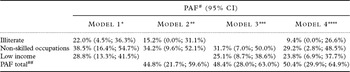
Table 2 presents the age- and gender- population attributable fractions (PAFs) for all indicators of socioeconomic adversities investigated. The age- and gender- adjusted PAFs for illiteracy, non-skilled occupations and low income were 22.0%, 38.5% and 28.8%, respectively (model 1). The PAF for the combination of the two most distal indicators of SEP (illiteracy and non-skilled occupations) was 44.8% (model 2), with a larger contribution of occupation, and the PAFs for the two most proximal indicators (non-skilled occupations and low income) were 48.4% (model 3), also with occupation contributing more. When the three indicators of SEP were considered simultaneously (model 4), the corresponding PAF increased to 50.4%, with similar contributions of occupation and income. PAF estimates were associated with wide 95%CIs.
Population attributable fractions (PAF) of prevalent dementia due to illiteracy, non-skilled occupations and low income (N = 2003)

#PAF = population attributable fraction.
*Model 1: age- and gender-adjusted PAFs for illiteracy, non-skilled occupations and low income.
**Model 2: age- and gender-adjusted PAFs for illiteracy and non-skilled occupations.
***Model 3: age- and gender-adjusted PAFs for non-skilled occupations and low income.
****Model 4: age- and gender-adjusted PAFs for illiteracy, non-skilled occupations and low income.
##PAF total: for the concomitant presence of SEP indicators in the model.
Discussion
We designed this study to determine how much of the prevalence of dementia in a low-income population of Brazil can be attributed to socioeconomic adversities. Our results show that socioeconomic indicators across the lifespan are inter-connected, and that women and the “old old” have been exposed to a particularly large number of adverse SEP indicators. Illiteracy, poor occupational achievement and low income accounted for 22.0% to 38.5% of the cases of dementia in our sample. Our analyses also showed that nearly 50% of the prevalence of dementia could be potentially attributed to the combination of two or three of the socioeconomic adversities investigated.
Other investigators had previously shown that these three indicators of socioeconomic adversity are associated with increased risk of dementia (Whalley et al., Reference Whalley, Dick and McNeill2006; Caamano-Isorna, Reference Caamano-Isorna, Corral, Montes-Martinez and Takkouche2006; Ngandu et al., Reference Ngandu2007), and our results add to this body of evidence by demonstrating that they probably contribute to modulate certain aspects of cognitive reserve later in life (Scazufca et al., Reference Scazufca2008a). In addition, the SEP indicators that we used in our study are likely to be associated with other risk factors for dementia, such as lifestyle (e.g. smoking and diet) and access to health services (thereby facilitating or hindering the management of hypertension and diabetes) (Andel et al., Reference Andel2005; Kivipelto et al., Reference Kivipelto, Ngandu, Laatikainen, Winblad, Soininen and Tuomilehto2006; Weih et al., Reference Weih, Wiltfang and Kornhuber2007). Of note, our three SEP indicators highlight the influence of extreme conditions (i.e. illiteracy, unskilled work and very low income) that are no longer socially acceptable. Indeed, one of the Millennium Development Goals established by the United Nations for 2015 is to ensure that all children throughout the world have access to primary schooling (United Nations, 2008). Another Millennium goal is to reduce poverty and hunger by achieving full employment and a decent income for all workers. This goal should reduce the proportion of adults whose only prospects in life are unskilled, poorly paid jobs. Also, minimum income policies aimed at reducing poverty among the elderly would have an impact on reducing the proportion of elderly with very low incomes. The results of our study suggest that the burden of dementia in the developing world could be much lower if the Millennium Development Goals were achieved. Unfortunately, society continues to move slowly towards these aspirational goals.
In middle income countries, such as Brazil, illiteracy in the younger population is already low and will continue to decrease in the next decades (United Nations Department of Economic and Social Affairs, 2002). However, most middle income countries are already in an advanced stage of population aging, and the main target for prevention of dementia should be the adult and elderly population that did not have access to schooling and now have poor occupational skills and low incomes (United Nations Department of Economic and Social Affairs, 2007). Again, improving occupational skills is more likely to impact the younger than the older adult population, as most older individuals are already retired. In contrast, improving the incomes of the elderly population could potentially have a more immediate impact in reducing the prevalence of dementia, by offering older adults at risk greater access to health services and a healthier lifestyle (e.g. improved diet).
This study has limitations and strengths that we wish to acknowledge. Although the sample size had enough power to show that the PAFs were different from zero (Browner and Newman, Reference Browner and Newman1989), the precision of the PAF estimates was low, leading to an uncertainty about their true value. We acknowledge that a cross-sectional study such as SPAH cannot establish a causal relationship between SEP indicators and dementia, although our results suggest that these factors play an important role in the expression of the syndrome, as confirmed by others working with socially deprived populations living in developed countries (Smith et al., Reference Smith2008). The socioeconomic characteristics of the study population are similar to those shown in the census data for heads of households aged 60 years or over in Brazil (Instituto Brasileiro de Geografia e Estatística, 2002), and this supports the external validity of our results. There is no reason to suppose that the observed associations would be different for the Brazilian population of older adults, and possibly for older adults from low socioeconomic status worldwide. The SEP indicators that we used in our study were simple and objective, but only allowed us to investigate the impact of extreme socioeconomic deprivation. We also acknowledge that the association between personal income and dementia could be potentially due to reverse causality, as the onset of dementia may reduce access to a regular income. Nonetheless, this seems an unlikely explanation for our findings, as the main source of income for older people is the retirement pension, which is introduced before Brazilians reach the age of higher risk for dementia (i.e. most Brazilians start receiving their pension by age 45–60 years after 30 years of work). We acknowledge that our ascertainment of “caseness” may have been influenced by some of our SEP indicators (such as poor education), but the 10/66 protocol that we used to establish the diagnosis of dementia was developed specifically to minimize this type of bias. Nevertheless, we cannot exclude the possibility of misclassification of dementia caseness, as in all epidemiological studies. However, we cannot see any reason why this measurement error would be related to our key exposures and therefore the expectation would be that this non-differential misclassification could bias our results towards the null. We also acknowledge that we did not adjust our models for factors that could potentially confound the observed associations, such as smoking, hypertension, diabetes, vascular diseases, depression and genetic predisposition. Consequently, the resulting PAFs associated with SEP indicators may have been inflated, although a previous analysis of this cohort found no obvious association between prevalent dementia and smoking, hypertension and diabetes (Scazufca et al., Reference Scazufca2008a).
In summary, our results show that improvements in education, occupational skills and income could potentially have a role in the primary prevention of dementia. A positive aspect of social policies aimed at decreasing social adversities is that the majority of the population welcomes them. In addition, the social benefits associated with the improvement in SEP indicators worldwide would not be limited to dementia, and the costs associated with their implementation now would be lower than the long-term costs of inaction.
Conflict of interest
None
Description of authors' roles
M. Scazufca and P. R. Menezes designed the study, formulated the research question, supervised the data collection, analyzed the data and wrote the paper. O. P. Almeida helped formulate the research question and draft the paper.
Acknowledgments
This study was funded by the Wellcome Trust, U.K. (GR066133MA) and Conselho Nacional de Desenvolvimento, Científico e Tecnológico, Brasil (whch partially supported M. Scazufca and P. R. Menezes). We thank Renata Nunes dos Santos and Cintia Seabra for their support at all stages of this project. We also thank the staff who contributed to the data collection.