Background
Breast cancer is characterized by abnormal and malignant proliferation of breast tissue cells (Dehghan et al., Reference Dehghan, Mogharabi and Zabbah2018). It accounts for about 25% of all cancers in women (Akbari et al., Reference Akbari, Sayad and Sayad2017), and its global incidence is estimated at 38 per 100,000 individuals (Ianakieva et al., Reference Ianakieva, Fergus and Ahmad2016). In Iran, like in several other developing countries, breast cancer is the most common cancer in women and is the second most common cancer after lung cancer (Keihanian et al., Reference Keihanian, Ghadi and Zakerihamidi2017).
Breast cancer can have profound effects on women's sexual health, including their sexual function (Shahid Sales et al., Reference Shahid Sales, Hasanzadeh and Sania Saggade2017). It has been shown that women with breast cancer may suffer from some degrees of sexual dysfunction (Kowalczyk et al., Reference Kowalczyk, Nowosielski and Cedrych2019), marital dissatisfaction (Esfandiari Dolabi et al., Reference Esfandiari Dolabi, Joulaei and Asli Azad2015), and sexual dissatisfaction (de Camargo, Reference De Camargo2016). Meanwhile, although medical factors, such as the extent of the disease and the type of treatment, play an essential role in women's sexual health (Del Pup et al., Reference Del Pup, Villa and Amar2019), evidence shows that the impact of cancer on women's sexual activity is unalike. Some women with breast cancer, despite the consequences of treatment such as surgery and hormone therapy, report that their sexual activity has not stopped and they have been able to balance their sex life with their illness (Andersen, Reference Andersen1999; Yurek et al., Reference Yurek, Farrar and Andersen2000). However, in some other patients, the diagnosis and treatment of cancer significantly affects their sexual life, and they report significant reductions in sexual desire and activity (Boswell and Dizon, Reference Boswell and Dizon2015; Bai et al., Reference Bai, Arver and Johansson2019).
Therefore, it seems that breast cancer, as a stressful factor in life, cannot be accounted for as the reason for the difference in sexual activity. Meanwhile, it seems that factors such as sexual identity and sexual role can play a critical role in the sexual function of women along with physical and physiological conditions. In this regard, the construct of sexual self-concept seems to be able to explain why the sexual activity of some women with breast cancer is stopped completely, while in some others, sexual activity is almost unaffected (Andersen, Reference Andersen1999; Yurek et al., Reference Yurek, Farrar and Andersen2000; Ziaei et al., Reference Ziaei, Farahmand Rad and Roshandel2018). This means that women with negative sexual self-concept can be predicted to have more sexual problems following the diagnosis and treatment of cancer (Ziaei et al., Reference Ziaei, Farahmand Rad and Roshandel2018). Because these women are generally less romantic and sensual in their emotions, they try less to adjust to their sexual problems, experience less sexual activity, and are more prone to negative emotions and cognitions such as shame and anxiety (Mohammadinik, Reference Mohammadinik2017; Yazdani et al., Reference Yazdani, Mahmoodi and Azin2019). In contrast, women with positive sexual self-concept are predicted to have higher levels of sexual response, sexual satisfaction, marital satisfaction, and marital adjustment; thus, they become more involved in sexual activity (Aliakbari Dehkordi, Reference Aliakbari Dehkordi2010; Blunt, Reference Blunt2012; Anderson, Reference Anderson2013; De Camargo, Reference De Camargo2016; Yazdani et al., Reference Yazdani, Mahmoodi and Azin2019). In this regard, it has been stated that sexual self-concept scores predict sexual changes following the diagnosis of breast cancer (Andersen, Reference Andersen1999; Yurek et al., Reference Yurek, Farrar and Andersen2000).
Studies have shown that women's sexual self-concept in certain conditions, including chronic diseases, may be compromised (Steinke et al., Reference Steinke, Wright and Chung2008; Carpenter et al., Reference Carpenter, Andersen and Fowler2009). In particular, breast cancer-related surgeries such as mastectomy can affect sexual self-concept (Yurek et al., Reference Yurek, Farrar and Andersen2000). Sexual self-concept is a multidimensional, active, and dynamic trait that refers to individuals’ positive and negative perceptions and feelings about themselves as sexual beings (Ramezani et al., Reference Ramezani, Ghaemmaghami and Talakar2013). Sexual self-concept is the feelings, beliefs, and perceptions that people have about their sexual issues, based on which they adjust their behaviors (Ramezani et al., Reference Ramezani, Ahmadi and Ghaemmaghami2018). This emotional phenomenon helps to gain awareness, identity, and self-esteem during one's sexual life (Ziaei et al., Reference Ziaei, Khoei and Salehi2013). Sexual self-concept originates from experiences, emerges in current experiences, and serves as a guide for sexual behaviors. How one feels about themselves, as sexual beings will affect their sexual behaviors and experiences (Deutsch et al., Reference Deutsch, Hoffman and Wilcox2014). The evaluation of sexual self-concept is a key predictor of the occurrence of sexual behaviors and can be effective in promoting mental and sexual health (Nekoueifard and Jahangiry, Reference Nekoueifard and Jahangiry2014). Since breast cancer targets one of the most important sexual organs of women, it is extremely vital to adopt strategies to promote sexual health, including sexual self-concept, in patients with this disease.
A review of the literature shows that various methods such as telephone counseling, web-based training (Hummel et al., Reference Hummel, Van Lankveld and Oldenburg2015), and social networking (Anderson, Reference Anderson2013) have been used to improve sexual health. Today, people can communicate and exchange information, regardless of social status or time. The predominant term for such sharing of ideas and information on the Internet or mobile operating systems is the “social media” (Lloyd, Reference Lloyd2014). Due to the increasing use of new technologies, such as the Internet and social spaces and groups and virtual channels, and their traceability, availability, and ease of use, the Internet has become one of the main ways to provide information to clients and educate those (Sedaghati and Ardjmand, Reference Sedaghati and Ardjmand2006). Thus, health education and health promotion researchers around the world are working to discover creative ways based on the Internet and other social media to increase the effectiveness of interventions (Kagan and Kuhn, Reference Kagan and Kuhn2004).
Internet use in Iran has surged markedly, and Iranian users are ranked fifth in using online networks. Reports indicated that the ranking of Iranian users in the use of Internet websites in 2016 was as follows: 4th for Yahoo, 5th for Wikipedia, 6th for Blogfa, 9th for Instagram, and 14th for Telegram and WhatsApp. On a global scale, the use of Telegram and WhatsApp in the USA, Russia, Italy, and Spain is after Iranian users (Ghaffari et al., Reference Ghaffari, Rakhshanderou and Mehrabi2017). Some of the benefits of using social media include increasing people's access regardless of age, education, race, and place of residence (Moorhead et al., Reference Moorhead, Hazlett and Harrison2013), as well as boosting people's self-confidence and sense of ownership. In addition, social networks allow receiving and responding information simultaneously. Therefore, this method has a higher efficiency than traditional methods (Latkin and Knowlton, Reference Latkin and Knowlton2015).
According to our search of the available literature, so far no study has attempted to promote sexual self-concept in women with breast cancer based on a social networks-based support program. Due to the high prevalence of breast cancer in Iran and the problems it causes in women's lives, sexual self-concept has become an important aspect in the lives of women with breast cancer, and support program based on social networks can be a promising approach to promote this trait. New studies, such as the current one, can help patients identify and modify negative attitudes, beliefs, and thoughts that people may hold about their gender.
Methods
Study design
A randomized controlled single-blind trial with a control group was conducted from April 2020 to August 2020. This study was approved by the Research Council and Ethics Committee of Mazandaran University of Medical Sciences (Code No. 6440).
Participants and recruitment
Participants of the study included women with breast cancer who were willing to participate in the study. The participants were recruited from the private office of a radio oncologist in Sari, Iran.
Inclusion criteria
Being Iranian, at least primary education, married women of childbearing age, one week after the last course of treatment (radiotherapy), stages 1–3 of the disease, living with the spouse for the past four weeks, no history of adverse events (e.g., the death of a family member or severe accident) in the last 3 months, failure to attend sexual health-related classes in the past 6 months, no depression, anxiety, or severe stress according to the DASS-21 questionnaire, lack of severe complications caused by radiotherapy at the discretion of the radio oncologist specialist consultant, and consent to participate in the research (Ziaei et al., Reference Ziaei, Farahmand Rad and Roshandel2018; Yazdani et al., Reference Yazdani, Mahmoodi and Azin2019).
Exclusion criteria
Participants with exacerbation of the disease (occurrence of latest metastases) or occurrence of an adverse event (death of relations or accident resulting in disability or divorce) during the study and until follow-up were excluded (Ziaei et al., Reference Ziaei, Farahmand Rad and Roshandel2018).
Sample size
The number of samples in each group was calculated at least 28 people using the following formula, considering α = 0.05 (reliability coefficient), β = 0.10 (type II error), the number of repetitions, m = 3, the correlation value of data before and after the intervention Ρ = 0.05, and a medium effect size of 0.5. To increase accuracy, 30 people in each group were studied.
 $$n = \displaystyle{{2 \times {( {Z_{1-( \alpha /2) } + Z_{1-\beta }} ) }^2( {1 + ( {m-1} ) \rho } ) } \over {m{( {( ( \mu_1-\mu_2) /\sigma ) } ) }^2}}$$
Randomization
After selecting the desired patients according to the checklist prepared by the research team and according to the inclusion criteria, eligible patients were contacted. The depression, anxiety, and stress questionnaires were provided to the participants in order to be more in line with the researchers’ inclusion criteria. In the case of a score of 15 and above in the depression scale, a score of 13 and above in the anxiety scale, and a score of 18 and above in the stress scale, the patient was excluded from the study. In addition, to observe ethics, there was an opportunity to answer the possible questions of patients who were not eligible to continue their study about their illness and, if necessary, they were advised to refer to medical centers. Then, the eligible individuals were provided with a written informed consent form and additional explanations about the study objectives and their importance. Then, the 60 eligible patients were divided randomly into the two groups of intervention and control using the permuted block randomization method. According to the statistical consultant, 60 envelopes were prepared, numbers 1–60 were written on them, and the names of the groups were placed in the envelopes according to the computer program. The envelopes were opened by the researcher consecutively, and they were randomly assigned into intervention or control groups.
Intervention group
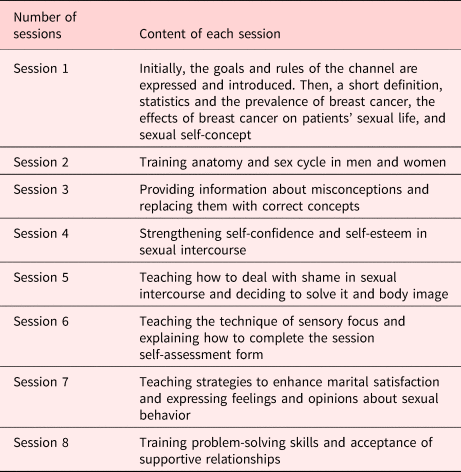
The social network-based support program was implemented by a master’s degree student in midwifery counseling under the supervision of a reproductive health specialist, a psychiatrist, a sex therapist, and a radiologist. Then, it was completed by asking for the opinion of two professors in the field of mental health (a psychiatrist and a Ph.D. clinical psychologist) and one professor in the field of midwifery; the experts’ comments were applied. The support program was held in eight sessions (two 45-min sessions per week) on WhatsApp messengers. In the first 10 min of each session, the participants were assigned to attend. In the following 20 min, they listened to a voice message prepared in advance. After that, the possible questions of the participants were answered for 15 min. It should be noted that according to the topics mentioned in each session, homework was given to the participants, and they were asked to do homework and practice the techniques learned during the week and to send them the personal account of the researcher on WhatsApp. During each session, the participants were given the opportunity to express their experiences and problems. The contents of the sessions are briefly presented in Table 1.
Content provided in each session in the intervention group

Control group
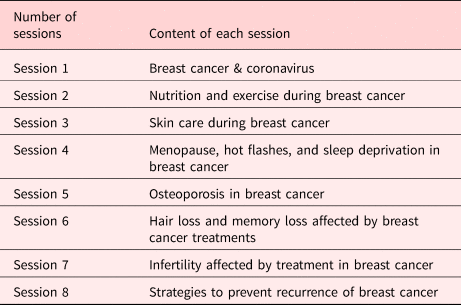
In the control group, eight sessions (two 45-min per week) were held on WhatsApp messenger; they received audio and video files whose content was not related to sexual self-concept. The contents of the sessions are briefly shown in Table 2.
Content provided in each session in the control group

Outcomes
The primary outcome was sexual self-concept, and the secondary outcomes were women's sexual quality of life and participants’ satisfaction. All the participants completed a socio-demographic characteristics form as well as Female Sexual Function Questionnaire (FSFI), Depression, Anxiety, Stress Scale (DASS), and Body Image Scale (BIS) at baseline. Also, they completed the Snell's Multidimensional Sexual Self-Concept Questionnaire (MSSCQ), women's Sexual Quality of Life Questionnaire (SQOL-F), and Clients’ Satisfaction Questionnaire-8 (CSQ-8) at baseline, immediately, and 1 month after the intervention. The questionnaires completed by the Porsline program online.
Measures
Snell's Multidimensional Sexual Self-Concept Questionnaire
The MSSCQ was designed by Snell and included 100 questions in 20 domains (Snell, Reference Snell, Davis, Yarber and Bauseman1998). Its Cronbach's α coefficient has been reported from 72% to 94% in different dimensions. Also, its reliability in the Iranian context was reported to be 88% (Ziaei et al., Reference Ziaei, Khoei and Salehi2013). The Persian version includes 78 questions in 18 domains, which are classified into the three dimensions of positive, negative, and situational sexual self-efficacy. The positive dimension includes 44 questions in 10 domains, the negative dimension includes 16 questions in 4 domains, and the situational dimension includes 18 questions in 4. This questionnaire is rated on a 5-point Likert scale as no expressions = 0, little = 1, somewhat = 2, high = 3, and totally = 4, and a higher score indicates a higher sexual self-concept in each dimension (Jaafarpour and Molaeinezhad, Reference Jaafarpour and Molaeinezhad2016). In the present study, its reliability was evaluated in a population of 20 breast cancer women at a two-week interval, which was 0.95 for the positive dimension, 0.73 for the negative dimension, and 0.78 for the situational sexual self-concept.
Women's Sexual Quality of Life Questionnaire
This questionnaire was introduced by Symonds and Quirk (Reference Symonds and Quirk2005), and its validity and reliability were established Iranian women (Maasoumi et al., Reference Maasoumi, Lamyian and Montazeri2013). It measures the quality of women's sexual life in four domains, i.e., sexual psychological feeling, sexual satisfaction, self-worthlessness, and sexual repression with 18 questions. Each question was rated in six options from 0 to 6 (strongly disagree, relatively disagree, somewhat disagree, somewhat agree, relatively agree, and strongly agree), with a higher score indicating a more desirable level of quality of sexual life (Symonds and Quirk, Reference Symonds and Quirk2005). The internal consistency of this instrument with 95% Cronbach's α coefficient was confirmed, and the test–retest method showed good result (r = 85, P = 0.001) (Maasoumi et al., Reference Maasoumi, Lamyian and Montazeri2013).
Female Sexual Function Questionnaire
This questionnaire measures women's sexual function in the areas of desire, psychological stimulation, moisture, orgasm, satisfaction, and sexual pain during the last 4 weeks (Rosen et al., Reference Rosen, Brown and Heiman2000). Its reliability was established in the Iranian context by Cronbach's α coefficient of 70% (Mohammadi et al., Reference Mohammadi, Heidari and Faghihzadeh2008). The scoring of the questionnaire is based on the Likert scale from 0 or 1 to 5, and the higher score indicates better sexual function.
Depression, Anxiety, Stress Scale
The tool was designed by Lovibond in 1983 on a 42-item scale (Lovibond and Lovibond, Reference Lovibond and Lovibond1995) and then a shorter version of DASS with 21 items was introduced (Brown et al., Reference Brown, Chorpita and Korotitsch1997). The DASS-21 scale consists of a set of three self-assessment subscales designed to measure negative emotional states of depression, anxiety, and stress. Each of the three subscales contains seven items in a 4-point scake from zero to three (it does not apply to me at all to it does apply to me at all). The total score ranged from 0 to 42 (Sahebi et al., Reference Sahebi, Asghari and Salari2015), and its Cronbach's α coefficients for the DASS were reported to be 0.94, 0.87, and 0.91, respectively (Antony et al., Reference Antony, Bieling and Cox1998). Also, its reliability coefficient was satisfactory in the Iranian population (Sahebi et al., Reference Sahebi, Asghari and Salari2015).
Body Image Scale
This 10-item BIS was developed by Hopwood that assesses affective (self-awareness), behavioral (difficulty looking at the naked body), and cognitive (such as appearance satisfaction) issues (Hopwood et al., Reference Hopwood, Fletcher and Lee2001). Clients can indicate body image symptoms on a 4-point scale from zero to three (never, very little, somewhat, and very much). The minimum and maximum scores of this tool are 0 to 30. A higher score means a higher level of body image disturbance (Melissant et al., Reference Melissant, Neijenhuijs and Jansen2018).
Clients’ Satisfaction Questionnaire-8
The CSQ-8 was developed by Larsen; it is an eight-item scale (Larsen et al., Reference Larsen, Attkisson and Hargreaves1979). This scale is designed to measure clients’ satisfaction with counseling and treatment services. For each question, a score between 1 and 4 is considered. The score range is between 8 and 32, with higher scores indicating greater satisfaction. The internal consistency coefficient of this questionnaire is 0.93, indicating a good structural and content validity (McMurtry and Hudson, Reference McMurtry and Hudson2000). The reliability of this scale in the Iranian population has been established in several studies with Cronbach's α coefficients of 0.86–0.94, demonstrating excellent internal coordination (Aliabadi et al., Reference Aliabadi, Shareh and Touzandeh Jani2020).
Statistical analysis
In this study, the collected data were transferred to SPSS version 20. Then, descriptive statistical methods were used to describe quantitative and categorical variables. To evaluate the normality of quantitative values, the Shapiro–Wilk test was used, and if it was not normal, the Mann–Whitney nonparametric test was used. Also, independent t-test, Mann–Whitney, χ 2, and Fisher's exact tests were used to assess socio-demographic characteristics in the intervention and control groups. The Mann–Whitney nonparametric test was used to compare quantitative variables in each of the intervention and control groups. A generalized equation estimation test was also run to control the effect of interfering factors. The effect sizes of treatment and confidence interval were also calculated. A P-value of less than 0.05 was considered significant.
Results
Flow of participants through the trial and recruitment
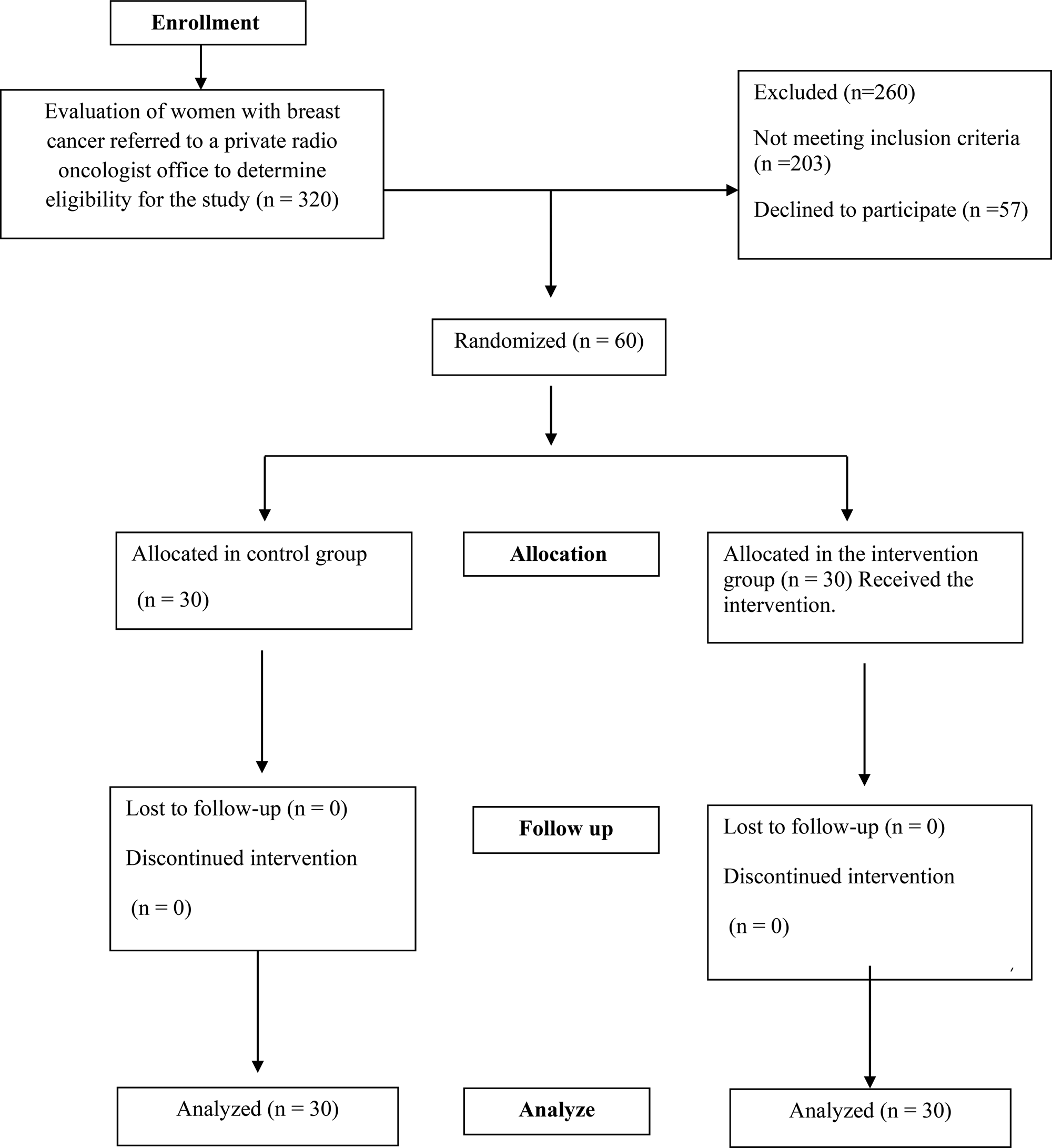
Sixty participants were recruited for this trial from April to August 2020. Sixty participants were recruited for the experiment between April 2020 and August 2020 and were analyzed by the end of that number. Probably one of the reasons for the lack of subject attrition was the scarcity of support programs for the sexual problems of women with breast cancer in Iranian society. Thus, this support program was welcomed by the participants and they remained in the trial until the end. In addition, following up and controlling the patients can be another reason for the lack of participant drop out. The flow of the participants is provided in Figure 1, including the number of recruited participants and the reasons for dropping out.
CONSORT flow diagram of participant.

Participant characteristics
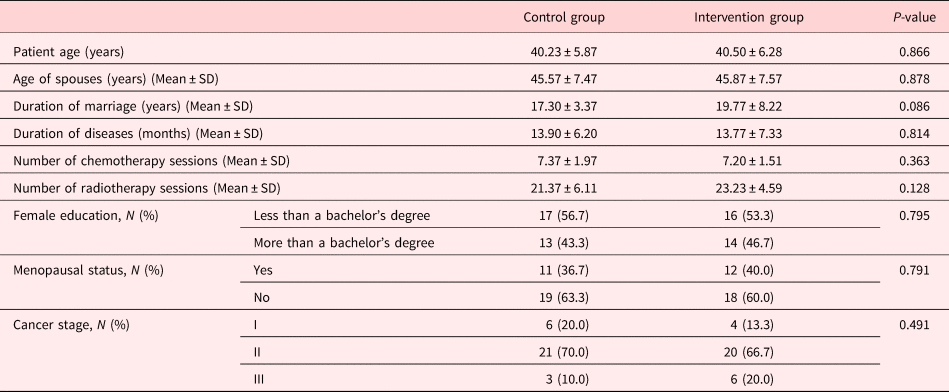
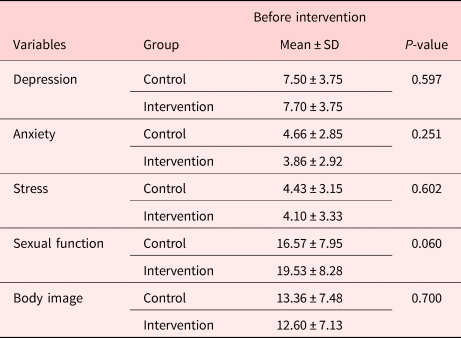
Table 3 presents the patients’ characteristics overall and by group assignment. Data were collected from 60 breast cancer women (age of the control group = 40.23 ± 5.87 years, age of the intervention group = 40.50 ± 6.28 years). The baseline demographic characteristics of the participants in the intervention and control groups were generally similar. The results of the Mann–Whitney test showed that the mean scores of depression, anxiety, stress, sexual function, and body image as confounder factors were not significantly different in the two groups before the intervention (Table 4).
Demographic characteristics of participants

Comparison of the mean and standard deviation of depression, anxiety, stress, sexual function, and body image scores in the both groups

Primary outcome: Sexual self-concept
Based on our findings, there was no significant difference between the two groups in terms of the mean score of sexual self-concept in the positive (P = 0.599), negative (P = 0.354), and situational (P = 0.733) dimensions before the intervention. In the positive self-concept score, there were significant differences between the groups immediately and 1 month after the intervention (119.70 ± 18.98 and 117.03 ± 17.57 in the intervention group versus 92.93 ± 21.92 and 87.86 ± 10.61 in the control group, respectively). The effect size was 1.30 immediately after the intervention and 2.00 1 month after the intervention. In the negative self-concept score, there were significant differences between the groups immediately and 1 month after the intervention (28.03 ± 10.09 and 29.50 ± 4.99 in the intervention group versus 35.70 ± 10.64 and 35.76 ± 10.75 in the control group, respectively). The effect size was 0.73 immediately after the intervention and 0.74 1 month after the intervention. In the situational self-concept score, there were significant differences between the groups immediately and 1 month after intervention (34.63 ± 8.77 and 31.83 ± 3.37 in the intervention group versus 43.60 ± 9.38 and 43.96 ± 7.52 in the control group, respectively). The effect size was 0.98 immediately after the intervention and 2.08 1 month after the intervention (Table 5).
Comparison of the mean and standard deviation of sexual self-concept score in the both groups

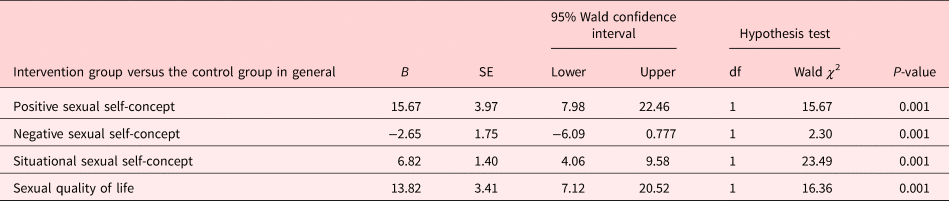
Also, using the generalized equation estimation test and considering the scores of positive, negative, and situational sexual self-concept and controlling the effect of time of measuring the consequences, the support program intervention based on social networks was significantly effective. Thus, the positive sexual self-concept score of the intervention group increased by 15.67 points, the negative sexual self-concept score decreased by 2.65 points, and the situational sexual self-concept score increased by 6.82 points compared to the control group (Table 7).
Secondary outcomes: Sexual quality of life and clients’ satisfaction
The results of the Mann–Whitney test showed that the mean scores of sexual quality of life in the two groups of intervention and control before the intervention were not significantly different (P = 0.678). However, immediately after the intervention, it significantly increased in the intervention group compared to the control group (P < 0.001). The results also showed that the mean score of sexual quality of life in the intervention group was significantly higher compared to the control group 1 month after the intervention (P < 0.001).
The effect size immediately after the intervention in the intervention group was 1.81, and 1 month after the intervention it was 2.09 (Table 6). Also, using the generalized equation estimation test and considering the score of quality of sexual life and controlling the effect of time of measuring the consequences, the support program based on social networks was significantly effective. Thus, the sexual quality of life score of the intervention group increased by 13.82 points compared to the control group (Table 7). The mean score of client satisfaction in the two groups of intervention and control immediately and 1 month after the intervention were not significantly different (P > 0.05).
Comparison of the mean and standard deviation sexual quality of life score in the both groups

Effect of time and intervention based on the generalized equation estimation

Discussion
The present study investigated the effect of a WhatsApp support program on sexual self-concept in women with breast cancer. The results of this study showed that the support program based on social networks increased positive sexual self-concept and situational sexual self-concept and reduced negative sexual self-concept immediately and 1 month after the intervention.
Unfortunately, there are currently insufficiently documented studies on the sexual self-concept of women with breast cancer. Therefore, a large study gap exists in this area to compare the results of studies, with similar conditions, with the present study. However, a limited number of clinical trials have examined the effect of educational, counseling, and psychological interventions on women's sexual self-concept. For example, the results of a study by Yazdani et al. showed that education through social networks improved the positive dimension of sexual self-concept and decreased the negative dimension of sexual self-concept in infertile women (Yazdani et al., Reference Yazdani, Mahmoodi and Azin2019). Also, the results of the study were stable 1 month after the intervention. The above study focused on the anatomy and sexual cycle, sexual behaviors and satisfaction, body image and shame in sex, misconceptions about sex, and problem-solving techniques. It tried to improve women's sexual self-concept, which was consistent in this regard with the results of the present study. However, the situation was inconsistent with the present study because participants were in the infertility treatment phase, and this could be one of the reasons that the negative dimension of sexual self-concept was not changed.
The results of the present study were consistent with the findings of Mohammadi (Reference Mohammadi2010) and Ziaei et al. (Reference Ziaei, Farahmand Rad and Roshandel2018) regarding women of reproductive age. These studies focused on group and individual counseling on sexual skills, changing people's attitudes about sexual beliefs and mental images, and the right way to have sex to improve sexual self-concept and improve women's sexual health, which were in line with the present study. Also, the results of the study were stable 1 month after the intervention. In addition, the study of Gharibiasl et al. (Reference Gharibiasl, Sodani and Atari2016) using cognitive-behavioral group counseling and challenging irrational thoughts with rational thinking improved the positive self-concept and the negative aspect of self-concept in patients with breast cancer. The results of the present study were consistent with the study of Ramezani et al. (Reference Ramezani, Ahmadi and Ghaemmaghami2018), Bavi et al. (Reference Bavi, Amanolahi and Atari2014), and Vahidvaghef (Reference Vahidvaghef2015) on women of reproductive age. These studies were conducted with the aim of examining the effectiveness of sex education on women's sexual self-concept, and their results showed that sex education reduces the negative dimension of sexual self-concept (i.e., sexual anxiety and sexual depression) and increases the positive dimension of sexual self-concept (i.e., sexual self-expression, sexual optimism, sexual self-efficacy, monitoring, and management of sexual problems). In this regard, researchers concluded that sexual education could prevent sexual problems and improve women's sexual health, including sexual self-concept.
Also, the results of the study of Vahidvaghef (Reference Vahidvaghef2015) were stable in the 6-month follow-up after the intervention. Another method that focuses on improving women's sexual self-concept is cognitive-behavioral therapy. Ghorbanshiroudi et al. (Reference Ghorbanshiroudi, Khalatbari and Keikhayfarzaneh2012) investigated the effect of cognitive-behavioral therapy on improving sexual self-concept in women of reproductive age. The researchers in that study showed that the intervention increased the positive dimension of sexual self-concept (sexual satisfaction and sexual confidence) and declined the negative dimension of sexual self-concept (sexual depression). Finally, the researchers concluded that cognitive-behavioral therapy for improving sexual self-concept should be considered as an adjunct to drug therapy in women.
It seems that due to the few studies that have been performed on the promotion of sexual self-concept in women with breast cancer, patients with breast cancer need comprehensive care and support programs to prevent and manage the physical and psychosocial effects of cancer and its treatments (Ganz, Reference Ganz2006; Stanton, Reference Stanton2006). Studies in high-income countries (HICs) and low- and middle-income countries (LMICs) have shown that cancer patients and their families may have unmet physical and psychosocial supportive care needs (Knaul and Bhadelia, Reference Knaul and Bhadelia2012; Cardoso et al., Reference Cardoso, Distelhorst and Bevilacqua2013). Supportive care is often a low priority in LMICs (Knaul and Bhadelia, Reference Knaul and Bhadelia2012). Integrating supportive care into the existing programs for women with breast cancer is an integral part of a multidisciplinary and interdisciplinary approach to cancer care that requires both professional health education and patient awareness of supportive care services (Schmid-Büchi et al., Reference Schmid-Büchi, Van den Borne and Dassen2011). Providing supportive care to women with breast cancer ensures that cancer patients receive comprehensive care that can improve adherence to treatment recommendations and other related symptoms (Cardoso et al., Reference Cardoso, Distelhorst and Bevilacqua2013). In the present study, by developing and implementing a support program for improving sexual health, especially the sexual self-concept of women with breast cancer and providing appropriate techniques and solutions to women with breast cancer, we tried to identify patients’ negative beliefs and perceptions about themselves and their gender, and by practicing the techniques and strategies provided, empowered them to solve their sexual problems and improve their sexual health, especially the various dimensions of sexual self-concept and its consequences. The only difference between the above studies and the present study is the method of performing the interventions, such that the mentioned were conducted in person, while the present study was conducted using social networks and in cyberspace (WhatsApp). This technology is a cost-effective method that removes many obstacles (Watzke et al., Reference Watzke, Haller and Steinmann2017) in providing fast and accessible services and improving sexual health services (Gibson and Cartwright, Reference Gibson and Cartwright2014). In fact, anonymity and freedom of expression have made the Internet a safe place to express one's problems (Yazdani et al., Reference Yazdani, Mahmoodi and Azin2019). Online and telephone training provides more access to counselors and healthcare professionals regardless of time and place, and those who feel uncomfortable discussing sexual issues can benefit from online interventions by expressing their problems. This led to an increase in positive sexual self-concept and a decrease in negative sexual self-concept in this group of patients. Few studies on social media-based interventions have focused on the sexual health of women with breast cancer. In general, the present study was consistent with the study of Hummel et al. (Reference Hummel, Van Lankveld and Oldenburg2015) and Salonen et al. (Reference Salonen, Tarkka and Kellokumpu-Lehtinen2009). The results of these two studies showed that Internet-based cognitive-behavioral therapy and telephone-based interventions reduced sexual problems and improved sexual intimacy, body image, sexual function, and overall sexual health in women with breast cancer. As a result, the quality of sexual life increased. Also, the results of the study of Hummel et al. (Reference Hummel, Van Lankveld and Oldenburg2015) 3 and 9 months after the intervention were stable. Our findings showed that the social media-based support program was effective in improving the sexual health of women with breast cancer and has potential benefits for cancer patients with sexual concerns. However, it should be noted that most studies involving patients with prostate, genital, and breast cancer have been performed in high-income countries with good web-based technology systems. Therefore, caution should be exercised in generalizing these results.
The strengths of this study include blinding the participants, random allocation of the samples, and holding consistent and weekly intervention sessions. On the other hand, providing homework to the participants in the intervention sessions, questions and answers, feedback, and review of homework to consolidate the content provided are the other strengths of the present study. Also, in this study, the research team examined and recorded clients’ satisfaction with the consultant, and it was shown that the majority of the participants had a high proportion of satisfaction. Also, by examining the percentage of participants who participated in each session, which is equivalent to adhering to or accepting treatment in pharmaceutical work, the majority of the participants (97.49%) in the intervention group were present in each session of the support program that is another strength of the present study that the researcher and the research team were able to achieve this success. However, many studies, without considering the above, conducted interventional studies that ultimately had a negative effect on the quality of study results. Finally, the intervention was implemented based on a protocol designed and validated by the research team.
One of the limitations of the present study was that due to the online nature of the support program, the participants may have not adhered to all the advice, training, and homework carefully, and this may to some extent affect the interpretation of the results. Also, due to the fact that all the questionnaires were completed by the participants, the participants’ reports may have not been accurate enough due to shame or confidentiality, which may prone the study findings to self-report bias. However, to control this limitation, the researcher gave the necessary explanations about the confidentiality of information and coding of the questionnaires, and the appropriate communication between the researcher and the patients caused the questions to be answered clearly. Because, in the study, the person performing the intervention was the person reviewing the results, this may be prone the study to diagnostic bias. In addition, blinding only at the level of participants may have undermined the study power. However, the evaluation of the patients was performed by questionnaires, and the researcher's involvement in this type of evaluation was minimized. In addition, due to the wide scope of the study, not all factors related to sexual self-concept, such as history of sexual abuse, were addressed. Also, because, in this study, women with at least primary education were enrolled, some might have been unable to use social networks, and this may to some extent affect the participation of individuals and the results of our study. It is suggested that further studies be implemented to investigate the effect of social media-based supportive programs on the sexual self-concept of newly diagnosed women with breast cancer and their husbands as a couple or separately.
Conclusions
The findings of this study indicated that providing counseling regarding sexual self-concept through social networks (WhatsApp) could increase the positive and situational sexual self-concept scores and lower the negative sexual self-concept score. As a consequence, due to the growing use of social networks and the sensitivity of sexual issues, adopting correct counseling approaches through virtual spaces can be an effective step toward improving the sexual health of women with breast cancer and reducing the complications of breast cancer. Based on this result, the use of virtual spaces such as WhatsApp is suggested to treat sensitive topics similar to sexual subjects. The researcher recommends performing studies similar to the present one on other topics or in other population groups.
Acknowledgments
This study was extracted from the Master of Science thesis in Midwifery. Hereby, I would like to thank the Research Deputy of Mazandaran University of Medical Sciences for their support, and I would like to thank all breast cancer women who participated in this study.
Ethical approval
The Research and Ethical Committee of Mazandaran University of Medical Sciences approved this research (IR.MAZUMS.REC.1399.6440).
Conflict of interest
The authors declare that they have no competing interests.