1. INTRODUCTION
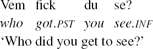
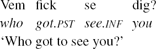
In the Germanic V2-languages, inverted order between the finite verb and the subject, i.e. VS order rather than SV order, is a typical main clause phenomenon. Still, subordinate inversion does exist, to a greater extent in some V2-varieties than in others (see e.g. Rohrbacher Reference Rohrbacher1999:14–20; Hrafnbjargarson & Wiklund Reference Hrafnbjargarson and Wiklund2009). This paper investigates a sub-type of subordinate inversion, namely inversion in relative clauses (relative inversion), in the history of Swedish. Whereas Present-Day Swedish (PDSw) does not permit VS word order in relative clauses, Early Modern Swedish (EMSw) does, at least in certain contexts; see (1a) below (cf. the PDSw counterpart in (1b) where the order is SV). We take Early Modern Swedish as referring to texts by authors born prior to 1700 but after 1500.
(1)


Now, consider also the relative clauses in (2a–b) below, where the relative pronouns are followed by a fronted adverbial clause. These examples show the same word order difference in the relative matrix between the two varieties as was illustrated in (1a–b): the finite verb precedes the subject only in EMSw. However, there is another difference as well: in the EMSw example (2a), the gap corresponding to the relative pronoun is found in the intervening adverbial clause, whereas the gap in the PDSw example (2b) is within the relative matrix.
(2)

This combination of word order difference and difference in the distribution of gaps can be accounted for structurally by assuming that the subject position is spec-FinP in PDSw (following e.g. Platzack Reference Platzack2001, Stroh-Wollin Reference Stroh-Wollin2002) but spec-TP in EMSw (following Magnusson Reference Magnusson2007a, Reference Magnusson, Wollin, Saarukka and Stroh-Wollinb, and Petzell Reference Petzell2010).
Such an account also felicitously predicts another, rarely discussed, difference regarding the use of imperatives in the two varieties. In PDSw, imperatives are obligatorily introduced by the imperative verb form; compare the verb-initial example in (3a) below to the ungrammatical (3a′), where the verb is preceded by an object (of a preposition). Non-verb-initial imperatives were, however, commonplace in EMSw, as shown in (3b).
(3)

Rather than assuming ad hoc that older imperative utterances could involve topicalisation of the same kind as in indicative clauses today, we will relate the presence of non-verb-initial imperatives in EMSw (as in (3b)) but not PDSw (as in (3a′)) to the same structural difference regarding subject positions between the varieties that needs to be assumed anyway to account for the distribution of relative inversion (as in (1a) and (2a) above).
This paper is organised as follows. In Section 2, the relevant phenomena – relative inversion and non-verb-initial imperatives – are presented in more detail. Section 3 contains a theoretical discussion of the syntax of the C-domain and the upper part of the I-domain. It is argued that subjects always compete with other categories to satisfy locality constraints in A-bar movement. Since the subject is higher than anything else, it must always win in such a competition, blocking movement of other categories into the left periphery. Assuming (with Richards Reference Richards1998) a Principle of Minimal Compliance, this blocking effect can, however, be eliminated if T or Fin – as the case may be – first raises past (‘inverts with’) the subject to the next head up. In Section 4, we return to the data and present a detailed analysis of the differences between EMSw and PDSw under investigation. The paper is summarised in Section 5.
2. EMPIRICAL BACKGROUND
This section contains the descriptive bulk of the paper: relative inversion is treated in Section 2.1, non-verb-initial imperatives in Section 2.2.
2.1 Relative inversion
In order to categorise relative inversion of the type illustrated in (1a) and (2a) above into relevant sub-types, we require a set of descriptive labels to refer to the clauses involved: there is the VS-initial clause that is present in both (1a) and (2a), and the adverbial clause located between the relative pronoun and the VS-initial clause in (2a). We will refer to the former as the VS-clause, to the latter as the X-clause, and to the combination of these as the XVS-clause.
As shown in (1a) above, there is a gap in a VS-clause that is not preceded by an X-clause. If there is an X-clause intervening between the relative pronoun and the VS-clause, EMSw cannot have VS-gaps. Still, there may be a gap in the X-clause, henceforth: an X-gap, as shown in (2a). Interestingly, there are also examples with no gap at all, henceforth: 0-gap examples, in which case one or two resumptive pronouns mark the relevant slot(s). Minimally, there is a resumptive pronoun in the X-clause, maximally in both the X-clause and the VS-clause. No examples contain a resumptive pronoun in the VS-clause alone. Additional EMSw examples of VS- and X-gaps are given in (4), and examples with 0-gaps are in (5).
(4)
(5)


The resumptive pronoun in 0-gap examples can be either a subject or a non-subject in either the X-clause or the VS-clause: in (5a), thet is an object in the X-clause; in (5b), the first det is a subject in the X-clause, the second det a subject in the VS-clause; in (5c), finally, han is a subject in the X-clause and honom an object in the VS-clause.
In examples with a gap, the distribution is different. In VS-clauses, the gap can never – naturally – be a subject, since an overt subject is a prerequisite for VS order in the first place. In the X-clause, on the other hand, it would be feasible with a gap in the subject position. Still, no such examples have been retrieved. We take this absence to be due to some sort of comp–trace filter (however this restriction is best formulated). Whatever prohibits examples such as (6a) below (where there is a trace after the extracted subject in the subordinate clause – see the grammatical (6a′), where the trace instead corresponds to an extracted object) in PDSw, also prohibits – presumably – the occurrence of subject-gaps in X-clauses in EMSw (see the constructed example in (6b)).
(6)

In both (6a) and (6b) there is an illicit trace directly after the wh-element initiating the embedded clause.
2.2 Non-verb-initial imperatives
In the introduction, it was shown that EMSw permits non-verb-initial imperatives (recall (3b) above); two more examples are given in (7). This word order is ungrammatical in PDSw (recall (3a′) above).Footnote 1
(7)

At first, it appears as if these imperative clauses in EMSw involve topicalisation, i.e. fronting of a phrase to the highest spec position in the clause. This is how the phenomenon is characterised by Delsing (Reference Delsing, Haskå and Sandqvist1999). However, there is no need to assume any difference between the varieties regarding topicalisation; it explains nothing but the observed patterns (i.e. it is an ad hoc explanation).
In addition, an analysis of the examples in (7) in terms of topicalisation does not help us understand how imperatives can also be embedded in EMSw; consider (8), where the imperative verb form (skrif ‘write’) occurs inside a relative clause.
(8)

Clearly, to understand how an imperative verb can be embedded, we need to understand more about the nature of imperative force.
3. SUBJECT POSITIONS, INVERSION AND THE NATURE OF IMPERATIVE FORCE
3.1 A broad outline of clause structure
Following Chomsky (Reference Chomsky2001) and Pesetsky & Torrego (2001), we can assume that the syntactic system is driven by the elimination of uninterpretable features. An uninterpretable feature ([uF]) is always eliminated by an interpretable counterpart ([F]); either [F] moves to a position structurally local to [uF] – this is the case if [uF] is marked with an EPP-feature – or a link is established from a distance between [uF] and a lower position containing [F]. Here, we will be concerned with local elimination only.
Both relative inversion and non-verb-initial imperatives involve placement of elements in the initial part of the clause that differs from the possible placement of the corresponding elements in PDSw. In EMSw, S and V invert in contexts where they cannot invert today, and imperative verbs need not, unlike today, be clause-initial. In order to understand these differences we must consider the structural properties of the topmost area of the clause, in particular the C-domain but also the upper part of the I-domain.
The analysis argued for in the following is more or less identical to the one in Petzell (Reference Petzell2010), which is to a large extent inspired by the analysis argued for by Stroh-Wollin (Reference Stroh-Wollin2002); she has in turn developed the ideas presented in Branigan (Reference Branigan1996), Rizzi (Reference Rizzi and Haegeman1997) and Platzack (Reference Platzack and Rosengren1998), but unlike the latter she maintains that main clauses and subordinate clauses are structurally different, i.e. they represent different phrase-types. In the present analysis, the difference between independent utterances and subordinate clauses is reduced to a question of feature distribution.Footnote 2
All finite clauses are treated as structurally identical maximal projections labelled TypePs. Typeo hosts uninterpretable features associated with clausal type ([utype]EPP) and structural status ([ustatus]EPP). The interpretable features that are capable of eliminating [utype]EPP are of several kinds: [dec] gives a declarative reading, [rel] a relative reading, [wh] an interrogative meaning, [excl] an exclamative reading, etc. The ones that are capable of eliminating [ustatus]EPP, however, are but two: [comp], which makes the clause subordinate, and [force], which makes it independent. The feature [comp] is connected to a visible or invisible complementiser, [force] often, but not always, to a finite verb. In exclamatives, [force] is apparently tied to the same element that hosts the type-feature, in (9a) below, to the interjection Jävlar ‘Damnit’ (see Magnusson Reference Magnusson2007a:212; Stroh-Wollin Reference Stroh-Wollin2011; see also Section 3.3 below). The type-feature [dec] is tied to all phrases that can be fronted in a declarative utterance, e.g. PPs, AdvPs and DPs (see (9b–d)).Footnote 3 The type-feature [rel] is associated with both relative pronouns and relative operators (see (9e–f)). Relative pronouns are often homonymous with interrogative pronouns (i.e. pronouns marked with the type-feature [wh]). There are, however, some distinct forms in the two paradigms, which indicate that it is indeed necessary to keep rel-marking and wh-marking separate in Swedish. The possessive vars ‘whose’ in (9e) is uniquely relative. Likewise, vem ‘who’ can only initiate a question (see (9g)).
(9)

We will assume that all finite verbs in (9) are associated with the feature [force]. At first, such an assumption appears problematic since not all finite clauses are independent; cf. the subordinate clauses in (9a) and (9e–g). In these cases, we could argue, however, that the force-feature is simply invisible to LF, given that it never reaches TypeP, where features of this sort are relevant, but instead remains in VP.Footnote 4 Still, there are non-independent clauses where the finite verb inverts with the subject, which indicates that it is indeed in Typeo; compare the comparative conditional in (10a) and the verb-initial conditional in (10b).
(10)

If [force] is assumed to be tied to all indicative verbs (rather than all finite verbs), comparative conditionals would not pose a problem for our analysis; as in (10a), the verb in comparative conditionals is in the subjunctive. Not even the presence of a force-feature on the (indicative) verb in (10b) need be problematic. In fact, it may shed some light on the distributional difference between conditionals initiated by a complementiser (om ‘if’) and verb-initial conditionals as in (10b). Unlike om-initial conditionals, verb-initial conditionals must appear initially; see (11a–b) below. Yet, they are never independent – the conditional interpretation can only be obtained when the verb-initial clause is tied to another matrix (as in 10b); otherwise, it is interpreted as a question (see (11c)). This intermediate status of verb-initial conditionals could be seen as an effect of [force] on the one hand being present on kommer ‘come’, but on the other hand being subordinate to another head with a force-feature (blir ‘become’).
(11)

It should be noted that a Type-head containing [force] may certainly be embedded in other contexts; this is shown in (12a) below, where there is a TypeP headed by [force] in the complement of a narrative complementiser (‘CP-recursion’). The effect of this embedding is that the proposition is interpreted as asserted by the speaker, an interpretation that is hardly made if there is a single TypeP headed by [comp], as in (12b) (for a discussion, see Andersson Reference Andersson1975). No comparable difference is demonstrable in the case of conditionals. Semantically, verb-initial conditionals as in (10b) (where [force] is in Typeo) and om-initial conditionals as in (11b) (where TypeP is headed by [comp]) are equivalent.
(12)

The phrase below TypeP, FinP, also hosts two uninterpretable features, one attracting the finite head (the verb or the complementiser) ([ufin]EPP) (see Holmberg & Platzack Reference Holmberg and Platzack1989, Reference Holmberg and Platzack1995) and one attracting the subject (see Branigan Reference Branigan1996). In EMSw, on the other hand, spec-FinP was not a pure subject position. Instead, the canonical position for subjects was spec-TP. Exactly what type of feature attracts the subject is not crucial for the present analysis. Magnusson (Reference Magnusson2007a, Reference Magnusson, Wollin, Saarukka and Stroh-Wollinb) and Petzell (Reference Petzell2010) suggest that in both EMSw and PDSw there is a pure subject feature in FinP, the difference between the varieties being that only in PDSw is this subject feature accompanied by an EPP-feature. Although such an account felicitously predicts the difference between the placement of subjects in the two varieties, it fails to predict the presence of non-subjects in spec-FinP in EMSw. Clearly, there must be some separate uninterpretable feature in FinP that is general enough to attract subjects as well as non-subjects.
The distribution of heads and phrases in the C-domain and the upper part of the I-domain in PDSw is presented in (13), and the EMSw system is shown in (14).
(13)
(14)


Motivations for this subject difference are given in Section 3.2. Inversion is handled in Section 3.3, and imperative force in Section 3.4.
3.2 Subject positions
The subject in PDSw has, since the late 1990s, been assumed to reside in the lower part of the C-domain (Platzack Reference Platzack and Rosengren1998, drawing on Branigan Reference Branigan1996; see also Platzack Reference Platzack2001; Stroh-Wollin Reference Stroh-Wollin2002; Josefsson, Platzack & Håkansson Reference Josefsson, Platzack and Håkansson2003; Magnusson Reference Magnusson2003, Reference Magnusson2007a, Reference Magnusson, Wollin, Saarukka and Stroh-Wollinb; Petzell Reference Petzell2010). The most important empirical motivation to support such a claim is presented in Platzack (Reference Platzack2001): since children acquiring the language produce V2-errors and subject-related errors (i.e. violations of the demand for an overt subject) during the same stage of acquisition, the two phenomena (V2/overt S) are assumed to belong to the same clausal domain (see Platzack Reference Platzack2001:369−370). If V2 is a C-phenomenon, so is the realisation of S.
Magnusson (Reference Magnusson2003, Reference Magnusson2007a, Reference Magnusson, Wollin, Saarukka and Stroh-Wollinb) and Petzell (Reference Petzell2010) suggest that subjects in EMSw, unlike subjects in PDSw, reside in the topmost spec position in the I-domain; we will refer to this as spec-TP. Magnusson (Reference Magnusson2003) connects this positional difference between subjects in the two varieties with the weaker demand for an overt subject in EMSw. This weaker demand is seen by Magnusson (Reference Magnusson2007a, Reference Magnusson, Wollin, Saarukka and Stroh-Wollinb) and Petzell (Reference Petzell2010) as a consequence of a stricter coordinator in the modern variety, ruling out any instantiation of asymmetrical coordinate gaps.
In Magnusson (Reference Magnusson2007a, Reference Magnusson, Wollin, Saarukka and Stroh-Wollinb) as well as in Petzell (Reference Petzell2010), the empirical motivation for assuming the subject to reide in spec-TP (rather than spec-FinP) comprises two types of coordination data. First, EMSw permits second conjuncts with Subject–Adverbial–Verb word order (SAV) in main clause coordination; see the examples in (15a) and (16a) below. The preverbal adverbial (AV) indicates that the verb remains in situ, i.e. in VP. Since definite subjects (as the subjects in the SAV sequences in (15a) and (16a)) are never realised inside VP, the SAV subjects must be in a higher subject position: spec-TP or spec-FinP. If they are assumed to be in spec-FinP as in PDSw, we are unable to account for the absence of V2; the uninterpretable feature in Fino ([ufin]EPP) cannot be left uneliminated; see the structures in (15b) and (16b). Overt verbal movement over A to To is, on the other hand, not expected to occur at this relatively late stage of Swedish (see Falk Reference Falk1993). Consequently, only if SAV subjects are assumed to reside in spec-TP is it possible to predict the post-adverbial position of the finite verb; see (15b′) and (16b′).
(15)
(16)


Second, it was possible in EMSw to use second conjuncts with VS word order not only in a main clause context (as in Old Swedish, Alving Reference Alving1916:22–44), but also inside a subordinate clause; see (17a) below. With the subject in spec-FinP as in PDSw, the initial finite verb would have to reside in Typeo, which would mean that we are dealing with coordination on a TypeP-level, see (17b). If the subject resides in spec-TP, on the other hand, we can assume the example to involve FinP+FinP-coordination; see (17c).
(17)

The most critical problem with the TypeP-analysis in (17b) is that it involves coordination of two TypePs with different structural status. The status of conjunct 1 is subordinate, since it is headed by the feature [comp] (associated with the complementiser), but the status of conjunct 2 is independent, since it is headed by [force] (associated with the finite verb).Footnote 5 Apart from the fact that the VS sequence in this particular context must be interpreted as being part of the complement of the verb säga, ‘say’, i.e. embedded under at, we lack independent evidence that EMSw, unlike its modern counterpart, in fact allowed TypePs with different structural statuses (main clauses and subordinate clauses) to be coordinated. None of these difficulties arise if the conjuncts in (17a) are treated as FinPs, as in (17c), which is only possible if the subject in EMSw is assumed to be in spec-TP.
If the subject does not need to move into FinP in EMSw, spec-FinP should be able to host non-subjects. In other words, our analysis predicts there to be something of an A-bar position just below Typeo in EMSw but not in PDSw (i.e. spec-FinP). Presumably, this is where the adverbial clause, i.e. X, in XVS-clauses and clause-initial phrases in non-verb-initial imperatives reside.
Håkansson (Reference Håkansson2008) argues that subjects were even lower in Old Swedish (OSw) than in EMSw, namely spec-vP, and that spec-TP was an A-bar position at this earlier stage. If we combine Håkansson's account with the present analysis we get two A-bar positions above the subject but still below Typeo in OSw: spec-FinP and spec-TP. Given such a structure we would in fact expect OSw to permit one pattern that we do not find in EMSw: relative clauses with XVS word order containing a trace after a relativised phrase in the VS-clause rather than a resumptive pronoun as in EMSw (recall the 0-gap examples discussed in Section 2.1 above). In EMSw, the X blocks relativisation (movement), since there is no A-bar position above X but below [comp]: the subject is in spec-TP and X is in spec-FinP. In OSw, on the other hand, there is such a position available: the subject is in spec-vP, and X in spec-TP leaving spec-FinP free for a relativised phrase to pass through.Footnote 6 There are OSw examples that seem to indicate that this prediction is correct; see (18), where the relativised object of æta ‘eat'has moved past both the subject (mæn ‘men’) and the X (ey ‘not’).
(18)

First, we should note that the OSw X is non-clausal, unlike X in EMSw. Second, the relative clause is initiated by the relative complementiser (som ‘that’) and not by a pronoun as in the majority of examples in EMSw. To investigate relative inversion in OSw more thoroughly, and to relate it to relative inversion in EMSw, is, unfortunately, beyond the scope of the present article.
3.3 Inversion
We will assume that spec-TypeP-movement has nothing to do with information structure. It is certainly evident that the clause-initial position has relevance for what is perceived as the topic of an utterance (cf. the label topicalisation), but it is not at all clear why this should be a matter of syntax (see Engdahl's Reference Engdahl and Mereu1999 critique of Rizzi Reference Rizzi and Haegeman1997, who assumes that focus- and topic-features syntactically motivate phrasal movement to the C-domain; see also Platzack Reference Platzack2008). In our view, it is syntactically relevant only that [utype]EPP needs to be eliminated, i.e. that something with a relevant interpretable feature moves into TypeP.Footnote 7 Syntax does not, however, specify why this or that constituent is raised to first position in a certain case. This latter concern lies outside the domain of syntax proper. All phrases that are compatible with placement in spec-TypeP are assumed to have the status of possible spec-TypeP candidates in every derivation. This means that syntax does not care what phrase eventually ends up in spec-TypeP, as long as some phrase does.Footnote 8
Yet, it is well known that syntactic operations are restricted by some sort of economy principle, according to which feature matching always needs to be as local as possible. This principle is usually labelled Shortest Move (SM) and appears in the literature in several versions (see e.g. Rizzi Reference Rizzi1990, Chomsky Reference Chomsky1995). Here, we will assume the SM formulation of Richards (Reference Richards1998), quoted in (19); minimal domain means maximal phrase.
(19) Shortest Move (SM)
A feature F must attract another feature G, such that G's minimal domain is not separated from F by any other feature that could participate in this attraction relation. (Richards Reference Richards1998:614)
Since subjects in PDSw have always raised to a higher spec position than other spec-TypeP candidates prior to the merging of Typeo (i.e. to spec-FinP), the type-feature associated with the subject ([dec], [rel] or [wh]) will always be structurally closer to [utype]EPP than any other type-feature in the clause. Still, only some clauses are subject-initial, i.e. comply with SM by moving the subject to spec-TypeP; see (20a) below. In (20b), a phrase within VP marked with the type-feature [dec] (the object [DPen björn]) has moved across FinP to spec-TypeP in violation of SM, since VP (the minimal domain of [DPen björn]) is separated from [utype]EPP by the dec-feature of [DP jag] in spec-FinP.Footnote 9
(20)

Apparently, the SM violation in (20b′) is not crucial; clauses with fronted non-subjects are indeed perfectly grammatical. As illustrated by Richards (Reference Richards1998:614–627), there are several constructions in other languages that seem to violate SM, e.g. object shift in Icelandic and certain participle constructions in French. Characteristic of the SM violations discussed by Richards is that they are all preceded by operations that do not violate SM.Footnote 10
The fact that a licit operation with respect to SM appears to be able to ‘save’ an otherwise illicit operation leads Richards to the assumption that there must be some kind of loophole in the grammar of human languages. He formulates this loophole as a universal principle, the Principle of Minimal Compliance (PMC), stating that a given restriction may be circumvented if it has previously been obeyed. The principle is quoted in (21), and discussed in the following.
(21) Principle of Minimal Compliance (PMC)
For any dependency D that obeys constraint C, any elements that are relevant for determining whether D obeys C can be ignored for the rest of the derivation for purposes of determining whether any other dependency D′ obeys C.
Richards’ definition of relevance
An element X is relevant for determining whether any dependency D with a head A and a tail B obeys constraint C if
(a) X is along the path of D
(that is, X = A, X = B or A c-commands X and X c-commands B), and
(b) X is a member of the class of elements to which C makes reference.
(Richards Reference Richards1998:601)
Let us now re-consider the structure in (20b′) above, repeated below as (22). As already noted, the movement of the non-subject (the object) to spec-TypeP violates SM, since the subject is a structurally closer candidate for fronting. However, the raising of the verb from Fino to Typeo – an operation that fully obeys SM – includes the subject in path D (spec-FinP is between the head of the verbal movement, Typeo, and its tail, Fino). Given PMC, the subject is not taken into consideration when the next movement is being evaluated with respect to SM. Long distance fronting of VP-elements can thus be permitted. Footnote 11
(22) [TypeP [utype]EPP [dec] [en björn]j sågv [FinP [dec] jagi tv . . . [VP ti tv tj]]]
No SM violation given PMC.
This analysis of long distance fronting can straightforwardly be extended to subordinate clauses. In the relative clause in (23) below, the relativised object of såg ‘saw’ (Op) has moved to spec-TypeP over the subject in spec-FinP. Just as in main clauses, such an operation must be preceded by head movement from Fino to Typeo, since the dec-feature of the subject that is structurally closer to [utype]EPP than the rel-feature of the object needs to be hidden from the SM mechanism; a raising of the complementiser som ‘that’ in (23a′) thus serves the same purpose as the raising of the finite verb såg ‘saw’ in (20b′) (for independent evidence of complementiser movement, see e.g. Roussou Reference Roussou2000, Roberts Reference Roberts and Luigi2004, Rizzi & Schlonsky Reference Rizzi, Schlonsky and Gärtner2007). Consequently, inversion with the subject cannot be viewed as a strictly verbal phenomenon, but a characteristic of all finite heads, i.e. both complementisers and finite verbs.
(23)
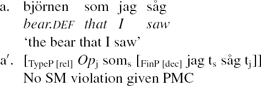
The fact that [dec] can never co-occur with [comp] inside TypeP (see (24a–b) below) is irrelevant as far as the elimination of [utype]EPP is concerned. Both [dec] on the subject and [rel] on the relativised object are capable of eliminating [utype]EPP and are thereby competing for movement into TypeP; the fact that [dec] and [comp] are incompatible is a separate matter. We will simply conclude that some combinations of type- and status-features are illicit. Presumably, it is such a combinatory restriction that is responsible for the absence of relative inversion in PDSw (where inversion, unlike inversion in EMSw, always involves movement of the finite verb to Typeo); see (24c–d). Here, [rel] associated with the pronoun and [force] on the finite verb are both contained within the same TypeP, a combination that is – apparently – not allowed. The ban on certain feature pairs in TypeP is clearly an LF-restriction (see Magnusson Reference Magnusson2007a:281–282).
(24)

In relative clauses that are initiated by a relative pronoun, we need to assume the presence of an invisible complementiser (Comp); see (25a–a′) below. This complementiser has been base generated in Fino and then moved to Typeo concealing the subject from the SM device and thereby allowing non-subject fronting, just as the overt som ‘that’ in (23). Without a complementiser trace in Fino, we expect verb movement to this head (to eliminate the feature [ufin]EPP), but such movement never occurs; see (25b), with the ungrammatical V–adverbial order which V-to-Fin movement would generate.
(25)

For an alternative analysis of relative clauses lacking an overt complementiser, see Stroh-Wollin (Reference Stroh-Wollin2002, in particular pages 294–297).
3.4 Imperative force
In the generative literature, imperative force has been linked to a feature [imp] that is tied to the imperative verb form (identical to the verb stem in Swedish) residing in the highest phrase of the clause, i.e. TypeP in our model (see e.g. Platzack & Rosengren Reference Platzack1998). It is, however, not evident why [imp] and the verb would always go together. We know that other type-features are not necessarily bound to overt (visible) lexical items, even though they may indeed be so. The polarity feature ([pol]), for instance, comes with the invisible operator Q in yes/no questions, but is associated with the complementiser in the corresponding subordinate clauses (see (26a–b) below; also Magnusson Reference Magnusson2007a:214–215). Furthermore, an exclamative feature is sometimes associated with an interjection (as in (26c); see. also (9a) above), but sometimes it is not. In the latter case, we may assume an invisible exclamative operator (E) in TypeP; see (26d).
(26)

This ambivalence in the associate behaviour of type-features should constitute a natural domain for parametric variation. The type-feature [imp] would be no exception; it is expected either to be tied to an operator (I) or associated with a lexical item. Like [excl] (but unlike [pol]), [imp] is intrinsically paired with the feature [force]. Suppose that [imp] is associated with the imperative verb (i.e. Vstem) in PDSw but tied to an operator (I) in EMSw. Adding the subject difference, both systems generate verb-initial imperatives with post-verbal subjects (when overt), as shown in (27) below; in (27a), Vstem must move to Typeo in order for the [imp]–[force] feature pair to get there; in (27b), these features (being tied to the operator I) are instead merged directly in Typeo, whereas the verb remains in Fino.Footnote 12 In both cases, (S) ends up to the right of the verb.Footnote 13
(27)

The crucial effect of the combination of the subject difference and the difference regarding the associate status of [imp] is that there is room for a non-subject above the imperative verb (i.e. in spec-FinP) in EMSw but not in PDSw, offering us an account of the occurrence of non-verb-initial imperatives in the older variety but not in the modern one.
4. ACCOUNTING FOR THE DIFFERENCES
In Section 3, we introduced two structural differences between PDSw and EMSw: one regarding the position of subjects (spec-FinP in PDSw, spec-TP in EMSw) and the other concerning the imperative type-feature [imp] (which is assumed to be verbally associated only in PDSw). In this section, the structural analysis is put to the test when we return to the data introduced in Section 2.
4.1 Relative inversion
It follows from the independently motivated difference with respect to the position of subjects between EMSw and PDSw (see Section 3.2 above) that inverted word order is possible in relative clauses in the older variety only. Relative VS must have S in spec-TP. If S is in spec-FinP as in PDSw, VS order can only be obtained via movement of the finite verb into TypeP, which prohibits the establishment of subordinate status since the verb carries the feature [force].
Furthermore, we need to make clear that although spec-FinP was something of an A-bar position in EMSw, the subject in spec-TP would always be the least complicated choice structurally – the element in spec-TP is simply the closest candidate to fill spec-FinP. Consequently, the modern Comp + SV order (as in (1b) above) is by far the most typical order in EMSw as well; see (28).
(28)

As in PDSw, the (invisible) complementiser moves from Fin to Type thereby (given PMC) concealing the subject (han) and making relativisation of the non-subject (med hwilcket) licit.Footnote 14
In VS examples like the one in (29), the subject remains in spec-TP and the non-subject relative pronoun is therefore first moved to spec-FinP before it advances to spec-TypeP. However, for a non-subject to be able to move to spec-FinP, the subject in spec-TP needs to be concealed, just like the subject in (28). Complementiser movement is not an option here, since complementisers are always base-generated above TP (either in FinP, from where it moves to TypeP, or, as here, directly in TypeP). Instead, movement of the finite verb does the job, which leads to inverted word order in these cases.
(29)

XVS examples share with the VS examples the characteristic of having moved a non-subject to spec-FinP over the subject in spec-TP, a subject concealed from the SM-device by inversion. In the XVS examples, the element fronted to spec-FinP is an entire adverbial clause, the X. The relative pronoun in spec-TypeP of an XVS-structure is linked to either a resumptive pronoun or to a gap in the adverbial clause X, 0-gap examples and X-gap examples respectively; this is shown in (30) and (31).
(30)
(31)


Presumably, 0-gap examples ((30a)) represent subordinate versions of left dislocation. In PDSw, left dislocated elements must correspond to a pronominal copy within the first clausal domain possible. For comparison, consider the characterisation in The Swedish Academy Grammar (SAG:4:446): ‘den pronominella kopian [står] normalt inte senare i satsen än som fundament eller del av fundamentet’ [the pronominal copy does not normally come later in the clause than in or within spec-CP]. If we assume that the same restrictions apply to EMSw (the unmarked assumption), single resumptive copies in the VS part of an XVS-clause are predicted to be avoided – X would be the preferred place for such a pronoun – a prediction that is borne out. As was pointed out above, resumptive pronouns in 0-gap examples never occur in the VS-clause alone.
Examples involving X-gaps (i.e. (31a)) are – in one respect – structurally equivalent to examples involving movement of relative pronouns from spec-FinP to spec-TypeP (i.e. VS-gap examples as in (29)). In both cases, there is an instance of FinP-to-TypeP-movement.Footnote 15 The filling of spec-TypeP by long distance relativisation (which would generate gaps in the VS part of an XVS-clause) is blocked by the fact that the only possible PMC-concealer of X is the finite verb, which cannot reside in TypeP together with [rel], as already noted. In other words, the PMC-analysis predicts there to be no VS-clauses with gaps if X intervenes. Precisely this type is unattested. On the other hand, when an X-clause is followed by SV word order, as in the PDSw example in (2b) above, X has no such blocking effect, indicating that the X-clause is less integrated, i.e. parenthetical, in these cases. Apart from the lack of a blocking effect, the parenthetical nature is also reflected in the absence of gaps after the relative pronoun within an X-clause that is followed by SV.
Examples with a gap in both an X-clause and a VS-clause are also unattested. In such a structure, long distance movement into spec-TypeP would, as it were, coincide with local movement. It is, however, blocked by the fact that the trace within the X-clause would not c-command its trace in the VS-clause being itself contained in the deeply embedded X-clause; see the constructed example in (32).
(32)

Why the relative pronoun in VS examples ((29) above) always moves to spec-TypeP, but an X-clause internal element only optionally does so (see (30) and (31) above) is an intriguing question. It is clearly related to another question: Why may some non-subjects stay in spec-FinP, and not others? Evidently, there is some mechanism restricting what XPs may dwell in FinP after spell-out. For instance, the proposed analysis is unable to block by itself the generation of main clause strings of the type XPVXPS; if V moves to TypeP to conceal the XP in spec-FinP, any XP should be up for topicalisation. But for some reason, the non-subject in spec-FinP can seldom remain there. Even proper subjects, e.g. subjects that come in the form of an infinitival phrase, are banned from spec-FinP in PDSw, indicating that something is the matter independently of the analysis proposed here;Footnote 16 compare the grammatical (33a) below, where the subject att simma ‘to swim’ is clause-initial (i.e. has moved through spec-FinP), to the ungrammatical (33b), where it is postverbal (i.e. resides in spec-FinP).
(33)

In sum, the subject difference between PDSw and EMSw is the crucial structural difference one needs in order to explain why the different types of relative inversion no longer occur. Examples with a gap always involve movement of a relative pronoun to the spec position of the highest phrase in the C-domain (TypeP) via spec-FinP. Examples without a gap, in contrast, contain a directly merged pronoun in spec-TypeP and an adverbial clause (X-clause) in spec-FinP. Neither of these types is available in PDSw, since in the modern variety, spec-FinP can contain only subjects.
4.2 Non-verb-initial imperatives
Having consolidated the subject difference between PDSw and EMSw, non-verb-initial imperatives fall neatly into place. There is no need for any additional assumption that EMSw imperatives, unlike PDSw imperatives, allowed material which is normally consistent only with a declarative interpretation of the clause in spec-TypeP. Instead, the phrase heading a non-verb-initial imperative utterance would have its place in spec-FinP, since this position was not restricted to subjects in EMSw. And, given the assumption that [imp] comes with an invisible operator, I, and is not verbally associated in EMSw (cf. section 3.3), the verb may stay in Fino; see (34).
(34)

Furthermore, the lack of imperative force on the Vstem as such predicts that it be less restricted in its distribution than in PDSw.Footnote 17 And this prediction is, as we have seen, borne out. Unlike today, the Vstem in EMSw may be used in subordinate contexts; the example in (8) above is repeated as (35).
(35)

A relative clause lacking a tensed verb might strike us as somewhat odd but nothing in principle prohibits dependent clauses from being tenseless: the combination of (S) and V is not set in time, but is, just like independent imperatives (although indirectly, via its matrix clause), anchored in the moment of speech.
4.3 A note on Latin influence
There are still remnants in PDSw of the embedded construction illustrated in (35). In the short-hand style of dictionaries, the phrase om vilket se (lit. ‘of which see’) is used to direct the reader forward. Referring phrases of this exact sort occur in Latin: quod vide. Presumably, the Swedish om vilket se should be seen as an instance of adaptation to the Latin equivalent, an adaptation that has occurred in other European languages as well (e.g. English which see). The Latin phrase is not to be analysed as a subordinate clause containing an imperative verb form. Rather, it is an instance of so called relative connection, whereby a wh-phrase is used in a non-interrogative (i.e. relative) way in an independent utterance.
Suppose that the usage of embedded imperatives on the whole in older Swedish – including not only fixed phrases such as om vilket se but also the productive usage illustrated in (35) above – is in fact imported from Latin. If so, it is not evident that they are embedded at all. In the source language (i.e. Latin), this is clearly not the case. It might be, then, that the wh-phrases with a relative meaning in older Swedish had the same lexical status as their Latin equivalents (not marked for structural type), differing from relative wh-phrases in PDSw, which are restricted to subordinate clauses (i.e. must not be combined with [force]).
The non-interrogative use of wh-words is certainly to be derived from Latin influence (see Noreen Reference Noreen1904:411; Wessén Reference Wessén1941:79; Lindblad Reference Lindblad1943:132ff.; Wollin Reference Wollin1983:139−142; Höder Reference Höder2010:266), but the question is how much of the original distribution was imported.Footnote 18 To implement the Latin relative connection into the syntax of independent utterances would mean to combine non-interrogative, i.e. relative wh-words, with typical root clause characteristics such as inverted order between S and V and imperative mood, i.e. exactly those combinations that occur in EMSw. Consequently, there is – in principle at least – the possibility that what distinguishes EMSw from PDSw is the status of relative wh-phrases: if these are as free in their distribution as their Latin counterparts, it explains the combination of such phrases with inversion and with imperatives.
Such an account, however, fails to explain why EMSw – but not PDSw – permits non-verb-initial imperatives initiated by ordinary XPs. Such a difference is impossible to relate to a stipulated lexical difference between older and more modern relative wh-words. Also, there are other structural differences between the varieties that remain unresolved, namely the coordinate differences discussed in Section 3.2 that would have to be related to the subject difference anyway.
Apparently, Latin influence is responsible for the introduction of relative wh-words, but the implementation of relative connection must have been handled within the domain of subordination. What is more, there are embedded imperatives in Old Swedish (OSw) that can hardly be characterised as Latin transfer; see (36) and also Platzack (Reference Platzack and van der Wurff2007), who presents similar examples from Old Icelandic.
(36)

Even if the wh-initial imperatives from the Early Modern era were treated as independent utterances expressing relative connection of the Latin type, we would still need an independent account of embedded imperatives in OSw.
Our analysis accounts for all relevant differences between older varieties of Swedish and the modern language, assuming only two structural differences between the varieties: the status of spec-FinP and the locus of [imp]. No stipulated difference regarding the status of relative wh-phrases is needed.Footnote 19
5. SUMMARY
In this article, we have addressed two seemingly unrelated syntactic differences between PDSw and EMSw, and presented a unified account of them. The first difference regards the use of inversion and non-subject fronting in relative clauses. The second difference regards the position of imperative verb forms. Unlike PDSw, EMSw permits both VS word order (inversion) and XVS word order (where X is an adverbial clause) in relative clauses. In addition, it was common in EMSw, but is ungrammatical in PDSw, to have non-verb-initial imperatives.
Two underlying (and sometimes conspiring) structural discrepancies between PDSw and EMSw are assumed to be responsible for the syntactic differences at hand. First, there is the status of spec-FinP, a position that is restricted to subjects in PDSw but not in EMSw (where the canonical subject position is instead spec-TP). Second, there is the status of the imperative type-feature [imp], which is always tied to the imperative verb form (in practice, the verbal stem – Vstem) in PDSw, but tied to an operator in EMSw.
When the subject resides in spec-TP (as in EMSw), subject–verb inversion can be obtained via verbal movement to Fino, i.e. within the complement of the highest head in the C-domain, Typeo, which contains a complementiser in relative clauses. With the subject in spec-FinP, however, the verb needs to move into Typeo itself to create inversion, thereby ruling out relative clauses as a possible context for VS order. In addition to making relative inversion possible, a lower subject position (spec-TP) leaves the field clear for non-subjects in spec-FinP; hence, there is XVS word order in EMSw but not PDSw relative clauses. As for imperatives, the subject-difference alone cannot account for the possibility in EMSw of initiating imperatives with, for instance, objects. There is certainly room for an initial non-subject in spec-FinP, but this non-subject would only be clause-initial if the imperative verb had its place below spec-FinP. Given that [imp] is not tied to the Vstem in EMSw, such a low verbal position in imperatives is feasible.
The assumption that subjects reside in spec-TP in EMSw is independently motivated by coordinate data in the previous literature, and the assumption that the subject position is spec-FinP in PDSw is supported by findings in the previous literature on language acquisition. The imp-difference is certainly stipulated to begin with, but it correctly predicts the Vstem to be less restricted in its syntactic distribution in EMSw than in PDSw. Indeed, only in the older variety may the Vstem occur in embedded contexts.
ACKNOWLEDGEMENTS
I would like to thank the three anonymous reviewers for useful and important comments. Thanks also to editor Sten Vikner for his helpful suggestions. Any remaining errors and/or inconsistencies are of course my responsibility.