Addressing the causes and consequences of climate change presents one of the major policy challenges to humankind. Climate change co-operation poses a particular problem because states need to agree on a set of policies internationally that have to be enforced domestically. Yet there exists a strong incentive to freeride on the climate policy efforts of other countries. A potential solution to this problem may stem from the domestic politics of climate policy. If there exists strong enough public support for global climate co-operation in several countries, electoral accountability may motivate policy makers to agree on and domestically enforce mitigation policy objectives. However, while some individuals support climate policy, others remain opposed. What explains domestic disagreement on international climate co-operation? Answering this question can shed light on the path to an effective climate deal that stands a chance of being domestically enforceable.Footnote 1 To the extent that conflict mirrors asymmetries in the expected economic costs of climate mitigation, there may be opportunities to adopt policies that guarantee that the costs and benefits of reducing greenhouse gases are widely shared. To the extent that conflict mirrors differences in social norms, countries may realize effective international climate co-operation by designing policies and institutions in ways consistent with these other-regarding concerns.
Examining the importance of costs and norms in explaining public support for climate policy relates to a classic debate in the social sciences that asks whether actors are motivated primarily by their economic well-beingFootnote 2 or their social values and beliefs.Footnote 3 The debate about whether self-interest or norms explain behavior also characterizes large literatures in political science. For example, international relations theories often emphasize either the role of national interests or the importance of normsFootnote 4 for explaining international co-operation and conflict. The interests–norms dichotomy also underlies the distinction between the logic of consequences, according to which actors’ choose the policies that they expect to maximize their personal well-being, and the logic of appropriateness, which holds that individuals choose actions consistent with their normative beliefs about what constitutes virtuous behavior.Footnote 5 The debate about the role of interests and values for our understanding of policy choice continues to structure a diverse set of literatures on the sources of support for free trade,Footnote 6 immigration,Footnote 7 and redistributive policy.Footnote 8 These debates share a common feature in that they typically pose the question in either/or terms: in one view actors are primarily motivated by their interests while in the other their behavior should be understood as a product of values and deeply held social norms.
Yet in most areas of social and economic life, individuals appear to be motivated by both interests and values. For example, people prefer to make more money than less and to pay less for goods than more, but they also choose careers that they find meaningful at substantial financial sacrifice and shy away from buying goods produced by mistreated workers even though they cost less. Building on this idea, our theory holds that individuals’ willingness to back international climate policy efforts depends on both the expected costs resulting from climate mitigation and the social norms individuals hold. We offer a direct empirical evaluation of these arguments using individual-level data and novel measures of key theoretical concepts. We employ correlational and experimental data from original large-scale surveys fielded in France, Germany, the United Kingdom, and the United States – four developed democracies with a long history of greenhouse gas emissions whose willingness to support mitigation efforts will be crucial for progress in global climate policy.
To study the importance of economic interests and social norms, we develop novel measures of individuals’ expected costs of mitigation and quasi-behavioral measures of intrinsic social values. We capture the expected, sector-specific costs of climate co-operation by measuring the emission levels and the energy intensity of individuals’ sectors of employment. To account for social norms we employ behavioral information from pay-off-relevant, game-theoretic experiments embedded in our survey. We focus on altruism and reciprocity since the literature on public good provisionFootnote 9 and climate policyFootnote 10 has repeatedly emphasized their importance in understanding when societies overcome the co-operation problem inherent in climate policy. We use these explanatory variables along with a large set of control variables to examine mass support for international climate policy and related environmental policy outcomes. The results indicate a strong negative partial correlation between the pollutiveness of an individual’s industry of employment and support for climate co-operation. Specifically, our estimates imply that belonging to a high environmental impact sector decreases the probability of supporting climate change agreements by 7 percentage points. We also find evidence of a strong positive relationship between being an altruistic or high reciprocity type and support for climate co-operation. Individuals with above the median scores on our quasi-behavioral reciprocity and altruism measures are on average 10 percentage points more likely to support climate co-operation.
We complement these main results with a second set of analyses that rely on multi-country data from an experimental climate treaty conjoint study.Footnote 11 The conjoint design randomly assigned individuals to hypothetical climate agreements with different attributes. We focus on two sets of attributes, one relating to the role of economic interests (monetary costs of the treaty), the other relating to norms of conditional co-operation (international participation in the treaty). We examine how variation on each of these dimensions affects mass support for global climate agreements, and how the findings on the two dimensions are mediated by the sector-based expectations, which is the measure that is fully generated outside of the survey framework. We find that public support is highly sensitive to the costs of alternative climate agreements, but also depends on the extent of conditional co-operation by other countries. To explore whether these sensitivities mirror differences in the expected, sector-specific costs caused by stricter climate policy, we examine the treatment effects by our pollution measures. First, we find that respondents working in high-emission industries are significantly more sensitive to the inclusion of sanctions for countries that fail to meet their emission targets. This is consistent with the idea that individuals working in more pollutive industries expect larger sanctions to raise the pressure to meet abatement obligations which, in turn, increases their expected, industry-based costs of joining a climate agreement. Second, we find that the policy opinions of respondents employed in high-emission industries depend less strongly on the extent of participation by other countries. This suggests that interest-based concerns can mitigate the importance of conditional co-operation in climate change opinion.
Overall, our study indicates that economic interests and social norms are both important domestic foundations of support for global governance in wealthy democracies. Although many societies value the potential benefit of participating in international emission abatement, our findings indicate that distributional concerns can limit enthusiasm for mitigation efforts while the presence of social norms can increase support for climate co-operation. Thereby, our study extends work on public opinion about climate changeFootnote 12 and more generally highlights the usefulness of paying attention to social norms and interest-based factors as complementary explanations for domestic conflict over the provision of global public goods and mass support for international co-operation.
I. THE FOUNDATIONS OF SUPPORT FOR GLOBAL CLIMATE POLICY: INTERESTS AND NORMS
Our investigation of the role of interests and norms in guiding individual preferences on climate policy directly relates to a large body of scholarly work on the domestic determinants of international agreements. This research has studied the politics of domestic commitments to international integrationFootnote 13 as well as the trade-offs between international participation and compliance,Footnote 14 highlighting that the supply of manageable greenhouse gases constitutes a model of environmental public good for which cross-national domestic support is essential.
In a simplified model of climate policy, societies can decide to either mitigate emissions or continue polluting. Addressing climate change requires costly co-operation since countries have to reduce energy consumption and adopt new technologies to mitigate greenhouse gas emissions. While the associated costs remain ultimately private, the gains from co-operation are public and arise from the collective benefits due to reduced emissions in the form of preserved natural resources and, in the long run, a more stable and habitable climate.Footnote 15 This creates a freerider problem that countries may potentially overcome if there exists enough domestic support for global climate policy. But which cleavages underlie public opinion on climate co-operation?
A. Interests: Sector of Employment and Support for Climate Co-operation
We theorize that the domestic distribution of costs and benefits of emission abatement help explain individual support for global climate policy. Clearly, some individuals may remain unwilling to contribute to this global public good under any circumstances. For many others, however, losses and gains of co-operation will matter. We argue that two types of factors determine these costs and benefits: considerations rooted individuals’ own positions within the economy as well as internalized social norms they use to assess the normative desirability of policy. These two different types of motivations also tap into the distinction between the logic of consequences, which highlights the importance of interests in understanding political choice, and the logic of appropriateness according to which actors’ make decisions that mirror their normative convictions.Footnote 16
The idea that actors condition their support for a policy on the financial burden it entails figures prominently in many theoretical accounts of preferences over public policy. It has been applied to explain attitudes toward free trade,Footnote 17 foreign direct investment,Footnote 18 and international financial rescues.Footnote 19 For example, some have argued that occupation-based interests explain the public divide between those who support European integration and those who oppose it.Footnote 20 Similarly, previous work has emphasized the expected fiscal consequences of immigration inflows as an explanation for anti-immigration sentiment.Footnote 21
In the climate change context, approving an international agreement will have economic, redistributive consequences if the policy is to be effective. After all, the key objective of global climate co-operation is to reduce greenhouse gas emissions, so the necessary regulatory policies require industries to incur non-trivial adjustment costs in the form of emission reductions or investment in technology. These adjustment costs will have repercussions on firms’ profits and, in turn, on individuals’ work conditions and salaries.
We start from the assumption that adjustment costs will not be uniformly distributed across sectors. Instead, climate policy entails costs that vary considerably between economic sectors as a function of their levels of emissions.Footnote 22 The idea of variation in the costs of climate mitigation and adaption efforts also underlies recent work on how the geographic distribution of wind turbines affects electoral choice and thus conflict over energy policy.Footnote 23
We argue that industry-based differences in the costs of abatement help explain support for climate policy. Industries that emit large amounts of greenhouse gases will incur higher adjustment costs than sectors that contribute little to nothing to a country’s emissions. While lobbying efforts,Footnote 24 differences in subnational policy implementation,Footnote 25 and the benefits of improving production practices may temper these costs to some extent, effective climate change policies will necessarily impose higher costs on ‘dirtier’ sectors. This affects the relative profitability of sectors that produce large amounts of greenhouse gas emissions compared to industries that only account for a small share of total emissions. Consequently, individuals working in more pollutive industries expect intensified climate regulation to negatively affect their employment situation either in terms of lower wages or in terms of job security. Therefore, we expect individuals working in sectors that emit large amounts of greenhouse gases to display more opposition to international climate policy efforts than those employed in sectors that produce less greenhouse gases. Vice versa, the lower the pollution intensity of an individual’s sector of employment, the lower the anticipated costs of international climate co-operation, hence the higher the support for international climate policy, ceteris paribus.
B. Social Norms: Reciprocity and Altruism
A second and complementary set of arguments that may help explain why some citizens support or oppose global climate co-operation originates from work on individuals’ willingness to contribute to public goods.Footnote 26 This research suggests that individuals often accept the costs from public goods provision because they have internalized social norms that foster co-operation. Two norms that may offer useful explanations in this context are reciprocity and altruism. For example, recent work suggests that, in the context of climate change, individuals may be more likely to support cutting back on greenhouse gas emissions for altruistic reasons or to reciprocate other actors’ efforts.Footnote 27 Along similar lines, international relations scholars have argued that norms of other-regardingness matter when countries negotiate climate change agreements.Footnote 28 Therefore, we also concentrate on these two types of social norms – reciprocity and altruism – as they promise to improve our understanding of the conditions under which individuals support global climate policy.
Reciprocity refers to the general willingness to return favors and retaliate unfriendly actions.Footnote 29 When considering a simple, two-player public goods problem, a reciprocity norm would lead an individual to contribute to the public good if she believes the other person will also contribute.Footnote 30 A large lab-experimental literature has demonstrated that reciprocity strongly fosters co-operation in social dilemma situations.Footnote 31 To effectively combat global warming, countries have to co-operate and accept costly abatement policies in the presence of incentives to freeride on the policy efforts of others. Reciprocity reduces the risk of freeriding because it stabilizes expectations about others’ co-operative behavior which fosters the evolution of co-operation. Plausibly, individuals expect at least some, albeit potentially small, nonzero efforts by other countries. While these expectations about the co-operative behavior of others should remain inconsequential in the case of non-reciprocal individuals, we would expect those embracing a norm of conditional co-operation to be more supportive of international climate co-operation.
Since climate policy constitutes a public good, a second important norm that should increase an individual’s willingness to support global climate co-operation is altruism, defined as a general concern for the well-being of other individuals.Footnote 32 Previous work has shown that altruism explains individuals’ donations for public causes and the supply of public goods.Footnote 33 Consequently, this norm may play an important role for understanding individual preferences for climate policy, because the advantages resulting from emission reductions will benefit all societies including yet unborn generations. While we remain agnostic about the exact origin of individuals’ altruistic inclinations, in particular, the extent to which these constitute pure or impure forms of altruism,Footnote 34 one would expect more altruistic individuals generally to be more in favor of international climate co-operation than less altruistic persons.
Reciprocity and altruism constitute two distinct, theoretically independent types of social norms. While reciprocity implies that one’s own willingness to contribute to a public good depends on the expected behavior of other actors, altruism does not involve such a condition.Footnote 35 In other words, both altruistic and non-altruistic individuals could be conditionally co-operative or not. Moreover, one may argue that social norms form part of an individual’s general political left–right ideology. For example, just as more altruistic convictions could be more widespread among leftist individuals, reciprocity, understood as the willingness to contribute to a public good if others also do their share, belongs to a more conservative attitude. While we remain agnostic about whether this is the case, this possibility suggests that one should control for ideology in the part of our analysis that employs observational data.
In what follows we introduce our sector-based measures of economic interests and quasi-behavioral measures of norms and evaluate our predictions with the objective of determining how these factors influence support for global climate policy. Afterwards, we present experimental evidence that allows us to further explore the effects of costs and reciprocity features of climate change agreements.
II. CORRELATES OF SUPPORT FOR CLIMATE CHANGE CO-OPERATION
We first test our hypotheses using data from original surveys that we fielded in the summer of 2012 in France, Germany, the United Kingdom, and the United States. All four surveys were conducted by YouGov over the internet on representative samples of the adult population. YouGov employs an opt-in panel together with matched sampling to approximate a random sample of the adult population.Footnote 36 Matched sampling involves taking a stratified random sample of the target population and then matching available internet respondents to the target sample. Recent work shows that matched sampling also produces accurate population estimates and replicates the correlational structure of random samples using telephones and residential addresses.Footnote 37 The sample size was 2,000 for France, Germany, and the United Kingdom, and 2,500 for the United States. We begin our analysis by examining the extent to which objective measures of economic interest and quasi-behavioral measures of norms correlate with public opinion about climate co-operation and support for climate policy. In the next section we move to exploring the effects of cost and norm attributes of a climate agreement through a conjoint experiment.
A. Outcome Variables
Our main outcome variable measures support for international climate change policy. We asked respondents the following question: ‘As you probably know, many experts say that countries have to reduce their greenhouse gas emissions to address global warming. Generally speaking, how strongly do you support or oppose international co-operation to reduce greenhouse gas emissions even if this involves significant costs?’
Respondents could answer that they ‘strongly oppose’ (1), ‘somewhat oppose’ (2), ‘neither oppose nor support’ (3), ‘somewhat support’ (4), or ‘strongly support’ (5) co-operation. We set the variable Support: Global Climate Co-operation equal to one for those who ‘support’ or ‘strongly support’ international climate co-operation, and equal to zero otherwise.
International co-operation on environmental issues is multifaceted and respondents may think of different aspects of global climate co-operation. To strengthen the interpretation of our findings based on the Support: Global Climate Co-operation variable, we measured attitudes toward two additional aspects of climate policy: the importance of reducing greenhouse gas emissions and the willingness to incur costs to protect the environment.
The variable Importance of CO 2 Reductions provides us with a measure of the priority that respondents attach to carbon abatements. It is based on the following question: ‘How important do you think it is for [France, Germany, the United Kingdom, the United States] to reduce greenhouse gas emissions?’
The answers ranged from 0 for ‘not at all important’ to 10 for ‘extremely important’.
The variable Willingness to Pay for the Environment intends to elicit the value of realizing CO2 emissions through individual action with the associated costs being conceptualized relative to a respondent’s monthly income. The variable is based on responses to the question: ‘If you consider your monthly income, how much of it would you be willing to invest into reducing greenhouse gas emissions (for example, buying energy efficient electric appliances, installing heat insulation in your home, buying electric power produced from renewable energy sources, buying locally produced food)?’
The answers ranged from 0 per cent to 100 per cent, with 0 per cent meaning ‘nothing at all’ and 100 per cent meaning ‘my whole income’. While we believe that the level of the Willingness to Pay for the Environment outcome will be inflated, we can still analyze the observable variation to evaluate the empirical relevance of our theoretical arguments.
B. Measuring Sector-Based Interests
The evaluation of our theoretical argument about the importance of sector-based interests requires a measure of how costly reducing greenhouse gas emissions is likely to be in the sectors in which individuals are employed. This focus necessitates restriction of our analyses to individuals that are employed. While this reduces our sample size, it allows us to rely on objective pollution measures to proxy for the expected costs of climate regulation as opposed to subjectively stated economic interests that may be endogenous to climate policy attitudes. Moreover, focusing on employed individuals means analyzing a rather clear set of individuals who are highly politically relevant both in terms of policy preferences and interest group representation.
Our novel sector-based interest variables were measured as follows. We asked those respondents that selected ‘paid work’ on a simple employment status question to select their sector of employment using the twenty-one International Standard Industrial Classification (ISIC) categories.Footnote 38 4,009 respondents identified themselves as workers in one of the twenty-one sectors (817 in France, 929 in Germany, 1,141 in the UK, 1,122 in the US).Footnote 39 We also included a ‘none of these’ answer for the sectors, which resulted in the respondent having the option of verbally describing her profession. In the Appendix we describe how we qualitatively assessed whether the industry of those selecting this alternative category is identifiable based on their written response.
Based on this information, for each respondent we collected indicators on their industries’ objective environmental impact from a number of data sources. Our main industry cost indicator is the Greenhouse Gases (GHG) Emissions variable. This variable measures gross direct emissions in million tons of produced CO2-equivalent gases for the year 2011. We collected the raw figures from the OECD Environmental Statistics database, which follows the GHG concept of the International Panel on Climate Change (IPCC), the scientific intergovernmental body of the United Nations Framework Convention on Climate Change.Footnote 40 We prefer this measure over alternative indicators of pollution-based industrial interests because it offers a comprehensive way of capturing industry-specific climate policy costs. More specifically, this variable accounts for emissions from energy use and industrial processes, which mainly produce CO2, as well as emissions from solid waste, mining, and agriculture, which mainly produce methane, in addition to other greenhouse gases. The OECD database aggregates greenhouse gas emissions at the sectoral level for most ISIC categories, albeit not for the service sectors.Footnote 41 To generate an estimate of GHG emissions for the ISIC public service sectors (ISIC 9–21) we multiplied the total services emissions by each of the thirteen service sectors’ share of total value added.Footnote 42 This allows us to generate weighted emissions for service sectors with possibly different environmental ‘footprints’.
The GHG Emissions variable captures large differences in emissions across sectors which are relatively similar – in relative terms – in the four countries. For example, in the US, the Transportation sector generated about 1,700 million CO2 equivalent emissions in 2011 (roughly one-third of total emissions, according to our calculations). By contrast, the Education sector emits about eight million emissions (less than 1 per cent). To account for measurement error and to relax the functional-form assumptions underlying our estimations we dichotomize the pollution measures by splitting the sectors at the median of their pollution measure distribution within each country. Thus, we convert the GHG emissions variable as well as our alternative pollution measures into binary indicators that take on the value zero for low GHG emissions and equal one for high GHG emissions. When matching this information with our individual-level data we find that 2,261 individuals in our sample work in sectors with relatively low greenhouse gas emission, while 1,748 work in sectors with high emissions GHG Emissions: High.Footnote 43 Note that our results are not sensitive to this dichotomization, as using more continuous versions of this measure generates qualitatively similar results (see Table A-17).
C. Quasi-Behavioral Measures of Social Norms
To explore the role of norms in explaining support for international climate co-operation, we use quasi-behavioral measures of reciprocity and altruism.
C.1. Reciprocity
We measure reciprocity using the strategy method within the context of a two-player linear public good game.Footnote 44 Specifically, respondents were told that all individuals completing the survey had a chance to win one of two Amazon gift cards and that the amount of the gift card would depend on their decision about whether to give some amount of the gift card to another winner and the analogous decision made by that winning respondent. Any amount given to another respondent would be subtracted from the individual’s winnings and doubled before it was distributed to the other winner.Footnote 45 The strategy method asks individuals how much they would like to give the other winner if they knew that respondent’s gift to them. Individuals are considered to be high reciprocity types if their gift amount is relatively sensitive to the gift of the other winner. Specifically, we estimated an auxiliary regression for each respondent in which we regressed her contribution on a variable that indicated the amount given by the other person (0, 25, 50, 75 and 100). We use the coefficients from these regressions as a measure of reciprocity. To account for potential measurement error and to stay consistent with the operationalization of our sector-based interests variable, we converted the reciprocity measure into a binary indicator, Reciprocity: High, that scores one for respondents that exhibited more reciprocal behavior than the median respondent and is zero otherwise.
C.2. Altruism
We also use a quasi-behavioral measure of individual’s level of concern for the well-being of others. This measure of unconditional altruism is based on the following survey instrument. We informed respondents that we would raffle another €/£/$100 among all respondents that completed the survey and that the winner could decide to donate parts of the voucher to a charity. We then asked respondents whether they would like to donate in case they won a voucher. If respondents indicated that they wanted to donate, we offered a long list of charities from which individuals could choose and we asked them the amount they would like to give. We coded the binary variable Altruism: High equal to one if respondents donated a nonzero amount (which also was the median donation) and zero otherwise. It is worth noting some minor distributional differences between, on the one hand, Germany and France and, on the other hand, the US and the UK, on the altruism variable. However, generally, both norm measures are similarly distributed across the four countries. Moreover, and in line with the conceptual difference between reciprocity and altruism, we find that the two measures are at most very weakly correlated (the correlation is 0.05).
D. Predictors of Support for Climate Co-operation
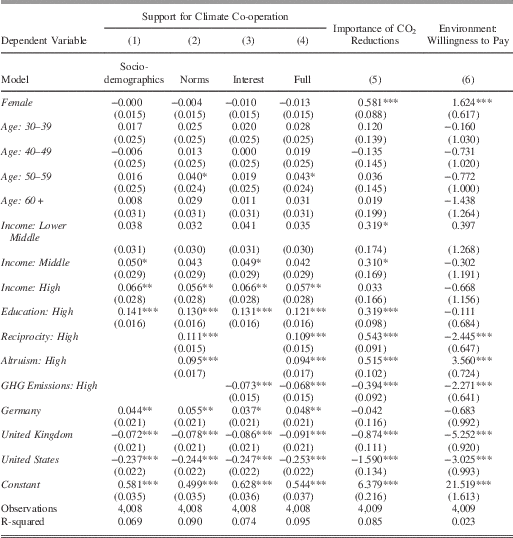
We first explore the socio-demographic dividing lines in support for global climate policy by regressing the variable Support: Global Climate Co-operation on measures of socio-demographic characteristics. Model 1 in Table 1 shows the baseline results, where we include fixed effects for the four countries and calculate robust standard errors.Footnote 46 We find that individuals with higher levels of education are significantly more in favor of international climate co-operation as are individuals in the highest income quartile. We do not find significant differences by gender or age.
Support for Climate Cooperation: Norms and Interests

This table reports OLS regression coefficients and robust standard errors (in parentheses).
***p<0.01, **p<0.05, *p<0.10. Reference groups are: Sex: Male, Age: 18–29, Income: Low, Education: Low, Reciprocity: Low, Altruism: Low, GHG Emissions: Low, Country: France. The sample is employed respondents in the pooled data for France, Germany, the UK and the US.
We address each part of our theoretical argument by separately focusing on the effect of norms and interests on support for climate co-operation. Model 2 in Table 1 adds our binary measures of reciprocity and altruism. We find that both variables enter highly significant and have positive signs. On average, more reciprocal respondents are significantly more in favor of global climate policies as are individuals who are more altruistic. The coefficients are also sizeable. Substantively, the effect of both variables is roughly a 10 percentage points’ increase in public support. Arguably, this evidence constitutes only an indirect test of the reciprocity argument, as we have no measure of beliefs about expected co-operation from others. However, the experimental results presented further below explicitly and exogenously vary the contribution other actors make (the participation dimension), which will allow for a more rigorous test of the theory.
Moving to test the second half of our argument, in Model 3 we evaluate the importance of sectoral-based interests by including the GHG Emissions: High variable. We find that respondents working in a more pollutive sector are significantly less supportive of global climate co-operation. The magnitude of this effect is closely comparable to the effects of social norms, in that working in an industry with a high environmental impact decreases the support for climate co-operation by 7 percentage points.
To test whether social norms and industry-specific cost considerations independently explain support for climate co-operation, we estimate a fully specified model (Model 4) that includes all socio-demographic predictors as well as our measures of norms and interests. We find that the coefficients on our variables of interest remain significant and similar in terms of magnitudes. This suggests that norms and interests both add to our understanding of which individuals support climate co-operation and which oppose it.
To what extent do these results generalize to other facets of climate policy? We answer this question by re-estimating the fully specified model using our two additional measures of support for environmental policy. We first turn to the Importance of CO 2 Reductions variable which captures the priority respondents attach to carbon abatements (Model 5 in Table 1). We again find that industry-based interests and social norms significantly correlate with the importance of CO2 reductions in ways consistent with our results on support for global climate co-operation. This suggests that sectoral interests and general beliefs about what constitutes socially appropriate behavior in the context of public goods problems helps explain why some individuals attach higher salience to addressing the sources of global warming than others.
Finally, we enrich these findings by exploring whether norms and industry-based interests also help explain variation in individuals’ willingness to pay for environmental protection. The results from Model 6 in Table 1 suggest that again altruists are significantly more willing to pay for the environment while individuals employed in high-emission sectors are significantly less willing. Interestingly, the results change for the reciprocity measure. For the willingness to pay variable, we estimate that conditional co-operators, that is, those with higher levels of reciprocity, are less willing to contribute than those with low levels of reciprocity. This switch of sign appears consistent with the theory because the willingness to pay emphasizes costs without a reference to the efforts of other countries and, therefore, conditional co-operators should actually be less willing to back costly mitigation efforts under those circumstances.
While the evidence so far supports the view that both interests and norms add to our understanding of the domestic political divisions between supporters and opponents of climate policy, one may also argue that reciprocial considerations and altruistic concerns may be more powerful when the costs of climate policy are low, that is, when it is relatively less costly to pursue ambitious, international climate policies. This reasoning predicts interaction effects between social norms and the costs of climate co-operation. For example, we would expect the positive association between altruism and climate policy support to be more pronounced among those working in low-emitter sectors than among individuals employed in sectors that produce large amounts of greenhouse gas emissions. To evaluate this argument we re-estimated the main models and added multiplicative terms between the norms and interest variables. However, the empirical evidence lends weak to no support to this prediction. The coefficents on the interaction terms are mostly statistically indistinguishable from zero (see Table A-15 in the Appendix).
III. INTERESTS, NORMS AND SUPPORT FOR CLIMATE CO-OPERATION: EXPERIMENTAL CONJOINT EVIDENCE
We have presented evidence suggesting that both norms and interests matter when trying to explain support for international climate policy. In the following, we complement our main findings with evidence from a randomized choice-based experiment in which individuals could choose their most preferred climate treaty. This analysis not only extends findings reported in previous work,Footnote 47 but also validates our theoretical argument by largely confirming the results presented in the previous section using a different research design.
A. Conjoint Design
Conjoint analysis has been developed in psychology and marketing and involves having respondents rank or rate two or more hypothetical choices that have multiple attributes, with the objective of estimating the influence of each attribute on respondent choices or ratings.Footnote 48 We devise a fully randomized (unrestricted) conjoint since none of the potential climate agreements described by the features (see below) seem internally inconsistent and feasible politically, although, in principle, even atypical combinations of features would not pose a threat to the internal validity of our causal estimates. We show each respondent two international agreements in comparison and then ask to choose between them. This forced-choice design allows us to assess the influence of different features of climate change agreements on how individuals evaluate a given agreement relative to another. Each respondent was shown four such binary comparisons. For each agreement that a given respondent considered, we constructed the variable Agreement Support and coded it one if an individual chose that agreement and zero if not.
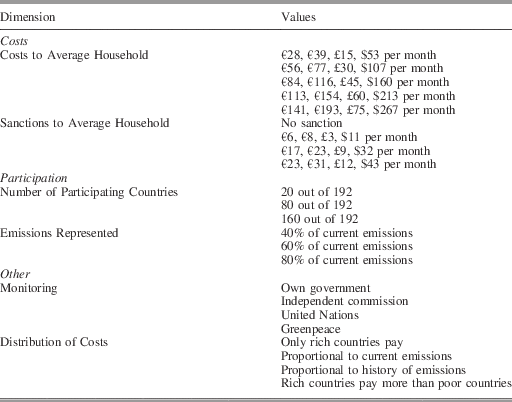
Table 2 shows the dimensions and values used in the conjoint experiment. We focus on cost and participation features since these directly relate to our theoretical interest in the monetary costs of intensified climate policy and norms of conditional co-operation. Moreover, these features remain particularly contentious in the domestic politics of international environmental decision makingFootnote 49 with important implications for the public debate on international climate policy in developed democracies.Footnote 50 The cost dimension distinguishes between the costs from policy implementation and potential sanctions imposed in case a country fails to meet its emission reduction obligations. We have chosen the values of the different features such that they correspond to the most plausible and widely discussed cost scenarios. A modal estimate by climate scientists is that it will cost about 2 per cent of industrialized countries’ GDP to achieve a constant level of CO2 concentration at 550 particles per million (ppm).Footnote 51 To make these cost quantities as informative as possible to our respondents, we computed prices in monthly costs to the average household in the country’s currency. We computed monthly abatement costs to the average household for five different cost scenarios, ranging from 0.5 per cent to 2.5 per cent of a country’s GDP in steps of 0.5 percentage points.Footnote 52 For sanctions, we distinguished between no sanction and a low, medium and high sanction. For each country, the low, medium and high sanction values correspond to 5 per cent, 15 per cent and 20 per cent of the monthly household costs for the 2 per cent of GDP scenario.
Policy Dimensions and Values for the Global Climate Agreement Experiment

The table shows the policy dimensions and corresponding values used in the conjoint experiment. For costs and sanctions, the values are given in order for France, Germany, the UK and the US.
The participation dimension captures aspects that relate to issues of reciprocal or conditional co-operation. Specifically, we consider the number of countries that participate in a climate agreement and, as an alternative conceptualization of this dimension, the share of global emissions represented by these countries. The number of participating countries can vary from 20 to 80 to 160 out of 192, and the emissions accounted for by participating countries from 40 per cent to 60 per cent to 80 per cent of current emissions. All these values were randomly assigned in the agreements that respondents had to consider. The order of the dimensions was randomly assigned for each respondent but remained consistent across the four binary comparisons (see Appendix for further information). We conducted a pilot study in which we tested the feasibility and relative strength of the attributes before fielding the main survey.
The experimental setup allows us to estimate non-parametrically the causal effects of costs and participation aspects on attitudes toward international climate co-operation by comparing levels of support across different values of the agreement dimensions. Our analysis also explores how these treatment effects vary across different types of respondents in our sample – specifically respondents who face different costs or hold different norms. These conditional treatment effects are also non-parametrically identified in our fully randomized conjoint experiment as long as the respondent characteristics are not affected by the treatments, an assumption that appears plausible in our application.
Thanks to the randomization, we can estimate the effects of a climate agreement’s costs and participation features on support for climate co-operation by computing differences in means. We obtain the difference-in-means estimators by regressing the variable Support Agreement on a set of dummy variables for each value of each dimension (with the exclusion of one value in each dimension as the baseline).Footnote 53 The regression coefficient for each dummy variable indicates the average marginal component-specific effect of that value of the dimension relative to the omitted value of that dimension.
In contrast to previous work,Footnote 54 we are not only interested in exploring how cost and participation attributes of climate treaties affect support for international climate co-operation but also in the extent to which sector-based interests as captured by our novel pollution measures moderate these effects. To this end we explore whether objective measures of the emission level of an individual’s sector of employment conditions the sensitivites to agreement features in ways predicted by the theory.
B. Climate Agreement Conjoint Results
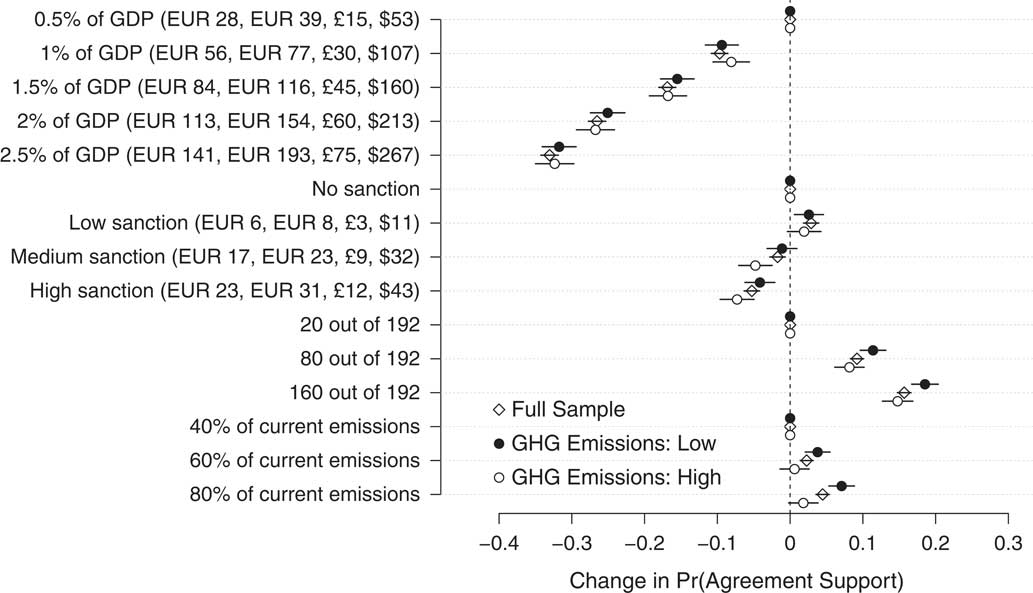
Figure 1 shows the estimated effects along with 95 per cent confidence intervals based on three linear probability models in which we regress support for a climate on agreement features. The first model (diamonds) reports the average treatment effects estimated on the full sample. We find that individuals care about both the costs of implementing a climate change agreement and the inclusiveness of the treaty. Climate treaty support decreases significantly as the household costs arising from implementation increase: as the costs increase from 0.5 per cent to 1 per cent of GDP public support for a global climate agreement decreases by 10 percentage points. We also find that publics are sensitive to sanctions. On average, individuals prefer a small sanction over no sanction. However, agreements receive significantly less support when they include medium or high sanctions. For example, an agreement that imposes a high sanction on countries that fail to meet their obligations decreases public support by about 5 percentage points on average.
The causal effect of costs and participation on support for climate agreements by GHG (CO2-equivalent) emissions in France, Germany, the United Kingdom, and the United States. This plot shows the estimates of the effect of randomly assigned agreement features on the probability of supporting an agreement for the full sample (points, N=68,000 agreements) and by CO2-equivalent GHG emissions of respondents’ sector of employment (N=33,408 agreements). Estimates are based on the regression of Agreement Support on dummy variables for values of the agreement dimensions, with SEs clustered by respondent. The bars indicate 95% confidence intervals computed from robust standard errors clustered by respondent. Points without bars indicate the reference category for a given agreement dimension.

To what extent do these sensitivities mirror concerns about the sector-specific costs of intensified climate co-operation? To explore this question we first partition the data using our novel pollution measure and contrast respondents working in sectors with relatively low greenhouse gas emissions with those working in sectors with high emissions. Figure 1 reports the results.
We find that a medium sanction decreases support among respondents working in more pollutive industries significantly by about 5 percentage points. This is not the case for individuals employed in low-emission sectors who remain indifferent between a climate agreement that does not sanction excessive emissions and one that imposes a medium sanction. We also find a pronounced difference between the effects of a high sanction depending on the pollutiveness of respondents’ sectors of employment. Among individuals working in low-emission industries a high sanction decreases support for a climate agreement by 3.7 percentage points on average. This effect doubles, however, when we consider those working in sectors with high levels of emissions. When estimating the heterogeneity of these treatment effects using interaction terms in a regression model, we find that the differences are statistically significant at the 5 per cent level. This pattern suggests that sector-based variation in expectations about the costliness of intensified climate policy helps explain why some individuals are less supportive of climate agreements than others.
While we find a pronounced heterogeneity in the effects of sanctions, we do not find significant differences in the effects of household costs depending on the emissions produced by respondents’ sectors of employment. One potential interpretation of this result is that the cost dimension assumes that mitigation takes place, that is, these costs are certain. In contrast, sanctions will only apply in case of incomplete mitigation. Presumably, individuals form beliefs about the difficulty of climate mitigation and the probability of failing to meet emission targets based on their daily work experience. As a consequence, respondents in high-emission industries may expect the risk of having to pay fines to be higher than individuals employed in sectors that produce only low amounts of greenhouse gases. Thus, individuals in high-pollution sectors will exhibit a greater degree of sensitivity to the inclusion of sanctions in a climate agreement because they factor in the probability of having to pay a fine which results in higher expected costs of joining a climate treaty. Since the household costs do not depend on this probability, the effects should be constant across individuals’ sectors of employment, which is what we observe.
How do conditional co-operation features affect support for climate policy? Generally, we find that individuals prefer more encompassing agreements. An increase in the number of participating countries from 20 to 160 (out of 192) causes an increase in support for an agreement of 15 percentage points according to the full sample model. Similarly, although with smaller magnitudes, the proportion of current global emissions increases support for a climate agreement. These results suggest that both the costs and features related to conditional co-operation cause shifts in support for climate co-operation. Moreover, and consistent with the reciprocity argument, we find that higher levels of co-operation (more participating countries/higher share of global emissions represented by participating countries) increase support for a climate treaty more strongly among individuals with high levels of reciprocity as measured by the behavior observed in our pre-treatment public goods experiment (see Figure A-6 in the Appendix).
Turning back to the role of industry-specific costs of abatement, we also find that these sectoral interests seem to matter when trying to understand the effect of conditional co-operation features: individuals working in more pollutive sectors are significantly less sensitive to the participation dimension than respondents in less pollutive industries. For example, increasing the number of participating countries from 20 to 160 increases climate policy support by about 19 percentage points among respondents working in cleaner sectors. Among individuals employed in sectors with high greenhouse gas emissions, however, this effect is only 14 percentage points, a difference that is statistically significant and therefore evidences an interaction effect. The difference in the treatment effects of participation features is even more pronounced when we examine the effects of the share of emissions represented by participating countries: Respondents working in sectors that emit less greenhouse gases are more than twice as sensitive to conditional co-operation features than respondents in high-emission sectors.
IV. WILLINGNESS TO PAY FOR AGREEMENT DESIGN FEATURES
We can further capitalize on the results from our randomized choice experiment to obtain estimates of individuals’ willingness to pay for specific climate policy design features. To compute these quantities we have to re-estimate our main conjoint results using a continuous variable of the cost dimension. We regress the outcome variable agreement support on the continuous cost variable along with all agreement design indicator variables. The coefficient on this variable measures the cost elasticity of support for an agreement, that is, the impact of a one €, ₤, $ increase in the costs of a climate agreement on the probability of agreement support. Obviously, this parametrization relies on the assumption of a linear relationship between costs and support for a climate agreement. This assumption seems plausible given the results reported in Figure 1 which suggest that increases in the monetary costs of climate co-operation translate into lower support in a roughly linear fashion. We estimate the monetary value of each feature by multiplying its treatment effect by −1 and dividing the result by the coefficient on the cost variable. This conversion re-expresses the treatment effect such that it equals the monetary value of including a specific agreement design feature relative to the reference category. Since the cost sensitivities vary moderately by country, we compute the willingness to pay for agreement features separately for each country included in our analysis.
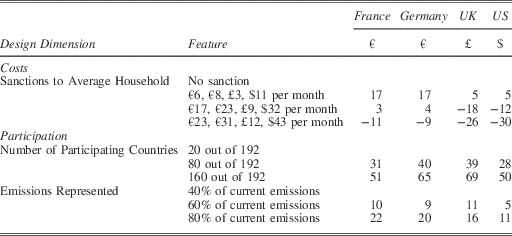
Table 3 reports the estimated willingness to pay for different agreement design components by country. The results suggest that individuals in France and Germany would pay €17 if a climate policy proposal included a small sanction instead of no sanction. Similarly, individuals would be willing to pay for more encompassing agreements. For example, our estimates suggest that publics in those two countries would pay €31 (France) and €40 (Germany) for increasing the number of participating countries from twenty to eighty. In the United Kingdom and the United States, the willingness to pay for including small sanctions for countries that have failed to meet their emission reduction targets is a bit lower ($/₤5) and publics in those countries also exhibit higher reluctance against the inclusion of medium and high sanctions as evidenced by the more negative willingness-to-pay estimates. Overall, however, we find a relatively large degree of similarity in the willingness to pay for specific agreement design features.
Willingness to Pay Estimates.

The table shows estimates of how much individuals would be willing to pay for a specific agreement design feature based on the conjoint experiment results (see text for details). Rows without values are reference categories.
V. ROBUSTNESS
Our results are robust to a large set of sensitivity tests. We first report the additional tests performed on the correlational data. We then turn to the robustness of the experimental conjoint findings.
A. Robustness of Correlational Evidence
We evaluate the robustness of the correlational results in several ways. We first explore the sensitivity of our findings to how we measure the pollutiveness of individuals’ sectors of employment. We then re-estimate our main model using an alternative measure of a sectors’ level of greenhouse gas emissions that is based on the World Bank Development Indicators database. Model 1 in the Appendix shows that this variable (GHG Emissions (WB): High) has a significantly negative coefficient, consistent with the prediction that those working in sectors that emit more greenhouse gases are systematically less in favor of climate co-operation. Model 2 re-estimates our model using the difference between the level of greenhouse gas emissions and the level of non-CO2 gases as a sectoral-based interests indicator and also shows a significantly negative coefficient. Model 3 uses a measure of climate-relevant energy intensity in tonnes of oil equivalent (2011) weighted by the sectors’ value added. Again, the coefficient is significantly negative which suggests that those working in more energy-intense sectors are more opposed to global climate policy efforts. In Model 4 we include an Employee-Weighted GHG Emissions variable, which is the main GHG Emissions variable weighted by the number of employees in each of the twenty-one ISIC sectors. The results remain similar: those working in more pollutive sectors are significantly less in favor of international climate co-operation.
We conducted an analogous set of robustness tests for our Importance of CO 2 Reductions dependent variable, again using the same alternative measures of sector-based pollution costs. Table A-7 in the Appendix reports the estimates, which agree with our main findings. We repeat this exercise using our willingness to pay measure as the dependent variable. The results in Table A-8 are consistent with the finding that those working in more pollutive industries are less willing to pay for environmental protection. The strength of sectoral-based cleavages in public opinion over climate change policy stands in contrast to the public opinion literature on trade policy opinions which has largely failed to detect substantively significant cleavages by industry of employment.Footnote 55
We also explore whether our estimates remain robust to including a variable that captures whether a respondent owns a car or not as an alternative measure of private interests. We report the results from these estimations in Table A-9 in the Appendix. Across all three dependent variables, our key findings are qualitatively the same, with the estimate for car ownership negative and statistically significant in two out of the three specifications. Furthermore, we assess whether our results remain robust against the inclusion of individuals’ ideological positions, since a large literature has demonstrated that left-right ideology correlates with environmental policy preferences and ideology may also correlate with social norms. Table A-10 in the Appendix shows the results when we include a standard left–right measure that is based on individuals’ self-reported ideological position, and takes the value of one if the respondent identifies with the right and zero otherwise. We find that more rightist individuals are significantly more opposed to climate co-operation, less strongly believe that reducing emissions is important and have a significantly lower willingness to pay for the environment. Most importantly, however, all our main findings remain intact even when accounting for individual differences in ideological convictions.
In our main estimations we have only considered employed individuals since the industry-based pollution measures are naturally missing for all respondents that are not in paid work. To further explore the robustness of our results we recode our main measure of industry-based pollutiveness such that it incorporates missing values as a separate category. Table A-11 in the Appendix reports the results. Although in Model 1 individuals not in paid employment are somewhat less in favor of climate co-operation than those working in cleaner sectors (the reference group), this correlation – which is only borderline significant – is no longer significant when we re-estimate the model using the original five-point scale. Our result that those working in sectors that emit more greenhouse gases are significantly less supportive of global climate policy remains robust to including individuals not in paid work.
A rival explanation for our findings could be that environmentalists self-select into working in sectors that emit less greenhouse gases. To address this issue we re-estimated our main model of support for climate co-operation including our Importance of CO 2 Reductions measure of environmentalism as a control variable. This likely introduces endogeneity which would bias the results against our theoretical argument.Footnote 56 It is nonetheless reassuring that, as the estimates reported in the last column in Table A-11 in the Appendix suggest, we still find that those working in high-emissions industries are less supportive of climate co-operation. We also assess the robustness of our results against adding an indicator variable that identifies individuals working in sectors with a large share of employees. As the results in Table A-14 indicate, our findings remain unchanged.
Finally, we investigate the within-country consistency of our findings by estimating our main model for each separate country. Table A-12 reports the results. These findings suggest some interesting heterogeneity across countries: Reciprocity has a strong positive effect on climate co-operation support among individuals in France, Germany and the United Kingdom, but the effect only borders significance in the United States. Contrastingly, altruists are not significantly more supportive of climate change agreements in France and Germany, while they are in the United Kingdom and the United States. With regards to our measure of economic interests, we find that the most notable differences exist in the United Kingdom and the United States. We believe these findings are consistent with a large literature on the interaction between the welfare state and support for trade openness. This literature argues that generous welfare states mitigate domestic distributive conflict by ensuring that the costs and benefits of globalization are widely shared.Footnote 57 We note, however, that the direction of the effects across all countries is consistent with our expectations, and overall validate our aggregate results. Table A-13 in the appendix offers further robustness tests employing ordered probit and tobit models to take into account various features of our dependent variables.
B. Robustness of Conjoint-Based Evidence
We also perform sensitivity tests on experimental conjoint responses, despite the fact that the experimental research design allows us to dismiss the influence of confounders. We first explore the robustness of our findings by re-estimating the results by alternative measures of industry-level pollution. Figure A-2 shows the results for the GHG (WB) Emissions indicator. The findings remain very similar, and are perhaps even stronger than our main results suggest. Figure A-3 shows the results by CO 2 -Only Emissions and Figure A-4 shows the treatment effects by Oil Equivalent Energy Flows. Again, we find that economic interests have similar effects on support for climate co-operation when looking at the effects of participation features, for example, the number of involved countries. Our results remain also unchanged when using the Employee-Weighted GHG Emissions (Figure A-5) to split our sample.
One may also ask whether the conjoint instructions may have been understood better or read more carefully by respondents with higher levels of education. Alternatively, more educated individuals could generally pay more attention to the design of policy. However, as the results reported in Figure A-7 in the Appendix suggest, the evidence does not support this idea. Instead, we find that the design features have very similar effects on climate agreement support when comparing respondents with different levels of education.
Although our data do not lend themselves to statistical analyses at the country level because they comprises only four countries, we did explore potential cross-country heterogeneity to check the consistency of the experimental data. Figure A-8 shows that the effects we estimate using the pooled data remain largely comparable when considering individual countries. We uncover some cross-country differences when looking at differences between individuals that work in more and less pollutive industries, which may reflect the different structures of the countries’ economies as well as different types of welfare provision. Nonetheless, in all countries we find very similar sensitivities to cost and participation features of global climate agreements.
VI. CONCLUSION
How can countries realize more effective global climate co-operation? The effectiveness of any climate agreement crucially depends on its domestic political popularity. If large parts of the national electorate remain antagonistic to a climate deal, its government will be reluctant to join it because it fears an electoral backlash.Footnote 58 Moreover, even if countries join an agreement, they are unlikely to meet the obligations necessary for mitigation efforts to be successful unless there is widespread public support for international efforts. However, governments can design climate agreements in ways such that their features generate high levels of domestic approval. Such optimal policy design necessitates scholarship that explores public support for climate agreements and domestic conflict over climate co-operation.
We argue that both individuals’ sector-based interests and the presence of internalized social norms shape the popularity of international climate policy. In analyzing different types of survey data for France, Germany, the United Kingdom and the United States we find empirical support for our argument. Both employment-related interests as well as social norms such as reciprocity and altruism significantly predict general support for climate co-operation, the importance individuals attach to realizing reductions in greenhouse gas emissions and their willingness to pay for environmental protection more generally. Leveraging a randomized conjoint experiment we present additional evidence on the effects of cost- and participation-related features of climate agreements. More importantly, the effects of these features vary significantly between respondents working in sectors with high levels of greenhouse gas emissions and those whose sectors of employment are less pollutive in ways consistent with the theory.
In sum, our results not only offer a theoretically informative characterization of the dividing lines that underlie support for climate policies, but also contribute to a long-standing debate about the origins of preferences for policies that aim to provide public goods. By exploring the material and behavioral foundations of international environmental co-operation we offer useful information for policy makers interested in the conditions under which citizens are willing to approve climate co-operation. Our results suggest that both policies that compensate those who fear to lose economically from intensified climate change targets and forms of co-operation that resonate with widespread and largely time-invariant social norms can contribute to reducing public opposition to costly global climate agreements, as exemplified by the German government’s policy response to the recent protests of coal power producers against the introduction of a climate tax for highly polluting power plants.Footnote 59 Rather than treating economic interests and social norms as rival explanations for differences in political views, our study suggests that combining both sets of factors may provide better insights into the sources of individual policy preferences across countries. Such a research agenda may also contribute to a better understanding of the conditions under which governments will reach co-operative solutions to global collective action problems in the face of domestic political constraints.