Introduction
Until the 1920s, Reticulitermes lucifugus (Rossi) (Isoptera, Rhinotermitidae) was the only native species in the genus Reticulitermes known to exist in Europe and the circum-Mediterranean area. Another species, R. santonensis Feytaud, was described in 1924, based on samples collected on the western coast of France, but was later found to be synonymous with R. flavipes (Kollar) (Austin et al., Reference Austin, Szalanski, Scheffrahn, Messenger, Dronnet and Bagnères2005), a North American species introduced by man to Europe. Reticulitermes flavipes was previously discovered in Vienna (Kollar, Reference Kollar1837) and later in other French localities (Dronnet et al., Reference Dronnet, Ohresser, Vargo, Lohou, Clément and Bagnères2002) in Hamburg, Germany (Weidner, Reference Weidner1937) and in northern Italy (Ghesini et al., Reference Ghesini, Pilon and Marini2011). In 1952, R. clypeatus Lash was described, based mainly on its enlarged postclypeus, from samples collected in Israel (Lash, Reference Lash1952).
Studies conducted during the last few decades have revealed that what was originally described as R. lucifugus was in fact a complex of different species and subspecies. The distribution of R. lucifugus is now restricted to Italy, southern France and Corse, with the subspecies R. lucifugus lucifugus in peninsular Italy and some localities of Provence, the subspecies R. lucifugus corsicus on Sardinia, Corse, and on the coasts of Tuscany and Provence, and a third subspecies in Sicily (Clément, Reference Clément1978; Clément et al., Reference Clément, Bagnères, Uva, Wilfert, Quintana, Reinhard and Dronnet2001; Marini & Mantovani, Reference Marini and Mantovani2002; Luchetti et al., Reference Luchetti, Trenta, Mantovani and Marini2004b; Lefebvre et al., Reference Lefebvre, Châline, Limousin, Dupont and Bagnères2008).
In the Iberian Peninsula and in the contiguous French regions, two species are present: R. grassei Clément on the Atlantic side and R. banyulensis Clément on the Mediterranean side (Clément et al., Reference Clément, Bagnères, Uva, Wilfert, Quintana, Reinhard and Dronnet2001; Nobre et al., Reference Nobre, Nunes, Eggleton and Bignell2006).
In addition, R. urbis Bagnères, Uva et Clément is distributed along the Adriatic and Ionic coasts of Balkan Peninsula, down to the southern Peloponnese, and is also present in some localities on the Adriatic side of Italy and in south-eastern France (Bagnères et al., Reference Bagnères, Uva and Clément2003; Luchetti et al., Reference Luchetti, Marini and Mantovani2007).
The Aegean area shows a high degree of complexity. Taxonomy and phylogeny of eastern Mediterranean termites remains unclear, due to the insufficient sampling in certain areas.
Reticulitermes balkanensis Plateaux & Clément is localized in Attica, restricted to an area in the neighbourhood of Athens (Luchetti et al., Reference Luchetti, Marini and Mantovani2007). Certain samples appear to belong to different clades and are still under investigation. They include a clade from the Halkidiki Peninsula, another clade from north-eastern Greece and north-western Turkey, a third clade from the island of Crete (Luchetti et al., Reference Luchetti, Marini and Mantovani2007; Velonà et al., Reference Velonà, Ghesini, Luchetti, Marini and Mantovani2010). Turkish Reticulitermes are still referred to as R. lucifugus, a denomination they have retained from the times when R. lucifugus was believed to be the only Reticulitermes species in the circum-Mediterranean area. It is now widely accepted that Turkish R. lucifugus are different from the European R. lucifugus (Austin et al., Reference Austin, Szalanski, Uva, Bagnères and Kence2002, Reference Austin, Szalanski, Ghayourfar, Kence and Gold2006; Luchetti et al., Reference Luchetti, Marini and Mantovani2005). In fact, it appears they are more similar to R. clypeatus and Reticulitermes from Iran (Austin et al., Reference Austin, Szalanski, Ghayourfar, Kence and Gold2006).
Cyprus has received very little attention by termitologists, despite being the third largest Mediterranean island after Sicily and Sardinia. To date, only one termite sample has been reported from Cyprus. Hagen (Reference Hagen1858) reported R. lucifugus from Cyprus, based on a single sample collected, with no further data or reference to sampling locality.
The island of Cyprus began to emerge from the sea about 20 million years ago, as a consequence of the subduction of the African plate under the Eurasian plate. The south-western part of the island is dominated by the Troodos Massif, with a maximum elevation of 1952m. Along the northeast margin of the island is a range of hills, the Kyrenia Range. Between these two mountainous areas is the plain of Mesaoria.
Despite its proximity to the nearby mainland (about 70km to the southern coasts of Turkey, about 100 and 170km to the eastern coasts of Syria and Lebanon, respectively), Cyprus is one of the most biogeographically isolated Mediterranean islands (Corti et al., Reference Corti, Masseti, Delfino and Pérez-Mellado1999; Simmons, Reference Simmons1999). Its zoogeographic affinities are different depending on the group of organisms considered. In the case of the Levant water frog, Pelophylax (=Rana) bedriagae (Camerano) (Anura, Ranidae), Cypriot populations have strong affinities with Syrian populations (Lymberakis et al., Reference Lymberakis, Poulakakis, Manthalou, Tsigenopoulos, Magoulas and Mylonas2007). The same is true for the skink Ablepharus budaki Göçmen, Kumlutas and Tosunoglu (Squamata, Scincidae) (Poulakakis et al., Reference Poulakakis, Lymberakis, Tsigenopoulos, Magoulas and Mylonas2005). On the other hand, in the case of earthworms, Cypriot fauna has more affinities with the Anatolian fauna than with the Levant (Pavlíček & Csuzdi, Reference Pavlíček and Csuzdi2006). A similar pattern is found in the case of the pine processionary moth Thaumetopoea wilkinsoni Tams (Lepidoptera, Notodontidae) whose Cypriot populations have a strong genetic similarity with Turkish populations (Kerdelhué et al., Reference Kerdelhué, Zane, Simonato, Salvato, Rousselet, Roques and Battisti2009). In the case of the Kotschy's gecko, Cyrtopodion kotschyi (Steindachner) (Squamata, Gekkonidae), Cypriot samples have affinities with those from south-eastern Turkey and, to a lesser degree, to those from Israel (Kasapidis et al., Reference Kasapidis, Margoulas, Mylonas and Zouros2005).
Current opinion is that Cyprus was never connected with the mainland and that, even at times of minimum sea level, it was separated from the mainland by at least 30–40km wide areas of water (Simmons, Reference Simmons1999). Such a distance is not believed to be an unsurpassable barrier for subterranean termites. The colonization of an island by termites might occur through the dispersal of primary reproductives or portions of colonies. Termite primary reproductives are not strong flyers, but they can be carried long distances via wind currents. Portions of termite colonies can travel inside logs or branches floating on water.
The current study focuses on describing morphological characteristics of Cypriot termites of the genus Reticulitermes, and on studying their position in the phylogeny of European termites, through the analysis of portions of the mitochondrial genes COII (cytochrome oxidase II) and 16S (mitochondrial large ribosomal subunit).
Materials and methods
Samples
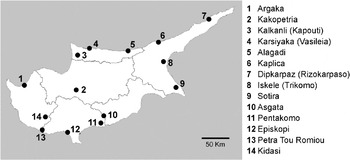
Samples of termites belonging to the genus Reticulitermes were collected from Cyprus during February and November 2009. Termite surveys were focused mainly along the coast, in order to obtain samples from the furthermost points of the island. Sampling localities are shown in fig. 1. For locality 4 (Karsiyaka), two colonies were sampled, approximately 30m apart. The corresponding samples will be referred to as sample 4A and sample 4B.
Collection sites of Reticulitermes sp. on the island of Cyprus.

Morphology
Measurements were taken with an ocular micrometer mounted in a stereomicroscope. A total of nine alates and 29 soldiers, belonging to eight different colonies, were observed. For alates, the following measurements were taken: head length (from the distal margin of the clypeus to the posterior end of the head), head width, maximum eye diameter, minimum eye diameter, distance between eye and ocellus, pronotum length along the median line, pronotum width, tibia length in the third right leg, right forewing length (from basal suture to wing tip), maximum right forewing width, right hind wing length (from basal suture to wing tip), maximum right hind wing width. For soldiers, the same measures were taken, with the obvious exception of those concerning eyes, ocelli and wings, and with the addition of left mandible length, postmentum length, maximum and minimum postmentum width. For soldiers, head length was measured as the distance between the line joining the two mandible insertions and the posterior end of the head.
The number of antennal segments was counted for ten alates and 29 soldiers. Only complete antennae, recognizable by the oval shape of the last segment, were considered. Thus, a total of 20 and 39 antennae were counted for alates and soldiers, respectively.
Pictures were taken with a scanning electron microscope (Jeol JSM-5200). A total of four alates, three soldiers and three workers were observed. Samples were dehydrated in increasing concentrations of ethanol (80%, 90%, 95%, 100%), then kept in a 1:1 solution of hexamethyldisilazane/ethanol for 2–3 hours, then immersed in 100% hexamethyldisilazane, and finally air dried. Samples were mounted on aluminium supports and coated with gold in a metalizer BIO-RAD SC 502 (45s at 15mA). The number of ommatidia was counted in five eyes belonging to five individuals.
Statistical analysis of measurements was carried out with PAST 1.90 (Hammer et al., Reference Hammer, Harper and Ryan2001). Cluster analysis was performed on standardized measures, choosing euclidean distance and Ward's method. Hartigan's dip test for unimodality was computed in R 2.13.2 (R Development Core Team, 2011) with the package ‘diptest’ 0.75-1.
Mitochondrial DNA
Total DNA was extracted from individual termite heads with a CTAB protocol (Doyle & Doyle, Reference Doyle and Doyle1987). Two individuals for each sample were analyzed. For each individual, a 684bp portion of the mitochondrial gene COII, encoding for 228 amino acids, and a 504bp portion of the mitochondrial gene 16S were amplified.
Amplification of COII gene was obtained with the primers TL2-J-3034 = mtD-13 (5′-AATATGGCAGATTAGTGCA-3′) and TK-N-3785 = mtD-20 (5′- GTTTAAGAGACCAGTACTTG-3′). Amplification of the 16S gene was obtained using the primers LR-J-12887 = mtD32 (5′-CCGGTCTGAACTCAGATCACGT-3′) and LR-N-13398 = mtD34 (5′-CGCCTGTTTAACAAAAACAT-3′).
PCR was performed in a 50μl mixture using GoTaq® Flexi DNA Polymerase kit (Promega, Madison, WI, USA), following the enclosed protocol. Reaction conditions were set as follows: initial denaturation at 94 °C for 5min; 30 cycles composed by denaturation at 94 °C for 30s, annealing at 48 °C for 30s, extension at 72 °C for 30s; final extension at 72 °C for 7min. Purification and sequencing were performed by Macrogen Inc. (Seoul, South Korea). Sequencing was carried out with the same primers that were used for amplification, and both strands were sequenced.
The preliminary analysis of DNA sequences was performed with MEGA version 4 (Tamura et al., Reference Tamura, Dudley, Nei and Kumar2007). The parsimony network for the combined haplotypes of Cypriot termites was obtained with TCS 1.21 (Clement et al., Reference Clement, Posada and Crandall2000). Cypriot sequences were aligned with sequences representative of eastern Mediterranean Reticulitermes clades that were identified in previous works (Austin et al., Reference Austin, Szalanski, Uva, Bagnères and Kence2002, 2006; Luchetti et al., Reference Luchetti, Bergamaschi, Marini and Mantovani2004a,b, 2007; Velonà et al., Reference Velonà, Ghesini, Luchetti, Marini and Mantovani2010). The alignment was obtained with Clustal X in Mega 4 and controlled manually. Sequences from R. flavipes and R. lucifugus (GeneBank A.N. GU 070788, GU070789, AF291723 and AF292006) were used as outgroups.
Models of nucleotide substitution were tested with ModelTest Server 1.0 (Posada, Reference Posada2006; Posada & Crandall, Reference Posada and Crandall1998). According to BIC criterion, the best substitution models resulted HKY + Γ (Γ = 0.1570) for COII gene, K81uf + I (I = 0.8071) for 16S gene and HKY + I+Γ (I = 0.6110, Γ = 0.9553) for the combined dataset. The partition homogeneity test (Farris et al., Reference Farris, Källersjö, Kluge and Bult1995), implemented in PAUP* 4.0b10 (Swofford, Reference Swofford2003), was used to determine the suitability of the two genes for use in a combined dataset (100 replicates, P = 0.97).
Pairwise genetic distances were computed in PAUP* 4.0b10, using the HKY + I+Γ model for the combined dataset.
Maximum likelihood and maximum parsimony analyses were performed with PAUP* 4.0b10, combining the two genes into a single dataset. Bootstrap values were calculated with 100 and 1000 replicates, respectively. Gaps were treated as informative characters during the maximum parsimony analysis.
The Bayesian tree was obtained using MrBayes 3.1.2 (Huelsenbeck et al., Reference Huelsenbeck, Ronquist, Nielsen and Bollback2001; Ronquist & Huelsenbeck, Reference Ronquist and Huelsenbeck2003) and setting different substitution models for the two genes. Convergence was reached after two million generations (variance of split frequencies <0.01). Trees were sampled every 100 generations, and the first 5000 trees were discarded as burn-in, after graphic visualization.
Results
Termites were collected in natural and urban environments, from sea level to 400m above sea level. Colonies were collected from cardboard, tree stumps, discarded logs and dead branches at least 2–3 years old, also if partially degraded by fungi. The infested wood and tree species were mostly Pinus brutia Tenore, P. pinea L. and Cupressus sempervirens L., but also Tamarix sp., Dittrichia viscosa (L.) and Salix sp. Alates were only found in Kakopetria and were still inside the nest. All the alates sampled were determined to be male.
Morphology
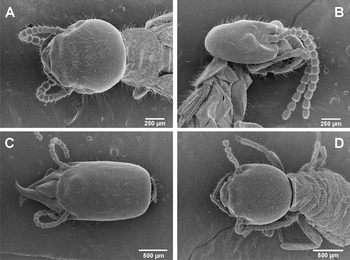
Morphological analysis was carried out mainly on alates and soldiers, which are the most useful castes for taxonomic purposes. For workers, we only show the image of the head, with no further discussion (fig. 2).
(A) Head of an alate, dorsal view; (B) head of an alate, lateral view; (C) head of a soldier, dorsal view; and (D) head of a worker, dorsal view.

Alates
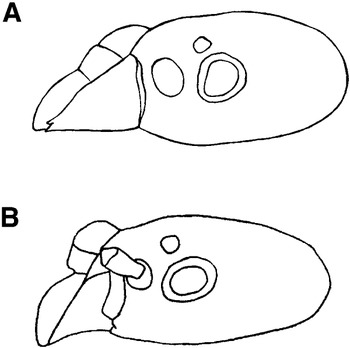
The body colour is dark brown with a light brown-yellow clypeus and postclypeus. Tarsi and the distal portion of tibiae are whitish, scarcely pigmented. The postclypeus protrudes quite noticeably (fig. 2). Compound eyes are formed by a number of ommatidia ranging from 94 to 102, with a mean of 97.80 ± 3.19. The unpigmented margin of the eye (sclerite sensu Lash, Reference Lash1952) is about as wide as in R. clypeatus (fig. 3).
Heads of alates, profile. (A) Reticulitermes sp. from Cyprus, (B) R. clypeatus (image reproduced from Lash, Reference Lash1952). In (A) mandibles are open and the clypeus is inflated owing to the high hydration of the sample.

The antennae of 80% of individuals are composed of 18 segments, stapes included. The third and the fourth segments are the shortest. The remaining 20% of the individuals have asymmetric antennae, one with 17 and the other with 18 segments. In antennae with 17 articles, the third article is longer than in antennae with 18 articles, so that the length of 17-segmented and of 18-segmented antennae is approximately the same.
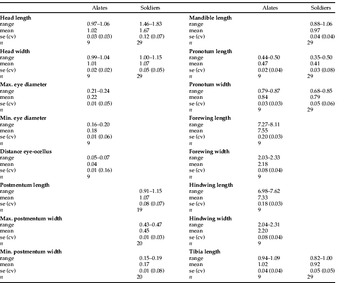
The measurements of alates are shown in table 1.
Measurements (in millimetres) of alates and soldiers of Cypriot Reticulitermes. se, standard error; cv, coefficient of variation; n, number of individuals.

Soldiers
Antennae are composed of 13–17 segments. The number of segments found more frequently is 15 (36% of antennae), followed by 14 and 16 (28% each). Only 13 individuals were collected with both antennae complete. Of those, eight (62%) have symmetric antennae, with 14, 15 or 16 articles, while the other five (38%) have asymmetric antennae, with 14–15 or 13–15 segments.
The left mandible typically overlaps on top of the right mandible when crossed (fig. 2).
Soldier measurements are shown in table 1. The shape of histograms of measured characters often leads to suspect bimodality (data not shown). For some characters, Hartigan's dip test allows to reject the hypothesis of unimodality (P = 0.002 for tibia length, P = 0.016 for mandible length, P = 0.021 for postmentum maximum width). For other characters, the result of the test is not conclusive (P = 0.074 for head width and pronotum length, P = 0.049 for pronotum width, P = 0.073 for minimum postmentum width). For head length and postmentum length, the hypothesis of unimodality cannot be rejected (P = 0.292 and P = 0.171, respectively).
Cluster analysis allows identifying two main groups, formed by soldiers having comparatively high or low values for the measured characters, respectively. For most of the measured characters (head length, head width, postmentum length, mandible length, pronotum length, pronotum width, tibia length), the two size groups have significantly different distributions (Mann-Whitney test, P < 0.01 in all the cases). No significant differences between the two groups can be detected for postmentum maximum and minimum width (Mann-Whitney test, P = 0.288 and P = 0.111, respectively). Except for colony 5 (Alagadi), where one soldier is classified as ‘big’ while the others are ‘small’, soldiers from the same colony always cluster in the same size group: ‘big’ soldiers are found in colonies 4A, 8 and 14, while ‘small’ soldiers are found in colonies 2, 7, 9 and 11.
Mitochondrial DNA
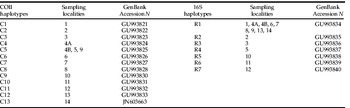
Partial sequences of the mitochondrial genes COII and 16S were obtained for 15 samples of Cypriot Reticulitermes collected from 14 localities. For both genes, the sequences obtained in the two individuals analyzed for each sample were identical. The sequences obtained in this study are deposited in GenBank under accession numbers GU993821-GU993828, GU993829-993832 and JN603663 (table 2).
COII and 16S haplotypes. Sampling localities as in fig. 1.

Haplotypes
For the COII gene, 13 different haplotypes are present (table 2). Samples 4B, 5 and 9 share the same haplotype, while all the other samples are characterized by a distinct haplotype, differing from the most common one for 1–5 substitutions. There are 20 variable sites (three at the first, one at the second and 16 at the third codon position), and the number of differences between haplotypes ranges from one to eight. There are no insertions or deletions. The maximum P-distance between colonies is 0.012 ± 0.004; the average P-distance among all the colonies is 0.006 ± 0.001. The average A + T content is 62.6%.
For the 16S gene, seven haplotypes were identified (table 2). Samples 1, 4A, 4B, 5, 6, 7, 8, 9, 13 and 14 share the same haplotype, while the other samples each have a distinct haplotype that differs from the most common one by a single substitution. There are five variable sites, and the number of differences between haplotypes ranges from one to two. There are no insertions or deletions. The maximum P-distance between colonies is 0.004 ± 0.003, while the average P-distance among all the colonies is 0.001 ± 0.001. The average A + T content is 62.9%.
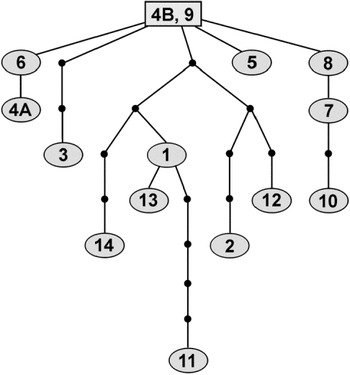
Colonies 4B and 9 have the same haplotype both for COII and 16S genes, while all the other colonies have a distinct combined haplotype. The maximum P-distance between samples is 0.0076 ± 0.0024. The average P-distance among all the samples is 0.009 ± 0.002. The parsimony network of combined haplotypes (fig. 4) reveals a group formed by the haplotypes from the west of the island (samples 1, 2, 11, 12, 13 and 14) and a less structured group formed by the central-eastern haplotypes. The haplotype most likely to be ancestral is the one shared by samples 4B and 9.
Combined-haplotype parsimony network. Black dots represent hypothetical missing haplotypes. Numbers refer to sampling localities as in fig. 1.

Phylogeny
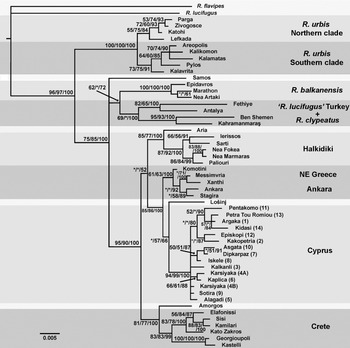
Phylogenetic trees obtained using the maximum parsimony method (TL = 751, CI = 0.551, RI = 0.886, RC = 0.488), the maximum likelihood method, and the Bayesian inference share the same topology (fig. 5).
Maximum parsimony, maximum likelihood, and Bayesian inference tree (topologies are coincident), calculated on combined COII and 16S sequences. Numbers at nodes indicate percent bootstrap values (MP/ML/BI). Values less than 50 are not shown.

The same groups found in Velonà et al. (Reference Velonà, Ghesini, Luchetti, Marini and Mantovani2010) can be identified and the inclusion of Cypriot samples does not change the relationships among the groups examined in previous studies (Luchetti et al., Reference Luchetti, Marini and Mantovani2007; Velonà et al., Reference Velonà, Ghesini, Luchetti, Marini and Mantovani2010). Eastern Mediterranean Reticulitermes form two major clades. The first clade includes R. urbis samples, distinguished in two groups, corresponding to northern (Croatia, Epirus, central Greece) and southern (Peloponnese) samples. The second clade consists of a polytomous group including: (i) the sample from Samos; (ii) a clade formed by R. balkanensis, R. clypeatus and samples from north Turkey; and (iii) another clade including four well supported groups, formed, respectively, by samples from Halkidiki peninsula, northeast Greece and north Turkey, Cyprus and Crete, as well as samples from Aria (Peloponnese), Lošinj (Croatia) and Amorgos (Cyclades Islands).
All the Cypriot colonies form a single clade, whose internal structure, reflecting the same topology evidenced by the haplotype network (fig. 4), is not always well supported. The Cypriot clade is sister to the population from Lošinj (Croatia). The sister clade of the group Cyprus + Lošinj includes the populations from Ankara (Turkey), Stagira, Xanthi, Messimvria and Komotini (Thrace, northeast Greece). The population from Komotini is the one with the lowest genetic distances from Cyprian termites, ranging from 0.0070 (colonies 1B and 9) to 0.0125 (colony 11).
Discussion
The first morphological data on Cypriot Reticulitermes, including qualitative observations and measurements of alates and soldiers, are presented in this study. For western-Mediterranean taxa in the genus Reticulitermes, available morphological data often date back to times when R. lucifugus and R. santonensis (=R. flavipes) were the only species known to exist in the area; and, for most central and east Mediterranean taxa, morphological data are scarce or nonexistent, so the possibility of comparing data is limited.
Alates from Cyprus have a noticeably enlarged postclypeus, a feature that is found in R. clypeatus (Lash, Reference Lash1952) but also in the other species described for the east-central Mediterranean area: R. urbis and R. balkanensis (Clément et al., Reference Clément, Bagnères, Uva, Wilfert, Quintana, Reinhard and Dronnet2001). Cypriot alates have an unpigmented margin of the eye about as wide as what is described for R. clypeatus, for which is considered a distinctive feature (Lash, Reference Lash1952). The antennae of the alates of Cypriot Reticulitermes are usually composed by 18 segments, less often by 17 segments, while R. clypeatus typically has 17 antennal articles (Lash, Reference Lash1952).
Only male alates were collected from Cyprus. In the case of R. speratus (Kolbe), dispersal flights occur earlier for males than for females (Matsuura, Reference Matsuura2006). If this were true also for the other species within the genus, then the collection of males only could be explained by the sampling having taken place at an early stage of swarming.
Comparisons should be made only between datasets that include measurements of alates of the same sex because, in the alates of the genus Reticulitermes, sexual dimorphism is known to occur, with females larger than males (Matsuura, Reference Matsuura2006, and references therein).
The sex of the alates measured is not stated in the description of R. clypeatus (Lash, Reference Lash1952). However, some characters of Cypriot alates, namely head width and maximum eye diameter, have minimum values higher than the maximum values indicated for R. clypeatus. The other comparable characters (head length, distance eye-ocellus, pronotum width and pronotum length) have partially overlapping ranges of variation, but higher means compared with those of R. clypeatus. Thus, as males are expected to be smaller than females, we can assume that Cypriot alates are actually larger than R. clypeatus alates.
Clément (Reference Clément1979) reports separately measurements of male and female alates, for colonies of R. grassei, R. banyulensis, R. lucifugus corsicus and R. flavipes. For most comparable characters (pronotum length, forewing length and width, hind wing length and width, tibia length), Cypriot alates have means smaller than males of R. banyulensis, R. lucifugus corsicus and of most of the colonies of R. grassei, while they have means higher than R. flavipes. Instead, in the case of head length and width, Cypriot alates have means higher than all of the above mentioned species.
In Cypriot soldiers, two size groups can be identified. Soldiers from the same colony usually belong to the same group. Soldier size appears to be unrelated to the geographic origin of the colony and to the haplotype group to which the colony belongs. In lower termites, soldiers can differentiate from different instars (Buchli, Reference Buchli1958). In young colonies, soldiers tend to differentiate from young instars, while, in mature colonies, soldiers tend to differentiate from older instars (Buchli, Reference Buchli1958; Horiuchi et al., Reference Horiuchi, Yamamura and Abe2002). The presence of two size groups in Cypriot soldiers could be due to the sampling of colonies of different ages. The high variability of soldier size, possibly related to colony age, suggests caution when comparing measurements of soldiers from different populations or from different species, when measurements from only one or a few colonies are available because, in such cases, it is likely that the range of variation is not fully represented in the data.
The first molecular data on Reticulitermes termites from the island of Cyprus were obtained in this study. Partial sequences of the mitochondrial genes COII and 16S were analyzed. For COII gene, 13 haplotypes were scored, while 16S gene was found to be less variable, with seven haplotypes. A lower variability of 16S gene compared with COII gene is a common finding in Reticulitermes termites (Luchetti et al., Reference Luchetti, Trenta, Mantovani and Marini2004b; Velonà et al., Reference Velonà, Ghesini, Luchetti, Marini and Mantovani2010).
The haplotype identified by TCS 1.21 as ancestral is found in Karsiyaka (sample 4B) and Sotira (sample 9) in the central-east part of the island: Karsiyaka in the north and Sotira in the south. The haplotypes with the highest similarity with the ancestral one are those found in eastern Cyprus, while those found in western Cyprus, particularly in its central and southern regions, are the most distant from the ancestral one. Colonies from Karsiyaka and Sotira are also those with the lowest genetic distance from populations outside Cyprus, namely those of northeast Greece and northern Turkey. Therefore, it is probable that the haplotype found in Karsiyaka and Sotira can be considered the most ancestral among those sampled in Cyprus and that the colonization of the island started from the central region of the island. The higher distance of western haplotypes from the ancestral one and the higher degree of complexity of their phylogenetic relationships, shown by both the haplotype net and the phylogenetic trees, could be explained by the higher level of isolation experienced by western colonies. In fact, the presence in western Cyprus of Troodos Massif can probably hinder the dispersal of alates, at least in certain directions. The Kyrenia Range, which is lower and much narrower than Troodos Massif and which is crossed by many passes, probably does not represent an important obstacle to the dispersal of termites. This could explain why, in eastern Cyprus, haplotypes are comparatively homogeneous.
The phylogenetic trees obtained with maximum parsimony, maximum likelihood, and Bayesian inference methods share the same topology. The inclusion of Cypriot samples does not change the relationships among the clades identified in previous studies (Luchetti et al., Reference Luchetti, Marini and Mantovani2007; Velonà et al., Reference Velonà, Ghesini, Luchetti, Marini and Mantovani2010). The samples from Cyprus form a single clade. Contrary to what might be expected considering the geographic location of Cyprus, the samples that show the highest affinity with Cypriot ones are not those from the nearby mainland (southern Turkey: Fethiye, Antalya and Kahramanmaraş), but those from Lošinj (Croatia), Ankara (northern Turkey), Stagira, Xanthi, Messimvria and Komotini (Macedonia and Thrace, northeastern Greece). The population from Lošinj, geographically distant from the other populations of this group, could be the result of an introduction by man (Luchetti et al., Reference Luchetti, Bergamaschi, Marini and Mantovani2004a) or an insularized population of a taxon with a larger ancient range, now mainly restricted to the Aegean area. The group, including samples from Cyprus, Lošinj, Ankara and northeast Greece, together with those from Crete, Amorgos, the Halkidiki peninsula and Aria (Peloponnese), form a well supported north-eastern Mediterranean clade. Reticulitermes clypeatus is in the same clade with the Turkish ‘R. lucifugus’, as described in Luchetti et al. (Reference Luchetti, Marini and Mantovani2007). Genetic distances inside this clade are comparatively high, so it is possible that the Turkish ‘R. lucifugus’ is a group of taxa at least on a subspecific level. The possibility that populations with an affinity to those of Cyprus could be present in the south of Turkey cannot be ruled out. Further sampling in Turkey is needed to gain a better understanding of the taxonomic status of Turkish populations.
Acknowledgements
We wish to thank Gian Battista Vai for helping with some aspects of the geological history of Cyprus, Rebecca Lash for kindly granting us the permission to reproduce the drawing of Reticulitermes clypeatus head, Giuliano Bonomi and Fabiano Bitonte for their help in collecting samples and two anonymous reviewers for supplying helpful corrections and suggestions.