INTRODUCTION
Proneness to psychological distress is inherent in one’s personality. It is a relatively stable, lifelong characteristic that is captured by the construct of “Neuroticism” which comprises anxiety, anger, depression, self-consciousness, impulsivity, and vulnerability (Costa & McCrae, Reference Costa and McCrae1992). Individuals with higher levels of Neuroticism normally experience greater degrees of stress in response to both mundane (e.g., a speeding ticket) and extraordinary (e.g., military combat) stressors, and are less likely to make healthy choices in their lifestyle habits or in adapting to stress. In contrast, a different personality trait, Conscientiousness has been associated with greater adherence to medical therapy [resulting, for example, in better diabetic control (Fisher, Hessler, Masharani, & Strycker, Reference Fisher, Hessler, Masharani and Strycker2014)], and lifestyle factors that influence vascular health including better dietary habits (Lunn, Nowson, Worsley, & Torres, Reference Lunn, Nowson, Worsley and Torres2014), reduced obesity rates (Sutin & Terracciano, Reference Sutin and Terracciano2016), and greater exercise capacity and adherence (Malinauskas, Dumciene, Mamkus, & Venckunas, Reference Malinauskas, Dumciene, Mamkus and Venckunas2014).
Chronic psychological distress has been associated with a variety of adverse health outcomes (Goodwin & Friedman, Reference Goodwin and Friedman2006), including dementia (Johansson et al., Reference Johansson, Guo, Duberstein, Hallstrom, Waern, Ostling and Skoog2014; Yaffe et al., Reference Yaffe, Vittinghoff, Lindquist, Barnes, Covinsky, Neylan and Marmar2010). Early studies suggested that stress related chronic elevations in cortisol levels were associated with hippocampal pyramidal cell death in multiple animal species including primates (Sapolsky, Krey, & McEwen, Reference Sapolsky, Krey and McEwen1986; Uno, Tarara, Else, Suleman, & Sapolsky, Reference Uno, Tarara, Else, Suleman and Sapolsky1989), reflecting glucocorticoid receptor mediated enhanced hippocampal neuronal vulnerability to a variety of potentially damaging stressors, the glucocorticoid cascade hypothesis (Sapolsky, Uno, Rebert, & Finch, Reference Sapolsky, Uno, Rebert and Finch1990). Some have questioned whether early findings in laboratory animals represented a post-mortem settling artifact, but further research has shown a variety of functional and structural changes in the absence of gross neuropathology (Lucassen, et al., Reference Lucassen, Pruessner, Sousa, Almeida, Van Dam, Rajkowska and Czeh2014).
Consistent with the glucocorticoid cascade hypothesis, cross-sectional studies have reported associations between elevated cortisol levels in humans with reduced memory performance (Lee et al., Reference Lee, Glass, McAtee, Wand, Bandeen-Roche, Bolla and Schwatz2007; Lupien, Lecours, Lussier, Schwartz, Nair, & Meaney, Reference Lupien, Lecours, Lussier, Schwartz, Nair and Meaney1994) and hippocampal atrophy (Lupien et al., Reference Lupien, de Leon, de Santi, Convit, Tarshish, Nair and Meaney1998). Longitudinally, results have been less clear, but have generally supported modest associations with memory (Beluche, Carriere, Ritchie & Ancelin, Reference Beluche, Carriere, Ritchie and Ancelin2010; Gerritsen, Comijs, Deeg, Penninx, & Geerlings, Reference Gerritsen, Comijs, Deeg, Penninx and Geerlings2011; Li et al., Reference Li, Cherrier, Tsuang, Petrie, Colasurdo, Craft, Schellenberg and Wilkinson2006; Seeman, McEwen, Singer, Albert & Rowe, Reference Seeman, McEwen, Singer, Albert and Rowe1997) and executive skills (Beluche et al., Reference Beluche, Carriere, Ritchie and Ancelin2010; Greendale, Kritz-Silverstein, Seeman & Barrett-Connor, Reference Greendale, Kritz-Silverstein, Seeman and Barrett-Connor2000; Singh-Manoux, Dugravot, Elbaz, Shipley, Kivimaki, & Kumari, Reference Singh-Manoux, Dugravot, Elbaz, Shipley, Kivimaki and Kumari2014) with some notable exceptions (Comijs, Gerritsen, Penninx, Bremmer, Deeg, & Geerlings, Reference Comijs, Gerritsen, Penninx, Bremmer, Deeg and Geerlings2010; Peavy et al., Reference Peavy, Salmon, Jacobson, Hervey, Gamst, Wolfson and Galasko2009; Schrijvers et al., Reference Schrijvers, Direk, Koudstaal, Kirschbaum, Hofman, Tiemeier and Breteler2011).
Memory normally declines with age, and Wilson et al. reported that elderly clergy with high (90th percentile) Neuroticism experience greater cognitive decline, and have higher incident rates of mild cognitive impairment (MCI) and dementia than those with low (10th percentile) Neuroticism (Wilson, Evans, Bienias, Mendes de Leon, Schneider, & Bennett, Reference Wilson, Evans, Bienias, Mendes de Leon, Schneider and Bennett2003). Results were less robust for a biracial community cohort, especially among African Americans (Wilson, Bennett, Mendes de Leon, Bienias, Morris, & Evans, Reference Wilson, Bennett, Mendes de Leon, Bienias, Morris and Evans2005), and overall, the literature remains unclear as to the putative adverse effects of a stress-prone personality on the rate of age-related cognitive decline with evidence both for (Chapman et al., Reference Chapman, Duberstein, Tindle, Sink, Robbins, Tancredi and Franks2012; Hock et al., Reference Hock, Lee, Bienvenu, Nestadt, Samuels, Parisi and Spira2014; Tschanz et al., Reference Tschanz, Pfister, Wanzek, Corcoran, Smith, Tschanz and Norton2013) and against (Jelicic, Bosma, Ponds, Van Boxtel, Houx, & Jolles, Reference Jelicic, Bosma, Ponds, Van Boxtel, Houx and Jolles2003; Schroder, Kratz, Pantel, Minnemann, Lehr, & Sauer, Reference Schroder, Kratz, Pantel, Minnemann, Lehr and Sauer1998; Wetherell, Reynolds, Gatz, & Pedersen, Reference Wetherell, Reynolds, Gatz and Pedersen2002). Age-related memory decline is accelerated in individuals with a prevalent genetic risk factor for Alzheimer’s disease (AD), the ɛ4 allele of apolipoprotein E (APOE) (Caselli et al., Reference Caselli, Dueck, Osborne, Sabbagh, Connor, Ahern and Reiman2009), and this effect is further aggravated by cerebrovascular risk factors (Caselli et al., Reference Caselli, Dueck, Locke, Sabbagh, Ahern, Rapcsak and Reiman2011), the control of which may be influenced by personality traits.
It is plausible, therefore, that personality could be associated with patterns of cognitive aging either directly through stress-related glucocorticoid mediated neuronal vulnerability, or indirectly by influencing behaviors that affect cerebrovascular health. To further explore the influence of personality, we administered the Neuroticism Extraversion Openness Personality Inventory-Revised (NEO-PI-R) to cognitively normal members of the Arizona APOE Cohort. The NEO-PI-R Neuroticism score has been shown to be a reliable indicator of proneness to psychological distress (Boyes & French, Reference Boyes and French2010; Schneider, Reference Schneider2004; Vollrath & Torgerson, Reference Vollrath and Torgerson2000). We hypothesized that individuals with high Neuroticism would experience a greater rate of age-related memory decline than those with low Neuroticism, and that high Conscientiousness would mitigate age-related memory decline. We further hypothesized that, similar to the impact of other physiological stressors, such an effect would be further influenced by APOE genotype.
METHODS
Study Participants
From January 1, 1994, through December 31, 2013, cognitively normal residents of Maricopa County age 21 years and older were recruited through local media ads and underwent APOE genotyping and longitudinal neuropsychological assessment every 2 years. All individuals gave their written, informed consent to participate in the study and have the results of the APOE test withheld from them which was approved by the Mayo Clinic Institutional Review Board. Determination of APOE genotype was performed using Taqman Single Nucleotide Polymorphism assays.
All identified ɛ4 homozygotes (HMZ) were matched by age, sex, and education to one ɛ4 heterozygote (HTZ; all with the ɛ 3/4 genotype) and two ɛ4 non-carriers. Many additional heterozygous persons and non-carriers who were otherwise eligible for enrollment were also recruited so that roughly half the cohort represented matched quartos and the remaining members were not matched but otherwise fulfilled entry criteria. Each participant had screening tests that included a medical history, neurological examination, the Folstein Mini-Mental Status Exam (MMSE), Hamilton Depression (Ham-D) Rating Scale, Functional Activities Questionnaire (FAQ), Instrumental Activities of Daily Living (IADL), and Structured Psychiatric Interview for DSM-III-R. We excluded anyone with potentially confounding medical, neurologic, or psychiatric problems (essentially any condition that might adversely affect cognitive abilities such as end-stage organ disease, stroke, or active major depression). Anyone with a history, self-reported or documented, of a psychotic disorder or psychiatric hospitalization was excluded.
None met published criteria for mild cognitive impairment [MCI; (Albert et al., Reference Albert, DeKosky, Dickson, Dubois, Feldman, Fox and Phelps2011), AD (McKhann et al., Reference McKhann, Knopman, Chertkow, Hyman, Jack, Kawas and Phelps2011)], other forms of dementia, or major depressive disorder (American Psychiatric Association, 1994). Entry criteria included scores of at least 27 on the MMSE (with at least 1 of 3 on the recall subtest), 10 or less on the Ham-D, and perfect scores on the FAQ and IADL. Data were reviewed at each visit by a neurologist (R.J.C.) and neuropsychologist (D.E.C.L.) for indications of cognitive impairment, and anyone who met published criteria for MCI or AD during the course of follow-up was excluded from this analysis to avoid skewing the results by a small number of individuals with more precipitous disease-driven decline.
Neuropsychological Testing
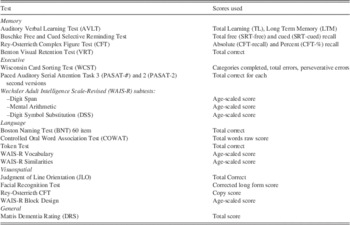
A previously described comprehensive neuropsychological battery was administered every 2 years (Caselli et al., Reference Caselli, Locke, Dueck, Knopman, Woodruff, Hoffman-Snyder and Reiman2014) and is summarized in Table 1.
Neuropsychology battery

Personality assessment
Personality was assessed with the NEO-PI-R which defines personality according to five factors: Neuroticism, Extraversion, Openness, Agreeableness, and Conscientiousness. It was added to our battery in 2006. Brief operational definitions of these five factors are as follows (adapted from Deary, Weiss, & Batty, Reference Deary, Weiss and Batty2010): Neuroticism is a tendency to feel anxiety and other negative emotions, Extraversion is a tendency to be outgoing and lead in social contexts, Openness is a tendency to be receptive to new ideas and experiences, Agreeableness is a tendency to be trusting and deferential, and Conscientiousness is a tendency to be organized and rule abiding. Each factor is comprised of six facets. For example, the six facets of the Neuroticism factor all reflect reactivity to stress and include the tendency to experience anxiety, anger, depression, and self-consciousness; the ability to resist temptations and cravings (impulsivity); and a general ability to cope with stress (vulnerability) (Costa & McCrae, Reference Costa and McCrae1992).
Data Analysis
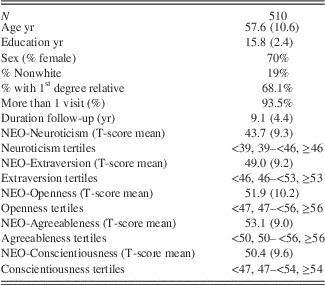
To isolate the longitudinal cognitive change for each neuropsychological measure while accounting for the neuropsychological measure at study entry in these cross-sectional and longitudinal samples, we used two sets of mixed models (1) to gauge change in cognition over time between patients by NEO scores, and (2) to assess whether APOE ɛ4 status impacted changes between patients by NEO scores (i.e., whether APOE ɛ4 status interacted with Neuroticism in modeling cognition over time). For both sets of models, NEO scores were first treated as a trichotomized variable using the sample’s 33rd and 66th percentile (Table 2), and subsequently as a continuous variable. In the first set of models for assessing the impact of NEO score on cognitive changes over time, a quadratic mixed model for each cognitive outcome Y ij (the j th score for the neuropsychological measure being modeled for the i th subject) is as follows:
 $$\eqalignno{ E(Y_{{ij}} {\!}\mid {\!}b_{{1i}} )\,{\equals}&\,\beta _{1} {\plus}\beta _{2} NEO_{{mid,i}} {\plus}\beta _{3} NEO_{{hi,i}} {\plus}\beta _{4} Agec_{{i1}} \cr &{\plus}\beta _{5} NEO_{{mid,i}} \,\times Agec_{{i{\rm 1}}} {\plus}\beta _{6} NEO_{{hi,i}} \,\times Agec_{{i1}} \cr &{\plus}\beta _{4} Agec_{{i1}} ^{2} {\plus}\beta _{7} Agec_{{ij}} {\plus}\beta _{8} NEO_{{mid,i}} \,\times Agec_{{ij}} \cr &{\plus}\beta _{9} NEO_{{hi,i}} \,\times Agec_{{ij}} {\plus}\beta _{7} Agec_{{ij}} ^{2} {\plus}b_{{1i}} $$
where NEO mid , i and NEO hi , i represent the second and third tertile score groups based on the given NEO domain for the i th individual (NEO mid,i : 1=second tertile, 0=other; NEO hi,i : 1=third tertile, 0=other); Agec ij is the age minus 60 (i.e., centered age) of the i th individual at the time of the j th score; and b 1i is an individual specific random effect allowing each subject to have a different intercept. From this model, the longitudinal growth model for subjects in the first (lowest) tertile for the given NEO domain is given by:
 $$\eqalignno {E(Y_{{ij}}| -Y_{{i1}} )\,{\equals}\,&\beta _{8} (Agec_{{ij}} -Agec_{{i1}} )\cr &{\plus}\beta _{{11}} (Agec_{{ij}} ^{2} -Agec_{{i1}} ^{2} ),$$
and the longitudinal growth model for subjects in the third (highest) tertile for the given NEO domain is given by:
 $$\eqalignno {E(Y_{{ij}} -Y_{{i1}} )\,{\equals}\,&(\beta _{8} {\plus}\beta _{{10}} )(Agec_{{ij}} -Agec_{{i1}} )\cr &{\plus}\beta _{{11}} (Agec_{{ij}} ^{2} -Agec_{{i1}} ^{2} ).$$
Entry characteristics

Note. Entry characteristics of the study population including NEO T scores. Table values are means (standard deviations) for continuous variables.
From Eq. [1], the regression coefficients
 $\widehat{{\beta _{8} }}{\plus}\widehat{{\beta _{{11}} }}(Agec_{{ij}} )$
is used to estimate the longitudinal mean annual change per year for subject at the given age in the first (lowest) tertile for the given NEO domain. From Eq. [2], the regression coefficients
 $\widehat{{\beta _{8} }}{\plus}\widehat{{\beta _{{10}} }}{\plus}\widehat{{\beta _{{11}} }}(Agec_{{ij}} )$
are used to estimate the mean annual change per year for subjects at the given age in the third (highest) tertile for the given NEO domain. Finally, a test of the significance of the regression coefficient
 $\widehat{{\beta _{{10}} }}$
is used to assess whether the estimated mean annual changes per year differed between subjects in the lowest and highest tertiles.
In the second set of models for assessing interaction between APOE ɛ4 status and NEO domain scores, a quadratic mixed model for each cognitive outcome (dependent variable) was similarly developed and included the following independent variables: APOE ɛ4 status (carrier vs. non-carrier); NEO score (trichotomized and then continuous); age at first visit; pairwise and three-way interaction among APOE ɛ4 status, NEO score, and age at first visit; age-squared at first visit; interaction between APOE ɛ4 status and age-squared at first visit; age at current visit; interaction between APOE ɛ4 status and age at current visit; interaction between NEO score and age at current visit; three-way interaction among APOE ɛ4 status, NEO score, and age at current visit; age-squared at current visit; and interaction between APOE ɛ4 status and age-squared at current visit.
In a similar manner as for the previous set of models, regression coefficients were used to estimate the mean annual change per year for subjects in four groups: APOE ɛ4 non-carriers in the first (lowest) NEO domain tertile, APOE ɛ4 non-carriers in the third (highest) NEO domain tertile, APOE ɛ4 carriers in the first (lowest) NEO domain tertile, and APOE ɛ4 carriers in the third (highest) NEO domain tertile. Finally, the difference in mean annual changes between the first and third NEO domain tertiles within APOE ɛ4 non-carriers was compared to that of APOE ɛ4 carriers using a test of significance of the three-way interaction among APOE ɛ4 status, NEO score (highest tertile vs. lowest tertile), and age at current visit.
Quadratic interaction effects between NEO and age were not statistically significant in any preliminary statistical analysis and thus were not included in final models. In previous statistical analysis of this cohort (Caselli et al., Reference Caselli, Dueck, Osborne, Sabbagh, Connor, Ahern and Reiman2009), significant quadratic interaction effects between APOE ɛ4 and age were observed and, thus, were retained in all models involving APOE ɛ4 status. Age is centered in all models to reduce the correlation between the age and age-squared terms in quadratic models, and to aid in the interpretation of coefficients. NEO and neuropsychological scores were standardized to have a mean of zero and a standard deviation of one using the sample mean and standard deviation to aid in comparison of mean annual changes across measures. Modeling was carried out using SAS PROC MIXED (SAS Version 9).
RESULTS
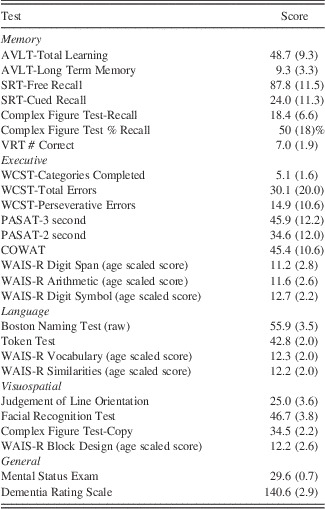
A total of 510 cognitively healthy individuals completed the NEO-PI-R. Entry characteristics are summarized in Table 2. Mean age was 57.6 years (range, 20–86 years) and 70% were women. 93.5% had more than one visit with a mean follow-up duration of more than 9 years. Neuropsychological Test performances at entry, grouped by cognitive domain, are summarized in Table 3.
Neuropsychological test scores at entry

Note. Entry scores on neuropsychological tests. AVLT=Auditory Verbal Learning Test; SRT=Selective Reminding Test; VRT=Visual Retention Test; WCST=Wisconsin Card Sorting Test; PASAT=Paced Auditory Serial Attention Task; COWAT=Controlled Oral Word Association Test; WAIS-R=Wechsler Adult Intelligence Scale-Revised.
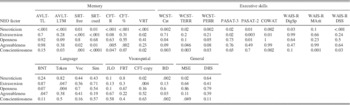
Table 4 summarizes the significance of each NEO personality factor T-score treated as a continuous variable on each neuropsychological test score, and the full models are presented in supplemental eTable 1. Within the memory domain, changes over time for all four tests (AVLT, SRT, CFT-recall, and VRT) were significantly associated with both Neuroticism and Conscientiousness. Increasing Neuroticism was associated with greater age-related declines on all memory measures (effect sizes from −0.8 to −1.7% per year) while Conscientiousness had an opposite association with the same memory measures (effect sizes 0.6 to 1.0% per year). Similarly, within the executive domain, Neuroticism was associated with adverse changes in longitudinal performance on five (WCST, PASAT, COWAT, WAIS-R Digit Span, and WAIS-R Digit Symbol) of six tests (effect sizes −0.6 to −1.3% per year) and Conscientiousness was associated with an opposite trend on four (WCST, COWAT, WAIS-R Arithmetic, and WAIS-R Digit Symbol) of six tests (effect sizes 0.7 to 1.2% per year). Associations between personality factors and tests within other cognitive domains were much less consistent.
NEO effect on longitudinal neuropsychological performance: Continuous model, p values

Note. NEO factor T scores were treated as continuous variables. The p values of NEO-by-age at current visit interaction on each neuropsychological test score within each cognitive domain. The most consistent significant effects are seen in memory and executive domains for Neuroticism and Conscientiousness. See eTable 1 for estimated coefficients, standard errors, and p values for all independent variables in each model.
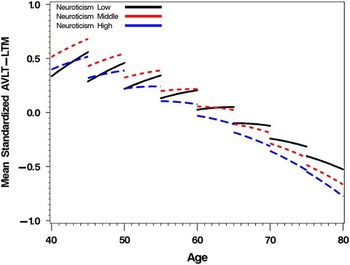
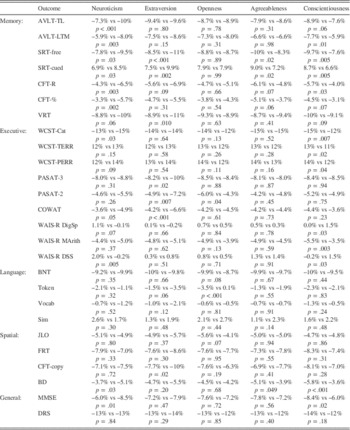
Table 5 and Figure 1 summarize the estimated mean annual changes and the statistical significance of the difference between the changes of the lowest and highest tertile NEO factor groups. Neuroticism and Conscientiousness associations with memory were highly consistent across all tests and in consistently opposite directions. For Neuroticism, compared with the lowest tertile, the highest tertile declined between 1.5 (VRT) and 2.7% (AVLT-Total Learning) more per year. For Conscientiousness, compared to the lowest tertile, the highest tertile declined between 1.4 (VRT) and 2.1% (SRT free recall) less per year. Associations with executive tests were less consistent. Associations between personality factors and tests within other cognitive domains were again less consistent making interpretation difficult: Extraversion was associated with longitudinal performances of five tests but there did not appear to be clear domain specificity. Openness and Agreeableness were each associated with two tests. For language, visuospatial, and general measures, half or fewer of the tests within each domain were associated with any personality domain.
With NEO Neuroticism T scores trichotomized, there is a significant “dose related” effect on memory tests illustrated by the Auditory Verbal Learning Test Long Term Memory score such that those in the highest tertile (most “neurotic”) experience greater performance decline with age than those in the lowest tertile (“least neurotic”).

NEO tertiles: estimated mean annual change for the lowest vs. highest NEO tertile groups at age 70

Note. Estimated mean annual change (in percent of a standard deviation) for a subject in the lowest versus highest NEO Tertile group on each neuropsychological measure shown at age 70 years. p value represents the statistical significance of the
$$\widehat{{\beta _{{10}} }}$$
coefficient, or the difference in the estimated mean annual changes between the lowest and highest NEO Tertile group. Point estimates are computed at age 70, although the difference between groups and p value apply to any computed age. AVLT=Auditory Verbal Learning Test; SRT=Selective Reminding Test; VRT=Visual Retention Test; WCST=Wisconsin Card Sorting Test; PASAT=Paced Auditory Serial Attention Task; COWAT=Controlled Oral Word Association Test; WAIS-R=Wechsler Adult Intelligence Scale-Revised.
There were 213 APOE ɛ4 carriers and 297 non-carriers who did not differ by age (mean 57.6±10.6 years; p=.48; t test), education (mean 15.8±2.4 years; p=.90; t test), sex (70% women; p=.34; χ2), or race (19% nonwhite; p=.11; χ2). NEO Neuroticism (44.5±9.6 vs. 43.0±9.0; p=.07, t test) and Extraversion were slightly higher in ɛ4 carriers (50.0±9.5 vs. 48.2±9.0; p=.04; t test). APOE ɛ4 carriers had a modestly longer mean follow-up period (9.6±4.3 vs. 8.8±4.5 years; p=.05; t test) and a higher proportion with a first degree relative with dementia (81.1% vs. 58.7%; p<.001; χ2). In quadratic models with NEO factors treated as a continuous variable, APOE ɛ4 interactions were generally inconsistent across tests within domains for each NEO factor with the exception of Agreeableness which reached significance on scores for three of four memory tests (with deleterious effect sizes of −1.2 to −2.0% per year).
Comparing the differences between the lowest and highest NEO factor tertile groups between APOE ɛ4 carriers and non-carriers, there were no significant APOE ɛ4 interactions with Neuroticism on verbal memory. There were significant APOE ɛ4 interactions with Conscientiousness on both tests of verbal memory (AVLT long term recall, effect size 3% per year, p=.04; SRT free recall, effect size 4.7% per year, p=.002; SRT cued recall, effect size −4.3% per year, p=.004), and with Agreeableness on one verbal memory test (SRT free recall, effect size −4.5% per year, p=.003; SRT cued recall, effect size 5.1% per year, p<.001) that again was deleterious. In addition, there were consistently beneficial APOE ɛ4 interactions with Openness on tests sensitive to visuospatial memory (CFT recall, effect size 4.5%; p=.003; CFT % recall; effect size 4.2%; p=.006; VRT, effect size 3.1%; p=.05) and visuospatial skills (JLO, effect size 4.1%; p=.01; FRT, effect size 5%; p=.01; and WAIS-R BD, effect size 2.8%; p=.03). The full continuous (eTable 2) and tertile models for APOE interactions (eTable 3) are included in the supplementary material.
DISCUSSION
In a large cohort that is generally younger than those previously reported (Chapman et al., Reference Chapman, Duberstein, Tindle, Sink, Robbins, Tancredi and Franks2012; Hock et al., Reference Hock, Lee, Bienvenu, Nestadt, Samuels, Parisi and Spira2014; Tschanz et al., Reference Tschanz, Pfister, Wanzek, Corcoran, Smith, Tschanz and Norton2013; Wilson et al., Reference Wilson, Bennett, Mendes de Leon, Bienias, Morris and Evans2005, Reference Wilson, Evans, Bienias, Mendes de Leon, Schneider and Bennett2003), and consistent with our first hypothesis, we found that higher Neuroticism was associated with greater cognitive decline with advancing age while Conscientiousness was associated with less decline. Tests within the most age-sensitive domains, memory and executive domains were the most consistently involved, and the same tests associated with Neuroticism were generally also associated with Conscientiousness but in opposite directions.
Regarding our second hypothesis, although we did not find that higher Neuroticism correlated with greater APOE ɛ4-related memory decline, we cannot exclude a possible interaction with Agreeableness or Conscientiousness on verbal memory. We also unexpectedly found a beneficial interaction between Openness and visuospatial abilities in APOE ɛ4 carriers. The broad implications of these findings are that personality factors related to proneness to stress and how we deal with it are associated with the most age-sensitive cognitive domains (memory and executive skills).
In rodents, the effect of stress on learning and memory is influenced by personality as well as APOE genotype in that rats who are highly reactive to a novel environment (Touyarot, Venero, & Sandi, Reference Touyarot, Venero and Sandi2004) as well as APOE-knockout mice (Grootendorst, de Kloet, Vossen, Dalm, & Oitzl, Reference Grootendorst, de Kloet, Vossen, Dalm and Oitzl2001) each show greater stress-induced deficits on spatial memory tasks than their less reactive and wild-type counterparts, respectively. In humans, acute psychological distress can impair memory retrieval (Kuhlmann, Piel, & Wolf, Reference Kuhlmann, Piel and Wolf2005).
Chronic psychological stress has less apparent effects on day to day memory performance, but previous studies have correlated stress (Johansson et al., Reference Johansson, Guo, Duberstein, Hallstrom, Waern, Ostling and Skoog2014; Yaffe et al., Reference Yaffe, Vittinghoff, Lindquist, Barnes, Covinsky, Neylan and Marmar2010), reactivity to stress (Crowe, Andel, Pedersen, & Gatz, Reference Crowe, Andel, Pedersen and Gatz2007; Katz et al., Reference Katz, Derby, Wang, Sliwinski, Ezzati, Zimmerman and Lipton2016), or proneness to stress (Wilson et al., Reference Wilson, Bennett, Mendes de Leon, Bienias, Morris and Evans2005, Reference Wilson, Evans, Bienias, Mendes de Leon, Schneider and Bennett2003) with a higher rate of incident dementia, as well as other effects including lower remission rates from depression (Steffens, McQuoid, Smoski, & Potter, Reference Steffens, McQuoid, Smoski and Potter2013), reduced resilience to AD pathology (Terracciano et al., Reference Terracciano, Iacono, O’Brien, Troncoso, An, Sutin and Resnick2013), reduced functional integration of limbic networks (Jovanovic, Perski, Berglund, & Savic, Reference Jovanovic, Perski, Berglund and Savic2011), reduced gray matter volumes in frontostriatal regions (Blix, Perski, Berglund, & Savic, Reference Blix, Perski, Berglund and Savic2013; Kempton et al., Reference Kempton, Salvador, Munafo, Geddes, Simmons, Frangou and Williams2011), generally increased morbidity and mortality (Goodwin & Friedman, Reference Goodwin and Friedman2006; Weiss & Costa, Reference Weiss and Costa2005), and a variety of functional and structural changes in prefrontal and hippocampal regions (Lucassen et al., Reference Lucassen, Pruessner, Sousa, Almeida, Van Dam, Rajkowska and Czeh2014).
More recently, the Australian Imaging, Biomarkers, and Lifestyle Research Group showed that among cognitively normal individuals with positive amyloid PET scans, higher levels of trait anxiety are associated with more rapid decline on measures of global cognition, verbal memory, language, and executive skills (Pietrzak et al., Reference Pietrzak, Lim, Neumeister, Ames, Ellis and Harrington2015).
While cross-sectional studies in humans have correlated elevated cortisol levels with reduced memory performance (Lupien et al., Reference Lupien, Lecours, Lussier, Schwartz, Nair and Meaney1994) and hippocampal atrophy (Lupien et al., Reference Lupien, de Leon, de Santi, Convit, Tarshish, Nair and Meaney1998), stress-related anatomical abnormalities may indicate vulnerability rather than consequence. A pivotal twin study showed that, although Vietnam veterans who developed post-traumatic stress disorder (PTSD) had smaller hippocampi than veterans who did not develop PTSD, so did their unexposed co-twins, strongly suggesting that hippocampal volume differences represented a predisposing factor rather than a result of PTSD (Gilbertson et al., Reference Gilbertson, Shenton, Ciszewski, Kasai, Lasko, Orr and Pitman2002).
Some longitudinal studies seeking associations between elevated cortisol levels and cognition have shown changes in memory and various executive measures, but not all. Cortisol measures vary between studies (salivary or plasma cortisol obtained in the morning, evening, or the diurnal change; overnight or 12 hour urinary excretion of cortisol) as do neuropsychological batteries and specific tests. The Rotterdam study followed 3341 initially healthy individuals for a mean of 7.1 years, including 27% APOE ɛ4 carriers and found no correlation with mental status examination, executive measures, or incident dementia but unfortunately did not include any memory measure (Schrijvers et al., Reference Schrijvers, Direk, Koudstaal, Kirschbaum, Hofman, Tiemeier and Breteler2011). The Longitudinal Aging Study of Amsterdam (LASA) initially reported lower verbal learning and slower information processing cross sectionally, but no correlation with decline longitudinally in global cognition, verbal memory, or information processing speed among 1154 older adults followed up to 6 years (Comijs et al., Reference Comijs, Gerritsen, Penninx, Bremmer, Deeg and Geerlings2010).
In a subsequent cohort of 911 individuals followed up to 4 years, memory decline in ɛ4 carriers correlated with higher evening salivary cortisol levels and flattened diurnal variation (Gerritsen et al., Reference Gerritsen, Comijs, Deeg, Penninx and Geerlings2011). Singh-Manoux et al. reported faster decline in verbal fluency in ɛ4 carriers from a cohort of 3229 adults followed over 5 years (Singh-Manoux et al., Reference Singh-Manoux, Dugravot, Elbaz, Shipley, Kivimaki and Kumari2014), and Greendale et al. reported faster decline in category fluency over 2 years among 502 postmenopausal women in the Rancho Bernardo Study (Greendale, Kritz-Silverstein, Seeman, & Barrett-Connor, 2000). Cortisol-associated memory decline has been reported in other smaller cohorts of 197 followed up to 4 years (Beluche et al., Reference Beluche, Carriere, Ritchie and Ancelin2010) and 46 followed for 3 years (Li et al., Reference Li, Cherrier, Tsuang, Petrie, Colasurdo, Craft, Schellenberg and Wilkinson2006).
The Macarthur study of successful aging in women correlated urinary cortisol excretion with memory performance over 2.5 years and found an inverse relationship between the two (Seeman et al., Reference Seeman, McEwen, Singer, Albert and Rowe1997). Patients with MCI and dementia progress more rapidly in association with higher cortisol levels (Csernansky et al., 2006; Popp et al., 2015) with higher rates of incident MCI (Karlamangla, Singer, Chodosh, McEwen, & Seeman, 2005), but one study actually found slower decline in MCI patients (Peavy et al., Reference Peavy, Salmon, Jacobson, Hervey, Gamst, Wolfson and Galasko2009).
Adaptation to stress is achieved by multiple biological systems including the hypothalamic–pituitary–adrenal axis (that regulates cortisol levels), the autonomic nervous system, the metabolic system, the immune system, and others so that besides cortisol, many other mechanisms have been proposed to mediate the relationship between stress, proneness to stress, other personality factors and cognitive decline (McEwen & Gianaros, Reference McEwen and Gianaros2011). People with psychiatric disorders, particularly anxiety and depression, typically experience high degrees of stress over prolonged periods of time, and some studies have demonstrated shortened leukocyte telomere length in such patient populations (Shalev et al., Reference Shalev, Moffitt, Braithwaite, Danese, Fleming, Goldman-Mellor and Caspi2014; Verhoeven, Revesz, Epel, Lin, Wolkowitz, & Penninx, Reference Verhoeven, Revesz, Epel, Lin, Wolkowitz and Penninx2014), a sign of cellular aging.
Another major contributor to cognitive aging is vascular pathology. Cognitive reserve, which has been suggested to protect against age or pathology-driven cognitive decline can be largely explained by the impact of its various proxies (such as education and occupation) on cerebrovascular pathology (Bennett, Arnold, Valenzuela, Brayne, & Schneider, Reference Bennett, Arnold, Valenzuela, Brayne and Schneider2014). Cerebrovascular pathology in turn is mitigated by healthier behaviors such as exercise, low fat diets, and medication compliance, as well as socioeconomic factors including and deriving from better education, greater wealth (related to a better job), and more access to health care.
Linkages between stress and heightened risk of cardiovascular disease have identified stress-related effects on health-related behaviors including smoking, physical inactivity, excess alcohol consumption, and sleep disturbances (Steptoe & Kivimaki, Reference Steptoe and Kivimaki2012; Terracciano & Costa, Reference Terracciano and Costa2004). Acutely, stress leads to elevations in epinephrine as well as sympathetic nervous system activity which raise heart rate and blood pressure, but sustained over time may lead to endothelial dysfunction, increased inflammatory cytokines, and prothrombotic changes that accelerate atherosclerosis (Steptoe & Kivimaki, Reference Steptoe and Kivimaki2012). Chronic stress has also been associated with an increased risk for metabolic syndrome and obesity, both contributors to cardiovascular disease (Steptoe & Kivimaki, Reference Steptoe and Kivimaki2013).
In our cohort, higher Conscientiousness correlated with less age-related memory and executive decline, consistent with previous studies (Chapman et al., Reference Chapman, Duberstein, Tindle, Sink, Robbins, Tancredi and Franks2012; Hock et al., Reference Hock, Lee, Bienvenu, Nestadt, Samuels, Parisi and Spira2014; Wilson, Schneider, Arnold, Bienias, & Bennett, Reference Wilson, Schneider, Arnold, Bienias and Bennett2007) as would be expected from its associations with greater medical compliance (Fisher et al., Reference Fisher, Hessler, Masharani and Strycker2014), reduced obesity rates (Sutin & Terracciano, Reference Sutin and Terracciano2016) and healthier diet (Lunn et al., Reference Lunn, Nowson, Worsley and Torres2014) and exercise habits (Malinauskas et al., Reference Malinauskas, Dumciene, Mamkus and Venckunas2014), all factors that influence vascular health and cognitive reserve. [And as one might predict from these associations, within our cohort decreasing body mass index correlated with higher Conscientiousness (R2=.045; p<.001)].
Higher Neuroticism in contrast has been shown to correlate with less healthy behaviors (Steptoe & Kivimaki, Reference Steptoe and Kivimaki2012; Terracciano & Costa, Reference Terracciano and Costa2004), thus having the opposite effect on cognitive reserve and raising the testable hypothesis that personality factors may be associated with cerebrovascular contributions to cognitive reserve, a possibility for which there is already some evidence (Dermody et al., Reference Dermody, Wright, Cheong, Miller, Muldoon, Flory and Manuck2015; Duron et al., Reference Duron, Vidal, Bountiro, Ahmed, Seux, Rigaud and Martel2014). In addition, although a neuropathological correlate for Conscientiousness has not been found, higher Conscientiousness has been shown to be associated with an attenuated cognitive impact of dementia-related pathology especially terminally (Wilson, Boyle, Yu, Segawa, Sytsma, & Bennett, Reference Wilson, Boyle, Yu, Segawa, Sytsma and Bennet2015).
An unexpected finding in our study was the consistent, positive association between higher Openness and visuospatial memory and visuospatial skills in APOE ɛ4 carriers. Data directly assessing the relationship between visuospatial abilities and Openness are sparse, but support a relationship between spatial attention and higher Openness (Wilson, Lowe, Ruppel, Pratt, & Ferber, Reference Wilson, Lowe, Ruppel, Pratt and Ferber2016). A longitudinal MRI study found that Openness inversely correlated with age-related right parietal atrophy (Taki et al., Reference Taki, Thyreau, Kinomura, Sato, Goto, Wu and Fukuda2013), a key region for spatial cognition. Intuitively, if individuals who are more open to new experiences travel to unfamiliar places more frequently, they would benefit from learning and navigating a new landscape efficiently. Higher openness has been associated with creativity (Kaufman et al., Reference Kaufman, Quilty, Grazioplene, Hirsh, Gray, Peterson and DeYoung2016) and synesthesia (Chun & Hupe, Reference Chun and Hupe2015; Rouw & Scholte, Reference Rowe and Scholte2016), possibly reflecting a relationship with mental imagery as well. Why such an effect was not seen for the cohort overall, however, is unclear but raises the testable hypothesis that this ɛ4 specific correlation might suggest that Openness has a mitigating effect on preclinical AD driven decline in visuospatial abilities.
A limitation of our study is that our population is not a random community sample, but instead genetically enriched for the APOE ɛ4 allele. As noted, there did not appear to be a strong APOE ɛ4 effect and this gave us greater power to detect subtle changes that might have been attributable to preclinical AD. Second, our entry criteria exclude those with longstanding severe mental illness, that is, those individuals who would be predicted to experience the greatest degree of chronic psychological stress. Additional research of such patient cohorts specifically will be needed to address this question.
The NEO-PI-R is a measure of normal personality not designed to capture pathology or clinical impairment, but rather, to quantify the level of each trait along a continuum on which all degrees are considered normal and so was appropriate for the population in this study. Finally, the NEO-PI-R was added to our battery in 2006, well after the study began. Personality is thought to be highly stable in adults (Costa & McCrae, Reference Costa and McCrae1992; Deary et al., Reference Deary, Weiss and Batty2010), although subsequent findings from the Baltimore Longitudinal Study of Aging cohort, which is demographically similar to ours, showed subtle age-related changes in personality factors that together accounted for roughly 1 T score point or less per decade (Terracciano, McCrae, Brant, & Costa, Reference Terracciano, McCrae, Brant and Costa2005). It is possible that our findings may reflect, in part, the age at which participants completed the NEO-PI-R, although linear regression models of our cohort’s Neuroticism and Conscientiousness scores showed far less of an impact with roughly only one T score point difference across the entire adult age span (Supplementary Figure 1), suggesting this is unlikely to have significantly influenced our findings.
In summary, the personality factors Neuroticism and Conscientiousness were associated with the most age-sensitive domains of cognition, memory, and to a lesser degree executive skills. Individuals who are more prone to stress as reflected by high Neuroticism scores have greater cognitive decline with age, whereas higher Conscientiousness that has been associated with healthier lifestyle behaviors exhibit less age-related cognitive decline.
Acknowledgments
Supported by NIA P30 AG19610, NIA R01 AG031581, and the Arizona Alzheimer’s Consortium. Disclosure of Conflicts of Interest: The Authors have no conflict of interest or financial involvement with this manuscript.
Supplementary material
To view supplementary material for this article, please visit http://dx.doi.org/10.1017/S1355617716000527