




No CrossRef data available.
NAHUA IN ANCIENT MESOAMERICA: Evidence from Maya inscriptions
Published online by Cambridge University Press: 04 March 2004
Abstract
This paper examines Nahua words found in both the Maya codices and the monumental texts. These words, spelled with syllabic signs, occur for the most part in contexts associated with foreign influence: Nahuatl deity names and words for “helmet,” “tribute,” and “heart.” One word—“and then”—is a conjunction used frequently in discourse. Sound correspondences between these loan words and the Nahua sources suggest an Eastern Nahua dialect as the likely source during the Classic period. Thus, Mexican influence in the Maya area, frequently attributed directly to Teotihuacan, may in fact have come by way of Nahua-speakers settled in the Gulf region. The epigraphic evidence establishes that Nahua speakers were influential in Mesoamerica far earlier than previously believed.
Information
- Type
- Research Article
- Information
- Copyright
- © 2003 Cambridge University Press
Nahuatl, the tongue of the Mexica (Aztec) empire, is documented in a vast body of literature. Historical texts, poetry, dictionaries, and grammars provide a clear picture of this language, which is still spoken today in the Valley of Mexico but was once also widely dispersed throughout Mesoamerica as a result of political and commercial interaction and population movement. The language of the Mexica, however, was only one of a number of related languages and dialects collectively termed Nahua. We use Nahuatl to refer to the language of the Aztecs and those contemporary dialects directly related to it. Nahua includes Nahuatl and other related languages and dialects in Veracruz, Chiapas, and Guatemala, as well as Pipil, spoken today in western El Salvador, and Pochutec from Oaxaca.
The diversity of this language family is suggested by sixteenth-century native histories that differentiate between groups speaking Nahuatl and those whose languages are similar but not precisely the same:
These Tolteca, as it is said, were Nahua; they did not speak a barbarous tongue. However, their language they called Nonoalca…. [A]ll the Nahua, those who speak clearly, not the speakers of a barbarous tongue, are the descendants of the Tolteca, for they are those who remained, those who could no longer migrate [Sahagún 1959–1982:Book 10:170].
Here are mentioned—are named—those called Nahua. They are the ones who speak the Nahuatl language. They speak a little [like] the Mexica, although not really perfectly, not really pronounced in the same way [Sahagún 1959–1982:Book 10:175].
The Tlalhuica. These are the dwellers of the hot lands. They speak Nahuatl [Sahagún 1959–1982:Book 10:186].
They [the Coixca] are not speakers of a barbarous tongue; they speak Nahuatl [Sahagún 1959–1982:Book 10:187].
These passages suggest at least as much diversity in the Nahua family in the sixteenth century as can be observed today (Lastra de Suárez 1986; Monzón 1990). Nahua-speaking towns included many of the principal population centers in central Mexico, including the two other members of the Triple Alliance, Texcoco and Tlacopan, and Epi-Toltec centers such as Chalco, Colhuacan, Tenayocan, and Tepepolco. These populations were already established in the region when the Mexica arrived in the early fourteenth century.
Historical linguistics provides additional information in support of this diversity. By comparing phonetic, morphological, and lexical features of contemporary and historically attested languages, inferences can be made about the historical relationships among them. These studies show that Nahua is a subgroup of the Uto-Aztecan stock that includes contemporary and historical dialects of Nahuatl, Pipil, the now extinct Pochutec, and most likely other languages of which we have no record. Of Nahua languages, the ones for which the best documentation exists are classical Nahuatl (Molina 1977 [1571]; Olmos 1985; Siméon 1977 [1885]) and Pipil (Campbell 1985).
Una Canger and Karen Dakin (1985; Dakin and Wichmann 2000:58) have proposed that certain Nahua dialects of the eastern state of Mexico, the Valley of Mexico, Morelos, central Guerrero, and Tlaxcala represent the eastern branch of Nahua. At a much later date, speakers of Western Nahua migrated into central Mexico, coming into contact with speakers of Eastern Nahua dialects. The Eastern Nahua dialects ultimately spread northeastward to the Huasteca and south into the Sierra of Puebla, to the Gulf Coast and Chiapas, and ultimately into Central America. But the distribution of historical and contemporary Nahua dialects shows significant evidence of mixing in many regions of Mexico and Central America, probably as a result of the later spread of Western Nahua speakers into regions where Eastern Nahua was already being spoken. Variant forms in Molina's dictionary can be cited as evidence of this mixing in Central Mexico (Canger and Dakin 1985). In addition, Lyle Campbell (1988:276) identifies two varieties of Nahua in Chiapas: Nahuatl, or Mexican, and “corrupt Mexican,” Nahuat, or Pipil (Waliwi). Such dialect diversity suggests historical overlays of dialectal forms resulting from successive waves of population movement.
Several linguists and archaeologists have suggested dates for some of these developments. Some estimates rely on glottochronology (a method of statistical calculation that requires positing a constant rate of change; it is no longer widely accepted), whereas others are based on impressionistic comparisons of languages and dialects and correlation with events reconstructed from archaeological and historical data. The minimum time depth of Nahua—that is, the split of Pochutec (representing the western group) from Proto-Nahua—has been estimated at a.d. 400 (Suárez 1983:149) and at a.d. 500 (Campbell and Langacker 1978:86), and calculated at a.d. 543 (Lukenbach and Levy 1980). The minimum time of the separation of Pipil has been estimated at a.d. 800 (Campbell and Langacker 1978:86; Luckenbach and Levy 1980) and a.d. 850 (Justeson et al. 1985:25).
Recent research by other scholars points the way toward a new understanding of the antiquity of Nahua in Mesoamerica. For instance, based on the reconstruction of a vocabulary of the maize-cultivation complex for proto–Uto-Aztecan, Jane Hill (2001a) suggests a Mesoamerican origin for the Uto-Aztecan family as a whole. She supports this hypothesis by showing that several of the structural traits thought to define the Mesoamerican linguistic area (Campbell et al. 1986) are not limited to Nahuatl but are, in fact, found throughout the Uto-Aztecan family (Hill 2001b). Hill's research suggests that Uto-Aztecan languages participated in the Mesoamerican region from perhaps as early as the beginnings of agriculture.
Consistent with these interpretations are the findings of Dakin and Søren Wichmann (Dakin 1995; Dakin and Wichmann 2000; Wichmann 1998:300–302), who propose that the term for cacao (chocolate) in early Maya inscriptions points to early Nahua influence in the Maya region. They demonstrate that “cacao” derives from a more general proto–Uto-Aztecan term *kaN-paN (hard pod, shell). The word is widely distributed throughout Mesoamerica, including in the Mayan language family. An early attestation of the loan, spelled syllabically ka-ka-wa, comes from a vessel dating to the fifth century a.d. from the Maya site of Río Azul (Figure 1). This isolated example occurs two centuries before the fall of Teotihuacan and many centuries before the arrival of the Mexica in the Valley of Mexico.

Río Azul cacao pot, ka-ka-wa kakaw (cacao; drawing by Matthew Looper after Stuart 1988:Figure 1b).
If Dakin and Wichmann are correct: kakaw provides concrete evidence of Nahua in Early Classic-period Mesoamerica. But the term is so widespread in Mesoamerican languages as to suggest that it may not have been a direct loan from Nahua to Maya. The data presented here clarify the historical relationship of Nahua to Mayan languages by documenting the occurrence of several Nahua words in Maya texts as early as the seventh century. We suggest that Nahua influence on the Maya was in fact direct and more extensive than has previously been supposed. Our research is based on the evidence of Maya inscriptions, which provide a precisely datable record of linguistic change. A comprehensive survey of this corpus suggests that influence from Nahua languages can be detected during both the Late Classic period (seventh–tenth centuries) and the Postclassic period (eleventh–sixteenth centuries). These early loan words are consistent with, though not dependent on, Hill's arguments for an origin of Uto-Aztecan languages in Mesoamerica. In reverse chronological order, we begin with a review of evidence of Nahuatl terms in the Dresden Codex, one of the four surviving ancient Maya books. A discussion of additional Nahua words spelled in Classic Maya texts follows. Before proceeding to the data, we examine methodological issues pertaining to historical linguistics.
IDENTIFYING LEXICAL BORROWINGS
One of the most widely cited indices of linguistic interaction is lexical borrowing—or words from one language that have been incorporated into the lexicon of another language. If the two languages differ phonologically, the word may either undergo sound changes through which speakers attempt to approximate the phonological characteristics of the borrowing language, or in some cases the foreign sounds themselves may be borrowed. In the process of borrowing, a word may undergo semantic change, resulting in a more restricted or more general meaning in the borrowing language.
Words pass between languages as a result of a variety of social processes. To the extent that these social processes can be determined, we can learn a great deal about which languages enjoyed prestige at any given time; which language group is likely to have been the originator of certain objects or concepts; whether the contact was limited or intensive; and whether the contact was a discrete event, a continuous process, or was made up of multiple waves of influence. Several authors have discussed lexical borrowings specifically in Mesoamerican languages in an effort to test hypotheses about the roles played by speakers of various languages in the transmission of cultigens, trade goods, material cultural, and intellectual concepts (Campbell and Kaufman 1976; Dakin and Wichmann 2000; Justeson et al. 1985; Wichmann 1995:222–226, 1998).
Loan words that retain foreign sounds, that combine sounds in unfamiliar ways, or that show uncharacteristic syllable structures are the easiest to identify. A word that can be analyzed—that is, that can be broken into root(s) plus affixes in only one language—is more likely to have originated in the language in which it can be analyzed. Loan words can also be identified when they have cognates that are widely distributed across the languages in the family of the donor language but occur in only one or a limited number of languages in the family of the borrowing language. Sometimes, however, older loans may have spread into many branches of a language group and can thus be difficult to identify. Frequently, loans are restricted to specific semantic domains—for example, luxury goods, ceremonial items, or imported foods. In the loan words discussed later, these criteria are used to demonstrate the Nahua origin of several words spelled phonetically in Maya texts.
To evaluate possible Nahua borrowings into the lowland Mayan language families, Yukatekan and Ch'olan, both of which are associated with the hieroglyphic script, it is necessary to compare briefly the sound systems of the two groups. The Yukatekan languages include Yukatek, Itzaj, Mopan, and Lakantun; Ch'olan languages include Ch'ol, Ch'orti', Ch'olti', and Chontal. Several Nahua consonants do not occur in Mayan languages, so it is possible to predict certain sound changes. For example, it is predictable that /tl/ in Nahuatl will be interpreted as /t/ in Mayan languages, and /kw/ in Nahuatl as /k/, plus a rounded vowel /o/ or /u/. Finally, Mayan languages have a series of ejective stops and affricates that are not found in Nahua languages. Mayan and Nahua languages also differ markedly in word shape—that is, the typical arrangements of segments into syllables and morphemes. The majority of words in Yukatekan and Ch'olan languages are composed of a CV(V/h/')C root to which may be added inflectional and derivational suffixes (in this notation, C represents consonant; V represents vowel; and ' represents glottal stop). Seldom is a noun or verb root composed of more than two syllables. Nahua words, by contrast, are typically polysyllabic and are often composed of one or more roots as well as derivational and inflectional affixes. Nouns have an absolutive suffix, -tl(i) or -li.
NAMES FROM THE VENUS TABLE OF THE DRESDEN CODEX
Gordon Whittaker (1986) first identified the spellings of Nahuatl deity names in the Dresden Codex, one of four surviving Maya manuscripts (Schele and Grube 1997; Taube and Bade 1991). The Dresden Codex dates from the Postclassic period (a.d. 1000–1500). It is, however, a collection of almanacs and tables that can be shown to have been created at several different times (Bricker and Bricker 1992). Pages 24 and 46–51 of the Dresden Codex constitute a table that was used to calculate the phases of the planet Venus. Although a date of a.d. 1324 occurs as the latest base date of the Venus table, the table itself appears to have been originally calculated to begin in a.d. 934 (Bricker and Bricker 1992:83; Lounsbury 1983). It is not clear whether the accompanying text and illustrations were originally included in the tenth-century almanac, or whether they were added later.
The Venus table is preceded by an account of the beginning of the current era of creation on 4 Ajaw 8 Kumk'u on page 24 of the Dresden Codex (hereafter cited as D and page number). Each of the five pages that follow has three color illustrations depicting elaborately costumed human figures, and in one case a deer. The middle figure on each page holds an atlatl and a shield or darts. Names identifying these individuals are given in the glyphic texts directly above the figure. The first such glyph identifies the figure on page 46 as God L, although the actual reading of the God L name glyph is unknown. God L is also named on page 24 as an actor in the creation event. The name of the central figure on page 47 is Ten Sky, written with the numeral ten followed by as sky glyph. This deity is known from the Yukatek Maya books of Chilam B'alam by the Ch'olan version of this name, Lahun Chaan (Edmonson 1982:36; Roys 1967:101, 105). Lahun Ká'an would be the expected Yukatek form. Ten Sky is also listed as an actor with God L on D24.
The central figures of D48–50 depict costumed figures representing Venus that bear Nahuatl names, none of which occur on D24 (Figure 2, Table 1). The names for the figures on D48 and D49 correspond to parts of, or are otherwise associated with, known Nahuatl deity names. The third deity name, on D50, appears to be a Nahuatl word, though its significance is not understood.
Nahua words in the Dresden Codex


(a) Dresden 48eA2; (b) Dresden 49eA2; (c) Dresden 50eA2 (from a reproduction by Ernst Förstemann; courtesy Dumbarton Oaks Research Library and Collection, Washington, DC).
The first Nahuatl name is spelled ta-wi-si-ka-la, tawis(i)kal(a) (Figure 2a). Colonial documents name Tlahuizcalpantecuhtli (Lord of the House of Dawn) as the fierce deity of Venus as morning star, and indeed, the D48 figure has usually been associated with this deity (Whittaker 1986). However, as Karl Taube (1992:120) observes, the iconography of this figure, which has the face of a monkey, is not easily reconciled with other images of Tlahuizcalpantecuhtli. In fact, the name as written is a very close approximation of the Nahuatl tlahuiscal- (rosy light of dawn) (Karttunen 1983:270). Phonologically, the Maya scribe wrote t for the initial consonant. Two explanations for this are possible: First, the Maya, not having tl, substituted the closest sound to it, t. A second explanation is that the word may have been borrowed from a Nahua language or dialect having ta instead of tla, as is the case for several contemporary dialects of Nahuatl.
The second name, chäk xi-wi-te-i, chäk xiwitei, begins with the Maya word for “red” or “great.” Venus is frequently named chäk èek' (great star.) The next part is very close to the Nahuatl xihu(i)tl (year or grass; green stone, turquoise) and xi:hu(i)tl (comet) (Karttunen 1983:324), the two words differing only in vowel length of the first syllable (Figure 2b). The iconography of the figure clearly identifies it with the Aztec deity of fire, Xiuhtecuhtli (Taube and Bade 1991), although the syllabic spelling favors “comet” or “year.” The possible relationship between the name Xiuhtecuhtli and xi:hu(i)tl warrants further investigation that is beyond the scope of this paper.
The third word is kak(a)tunal(a), which Whittaker (1986) suggests refers to a Mexican god, Kaktonal (Figure 2c). If the name is related to the Nahuatl word kak-tli (sandal) (Siméon 1977 [1885]:57), it may refer to the Pleiades, which in Ch'ol and Tzeltal is referred to as “sandal”—for example, xäñab’ ‘Pleiades' (Aulie et al. 1998:145). A related word is kaktonki (barefoot) (Siméon 1977:57). There is also a verb in Nahuatl, kakali (to shoot arrows) (Siméon 1977:54). Combined with to:nal (sun) (Dakin 1982:171), the glyph may name Venus as the “shooter of the sun.” What is depicted in the accompanying illustration is a costumed figure, barefoot (as are all but the first of the five central figures), with covered eyes and with atlatl and spear in hand. The spelling ka-ka-tu-na-la occurs earlier at the bottom of D47 in a passage that may be part of an augury. The significance of this word also warrants further investigation.
In each case in the Dresden Codex, the glyphs associated with the central figure spell a word that can be interpreted as a deity's name or that can be read simply as a specific natural phenomenon—for example, “dawn” and “comet.” Because the central figure is in each case a representation of Venus, these names seem to be epithets referring to the planet, showing the close relationship that existed in ancient Mesoamerica between natural phenomena and deities that personified them. The Maya forms are much simpler than the later Nahuatl names in use in central Mexico in the sixteenth century. This may have resulted from a simplification when the words were borrowed by the Maya, or it may reflect the fact that in earlier times, the epithets or names associated with certain deities were composed of fewer morphemes.
Based on the close correspondence of the terms in the Dresden Codex to Nahuatl and the late date of the manuscript, scholars have generally assumed that the terms represent influence as a result of Mexica (Aztec) imperial expansion, which reached even into Guatemala. But if both the text and figures in the Venus table were copied from an older manuscript, the possibility remains that the words are rooted in an earlier Nahua presence among the Maya.
NAHUA WORDS IN CLASSIC-PERIOD INSCRIPTIONS
A similar methodology can be used to demonstrate the presence of Nahua loans in the Classic period. Although additional examples exist, we have selected four words that are both securely deciphered and etymologically transparent. In each case, the word exists both in Nahua and in at least some Mayan languages. Nahua can be identified as the originating language according to the criteria listed above: All of the words can be analyzed morphologically in Nahua but not in Mayan, and several have cognates in other Uto-Aztecan languages, contrasting with a limited occurrence in Mayan languages.
yóol (heart)
The word (y)óol (heart) exists in both Yukatekan and Nahua. It does not occur in Ch'olan languages but is found in all four branches of the Yukatekan group. It is usually translated as “heart” but refers specifically to the abstract concept of “life, energy, spirit” (Table 2). Similar and possibly cognate forms are found in Tzeltalan—for example, the proto-Tzeltalan *'o'ntänil (heart) (Kaufman 1972:113) and the colonial Tzotzil 'olotonil (heart, mind) (Laughlin 1988:154).
“Heart” in Yukatekan languages

Another word for “heart” occurs in Yukatekan, puksik'al (pusik'al in Itzaj [Hofling and Tesucún 1997:730], püsük'al in Mopan [Ulrich and Ulrich 1976:166]). The word is also found in Ch'olan languages. Terrence Kaufman and William Norman (1984:129) reconstruct *puksik'al as “heart” for proto-Ch'olan, which Norman suggests is a borrowing from Totonac. This term refers specifically to the physical organ, whereas in Yukatekan, (y)óol refers to the abstract concept of “spirit.”
Two words very similar to the Yukatekan (y)óol are found in Classical Nahuatl and Pipil: yo:li and yo:llotl. Franz Boas (1917:40) also recorded a cognate in Pochutec (Table 3). The root of these terms comes from the proto–Uto-Aztecan “to live.” Wick Miller (1967:44) provides cognates in O'odham, Southern Tepehuan, Yaqui, and Nahuatl. For the verb “live,” Dakin (1982:125) reconstructs the proto–Uto-Aztecan *yo and proto–Southern Uto-Aztecan *yoli (with cognates in Mayo and Huichol), and the proto-Nahuatl form as

. The form yo:llotl (heart) is derived by adding the abstract noun suffix -yo- to the root. Thelma Sullivan notes that, when the stem of an abstract noun ends in l or z, the semivowel -y- of the abstract noun suffix -yo- is assimilated to that consonant (López Austin 1988:2:212; Sullivan 1988:18). Accordingly, yo:l + yo + tl yields the form yo:llotl. In borrowing the term yo:l-, Yukatekan speakers interpreted the initial y- as the third person ergative/possessive prefix; thus, in Yukatek we find inw-óol (my heart), aw-óol (your heart), and most commonly, y-óol) (his or her heart.) The Nahuatl word names the physical organ, but its extended meaning as “vitality; spirit; consciousness; feeling” derives from proto–Uto-Aztecan and matches the meaning of óol in Yukatekan (López Austin 1988:1:190).
“Live; heart” in Nahua languages

In Classic-period inscriptions, several collocations have been read as yóol, although in some cases it cannot be demonstrated that the intended meaning is “heart.” Other possible interpretations may relate to several similar sounding words, including the Ch'ol ojlil (half, middle) (Aulie et al. 1998:86), the Itzaj hol (hole, well, opening, cave, door) (Hofling and Tesúcun 1997:317), or the Yukatek óolak (almost) (Bricker et al. 1998:7). The most common occurrence is spelled using the grapheme T506/774 (the letter T signifies the catalog number in Thompson 1962). In addition to its function as the day sign K'an (Landa [1566] in Tozzer 1941:134), T506/774 is used as a logograph in two major contexts. One is in the collocation (o-)T506/774(-la)-si, a word or phrase of uncertain meaning that appears on Yaxchilan Lintel 37 dating to the mid–sixth century a.d. (Graham 1979:83). Syllabic substitution spellings of this term as o-la-si confirm the logographic value of T506/774 as óol (Stuart et al. 1999:44). The other principal context is in the glyph for the calendrical period Kumk'u, spelled T155:506/774:178 (see the discussion in Freidel et al. 1993:450–451). Nevertheless, because this glyph nearly always occurs with the T155 superfix, which does not freely substitute for other o graphemes, the function of T506/774 as a logograph is suspect in this context.
The most common affixation found with T506/774 is the complementary syllabic spelling of yóol as yo-óol-la. It first occurs on Copan Stela E, a monument that probably dates to the reign of Smoke Imix (a.d. 628–695), possibly to a.d. 642 (Figure 3). More securely dated early occurrences of yo-óol-la appear at Palenque on the Temple of the Inscriptions west panel (B7, O9), dated to a.d. 683. On the altar of El Peru Stela 34, the collocation appears in the phrase tuyóol ahk (in the heart/middle/opening of the turtle), accompanied by an image of a figure seated inside a quatrefoil-shaped opening in the back of a turtle (Freidel et al. 1993:Figure 4:27). These examples provide clear evidence that yóol was borrowed into Mayan languages by the mid–seventh century.

Copan Stela E D8, yo-óol-la yool (heart; drawing by Matthew Looper).

Yaxchilan Hieroglyphic Stairway 3, Step 4, C6, 12 pa-ta läjcha' pat(a(n)) (twelve tributes; drawing by Matthew Looper).
pat(a(n)) (tribute)
In Classic-period inscriptions, the syllabic combination pa-ta occurs fairly often, sometimes as a numeral classifier (Macri 2000:22–23). Noting its association in texts on ceramic vessels with scenes of trade or tribute payment, David Stuart (1995:354–357) read the collocation as pata(n) (tribute, service). He notes that the final -n, omitted here, is frequently not indicated in syllabic spellings—for example, i-tz'i for íitz'in (younger brother) and sa-ku for sukú'un (elder brother) in contemporary Yukatek. He further suggests that T565, if read as “tan,” might provide a full spelling of the word patan. In our view, T565 should be interpreted only as ta (Macri and Looper 2003), although the syllabic sequence pa-ta can in fact represent pat, pata, or patan.
The verb pat (make) is found in many Mayan languages. Stuart (1995:354) suggests that patan is a derived noun formed from the root pat and the participial ending -an, meaning “something that is worked or made” (Kaufman and Norman 1984:128 reconstruct proto-Mayan *pata:n [work]). There are two problems with this argument. First, the proto–Ch'olan form of the verb for “make” is *pät rather than *pat, and it is usually distinguished in the inscriptions by being spelled with a logograph (T79). Examples of pät (make) spelled pa-ta occur on the Copan Reviewing Stand T1 and B'1. In this context, pät usually refers to the carving of monuments. Items associated with tribute scenes include not just pottery vessels and textiles but also cacao beans and feathers—that is, items that are not manufactured goods. A better semantic fit is found in the noun patan, which has the specific sense of “tribute, tax.” Its distribution is scattered, being found in Yukatek, Tzotzil/Tzeltal, Ch'olti', Ch'orti', Acalan Chontal, Kaqchikel, and K'iche', but not in available lexical sources for Mamean or Q'anjob'alan languages (Table 4; see similar word list in Schele and Miller 1983:86).
“Tax, tribute” in Mayan languages

Given its limited occurrence and its similarity to a Nahua form, we propose that the root patan, when referring to tribute, is not Mayan in origin but is borrowed from a Nahua word related to the Nahuatl words patla (to trade, to change) and patiuhtli (price, payment, security, salary) (Karttunen 1983:189; Siméon 1977 [1885]:376). Patla is also attested in Pipil (Campbell 1985:241).Within Uto-Aztecan, Dakin reconstructs proto-Nahuatl *patla (to trade, to change) (Dakin 1982:161) and proto–Southern Uto-Aztecan *pa:ta (to change; with a cognate form in Cora) (Dakin 1982:122). As with the word tlahuiscal (dawn), discussed earlier, Maya speakers, not having the sound tl, either substituted the closest sound to it, t, or borrowed the form as pata from a Nahua language having ta in place of tla, as is the case, for example, in contemporary dialects of Zacapoaxtla, Puebla, and Mecayapan, Veracruz (Dakin 1982:161).
The earliest datable example of pat(a(n)) in Classic-period texts is from the east panel of the Palenque Temple of Inscriptions (R2), dating to a.d. 683, although the precise meaning of it here is not clear. The earliest examples of pat(a(n)) used as a counted noun or a numeral classifier (that is, any word preceded by a number) is from Yaxchilan Hieroglyphic Stairway 3, dating to a.d. 723 (Figure 4). In addition to certain Colonial and contemporary Mayan languages, the glyphic texts thus offer evidence of the term as early as the eighth century a.d.
ko'haw (helmet)
The grapheme T678 represents a helmet composed of shell mosaic, sometimes termed the “drum major headdress.” The first use of the logograph in Maya inscriptions is on Piedras Negras Lintel 2, dated to a.d. 667 (Figure 5a). The logograph also appears six times on the Palenque Temple of Inscriptions, middle panel at C6, D9, F2, I9, K8, and M4, dated to a.d. 683 (Figure 5b). Thus, the glyph is geographically restricted and probably a loan from Piedras Negras to Palenque (Thompson 1962:279). In iconography, however, the mosaic headdress is much older, appearing first on Tikal Stela 31 and other Early Classic monuments such as Tres Islas Stela 1 (Stone 1989:Figures 1, 4). The phonetic reading of this glyph is suggested both by its appearance with a syllabic complement of -wa, and by full substitution syllabic spellings of ko-o-ha-wa, twice on Piedras Negras Lintel 2 (P2-Q1; X4-W5), and ko-ha-wa on an unprovenienced panel from the Piedras Negras area (Mayer 1987:Catalog no. 39). These examples suggest that the word for “helmet” was pronounced ko'haw or ko'waw. A similar word appears in sixteenth-century Tzotzil kovov (helmet) (Laughlin 1988:224), but this is the only other example in a Mayan language. Two features of Tzotzil are relevant here: /v/ in Tzotzil corresponds to /w/ in other Mayan languages (Campbell 1984:6), and /a/ in proto-Tzeltalan, in many cases, becomes /o/ (Kaufman 1972:21). The limited occurrence of this word, and its association with a ceremonially important object of known foreign origin (discussed later) strongly suggest that this word for “helmet” is a loan.

(a) Piedras Negras Lintel 2 ko'haw ko'haw (helmet); (b) Palenque Temple of the Inscriptions, middle panel, C6, u-ko'haw-wa u-ko'haw (his helmet; drawings by Matthew Looper).
A likely source for the Maya word is the Nahuatl root cua:(i)-tl (head; Proto-Nahua *kwa-h [Dakin 1982:146]). This term refers not to the whole head above the neck but specifically to the crown of the head, without the face (López Austin 1988:2:143). This is precisely the part of the head covered by the mosaic helmet, as depicted in Classic-period art and texts. The root cua:- occurs in a number of compound terms for various helmets named in Molina's dictionary and in the Florentine Codex (Clayton 1999:472–484). The final -w can best be explained by referring to Pipil. In that language, kwa(h)-, kwa:- is “head” (Campbell 1985:312). When a noun carries a possessive prefix, the absolutive suffix is replaced by -w (Campbell 1985:43). The cognate form of the possessive suffix in Classical Nahuatl is -huan (Sullivan 1988:26, 28). Thus, the Pipil form kwa:w is very close to the Tzotzil form and to the full syllabic spelling in the Maya texts. It may be relevant that all but one of the glyphic examples is preceded by the Mayan possessive prefix u- (Figure 5b). The ancient Maya seem to have borrowed kwa:w, the possessed form of the word for “vertex, crown of the head,” as the name of a specific type of helmet.
i(yu)wal- (and then)
The last word discussed here differs from the others in that it is not a noun but a conjunction. The phonetic spelling i-yu-wa-la i(yu)wal occurs in two contexts, thirteen times on Stela J at Copan (a.d. 702) and once on the undated Stela 1 of Jonuta, Tabasco. On Stela J (Figure 6) it clearly functions as a conjunction joining dates in a listing of tun (360-day period) endings from 9.0.1.0.0, 9 b'ak'tuns (9 × 400 tuns), 0 k'atuns, 1 tun, (a.d. 436), through 9.0.18.0.0, 9 b'ak'tuns, 0 k'atuns, 18 tuns (a.d. 453). In several cases, i(yu)wal directly precedes the coefficient of the number of tuns, making it clear that it is not a verbal prefix. It seems to have a temporal as well as an additive meaning, “and then.” The Jonuta stela is fragmentary, but here i(yu)wal precedes what is probably a verbal phrase (Figure 7). A similar form, 〈yuual〉, occurs in the Acalan Chontal document, where it introduces subordinate clauses. Ortwin Smailus (1975:179) translates the term into Spanish as pues, cuando, luego, but his interlinear translation sometimes has cuando (when) (e.g., Smailus 1975:29).

Copan Stela J B5-B7 (drawing by Matthew Looper).

Jonuta Stela 1, inscription (drawing by Matthew Looper).
These forms differ phonologically, semantically, and functionally from the Yukatek iwal (all day, from morning until night) (Barrera Vásquez et al. 1980:274; Michelon 1976:166) and the Ch'olti' yual, a prefix indicating the stem for the present tense or aspect of transitive verbs (Fought 1984:50; Moran 1935 [1625]:9). The word *iwal (and then) was reconstructed by John Justeson for proto-Ch'olan (Justeson and Norman in Justeson 1984:350), presumably based on the Acalan Chontal document and the glyphic examples. The first sign in the glyphic spellings, T679, is known from Landa's syllabary to have the value i (Tozzer 1941:170). Supposing an alternation of the full spelling i-yu-wa-la and T679, which occurs frequently in Classic Maya inscriptions, epigraphers have assumed that the spellings on Stela J were full representations of a logographic value of T679. On this basis, T679 is currently considered by some epigraphers to be a bivalent grapheme signifying iwal as a logograph, and i as a syllabic sign. The conjunction ii and iij (and then) in Itzaj (Hofling and Tesucún 1997:288) and i (and then) in Ch'ol (Josserand 1997:127, note 4) is more likely the word signified by T679 when it occurs in this logographic context.
In Nahua, the word i:wa:n—or, in Nahuatl orthography, i:hua:n—has the same meaning as, and is phonologically similar to, the Acalan Chontal and the Classic-period conjunction. This conjunction joins both sentences and words with the meaning “and, and also; and moreover” (Sullivan 1988:270). In the Florentine Codex, it occurs in a variety of contexts—for example, 〈vncatca imolpixcaoa, ioan inmolancaoan〉 (There were his ball-catchers and his ball-players) (Sahagún 1959–1982:Book 8:29). It is derived from the relational noun -wan (with; and; also) prefixed with the third-person possessive i:-. In Pipil, the corresponding form is wan. It is glossed as “and,” but in the ten examples provided, wan always conjoins sequential actions—for example, ne ta:kat kitskih ne michin wan kikwah (The man caught the fish and ate it), and kitek wan kiwa:kak ka ichan (She cut it and took it to her house) (Campbell 1985:121–123). In each case, it has the same function as the conjunction on Stela J and in the Acalan document in referring to a temporal sequence of events.
Comparing the Nahua and Mayan forms, we see that the final n of i:wa:n corresponds to l in iwal. Both phonemes are voiced alveolar sonorants, which tend to be devoiced in word-final position in Nahua and many Mayan languages (Campbell 1978:118). This may explain the loss of nasalization in the borrowed Mayan form. The fact that the form can be analyzed in Nahua and not in Mayan shows that the direction of borrowing was from Nahua to Mayan. The presence of the syllabic spellings on Copan Stela J and Jonuta Stela 1 indicate that the word was known at least by the time that these texts were carved in the eighth century. It was still in use, or was borrowed independently, by speakers of Acalan Chontal at the time of the writing of the Paxbolon papers in the sixteenth century. Colonial documents confirm that Nahuatl speakers were found in many of the communities of Campeche and Tabasco, where the documents were produced (Scholes and Roys 1968). Several Nahuatl loans into Chontal are believed to date from the fifteenth and sixteenth centuries. What is unexpected is that the borrowing of i:wa:n dates to the eighth century.
DISCUSSION
Table 5 summarizes the four Nahua loan words identified in the Mayan inscriptions and their earliest dates of attestation. In addition to Nahua borrowings documented for the seventh and eighth centuries, there is a separate Postclassic period of influence. The precise boundaries of these episodes are not certain, however, and await refinement by future studies. These data suggest that Nahua influence may have been episodic, reflecting shifts in political, economic, and cultural relationships between speakers of Mayan and Nahua languages.
Nahua words identified in Classic-period Maya texts

In asserting diffusion or cultural influence, it is important not only to demonstrate that the influence has occurred but also to try to explain the nature of the interaction (Schortman and Urban 1987:45). Clearly, the appearance of Nahua terms in Maya inscriptions provides evidence that Maya elites were to some extent familiar with Nahua. Such a situation could have developed in the context of elite Maya travel to Nahua-speaking areas, or from the presence of Nahua-speaking enclaves in the Maya area, with whom the Maya elites dealt on a regular basis. Either of these scenarios is supported by the observation that two of the four words, “tax” and “helmet,” pertain directly to elite culture. Although Classic-period images associated with patan do not specifically indicate trade between Maya and non–Maya people, the presence of a borrowed Nahua word for the concept of taxation suggests that, at some point, a relationship existed between speakers of Mayan and Nahua languages that included the payment of taxes or offering of tribute. The other, ko'haw, refers to mosaic headdresses worn by the elite and their patron gods. Such helmets have been specifically associated with elite martial ceremonies (Hellmuth 1969; Stone 1989). The term, yóol (heart; vitality) suggests extended contact, through which a word for an important abstract concept was borrowed. The Yukatekan word itself provides evidence of this loan, and its attestation in hieroglyphic texts confirms that it was borrowed in antiquity.
It was once believed that, in a situation of language contact, nouns such as those listed earlier made up the majority of words borrowed from one language into another. But the borrowing of the discourse marker i:wa:n is typical of another category of frequent borrowings. Jill Brody (1987) documents several Spanish particles that frequently have been borrowed into Mayan languages. They include conjunctions, interjections, time adverbials, indicators of indecision, and other discourse words. Campbell (1985:121) notes several conjunctions borrowed into Pipil: pero, ni, sino, y, and mas bien, as well as porké, inmediatamente, como recuerdo, and asta (Campbell 1985:123–133). The phenomenon has also been attested for languages outside Mesoamerica proper. For example, Cora, a Uto-Aztecan language of northwestern Mexico, has aru (pero), porki, o, puh (pues), and even kara:mpa (caramba) (Casad 1988). The widespread borrowing of Spanish discourse markers into indigenous languages seems to have a precedent in the borrowing of the Nahua conjunction i:wa:n into certain Ch'olan languages.
In addition to their elite contexts in the Classic period, all the terms discussed here also occur in vernacular speech. Yóol can be found today only in Yukatekan. Patan is limited to contemporary Yukatekan, Tzeltalan, and some K'ichean languages. I(yu)wal and ko'haw also show restricted patterns of borrowing, recorded only in Acalan Chontal and Colonial Tzotzil, respectively. The limited attestations of these loans in contemporary languages may reflect the survival of terms that previously were widely distributed. They suggest that during certain periods local Maya populations, probably located in Chiapas, highland Guatemala, Tabasco, and Campeche, interacted with Nahua-speakers frequently enough for at least limited bilingualism to develop. The first appearance of a Nahua term in the epigraphic record cannot necessarily be taken as evidence of the location or the earliest time period in which Nahua was present (e.g., i(yu)wal at Copan, Honduras). Such examples may be the result of chance or of long-range elite interactions. For instance, the appearance of i(yu)wal on Copan Stela J may have been associated with elite interaction between Copan and Palenque or other western centers. Ultimately, it is the archaeological record that must provide the evidence for the particular regions in which the Maya were in contact with Nahua speakers.
To some scholars, an obvious candidate for the source of Nahua influence was Teotihuacan, an important political and cultural power in northern Mesoamerica during the Classic period (Borhegyi 1965:39; Coe 1994:105; Pasztory 1997:251). Indeed, certain Colonial-period documents claim that the ancestors of the Mexica passed through and even built the pyramids of Teotihuacan (Sahagún 1959–1982:Book 10:191, 194). Two ethnohistorical accounts, however, are not in agreement, suggesting a Toltec (Ixtlilxóchitl 1891:I:38) or Totonac (Torquemada 1968:I:278) attribution. Many scholars, seeing little evidence of independent development in varieties of Nahuatl, consider the time depth too shallow to allow for a Nahua presence at Teotihuacan (Campbell 1997:161). As an alternative, Totonac has been suggested as the language of Teotihuacan (Justeson et al. 1985), though the proposal has not met with universal acceptance (Wichmann 1998:301).
In the final analysis, only the existence of texts recorded in a phonetic script would constitute proof of the linguistic identity or identities of Teotihuacan. However, scholars have not yet reached a consensus about whether Teotihuacan had such a system (Barthel 1982; Berlo 1989:20; Langley 1986, 1991, 1992, 1993; Marcus 1992:3). In one attempt to decipher Teotihuacan writing, Taube makes direct use of the Nahuatl lexicon. For example, he suggests that the root motif in Teotihuacan murals represent the Nahuatl term tlanelhuatl (root) as a rebus signifying the locative -tlan (place of) (Taube 2000:51, note 5). In a similar vein, George Cowgill (1992) associates terms from sixteenth-century Nahuatl with certain elements of Teotihuacan iconography. For example, one of the glyphs associated with images of flowering plants in the murals of the apartment compound of Techinantitla represents an inverted red basket. He suggests that this usage corresponds to a flower known in Nahuatl as tlapaluacalixochitl (red basket flower) (Cowgill 1992:238–240). A second compound from Techinantitla consisting of a flower and red bone is interpreted as corresponding to the Nahuatl flower name tlapalomixochitl (red bone flower) (Cowgill 1992:236–238). Rightly, Cowgill qualifies these observations by stating that these signs do not necessarily constitute clear phonetic evidence. Such calques, loan translations for specific items, are known throughout Mesoamerica.
Although the question of linguistic representation at Teotihuacan remains problematic, the fully phonetic character of the Maya script provides an opportunity to explore the relationship of Nahua language to Teotihuacan. In particular, one of the Nahua-derived terms cited earlier, ko'haw, is represented in the script by a logograph that has been associated with Teotihuacan iconography (von Winning 1981). Although this example suggests connections between Maya and Teotihuacan symbol systems, it would be premature to use this as evidence of direct borrowing between two writing systems. In particular, it is clear that the Teotihuacan art style (sometimes referred to as “Mexican style”) was widespread throughout Mesoamerica. Thus, it is possible that the Maya borrowed this Teotihuacan-style motif from a Nahua-speaking group that was not located at Teotihuacan proper, or even in central Mexico.
The precise nature of contact between central Mexico and the Classic Maya itself generates considerable debate. Whereas some scholars think that Teotihuacan established colonies in the Maya area by means of conquest (Cheek 1977), others believe that the interaction occurred on a smaller scale (Demarest and Foias 1993). In one view, the Teotihuacan–Maya relationship was mediated through trade and diplomacy (Brown 1977; Schele and Freidel 1990:452–453, note 72). In another, several high-ranking people from Teotihuacan are thought to have arrived in the central Peten in the Early Classic period, in a.d. 378 (Proskouriakoff 1993; Stuart 2000). Another mode of direct interaction is thought to have been the movement of Maya people to Teotihuacan in the context of ceremonial pilgrimage or trade (Carrasco 1982; Fash and Fash 2000). In support of this theory, Maya artifacts and styles are documented at Teotihuacan, especially during the Early Classic period, in association with the Merchants' Barrio (Ball 1983; Linné 1934, 1942; Millon 1988; Rattray 1986, 1990). In addition, short painted texts in the Maya script at Teotihuacan suggest that literate Maya were also present in central Mexico in the Early Classic period (Taube 1999).
From the evidence provided by the present study, it seems unlikely that Teotihuacan was the direct source of the loan of Nahua terms to Maya script. These terms first appeared in Maya texts after the collapse of Teotihuacan in the mid–seventh century a.d. It seems more likely that the sources of these Nahua loan words were located much closer to the Maya area, possibly in the Mexican Gulf Coast area (Veracruz and Tabasco), the isthmian zone of Chiapas, or the Guatemalan Pacific slope. Not only are these areas generally contiguous with or directly accessible by water routes to the Maya areas associated with the Nahua loan words noted earlier, but there is historical evidence for Nahua populations in these areas.
Phonological evidence may suggest the particular branch of Nahua that influenced the Maya script. For example, Campbell (1970, 1978:109) discusses the impact of Eastern Nahua on Mayan languages. Nahua loans into K'ichean languages can be associated with certain dialects of the Gulf Coast. This conclusion is supported by several phonological correspondences (Campbell 1970:7–8). Specifically, t in Nahua loans in K'ichean suggests t in the Nahua source. (Campbell notes that this is weak evidence, because the t/tl variation cuts across Eastern and Western dialects.) Also, K'ichean forms show loss of w in iwi, as do Gulf (Eastern Nahua) dialects. They also have ko in place of kwaw, also as do Gulf dialects, and u for o. (Campbell notes that this also is weak evidence, because the u/o variation exists in other non–Central Mexican dialects.) Thus, the K'iche' xit (jade, green stone) corresponds to the Western Nahua xihui-t, and the K'ichean (and Yukatekan) word for “eagle,” kot, corresponds to cuauh-tli.
Analogously, the fact that ko'haw features ko rather than kwaw suggests an Eastern Nahua form borrowed by the Maya in the Classic period. The word xi-wi-te-i in the Dresden Codex, by contrast, resembles a Western Nahua form xihu(i)tl (year) or xi:hu(i)tl (comet) more closely than the xiuht- in the name of the Aztec fire deity. If the words for the deity name and “comet” have a common origin, it would indicate that the Dresden name was borrowed from Western Nahua–speakers, pointing to a period of contact much later than that reflected in the seventh-century inscriptions. One wonders how these words for “year” and “comet” and the name of the fire deity are ultimately related and whether they reflect dialect mixing in the central Mexican region.
The likelihood that the Gulf Coast was home to Nahua-speakers with whom the Maya interacted in the Classic period deserves an extended study that is beyond the scope of this paper. Suffice it to say that the archaeological record provides abundant evidence of settlement in these regions during the Classic period. Many of these communities, such as Matacapan (Santley 1994) and the sites of the La Mixtequilla region in Veracruz (Stark and Curet 1994) also show connections to Teotihuacan at this time. Indeed, several archaeologists have posited an Uto-Aztecan presence in the Gulf Coast region as early as the Late Formative period, beginning about the fourth or fifth century b.c. S. Jeffrey Wilkerson (1994:184) in particular has identified a major influx of Nahua-speakers into the Gulf coastal region at least by the Early Classic period in central Veracruz in the region of El Pital and the Sierra de Chincoquiaco. He states, “[I]n the North–Central area, the closest coastal regions to central Mexico, the population suddenly begins to concentrate in sizable numbers in the lower river valleys, and particularly the deltas, during the Late Formative period. Artifacts also suggest a pulque cult and other new introductions by this time. This may be a time of intensive Nahua influence, or perhaps initial presence.” In Wilkerson's view, Nahua influence rapidly extended along the Gulf Coast during the Early Classic period. These populations may have participated in the establishment of Nahua-speaking enclaves in Chiapas, Tabasco, and the Guatemalan Pacific coast with whom the Maya interacted during the Classic period.
There is some archaeological support for this position from the Maya area, as well, drawn principally from ceramics and architecture. Not only are trade items from Veracruz evident in the Classic Maya archaeological record, but many of the features of Early Classic Maya ceramics often thought to be derived from Teotihuacan, such as the cylinder tripod, may be more directly related to forms typical of Veracruz and the Pacific coast (Demarest and Foias 1993:155; Kidder et al. 1946; Laporte 1988; Laporte and Fialko 1987; cf. Parsons 1978). Architectural profiles in the Maya area are also similar to those found at sites in Veracruz, rather than Teotihuacan (Pasztory 1978:109; Santley 1987). Further, it is likely that northwestern Yucatan played a particularly important role in this exchange. Not only did this region have particularly strong connections with Veracruz in the Classic period, but many of the Maya-style ceramics found in the Merchants' Barrio at Teotihuacan were imported from northwest Yucatan (Ball 1983), an area likely to have been dominated by Yukatekan-speakers during the Classic period. Such an intensive interaction with Nahua traders from Veracruz may explain the borrowing of terms such as yo:l into Yukatek but not into other Mayan languages.
It seems clear that the example of kakaw, a Nahua loan into Mayan during the Early Classic period, is not unique. Evidence from Maya inscriptions shows several additional examples of Nahua words loaned during the Classic period, especially during the seventh and eighth centuries. The clustering of first attestations of many of these terms from about a.d. 650–700 may suggest increased intensity of interaction between Nahua- and Maya-speakers following the collapse of Teotihuacan. Not only are all of these words found in the inscriptional corpus, but they are also documented in colonial and/or modern dictionaries. Two of these terms are specifically related to aspects of elite culture or economic transaction. This pattern points to the elite mercantile context of linguistic borrowing during the Classic period. Phonetic evidence also suggests that principal populations with whom the Maya came into contact were Eastern Nahua–speakers, probably centered in the Gulf Coast or Chiapas. This pattern apparently shifted during the Postclassic period, in which more lengthy terms were adopted from Western Nahua. This change is also reflected in a shift in semantic content of the borrowed terms, from simple nouns and discourse markers to deity names or deity-related terminology. These words in the script confirm what is known through iconography, ceramics, lithics, and architecture: that Mexican and Maya people have a long and complex history of interaction.
RESUMEN
Este trabajo examina palabras nahuas tanto en los códices mayas así como en los textos monumentales. Estas palabras, escritas con signos silábicos en contextos asociados con influencia foránea: nombres de dioses nahuatl, y palabras para yelmo, tributo, y corazón. Una de estas palabras, la palabra entonces, es una conjunción usada con frecuencia en discurso. Correspondencias de sonidos entre estos préstamos y las fuentes nahuas sugieren influencia temprana de un dialecto nahua del oriente durante del período clásico. La influencia mexica en el área maya, atribuida frecuentemente a Teotihuacan, es posible que provenga de hablantes de nahua que vivían en el area del golfo. La evidencia epigráfica muestra que hablantes de nahua tuvieron influencia en mesoamérica mucho antes de lo que se suponía.
ACKNOWLEDGMENTS
The research presented here was made possible by the Maya Hieroglyphic Database, funded in part by grants from the National Endowment for the Humanities (RT21365-92, RT21608-94, PA22844-96) and the National Science Foundation (SBR9710961, SBR9905357). Some of the ideas presented in this paper benefited greatly from exchanges with George Cowgill, Jane Hill, Stephen Houston, Terrence Kaufman, and Barbara MacLeod. The presentation of data and the conclusions drawn are the sole responsibility of the authors.
References
REFERENCES
Aulie, H. Wilbur,
Evelyn W. de Aulie, and
Emily Scharfe de Stairs
1998
Diccionario ch'ol–espanol, espanol–ch'ol de
Tumbalá, Chiapas, con variaciones dialectales de Tila y
Sabanilla.
Serie de Vocabularios y Diccionarios Indígenas, Mariano Silva
y Aceves, 121.
Instituto Lingüístico de Verano,
Mexico City.
Ball, Joseph W.
1983
Teotihuacan, the Maya, and Ceramic Interchange: A Contextual
Perspective. In
Highland–Lowland Interaction in Mesoamerica:
Interdisciplinary Approaches, edited by
Arthur G. Miller, pp.
125–145.
Dumbarton Oaks,
Washington, DC.
Barrera Vásquez, Alfredo,
Juan Ramon Bastarrachea Manzano,
William Brito Sansores,
Refugio Vermont Sales,
David Dzul Gongora, and
Domingo Dzul Poot
1980
Diccionario maya Cordemex: maya–español,
español–maya.
Ediciones Cordemex,
Mérida, Yucatan.
Berlo, Janet Catherine
1989
Early Writing in Central Mexico: In tlilli, in
tlapalli before A.D. 1000. In
Mesoamerica after the Decline of Teotihuacan A.D. 700–900,
edited by
Janet Catherine Berlo and
Richard A. Diehl, pp.
19–47.
Dumbarton Oaks Research Library and Collection,
Washington, DC.
Boas, Franz
1917
El dialecto mexicano de Pochutla, Oaxaca.
International Journal of American Linguistics
1:9–44.Google Scholar
Borhegyi, Stephen F.
1965
Archaeological Synthesis of the Guatemalan Highlands. In
Archaeology of Southern Mesoamerica, Part 1, edited by
Gordon R. Willey, pp.
3–58.
Handbook of the Middle American Indians, vol. 2.
University of Texas Press,
Austin.
Bricker, Victoria R., and
Harvey M. Bricker
1992
A Method for Cross-Dating Almanacs with Tables in the
Dresden Codex. In
The Sky in Mayan Literature, edited by
Anthony F. Aveni, pp.
43–86.
Oxford University Press,
New York.
Bricker, Victoria R.,
Eleuterio Po'ot Yah, and
Ofelia Dzul de Po'ot
1998
A Dictionary of the Maya Language as Spoken in Hocabá,
Yucatán.
University of Utah Press,
Salt Lake City.
Brody, Jill
1987
Particles Borrowed from Spanish as Discourse Markers in Mayan
Languages.
Anthropological Linguistics
29:507–521.Google Scholar
Brown, Kenneth L.
1977
Toward a Systematic Explanation of Culture Change within the
Middle Classic Period of the Valley of Guatemala. In
Teotihuacan and Kaminaljuyu: A Study in Prehistoric Culture
Contact, edited by
William T. Sanders and
Joseph W. Michels, pp.
411–439.
Pennsylvania State University,
University Park.
Bruce, Robert D.
1968
Gramática del lacandón.
Instituto Nacional de Antropología e Historia, 21.
Departamento de Investigaciones Antropológicas, Instituto
Nacional de Antropología e Historia,
Mexico City.
Bruce, Robert D.
1979
Lacandon Dream Symbolism: Dream Symbolism and Interpretation among
the Lacandon Mayas of Chiapas, Mexico, Vol. 2. Dictionary, Index and
Classifications of Dream Symbols.
Ediciones Euroamericanas,
Mexico City.
Campbell, Lyle
1970
Nahua Loan Words in Quichean Languages, pp.
3–13.
Papers from the Sixth Regional Meeting,
Chicago Linguistic Society,
Chicago.
Campbell, Lyle
1978
Quichean Linguistic Prehistory.
University of California Publications in Linguistics 81.
University of California Press,
Berkeley.
Campbell, Lyle
1984
The Implications of Mayan Historical Linguistics for Glyphic
Research. In
Phoneticism in Mayan Hieroglyphic Writing, edited by
John S. Justeson and
Lyle Campbell, pp.
1–16.
Institute for Mesoamerican Studies, Publication No. 9.
State University of New York,
Albany.
Campbell, Lyle
1985
The Pipil Language of El Salvador.
Mouton,
Berlin.
Campbell, Lyle
1988
The Linguistics of Southeast Chiapas, Mexico.
Papers of the New World Archaeological Foundation 50.
New World Archaeological Foundation, Brigham Young University,
Provo, UT.
Campbell, Lyle
1997
American Indian Languages: The Historical Linguistics of Native
America.
Oxford University Press,
Oxford.
Campbell, Lyle, and
Terrence Kaufman
1976
A Linguistic Look at the Olmecs.
American Antiquity
41:80–89.Google Scholar
Campbell, Lyle,
Terrence E. Kaufman, and
Thomas C. Smith-Stark
1986
Mesoamerica as a Linguistic Area.
Language
62:530–570.Google Scholar
Campbell, Lyle, and
Ronald W. Langacker
1978
Proto-Aztecan Vowels: Part I.
International Journal of American Linguistics
44:85–102.Google Scholar
Canger, Una, and
Karen Dakin
1985
An Inconspicuous Basic Split in Nahuatl.
International Journal of American Linguistics
51:358–361.Google Scholar
Carrasco, Davíd
1982
Quetzalcoatl and the Irony of Empire: Myths and Prophecy in the
Aztec Tradition.
University of Chicago Press,
Chicago.
Casad, Eugene H.
1988
Post-Conquest Influences on Cora (Uto-Aztecan). In
In Honor of Mary Haas: From the Hass Festival Conference on Native
American Linguistics, edited by
William Shipley, pp.
77–136.
Mouton de Gruyter,
Berlin.
Cheek, Charles D.
1977
Teotihuacan Influence at Kaminaljuyu. In
Teotihuacan and Kaminaljuyu: A Study in Prehistoric Culture
Contact, edited by
William T. Sanders and
Joseph W. Michels, pp.
441–452.
Pennsylvania State University,
University Park.
Clayton, Mary L.
1999
Three Questions in Nahuatl Morphology: “Wedge,”
“Helmet,” “Plaster.”
International Journal of American Linguistics
65:466–484.Google Scholar
Codex Dresden
1880
Die Maya Handschrift der Königlichen Bibliotlek du Dresden;
harausgegeben von Prof. Dr. E. Förstemann.
Leipzig.
Copy in Dumbarton Oaks Research Library,
Washington, DC.
Coe, Michael D.
1994
Mexico: From the Olmecs to the Aztecs. 4th ed.
Thames and Hudson,
London.
Cojtí Marcario, Narciso,
Martin Chacach Cutzil, and
Marcos Armando
1998
Diccionario kaqchikel.
Proyecto Lingüístico Francisco Marroquín,
La Antigua, Guatemala.
Cowgill, George L.
1992
Teotihuacan Glyphs and Imagery in the Light of Some Early Colonial
Texts. In
Art, Ideology, and the City of Teotihuacan, edited by
Janet Catherine Berlo, pp.
231–246.
Dumbarton Oaks Research Library and Collection,
Washington, DC.
Dakin, Karen
1982
La evolución fonológica del protonáhuatl.
Universidad Nacional Autónoma de México,
Mexico City.
Dakin, Karen
1995
Uto-Aztecan Compounds.
Paper presented at the International Congress of Linguistics,
Quebec.
Dakin, Karen, and
Søren Wichmann
2000
Cacao and Chocolate: An Uto-Aztecan Perspective.
Ancient Mesoamerica
11:55–75.Google Scholar
Demarest, Arthur A., and
Antonia E. Foias
1993
Mesoamerican Horizons and the Cultural Transformation of Maya
Civilization. In
Latin American Horizons, edited by
Don S. Rice, pp.
147–191.
Dumbarton Oaks,
Washington, DC.
Edmonson, Munro S.
1982
The Ancient Future of the Itza: The Book of Chilam Balam of Tizimin.
University of Texas Press,
Austin.
Fash, William L., and
Barbara W. Fash
2000
Teotihuacan and the Maya: A Classic Heritage, in Classic Maya
History. In
Mesoamerica's Classic Heritage: From Teotihuacan to the
Aztecs, edited by
Davíd Carrasco,
Lindsay Jones, and
Scott Sessions, pp.
433–463.
University Press of Colorado,
Boulder.
Fisher, William Morrison
1973
Towards the Reconstruction of Proto-Yucatec.
Ph.D. dissertation,
Department of Linguistics, University of Chicago.
Fought, John
1984
Choltí Maya: A Sketch. In
Linguistics, edited by
Munro S. Edmonson and
Partricia A. Andrews, pp.
43–55.
Supplement to the Handbook of Middle American Indians, vol. 2.
University of Texas Press,
Austin.
Freidel, David,
Linda Schele, and
Joy Parker
1993
Maya Cosmos: Three Thousand Years on the Shaman's Path.
William Morrow,
New York.
Graham, Ian
1979
Corpus of Maya Hieroglyphic Inscriptions, Vol. 3, Part 2:
Yaxchilan.
Peabody Museum of Archaeology and Ethnology, Harvard University,
Cambridge, MA.
Hellmuth, Nicholas
1969
Mexican Symbols in Classic Art of the Southern Maya Lowlands.
M.A. thesis,
Department of Anthropology, Brown University,
Providence, RI.
Hill, Jane H.
2001a
Proto–Uto-Aztecan: A Community of Cultivators in Central
Mexico?
American Anthropologist
103(4):1–22.Google Scholar
Hill, Jane H.
2001b
Uto-Aztecan and the Mesoamerican Linguistic Area.
Paper presented at the 100th Annual Meeting of the American
Anthropological Association,
Washington, DC.
Hofling, Charles Andrew, with
Félix Fernando Tesucún
1997
Itzaj Maya–Spanish–English Dictionary.
University of Utah Press,
Salt Lake City.
Ixtlilxóchitl, Fernando de Alva
1891
Obras históricas.
2 vols.
Oficina Tip de la Secretaria de Fomento,
Mexico.
Josserand, J. Kathryn
1997
Participant Tracking in Maya Hieroglyphic Texts: Who Was That Masked
Man? In
The Language of Maya Hieroglyphs, edited by
Martha J. Macri and
Anabel Ford, pp.
111–127
(originally published in Journal of Linguistic Anthropology
5:65–89).
Justeson, John S.
1984
Appendix B: Interpretations of Mayan Hieroglyphs. In
Phoneticism in Mayan Hieroglyphic Writing, edited by
John S. Justeson and
Lyle Campbell, pp.
315–362.
Institute for Mesoamerican Studies, Publication No. 9.
State University of New York,
Albany.
Justeson, John S.,
William Norman,
Lyle Campbell, and
Terrence Kaufman
1985
The Foreign Impact on Lowland Mayan Languages and Script.
Middle American Research Institute, Publication 53.
Tulane University,
New Orleans.
Karttunen, Frances
1983
An Analytical Dictionary of Nahuatl.
University of Oklahoma Press,
Norman.
Kaufman, Terrence
1972
El Proto-tzeltal-tzotzil: Fonología comparada y diccionario
reconstruido.
Centro de Estudios Mayas, Cuaderno 5.
Coordinación de Humanidades, Universidad Nacional
Autónoma de México,
Mexico City.
Kaufman, Terrence, and
William Norman
1984
An Outline of Proto-Cholan Phonology, Morphology and Vocabulary. In
Phoneticism in Mayan Hieroglyphic Writing, edited by
John S. Justeson and
Lyle Campbell, pp.
77–166.
Institute for Mesoamerican Studies, Publication No. 9.
State University of New York,
Albany.
Kidder, A.V.,
J.D. Jennings, and
E.M. Shook
1946
Excavations at Kaminaljuyu, Guatemala.
Carnegie Institution Publication 501.
Carnegie Institution of Washington,
Washington, DC.
Langley, James C.
1986
Symbolic Notation of Teotihuacan: Elements of Writing in a
Mesoamerican Culture of the Classic Period.
BAR International Series 313.
British Archaeological Reports,
Oxford.
Langley, James C.
1991
The Forms and Usage of Notation at Teotihuacan.
Ancient Mesoamerica
2:285–298.Google Scholar
Langley, James C.
1992
Teotihuacan Sign Clusters: Emblem or Articulation? In
Art, Ideology, and the City of Teotihuacan, edited by
Janet Catherine Berlo, pp.
247–280.
Dumbarton Oaks Research Library and Collection,
Washington, DC.
Langley, James C.
1993
Symbols, Signs, and Writing Systems. In
Teotihuacan: Art from the City of the Gods, edited by
Kathleen Berrin and
Esther Pasztory, pp.
128–139.
Thames and Hudson,
London.
Laporte, Juan Pedro
1988
Alternativas del clásico temprano en la relación
Tikal–Teotihuacán: Grupo 6C-XVI, Tikal, Petén,
Guatemala.
Ph.D. dissertation,
Department of Anthropology, Universidad Nacional Autónoma
de México,
Mexico.
Laporte, Juan Pedro, and
Vilma Fialko C.
1987
La cerámica del clásico temprano desde mundo
perdido, Tikal: una reevaluación. In
Maya Ceramics: Papers from the 1985 Maya Ceramic Conference,
edited by
Prudence Rice and
Robert Sharer, pp.
123–182.
BAR International Series 345(i).
British Archaeological Reports,
Oxford.
Lastra de Suárez, Yolanda
1986
Las áreas dialectales del náhuatl moderno.
Universidad Nacional Autónoma de México,
Mexico City.
Laughlin, Robert M.
1974
The Great Tzotzil Dictionary of San Lorenzo Zinacantán.
Smithsonian Contributions to Anthropology No. 19.
Smithsonian Institution Press,
Washington, DC.
Laughlin, Robert M.
1988
The Great Tzotzil Dictionary of Santo Domingo Zinacantán
with Grammatical Analysis and Historical Commentary, Vol. 2:
English–Tzotzil.
Smithsonian Contributions to Anthropology No. 31.
Smithsonian Institution Press,
Washington, DC.
Linné, Sigvald
1934
Archaeological Researches at Teotihuacan, Mexico.
Ethnographical Museum of Sweden, New Series 1.
Stockholm.
Linné, Sigvald
1942
Mexican Highland Cultures: Archaeological Researches at
Teotihuacan, Calpulalpan, and Chalchicomula in 1934–35.
Ethnographical Museum of Sweden, New Series 7.
Stockholm.
López Austin, Alfredo
1988
The Human Body and Ideology: Concepts of the Ancient Nahuatl.
2 vols.
Translated by Thelma Ortiz de Montellano and Bernard Ortiz de
Montellano.
University of Utah Press,
Salt Lake City.
Lounsbury, Floyd
1983
The Base of the Venus Tables of the Dresden Codex, and Its
Significance for the Calendar-Correlation Problem. In
Proceedings of the 44th International Congress of Americanists,
edited by
Anthony F. Aveni and
Gordon Brotherston, pp.
1–26.
BAR International Series 174.
British Archaeological Reports,
Oxford.
Luckenbach, Alvin H., and
Richard S. Levy
1980
The Implications of Nahua (Aztecan) Lexical Diversity for
Mesoamerican Culture-History.
American Antiquity
45:455–461.Google Scholar
Macri, Martha J.
2000
Numeral Classifiers and Counted Nouns in the Classic Maya
Inscriptions.
Written Language and Literacy
3:12–35.Google Scholar
Macri, Martha J., and
Matthew G. Looper
2003
The New Catalog of Maya Hieroglyphs, Vol. 1: The Classic Period
Inscriptions.
University of Oklahoma Press,
Norman.
Marcus, Joyce
1992
Mesoamerican Writing Systems: Propaganda, Myth, and History in Four
Ancient Civilizations.
Princeton University Press,
Princeton, NJ.
Mayer, Karl Herbert
1987
Maya Monuments: Sculptures of Unknown Provenance, Supplement 1.
Verlag Von Flemming,
Berlin.
Michelon, Oscar (editor)
1976
Diccionario de San Francisco.
Akademische Druck- u.
Verlagsanstalt,
Graz.
Miller, Wick R.
1967
Uto-Aztecan Cognate Sets.
University of California Publications in Linguistics No. 48.
University of California Press,
Berkeley.
Millon, René
1988
The Last Years of Teotihuacán Dominance. In
The Collapse of Ancient States and Civilizations, edited by
Norman Yoffee and
George L. Cowgill, pp.
102–175.
University of Arizona Press,
Tucson.
Molina, Fray Alonso de
1977 [1571]
Vocabulario en lengua castellana y mexicana y mexicana y
castellana. 2nd ed.
Editorial Porrúa,
Mexico City.
Monzón, Cristina
1990
Registro de la variación fonológica en el
náhuatl moderno: Un estudio de caso.
Ediciones de la Casa Chata 34. Centro de Investigaciones y Estudios
Superiores en Antropología Social,
Mexico City.
Moran, Pedro
1935 [1625]
Arte y diccionario en lengua cholti.
Maya Society,
Baltimore.
Olmos, Andres de
1985
Arte de la lengua mexicana y vocabulario.
Edición de René Acuña.
Instituto de Investigaciones Filológicas, Gramáticas y
Diccionarios 4.
Universidad Nacional Autónoma de México,
Mexico City.
Parsons, Lee A
1978
The Peripheral Coastal Lowlands and the Middle Classic Period. In
Middle Classic Mesoamerica: A.D. 400–700, edited by
Esther Pasztory, pp.
25–34.
Columbia University Press,
New York.
Pasztory, Esther
1978
Artistic Traditions of the Middle Classic Period. In
Middle Classic Mesoamerica: A.D. 400–700, edited by
Esther Pasztory, pp.
108–142.
Columbia University Press,
New York.
Pasztory, Esther
1997
Teotihuacan: An Experiment in Living.
University of Oklahoma Press,
Norman.
Pérez Martínez, Vitalino,
Federico Garcia,
Felipe Martínez, and
Jeremías López
1996
Diccionario del idioma ch'orti'.
Proyecto Lingüístico Francisco Marroquín,
La Antigua, Guatemala.
Proskouriakoff, Tatiana
1993
Maya History, edited by
Rosemary Joyce.
University of Texas Press,
Austin.
Rattray, Evelyn C.
1986
A Gulf Coast–Maya Enclave at Teotihuacán.
Paper presented at the 51st Annual Meeting of the Society for
American Archaeology,
New Orleans.
Rattray, Evelyn C.
1990
The Identification of Ethnic Affiliation at the Merchants'
Barrio, Teotihuacan. In
Etnoarqueología: Primer Coloquio Bosch-Gimpera, edited by
Y. Sugiura and
M.C. Serra, pp.
113–138.
Instituto de Investigaciones Antropológicas, Universidad
Nacional Autónoma de México,
Mexico City.
Roys, Ralph L.
1967
The Book of Chilam Balam of Chumayel.
University of Oklahoma Press,
Norman.
Sahagún, Bernardino de
1959–1982
Florentine Codex: General History of the Things of New Spain,
translated and edited by
Charles E. Dibble and
Arthur J.O. Anderson.
12 books in 13 vols.
School of American Research,
Santa Fe, NM, and
University of Utah,
Salt Lake City.
Santley, Robert S.
1987
Teotihuacan Influence at Matacapan: Testing the Goodness of Fit of
the Enclave Model.
Paper presented at the 52nd Annual Meeting of the Society for
American Archaeology,
Toronto.
Santley, Robert S.
1994
The Economy of Ancient Matacapan.
Ancient Mesoamerica
5:243–266.Google Scholar
Schele, Linda, and
David Freidel
1990
A Forest of Kings: The Untold Story of the Ancient Maya.
William Morrow,
New York.
Schele, Linda, and
Nikolai Grube
1997
Notebook for the XXIst Maya Hieroglyphic Workshop, March
8–9, 1997.
Department of Art and Art History, the College of Fine Arts, and the
Institute of Latin American Studies. University of Texas,
Austin.
Schele, Linda, and
Jeffrey H. Miller
1983
The Mirror, the Rabbit, and the Bundle: “Accession”
Expressions from the Classic Maya Inscriptions.
Studies in Pre-Columbian Art and Archaeology No. 25.
Dumbarton Oaks Research Library and Collection,
Washington, DC.
Scholes, France V., and
Ralph L. Roys
1968
The Maya Chontal Indians of Acalan-Tixchel: A Contribution to the
History and Ethnography of the Yucatan Peninsula.
University of Oklahoma Press,
Norman.
Schortman, Edward M., and
Patricia A. Urban
1987
Modeling Interregional Interaction in Prehistory. In
Advances in Archaeological Method and Theory, Vol. 11, edited by
Michael B. Schiffer, pp.
37–95.
Academic Press,
Orlando.
Siméon, Rémi
1977 [1885]
Diccionario de la lengua nahuatl o mexicana: redactado según los
documentos impresos y manuscritos más auténticos y precedido de
una introducción.
Siglo Veintiuno,
Mexico.
Slocum, Marianna C., and
Florencia L. Gerdel
1980
Vocabulario Tzeltal de Bachajon.
Serie de Vocabularios Indigenas Mariano Silva y Aceves 13.
Instituto Lingüístico de Verano,
Mexico City.
Smailus, Ortwin
1975
El maya–chontal de acalan: Análisis
lingüístico de un documento de los años
1610–12.
Centro de Estudios Mayas, Vol. 9.
Coordinación de Humanidades, Universidad Nacional Autónoma
de México,
Mexico City.
Stark, Barbara L., and
L. Antonio Curet
1994
The Development of the Classic-Period Mixtequilla in
South–Central Veracruz, Mexico.
Ancient Mesoamerica
5:267–287.Google Scholar
Stone, Andrea
1989
Disconnection, Foreign Insignia, and Political Expansion:
Teotihuacan and the Warrior Stelae of Piedras Negras. In
Mesoamerica after the Decline of Teotihuacan A.D. 700–900,
edited by
Janet Catherine Berlo and
Richard A. Diehl, pp.
153–172.
Dumbarton Oaks Research Library and Collection,
Washington, DC.
Stuart, David
1988
The Río Azul Cacao Pot: Epigraphic Observations on the
Function of a Maya Ceramic Vessel.
Antiquity
62:153–157.Google Scholar
Stuart, David
1995
A Study of Maya Inscriptions.
Ph.D. dissertation,
Department of Anthropology, Vanderbilt University,
Nashville, TN.
Stuart, David
2000
“The Arrival of Strangers”: Teotihuacan and Tollan in
Classic Maya History. In
Mesoamerica's Classic Heritage: From Teotihuacan to the
Aztecs, edited by
Davíd Carrasco,
Lindsay Jones, and
Scott Sessions, pp.
465–513.
University Press of Colorado,
Boulder.
Stuart, David,
Stephen Houston, and
John Robertson
1999
Recovering the Past: Classic Mayan Language and Classic Maya Gods.
The XXIIIrd Linda Schele Forum on Maya Hieroglyphic Writing, March
13–14, 1999.
Maya Workshop Foundation,
University of Texas, Austin.
Suárez, Jorge A.
1983
The Mesoamerican Indian Languages.
Cambridge University Press,
Cambridge.
Sullivan, Thelma D.
1988
Thelma D. Sullivan's Compendium of Nahuatl Grammar,
translated by Thelma D. Sullivan and Neville Stiles, edited by
Wick R. Miller and
Karen Dakin.
University of Utah Press,
Salt Lake City.
Taube, Karl A.
1992
The Major Gods of Ancient Yucatan.
Studies in Pre-Columbian Art and Archaeology No. 32.
Dumbarton Oaks,
Washington, DC.
Taube, Karl A.
1999
Tetitla and the Maya Presence at Teotihuacan.
Paper presented at the 64th Annual Meeting of the Society for
American Archaeology,
Chicago.
Taube, Karl A.
2000
The Writing System of Ancient Teotihuacan.
Ancient America No. 1.
Barnardsville, NC, and Washington, DC.
Taube, Karl A., and
Bonnie L. Bade
1991
An Appearance of Xiuhtecuhtli in the Dresden Venus Pages.
Research Reports on Ancient Maya Writing 35.
Center for Maya Research,
Washington, DC.
Thompson, J. Eric S.
1962
A Catalog of Maya Hieroglyphs.
University of Oklahoma Press,
Norman.
Torquemada, Juan de
1968
Monarquía Indiana.
Porrúa,
Mexico City.
Tozzer, Alfred M.
1941
Landa's Relación de las cosas de Yucatan: A Translation.
Papers of the Peabody Museum of American Archaeology and Ethnology Vol.
18.
Harvard University,
Cambridge, MA.
Ulrich, E. Matthew, and
Rosemary Dixon de Ulrich
1976
Diccionario maya mopan/español, español/maya
mopan.
Instituto Lingüístico de Verano,
Guatemala City.
Von Winning, Hasso
1981
An Iconographic Link between Teotihuacan and Palenque.
Mexicon
3:30–32.Google Scholar
Whittaker, Gordon
1986
The Mexican Names of Three Venus Gods in the Dresden Codex.
Mexicon
8:56–60.Google Scholar
Wichmann, Søren
1995
The Relationships among the Mixe–Zoquean Languages of Mexico.
University of Utah Press,
Salt Lake City.
Wichmann, Søren
1998
A Conservative Look at Diffusion Involving Mixe–Zoquean
Languages. In
Archaeology and Language II: Archaeological Data and Linguistic
Hypotheses, edited by
Roger Blench and
Matthew Spriggs, pp.
297–323.
Routledge,
London.
Wilkerson, S. Jeffrey K.
1994
Nahua Presence on the Mesoamerican Gulf Coast. In
Chipping Away on Earth: Studies in Prehispanic and Colonial Mexico
in Honor of Arthur J.O. Anderson and Charles E. Dibble, edited by
Eloise Quiñones Keber, pp.
177–186.
Labyrinthos,
Lancaster, CA.
Ximénez, R.P., and
Fray Francisco, O.P.
1985
Primera parte del tesoro de las lenguas cakchiquel, quiché
y zutuhil, en que las dichas lenguas se traducen a la nuestra,
española, edited by
Carmelo Sáenz de Santa María.
Academia de Geografía e Historia de Guatemala,
Guatemala City.
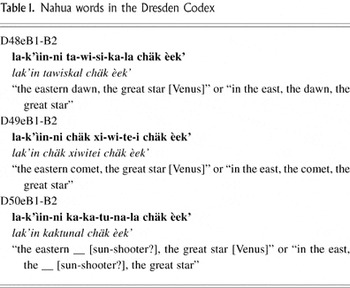
Nahua words in the Dresden Codex
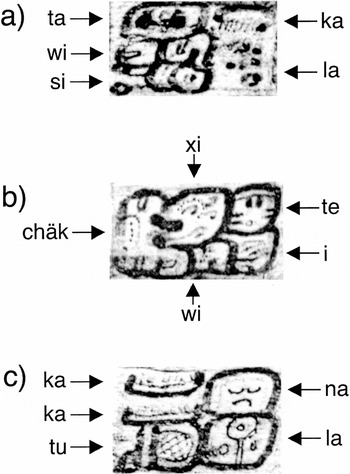
(a) Dresden 48eA2; (b) Dresden 49eA2; (c) Dresden 50eA2 (from a reproduction by Ernst Förstemann; courtesy Dumbarton Oaks Research Library and Collection, Washington, DC).
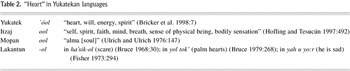
“Heart” in Yukatekan languages
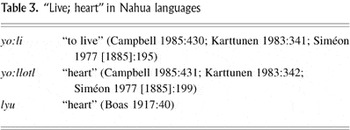
“Live; heart” in Nahua languages

Copan Stela E D8, yo-óol-la yool (heart; drawing by Matthew Looper).
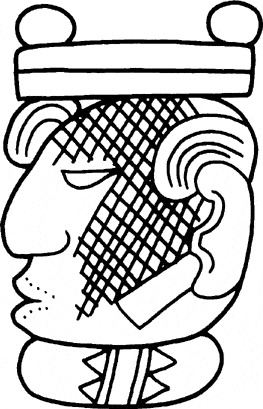
Yaxchilan Hieroglyphic Stairway 3, Step 4, C6, 12 pa-ta läjcha' pat(a(n)) (twelve tributes; drawing by Matthew Looper).
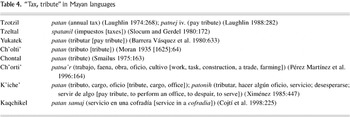
“Tax, tribute” in Mayan languages
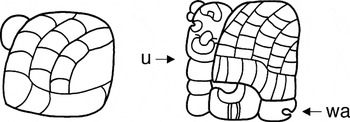
(a) Piedras Negras Lintel 2 ko'haw ko'haw (helmet); (b) Palenque Temple of the Inscriptions, middle panel, C6, u-ko'haw-wa u-ko'haw (his helmet; drawings by Matthew Looper).
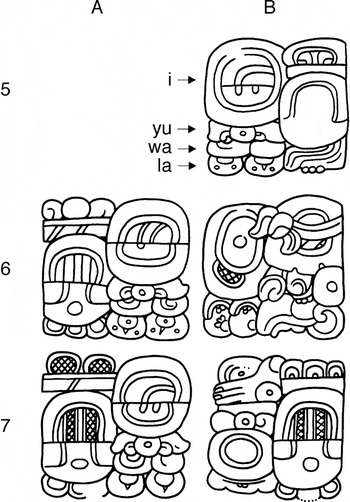
Copan Stela J B5-B7 (drawing by Matthew Looper).
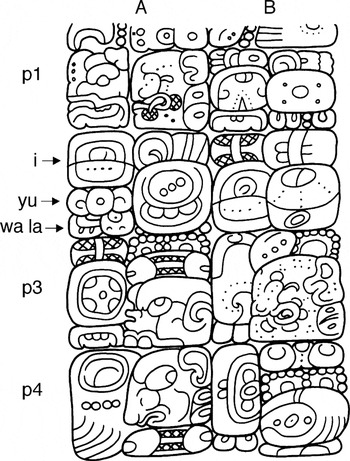
Jonuta Stela 1, inscription (drawing by Matthew Looper).
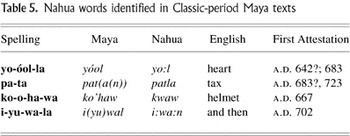
Nahua words identified in Classic-period Maya texts
 You have
Access
- 19
- Cited by