1. Introduction
The Japanese security policy has gradually changed since the early 1990s. As a result, the range of responses Japan can make in international crisis has significantly expanded.
Until the early 1990s, the scope of Japanese security policy was much limited. Its main objective was to defend Japan from a direct invasion by a foreign country. The scope of operations by the Japan's Self Defense Force (SDF) was restricted to activities related to the defense of Japan.
Japanese security policy began to change after Japan had dispatched the Land Self Defense Force to participate in the UN peacekeeping operations in Cambodia in 1992. Then, Japan sent the SDF to other UN peacekeeping operations in Mozambique, East Timor, and other areas. In November 2001, following the 11 September attacks in the USA, the Koizumi cabinet legislated the Special Bill to Counter Terrorism in order to send the Maritime Self Defense Force to provide rear area support for the US and multinational forces fighting the War on Terror. The Koizumi cabinet expanded the scope of Japanese security policy even further. In July 2003, it succeeded in having the Diet pass the Special Bill for Cooperation on the Reconstruction of Iraq to dispatch the Land Self Defense Force to post war Iraq.
Then, in March 2009, the Aso cabinet sent the MSDF to the Somali Coast to protect the Japanese vessels from attacks by the Somali pirates. It also passed a legislation, which made it possible for the MSDF to guard ships from other countries.
Such gradual evolution and expansion of the Japanese security policy culminated in the reinterpretation of the Japanese constitution on the right of collective self-defense in July 2014 and the legislation of security-related bills under the Third Abe Shinzo cabinet in September 2015.
The security-related bills have significantly transformed Japanese security policy as they now allow Japan to exercise the right of collective defense. With the new legislation, Japan can resort to exercise of force when there is an armed attack against a foreign country, which is in close relationship with Japan and the attack threatens Japan's survival. The legislation of security-related bills also has made it possible for the SDF to engage in a wider range of rear area support activities to assist forces of other countries in international crises.
Long-term shifts in Japanese security policy have attracted much academic attention so far (Shinoda, Reference Shinoda2002, Reference Shinoda2006, Reference Shinoda2007a; Midford, Reference Midford2003; Hughes, Reference Hughes2004, Reference Hughes2005, Reference Hughes2009, Reference Hughes2017; Arase, Reference Arase2007; Catalinac, Reference Catalinac2007, Reference Catalinac2016; Hughes and Krauss, Reference Hughes and Krauss2007; Samuels, Reference Samuels2007; Fujishige, Reference Fujishige2008; Oros, Reference Oros2008, Reference Oros2017; Estévez-Abe et al., Reference Estévez-Abe, Hikotani, Nagahisa, Kohno and Rosenbluth2009; Soeya, Reference Soeya, Soeya, Tadokoro and Welch2011; Singh, Reference Singh2013; Hatakeyama, Reference Hatakeyama2015; Liff, Reference Liff2015, Reference Liff2017, Reference Liff2018; Miyagi, Reference Miyagi2016; Sakaki and Lukner, Reference Sakaki and Lukner2017; Hikotani, Reference Hikotani2018; Smith, Reference Smith2019).Footnote 1
In the literature on Japanese security policy, scholars have so far paid particular attention to three subjects. The first is on causes of changes. The existing literature refers to three causes, changes in international environment (Midford, Reference Midford2003; Hughes, Reference Hughes2004, Reference Hughes2017; Samuels, Reference Samuels2007; Liff, Reference Liff2018), changes in norms and public opinion (Catalinac, Reference Catalinac2007; Shinoda, Reference Shinoda2007a, Reference Shinodab; Fujishige, Reference Fujishige2008; Singh, Reference Singh2013; Hatakeyama, Reference Hatakeyama2015), and reforms in domestic institutions since the 1990s (Shinoda, Reference Shinoda2002, Reference Shinoda2006, Reference Shinoda2007b; Arase, Reference Arase2007; Hughes and Krauss, Reference Hughes and Krauss2007; Catalinac, Reference Catalinac2016).
The second is on constraints on policy makers when they have tried to formulate new security policies. While many scholars accept the nature of Japanese security policy has changed, scholars emphasize two factors as constraints, namely, norms and public opinion (Oros, Reference Oros2008; Midford, Reference Midford2011). The third is on whether the changes were radical or evolutionary (Hughes, Reference Hughes2015; Lind, Reference Lind2016; Hughes, Reference Hughes2017; Liff, Reference Liff2018; Smith, Reference Smith2019).
Bearing the contributions which other scholars have made in mind, this article pursues three objectives. First, while it considers all three aforementioned causes are relevant, it contends that even after the prime minister's power has expanded his institutional power, the House of Councilors continues to restrict the prime minister's power as an institution when he formulates security policies. It specifies conditions under which the House of Councilors constrains the prime minister's security policy formulation.
Second, it demonstrates that in addition to norms and public opinion, the House of Councilors has been a major constraint on Japanese policy makers in the field of security policies. Third, it demonstrates that the House of Councilors is an important factor that has made the nature of changes in Japanese security policy ‘evolutionary’ and ‘gradual’ as pointed out by some scholars (Liff, Reference Liff2018: 12; Oros, Reference Oros2017: 35).
Among three objectives, this article provides more description for the first objective. Influences of the House of Councilors can be both electoral and parliamentary. It is possible to examine influences of the Upper House through elections such as the ones through electoral campaigns or the ones over prime minister calculations on the timing of proposing new security policies. This article, however, focuses on the parliamentary influences by the House of Councilors over the formation of security policy and legislation of bills because they are more conspicuous.
In other words, it explores conditions under which the House of Councilors affects the formulation of security policies, paying particular attention to the influence which it projected mainly in the process of legislation of bills in the field of security policy. It demonstrates that since the House of Councilors has significant power in the Japanese political system, Japanese prime ministers often had to revise their security policies or had to see the implementation of some security policies delayed.
This article shows the conditions when the second chamber imposes constraints on the prime minister in formulating his security policies. It considers that distribution of seats in the Diet determines the conditions on how the House of Councilors projects influence. Two elements are important. The first is whether the prime minister can obtain support from other parties to receive support from the majority of the second chamber when his party does not have a majority in the chamber. The second is whether the prime minister can secure support from the super-majority in the Lower House when he cannot obtain support from the majority of the second chamber.
So far, this article has presented its objectives. This article proceeds as follows. The second section provides a brief overview on the state of literature on the evolution of Japanese security and points out an issue to be further addressed. It is power projected by the House of Councilors on the Japanese prime minister when he formulates security policies. The third section provides an analytical perspective to explain how the prime minister is constrained in the formulation of Japanese security policy in recent years. It also highlights the conditions under which the House of Councilors projects influence in security policy formulation.
Then, in the fourth section, it conducts five case studies on the formulation of security policies: the legislation of the United Nations Peace Keeping Operations (PKO) Cooperation Bill in 1992, the legislation of the Bill concerning the Measures for Peace and Safety of Japan in Situations in Areas Surrounding Japan in 1999, Japanese cooperation for the US-led multinational forces in the War on Terror since 2002, the legislation of Anti-Piracy Bill in 2009 and the legislation of security-related bills in 2015. In the concluding section, this article examines the findings from the case studies and their implications on the formulation of the Japanese security policy.
2. Expansion of Japanese prime minister's power and constraints
Gradual changes in Japanese security policy have so far gathered much academic attention. While most researchers consider that Japan has made a dramatic shift in its security policy from the beginning of this century, the existing literature on long-term shifts in Japanese security policy has focused on three major issues. The first issue is on the causes of change. Scholars point out three causes, changes in international environment, changes in norms and public opinion, and changes in domestic institutions since the 1990s.
Those who ascribe evolutions to changes in international environment argue that after the end of the cold war, security environment in the Far East has changed. China continues to grow not only as an economic power but also as a military power. North Korea has developed nuclear weapons and has become a threat to Japan. As a result, it has become necessary for Japan to change its security policy to be able to formulate a more active defense policy and enhance security cooperation with the USA.
Those who focus on norms and public opinions argue that the Japanese public traditionally took a very negative view on Japan being engaged in military activities abroad. Since public views have gradually changed from the 1990s, it has become possible for the Japanese government to expand the scope of security policy.
Lastly, those who attach importance to the role of political institutions on the process of policy formulation emphasize the impact projected by a series of institutional reforms implemented since the 1990s on the formation of security policies as a cause of change. Japan has carried out two important institutional reforms since the 1990s, the political reform of 1994, which changed the Japanese electoral system, and the administrative reform of 2001, which expanded the legal authority of the prime minister. These reforms contributed to expanding the power of the prime minister (Estevez-Abe, Reference Estevez-Abe2006; Takenaka, Reference Takenaka2006, Reference Takenaka2019; Mulgan, Reference Mulgan2018). As the power of the prime minister grew, it has become possible for the Japanese prime minister to overcome resistance within the ruling parties against the formulation of a more active defense policy (Shinoda, Reference Shinoda2002, Reference Shinoda2006, Reference Shinoda2007a; Arase, Reference Arase2007; Estévez-Abe et al., Reference Estévez-Abe, Hikotani, Nagahisa, Kohno and Rosenbluth2009).
The second issue is on constraints on Japanese policy makers in formulating policies. Scholars often refer to norms and public opinion as major constraints (Oros, Reference Oros2008; Midford, Reference Midford2011; Smith, Reference Smith2019). They argue that norms of ‘anti-militarism’ (Oros, Reference Oros2008: 171) and public opinion who are suspicious of exercise of military capacities abroad (Midford, Reference Midford2011) have limited the changes of Japanese security policy and restricted the scope of activities of Japan's SDF.
The last issue is on the evaluation of the nature of changes in security policies. Most scholars consider changes were gradual and make similar evaluations on the reinterpretation of the Japanese constitution on the right of the collective defense and the 2015 security-related legislation (Liff, Reference Liff2015, Reference Liff2018; Lind, Reference Lind2016; Hughes, Reference Hughes2017; Smith, Reference Smith2019). Yet, some scholars such as Hughes consider that changes have been more far-reaching (Hughes, Reference Hughes2009) and argue that the 2015 legislation mark “watershed moments in the Japanese security policy”(Hughes, Reference Hughes2017: 98).
This article considers all three aforementioned factors; changes in international environment, in norms and public opinions as well as in political institutions are relevant in changes in Japanese security policy. Yet, when we observe changes in Japanese security policy, it is important to bear in mind that the Japanese prime minister is under constraints in formulating security policies including norms and public opinion.
This article highlights important constraints from one political institution that has been overlooked. They are the constraints projected from the House of Councilors on the prime minister. Just emphasizing institutional reforms that have contributed to expanding the prime minister's power neglects the fact that the Japanese prime minister remains subject to severe institutional constraints from the second chamber in formulating Japanese security policies.
Seminal works on the influence of the Diet on Japanese security policy demonstrate that the Diet projects significant influence on the government's security policy even after the institutional reforms (Sakaki and Lukner, Reference Sakaki and Lukner2017; Hikotani, Reference Hikotani2018). To support their arguments, they mainly focus on how the existing laws on security policy empower the Diet to project influence on the formation of security policy by the government.
This article considers that it is necessary to pay more attention to the influences of the second chamber, the House of Councilors, on security policies. The existing literature argues that the House of Councilors projected significant influence in political process even after the reform (Takenaka, Reference Takenaka2010; Thies and Yanai, Reference Thies, Yanai, Pekkanen, Reed and Scheiner2013, Reference Thies and Yanai2014). Despite these findings, previous works have seldom examined the role of the House of Councilors in the formulation of security policy (Hikotani, Reference Hikotani2018: 807).
Likewise, when we evaluate the nature of changes in long-term Japanese security policy, it is necessary to take into account the influence from the House of Councilors and examine how it affected the nature of changes.
3. Analytical perspective
3.1 Nature of the Japanese political system
To understand how the Japanese prime minister formulates Japanese security policies under constraints from the House of Councilors, it is necessary to understand the nature of the Japanese political system.
Japan adopts a parliamentary system. The essence of parliamentary system lies in the relationship between the executive and the legislature. Under the parliamentary system, the person who can receive support from the majority of the parliament becomes the prime minister and appoints ministers to form a cabinet. A cabinet remains in power as long as it can keep support from the parliament.
The parliament can withdraw support from the cabinet by passing a vote of no confidence. When the parliament passes the vote of no confidence, the cabinet has two choices. The first is to resign. The second is to dissolve the parliament and call for a general election. Regardless of which options the cabinet chooses, the result is more or less the same. The new cabinet, which is formed, will have support from the parliament. This means that the cabinet can expect support for the legislation of the bills it submits to the parliament. This is the ‘efficient secret’ articulated by Robert Bagehot (Bagehot, Reference Bagehot1966).
In the Japanese political system, such a relationship can be only found between the cabinet and the House of Representatives. Such a relationship does not exist between the cabinet and the second chamber, the House of Councilors. The constitution does not secure that the person who can command support from the majority of the House of Councilors becomes the prime minister. While it is true that the House of Councilors nominates prime ministers following the general elections of the Lower House, when the vote by the Lower House differs from the one by the House of Councilors, the decision by the Lower House prevails over the one by the House of Councilors.
Further, the House of Councilors does not have the power to submit vote of no confidence against the cabinet. The cabinet, in turn, cannot dissolve the House of Councilors. The members of the House of Councilors have a fixed term of 6 years.
In other words, there is no legal guarantee that the cabinet shall have support from the majority of the House of Councilors.
3.2 Importance of House of Councilors in legislations
The relationship between the cabinet and the House of Councilors poses a problem for the prime minister, in particular, when the opposition obtains a majority of seats in the House of Councilors and the Diet becomes ‘divided.’
Under the Japanese constitution, the Lower House has superiority over the House of Councilors in approving the budget as well as ratifying treaties. Yet, the relationship between the Lower House and the House of Councilors is more equal as regard to the legislation.
When the two chambers make different decisions on a bill, the Lower House can override the vote by the House of Councilors with a two-third majority. Yet, it is often difficult for the cabinet to have support from two-third of the seats in the Lower House. Under such a political circumstance, the cabinet cannot legislate the bill when opposed by the House of Councilors.
Further, even when the cabinet can secure enough seats necessary for the override, the so-called ‘60 days rule’ often serves as an impediment for the prime minister to resort to the override. After the Lower House passes a bill and sends it to the House of Councilors, if the House of Councilors does not take any vote on the bill, the Lower House has to wait for 60 days to make an override vote under the constitution. On the 61st day, the Lower House first passes a resolution stating that it considers that the House of Councilors has rejected the bill and then has to resort to the override. This rule can be a serious impediment for the cabinet to formulate policies, in particular, when it introduces bills in an extraordinary session of the Diet, which is usually convened in the fall.
This is because the regular session of the Diet has to be convened in January. An extraordinary session of the Diet can be extended until January 30 of the next year at most. In Japan, all bills, which are not legislated in a Diet session, are tabled and discarded unless the chamber deliberating the bill passes a resolution for a continued deliberation in the next session. If the cabinet cannot have the House of Representative pass the bills by the end of November, it may become difficult for the Diet to pass through the legislations even when the cabinet is willing to rely on the Lower House for the override. In other words, it has high chances of the legislation of bills forestalled until the regular Diet session in the following year.
Thus, the prime minister is likely to be significantly constrained in formulating policies when the Diet is ‘divided’ even when the ruling parties have a two-third majority in the Lower House.
Constraints on the prime minister become more severe when the Diet is ‘divided’ and when the ruling parties lack a two-third majority in the Lower House. It becomes impossible for the cabinet to legislate any bill without receiving consent from the House of Councilors. The House of Councilors obtains the power to veto cabinet policies.
3.3 Conditions for projection of power by the House of Councilors
Now, under what conditions does the House of Councilors affect the security policy formulation process in Japan? As has been already stated, this article examines the parliamentary influence of the second chamber, namely, effects from the House of Councilors over the process of actual security policy formation and legislation.
This article supposes that the prime minister's party has a majority in the Lower House and that he commands support from his party. With this assumption, it explores conditions under which the House of Councilors projects influence when the Japanese prime minister formulates security policies. The most common condition under which the House of Councilors extends influence is the situation in which the prime minister's party does not have a majority in the second chamber.
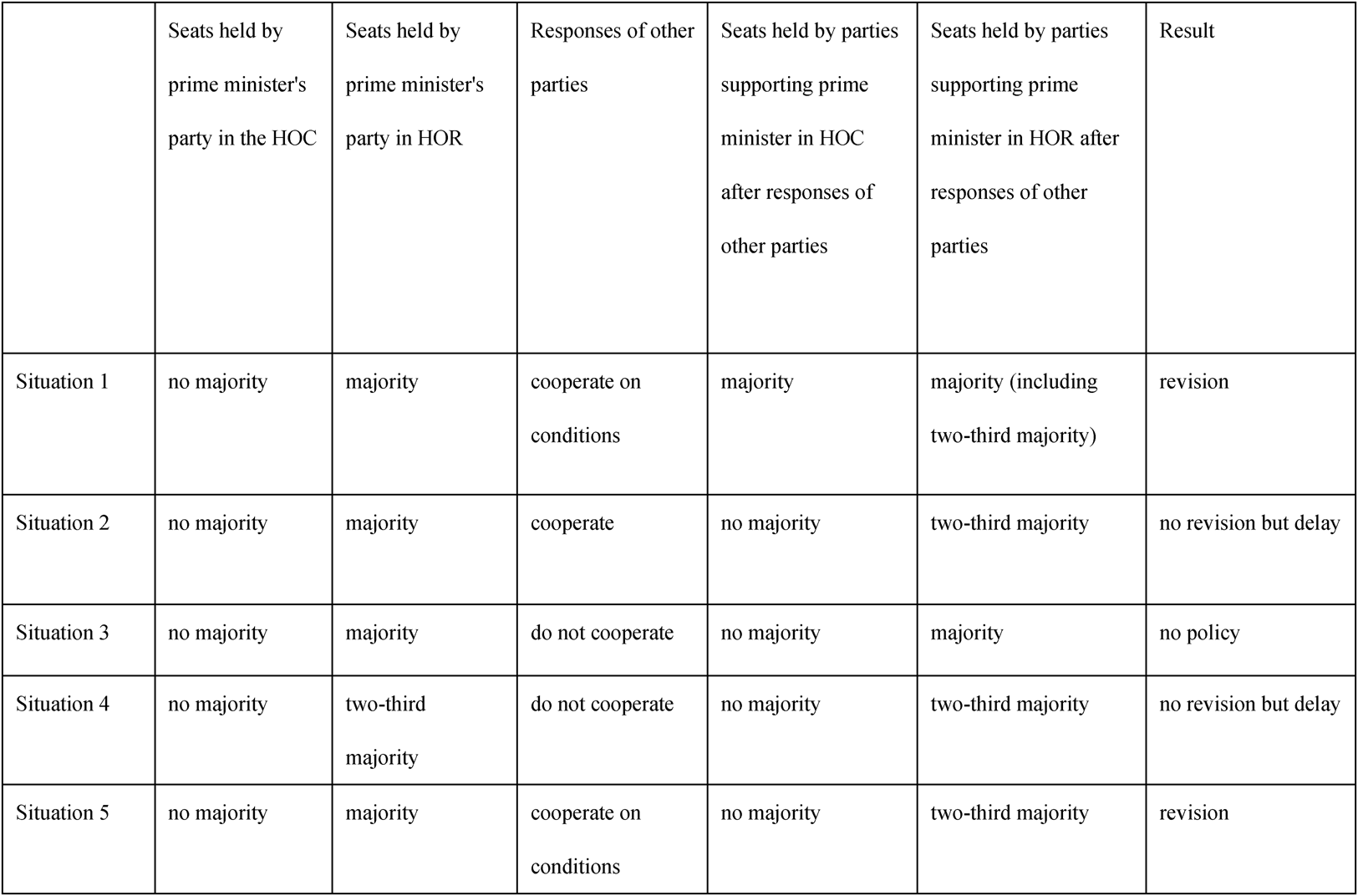
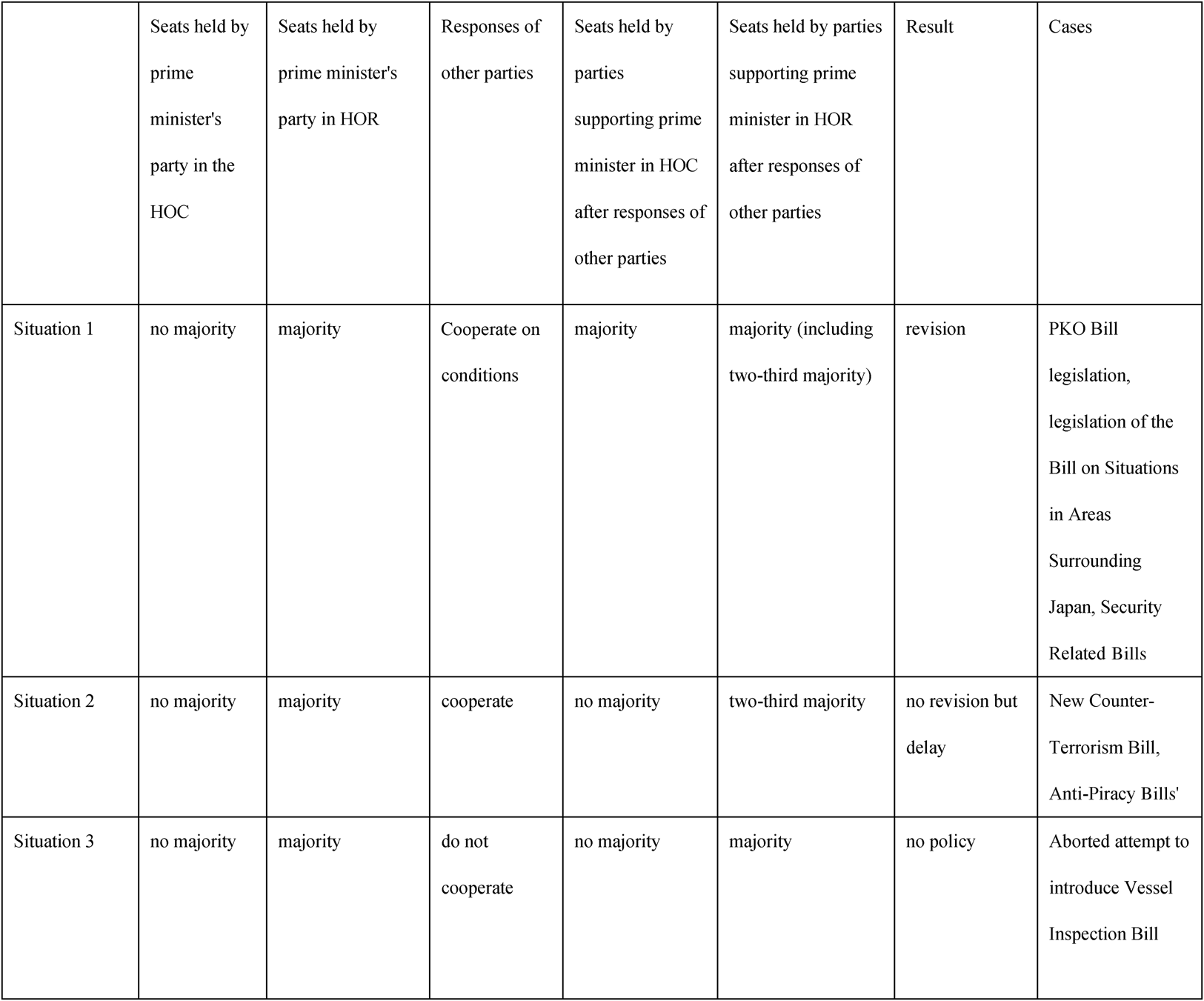
In addition, there are three major different situations under which the House of Councilors influences the process of legislation (Figure 1).
Conditions for projection of power by the HOC

The first is a situation in which the prime minister's party does not have a majority in the House of Councilors. In such a situation, the prime minister can seek cooperation from other parties in return for accepting some demands made by such parties to create a majority in the House of Councilors. In this case, he cannot implement policies as he has originally intended. It is also likely the prime minister has to see the implementation of policy delayed because of negotiations with other parties. Yet, he can avoid seeing the bill being aborded because of the opposition from the House of Councilors.
While the prime minister may obtain such support from a coalition partner, he may forge a majority with other political parties. In other words, this article treats bargaining with a coalition partner as one mean of securing a majority in the second chamber. As a result of receiving support from other parties, he may secure support from the super-majority in the Lower House. Yet, this does not affect the result of the policy outcome.
The second condition is when the prime minister cannot obtain support from the majority in the House of Councilors through seeking cooperation from other parties (situation 2). Even under such a circumstance, if he can create a two-third majority in the Lower House with support from other parties in the Lower House, he can implement his policy by resorting to the override with the two-third majority in the Lower House although he may see his policies delayed because of the obstructions from the second chamber for some time. Derivative of this situation is when the prime minister's party has a super-majority in the Lower House (situation 4). In this case, he can have the cabinet bill legislated with override in the Lower House even without seeking cooperation from any other parties.
The last circumstance is when he cannot create a two-third majority in the Lower House (situation 3). Under this condition, he cannot realize his policy.
It is possible to conceive one more situation although this situation rarely takes place (situation 5). This is a circumstance in which he may succeed in forming support from the super-majority through cooperation from other parties while the prime minister may not be able to build a majority in the House of Councilors through making concessions to other parties. In this case, it is likely that he has to not only revise the original policy which he has intended but also has to expect a delay in realizing the revised policies.
In the next section, this paper examines how the House of Councilors has affected the prime minister's formulation of security policy in different political circumstances.
4. Legislation of PKO Cooperation Bill in 1992
4.1 Gulf crisis
The first case is the legislation of the PKO Cooperation Bill, which the Miyazawa cabinet had the Diet legislated in June 1992. At the time, the prime minister's ruling party, the LDP, fell short of the majority in the Upper House. Prime Minister Kiichi Miyazawa needed cooperation from other political parties, the Komeito and the Democratic Socialist Party (DSP). He accepted the revisions demanded by the two parties to secure support from the majority of the House of Councilors and had to abandon some policies which he had initially endorsed (situation 1 in Figure 1).
In June 1992, the Miyazwa cabinet had the Diet legislate the bill to enable the government to dispatch the SDF to the UN PKO. To discuss the role of the House of Councilors in legislating the PKO Cooperation Bill, it is necessary to start the analysis with the story of the Japanese involvement in the Gulf Crisis in August 1990. The Gulf Crisis began in August 1990 when Iraq invaded and occupied Kuwait. In January 1991, multinational forces led by the United States began attacks on Iraq and regained Kuwait by the end of February to be followed by a cease-fire in March.
The Kaifu cabinet prepared and submitted the UN Peace Cooperation Bill to the Diet in October 1990. The bill aimed at dispatching the SDF as the UN Peace Cooperation Corps to offer rear area support for the multinational forces authorized by the UN and to be engaged in UN PKO. There was a strong opposition from minority parties against sending the SDF abroad. In addition, the opinions within the cabinet as well as within the LDP diverged on the bill. Thus, the bill was tabled and discarded in November 1990.
While the bill was tabled and discarded, the LDP, the Komeito, and the Democratic Socialists agreed to set up an organization independent of the SDF to be engaged in UN PKO.
4.2 Toward participation in UN PKO
After the Gulf Crisis had ended in March 1991, the Kaifu cabinet began preparing the Bill concerning Cooperation with the UN PKO. It gave up the idea of setting up an organization independent of the SDF and decided to dispatch the SDF itself to the UN PKO.
What was important was the allocation of seats in the House of Councilors at the time. In the House of Councilors election of July 1989, the LDP lost heavily and as a result, it did not have a majority in the House of Councilors. After the election, the LDP sought cooperation from the Komeito and the DSP to legislate important bills. In order to legislate a bill, which would allow the Japanese government to dispatch the SDF for UN PKO, the Kaifu cabinet needed cooperation from the two political parties. Thus, the LDP, the Komeito, and the DSP began discussions from August 1991 on the content of the bill. While negotiations continued, the Kaifu cabinet submitted the UN PKO Cooperation Bill to the extraordinary session of the Diet in September. The bill, however, was tabled in that session due to the sudden collapse of the Kaifu cabinet, following the failed attempt to legislate political reform bills in November.
The Miyazawa cabinet succeeded the Kaifu cabinet. The bill deliberation resumed under the Miyazawa cabinet in the same month. The deliberation, however, soon stagnated in the Lower House because the DSP demanded authorization by the Diet before dispatching the SDF to PKO.
Eventually, the DSP conceded and requested authorization by the Diet within 6 months after sending the SDF to PKO. In turn, the LDP and Komeito accepted to amend the bill to make it necessary for the government to seek approval from the Diet if the government wanted to continue to have the SDF participate in the PKO beyond the second year. The DSP did not agree to this amendment. The LDP and the Komeito decided to have the bill pass the Lower House after making this amendment. The LDP and Komeito amended and passed the bill in the Lower House in December 1991.
After the deliberations of the bill had begun in the House of Councilors, the Komeito became more reluctant to legislate the bill as its supporters grew more concerned about the bill. In the end, the Komeito proposed to temporarily suspend the participation of the SDF in the Peace Keeping Forces (PKF).
Prime Minister Miyazawa accepted such a proposal to have the bill legislated.
The LDP, the Komeito, and the DSP agreed to make the two following changes in the bill. The first was to suspend the participation of the SDF in the PKF. The second was to make the pre-authorization of the Diet necessary for dispatching the SDF to the UN PKO when the Diet was in session. When the Diet was not in session it became necessary for the government to receive authorization from the Diet in the first session, which would convene following the dispatch of the SDF.
Prime Minister Miyazawa could have the House of Councilor pass the amended bill with support from the Komeito and the DSP in July 1992. Because of this amendment, Japanese prime ministers could not have the SDF participate in the PKF for nearly 10 years. It was the Koizumi cabinet that had revised the law in December 2001 to make it possible for the Japanese government to dispatch the SDF to take part in the PKF.
5. Legislation of the Bill concerning the Measures for Peace and Safety of Japan in Situations in Areas Surrounding Japan in 1999
5.1 Revision of Japan-US Defense Guidelines
In May 1999, the Obuchi cabinet legislated the Bill concerning the Measures for Peace and Safety of Japan in Situations in Areas Surrounding Japan. This bill made it possible for the government to engage the SDF in rear support activities for the US forces when a crisis took place in areas surrounding Japan. Prime minister's party, the LDP, did not have the majority of seats in the Upper House. As a result, Prime Minister Keizo Obuchi had to change the original bill to secure enough support from other parties in the second chamber for the legislation (situation 1). Originally, he intended to enable the SDF to engage in vessel inspection activities. However, he had to give up this idea and agreed to exclude the section on the vessel inspection from the original bill. Later, he tried to introduce a separate bill on the vessel inspection. Yet, as he could not secure sufficient support from other parties for the policy idea, he abandoned the idea of introducing the bill itself (situation 3).
It was Prime Minister Ryutaro Hashimoto who had initially made an attempt to legislate the bill from April 1998. The original bill intended to expand the scope of SDF activities in three ways when ‘situations in areas surrounding Japan’ occur. It made it possible for the SDF to provide rear support for the US forces, to search and rescue missing American soldiers and to carry out vessel inspections. At the time, he did lead a coalition government consisting of his LDP, the Harbinger Party, and the SDP. He could not obtain support from the SDP for the bill, which was necessary to secure a majority in the Upper House. He resigned following the loss of the LDP in the upper house election in July to hand over the task to his successor, Prime Minister Keizo Obuchi.
When Prime Minister Obuchi made the attempt to legislate the bill, he did not have support from the majority of the Upper House. He had to abandon some elements in the original policy measures and revise the bill in order to obtain support from the Komeito and the Liberal Party to secure a majority in the Upper House.
The legislation is closely related to the revision of the Guideline of Japan-US Defense Cooperation in 1997.
In April 1996, Prime Minister Hashimoto and the US President Clinton agreed to revise the former Guidelines of the Japan-US Defense Cooperation, which the two governments had adopted in 1978 in order to prepare for a possible invasion of Japan. Behind this agreement, there were growing tensions in areas near Japan. First, the relationship between Japan as well as the United States and North Korea intensified as North Korea was suspected of developing nuclear weapons. Second, tension over the Taiwan Strait developed as China shot a number of missiles in March 1996 to the seas near Taiwan before the first direct presidential election in Taiwan.
In September 1997, the United States and Japan reached an agreement on the new Guidelines for Japan-US Defense Cooperation. The new Guidelines were prepared for Japan-US cooperation under different circumstances. The first was a direct attack on Japan. The second was called ‘situations in areas surrounding Japan,’ which really meant the occurrence of an international crisis in regions close to Japan. Such a crisis was likely to have dire consequences for Japanese security. The Guidelines stipulated various types of cooperation between Japan and the United States for such a crisis such as rear area support by Japan for the US armed forces including transportation and supply, search and rescue of soldiers, evacuations of non-combatant, and measures to make economic sanction effective.
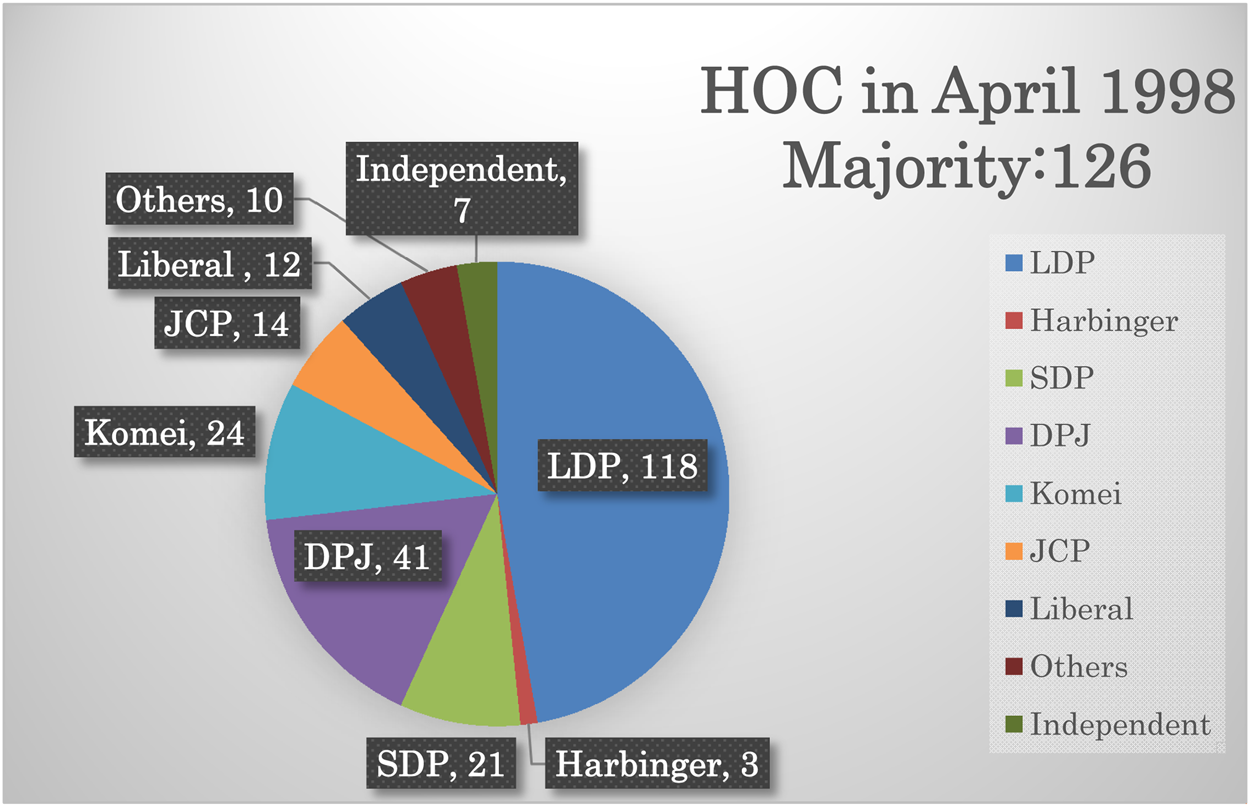
In order to make the new Guidelines effective, the Hashimoto cabinet began to design a new bill in February 1998. The Hashimoto cabinet was a coalition consisting of the LDP, the Social Democratic Party, and the Harbinger Party. The LDP had only 119 seats out of 252 seats in the House of Councilors and needed cooperation from the SDP to pass legislation in the House of Councilors. (Figure 2)
Distribution of Seats in HOC in April 1998.

.
In April 1998, the three political parties began negotiations on the content of the new bill. Yet, negotiations did not make such progress as the SDP was opposed to the Japan-US cooperation in situations in areas surrounding Japan. The Hashimoto cabinet, nonetheless, submitted the Bill concerning the Measures for Peace and Safety of Japan in Situations in Areas Surrounding Japan to the Diet in the same month. The bill would allow the SDF to provide rear area support for the US armed forces in the situations in areas surrounding Japan and search and rescue combatants who became missing. It also would allow the SDF to make an inspection of foreign vessels based on the UN Security Council resolutions.
In June, the SDP and the Harbinger Party left the coalition. In July, the House of Councilors election was held and the LDP lost heavily, obtaining only 44 seats.
5.2 ‘Divided’ diet and formation of the LDP-Liberal-Komeito coalition cabinet
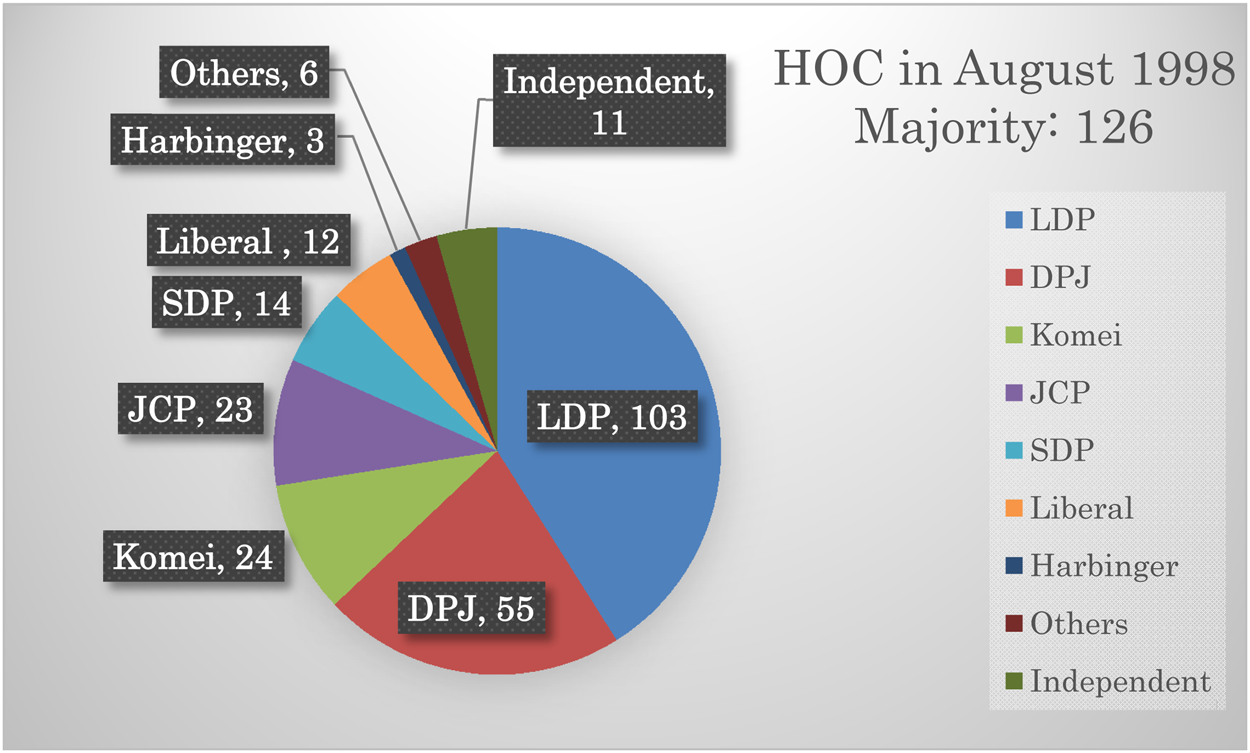
Following the defeat, Prime Minister Hashimoto resigned to be succeeded by Foreign Minister Keizo Obuchi. Prime Minister Obuchi did not have support from the majority of the House of Councilors. As a result, the Bill concerning the Measures for Peace and Safety of Japan in Situations in Areas Surrounding Japan became stalled in the Lower House as the Obuchi cabinet could not have any prospect of having the bill legislated in the House of Councilors. (Figure 3).
Distribution of Seats in HOC after 1998 HOC election.

Prime Minister Obuchi experienced a very hard time in legislating a set of bills to deal with the financial crisis hitting Japan at the time in the extraordinary session of the Diet, which had convened in July 1998, following the Upper House election. In essence, he had to accept most of the proposals made by the Democratic Party of Japan, the largest opposition party in the House of Councilors, to legislate a bill to deal with possible collapses of financial institutions.
After the Diet session had ended in October, Prime Minister Obuchi began to seek collaboration from other political parties to secure support from the majority of the House of Councilors. First, he agreed with the Liberal Party to form a coalition government in November. The coalition cabinet was formed in January 1999. Yet, even with the seats of the Liberal Party, the LDP still fell short of a majority of seats in the House of Councilors.
Thus, Prime Minister Obuchi strived to receive cooperation from the Komeito to legislate the bill. The LDP, the Liberal Party, and the Komeito began negotiations from the beginning of February 1999 on how to revise the bill concerning the Measures for Peace and Safety of Japan in Situations in Areas Surrounding Japan in 1999.Footnote 2
In April 1999, the three political parties agreed to make four major changes. First, the text ‘situation, which is likely to lead to a direct attack against Japan’ would be inserted as an example of ‘situations in area surrounding Japan’ in the bill. Second, operations of the SDF would become subject to pre-authorization by the Diet although post-facto approval would be permitted in urgent situations. Third, activities in the situations in the area surrounding Japan would be subject of the report to the Diet after the termination of operations. Lastly, the bill would not include sections on the vessel inspection for which they would prepare a different bill.
The vessel inspection was the most controversial issue in the negotiations. The Komeito considered that a resolution by the UN Security Council was a necessary condition to carry out vessel inspection. The Liberal Party, however, opposed the UN Security Council resolution as a condition. As the three parties could not reach an agreement on the terms of the naval inspection, they decided to drop the issue from the bill and agreed to introduce an independent bill for the naval inspection in situations in areas surrounding Japan.
Prime Minister Obuchi accepted amending the bill and succeeded in legislating the revised bill in May 1999. He, however, could not prepare the bill specifying the terms of vessel inspection as he could not bring the Liberal Party and Komeito to an agreement on conditions that would allow the SDF to engage in the vessel inspections. Note that although the revision of the original itself took place in the Lower House, Prime Minister Obuchi agreed to change the bill in order to secure support from the Komeito in the House of Councilors.
After the Liberal Party had left the coalition in April 2000 and the Mori cabinet had been formed, the Mori cabinet legislated the Bill for the Vessel Inspection in November 2000. Under the new law, in situations in areas surrounding Japan, the SDF can inspect foreign vessels when a UN Security Council resolution is adopted or when the flag state of the ship agrees to an inspection.
In the legislation of the Bill concerning the Measures for Peace and Safety of Japan in Situations in Areas Surrounding Japan in 1999, the House of Councilors again constrained the prime minister's capacity to formulate security policies. Prime Minister Obuchi had to abandon an important policy, the vessel inspection, to secure support in the House of Councilors.
6. Cooperation in the war on terror
6.1 Japan's maritime self-defense force and war on terror
In January 2008, the Fukuda cabinet could legislate the Replenishment Support Special Measures Bill (hereafter referred to as the new counter-terrorism) to make it possible for the Maritime Self Defense Operations to continue supporting activities for the vessels of the multinational forces engaged in the War on Terror. The LDP did not have a majority in the House of Councilors. Prime Minister Fukuda secured cooperation from the Komeito, the coalition partner, for the bill. While he could not have support from a majority of the seats in the House of Councilors, he managed to obtain support from more than two-thirds of the seats and succeeded in legislating the bill with the override in the Lower House (situation 2). Prime Minister Fukuda had to be protracted in having the bill legislated in the form as he had originally planned.
This bill was virtually a replacement of the Special Bill to Make Measures for the War on Terror (hereafter referred to as the former counter-terrorism bill), which the Koizumi cabinet had originally legislated in October 2001. The objective of the bill was to make it possible for the SDF to corporate with the multinational forces led by the United States in the War on Terror, which began in October soon after the 9.11 attacks.
After the 9.11 attacks against the United States in 2001, Prime Minister Koizumi decided to cooperate with the USA in the War on Terror. Shortly after the attack, the Koizumi cabinet drafted the former counter-terrorism bill and had the Diet legislate it in October 2001. The objective of the bill was to dispatch the MSDF to the Indian Ocean to provide rear support such as supplies of replenishment for multinational forces as well as to transport refugees. The law was valid for two years. In October 2003, the Koizumi cabinet renewed it for another two years. In October 2005, it extended the expiration date of the law once again, but just for a year. The Abe cabinet made the third extension in October 2006 and the law was effective until 1 November 2007.
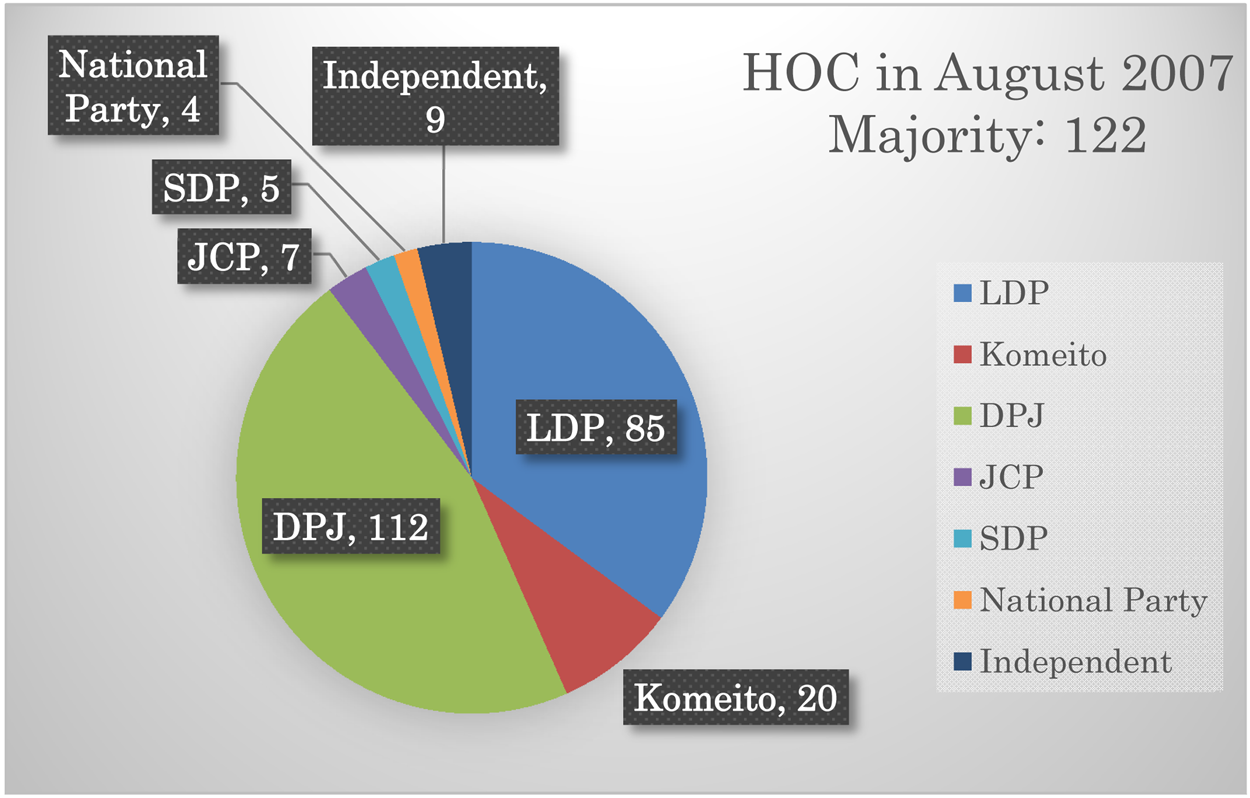
In July 2007, the LDP lost heavily in the House of Councilors election, winning only 37 seats. Even with its coalition partner, the Komeito, the LDP could secure only 105 seats in the House of Councilors, which fell short of 122 seats necessary to secure a majority. Prime Minister Abe resigned in September because his health conditions deteriorated. (Figure 4).
Distribution of Seats in HOC after 2007 HOC election.

6.2 Introduction of a new bill
Before its resignation, the Abe cabinet had already given up introducing a new bill to extend the former counter terrorism law because it was unlikely that it would be able to get that bill legislated before the arrival of the due date.
To understand this decision, it is necessary to take into account the constraints from the ‘60-day rule,’ which this article has already described. The LDP and Komeito held more than two-thirds of the seats in the Lower House. Thus, even if the House of Councilors had rejected a bill passed by the House of Representatives, the LDP and Komeito were in the position to override that decision and pass the bill. Yet, in extending the former counter-terrorism law, the 60-day rule worked as an impediment. It was very unlikely that the Abe cabinet could pass through the new bill to extend the expiration date of the former law in the House of Representatives by early September. The opposition parties, which now commanded a new majority in the House of Councilors and controlled the legislative agenda, were sure to delay deliberation on the bill in the House of Councilors beyond 1 November 2006. Thus, the former counter terrorism law was likely to expire on November 1.
Faced with this situation, the Abe cabinet decided instead to prepare the new counter-terrorism bill. The new bill would limit the operations of the MSDF to the provision of supplies such as fuel and water to the vessels in multinational forces fighting the War on Terror. Prime Minister Abe, however, resigned in September 2007 before submitting the bill to the Diet.
6.3 Failed attempt of a grand coalition and suspension of MSDF activities
Yasuo Fukuda, former Chief Cabinet Secretary of the Koizumi cabinet, became the new prime minister in the same month and took over the task of legislating the bill. The Fukuda cabinet submitted the new counterterrorism bill at the beginning of October. The DPJ and other opposition parties were against the bill, making it likely that the deliberation process would be prolonged.
Thus, after submitting the bill, Prime Minister Fukuda made an attempt to break the impasse. He tried to form a grand coalition with the DPJ. Prime Minister Fukuda and DPJ leader Ichiro Ozawa held summit meetings twice from the end of October to early November. At the second meeting, they agreed to form a grand coalition. Prime Minister Fukuda, however, could not break the deadlock through forming a grand coalition as Ozawa could not persuade the other members of the DPJ to establish a coalition cabinet with the LDP.
The Lower House passed the new counter-terrorism bill on November 13. The DPJ and other opposition parties, however, resisted deliberations on the bill in the House of Councilors. They finally rejected the bill on 11 January 2008, which was the 59th day since the beginning of the deliberation in the House of Councilors. The day was just two days before it would have become possible for the House of Representatives to pass a resolution, which would treat the bill as having been rejected by the House of Councilors. Prime Minister Fukuda could have the Diet legislate the bill on the same day with the override vote. Because the legislation was protracted, however, the MSDF had to suspend its operations in the Indian Ocean from November 2007 to January 2008.
7. Legislation of the Anti-Piracy Bill in 2009
The Aso cabinet legislated the Anti-Piracy Bill in June 2009. The aim of the bill was to make it possible for the Maritime SDF to cooperate with navies of other countries in the fight against the piracy of the coast of Somalia. The LDP did not have the majority of the seats in the Upper House. Yet, Prime Minister Aso could secure support for the bill from the Komeito, the coalition partner. He could rely on the super-majority consisting of the LDP and the Komeito in the Lower House to have the bill legislated while the two parties did not have a majority in the House of Councilors (situation 2). As was the case with the new counter-terrorism bill, Prime Minister Aso relied on the override by the Lower House.
The legislation of the anti-piracy bill became a political agenda for Prime Minister Aso as attacks by the piracy against commercial vessels off the coast of Somalia spread in 2008. NATO began to send warships to guard private ships in October 2008.Footnote 3 Prime Minister Aso decided to send the MSDF to join international cooperation activities against the piracy. When the Aso cabinet initially sent Japanese MSDF vessels in March, the existing law only allowed those vessels to protect ships owned by the Japanese or ships that had Japanese citizens or Japanese cargo on board. Such restrictions severely limited the scope of activities in which the MSDF could engage.
Thus, the Aso cabinet drafted a new bill so that MSDF ships could also guard foreign ships from the pirates. It proposed the new bill to the Diet in March. The bill passed the House of Representatives on 23 April 2008, but the DPJ was opposed. The bill was once again stalled in the House of Councilors. Aso finally had the Diet pass the bill with an override toward the end of June.
8. Legislation of the Security-Related Bills in 2015
8.1 Security-related bills, reinterpretation of the Japanese constitution and the House of Councilors
The Third Abe Shinzo cabinet succeeded in legislating the Security-Related Bills consisting of the Bill for Peace and Security and the Bill for Cooperation for International Peace Assistance in September 2015Footnote 4. The bills made it possible for Japan to exercise the right of collective defense under certain conditions and enhanced the scope of activities of the Japanese SDF in an international crisis.
The LDP did not have a majority in the House of Councilors while it had a majority in the Lower House. Thus, the prime minister needed cooperation from its coalition partner for a successful legislation. Thus, in the process of preparing the bill, Prime Minister accommodated the demands made by the Komeito and agreed to revise the original texts of the bills prepared by the government to secure necessary seats in the House of Councilors (situation 1). The prime minister made some compromise on the substance of the security policy he had originally envisioned due to the lack of a majority of his party in the House of Councilors.
About one year before this legislation, in July 2014, to make it possible for Japan to exercise the right of collective defense, the Abe administration made the cabinet decision to change the interpretation of the Japanese constitution on the right of the collective defense. In determining how to reinterpret the constitution, Prime Minister Abe made the conditions in which Japan could use the right of the collective defense more restrictive than the original proposal, accepting demands from the Komeito. The reinterpretation a government decision did not involve the decision by the Diet. Yet, the moderation by the prime minister after all reflected the constraints imposed by the House of Councilors. The prime minister accepted the demands from the Komeito as it was the LDP coalition partner and the LDP after all needed to keep the coalition with the Komeito because it lacked the majority in the Upper House.
8.2 Security-Related Bills
The Security-Related Bills had four pillars. First, the Bill for Peace and Security stipulated the conditions under which Japan could use the right of self-collective defense. Namely, ‘when an armed attack against a foreign country, which is in a close relationship with Japan, occurs and as a result threatens Japan's survival and poses a clear danger to fundamentally overturn people's right to life, liberty, and pursuit of happiness’ and ‘there is no other appropriate means available to repel the attack and ensure Japan's survival and protect its people,’ Japan can use force against a country, which has attacked a country, which is in a close relationship with Japan. Before Japan could not resort to the right of self-collective defense under any circumstance. Thus, this was a significant departure from the Japanese security policy, which Japan had pursued up to this point since the end of the Second World War.
Second, the Bill for Peace and Security revised the Law concerning the Measures for Peace and Safety of Japan in Situations in Areas Surrounding Japan. The bill changed the name of the law to the Law concerning the Measures for Peace and Safety of Japan in Important Situations, taking away the words ‘situations in areas surrounding Japan’ and expanded the scope of the operations in which the SDF could engage with foreign military forces in the following three ways. First, when important situations, which will project important influences over security and peace of Japan, arise, the SDF can offer rear area support to foreign armed forces. Important situations do not have to emerge in areas geographically surrounding Japan. Second, the SDF can now cooperate not only with the American forces but also with the forces of other countries if it is considered that operations of the forces from other countries are in line with the principles of the United Nations Charter. Third, the scope of the SDF operations to offer rear area support has widened. Before the SDF could not offer rear area support, which is considered to be closely associated with a use of force. For example, the SDF could not transport weapons, which would be used in the combat. With the revision, the SDF can now offer rear area support as long as there is no fighting in areas where the SDF operates.
The third pillar was the Bill for International Peace Support. This bill stipulated permanent conditions to dispatch the SDF to offer rear area support for the troops of foreign countries in events similar to the Gulf Crisis in 1991. Under the bill, Japan can send the SDF when a resolution by the UN General Assembly or Security Council recognizes that there is an aggression violating international peace and which calls on member states to take actions to recover international peace. With the legislation of the bill, the government does no longer have to introduce a special measure bill every time when some aggression takes place to dispatch the SDF.
Fourth, the Bill for Peace and Security expanded the scope of activities in which the SDF could engage in the UN PKO. Before the legislation of the bills, the SDF participating in the PKO could use weapons only to protect themselves but not to defend troops from other countries or private citizens attacked from a third party such as anti-government forces or militia as it was considered as ‘use of force’ that was only permitted when Japan was under attack. With the legislations of the bills, it has now become possible for the SDF to protect troop countries or private citizens.
8.3 Reinterpretation of constitution in July 2014
The discussions leading to the introduction of the Security-Related Bills began in February 2013 when Prime Minister Abe resumed the Advisory Panel on Reconstruction of the Legal Basis for Security, which he had set up in 2007 under his first administration. He asked the panel to discuss how to interpret the constitution in the ‘current international security environment,’ implying to re-examine the interpretation of the constitution as regard to the exercise of the right of self-collective defense.
In May 2014, the panel submitted the Final Report. In the report, the panel suggested that exercise of the right of self-collective defense should be made possible under some conditions. It also claimed that the constitution set no limit on Japan's participation in UN collective security activities.
In parallel with the discussions within the panel, the Second Abe cabinet started discussing how to revise the Guidelines for Japan-US Defense Cooperation with the United States which the two countries had revised in 1997. In early 2013, the United States and Japan agreed to change the Guidelines. The two countries intended to expand the scope of cooperation between Japan and the United States on security areas. In particular, they tried to widen the activities of the SDF to support the US forces when the security environment should change in East Asia.
In July 2014, the Abe cabinet decided to change the interpretation of the constitution on the exercise of the right of the self-collective defense: the new constitutional interpretation is as follows.
‘Not only when an armed attack against Japan occurs but also when an armed attack against a foreign country that is in a close relationship with Japan occurs and as a result threatens Japan's survival and poses a clear danger to fundamentally overturn people's right to life, liberty and pursuit of happiness, and when there is no other appropriate means available to repel the attack and ensure Japan's survival and protect its people, use of force to the minimum extent necessary’ is permitted under the Constitution as measures of self-defense.
In April 2015, Japan and the United States agreed on the new Guidelines for Japan-US Defense Cooperation and enhanced the scope of Japan-US Defense Cooperation reflecting the new constitutional interpretation. For example, it became possible for Japan and the United States to cooperate in defending the two countries from possible attacks with ballistic missiles. Further, Japan and the United States enhanced the scope of cooperation on the sea as it became possible for Japan to defend the US vessels on the high seas from possible aggression.
8.4 Influence of Komeito
In May 2015, the Third Abe cabinet submitted the Security-Related Bills to the Diet and the Diet passed the legislation in September 2015 virtually without any amendment.
Thus, on the surface, it appears as if the House of Councilors had no influence over the legislation. Yet, in fact it did. This is because the Komeito projected significant influence in the whole political process leading to the legislation of the Security-Related Bills including the reinterpretation of the Japanese constitution.Footnote 5 The influence of the Komeito originated from the power allocated to the House of Councilors. Prime Minister Abe sustained the coalition with the Komeito as it needed to secure its support to keep support from a majority of seats in the Upper House. The Komeito used the current allocation of seats in the House of Councilors as the leverage in the prime minister's decisions on security policies such as the reinterpretation of the constitution which did not directly accompany the legislation.
Although the LDP had been very much dominant in the Lower House since the general election in December 2012, its seats still fell short of the majority in the House of Councilors even after its victory in the election of House of Councilors in July 2013. In the regular Diet session starting from January 2015, the LDP had 116 seats in the House of Councilors. The majority was 122. Thus, the LDP still needed 20 seats held by its coalition partner, the Komeito to pass legislations in the Diet.
First, the Komeito affected the reinterpretation of the constitution as regard's to the exercise of the right of self-collective defense in July 2014. As it was a cabinet decision, an agreement with the Komeito was necessary.
Negotiations on the reinterpretation between the LDP and the Komeito took place between May 2014 and June 2014 on the conditions for permitting the exercise of the right of self-collective defense (Asahi Shimbun Seijibu Shuzaihan, 2015: 149–180). The LDP originally proposed the followings as the conditions for permitting the exercise:
‘when an armed attack against Japan occurs but also when an armed attack against a foreign country occurs and as a result there is a concern that Japan's survival necessary to protect people's right to life, liberty and pursuit of happiness may be threatened.’Footnote 6
The Komeito demanded stricter conditions. It requested more restrictions on the nature of countries, which Japan could defend through the exercise of the right of collective defense.Footnote 7 It also considered that mere ‘concern that Japan's survival necessary to protect people's right to life, liberty and pursuit of happiness may be threatened’ was insufficient as a condition and a graver situation was necessary to resort to the exercise.Footnote 8 It initially demanded to include ‘there is a concern that people's right to life, liberty and pursuit of happiness may be fundamentally overturned’ as a part of the condition and then demanded to replace ‘concern’ with more restrictive words.
Prime Minister Abe acquiesced to these demands. As regard to the nature of countries, the two political parties agreed that the countries, which Japan would defend, had to have ‘a close relationship with Japan.’ As regard to the gravidity of situations, the two political parties came to an understanding that there must be ‘a clear danger to fundamentally overturn people's right to life, liberty and pursuit of happiness.’
In the end, they agreed on the followings as the conditions to resort to the exercise of the right of self-collective defense. The conditions for permitting the exercise became stricter:
‘when an armed attack against Japan occurs but also when an armed attack against a foreign country that is in a close relationship with Japan occurs and as a result threatens Japan's survival and poses a clear danger to fundamentally overturn people's right to life, liberty and pursuit of happiness [letters in italic were added].’
8.5 Conditions in the Bill for International Peace Support
The Komeito also projected significant influence in the final legislation process of the security-related bills in particular on the conditions for dispatching the SDF to cooperate with other countries when other countries decided to fight against transgression by some country as did happen in the Gulf Crisis.
In drafting the Bill for International Peace Support, the Abe cabinet initially proposed to make the dispatch of the SDF possible when there was a request from an international organization such as the EU. Also, the cabinet proposed to make it necessary for the government to seek the approval from the Diet before dispatching the SDF ‘in principal,’ implying that there could be exceptions in which the government could send the SDF without prior authorization by the Diet.
The Komeito did not agree to these proposals. It demanded that the government could dispatch the SDF only when there were UN resolutions. It also required pre-authorization of the Diet without any exceptions.
Prime Minister Abe accepted these demands to secure a majority in the Upper House. As a result, the conditions for dispatching the SDF became more restrictive than he had originally intended.
9. Conclusion
This article has examined the role which the House of Councilors has played in the formation of the Japanese security policy since the 1990s. The Japanese security policy evolved and Japan came to have more policy options to sustain its security.
This article accepts that the Japanese prime minister has expanded his power as an institution after a series of institutional reforms since 1990. It is certain that the expanded power contributed to the revision of the Japanese security power. Yet, this article demonstrates through the five case studies that when Japanese prime ministers tried to change Japanese security, the House of Councilors often functioned as constraints. It often delayed policy formulation by various prime ministers. It also forced prime ministers to limit the scope of the activities of the SDF more than they had originally intended.
This article has explored political circumstances in which the Upper House likely projects significant influence in the prime minister's formulation of security policies. The House of Councilors likely projects influence when the prime minister's party cannot secure more than half of the seats in the House of Councilors.
Further, this paper has highlighted specific conditions in which the House of Councilors affects the prime minister's security policy formulation when the prime minister's party does not have a majority in the House of Councilors and demonstrated specific examples (Figure 5).
Conditions for projection of power by the HOC and cases of security policies

The first condition is when the prime minister can receive cooperation from other parties in return for accommodating some demands made by such parties. In this case, the prime minister has to make compromises. While the prime minister may obtain such support from a coalition partner, he may forge a majority with other political parties. The cases of the PKO legislation, the legislation of the Bill concerning the Measures for Peace and Safety of Japan in Situations in Area Surrounding Japan and the legislation of Security-Related Bills are the instances of the second situation.
The second situation is when the prime minister may not be able to build a majority in the House of Councilors through seeking cooperation from other parties. If his party has a two-third majority or he can create a two-third majority in the Lower House with support from other parties in the Lower House, he can implement his policy by resorting to the override with the two-third majority in the Lower House although he may see his policies delayed because of the obstructions from the second chamber for some time but in the end. The cases of the legislation of the new counter-terrorism and the legislation of anti-piracy bills are the instances of the third situation.
The third condition is when the prime minister may not be able to obtain support from the majority of the Upper House while the prime minister cannot create a two-third majority in the Lower House. Under this condition, he cannot realize his policy. The failed attempt by the Obuchi cabinet to legislate a bill to make vessel inspection possible applies to this case.
Thus, when we consider the institutional power of the prime minister as a driving force for changes in security policy, it is necessary not to overrate his power as his power is under severe constraints from the House of Councilors.
The influence of the House of Councilors on the formation of Japanese security policy has not been thoroughly examined in the existing literature. The House of Councilors could affect the substance of security policies because often the cabinet had to enact new bills to formulate new security policies.
The influences from the House of Councilors were rather passive. Yet, the House of Councilors projected two kinds of important influences. First, it made conditions in which Japan could take responses at the time of the international crisis more restrictive than the prime ministers had originally intended.
For example, as the Abe cabinet accepted the demands from the Komeito on the constitutional reinterpretation on the right of collective defense as well as on the substance of the Security-Related Bills restricted the conditions in which Japan could exercise the right of the collective defense. It also made conditions in which the SDF could provide rear area support for armed forces of foreign countries fighting against transgression by some country. It permitted the SDF to offer such support only when the UN adopts resolutions requesting or permitting such activities.
As this article has already introduced, there is a debate on the political significance of the reinterpretation of the Japanese constitution on the right of the collective defense and the 2015 legislation. As Japan could not use the right of collective defense before, the 2014 reinterpretation marked a major change from the previous security policy but as the government attached quite a few conditions for the exercise of the collective defense, it was evolutionary. In particular, the addition of the element that the attack has to be on a foreign country ‘that is in a close relationship with Japan’ as one condition made situations in which the government could use the right of the collective defense more limited. Given that the government has to explain to and convince the Japanese citizens why it needs to exercise the right of collective defense, this additional condition has made it more difficult for the Japanese government to exercise the right of the collective defense. The House of Councilors was a major cause that made the government put the additional condition.
Second, the House of Councilors deprived the Japanese government of important security policy measures and made it difficult for the Japanese government to make security cooperation with other governments for a certain period. For example, because of the amendment of the PKO bill in 1992, Japan could not have the SDF participate in the PKF for nearly 10 years. It became possible only after the first Koizumi cabinet had amended the PKO law in 2001. It held up the Japanese government from providing rear support for the US armed forces when necessary for about a year after the Japanese government had envisioned to become capable of making such cooperation in 1998. The Upper House also deprived the Japanese government of the vessel inspection as a possible security measure for two years. Moreover, it interrupted the Japanese cooperation with the Multinational forces in the War on Terror in 2007 and delayed the Japanese response to the piracy off Somalia coast in 2009.
Finally, it is possible to locate the influence of the House of Councilors in a larger picture of long-term changes in Japanese security policy formulation. The debate on the political significance of the reinterpretation of the Japanese constitution on the right of the collective defense and the 2015 legislation gives us insight on how to perceive the influence of the House of Councilors.
What was evolutionary was not just the reinterpretation of the constitution in 2014 and the legislation of the Security-Related Bills. In fact, since the PKO legislation of 1992, the changes of Japanese security policy were evolutionary as Japan gradually expanded the scope of security policies (Liff, Reference Liff2015). Japan might have come to make a more ‘assertive’ security policy (Hughes, Reference Hughes2009: 19). Yet, the pace of change was much limited.
Certainly, there is a number of factors which had contributed to making the nature of changes gradual such as norms and public opinion. Yet, the Japanese second chamber was one important factor that contributed to making shifts in Japanese security policy more gradual than the past prime ministers had originally intended. Because of the changes in the PKO legislation in 1992, Japan could not participate in PKF until 2001. Further, because of constraints imposed by the House of Councilors, implementation of policies articulated in the US-Japan Defense guidelines of 1997 became evolutionary with full realization being completed with the legislation of Bill for the Vessel Inspection in 2000.
Supplementary material
The supplementary material for this article can be found at https://dataverse.harvard.edu/dataset.xhtml?persistentId=doi:10.7910/DVN/OK1WFZ.
Acknowledgements
I would like to thank the editor, David Leheny and two anonymous referees for helpful comments.