Introduction
Insect generalists in agricultural environments often encounter a diversity of crop and non-crop hosts that are utilized for feeding, oviposition and shelter. Their capacity to exploit a range of host plants intrinsically expands their resource base and increases fitness in a variable environment (Strong et al., Reference Strong, Lawton and Southwood1984; Bernays & Minkenberg, Reference Bernays and Minkenberg1997). A prime example is Bemisia tabaci, a small (1 mm) whitefly recognized worldwide as an important pest in temperate and tropical zones. The broad polyphagy of B. tabaci, especially biotype B, coupled with well-developed dispersal capabilities enable proliferation on multiple crops, as well as many other ornamental and wild hosts, often culminating in destructive outbreaks. Some of the most severe outbreaks have occurred in the southwestern United States in the intensively farmed desert valleys of Arizona and California. In this and similar regions worldwide, a rotation of vegetable and field crops year round sustain B. tabaci populations during mild winters with rapid growth occurring in warmer months. Under such conditions, severe damage can spread across multiple crops as occurred in the Imperial Valley of California in 1991 when alfalfa, cotton, cantaloupe, lettuce, broccoli and cauliflower crops were ravaged in an outbreak of extreme proportions (Perring et al., Reference Perring, Cooper, Rodriguez, Farrar and Bellows1993). The progressive buildup throughout the year that culminated during the autumn growing season occurred as a result of the extraordinary ability of B. tabaci to exploit diverse crop, ornamental and wild host plants.
The management response to the biotically potent B. tabaci infestations has depended heavily upon insecticides to protect crops (Ellsworth & Martinez-Carrillo, Reference Ellsworth, Martinez-Carrillo, Naranjo and Ellsworth2001; Palumbo et al., Reference Palumbo, Horowitz, Prabhaker, Naranjo and Ellsworth2001). Repetitive spray treatments are commonly used to suppress field populations that are reinforced continually by immigrating adults originating from variable plant sources. Insecticide treatments registered for use on multiple crops prolong exposures as progressive development of B. tabaci populations takes place across sequentially grown crops. For example, treatment with an insecticide by one grower in late-season cantaloupes may be followed a short time later by a second grower applying the same insecticide to mid-season cotton. Heavy immigration between crops having different phenologies contributes to multi-crop, multi-season exposures. Such insecticide use patterns increase selection pressure and promote resistance development to multiple classes of insecticides in different regions of the world, exacerbating efforts to control B. tabaci infestations effectively (Denholm et al., Reference Denholm, Cahill, Dennehy and Horowitz1998).
Concern over the well-documented propensity of B. tabaci to develop resistance to insecticides has led to numerous efforts worldwide to monitor resistance and provide guidance to resistance management programs (Horowitz & Ishaaya, Reference Horowitz and Ishaaya1994; Prabhaker et al., Reference Prabhaker, Toscano, Henneberry, Castle and Weddle1996; Dennehy & Williams III, Reference Dennehy and Williams1997). Detection of genetic changes in a population leading to expression of resistance is generally the goal of monitoring programs, even if in most cases it is only the phenotypic expression that is observed in a bioassay result (Denholm, Reference Denholm1990). Significant variation in bioassay results among populations often is assumed to represent changes in resistance allele frequencies manifested as differential mortality in bioassays. However, phenotypic variability in responses of test populations to particular bioassay treatments can pose a challenge insofar as determining the fraction that is due to genetic causes (Via, Reference Via1986). This is especially true for a polyphagous pest such as B. tabaci that feeds as it moves across the landscape and potentially encounters multiple hosts prior to settling on a suitable plant. Another important source of unknown variation is the recent insecticide exposure history either within the crop from which whiteflies are collected or in adjacent fields from whence they have recently immigrated. Sublethal exposures to insecticide residues might influence bioassay results due either to synergism or inhibition of the test compound by crop residues. Still other factors that potentially impinge upon bioassay outcomes include environmental and operational factors that, together with genetic and other biological mechanisms, influence resistance expression (Georghiou & Taylor, Reference Georghiou and Taylor1977).
The severity of the outbreak in the Imperial Valley in 1991 mandated a response from researchers to investigate the causes and identify new management strategies to prevent further outbreak occurrences. An immediate suspect was that widespread resistance to insecticides had reduced field efficacies of insecticidal treatments. To investigate this possibility, the relative susceptibility of B. tabaci to various compounds had to be tested, as well as some determination made of baseline responses to new products coming to market. Monitoring insecticide resistance in B. tabaci populations was initiated in 1992 in conjunction with a program sponsored by FMC Corporation that provided bioassay test materials voluntarily to cooperating researchers (Staetz et al., Reference Staetz, Boyler, Gage, Riley and Wolfenbarger1992). The monitoring program was subsequently expanded by adopting a different bioassay methodology to enable testing of more insecticides. The prevalence of B. tabaci in the Imperial Valley made it possible to monitor populations almost continuously except for brief periods during winter months.
The accumulation of data began to reveal distinctive trends that appeared to relate to season or host crop from which whiteflies were collected and bioassayed (Castle et al., Reference Castle, Henneberry, Toscano, Prabhaker, Birdsall and Weddle1996). Seasonal fluctuation in susceptibility to insecticides had been shown in Drosophila melanogaster (Miyo et al., Reference Miyo, Akai and Oguma2000) and was also evident with B. tabaci in the Imperial Valley. Harsh climatic conditions in the Imperial Valley feature monthly high temperatures averaging 39, 42 and 41°C from June to August, respectively (http://www.weatherreports.com), and contrast sharply to more moderate temperatures experienced in early spring or late autumn. Biological stresses associated with high temperatures (Imasheva et al., Reference Imasheva, Loeschcke, Zhivotovsky and Lazebny1998) may affect susceptibility to insecticides and impact performance in bioassays. However, direct comparisons in susceptibility between seasons in the monitoring data were confounded by different crops from which whiteflies were collected during the spring, summer or autumn seasons. When overlap in crops did occur within a season, the phenological status of the respective crops, e.g. pre-flowering vs. post harvest, usually varied greatly.
Previous studies of insect herbivores have demonstrated how consumption of particular host plants can affect susceptibility to insecticides (Ghidiu et al., Reference Ghidiu, Carter and Silcox1990) or induce specific metabolic enzymes in the insect (Terriere, Reference Terriere1984; Brattsten, Reference Brattsten1988). Some of the cytochrome P450 enzymes (Danielson et al., Reference Danielson, Gloor, Roush and Fogleman1996) and glutathione S-transferases (Yu, Reference Yu1982, Reference Yu1983) induced by allelochemicals within host plants are known to be highly effective at detoxifying synthetic insecticides. Given the supporting evidence that particular host plants influence susceptibility to insecticides, the potential of host crop effects on the patterned variability in the resistance monitoring data from the Imperial Valley warranted further investigation. An additional objective of this study was to evaluate, experimentally, whether the feeding and colonization of host plants of B. tabaci grown under similar environmental conditions could affect insecticide susceptibility of B. tabaci.
Materials and methods
Monitoring of insecticide resistance in B. tabaci populations was conducted in Imperial Valley, CA beginning in 1992 and continued through 1997. Monitoring efforts concentrated on select pyrethroid and organophosphate insecticides through 1995 before shifting focus to neonicotinoids beginning in 1996. Collections of adult whiteflies for bioassay testing were made throughout the valley from a sequence of commercial crops over the course of each year. The general pattern of seasonal collections began with spring cantaloupes in late March that continued through June. Following harvesting and plow-down of cantaloupes in June, sampling for bioassays shifted to cotton where whiteflies built up rapidly after releasing from cantaloupes. Infestations generally increased through the summer despite frequent insecticide applications in cotton. Alfalfa also served as an important source of whiteflies during the summer but tended to have lighter infestations than cotton and so was not part of the seasonal sampling. In September, whitefly sampling continued mainly on cotton, but shifted to autumn broccoli as early plantings grew large enough to hold large numbers of whiteflies. The summer carryover of high whitefly numbers began to drop off in October with shorter days and cooler temperatures, becoming more pronounced in November. All whitefly collections throughout the year were made without knowledge of the pesticide use history for each field. Heavy dispersal on a daily basis through much of the summer and autumn tended to homogenize whiteflies regionally in contrast to localized populations having unique pesticide exposure histories.
Vial bioassay
Two bioassay methods were used, each one involving exposure of adult B. tabaci to insecticide residues. The vial bioassay was carried out as part of a resistance monitoring program sponsored by FMC Corporation (Philadelphia, PA, USA) in response to the multi-state outbreaks of B. tabaci in 1991. Sets of vial replicates treated with a range of quantities of either bifenthrin (Capture® 2 EC) or endosulfan (Thiodan® 4 EC) were prepared at FMC and shipped overnight to participating researchers. Inside surfaces of 20 ml glass scintillation vials were coated uniformly by adding known quantities of technical-grade insecticide dissolved in acetone and then evaporating the acetone to deposit the insecticide residue. Once received, vial sets were stored within their shipping boxes inside a cool room for up to five days, after which time they were disposed if unused. Adult test subjects retrieved from the field were briefly chilled to immobilize, then aspirated 20 at a time into a glass pipettor containing a fine nylon-mesh barrier before gently tapping the pipettor to release the whiteflies into each test vial. Screw caps on the vials confined the introduced B. tabaci adults following re-capping. After three hours at room temperature (22–24°C), mortality was scored by tapping uncapped and inverted vials to release contents onto a black cloth for assessment of live or dead whiteflies. Only immobile insects were considered dead while any movement was scored as alive, even if individuals experienced knockdown. A minimum of two replications per location was completed with a series of six vials, containing serial quantities of each product, making up each replicate.
Adults used in vial bioassays were collected in fields throughout the Imperial Valley using a hand-held and battery-operated vacuum device. Vacuuming of the adults from the crop canopy was aided by jostling leaves and branches to collect free-flying adults close to the canopy. Sufficient numbers for bioassay tests were generally collected in <0.5 min from April through November. After vacuuming, adults were released immediately from the nylon collecting bag into a wide-mouth, 3.8-l jar with the nylon bag rubber-banded over the jar opening to retain the whiteflies. The jar was then placed on its side within a small ice chest for transportation back to the laboratory. Bioassay tests were set-up within two hours after returning to the laboratory so as not to prolong the time following field collection.
Yellow-sticky card bioassay
A yellow-sticky card bioassay (Prabhaker et al., Reference Prabhaker, Toscano, Perring, Nuessly, Kido and Youngman1992, Reference Prabhaker, Toscano, Henneberry, Castle and Weddle1996) was implemented along with the vial bioassay to enable testing of a larger selection of insecticides (Castle et al., Reference Castle, Henneberry, Toscano, Prabhaker, Birdsall and Weddle1996) using on-site preparation methods. Commercial formulations of bifenthrin (Capture®, FMC Corp.) and endosulfan (Thiodan®, FMC Corp.) were mixed in water and diluted serially to produce six concentrations of each insecticide. A mixture of both insecticides was prepared by adding full label rates of each compound to water and then diluting to a series of six concentrations that produced a full range of mortality responses. Prepared dilutions of all three treatments were applied to yellow-sticky cards with a Potter spray tower (Potter, Reference Potter1952). Plastic yellow cards (7.5×12.5 cm) with a grid stamped in the middle were stapled to plastic pot labels and then coated with a fine layer of Tanglefoot® adhesive (Grand Rapids, MI). Treated cards were removed from the spray tower and air dried in a Styrofoam block with seven equal-spaced slots for inserting the plastic stake attached to each card. Each block was able to hold two full sets (six concentrations each+water spray control) of cards by paper clipping pairs of cards back-to-back from low to high concentrations. Once dried, each block of cards was loaded into individual small ice chests and transported to the field for collection of B. tabaci adults. By holding two pairs of cards in one hand, each collector could walk down a row shaking foliage with the free hand. Dislodged whiteflies in-flight responded immediately to the yellow cards and often filled each card within seconds. Yellow-sticky cards were considered full when ca. 50 adults were estimated within the central grids. Lighter infestations required longer travel down crop rows but usually did not exceed five minutes to minimize exposure to sunlight and/or high temperatures. During cool season months (November–March) when crop infestation levels were reduced, collection of whiteflies using a vacuum device was usually necessary. Adults were collected and released into the same 3.8-l jar used for the vial bioassays, but in this case were manipulated to fly from the jar to a treated yellow-sticky card. This was accomplished by holding each card over the jar opening and switching lights trained onto the card on or off according to when sufficient numbers were collected. Using this technique, whiteflies responded to the stimulus of the yellow cards in the lab much as they did in the field.
After all cards in a treatment set were loaded with B. tabaci adults, the Styrofoam blocks holding the cards were placed into a large ice chest and floated on 3.8-l of water to begin a 24-h incubation period in a humid environment at room temperature. Each Styrofoam block contained two untreated cards for evaluating control mortality. The following day, a stereo microscope was used to evaluate mortality of the immobilized whiteflies on the yellow cards. The same criterion used in the vial bioassays was used for the yellow-sticky cards, but gentle probing was relied upon to a greater degree to detect movement or lack thereof. All adults within the marked grid on each yellow-card were scored for mortality to guard against evaluating selected subjects.
Reciprocal transfer experiment
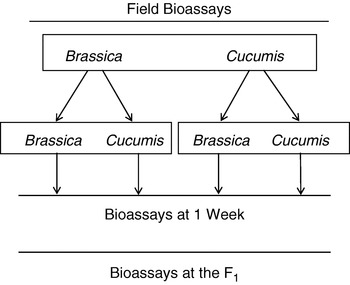
An opportunity arose in early spring 1996 on an organic farm in the Imperial Valley to collect whiteflies infesting cantaloupes and kale growing simultaneously and without exposure to synthetic organic insecticides. An additional advantage was the early time of year (April) before immigration pressure between fields or crops had increased, thus limiting potential variability due to exposure to plant hosts other than the crops from which the whiteflies were collected. The cantaloupe and kale fields were separated by ca. 80 m of fallow land that further contributed to the isolation of whiteflies on the respective crops. Three vacuum collections of B. tabaci adults were made over three consecutive weeks from each crop and tested by yellow-sticky card bioassays on each collection day. After loading two sets of bioassay cards that included bifenthrin and bifenthrin+endosulfan treatments for each source of whiteflies, the remaining adults were divided into two groups for each source and released onto either cantaloupe or broccoli plants confined within separate whitefly colony cages (35×35×85 cm) in a greenhouse. The released whiteflies were left to feed undisturbed for one week, after which adults within each of the two colonies from each field source (fig. 1) were used in a bioassay and tested with the same two treatments. Following completion of the one week bioassay, all remaining adults within the colonies were eliminated by removing the colony cages from the greenhouse and releasing the adults. Plants with developing immature whiteflies were placed back into their respective colony cages until adults emerged, at which time a third set of bioassays was conducted on the F1 adults. This entire process was carried out three times, beginning with the field collections of B. tabaci adults from kale and cantaloupes and continuing through to the F1 generation on broccoli or cantaloupes.
Diagram of the reciprocal transfer experiment as it progressed from bioassays of field-collected whiteflies to bioassays one week later and at the F1 generation after establishment in greenhouse cultures.

Data analyses
Mortality data for each insecticide treatment and field collection in the resistance monitoring study were subjected to probit analysis using POLO PC (Russell et al., Reference Russell, Robertson and Savin1987). The LC50s generated from each test were screened to meet a g-statistic (index of significance for potency estimation) criterion set at <0.5 (Robertson & Priesler, Reference Robertson and Priesler1991). The respective sets of screened LC50s, grouped by crops from which whiteflies had been collected, were tested in a one-way analysis of variance to determine the effect of crop on susceptibility to the various insecticide treatments. Although B. tabaci populations were collected sequentially through time, there was no pattern of repetition that might warrant repeated measures ANOVA. A Tukey's HSD mean separation test was conducted post-hoc. LC50s were log transformed to homogenize variance prior to conducting ANOVAs. The nonparametric Kruskal-Wallis test was used if treatment variances were unequal and Dunn's method was used in the multiple comparison procedure. Additional descriptive statistics and scatter plots were used to reveal differences among LC50s according to B. tabaci source crop.
For the reciprocal transfer test, LC50s produced for individual replicates were compared for each treatment by examining for non-overlap in 95% confidence intervals (C.I.s). Since there were no instances of non-overlap, data from all three replicates for each plant and insecticide treatment were grouped to produce one composite LC50 and 95% C.I. per treatment. The same criterion of non-overlap of 95% C.I.s was then used to compare composite LC50s among plant treatments within each insecticide treatment, i.e. bifenthrin or bifenthrin+endosulfan.
Results
Vial bioassays
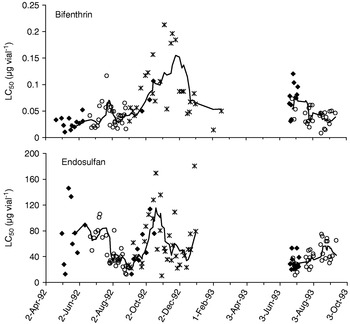
The responses of B. tabaci adults from diverse field sources produced dissimilar profiles in the bifenthrin and endosulfan vial bioassay (fig. 2). Bifenthrin exhibited much higher toxicity than endosulfan throughout the vial bioassay study. A general trend of decreasing susceptibility to bifenthrin from spring cantaloupes through summer cotton and autumn broccoli could be observed in 1992 (fig. 2). In contrast, susceptibility to endosulfan tended to increase through the summer cotton season, as evidenced by the declining LC50s, but then decreased steadily as monitoring shifted to Brassica spp. crops in late September through October. The highest LC50s for both bifenthrin and endosulfan were seen during the autumn when collections were made from broccoli or cauliflower crops. However, LC50s declined in late autumn and early winter even though whiteflies continued to be collected from Brassica spp. crops. Different trends in susceptibility to bifenthrin and endosulfan were evident again the following year as LC50s for bifenthrin declined from cantaloupes to cotton but increased for endosulfan (fig. 2).
Scatter plot of LC50s generated from whiteflies collected on cantaloupe, cotton or broccoli and tested by a vial bioassay. The solid line passing through the point scatter represents a moving average that uses five LC50s per increment (◆, Cucumis; ○, Gossypium;  , Brassica; —, M.A.).

Yellow-sticky card bioassays
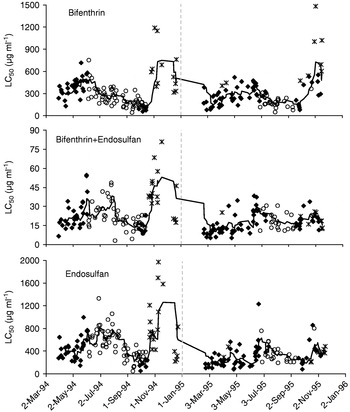
Bioassays of whiteflies with bifenthrin, endosulfan and a mixture of both compounds, using the yellow-sticky card method beginning in 1994, generated greater similarity in response profiles among the compounds (fig. 3) than observed previous years with the vial bioassays. The general trend in LC50s was consistent in each crop among all three treatments during 1994, as depicted by the moving averages. Beginning with spring cantaloupes, LC50s increased from early to late spring and then, in cotton, declined from early to late summer for all three treatments. The bifenthrin+endosulfan mixture varied in its cotton profile from the individual treatments but, nonetheless, maintained the overall trend towards increased susceptibility in late season cotton. A substantial increase in LC50s occurred for all three treatments as soon as whiteflies were collected from broccoli or cauliflower in 1994 (fig. 3). A trend towards higher LC50s continued through mid-November, but then declined in late December while B. tabaci collections were still being made in Brassica spp. crops. When monitoring resumed again in spring cantaloupes in 1995, lower LC50s overall were observed for all three bioassay treatments. This pattern remained true in summer cotton and autumn Brassica spp. crops with the exception of the bifenthrin bioassays in which susceptibility of whiteflies collected from broccoli again decreased markedly (fig. 3).
Scatter plot of LC50s generated from whiteflies collected on cantaloupe (Cucumis melo), cotton (Gossypium hirsutum) or broccoli (Brassica oleracea) and tested by three different insecticide treatments in a yellow-sticky card bioassay. The solid line passing through the point scatter represents a moving average that uses five LC50s per increment (◆, Cucumis; ○ Gossypium; , Brassica; —, moving average).

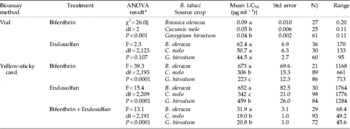
A comparison of mean LC50s by crop and bioassay method revealed that the significantly highest LC50s for bifenthrin were generated from whiteflies collected in broccoli for both the vial bioassay (χ2=26.0, P<0.001) and yellow-sticky card bioassay (F2,193=39.3, P<0.0001; table 1). Whiteflies from broccoli also generated the significantly highest LC50s for endosulfan (F2,209=15.4, P<0.0001) and bifenthrin+endosulfan (F2,191=13.1, P<0.0001) treatments on yellow-sticky cards. Significant differences also occurred in the yellow-sticky card bioassay in terms of whether cantaloupe or cotton, respectively, generated the second highest LC50s for the bifenthrin and endosulfan treatments, whereas no significant differences were seen in whiteflies from these two crops in the bifenthrin+endosulfan treatment (table 1). The endosulfan treatment in the vial bioassays produced no significant effects according to crop although the highest mean LC50 was observed for whiteflies collected from broccoli.
Comparison of mean LC50s and other descriptive statistics for crops within treatment groups and according to bioassay method. A one-way analysis of variance (ANOVA) tested the null hypothesis that no differences in LC50s due to whitefly source crop occurred.

* One-way ANOVA conducted if treatment variances were homogeneous according to O'Brien[.5] test.
§ Nonparametric Kruskal-Wallis test performed.
† Units for vial bioassay were μg×vial−1 of technical insecticide. Number followed by different letter within treatment group indicates significant difference (P<0.001).
‡ Number of bioassays performed for each treatment within bioassay method.
Reciprocal transfer experiment
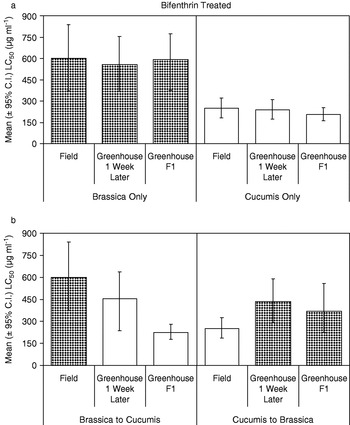
The mean LC50 to bifenthrin for whiteflies field-collected over three consecutive weeks from the organically grown kale was 596−225 (lower 95% C.I.) μg ml−1 compared to a mean LC50 of 250+72 (upper 95% C.I.) μg ml−1 collected on the same dates from the organically grown cantaloupes. These respective LC50s remained quite stable after culturing in the greenhouse for one week on broccoli or cantaloupes without host transferring, as well as for rearing the F1 generation (fig. 4a). For the field-collected whiteflies from kale that were transferred to cantaloupes in the greenhouse, the mean LC50 to bifenthrin dropped after one week (454+180 μg ml−1) and declined significantly more (based on non-overlap of 95% C.I.s) for the F1 (224+54 μg ml−1) compared to the mean LC50 of the parental whiteflies collected on kale (fig. 4b). In contrast, the mean LC50 increased for whiteflies which were field-originated on cantaloupes before being transferred to broccoli in the greenhouse. After one week on broccoli, the mean LC50 was 430 (−140) μg ml−1 compared to the field LC50 of 250 (+72) μg ml−1. For the F1, a slight decrease occurred in the mean LC50 (365−145) μg ml−1 relative to the one week LC50.
Mean LC50s (±95% C.I.) to bifenthrin for whiteflies field-collected from either kale (Brassica oleracea) or cantaloupe (Cucumis melo) and (a) sustained on the same host genera in the greenhouse for follow-up tests at one week and at the F1, or (b) transferred from the field host to the opposite host in the greenhouse culture and tested at one-week and at the F1 ( , Brassica source; □, Cucumis source).

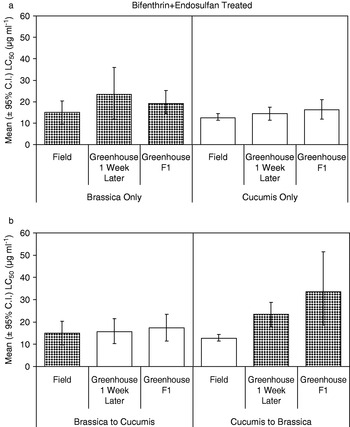
The same groups of whiteflies from the field or greenhouse subjected to bifenthrin bioassays also were tested with the bifenthrin+endosulfan mixture in yellow-sticky card bioassays. There were no significant differences in LC50s for whiteflies originating from either crop in the field or when they remained on the same hosts in the greenhouse (fig. 5a). The same was true for those whiteflies that originated on kale in the field but were transferred to cantaloupes in the greenhouse (fig. 5b). However, a significantly greater LC50 occurred for the one-week (23.4−5.4 μg ml−1) and F1 (33.6−15 μg ml−1) whiteflies on broccoli compared to the cantaloupe-originated whiteflies (12.6+1.8 μg ml−1).
Mean LC50s (±95% C.I.) to bifenthrin+endosulfan for whiteflies field-collected from either kale (Brassica oleracea) or cantaloupe (Cucumis melo) and (a) sustained on the same host genera in the greenhouse for follow-up tests at one week and at the F1, or (b) transferred from the field host to the opposite host in the greenhouse culture and tested at one-week and at the F1 (, Brassica source; □, Cucumis source).

Discussion
The intensity and duration of the resistance monitoring program for B. tabaci in the Imperial Valley provided a unique opportunity to observe seasonal variation in insecticide susceptibility. Monitoring programs carried out for other pest species have focused primarily on susceptibility in a single crop, often in cotton due to traditionally heavy reliance upon chemical control for managing cotton pests (Dennehy & Granett, Reference Dennehy and Granett1984; Forrester et al., Reference Forrester, Cahill, Bird and Layland1993; Kanga et al., Reference Kanga, Plapp, Wall, Karner, Huffman, Fuchs, Elzen and Martinez-Carrillo1995). The outbreak conditions in the Imperial Valley that persisted through the mid-1990s enabled collection of B. tabaci populations from three principal crops that altogether spanned the calendar year. Distinctive trends emerged from the scatter plots of LC50s by virtue of the large number of test results from one crop season to the next over multiple years. The most consistent pattern was the changeable susceptibility of whiteflies according to host crop from which they were collected. Both the vial and yellow-sticky card bioassays showed that B. tabaci collected on broccoli or cauliflower crops were significantly less susceptible to bifenthrin than when cantaloupe or cotton served as the source crop. The results produced by the yellow-sticky card bioassay also showed that whiteflies originating from Brassica spp. crops had significantly lower susceptibility to endosulfan and the mixture of bifenthrin+endosulfan. The endosulfan treatment in the vial bioassay was the only treatment that did not produce significant differences among the three crop hosts even though whiteflies collected from Brassica spp. crops had the highest mean LC50s. In the yellow-sticky card bioassay, profiles of LC50s for bifenthrin, endosulfan and the mixture of both were especially similar to one another. The rise and fall in susceptibilities to insecticides within and between crop seasons occurred relatively synchronously for all three bioassay treatments.
Changes in susceptibility within a crop season were especially apparent for whiteflies collected from Brassica spp. crops. The possibility that the higher LC50s observed early season in the Brassica spp. crops resulted from the intensive use of insecticides in the previous cotton crop cannot be ruled out. However, some indication of higher resistance in whiteflies collected from cotton at the end of the season should have been apparent if the cotton-selection scenario is correct, but in fact no such increase was observed. Similarly, the possibility that the decline in LC50s late in the Brassica spp. crop season was due to relaxed selection pressure from less insecticide use in the autumn vegetable crops also cannot be dismissed. An alternative consideration, however, is that the principle means of sampling B. tabaci adults changed late in the autumn as infestations decreased. Instead of collecting adults directly onto yellow-sticky cards in the field, the battery-operated vacuum device was often run for minutes on end before sufficient numbers could be collected. The strong force of the vacuum over a prolonged period may have weakened whitefly adults and increased their susceptibility to insecticides.
The general agreement between the two bioassays with respect to the tolerance patterns observed according to crop type is further supported by monitoring results obtained elsewhere. A similar vial monitoring program conducted in Texas, Florida and Georgia found the highest LC50s to bifenthrin were generated from B. tabaci adults collected on cabbage (Wolfenbarger et al., Reference Wolfenbarger, Riley, Staetz, Leibee, Herzog and Gage1998). Populations of B. tabaci sampled from various crops in Arizona and tested by vial bioassay also proved most tolerant to bifenthrin and other treatments when they were collected from broccoli (Sivasupramaniam et al., Reference Sivasupramaniam, Johnson, Watson, Osman and Jassim1997). The consistency among all of these results provides strong support for the idea that host plants influence B. tabaci susceptibility to insecticides. One additional study measured a 7.5-fold increase in resistance to bifenthrin in a bifenthrin-resistant strain of whitefly when reared on squash compared to the same strain reared on cotton or cabbage (Riley & Tan, Reference Riley and Tan2003). The absence of significant differences in bioassay results between whiteflies on cotton or cabbage, in this study, may be related to the fact that these were colony reared whiteflies that had been confined for more than two years, as opposed to the field-collected whiteflies tested in each of the monitoring studies.
Although variation in susceptibility to the three bioassay treatments was most readily associated with host crop, other variables, such as insecticide use patterns and seasonal temperature differences, had to be considered while assessing the resistance monitoring data. Spray applications of pyrethroids and endosulfan were most numerous in cotton during 1994–95 relative to cantaloupe or broccoli (http://www.ipm.ucdavis.edu/PUSE/2000/im00-sp.01.html), yet susceptibility levels to bifenthrin and endosulfan actually decreased during the cotton season each year. This suggests a minimal role for resistance in determining the patterns of variability observed in the resistance monitoring data. Different modes of action for bifenthrin and endosulfan would require two different mechanisms or complete cross-resistance to be present in Imperial Valley populations to produce the similar profiles. However, few examples of cross-resistance between bifenthrin and endosulfan exist (Forrester et al., Reference Forrester, Cahill, Bird and Layland1993).
Given the heavy immigration pressure into cotton fields from alfalfa and other unsprayed sources throughout the summer months, it is unsurprising that resistance levels did not track upwards by the end of the cotton season even though multiple generations of whiteflies in cotton alone would have been exposed to insecticide treatments. Numerous theoretical models (Comins, Reference Comins1977; Georghiou & Taylor, Reference Georghiou and Taylor1977; Taylor & Georghiou, Reference Taylor and Georghiou1979) have described the importance of susceptible genotypes maintained in unsprayed refugia mating with resistant individuals to slow the increase of resistance (R) allele frequencies (Tabashnik, Reference Tabashnik, Roush and Tabashnik1990). In the case of B. tabaci collected from cotton in the Imperial Valley, the decline in LC50s from June through September suggests that R allele frequencies actually decreased, or that some other mechanism was involved to account for the increasing susceptibilities observed each year in cotton. While high immigration rates of susceptible genotypes could have contributed to declining LC50s, environmental stress may also have been a contributing factor. The dispersal of adult whiteflies across fallow fields with little or no nourishment would likely reduce tolerance to insecticides. Samples of whiteflies for bioassay testing were often taken at the edge of cotton fields where immigrant whiteflies and other insects first settle. As the summer progressed, the quality of cotton as a nutritional host almost certainly declined as plants invested more resources into flowers and bolls instead of leaves. In addition, increasing whitefly densities through summer would likely cause deteriorating host quality. A combination of these factors, including the aforementioned extreme temperatures, could all have contributed to the trend of increasing susceptibilities in whiteflies collected from cotton.
Whereas interpretation of the resistance monitoring data was complicated by the crop and time of year that whiteflies were collected, the reciprocal transfer experiment was performed synchronously on whiteflies collected from kale and cantaloupes growing on the same organic farm. Thus, variable environmental influences associated with season were minimized along with potential differences in immediate exposure history to pesticides, leaving only source crop of the whiteflies as the controlling variable. The difference between bioassay responses of whiteflies collected in the field from kale or cantaloupe to bifenthrin was approximately the same magnitude of difference seen in mean LC50s for whiteflies on Brassica spp. crops or cantaloupes in the monitoring data. After establishing field-collected whiteflies on the same generic hosts in the greenhouse, the magnitude of difference between broccoli and cantaloupe remained constant when tested one week later and again at the F1 generation. However, those whiteflies from the field transferred to opposite hosts in the greenhouse showed movement in their LC50s at one week and at the F1. The direction of movement was predictable based on the monitoring data with LC50s from field-source kale whiteflies decreasing on cantaloupes in the greenhouse and LC50s from field-source cantaloupe increasing on broccoli. The bioassays conducted with the bifenthrin+endosulfan-treated yellow-sticky cards were less definitive in outcomes. The field-source kale whiteflies showed higher LC50s in the field and when kept on the same generic host in the greenhouse compared to those on cantaloupe, but not significantly so. However, LC50s of field-source cantaloupe whiteflies increased significantly by the F1 generation after being transferred to broccoli in the greenhouse.
There are numerous examples of phytophagous insects that show greater tolerance to specific insecticides according to feeding host (Yu et al., Reference Yu, Berry and Terriere1979; Siegfried & Mullin, Reference Siegfried and Mullin1989; Robertson et al., Reference Robertson, Armstrong, Suckling and Priesler1994) or through consumption of plant allelochemicals incorporated into artificial diet (Muehleisen et al., Reference Muehleisen, Benedict, Plapp and Carino1989; Hunter et al., Reference Hunter, Biddinger, Carlini, McPheron and Hull1994). In the case of B. tabaci in the present study and other insects in previous studies (Abd-Elghafar et al., Reference Abd-Elghafar, Dauterman and Hodgson1989; Muehleisen et al., Reference Muehleisen, Benedict, Plapp and Carino1989), tolerance changes may produce significant increases in LC50s to particular insecticides through putative allelochemical induction of detoxifying enzymes within the insect (Terriere, Reference Terriere1984; Brattsten, Reference Brattsten1988). Glucosinolates are the dominant class of secondary compounds in the Brassicaceae that serve in a defensive role against herbivores (Lankau, Reference Lankau2007; Velasco et al., Reference Velasco, Cartea, González, Vilar and Ordás2007). Previous work has shown induction of much higher titers of glutathione S-transferases in the fall armyworm fed on mustard compared to other non-cruciferous plants (Yu, Reference Yu1982, Reference Yu1983). Although our study did not determine changes in enzyme changes in whiteflies collected from cotton, cantaloupe or Brassica spp. crops, our results indicate that host plant may have strongly affected the relationship between whiteflies and insecticides. Further investigation will explore potential biochemical changes in B. tabaci resulting from dietary exposure to glucosinolate compounds incorporated in diet sachets and in Brassica spp. plants known to vary in concentrations of glucosinolates (Velasco et al., Reference Velasco, Cartea, González, Vilar and Ordás2007). Recent work by Liang et al. (Reference Liang, Cui, Yang and Gao2007) demonstrated the role of four species of host plants on carboxylesterase activity in B. tabaci and its susceptibility to insecticides. In the meantime, resistance monitoring programs need to be aware of potentially significant variation in susceptibility to insecticides due to host plant effects. The magnitude of differences between crops could be even larger for a single discriminating dose in comparison to the relatively insensitive LC50 (Roush, Reference Roush1989).
Acknowledgements
We express our gratitude to J.L. Blackmer, J.C. Palumbo and two anonymous reviewers for helpful comments on the manuscript and to the Imperial County Agricultural Commissioner's Office for their assistance and cooperation.