Introduction
The diagnosis of mania in the geriatric patient population is uncommon (van Gerpen et al., Reference van Gerpen1999) and little published data exist on late-life manic episodes (Beneditti et al., Reference Beneditti2008). There has been considerable controversy surrounding the symptomatology of mania or bipolar disorder, manic type, in the geriatric population. Traditionally, geriatric mania has been considered to have a more atypical presentation, with increased confusion, paranoia, agitation, dysphoria or irritability, and negativity (George, Reference George, Busse and Blazer1996).
Given that older manic patients tend to reside in the community, more research needs to be conducted on outpatients by addressing their clinical profile. Hence, the present study focuses on an outpatient-based sample of older adults diagnosed with manic episode and comparing them to a sample with unipolar depression. A priori hypotheses based on earlier studies (Shulman and Post, Reference Shulman and Post1980; Shulman et al., Reference Shulman1992) were that, in comparison with depression in old age, mania: (i) is a severe form of affective disorder with respect to psychotic and cognitive functions; and (ii) has more preponderance to neurological disorders and substance use disorders.
Methods
The work reported in this paper was conducted at a geriatric clinic which is a specialty outpatient clinic run by the Department of Psychiatry at a tertiary centre, the National Institute of Mental Health and Neurosciences (NIMHANS) in Bangalore, India. This specialty clinic has comprehensive responsibility for a geographically defined catchment area comprising both urban and rural areas of four adjoining southern states of India (Karnataka, Andhra Pradesh, Tamil Nadu and Kerala). NIMHANS being a tertiary-care referral center, also receives patients referred from other adjacent and nearby states of Maharashtra, Orissa, and even more distant states such as West Bengal and those in the north-east region.
The study sample includes all patients (n = 522) attending the geriatric clinic in the period 1999–2005. Patients for mania who met ICD-10 (World Health Organization, 1992) criteria for manic episode with or without bipolar affective disorder (denoted as the mania group) were included. The cases of “secondary mania” were excluded from chart analysis. The study sample was compared with patients with an ICD-10 diagnosis of depressive disorders (denoted as the depression group) using the same data. To select a homogenous group of depressive patients, patients suffering from bipolar depression at index episode were excluded. Subjects with medical problems or cerebrovascular disorders were not excluded in either group.
In all patients, diagnoses were made using a detailed face-to-face semi-structured clinical interview (Pro forma adapted from “Psychiatric Report and medical record”) (Sadock, Reference Sadock, Sadock and Sadock2000) by resident doctors in psychiatry and confirmed by consultant psychiatrists utilizing ICD-10 criteria (World Health Organization, 1992) as the standard practice of care in the geriatric clinic at NIMHANS.
The bulk of this study focused on a detailed reading of individual case files of patients from the clinic's database. Patients were identified via a search of the medical records. All patients who met ICD-10 criteria for manic episode or depressive disorders were identified and evaluated for inclusion. To achieve consistency in applying the inclusion and exclusion criteria, a single person (OP) reviewed all charts and compiled data regarding demographic profiles, clinical presentation, family history of affective disorder, treatment history, and previous psychiatric and neurological history. The chart reviewer (OP) was not blind to both groups.
The data were suitably coded and extracted on a SPSS 10.0 spreadsheet (SPSS Inc., 1999). One-way analysis of variance was used to compare differences between groups on dimensional measures. For categorical variables, the Pearson χ2 test was used. Statistical significance was noted at p < 0.05.
Results
Thirty elderly people with a manic episode were identified from the overall sample of 522 geriatric clinic attendees. Prevalence of mania among this clinic-based sample was approximately 5.74%. Of these, 23 (77%) were men and seven (23) were women. The mean age of patients from the mania group at index visit was 68.5years (SD = 5.75, range 60–80). Ninety-two patients (47 men and 45 women) satisfied the criteria for depressive disorders and their mean age at index visit was 68.18 years (SD = 6.0, range 60–88).
At least half of the sample (both mania and depression groups) had no formal education. Most of the patients from both groups were from low income (less than US$50 per month) and middle income (US$50–100 per month) groups. All except two patients (from the depression group) were married. Only 4.1% were separated or divorced, and 28.7% were widowed. None of the patients from either group was living in an institutional settings (nursing home, board-and-care, or rented room). The majority (60.7%) were living within their immediate nuclear family (spouse and/or children). Six patients (6.97%) from the depression group were living alone. All patients from the mania group were staying with relatives.
All patients were in a diagnosable episode when the assessment was made. In the mania group, nine patients satisfied criteria for unipolar manic episode at the index visit. The depression group also included dysthymia disorder (n = 15).
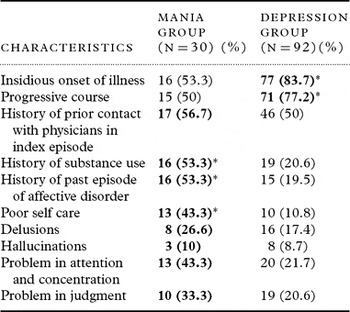
Patients from depression group had significantly (DF = 1, p < .001) more insidious onset of the illness as compared to patients with mania group. In addition, they had more progressive course of illness than the other group (Table 1).
Clinical profile of elderly patients with mania and unipolar depression

* Significant < 0.05.
At least two-thirds of the sample (mania 66.6%; depression 64.1%) had co-morbidity of medical illnesses, primarily hypertension, diabetes mellitus and cardiac illness. Eleven patients (36.7%) from the mania group and 38 (41.3%) from the depression group had two or more diagnosable medical conditions.
At least half of the manic patients had a positive history of affective disorder in the past (p < 0.05), compared with one-fifth of the depressed patients. Among them, 12 patients (13.1%) from the depression group had a history of neurotic disorders. While exploring the history of substance use, subjects were found to be dependent mainly on nicotine (11 and 13 patients from the mania and depression groups respectively) and alcohol (5 and 6 patients from the mania and depression groups respectively) (Table 1). Seven (23.3%) of the mania patients compared with 19 (20.6%) of the depressed patients had a positive family history affective disorder in a first-degreerelative.
Half of the patients with manic episode had psychotic symptoms while only 33 (35.8%) of depressed patients had psychotic symptoms (Table 1). In the mania group, two (6.6%) had formal thought disorder, while in the depression group, eight (8.7%) had “preoccupations” and three (3.2%) had problems with their stream of thinking.
On cognitive functions, patients with manic episode scored poorly relative to those with depression (Table 1). Three (10%) patients from the mania group as against seven (7.6%) from the depression group had problems with orientation and intelligence. The same patients from this group also had abnormal computed tomography (CT) findings (patient 1: infarcts in corona radiata and basal ganglia regions; patient 2: calcified lesions in frontal region; and patient 3: multiple lacunar infarcts) suggestive of neurological disorders. Overall, manic patients did not perform well on cognitive functions but interestingly, their scores on HMSE (the Hindi adaptation of MMSE) (Ganguli et al., Reference Ganguli1995) seem to be close to those of the depressed patients (depressed subjects’ scores: 22.54, SD = 10.50, SE = 1.39; manic patients: 21.10, SD = 9.39, SE = 2.05).
Mood stabilizers (lithium, valproate and carbamazepine in order of preference) were started in less than one-third of the patients from the mania group at index visit. More than half (n = 16; 53.3%) of the patients in the mania group were prescribed antipsychotic medications, primarily risperidone, olanzapine and haloperidol. Only about a quarter (n = 25; 27.2%) of the patients in the depressed group were prescribed antipsychotics. Among those in the depression group at index visit, all were prescribed antidepressants, primarily sertraline and fluoxetine.
Discussion
As far as we are aware, no other published or accessible research work has emanated from developing countries that attempts to explore mania in the elderly, though data for other psychiatric disorders exist (Nakasujja et al., Reference Nakasujja2007; Prakash et al., Reference Prakash2007).
The sample was drawn from a clinic-based population in tertiary care setting where patients are often referred from other treatment agencies after initial failure. Nevertheless, this sample of patients confers the maximum burden on themselves, their family and society, and often poses the greatest challenge to the treating physician. Thus, it may be argued that such a patient profile is actually most relevant to the study of mania in the elderly.
As expected, a greater proportion of elderly patients with manic episode reported severe psychopathology in the form of delusions, hallucinations and cognitive symptoms compared to elderly patients with depressive disorders, so supporting the hypothesis that mania is a severe form of affective disorder in the geriatric population.
The finding of neurological disorders in 10% of manic patients is in agreement with study by Shulman et al. (Reference Shulman1992) who identified 12% of manic patients having such disorders. The high rate (53.3%) of substance abuse co-occurrence in the manic elderly in our sample favors the hypothesis in comparison to the elderly depressives.
High medical co-morbidity in two-thirds of our sample reinforces the findings from previous studies (Charney et al., Reference Charney2003; Gildengers et al., Reference Gildengers2008). Only 23.3% of bipolar patients in our sample reported a family history of affective disorder, which appears to be lower than found in Western studies (Depp and Jeste, Reference Depp and Jeste2004) on bipolar disorders. This could be explained by low life expectancy at birth on the Indian subcontinent. Rates of a family history of affective disorder may be higher in Western studies because older probands are more likely to have a greater number of older first-degree relatives (including siblings and children), who subsequently have longer periods of exposure to the genetic and environmental influences that predispose people to psychiatric disorders. The other possible reason for low rates of such a family history in our sample lies in a limited exposure to mental health care in previous generations or perhaps under-recognition and/or under-diagnosis (Prakash et al., Reference Prakash2007).
The results of the study have shown that these individuals in the sample have significant stability within their family and community supports which allows them to remain outside institutional settings despite their chronic or recurring affective and psychotic symptoms. This finding also emphasizes the strength of the Indian family system in which the elderly are taken care of despite all adversities.
The current study will help in understanding more about the symptomatology of mania in the elderly. This study's primary limitations were its sample size and its retrospective chart design. In addition, this study did not include inpatients and institutionalized individuals. Compared to participants in many hospital-based studies, the participants in this study were impoverished and had less formal education.
Taken together, these findings provide confirmatory evidence that mania in old age continues to be a significant mental health problem in the latter half of life characterized by severe psychopathology. Future studies of mania in the elderly should focus on its distinct nature compared with depression.
Conflict of interest
None.
Description of authors’ roles
O. Prakash designed the study, supervised the data collection and wrote the paper. C. Naveen Kumar collected the data and assisted with writing the paper. P. T. Shivakumar provided patients for the sample and assisted in the data collection. S. Bharath and M. Varghese provided patients for the sample, assisted with the preparation and proof-reading of the manuscript, and were responsible for the statistical design of the study and for carrying out the statistical analysis.
Acknowledgment
Dr Om Prakash received a GSK Junior Investigator Travel Fellowship grant to present part of this paper at the Third Biennial Conference of the International Society for Bipolar Disorders on 28 January 2008 in New Delhi (India).