Non-technical Summary
Glypheid lobsters are a group of decapod crustaceans that have had a fascinating history since their appearance in the earliest Jurassic. They were cosmopolitan during the Mesozoic, known mainly from sublittoral marine environments worldwide. During the Cenozoic, they are recorded only from cold-water habitats and high latitudes of both hemispheres. They were thought to have become extinct 50 million years ago. Then in the 1970s a living species was found in a deep Pacific Ocean waters refuge. This history is discussed on the basis of all known fossil records. As an appendix, new data are added to the knowledge of the only Jurassic South American glypheid lobster, from Toarcian deposits of the Andes in western Argentina.
Introduction
This is an homage contribution to Rodney Feldmann, in recognition of his lifelong research career, leading multiple studies of fossil decapod crustaceans worldwide, particularly from Mesozoic and Cenozoic deposits of the Southern Hemisphere. The aims of this paper are threefold: (1) to redescribe in detail the morphology of a little-known Early Jurassic species from west-central Argentina to help elucidate its somewhat controversial generic allocation, (2) to expand and interpret a number of interesting taphonomic features concerning its peculiar condition(s) of occurrence, and (3) to outline a meaningful synthesis about the stratigraphic and geographic distribution of the family Glypheidae Winkler, Reference Winkler1881 on the basis of currently known records of such a fascinating group.
Among decapod crustaceans, glypheoid lobsters were especially abundant during the Mesozoic, when they were particularly diversified in sublittoral environments of tropical and subtropical regions. They later migrated to high latitudes and cold waters with poor fossil records, and today only two species, which were regarded as “living fossils” (Forest, Reference Forest1976; Forest et al., Reference Forest, de Saint-Laurent and Chace1976; Bruce, Reference Bruce1988), are dwelling in the depths of the Pacific Ocean.
The paleobiogeography of decapod crustaceans was the subject of many contributions that mention different aspects of the Glypheoidea distribution in space and time. Those from the Cretaceous and Tertiary from South America were treated by Feldmann and Chirino-Gálvez (Reference Feldmann and Chirino-Gálvez1994) and Feldmann et al. (Reference Feldmann, Aguirre-Urreta, Chirino-Gálvez, Casadío and Ricci1997), while Schweitzer (Reference Schweitzer2001) dealt with those from the North Pacific, and Feldmann and Schweitzer (Reference Feldmann and Schweitzer2006) made a comprehensive analysis of decapods from the Triassic to Recent from the Southern Hemisphere. In this context, it is interesting to focus on individual groups to analyze their worldwide distribution through time. The recent systematic revision by Charbonnier et al. (Reference Charbonnier, Garassino, Schweigert and Simpson2013) of every fossil and extant species of glypheid lobsters, the revised section of the Treatise on Invertebrate Paleontology (Feldmann et al., Reference Feldmann, Schweitzer and Karasawa2015), and the phylogenetic analyses performed on glypheoidean lobsters and their relatives (Amati et al., Reference Amati, Feldmann and Zonneveld2004; Karasawa et al., Reference Karasawa, Schweitzer and Feldmann2013; Charbonnier et al., Reference Charbonnier, Audo, Barriel, Garassino, Schweigert and Simpson2015), have established a good framework for the study of this group. We will assess herein the available knowledge on the global stratigraphic and geographic distribution of the Jurassic to Recent records of Glypheidae sensu stricto at the species level.
Fossil Decapoda are very rare in Early Jurassic beds of South America (see review in Pagani et al., Reference Pagani, Damborenea, Manceñido and Ferrari2011, p. 144). Although Early Jurassic deposits of western Argentina have been extensively surveyed, records are few, and only two Toarcian Glypheoidea species have been adequately described so far: a Glypheidae from Mendoza (Damborenea and Manceñido, Reference Damborenea and Manceñido1987) and a Mecochiridae from Chubut (Mecochirus robbianoi Pagani et al., Reference Pagani, Damborenea, Manceñido and Ferrari2011). In this context, we will provide here new evidence about Paraglyphea eureka (Damborenea and Manceñido, Reference Damborenea and Manceñido1987), the only Jurassic South American Glypheidae species known so far, and discuss its significance.
Stratigraphy and paleobiogeography of Glypheidae
As in other Decapoda, the Glypheidae fossil record is scanty and highly dependent on taphonomy, such as the presence of particular preservation conditions (Förster, Reference Förster1985), and on the survey intensity of each region. Not surprisingly, the record is relatively well known in Europe and only rare elsewhere in the world.
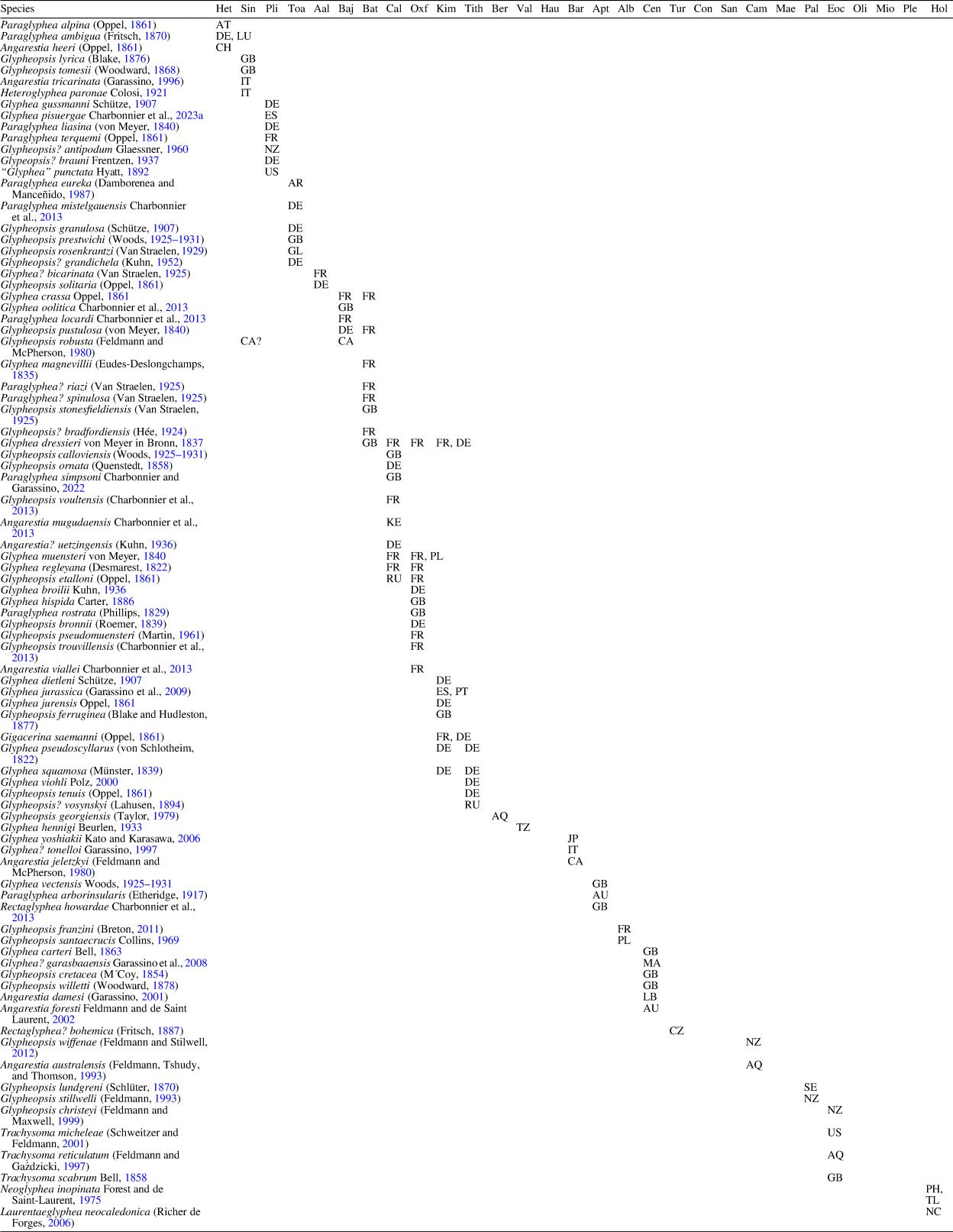
While the stratigraphic ranges and geographic distribution of fossil Glypheoidea were generally discussed (Feldmann and Schweitzer, Reference Feldmann and Schweitzer2006), there is no detailed global analysis for the Glypheidae sensu stricto. For our analysis, occurrence data for known species referred to the family Glypheidae were compiled from updated references, and simple diagrams of species diversity per stage and three maps (for Jurassic, Cretaceous, and Cenozoic times) were produced. Herein we follow the thorough synthesis and criteria by Charbonnier et al. (Reference Charbonnier, Garassino, Schweigert and Simpson2013), who comprehensively discussed the various diagnoses proposed by previous authors for the Glypheidae and reviewed each of the species in detail. We added for this analysis a few more recent records (such as those in Garassino et al., Reference Garassino, Charbonnier, Nyborg and Fam2019; Charbonnier and Garassino, Reference Charbonnier and Garassino2022; Charbonnier et al., Reference Charbonnier, Garassino and López-Horgue2023a, Reference Charbonnier, Garassino, Gendry, Devillez and Picotb, Chény et al., Reference Chény, Charbonnier and Audo2023, Dadykin and Shmakov, Reference Dadykin and Shmakov2023). The occurrence data for known species referred to Glypheidae are listed in Table 1 and shown on Figure 1. The table shows that just a few of the 86 species are known from more than one region or stage; in fact, most of the records are based on merely a few specimens. Nevertheless, as pointed out by Feldmann (Reference Feldmann1981), even considering the already mentioned flaws of the record, the high degree of species endemism observed in many fossil decapods is consistent with modern distribution patterns.
Distribution of Glypheidae species in space and time. Data from Charbonnier et al., Reference Charbonnier, Garassino, Schweigert and Simpson2013, Reference Charbonnier, Garassino and López-Horgue2023a, Reference Charbonnier, Garassino, Gendry, Devillez and Picotb; Garassino et al., Reference Garassino, Charbonnier, Nyborg and Fam2019; Charbonnier and Garassino, Reference Charbonnier and Garassino2022; Chény et al., Reference Chény, Charbonnier and Audo2023; Dadykin and Shmakov, Reference Dadykin and Shmakov2023. Species listed in stratigraphical order, reference of species to genera according to Charbonnier et al., Reference Charbonnier, Garassino, Schweigert and Simpson2013. Time-interval abbreviations (column heads): Het = Hettangian; Sin = Sinemurian; Pli = Pliensbachian; Toa = Toarcian; Aal = Aalenian; Baj = Bajocian; Bat = Bathonian; Cal = Callovian; Oxf = Oxfordian; Kim = Kimmeridgian; Tith = Tithonian; Ber = Berriasian; Val = Valanginian; Hau = Hauterivian; Bar = Barremian; Apt = Aptian; Alb = Albian; Cen = Cenomanian; Tur = Turonian; Con = Coniacian; San = Santonian; Cam = Campanian; Mae = Maastrichtian; Pal = Paleocene; Eoc = Eocene; Oli = Oligocene; Mio = Miocene; Ple = Pleistocene; Hol = Holocene. Location abbreviations (according to ISO 3166-1): AQ = Antarctica; AR = Argentina; AT = Austria; AU = Australia; CA = Canada; CH = Switzerland; CZ = Czech Republic; DE = Germany; ES = Spain; FR = France; GB = United Kingdom; GL = Greenland; IT = Italy; JP = Japan; KE = Kenya; LB = Lebanon; LU = Luxembourg; MA = Morocco; NC = New Caledonia; NZ = New Zealand; PH = Philippines; PL = Poland; PT = Portugal; RU = Russia; SE = Sweden; TL = Timor; TZ = Tanzania; US = United States of America.

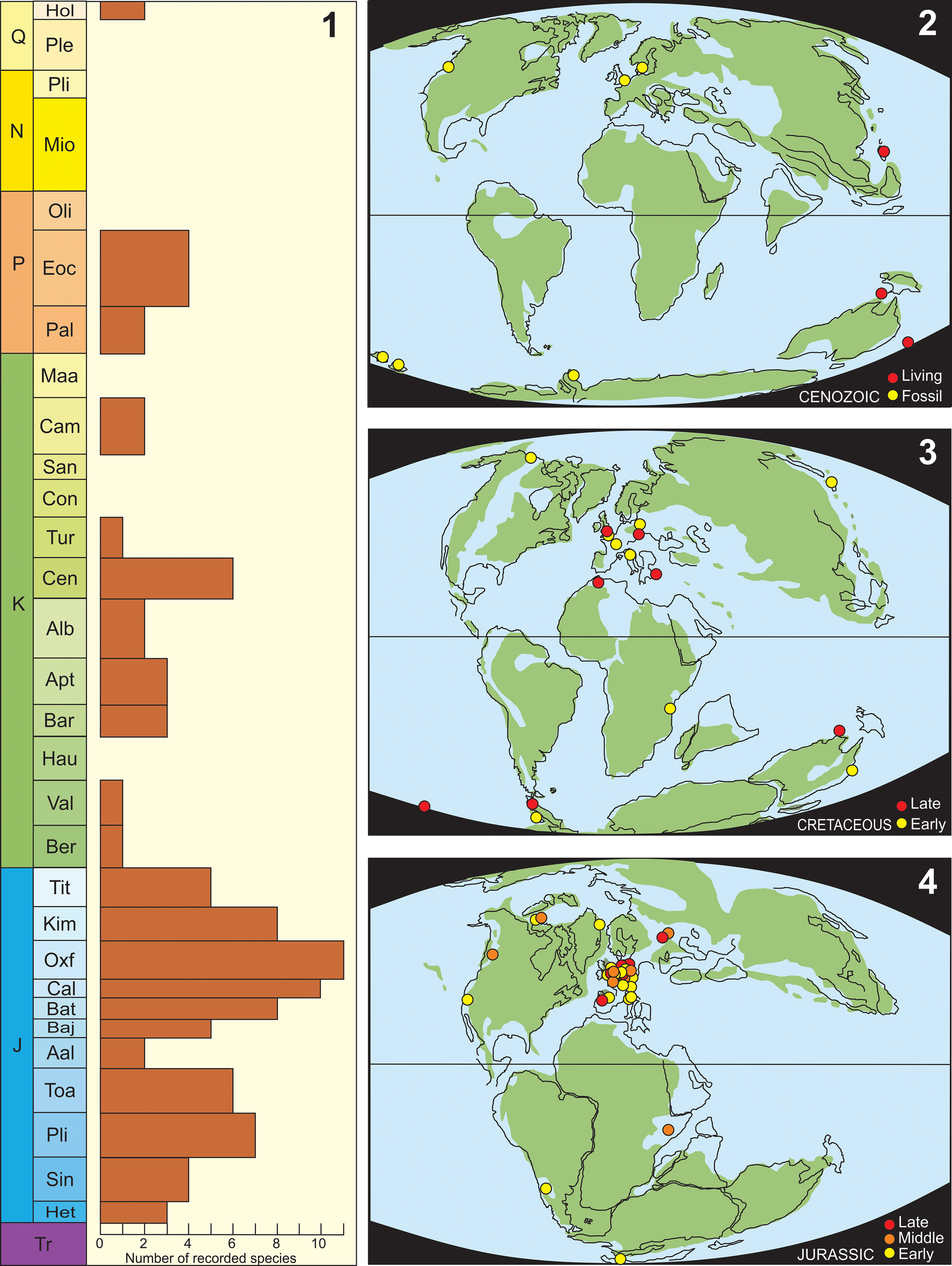
Synthesis of occurrences of Glypheidae species. (1) Stratigraphic distribution, bar diagram of number of species recorded per stage/series (see Table 1). (2) Paleogeographic distribution of Cenozoic species (base map sketched from Scotese, Reference Scotese2014a Eocene map). (3) Paleogeographic distribution of Cretaceous species (base map sketched from Scotese, Reference Scotese2014b Cenomanian map). (4) Paleogeographic distribution of Jurassic species (base map sketched from Scotese, Reference Scotese2014c Late Jurassic map).

At the genus level, there is no unified consensus among recent authors (e.g., Schweitzer et al., Reference Schweitzer, Feldmann, Garassino, Karasawa and Schweigert2010; Charbonnier et al., Reference Charbonnier, Garassino, Schweigert and Simpson2013; Feldmann et al., Reference Feldmann, Schweitzer and Karasawa2015) regarding the scope of each taxon and, consequently, about their geographic and stratigraphic ranges. We will perform the analysis at species level and will not delve into discussion of different generic concepts. Even considering the paucity of the records, from the overall picture it is possible to discern a few but significant patterns worthy of a brief discussion.
Discussion
Most authors agree that the origin of Glypheidae should be traced to the Triassic. Both Karasawa et al. (Reference Karasawa, Schweitzer and Feldmann2013) and Feldmann et al. (Reference Feldmann, Schweitzer and Karasawa2015, p. 10) mention the stratigraphic range of the family Glypheidae as Triassic (Norian) to Eocene, although they regard the Triassic genera as belonging to a different family (named by them Litogastroidae); in fact, none of the genera they include in the family extended back beyond the Hettangian. These authors also excluded the two extant genera from the family and placed them into Neoglypheidae Karasawa et al., Reference Karasawa, Schweitzer and Feldmann2013. This was specifically discussed by Charbonnier et al. (Reference Charbonnier, Garassino, Schweigert and Simpson2013, p. 32, Reference Charbonnier, Audo, Barriel, Garassino, Schweigert and Simpson2015), who maintained them in the Glypheidae sensu stricto, thus ranging from Early Jurassic to Recent according to this criterion.
By the earliest Jurassic (Hettangian), three species are known from around the margins of northern Tethys (central Europe: Austria, Germany, Luxembourg, and Switzerland). Charbonnier et al. (Reference Charbonnier, Garassino, Schweigert and Simpson2013) referred P. ambigua (von Fritsch, Reference von Fritsch1870) and P. alpina (Oppel, Reference Oppel1861) to Paraglyphea Beurlen, Reference Beurlen1928 and A. heeri (Oppel, Reference Oppel1861) to Angarestia Charbonnier et al., Reference Charbonnier, Garassino, Schweigert and Simpson2013. Only to exemplify the conflicting approaches at the genus level, it is enough to note that, alternatively, Schweitzer et al. (Reference Schweitzer, Feldmann, Garassino, Karasawa and Schweigert2010) included two of these species (P. alpina and A. heeri) in Trachysoma Bell, Reference Bell1858 and regarded Paraglyphea as subjective synonym of Glyphea von Meyer, Reference von Meyer1835.
The richness analysis at species level shows that the group diversified fast and spread widely during the Early Jurassic (Fig. 1.4). By Pliensbachian/Toarcian times, the Glypheidae already had a wide paleolatitudinal range, with records from Greenland in the north (Van Straelen, Reference Van Straelen1929) to New Zealand (Glaessner, Reference Glaessner1960) and western Argentina (Damborenea and Manceñido, Reference Damborenea and Manceñido1987) in the south (Table 1). Their diversity appears to have suffered a slight decline during late Toarcian–Aalenian, perhaps related to the early Toarcian biodiversity crisis linked to the Toarcian Oceanic Anoxic Event (TOAE), which affected benthic faunas (Hallam and Wignall, Reference Hallam and Wignall1997; Wignall et al., Reference Wignall, Newton and Little2005).
Glypheidae quickly recovered during the Middle Jurassic. Their highest species diversity occurred during the Callovian–Oxfordian, in coincidence with the species diversity peak recorded for Mesozoic lobster and shrimp species in general (Klompmaker et al., Reference Klompmaker, Schweitzer, Feldmann and Kowalewski2013, fig. 1A), and they thrived then in the northern Tethys (Fig. 1.1, 1.4). Some exceptionally rich faunas are known from Middle and Late Jurassic Lagerstätten in France, containing abundant and remarkably well-preserved material of several decapod species, including Glypheidae, and account in part for this high diversity. In Callovian limestones of Normandy, deposited in distal platform settings, at least three species of Glypheidae co-occur (Chény et al., Reference Chény, Charbonnier and Audo2023). The early Oxfordian relatively deep-water decapod fauna from Haute-Saône (Charbonnier et al., Reference Charbonnier, Pérès and Letenneur2012) is preserved in siliceous concretions. Again in Normandy, late Oxfordian carbonate and phosphate nodules contain abundant fauna, and the decapods were probably preserved in their burrows in subtidal mudflats (Charbonnier et al., Reference Charbonnier, Garassino, Gendry, Devillez and Picot2023b). In these cases, the exceptional preservation and abundance of specimens not only allow to perform detailed anatomical studies and quantitative analyses but also contribute to a precise knowledge of their different environmental settings.
From the paleobiogeographical perspective, the Glypheidae can be regarded as cosmopolitan during the Jurassic, considering that gaps in distribution most probably reflect the uneven degree of knowledge for the diverse regions.
The known fossil record shows that the group appears to have declined during the Early Cretaceous, followed by a slight diversification during the Late Cretaceous (Cenomanian), including again a very wide latitudinal and geographical range (Fig. 1.1, 1.3). It is also evident that their diversity in lower paleolatitudinal regions did not reach the level of the Jurassic.
From the available data, there is at this point of the group's history an indication that either a shift of or a subtle restriction in habitat was taking place, and it is interesting to note that from the latest Cretaceous on, fossil Glypheidae were not reported from low paleolatitudes (where they used to thrive), and all known records are from cold-water paleoenvironments (Table 1). In addition, by this time the family cannot be regarded as cosmopolitan any longer, and known records point to a bipolar or antitropical biogeographical pattern instead (further discussion follows). Only two species are known from the Campanian, both from the Southern Hemisphere: New Zealand (Feldmann and Stilwell, Reference Feldmann and Stilwell2012) and Antarctica (Feldmann et al., Reference Feldmann, Tshudy and Thomson1993).
As happened with many other Decapoda, the Glypheidae survived the Cretaceous/Paleogene crisis, although with a gap in the Maastrichtian record. Schweitzer and Feldmann (Reference Schweitzer, Feldmann, Koenemann and Jenner2005) extensively discussed the conditions for Decapoda survivorship and proposed that previous geographic distribution was a key survivor factor since temperate and high-latitude taxa appear to have had a higher survivorship rate. In a recent detailed analysis of selective extinction at the end-Cretaceous biotic crisis, Schweitzer and Feldmann (Reference Schweitzer and Feldmann2023) remarked that “the clawed lobster groups that were already dwindling, Glypheidea, experienced high extinction levels and never recovered, possibly because the group was already much reduced in diversity.” In fact, the few occurrences from the early Paleocene (Fig. 1.1, 1.2) are all from high paleolatitude localities of both hemispheres: Sweden (Schlüter, Reference Schlüter1870) and New Zealand (Feldmann, Reference Feldmann1993). The Eocene was a radiation time for Decapoda in general (Schweitzer and Feldmann, Reference Schweitzer, Feldmann, Koenemann and Jenner2005). Glypheid species, also from high-latitude localities, are referred mostly to Trachysoma Bell, Reference Bell1858 and were reported from New Zealand (Feldmann and Maxwell, Reference Feldmann and Maxwell1999) and Antarctica (Feldmann and Gaździcki, Reference Feldmann and Gaździcki1997) in the south, and western United States (Schweitzer and Feldmann, Reference Schweitzer and Feldmann2001) and England (Bell, Reference Bell1858) in the north.
For a long time, the group was thought to have become extinct about 50 million years ago, until two extant species were discovered in the deep Pacific, described as Neoglyphea inopinata Forest and de Saint Laurent, Reference Forest and de Saint-Laurent1975 and Laurentaeglyphea neocaledonica (Richer de Forges, Reference Richer de Forges2006) (see Forest, Reference Forest1976, Reference Forest2006a, Reference Forestb; Forest and de Saint Laurent, Reference Forest and de Saint-Laurent1976; Bruce, Reference Bruce1988) from the seas near the Philippines and around Timor/Australia/New Caledonia, respectively (Fig. 1.2). From the point of view of biodiversity history, this “pseudo extinction” appears to have been in fact a drastic restriction or change of habitat that occurred over a long time, first abandoning the low-latitude warm-water habitats during the Late Cretaceous and finally, most probably from late Eocene on, moving from neritic sublittoral environments to suitable refugia in the safety of bathyal waters, thus leaving no fossil record from Oligocene to Pleistocene (further discussion follows). Such high-latitude occurrences have been interpreted to have been possible by means of passage through the tropical regions along deeper, cooler water pathways (Feldmann and Schweitzer, Reference Feldmann and Schweitzer2006).
The post-Jurassic disjunct distribution of Glypheidae may shed light on some long-debated biogeographic questions, such as antitropical distribution. This particular distribution pattern is common in marine taxa, being also recognized in their past Earth history, with examples found across the main phyla (e.g., Crame, Reference Crame1986, Reference Crame1993; Briggs, Reference Briggs1995; Damborenea, Reference Damborenea, Johnston and Haggart1998; Shi and Grunt, Reference Shi and Grunt2000; Korovchinsky, Reference Korovchinsky2006; Stepanjants et al., Reference Stepanjants, Cortese, Kruglikova and Bjørklund2006; Böggemann and Orensanz, Reference Böggemann and Orensanz2007; Naughton et al., Reference Naughton, O'Hara, Appleton and Cisternas2014), and is observable at multiple taxonomic scales, including populations of a single species, sister species, genera, or families separated by the equatorial belt. Ludt (Reference Ludt2021) provided a general overview of the history of (extant) antitropicality focused on seven central hypotheses, meant to lay a general framework of explanations that have been recurrent throughout the literature over time. Considering the framework in which they have been developed, he grouped them into vicariance and dispersal hypotheses, and as such they are based on different assumptions concerning the dispersal capabilities and the physiological restrictions to cold waters of the taxa involved (Ludt, Reference Ludt2021, table 2). From the evolutionary and biogeographic history of the Glypheidae outlined here, it is clear that the group had a high dispersal capability, reaching a wide paleolatitudinal range soon after its first occurrence in the fossil record. This also points to a lack of physiological restrictions to cold environments, at least at the family level. In fact, the biogeographic history shown by the Glypheidae matches the hypothesis of biotic exclusion from the tropics. According to this hypothesis, new species originate in the tropics and outcompete older, widespread species that have expanded into the temperate zones of both hemispheres (Ludt, Reference Ludt2021). According to Ludt (Reference Ludt2021), three main predictions arise from this hypothesis: first, it assumes that antitropical species are old and should not have formed recently; second, it assumes that species are not restricted to temperate areas due to physiological constraints; third, it assumes that antitropical taxa originated in the tropics. Glypheidae has its earliest records in the tropical Tethys (although caution should be taken since this story, based on scanty fossil evidence, also is probably biased since deep-water deposits are far less represented than littoral and shelf deposits).
With regard to the possibility of a shift of (or a restriction in) habitat as mentioned above, we may recall that, as pointed out earlier (Forest et al., Reference Forest, de Saint-Laurent and Chace1976; Damborenea and Manceñido, Reference Damborenea and Manceñido1987), the restriction to deep-sea cold waters of several decapod families previously living in littoral and sublittoral environments was already noticed by Van Straelen (Reference Van Straelen1929) and Beurlen (Reference Beurlen1930). It was recently challenged by phylogenetic studies on another lobster group, the polychelids, which were also regarded as “living fossils” but lived in deep- water settings as early as Early to Middle Jurassic (Audo et al., Reference Audo, Barriel and Charbonnier2021; Chang et al., Reference Chang, Ahyong and Tsang2024).
Interestingly, the glypheid story mirrors the coeval history of several other invertebrate groups, such as Propeamussiidae Abbot, Reference Abbott1954 and Cuspidariidae Dall, Reference Dall1886 bivalves, which are likewise known from sublittoral habitats during the Early Jurassic worldwide and now survive in deep waters (Waller, Reference Waller1971; Dijkstra, Reference Dijkstra and Bouchet1995; Damborenea, Reference Damborenea, Johnston and Haggart1998, Reference Damborenea2002, Reference Damborenea2019). This restriction or shift in environmental range in bivalves (as well as in certain articulate brachiopods) was regarded as one of the possible results of pressure from predators and/or efficient competitors during the Mesozoic Marine Revolution (Vermeij, Reference Vermeij1987) and involved vulnerable groups with limited antipredatory and competitive capabilities among benthic animals (Harper and Skelton, Reference Harper and Skelton1993; Manceñido, Reference Manceñido1997; Manceñido and Owen, Reference Manceñido, Owen, Brunton, Cocks and Long2001).
From an ethological perspective, several examples of Jurassic glypheids occurring within thalassinoid burrows (Thalassinoides and Spongeliomorpha) have been reported, for example, a Toarcian species of Paraglyphea Beurlen, Reference Beurlen1928 from Greenland (Bromley and Asgaard, Reference Bromley and Asgaard1972, fig. 9.C), mid-Jurassic species of Glyphea von Meyer, Reference von Meyer1835 from the United Kingdom (Sellwood, Reference Sellwood1971, pl. 108, figs. 3, 4; Whicher et al., Reference Whicher, Collins, Chandler, Dodge and Davey2016, figs. 4, 5, 7), and an Oxfordian species from Dorset (Fürsich, Reference Fürsich1974, fig. 17.b). On the basis of such field association, these have been regarded as the likely excavators and sometimes suggested as cases of sheltered preservation of molts. Rodriguez-Tovar et al. (Reference Rodríguez-Tovar, Miguez-Salas and Duarte2017,) in an interesting study, reviewed changes experienced by tracemakers of Thalassinoides in connection with the TOAE (such as variations in tunnel diameter, horizontal development, and from Y- to T-junctions), thus reflecting how environmental alterations can determine behavioral and paleobiological responses by the producers.
Reappraisal of Paraglyphea eureka
Previous knowledge and geological setting
Glyphea eureka was first described by Damborenea and Manceñido (Reference Damborenea and Manceñido1987) on the basis of a single carapace. As discussed then (p. 61), since the status of Paraglyphea Beurlen, Reference Beurlen1928 was at that time unresolved, it was stated that in case a systematic revision of the group would revalidate this as a full genus, G. eureka should be included in it. Charbonnier et al. (Reference Charbonnier, Garassino, Schweigert and Simpson2013) regarded Paraglyphea as a long-living distinct genus (Hettangian–Albian), provided a revised diagnosis, and confirmed the Argentine species belonged within it. However, Feldmann et al. (Reference Feldmann, Schweitzer and Karasawa2015, p. 14), on the basis of subtle diagnostic differences, considered Paraglyphea as restricted to the Hettangian–Pliensbachian interval, and they did not include the Argentine species, which was implicitly referred by them to Angarestia Charbonnier et al., Reference Charbonnier, Garassino, Schweigert and Simpson2013. This question will be further addressed below.
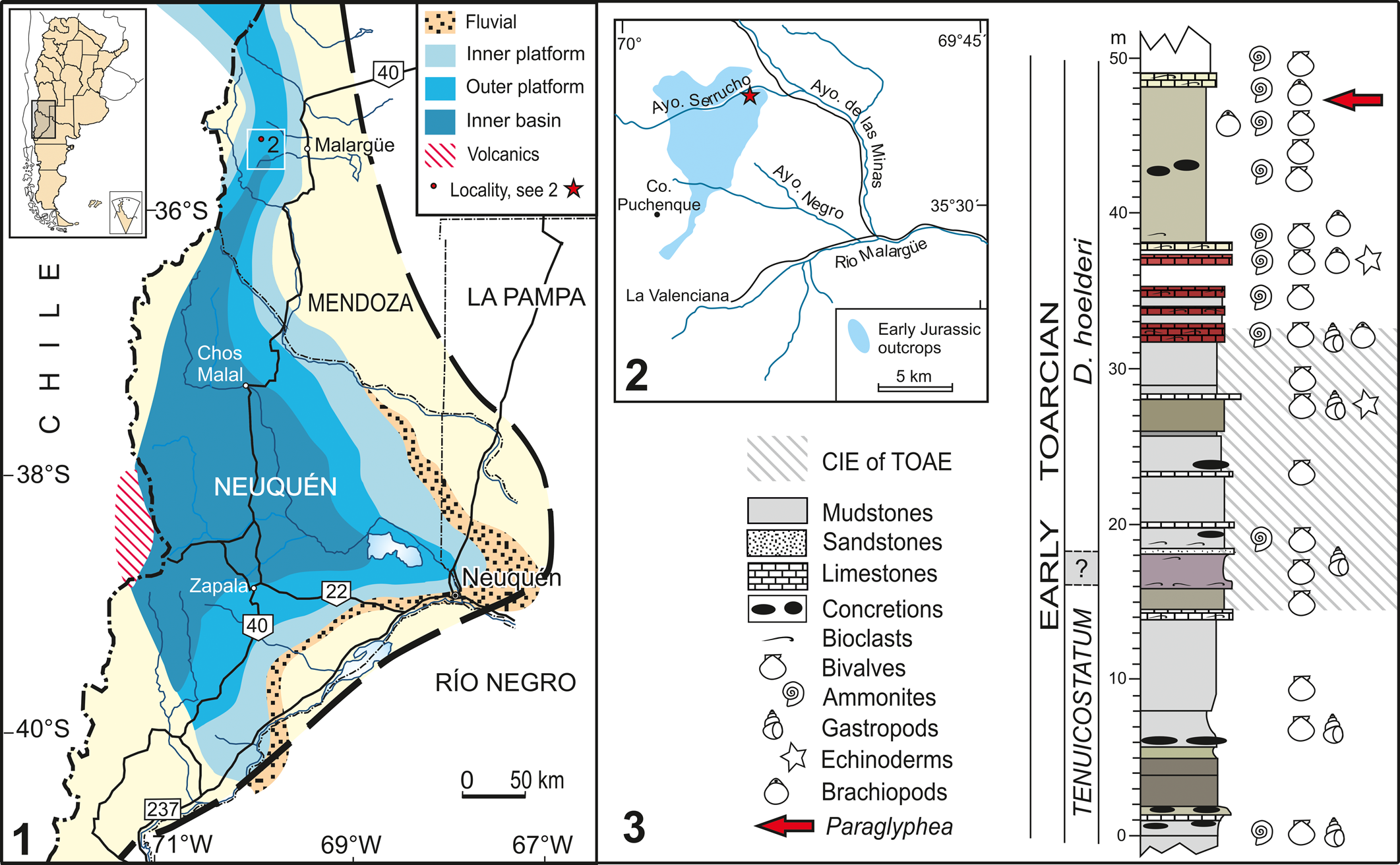
Subsequently, detailed new surveys of the bearing beds at the type locality (Arroyo Serrucho, Mendoza, Fig. 2.1, 2.2) resulted in the collection of a few more specimens, which are the subject of this paper, and are of interest because they allow a more complete characterization of the species, with new morphological data significant for the discussion of systematic relationships and taphonomy.
Location. (1) Map of the Neuquén Basin, general paleogeography for the Pliensbachian/Toarcian interval modified from Legarreta and Uliana (Reference Legarreta and Uliana2000). (2) Detail of locality at Arroyo Serrucho. (3) Part of logged section at Arroyo Serrucho, simplified from Al-Suwaidi et al. (Reference Al-Suwaidi, Hesselbo, Damborenea, Manceñido, Jenkyns, Riccardi, Angelozzi and Baudin2016, suppl. fig. 3), indicating stratigraphic location of bed.

All specimens were collected from a single bed of early Toarcian age. The section was logged and sampled in detail by the authors (see Damborenea, Reference Damborenea1987, text-fig. 3, section 8; Damborenea and Manceñido, Reference Damborenea and Manceñido1987, fig. 1) and more recently by Al-Suwaidi et al. (Reference Al-Suwaidi, Hesselbo, Damborenea, Manceñido, Jenkyns, Riccardi, Angelozzi and Baudin2016, fig. 8, section A–A´, and Supplementary fig. 3; see Fig. 2.3). The bearing bed is about 10–15 meters above the main negative carbon isotope excursion of the TOAE as recognized in this section by Al-Suwaidi et al. (Reference Al-Suwaidi, Hesselbo, Damborenea, Manceñido, Jenkyns, Riccardi, Angelozzi and Baudin2016, fig. 8). As indicated by the presence of exuviae and preservation of very delicate structures, these crustacean remains are clearly autochthonous.
Materials and methods
The systematic reappraisal of the species from Argentina is based on the holotype and new material from the same locality and level.
Abbreviations
C = carapace; L = length; H = height; mx = maxilliped; p = pereiopod.
Repositories and institutional abbreviations
Specimens examined in this study are deposited in the following institutions: Instituto Argentino de Nivología, Glaciología y Ciencias Ambientales (IANIGLA-PI), Mendoza, Argentina; Invertebrate Palaeontology collection, Museo de Ciencias Naturales La Plata (MLP), La Plata, Argentina.
Systematic paleontology
Superfamily Glypheoidea Winkler, Reference Winkler1881
Family Glypheidae Winkler, Reference Winkler1881
Genus Paraglyphea Beurlen, Reference Beurlen1928
Type species
Glyphea ambigua von Fritsch, Reference von Fritsch1870, from the Hettangian of Germany, subsequent designation by Glaessner (Reference Glaessner and Pompeckj1929, p. 305).
Other species
Charbonnier et al. (Reference Charbonnier, Garassino, Schweigert and Simpson2013, p. 92, table 3) included nine species, ranging from Hettangian to Aptian–Albian age, most of them known by few specimens. A Callovian species from Great Britain was recently added (Charbonnier and Garassino, Reference Charbonnier and Garassino2022). The oldest ones, the type species and P. alpina (Oppel, Reference Oppel1861), are from the Hettangian of central Europe. Paraglyphea liasina (von Meyer, Reference von Meyer1840) and P. terquemi (Oppel, Reference Oppel1861) were recorded from Pliensbachian beds in Europe, while Paraglyphea mistelgauensis Charbonnier et al., Reference Charbonnier, Garassino, Schweigert and Simpson2013 from Germany and P. eureka from Argentina are Toarcian in age.
Diagnoses
The two most recent diagnoses of Paraglyphea differ in some details and will be compared below, but the Argentine species fits well within this genus regardless of the diagnosis concerned.
Charbonnier et al. (Reference Charbonnier, Garassino, Schweigert and Simpson2013, p. 92) provided a detailed emended generic diagnosis based on carapace characters. Among other characters, they mentioned a “cephalic region with longitudinal smooth carinae”; and, regarding carapace grooves, they described “deep and very short gastro-orbital groove joined to cervical groove at level of gastro-orbital carina, with two small transverse divergent branches steeply inclined, delimiting two gastro-orbital lobes; deep postcervical groove joined dorsally and ventrally to branchiocardiac groove” (see Charbonnier et al., Reference Charbonnier, Garassino, Schweigert and Simpson2013, fig. 167). Feldmann et al. (Reference Feldmann, Schweitzer and Karasawa2015) included in the Treatise diagnosis the following slight differences in those characters: “three smooth or weakly granular, sinuous longitudinal carinae in cephalic region,” and concerning grooves, they stated that “gastro-orbital groove absent or perhaps very weakly developed; […] postcervical appearing to be discontinuous in some specimens, not merging with branchiocardiac groove or dorsal surface …”
Remarks
According to Charbonnier et al. (Reference Charbonnier, Garassino, Schweigert and Simpson2013, see fig. 583), the carapace of this genus differs from those of Glypheopsis and Angarestia by the presence of a gastro-orbital groove, which is deep and shorter than in Glyphea. Feldmann et al. (Reference Feldmann, Schweitzer and Karasawa2015, p. 14) conceived a somewhat different concept of this genus, and they mentioned that in Paraglyphea the gastro-orbital groove is absent or perhaps very weakly developed. Paraglyphea also differs from Glyphea by the lack of intercervical and laterocardiac grooves.
Paraglyphea eureka (Damborenea and Manceñido, Reference Damborenea and Manceñido1987)
Figures 3–5
- Reference Damborenea and Manceñido1987
Glyphea eureka Damborenea and Manceñido, p. 53, figs 2, 3.
- Reference Aguirre-Urreta1993
Glyphea eureka; Aguirre-Urreta, p. 100.
- Reference Garassino, de Angeli and Pasini2008
Glyphea eureka; Garassino et al., p. 48, 50.
- Reference Schweitzer, Feldmann, Garassino, Karasawa and Schweigert2010
Glyphea eureka; Schweitzer et al., p. 18.
- Reference Feldmann and Schweitzer2013
Glyphea eureka; Feldmann and Schweitzer, table 1 (p. 10).
- Reference Feldmann and Schweitzer2013
Paraglyphea eureka; Charbonnier et al., p. 92, 100, figs. 189–190.
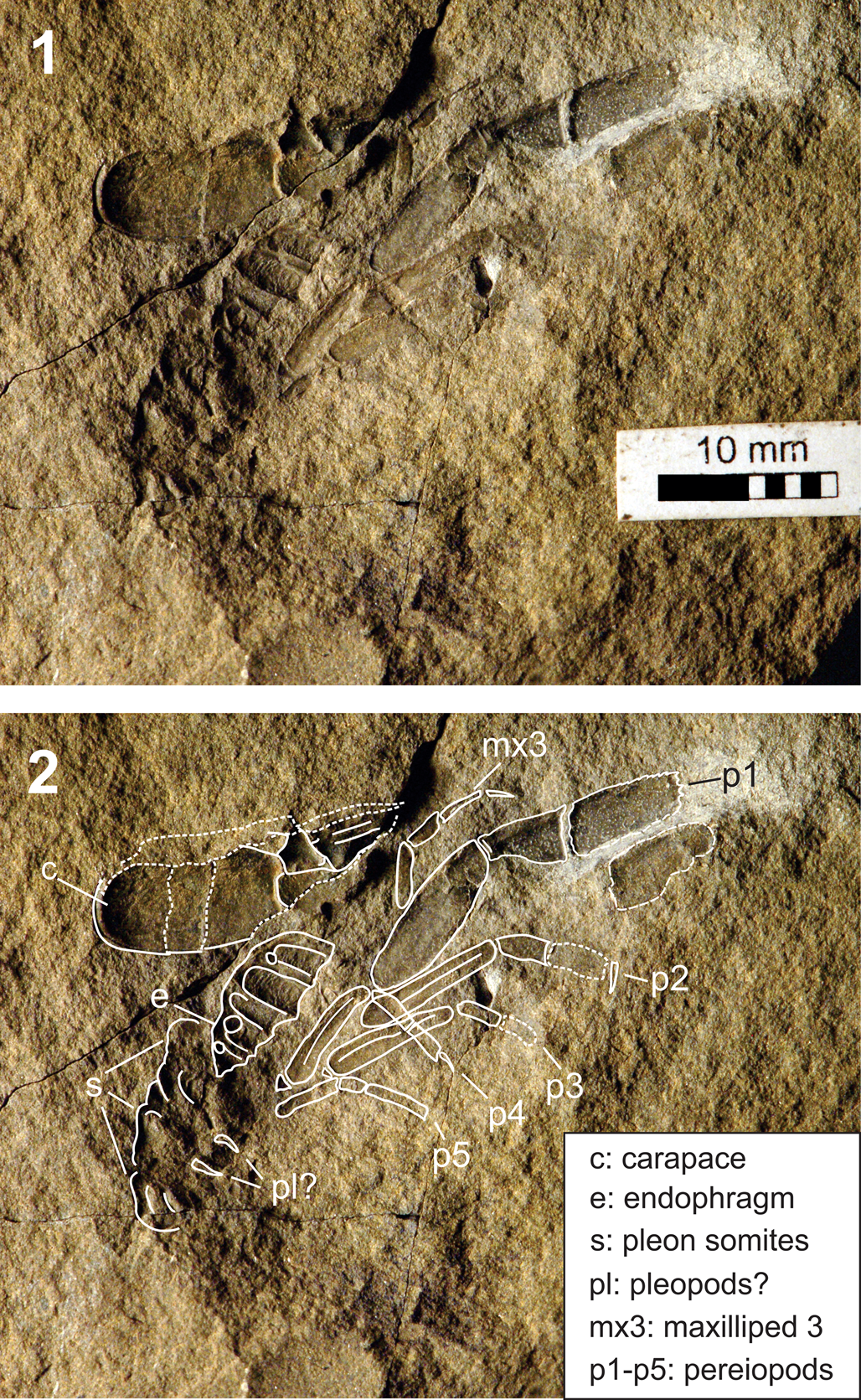
Paraglyphea eureka (Damborenea and Manceñido, Reference Damborenea and Manceñido1987), Arroyo Serrucho, Early Toarcian. (1) External mold of molted skeleton in Salter´s position, IANIGLA-PI 3460A (= MLP 36575), showing endophragmal skeleton and appendages. (2) Sketch of recognized skeleton pieces. Scale bar = 10 mm.

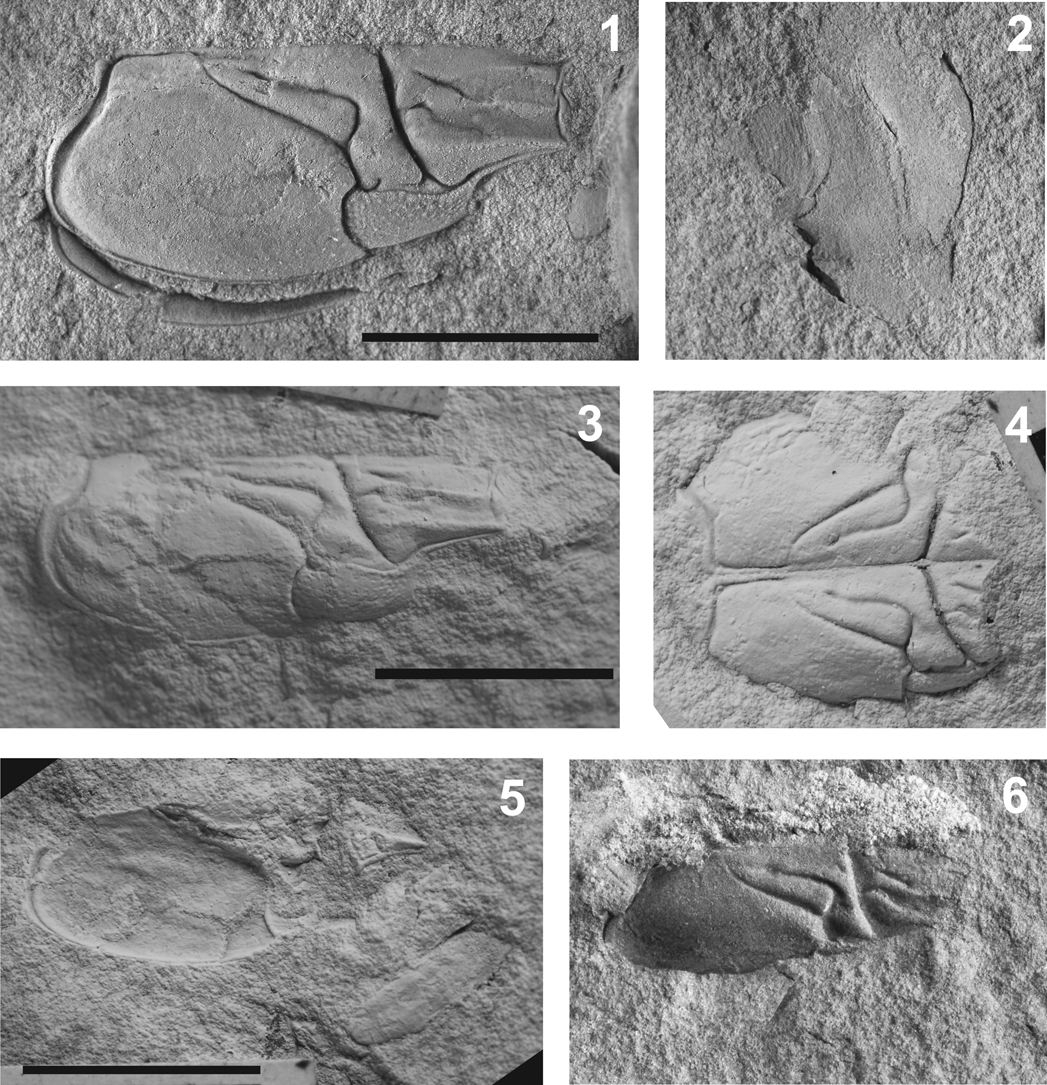
Paraglyphea eureka (Damborenea and Manceñido, Reference Damborenea and Manceñido1987), Arroyo Serrucho, Early Toarcian. (1) Holotype, MLP 20000, laterally flattened carapace, in right lateral view. (2) Part of uropod with exopod almost complete, IANIGLA-PI 3464 = MLP 36578b. (3) Laterally flattened carapace, in right lateral view, IANIGLA-PI 3461A = MLP 36576. (4) Cephalothorax in dorsal view with dorsoventral flattening, IANIGLA-PI 3462A = MLP 36577. (5) Molted specimen, showing carapace in lateral view and a first pereiopod merus, IANIGLA-PI 3461B = MLP 36576. (6) External mold of a small carapace, MLP 36574. All specimens to the same scale. Scale bars = 10 mm.

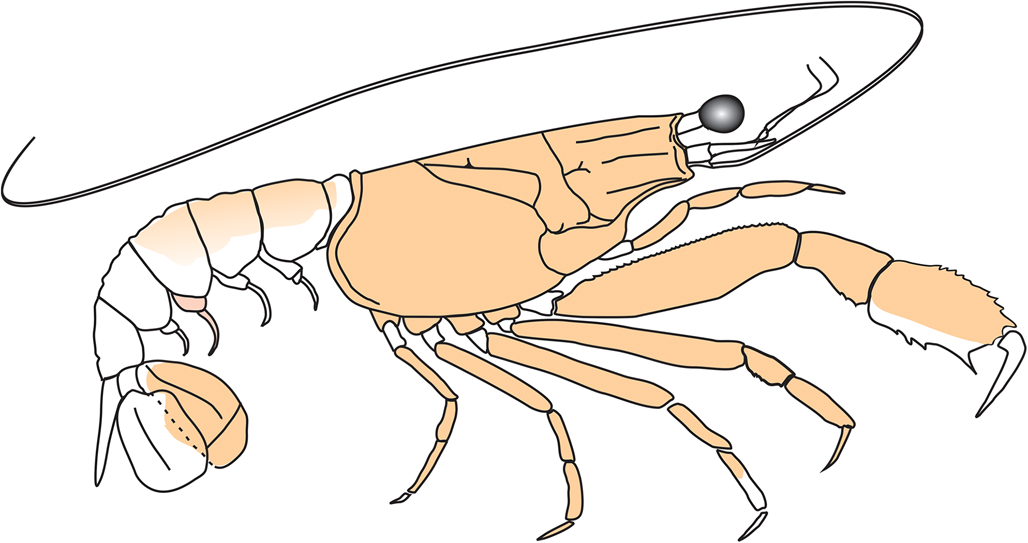
Paraglyphea eureka (Damborenea and Manceñido, Reference Damborenea and Manceñido1987), restoration sketch (S.D.) of the whole skeleton based on all known specimens. Parts in color are those easily recognizable in the preserved specimens; parts in light color are those possibly present. Morphology of parts not recognized or missing (in white) is conjectural.

Type material
The holotype, by monotypy, is a laterally compressed carapace, in right lateral view (MLP 20000) (Damborenea and Manceñido, Reference Damborenea and Manceñido1987, p. 53–57, figs 2, 3; Fig. 4.1).
Occurrence
Type locality: Arroyo Serrucho, near Puesto Basoalto, Mendoza, Argentina (Fig. 2.2, 2.3). According to the recorded ammonites: Cleviceras cf. C. exaratum (Young and Bird, Reference Young and Bird1828), Harpoceratoides cf. H. alternatus (Simpson, Reference Simpson1843), Harpoceras serpentinum (von Schlotheim, Reference von Schlotheim1813), and Hildaites cf. H. murleyi (Moxon, Reference Moxon1841), these beds belong to the early Toarcian Dactylioceras hoelderi Zone (about Serpentinum Standard Zone) of the regional ammonite biostratigraphic scheme (Riccardi, Reference Riccardi2008a, Reference Riccardib).
Description
Carapace description from Damborenea and Manceñido (Reference Damborenea and Manceñido1987) and Charbonnier et al. (Reference Charbonnier, Garassino, Schweigert and Simpson2013, p. 100, who examined a cast of the holotype), and new material: subcylindrical carapace, laterally compressed; very short, spineless rostrum, strongly upward-directed; cephalic region with three longitudinal weakly tuberculate carinae, equally distanced: orbital, gastro-orbital, and antennal carinae; very deep cervical groove straight, steeply inclined, intercepting dorsal margin at angle of ~75° at distance of four-ninths of total length of dorsal margin from anterior; cervical groove ventrally joined to antennal groove, delimiting very narrow cephalic region; ventral margin of antennal–pterygostomial region strongly concave; antennal groove strongly rounded ventrally, forming flat antennal lobe; antennal groove parallel to carinate ventral margin of cephalic region; deep, short gastro-orbital groove joined to cervical groove at level of gastro-orbital carina, with two small transverse divergent branches steeply inclined, delimiting two smooth gastro-orbital lobes (Fig. 4.1, 4.3); very deep postcervical groove joined ventrally to branchiocardiac groove (forming a raised elongate lobe), with deep depression developed dorsally (which may represent an incipient shallow cardiac groove) at about two-thirds of its length, fading posteriorly (Fig. 4.4); very deep branchiocardiac groove oblique, joining dorsal margin at angle of ~60°; relatively deep hepatic groove, deeper and convex ventrally at intersection with branchiocardiac groove and shallower, straight in the intersection with cervical groove; deep inferior groove, convex posteriorly, joined to hepatic groove. Immediately in front of this junction, a boss-like, round, conspicuous prominence (χ) marks the attachment area of the posterior dorsoventral muscle; at the triple junction of the antennal and hepatic grooves with the cervical groove, a short branch of the latter delimits posterodorsally a neat subtriangular prominence (ω), which corresponds to the external point of mandibular articulation. Cephalic region smooth between the carinae; cardiac, hepatic, pterygostomial, and branchial regions with small low tubercles, uniformly arranged (Fig. 4.1).
An isolated skeleton piece preserved near the anterior end of the carapace MLP 20000 (Fig. 4.1) was interpreted as a possible epistome (Damborenea and Manceñido, Reference Damborenea and Manceñido1987, fig. 3). It is a fragment of pentagonal shape, ornamented with rounded tubercles. It is not in contact with the carapace, and it might also be a fragment of a pereiopod segment.
The endophragmal skeleton is well preserved in the molted specimen on side view (Fig. 3). The bases of the pereiopods are grouped in fan-shaped position, it has an overall pentagonal/trapezoidal shape, and it fits well beneath the branchial region of the carapace. Its anterior margin is short, followed by a straight and long anterodorsal margin, which is inclined as the branchiocardiac groove of the carapace. The highest point of the endophragmal skeleton is at about its mid length, and the posterodorsal margin is continuous with the short posterior margin. The ventral margin has six concave notches corresponding to six thoracic somites (mxp3 and p1 to p5). The surface of each somite is convex and longitudinally corrugated. Somites are separated from each other by narrow grooves. The largest somite corresponds to the first pereiopod (p1) and is separated from the maxilliped somite by a double groove.
The pleon is not well preserved. Only in the most complete molt, the dorsal part of the pleonal first two somites can be hardly discerned, and very little can be said about their features (Fig. 3). A few fragments near the pleonal somites could be part of pleopods (Fig. 3). There is also an isolated skeleton fragment (Fig. 4.2) that is recognizable as a partial uropod, with the uropodal exopod nearly complete and a fragment of the endopod. The exopod has a rounded external margin, a curved low median carina, and a nearly straight dieresis. The distal part beyond the dieresis is small and flat and shows very faint parallel striae along its margin. Coxopodites and basipodites not preserved.
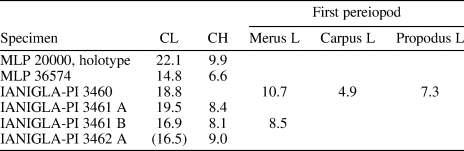
Thoracic appendages are relatively well preserved in the most complete molted specimen (Fig. 3). First and second maxillipeds not preserved. Third maxilliped long (about 50% CL), pediform, with four recognizable segments (long narrow merus, short carpus, propodus, and a narrow pointed dactylus; Fig. 3). First pereiopod long and strong, with subcylindrical segments. Merus laterally flattened, long (nearly 57% CL), with dorsal and ventral margins bearing rows of short spines (Fig. 4.5), covered with faint transverse striae and small low tubercles on the whole surface. Carpus short (about 26% CL), spinose, trapezoidal, with low tubercles; propodus a bit longer (about 40% CL), subrectangular, with dorsal, ventral, and terminal marginal spines; dactylus not preserved. Pereiopods 2 to 5 getting posteriorly smaller, with long, thin, apparently smooth segments, each ending in a pointed dactylus (Fig. 3). Every merus, carpus, and propodus bears small tubercles on the surface.
Additional materials
MLP 36574 and IANIGLA-PI 3460 to 3464 (casts MLP 36575 to 36578), all specimens from the same locality and bed as the holotype. They include three additional carapaces in lateral view, an incomplete carapace in dorsal view with a dorsoventral flattening, a molted specimen in side view, a partial uropod, and several fragments of pereiopods.
Measurements
See Table 2.
Measurements (in mm) of Paraglyphea eureka (Damborenea and Manceñido, Reference Damborenea and Manceñido1987). Incomplete specimen measurements in parentheses. CL = carapace length; CH = carapace height; L = length.

Remarks
Paraglyphea eureka was originally referred to Glyphea, and this criterion was followed by Schweitzer et al. (Reference Schweitzer, Feldmann, Garassino, Karasawa and Schweigert2010) and Feldmann and Schweitzer (Reference Feldmann and Schweitzer2013). According to Charbonnier et al. (Reference Charbonnier, Garassino, Schweigert and Simpson2013, p. 101), “the holotype shows that the morphological characters of this species are diagnostic of Paraglyphea, because the postcervical groove is joined dorsally and ventrally to the branchiocardiac groove (joined also medially in Glyphea) and the intercervical groove is absent (always present in Glyphea).”
The material herein described has morphological affinities with the type species of both Paraglyphea and Angarestia. Paraglyphea eureka is closely comparable to the neotype of P. ambigua (von Fritsch, Reference von Fritsch1870), from the Hettangian of Germany. This German species also has a posterior deep depression in the postcervical groove, which appears barely developed posteriorly (Charbonnier et al., Reference Charbonnier, Garassino, Schweigert and Simpson2013, figs. 168, 169); the deep cardiac groove contacts this depression, generating a V-shaped mark. The main difference is the incipient development of a cardiac groove in P. eureka. Further differences and similarities with P. ambigua can be found in Damborenea and Manceñido (Reference Damborenea and Manceñido1987).
The carapace of Paraglyphea eureka is very similar to that of P. mistelgauensis Charbonnier et al., Reference Charbonnier, Garassino, Schweigert and Simpson2013 (Charbonnier et al., Reference Charbonnier, Garassino, Schweigert and Simpson2013, figs. 198, 199) from the Toarcian of Germany. Both share the groove pattern and the mostly smooth surface, with only faint tubercles, which are most conspicuous on the pterygostomial region. They also share a strongly concave ventral margin of the antennal–pterygostomial region. This German species, nonetheless, differs from P. eureka in the presence of only two carinae in the cephalic region and a steeply inclined cervical groove (about 80° angle with the dorsal margin). Paraglyphea alpina (Oppel, Reference Oppel1861), from the Hettangian of Tyrol (Austria), has three carinae as P. eureka, but they are not subparallel: the antennal one converges posteriorly toward the gastro-orbital one. Unlike P. eureka, the Austrian species also has a very steeply inclined cervical groove and subparallel branchiocardiac and postcervical grooves delimiting a very narrow lobe.
Other Early Jurassic species were already compared with P. eureka (Damborenea and Manceñido, Reference Damborenea and Manceñido1987).
The type species of Angarestia, A. australensis (Feldmann et al., Reference Feldmann, Tshudy and Thomson1993), from the Campanian of the Antarctic Peninsula, has a feebly developed postcervical groove, only well developed in its anterior portion (Charbonnier et al. Reference Charbonnier, Garassino, Schweigert and Simpson2013, figs. 382, 387), contacting the branchiocardiac groove at right angles. Paraglyphea eureka also differs from species of Angarestia by the presence of a short but deep gastro-orbital groove, which appears only faintly insinuated in one specimen of A. australensis (Charbonnier et al., Reference Charbonnier, Garassino, Schweigert and Simpson2013, fig. 382). Feldmann et al. (Reference Feldmann, Schweitzer and Karasawa2015, p. 14) include in the diagnosis of Angarestia a “posterior margin broadly rimmed,” which is a character present in many Glypheidae (among them the type species of Paraglyphea and P. eureka) and thus is not a useful diagnostic feature. Admittedly, the Argentinian species is morphologically somewhat transitional between the two genera (Paraglyphea and Angarestia), yet considering that in the original material (and even better in the new, e.g., Fig. 4.6), the postcervical groove, albeit shallow dorsally, does converge to join the branchiocardiac groove, and a tenuous cardiac groove is also recognizable, we herein confirm assigning it to Paraglyphea.
Taphonomy and paleobiology
All specimens were found in a layer of well-stratified, homogeneous, noncalcareous siltstone, greenish-gray in color (arrowed in Fig. 2.3). These beds were deposited in a sublittoral outer shelf environment (Gulisano and Gutiérrez-Pleimling, Reference Gulisano and Gutiérrez-Pleimling1995; Al-Suwaidi et al., Reference Al-Suwaidi, Hesselbo, Damborenea, Manceñido, Jenkyns, Riccardi, Angelozzi and Baudin2016) and contain a diverse invertebrate fauna indicative of well-oxygenated quiet waters. Some of the bivalves recorded at the same level were studied by Damborenea (Reference Damborenea1987, Reference Damborenea2002) and Echevarría et al. (Reference Echevarría, Damborenea and Manceñido2021); they include: Lycettia hypertrigona Damborenea, Reference Damborenea1987, Modiolus gerthi Damborenea, Reference Damborenea1987, Cucullaea cf. C. rothi Leanza, Reference Leanza1942, Parvamussium pumilum (Lamarck, Reference Lamarck1819), Entolium mapuche Damborenea, Reference Damborenea2002, Promyophorella cf. P. exotica (Möricke, Reference Möricke1894), Pinna sp., Grammatodon cf. G. toyorensis Hayami, Reference Hayami1959, Neocrassina? sp., Goniomya sp., Cercomya sp., cf. Pteromya? sp. Other fauna includes brachiopods, such as Discinisca cf. D. papyracea (Goldfuss, Reference Goldfuss1833–1844) and Rhynchonelloidea lamberti Manceñido, Reference Manceñido, MacKinnon, Lee and Campbell1990, the already mentioned ammonites, and gastropods. Most aragonitic shells appear preserved as molds reflecting diagenetic dissolution. The search for microfossils has so far been unsuccessful around this interval of the logged section, presumably due to taphonomic bias.
Probably all the crustacean material corresponds to molts. In particular, one of the newly found specimens (Fig. 3) displays the endophragmal skeleton and the initial part of the abdomen attached to one another and the cephalothorax rotated dorsally with its left half seen from inside, but still close to the other parts, and their axes nearly at right angles. This arrangement was referred to as Salter´s position (Schäfer, Reference Schäfer, Oertel and Craig1972, p. 434–435, fig. 251; see also Glaessner, Reference Glaessner, Moore and Part1969, fig. 245). Such preservation is known in several glypheid materials, such as the holotype of Glypheopsis robusta (Feldmann and McPherson, Reference Feldmann and McPherson1980) (Feldmann and McPherson, Reference Feldmann and McPherson1980, pl. 2, figs. 8, 9; Feldmann, Reference Feldmann2003, fig. 1.2) and two Glyphea species from the Terrain à Chailles described by Charbonnier et al. (Reference Charbonnier, Pérès and Letenneur2012, figs. 3.A, 11.A, B, 12.A), although the Argentine specimen is less complete.
The new material also includes a carapace with dorsoventral flattening (Fig. 4.4). As mentioned by Charbonnier et al. (Reference Charbonnier, Pérès and Letenneur2012, figs. 3A, 8A–C), such preservation suggests that the dorsal margin probably acted as a hinge liberating the head of the molted animal.
Both MLP 20000 and additional specimens (Fig. 4.3, 4.5, 4.6) are lateral views of carapaces. It should be noted that the holotype is a whole carapace laterally flattened, rather than just a hemicephalothorax, which was split along the dorsal midline, with each half gently shifted and rotated in a scissors-like fashion upon being compressed sideways on the bedding plane. The underlapping left hemicephalothorax is clearly seen with its inner margin projecting slightly from below the right one. All this evidence favors its interpretation as an exuvia (cf. Schäfer, Reference Schäfer, Oertel and Craig1972, p. 434).
Evidence supports that exuviae remained immersed in water, thus faithfully maintaining most of the original morphology and with enough time of permanence at the sediment–water interface for the flowing water to produce a certain amount of dissociation.
The possibility of interpreting the bearing beds as a molting ground is less likely, according to Schäfer (Reference Schäfer, Oertel and Craig1972, p. 437), who asserted that in marine crustaceans, the accumulation of their exuviae may involve a certain degree of transportation, perhaps being washed together shortly after undergoing simultaneous release during ecdysis. Moreover, the observed variation in carapace size (cf. Table 2) implies that several ontogenetic stages co-occur.
Summarizing, the taphonomic features displayed by the specimens confirm a sublittoral outer shelf environment, with low energy (below storm wave-base) and a rather rapid burial rate.
Acknowledgments
We thank A. Riccardi (La Plata Museum) for the ammonite identifications and biostratigraphic support. J. Posik (La Plata Museum) aided with the preparation of the material. We also acknowledge T. Poulton and M. Coyne (both Geological Survey of Canada) for their assistance with biostratigraphical and curatorial data concerning Canadian occurrences. We are grateful to the Basoalto family (Arroyo Serrucho) for their hospitality and help. Fieldwork related to this paper was funded by Consejo Nacional de Investigaciones Científicas y Técnicas (CONICET PIP 112-201701-01103) and La Plata University (projects 11/N873 and 11/N978). Both reviewers, S. Charbonnier and A. Garassino, together with G. Schweigert, C. Schweitzer, and invited editors, are all thanked for their valuable comments, which helped to improve the original manuscript.
Declaration of competing interests
The authors declare none.