Introduction
Cochlear implantation is widely used to rehabilitate children with severe sensorineural hearing loss, and the optimal surgical methods and receiver–stimulator stabilisation techniques are under considerable debate. Over time, surgical fixation methods developed to minimise trauma have gained in popularity. However, these can be time-consuming and technically difficult.
Stabilisation of the receiver–stimulator is crucial for continuity of data transfer. In standard cochlear implant surgery, a bone bed is formed on the calvarium for internal device placement and stabilisation. Some surgeons fix the receiver–stimulator with additional sutures. Although this method is satisfactory in adult patients with sufficient calvarium thickness, the calvarium may be as thin as 1 mm in children, leading to undesirable complications such as epidural haematoma and cerebrospinal fluid fistulae.Reference Gosepath, Maurer and Mann 1 – Reference Arnoldner, Baumgartner, Gstoettner and Hamzavi 3 In addition, serious complications including lateral sinus thrombosis, temporal lobe infarction and meningitis may occur soon after surgery.Reference Staecker, Chow and Nadol 4 Moreover, improper fixation of the internal device can result in soft tissue problems and device migration, which can cause implant failure.
In the subperiosteal pocket technique for implant fixation, the receiver–stimulator is placed in the subperiosteal space on the temporal bone without drilling, and a bone bed is expected to form spontaneously after surgery. Thus, a time-consuming bone drilling procedure is unnecessary and possible complications related to dura exposition are avoided.
However, surgeons may have serious concerns about migration when using procedures for placing the receiver–stimulator in the subperiosteal space without drilling the bone. This study therefore aimed to monitor the extent of migration of the internal device after cochlear implantation using the subperiosteal pocket technique.
Materials and methods
This prospective clinical study included 32 paediatric patients who underwent cochlear implantation between December 2012 and January 2014. Ethical approval for the study was obtained from the institutional ethics committee and informed consent was provided by the parents of all patients. All cochlear implantations were performed using the subperiosteal pocket technique by two experienced surgeons (YG, KSO).
Surgical technique
First, temporal lines were identified by palpation and a small ‘C’-shaped retroauricular skin incision was made to expose the temporal bone periosteum. An anterior-based quadrangular Palva flap was created; at the posterosuperior corner of the flap, the superior incision was extended by 2 cm posteriorly to form a tailed Palva flap (Figure 1). A subperiosteal pocket was then created using a Freer elevator (Karl Storz, Tuttlingen, Germany). Standard mastoidectomy, posterior tympanotomy and cochleostomy were then performed. After placing the implant into the subperiosteal pocket, 3–0 gauge polyglycolic acid suture was fixed at the posterosuperior corner of the Palva flap to prevent anterior migration by tightening the entrance of the subperiosteal pocket. Electrodes were placed through gaps made during standard posterior tympanotomy and cochleostomy. After electrophysiological testing, the remaining periosteal incisions were closed with 3–0 gauge polyglycolic acid sutures (Figure 2).
Photograph showing the tailed Palva flap incision during cochlear implantation surgery using the subperiosteal pocket technique.

Photograph showing closure of the periosteal incision with sutures.

The original study plan was to evaluate migration of the receiver–stimulator via X-ray imaging. However, this plan was rejected because of concerns about the harmful effects of X-rays. Therefore, changes in the distances between previously determined reference points at implantation and six months after surgery were used instead. For this, the distance between the magnets of the receiver–stimulator (which were superficially palpable over the skin or located by the corresponding area of the external magnet) and reference points corresponding to the lateral canthus, tragus and mastoid tip on the skin surface were measured at the end of surgery (Figure 3). The head circumference was also recorded at implantation and six months after surgery. To correct for growth of the head during childhood, ratios of the measured distances to the head circumference were recorded instead of simply the distances between reference points. Measurements were analysed using paired t-tests in IBM SPSS Statistics software version 21.0 (Armonk, New York, USA). A p value of less than 0.05 was considered statistically significant.
Photograph showing the selected reference points and the distances between them.

Results
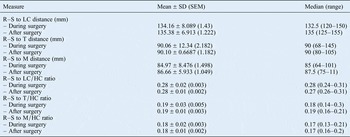
A total of 32 paediatric patients were included in the study (17 girls and 15 boys). Patients were aged between 12 and 96 months (mean±standard deviation (SD), 28±19 months). There were no major or minor surgical complications. During surgery, the distance from the receiver–stimulator to the lateral canthus was 134 ± 8 mm (mean ± SD), to the tragus was 90 ± 12 mm and to the mastoid tip was 85 ± 8 mm. Six months after surgery, the equivalent measurements were 135 ± 7 mm, 91 ± 7 mm and 87 ± 6 mm, respectively. During surgery, the mean ratio of the receiver–stimulator to lateral canthus distance to the head circumference was 0.28; the corresponding ratio for the receiver–stimulator to tragus distance was 0.19 and for the receiver–stimulator to mastoid tip distance was 0.18. When evaluated six months after surgery, the equivalent ratios were 0.28, 0.19 and 0.18, respectively. Thus, there was no significant difference between these values during and after surgery, indicating no significant anterior or posterior migration of the receiver–stimulator in the subperiosteal pocket (Table I).
Measurements between reference points and ratios of measurements during and after surgery

n = 32 patients. All comparisons between values obtained during and after surgery had p values of >0.05. R–S = receiver–stimulator; LC = lateral canthus; T = tragus; M = mastoid; HC = head circumference; SD = standard deviation; SEM = standard error of the mean
Discussion
The technique traditionally used for cochlear implantation involves drilling a socket into the calvarium to prevent implant migration. However, this technique carries a risk of intracranial complications due to dura exposure. Children are particularly prone to central nervous trauma during receiver–stimulator placement, and those whose calvarium thickness is as low as 1 mm are especially vulnerable to intracranial complications. Although the development of new, less invasive techniques to overcome these problems is ongoing, an optimal technique for fixing the receiver–stimulator during cochlear implantation is still lacking. The subperiosteal pocket technique is the latest surgical procedure to be developed for cochlear implantation.
Mobility and migration of the extra-cochlear device may contribute to the development of seroma, infection and extrusion, leading to device failure.Reference Gosepath, Maurer and Mann 1 , Reference Davids, Ramsden, Gordon, James and Papsin 5 , Reference Molony, Giles, Thompson and Motamedi 6 Migration of the receiver–stimulator part of the cochlear implant is reported to occur in 0–2 per cent of cases,Reference Black 7 , Reference Shelton and Warren 8 although the total reported complication rate decreased from 7 per cent in 2000 to 3 per cent in 2005 and 4 per cent in 2010.Reference Causon, Verschuur and Newman 9 Wang et al. reported that 1.9 per cent of cochlear implant revision procedures between 1982 and 2011 were needed because of device migration or extrusion.Reference Wang, Wang, Psarros and Da Cruz 10 In contrast, device migration was not reported in three separate studies (with cohorts of 148, 62 and 32 patients, respectively) that used the subperiosteal pocket technique.Reference Güldiken, Orhan, Yigit, Başaran, Polat and Güneş 11 – Reference Cuda 13 Similarly, device migration was not reported in recent studies by Cohen et al. and Sweeney et al.Reference Cohen, Ha, Kitsko and Chi 14 , Reference Sweeney, Carlson, Valenzuela, Wanna, Rivas and Bennett 15
Davids et al. reported loss of fixation in three out of five cases in which surgical re-exploration was needed because of soft tissue infection.Reference Davids, Ramsden, Gordon, James and Papsin 5 However, as these authors admitted, it was unclear whether loss of fixation was a consequence or the cause of soft tissue infection. Several methods exist for locating the electrodes and the receiver–stimulator. Conventional X-ray and computed tomography have mainly been used to verify the positions of intracochlear electrodes and the receiver–stimulator. However, there has been little discussion related to positioning the receiver–stimulator on the cranium.Reference Verbist, Joemai, Teeuwisse, Veldkamp, Geleijns and Frijns 16 – Reference Trieger, Schulze, Schneider, Zahnert and Mürbe 18 In a recent study using objective measurements of implant migration, Lui et al. reported very small downward movements of the receiver after implantation using minimally invasive incisions without tie-down sutures.Reference Lui, Peng, Li, Yang, Chen and Hwang 19
-
• In the subperiosteal pocket technique, the receiver–stimulator is placed in the subperiosteal space on the temporal bone without drilling, and a bone bed forms spontaneously
-
• Receiver–stimulator device migration rates of 0–7 per cent have been reported
-
• This study showed objectively that migration is a rare complication of the subperiosteal pocket technique
This study aimed to assess migration of the receiver–stimulator using objective data from patients who underwent cochlear implantation with the subperiosteal pocket technique. Measurements were made between selected reference points and the receiver–stimulator during and six months after surgery. To improve reliability of the measurements, they were corrected for normal growth by calculating the ratios of these distances to the head circumference. Neither the distances between reference points nor the ratios of these distances to the head circumference changed significantly up to six months after surgery.
Limitations of the study were the small sample size and the short follow-up period. More reliable results may be obtained using a larger sample size and longer follow up. However, this is the only study so far to use objective measurements to assess the degree of implant migration. Using this method, implant migration was found to be a rare complication of the subperiosteal pocket technique.