Mobility, defined as an individual’s ability to move about effectively in his or her surroundings (Patla & Shumway-Cook, Reference Patla and Shumway-Cook1999; Webber, Porter, & Menec, Reference Webber, Porter and Menec2010), is vital for the independence, quality of life, and survival of older adults (Hirvensalo, Rantanen, & Heikkinen, Reference Hirvensalo, Rantanen and Heikkinen2000; Rantakokko et al., Reference Rantakokko, Iwarsson, Kauppinen, Leinonen, Heikkinen and Rantanen2010; Simonsick, Guralnik, Volpato, Balfour, & Fried, Reference Simonsick, Guralnik, Volpato, Balfour and Fried2005). Difficulty with mobility is highly prevalent in older adult populations, with negative consequences for physical function, participation in daily activities, and social connectedness (Fried, Bandeen-Roche, Chaves, & Johnson, Reference Fried, Bandeen-Roche, Chaves and Johnson2000; Guralnik, Reference Guralnik1993; Guralnik, Ferrucci, Simonsick, Salive, & Wallace, Reference Guralnik, Ferrucci, Simonsick, Salive and Wallace1995). In short, maintaining mobility is considered by the World Health Organization (WHO) to be the best guarantee of retaining independence with aging (WHO, 1998).
Recent models of mobility (WHO, 2001; Verbrugge & Jette, Reference Verbrugge and Jette1994; Webber et al., Reference Webber, Porter and Menec2010) have drawn attention to environmental factors, such as characteristics in local built environments (Health Canada, 2002; Srinivasan, O’Fallon, & Dearry, Reference Srinivasan, O’Fallon and Dearry2003), that interact with underlying impairments and physical capacity to impede or enhance a person’s non-motorized outdoor mobility. A growing body of literature has documented a positive relationship between accessible built environments and outdoor mobility in older adults (Frank, Kerr, Rosenberg, & King, Reference Frank, Kerr, Rosenberg and King2010; Gauvin et al., Reference Gauvin, Richard, Kestens, Shatenstein, Daniel, Moore and Payette2012; King et al., Reference King, Sallis, Frank, Saelens, Cain, Conway and Kerr.2011; Rosso, Auchincloss, & Michael, Reference Rosso, Auchincloss and Michael2011). In particular, more “walkable” neighbourhoods (i.e., those with greater land use mix, shorter block length, and greater street connectivity) have been associated with greater mobility among older persons (Clarke, Ailshire, Bader, Morenoff, & House, Reference Clarke, Ailshire, Bader, Morenoff and House2008; Gallagher et al., Reference Gallagher, Gretebeck, Robinson, Torres, Murphy and Martyn2010; King et al., Reference King, Castro, Wilcox, Eyler, Sallis and Brownson2000; King et al., Reference King, Belle, Brach, Simkin-Silverman, Soska and Kriska2005; Li et al., Reference Li, Harmer, Cardinal, Bosworth, Acock, Johnson-Shelton and Moore2008; Michael, Beard, Choi, Farquhar, & Carlson, Reference Michael, Beard, Choi, Farquhar and Carlson2006; Nagel, Carlson, Bosworth, & Michael, Reference Nagel, Carlson, Bosworth and Michael2008; Patterson & Chapman, Reference Patterson and Chapman2004; Rodríguez, Evenson, Diez Roux, & Brines, Reference Rodríguez, Evenson, Diez Roux and Brines2009). Conversely, living in a neighbourhood without continuous sidewalks, designated crosswalks, or connected streets has been shown to be associated with reduced mobility (Clarke, Ailshire, Bader, Morenoff, & House, Reference Clarke, Ailshire, Bader, Morenoff and House2008; Gallagher et al., Reference Gallagher, Clarke, Loveland-Cherry, Ronis, Nyquist and Gretebeck2012) and a greater risk of outdoor falls (Berg, Alessio, Mills, & Tong, Reference Berg, Alessio, Mills and Tong1997; Li et al., Reference Li, Keegan, Sternfeld, Sidney, Quesenberry and Kelsey2006). Older adults with lower extremity impairment have also been shown to experience mobility challenges on grassy terrain and when carrying heavy packages over long distances (Shumway-Cook et al., Reference Shumway-Cook, Patla, Stewart, Ferrucci, Ciol and Guralnik2003).
Yet, surprisingly absent from this literature is any consideration of the impact of local weather on mobility. Specifically, we do not know how different weather conditions modify the impact of neighbourhood walkability on older adult mobility. Each year, some of North America’s major cities (including Boston, Detroit, Cleveland, and Minneapolis) receive an average of over one meter (3.3 feet) of snow and have snow on the ground for more than three months. Icy surfaces, snow banks, and snowy/slushy surfaces are the most frequently named barriers to mobility among pedestrians during winter, particularly those with underlying limitations in physical functioning (Li, Hsu, & Fernie, Reference Li, Hsu and Fernie2010; Ryser & Halseth, Reference Ryser and Halseth2008). More than 37 per cent of older adults in Toronto, Canada, reduced their outdoor walking during the winter when they expected slippery sidewalk conditions (Li, Hsu, & Fernie, Reference Li, Hsu and Fernie2013). Similarly, older adults in Detroit, Michigan, reported that a fear of falling on ice, sidewalks not cleared of snow and ice, and cold and rainy weather discouraged walking outdoors (Gallagher et al., Reference Gallagher, Gretebeck, Robinson, Torres, Murphy and Martyn2010). A lack of shelters at public transit stops and decreased daylight hours during the winter months can also restrict mobility (Gallagher et al., Reference Gallagher, Gretebeck, Robinson, Torres, Murphy and Martyn2010).
Thus, a neighbourhood that is somewhat walkable in summer months may become treacherous in winter, especially if uneven sidewalks are obscured by snow cover or if heavy rain makes cracks and uneven sidewalks difficult to distinguish. Further, a dirt or grass path may be navigable in dry weather, but is likely to become slippery when it rains. To counter these challenges, installing curb cuts at designated crosswalks may facilitate safe street crossings in places where older adults move more slowly or have difficulty stepping off the curb. However, if rain or snow accumulates at intersections to create puddles or snowbanks, this renders even designated “safe” crossings difficult to navigate. Older adults who rely on assistive devices for mobility (e.g., canes, walkers, wheelchairs, scooters) are even more vulnerable. For example, snow lodged in wheeled mobility devices forms an obstacle in the wheels and drive mechanisms and decreases the slip resistance of motorized scooters (Tadano, Tsukada, Shibano, Ukai, & Watanuki, Reference Tadano, Tsukada, Shibano, Ukai and Watanuki1998).
It is not possible, therefore, to comprehensively understand the relationship between neighbourhood built environments and mobility without considering the impact of weather. The current lack of knowledge about how the walkability of different built environments varies or changes in different weather conditions prevents a more complete understanding of older adult mobility. To overcome these limitations, we examined the impact of weather-related factors on mobility across older adults living in neighbourhoods with various degrees of walkability. We used archived weather data linked to survey data collected from a sample of low-income community-dwelling older adults in Vancouver, British Columbia (BC). Vancouver is one of Canada’s largest cities, with a moderate, oceanic climate. Although Vancouver is one of the wettest Canadian cities, receiving over 1,200 mm of rain per year on average, it also receives a non-trivial amount of snow (averaging 10.4–13.3 cm/month from December through February) (Environment Canada, n.d.). Both of these weather patterns cause slippery conditions and compromise mobility for Metro Vancouver’s sizable elderly population. We hypothesized that snow and rain would restrict older adults’ outdoor mobility, and that the mobility benefits of living in a walkable neighbourhood would be attenuated in rain and snow.
Methods
Data
Participants were recruited to take part in Walk the Talk (WTT), a cross-sectional study designed to investigate the association between the built environment and the mobility and health of low-income older adults (Chudyk et al., Reference Chudyk, Winters, Moniruzzaman, Ashe, Gould and McKay2015). Participants resided in eight cities in Metropolitan Vancouver (Burnaby, New Westminster, North Vancouver, Richmond, Surrey, Vancouver, West Vancouver, and White Rock). The WTT sampling frame consisted of 5,806 households that receive a Shelter Aid for Elderly Renters (SAFER) rental subsidy from BC Housing, had a head of household aged 65 or older, and a telephone number on file with BC Housing. Households were sampled using a stratified random design, randomly selecting 200 households from within each decile of Walk Score (Front Seat Management, LLC; www.walkscore.com) (n total = 2,000) to ensure that participants were recruited across a range of built environments.
Following a mailed letter introducing the study, all 2,000 households in the sampling frame were contacted via telephone between January and February 2012 to screen for eligibility. Of 1,319 individuals successfully contacted, 334 (25%) were not eligible to participate as a result of study exclusion criteria (i.e., diagnosed with dementia; left their home less than once in a typical week; unable to understand or speak English; unable to walk more than 10 meters with or without a mobility aid; unable to participate in a mobility assessment involving a four meter walk). Of the 985 eligible subjects, 161 agreed to participate (706 were not interested; 118 declined for health reasons), resulting in a 16 per cent response rate (which is comparable to other telephone surveys with older adults [Kohut, Keeter, Doherty, Dimock, & Christian, Reference Kohut, Keeter, Doherty, Dimock and Christian2012] [King et al., Reference King, Sallis, Frank, Saelens, Cain, Conway and Kerr.2011; Rosso, Grubesic, Auchincloss, Tabb, & Michael, Reference Rosso, Grubesic, Auchincloss, Tabb and Michael2013]). There were no differences between participants and non-participants with respect to gender, but those who agreed to participate were slightly younger than those who did not (mean age of 74 vs. 77 years respectively).
All study participants were invited to an in-person measurement session at local community centres between February and December 2012 to collect objective measures of physical and cognitive function (transportation was provided to and from sessions); 70 per cent of these assessments were conducted between February and March, 10 per cent between April and May, 15 per cent between June and September, and 5 per cent in December. Participants were then asked to complete a self-administered survey at home that asked detailed questions about sociodemographic characteristics and outdoor mobility activities. The surveys were subsequently collected via a courier service so as not to inconvenience participants with “mail ins” or “drop offs”. The University of British Columbia’s Clinical Research Ethics Board (certificate H10-02913) approved the procedures used in the study.
Measures
The key dependent variable, outdoor mobility, was assessed in the self-administered questionnaire using items from the Neighbourhood Environment Walkability Survey (NEWS) (Saelens, Sallis, Black, & Chen, Reference Saelens, Sallis, Black and Chen2003), which asks whether respondents walked to 26 different destinations in the past 30 days (including convenience store, supermarket, hardware store, fruit/vegetable market, dry cleaners, clothing store, post office, library, elementary school, other school, book store, restaurants, coffee shop, bank, video store, fast food place, pharmacy, hair salon, work/volunteer, bus or train stop, park, recreation centre, fitness facility, senior centre, health care clinic, bakery). We created a count of the total number of different destinations participants walked to in the past 30 days to capture the breadth of outdoor walking trips for day-to-day life activities that older adults may undertake within their local community.
Key independent variables included neighbourhood walkability, assessed objectively using Street Smart Walk Score (Front Seat Management, LLC). This single measure accounts for walkable street design (intersection density and block length) and network distance to popular amenities. We categorized walkability into four categories based on cut-off scores recommended by developers of Street Smart Walk Score (car dependent, 0–49; somewhat walkable, 50–69; very walkable, 70–89; and walker’s paradise, 90–100). Walk Score was linked to each participant’s residential address to get a score for their local neighbourhood (capturing features of the area within a one-quarter mile radius of that residential address).
Information about local weather was obtained from Weather Underground based on the Vancouver International Airport weather station (http://www.wunderground.com/history/airport/CYVR/). We downloaded daily weather data for 2012 (corresponding to the time frame when mobility data were gathered from study participants) and linked weather conditions in the past 30 days to each participant based on the date of interview. We focused on measures of precipitation, which we considered most likely to influence mobility, and with these data determined (1) the amount of rainfall (total mm), and (2) the proportion of days with any snow, both in the past 30 days. Due to a high correlation between temperature and precipitation, we could not include both in our statistical models. Thus, we purposely chose to focus primarily on the effects of precipitation.
Key co-variates include age (years), gender, race (White; non-White), Canadian born (vs. foreign born), education level (completed secondary school or less; some trade/technical school or college through completed trade/technical school or college diploma; some university or higher), marital status (single; married; widowed; separated or divorced), and whether participants had a vehicle at their disposal. Cognitive function was assessed with the Montreal Cognitive Assessment (MoCA) instrument, a reliable, rapid (10 minute) screening instrument to evaluate mild cognitive dysfunction (Nasreddine et al., Reference Nasreddine, Phillips, Bédirian, Charbonneau, Whitehead, Collin and Chertkow2005). The highest MoCA score possible is 30 points; a score of 26 or higher is considered normal. We measured functional capacity objectively using the Short Physical Performance Battery (SPPB) (Guralnik et al., Reference Guralnik, Simonsick, Ferrucci, Glynn, Berkman, Blazer and Wallace1994), a brief (<10 minute), reliable, performance battery that assesses balance, gait speed, and lower limb strength and endurance. SPPB includes three tests: gait speed over a 3-meter course, standing balance, and time to rise from a chair five times. Each performance test is assigned a score from 0 to 4 (where 4 captures high performance). Scores are summed to create a composite score that ranges from 0 to 12. Higher scores reflect better physical function. A score of less than 10 typically identifies a more physically impaired group (Gill, Reference Gill2010).
Statistical Analysis
Our mobility variable is a count of the number of different destinations participants walked to in the past 30 days. Therefore, we used Poisson regression to model the logarithm of the expected number of destinations older people walked to as a function of a linear combination of the independent variables. Analyses began by examining the separate effects of neighbourhood walkability and weather conditions on mobility, adjusting for individual co-variates. We then examined the association between snow and mobility and whether it varied by neighbourhood walkability, controlling for rain. A final model examined the moderating effect of neighbourhood walkability on the relationship between rain and mobility, controlling for snow. Statistical significance was assessed with a two-tailed alpha of .05 and all models were estimated in Stata 12 (StataCorp LP, College Station, Texas).
Results
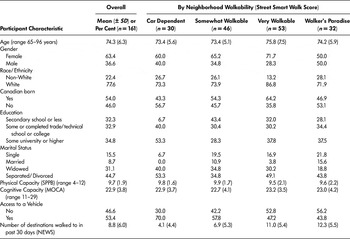
Table 1 describes the characteristics of the study sample, overall and by each category of neighbourhood walkability. On average, these 161 older adults were 74 years of age, and the majority (63%) were female. Just under half (46%) were foreign born and 77 per cent were White. Most participants were separated/divorced (45%) or widowed (31%), and about a third (32%) had a high school education or less. Mean SPPB score was 9.7 (range 4–12), which reflects some impairment in lower extremity function in these older adults on average. Mean score on the cognitive assessment (MoCA) was 23 (range 11–29), indicating mild cognitive impairment in our sample. There were no statistically significant differences in the health and sociodemographic characteristics of participants living in neighbourhoods with different levels of walkability.
Characteristics of the study sample overall and by neighborhood walkability: Data from Walk the Talk Study, Vancouver, BC (2012)

MoCA = Montreal Cognitive Assessment
NEWS = Neighborhood Environment Walkability Survey
SD = standard deviation
SPPB = Short Physical Performance Battery
A third of the study participants lived in neighbourhoods that were very walkable (32%) according to the Walk Score while 20 per cent lived in a walker’s paradise. However, approximately half lived in areas that were only somewhat walkable (29%) or car dependent (19%). Just over half had access to a vehicle on a regular basis. Despite the variation in neighbourhood walkability, these older adults reported walking to more than eight destinations, on average, in the past month (Table 1). Weather over the study period (163.2 [± 49.6] mm of rain per month) was typical for Metro Vancouver. In addition, snow fell on 5.7 (± 5.5) per cent of days in the past month on average (equivalent to 1.5 days in the past 30 days).
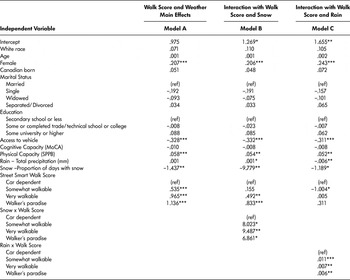
Table 2 reports results from the Poisson regression analyses for the number of places participants walked to in the past 30 days. Model A presents the coefficients for the main effects of neighbourhood walkability and weather conditions, adjusting for individual co-variates. Because the Poisson model is an exponential model, we can interpret the coefficients by taking the antilog of the parameter estimates. There were notable gender differences with women walking to more destinations in the past 30 days than did men (β = .207, Model A, Table 2). Expressing this effect in terms of the percentage difference in the expected number of destinations (100 [e .207 –1]), on average, women walked to 23 per cent more destinations than did men in the past month. Access to a vehicle reduced the expected number of destinations walked to by 28 per cent ([100(e −.328 –1)] = –28%). Older adults with greater physical capacity reported walking to a greater number of destinations. Specifically, for each unit increase in SPPB score, the number of places individuals walked to in the past month increased by 6 per cent. Cognitive capacity was not associated with the number of destinations older peopled walked to.
Poisson regression coefficients: Number of places walked to in past 30 days by neighbourhood walkability (Street Smart Walk Score) and weather conditions – Data from Walk the Talk Study in Vancouver, BC (n = 161) 2012
* p < .05 **p < .01 ***p < .001 (two-tailed tests)
MoCA = Montreal Cognitive Assessment
SPPB = Short Physical Performance Battery
There were no significant relationships between any of the other sociodemographic or health characteristics and mobility. However, there were notable effects of neighbourhood walkability and weather conditions (Model A, Table 2). Older adults living in more walkable neighbourhoods (greater intersection density, shorter block length, more amenities) walked to more destinations in the past month. Compared to those living in car-dependent neighbourhoods, older adults living in neighbourhoods with the highest ranked Walk Scores (walker’s paradise) walked to more than five additional destinations in the past month (211% additional destinations, holding all other co-variates at their reference – null – values).
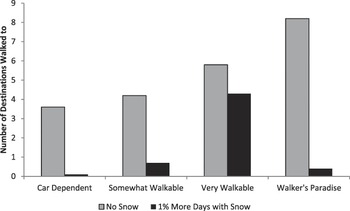
Conversely, snow had a negative effect on mobility. At average levels of rain (centered at the mean of 163 mm for analysis), a one per cent increase in the proportion of days with snow decreased the expected number of destinations older adults walked to in the past 30 days by a factor of .24 (e −1.437 = .24) or 76 per cent (Model A, Table 2). However, the adverse effects of snow on mobility varied depending on the walkability of the neighbourhood. Among older adults living in car-dependent neighbourhoods snow was strongly and negatively associated with mobility (Model B, Table 2). A one per cent increase in the proportion of days with snow in the past month was associated with almost a 100 per cent reduction in the number of destinations older adults walked to in this period ( = 100[e −9.779 − 1] = −99.99%). However, this negative effect was attenuated in more walkable areas. In very walkable neighbourhoods, a one per cent increase in the proportion of days with snow decreased the expected number of places older adults walked to by only 25 per cent( = 100[e −9.779 + 9.487 = −.292 − 1] = −25%) (Model B, Table 2). These differences are illustrated in Figure 1. Note that residing in the most walkable neighbourhoods (walker’s paradise) did not confer the same protective benefits in snowy weather. In these areas, a one per cent increase in the proportion of days with snow reduced the expected number of destinations that older adults walked to by 95 per cent ( = 100[e −9.779 + 6.861 = −2.918 − 1] = −95%) (Model B, Table 2).
Predicted number destinations older adults walked to in past 30 days by neighbourhood walkabilitya and proportion of days with snow
a Neighbourhood walkability is based on categories of Street Smart Walk Score. The predicted number of destinations walked to – at average levels of rain – is calculated for a 65-year-old non-White female, Canadian born, married, with secondary school education, without access to a vehicle, with average physical and cognitive capacity.

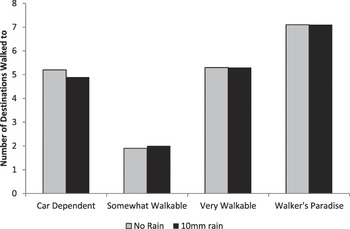
In contrast, rain had less pronounced effects on mobility in our Vancouver sample of older adults. Rain had no significant main effect on the number of destinations older adults walked to in the past month (Model A, Table 2), but the effect varied across different built environments (Model C, Table 2). Specifically, among older adults who lived in car-dependent neighbourhoods, rain was negatively associated with mobility. Holding all other co-variates at their reference (null) values, an increase in 10 mm of rain in the past 30 days decreased the number of destinations older adults walked to in car-dependent neighbourhoods by a factor of .94 (e −.06 = .94) or by 6 per cent ( = 100[e −.06 − 1] = −6%) (Model C, Table 2). In contrast, for older adults who lived in very walkable or highly walkable (walker’s paradise) neighbourhoods, rain had no significant effect on mobility. In a walker’s paradise, the effect of 10 mm of rain had no impact on the number of destinations walked to ( = 100[e −.06 + .06 − 1] = −0%), while in very walkable neighbourhoods the effect of 10mm of rain had almost no impact ( = 100[e −.06 + .07 − 1] = −1%). These differences are plotted in Figure 2.
Predicted number destinations older adults walked to in past 30 days by neighbourhood walkabilitya and total rainfall (millimetres)
a Neighbourhood walkability is based on categories of Street Smart Walk Score. The predicted number of destinations walked to is calculated for a 65-year-old non-White female, Canadian born, married, with secondary school education, without access to a vehicle, with average physical and cognitive capacity, with no snow in the past 30 days.

Discussion
We address current gaps in the knowledge base of older adult mobility by examining the role of weather conditions on the well-documented relationship between neighbourhood walkability and mobility. A key strength of our study was its focus on outdoor mobility in an under-studied, socioeconomically vulnerable population of community-dwelling older adults who were experiencing housing instability as well as physical and cognitive impairment. We found that those who lived in more walkable neighbourhoods walked to more destinations in the past month. This is consistent with studies of community-dwelling older adults of average income (Hirsch, Moore, Evenson, Rodriguez, & Roux, Reference Hirsch, Moore, Evenson, Rodriguez and Roux2013). However, we also found that weather conditions changed the degree to which walkable neighbourhoods were associated with mobility. Specifically, car-dependent neighbourhoods, characterized by longer block lengths, fewer intersections and greater distance to amenities, appeared to become almost inaccessible for older adults when there was snow. The predicted number of destinations that older residents walked to in these neighbourhoods decreased to almost zero when there was snow. Even older adults who lived in very walkable neighbourhoods walked to 25 per cent fewer destinations when there was snow. We did not find any interactions between snow and individual factors (physical or cognitive capacity, gender). However, women tended to walk to more destinations than men, and individuals with greater physical capacity tended to walk to more places than those who had reduced physical capacity. Not surprisingly, individuals with access to a motorized vehicle walked to fewer destinations in any given neighbourhood.
We were somewhat surprised by the negative effect of snow on mobility among those who lived in the most walkable neighbourhoods (walker’s paradise according to the Street Smart Walk Score). This may reflect the density of nearby stores and restaurants in walkable environments, which may offer delivery services that minimize the need for older people to go out in inclement weather. This finding may also be due to unmeasured differences in individual socioeconomic resources among those who lived in very walkable neighbourhoods that afford these participants greater flexibility to choose not to go out in adverse weather. For example, an older person’s decision to walk to the store when there is snow is likely dependent on financial (e.g., sufficient money to take a taxi) and human (e.g., someone else picks up groceries) resources that alone and together provide alternative options in the face of adverse weather. Although we found no difference in the health and sociodemographic characteristics of participants living in different neighbourhoods, measures of income and social support were not available in the data. Thus, we were unable to determine with our data whether those with access to greater economic resources and social support were more likely to live in the most walkable neighbourhoods. We therefore introduce this line of reasoning merely as one potential explanation for these apparently counterintuitive findings.
Rain was less of a barrier for mobility in these Vancouver-dwelling older adults. Rain had no effect on the number of destinations people walked to on average, and only a small negative impact on mobility for those who lived in car-dependent neighbourhoods. Rain is not uncommon in Vancouver, and older adults are likely to have learned how to manage getting out and about in the rain (e.g., by wearing appropriate footwear or clothing). This is especially likely since the majority of participants were long-term residents of Vancouver (over 35 years on average) and, as such, have been exposed to rainy conditions over many years. Most notably, the adverse effects of rain on mobility were essentially non-existent in very or highly walkable neighbourhoods.
On the other hand, snow was clearly a problem for these Vancouver seniors. While snow may not stay on the ground for an extended period of time, older adults in Vancouver are less familiar with these conditions that can generate icy surfaces and subsequent problems for mobility (Li et al., Reference Li, Hsu and Fernie2013). Elsewhere, older Americans were also found to have twofold higher odds of reporting “a great deal of difficulty leaving home when icy” compared to younger adults (Clarke, Yan, Keusch, & Gallagher, Reference Clarke, Yan, Keusch and Gallagher2015).
Although it is not possible to change the weather, we can invest in the design of outdoor built environments to minimize the impact of adverse weather on older adult mobility. Our findings emphasize that the negative influence of both snow and rain on mobility is diminished in more walkable neighbourhoods. Walkable neighbourhoods host a greater density of nearby destinations that require shorter trips to reach amenities. Thus, even in bad weather, walking remains a feasible form of transport in these types of neighbourhoods.
Our findings have relevance regarding allocation of resources by municipalities since wide, continuous sidewalks promptly cleared of snow and ice facilitate outdoor mobility even during winter weather (Hanson et al., Reference Hanson, Schiller, Winters, Sims-Gould, Clarke, Curran and McKay2013). Li et al. (Reference Li, Hsu and Fernie2013) argued for ensuring that ice and water do not build up at the base of curb cuts in winter weather, as this renders pedestrian crossings non-navigable for older adults. Municipalities might also consider alternative designs for curb cuts and pedestrian intersections that facilitate safe mobility for older adults in winter weather (Li et al., Reference Li, Hsu and Fernie2013; Perry, Reference Perry2014), even in the most walkable built environments.
Collectively, our results argue for the integration of weather conditions into studies of the built environment and mobility, and even into calculations of walkability indices more generally. Almost all studies of the built environment and mobility in older adults have been specific to single urban areas (e.g., Portland [Michael et al., Reference Michael, Keast, Chaudhury, Day, Mahmood and Sarte2009], Atlanta [Frank et al., Reference Frank, Kerr, Rosenberg and King2010], Baltimore [Glass, Rasmussen, & Schwartz, Reference Glass, Rasmussen and Schwartz2006], Detroit [Gallagher et al., Reference Gallagher, Gretebeck, Robinson, Torres, Murphy and Martyn2010]). This creates a gap in our knowledge regarding whether the association between key built environment features and mobility is unique to the weather or climate in specific regions. For example, a city neighbourhood considered very walkable in a hot, dry climate may not be as walkable in climates that experience more regular rain or snow. We also do not currently know how the relationship between key built environment factors, weather, and mobility is altered in small urban, rural, or remote communities.
Our study is not without limitations. The study sample was limited to a socioeconomically vulnerable population of older adults. However, our focus on this population could also be viewed as a strength because this is precisely the group most likely to be negatively affected by weather as they are less likely to own a car and have limited options for transportation. However, possibly in part because we were sampling from a vulnerable population of older adults, the participation rate in this study was low (16%). Nonetheless, this is comparable to participation rates from other telephone surveys (Kohut et al., Reference Kohut, Keeter, Doherty, Dimock and Christian2012) and surveys of older adult mobility (King et al., Reference King, Sallis, Frank, Saelens, Cain, Conway and Kerr.2011; Rosso et al., Reference Rosso, Grubesic, Auchincloss, Tabb and Michael2013). Information on the different destinations people walked to was collected through a self-administered survey, and we did not have the opportunity to uncover the reasons why some destinations were not walked to, including the impact of weather-related factors. In addition, our measure of mobility was based on the total number of different places walked to in the past 30 days, not the total number of walking trips. Future work would benefit from the use of objective measures of mobility linked to weather conditions in real time. Data were also restricted to Metro Vancouver, which has a unique oceanic climate, and differences by geographic region are likely when considering the impact of weather on mobility (Clarke et al., Reference Clarke, Yan, Keusch and Gallagher2015). However, given that weather restricted mobility even in a relatively mild Canadian climate like Vancouver, the impact could be of even greater magnitude for older adults living in regions with more severe or changeable weather conditions. We were not able to examine the effect of temperature on mobility over and above precipitation, given the strong collinearity between temperature and precipitation. However, in separate models, temperature had little effect on older adult mobility in this Vancouver sample. Data on the built environment were obtained using the Street Smart Walk Score, which relies on aggregate characteristics of block length, proximity to amenities, and intersection density to rate neighbourhood walkability. More detailed street features and pedestrian amenities (e.g., presence of curb cuts, bus shelters, trees, benches upon which to rest) would provide more information about built environment features that likely influence mobility in older adult populations. Finally, we were unable to model the effects of other personal factors, such as choice of footwear or balance problems, and we acknowledge that these could change older people’s decision to walk in snow or rain.
To conclude, we highlight that it is crucial to consider weather conditions when examining mobility in older adults. Further research should consider how a range of different weather conditions modify the walkability of built environments and how living in more or less walkable urban, suburban, or rural neighbourhoods attenuates or intensifies the impact of inclement weather on older adult mobility. Town and city planners should be encouraged to build more walkable neighbourhoods that encourage older adults to maintain outdoor mobility and social interaction even in challenging weather conditions (Perry, Reference Perry2014). It is not beyond the realm of possibility that neighbourhood walkability will become an important community-level coping tool that supports mobility in the very real face of climate change.