Introduction
Pest suppression in greenhouse crops is often accomplished using several species of natural enemies simultaneously for the control of one or more pests. This practice leads to the creation of artificial food webs where plants, pests and natural enemies engage in complex food web interactions (Janssen et al., Reference Janssen, Pallini, Venzon and Sabelis1998). Many biological control agents interact because they have overlapping food ranges and compete for the same food source. In addition, they also are likely to engage in intra-guild interactions with each other. This may or may not have an effect on pest density and, hence, influence pest control (e.g. Rosenheim et al., Reference Rosenheim, Kaya, Ehler, Marois and Jaffee1995; Finke & Denno, Reference Finke and Denno2003; Prasad & Snyder, Reference Prasad and Snyder2004; Rosenheim & Harmon, Reference Rosenheim, Harmon, Brodeur and Boivin2006). Food webs with multiple intra-guild predator species have been shown to be far less effective at suppressing herbivores than webs consisting largely of strict predators (Denno & Finke, Reference Denno, Finke, Brodeur and Boivin2006). Intra-guild interactions may especially occur when pest densities are low (Polis et al., Reference Polis, Myers and Holt1989), such as in greenhouse ornamentals where pest tolerance is very low.
Amblyseius swirskii (Athias-Henriot) (Acari: Phytoseiidae) is a relatively new predator used for whitefly and thrips control in greenhouse crops (Nomikou et al., Reference Nomikou, Janssen, Schraag and Sabelis2001; Messelink et al., Reference Messelink, Van Steenpaal and Ramakers2006). It is a generalist predator preying on many insect and mite species and also feeding on pollen. This broad host range is advantageous because A. swirskii could be used to control multiple pest species in the greenhouse, as is the case for many generalist predators (Symondson et al., Reference Symondson, Sunderland and Greenstone2002). In addition, A. swirskii populations increase much faster, and pest control is better, when two different prey species (whiteflies and thrips) are available, as compared to only one of the two prey species (Messelink et al., Reference Messelink, van Maanen, Van Steenpaal and Janssen2008). However, a broad host range could also be a problem if A. swirskii is preying on other biological control agents in the greenhouse ecosystem, such as Aphidoletes aphidimyza eggs or other predatory mite species. Amblyseius swirskii potentially is able to do so, because it has been shown to feed on protonymphs of the phytoseiid predatory mite Euseius scutalis (Athias-Henriot) (Rasmy et al., Reference Rasmy, Abou El-Ella and Hussein2004). In addition, there is ample evidence of related generalist phytoseiid mites feeding on other phytoseiids (McMurtry & Croft, Reference McMurtry and Croft1997) and generalist phytoseiid mites being more aggressive intra-guild predators of heterospecific phytoseiid mites than specialists (Schausberger & Croft, Reference Schausberger and Croft2000).
In many greenhouse crops, e.g. peppers, cucumber and gerbera, growers release both A. swirskii and Neoseiulus cucumeris (Oudemans) (Acari: Phytoseiidae). Although A. swirskii might to be superior for thrips control to N. cucumeris according to some studies (van Houten et al., Reference van Houten, Ostlie, Hoogerbrugge and Bolckmans2005; Messelink et al., Reference Messelink, Van Steenpaal and Ramakers2006), there are still too many unknown factors to decide which predator is the best. One of the reasons for releasing A. swirskii and N. cucumeris together is because N. cucumeris is less expensive as it is easily mass reared. Growers release N. cucumeris at the beginning of the crop and later add A. swirskii. There are indications that both species indeed interact negatively with each other. For example, it has been observed that plots of greenhouse cucumber to which N. cucumeris had been applied were accidentally colonized by A. swirskii, resulting in total elimination of the N. cucumeris population (Messelink et al., Reference Messelink, Van Steenpaal and van Wensveen2005).
It is not known if A. swirskii has intra-guild interactions with N. cucumeris, or vice versa, and if so, what the predation rate is. In contrast to many intra-guild interactions where there is an intra-guild predator and and intra-guild prey, A. swirskii and N. cucumeris potentially engage in symmetrical (mutual) intra-guild predation where adults of each species are eating juveniles of the competing species (Polis et al., Reference Polis, Myers and Holt1989; Polis & Holt, Reference Polis and Holt1992). Intra-guild interactions are likely to be more important if the quality of intra-guild prey as a food source is high, leading to a higher fitness, and if the predator has a preference for intra-guild prey. Therefore, in this study, we investigated (i) fitness parameters, such as oviposition rate, predation rate and development time, of A. swirskii and N. cucumeris when fed intra-guild or extra-guild prey (Frankliniella occidentalis (Pergande)); and (ii) A. swirskii and N. cucumeris prey preference in choice experiments.
Material and methods
Thrips and predatory mite rearing
A greenhouse colony of western flower thrips, F. occidentalis, was maintained on yellow potted chrysanthemum (Dendranthema grandiflora Tzvelev, var. Chesapeake). Cohorts of thrips larvae were reared on kidney bean (Phaseolus vulgaris L.) leaves embedded in 1.5% (w/v) agar in 9-cm Petri dishes with thrips-proof screened lids in a controlled environmental chamber (25°C±1, RH 70±10%, L:D 12:12). Twenty-five female thrips were allowed to oviposit on the leaf for two days. First instar larvae were obtained after four days (Robb, Reference Robb1989).
Laboratory colonies of predatory mites were established using A. swirskii and N. cucumeris from Biobest Canada Ltd (Leamington, ON, Canada). Amblyseius swirskii was reared according to methods adapted from Overmeer (Reference Overmeer, Helle and Sabelis1985) on kidney bean leaf disks that were placed upside down on water saturated sponges in 237-ml containers (Solo, Highland Park, IL, USA), which were closed with a fine mesh (100 μm mesh opening) screened lid. Mites were fed with cattail pollen (Typha sp.) every other day. Pollen was field collected and stored in the freezer at −15°C. Eggs were collected every day to create cohorts of a known age (<24 h). A colony of N. cucumeris was fed on Tyrophagus putrescentiae (Schrank) (Acari: Acaridae) maintained on wheat bran. Neoseiulus cucumeris adult females were collected from the colony and held on bean leaf disks with cattail pollen. To obtain evenly aged mite cohorts, eggs were collected and reared on pollen as described above for A. swirskii.
Predation and oviposition capacity
To investigate the effects of eating intra- or extra-guild prey, A. swirskii and N. cucumeris females (2–4 days old) were provided with prey ad libitum for four days. Predation (number of prey individuals consumed) and oviposition capacity (number of eggs laid) of both predatory mite species were measured when fed eggs, larvae or deutonymphs of the other predatory mite species and compared to data obtained when the predatory mites were fed first instar thrips larvae. One female predatory mite was confined on a leaf disk (1.5×1.5 cm) that floated upside down on a water saturated sponge in a 60-ml cup (Solo, Highland Park, IL, USA). The cup was closed with fine mesh (100 μm mesh opening) screening held in place by a plastic lid with a 2-cm diameter opening. Cups were placed in a controlled environmental chamber (25°C±1, RH 70±10%, L:D 16:8). Prey was renewed every day (10 eggs, 15 larvae, 10 deutonymphs, 10 first instar thrips). Trials were replicated 8–15 times. Data from the first day were omitted from the calculations of predation and oviposition capacity to reduce the influence of pre-experimental conditions (van Houten et al., Reference van Houten, van Rijn, Tanigoshi, van Stratum and Bruin1995).
Development time and survival to adult stage
The influence of different intra-guild and extra-guild prey on predatory mite development time was investigated for both A. swirskii and N. cucumeris. Eggs of either species (<12 h old) were individually placed on bean leaf disks such as were used in the previous experiments. Every 12 hours, eggs were checked for hatching. After hatching, the immature predatory mites were provided with prey ad libitum every 12 hours, either intra-guild predatory mite eggs or larvae or first instar thrips larvae. Predatory mite prey were frozen in order to prevent the eggs from hatching and to be able to recognize experimental larvae from prey larvae. This did not seem to influence mite feeding (R. Buitenhuis, personal observation). First instar thrips were alive. During development, predatory mites were checked every 12 hours for moulting, recognized by the presence of an exuvium on the leaf disk and for survival. The experiment was replicated 16 times in two blocks of eight replicates.
Choice experiments
Two different choice tests were conducted to determine if the predators had a preference for any prey species, or life stage, or if they predated indiscriminately. In the first experiment (performed only with A. swirskii), female predatory mites were offered two types of prey ad libitum and the quantities of each prey eaten were measured. In the second experiment (performed with the two predator species), one individual of each of two types of prey were offered in choice tests.
In the first experiment, female A. swirskii (2–4 days old) were individually placed on bean leaf disks such as were used in the previous experiments and given abundant prey of the two prey species/stages for two days (5 N. cucumeris eggs+15 N. cucumeris larvae; 5 N. cucumeris eggs+10 first instar thrips; 15 N. cucumeris larvae+10 first instar thrips). Data from the first day were omitted to reduce the influence of pre-experimental conditions (van Houten et al., Reference van Houten, van Rijn, Tanigoshi, van Stratum and Bruin1995). As an indiscriminate predator, it would be expected that the mite would eat half the amount of both prey types as measured in the experiment on predation capacity. It was not possible to perform the same experiment for N. cucumeris females because the A. swirskii larvae quickly molted to protonymphs which fed on the thrips and eggs, confounding the results. The treatments were replicated 15 times.
In the second experiment, female A. swirskii and N. cucumeris mites were observed when given the choice between one of each of two prey species/stages: between an egg or larva of the opposite predator species, an egg of the opposite predator species and a first instar thrips, or between a larva of the opposite predator species and a first instar thrips). A single female mite (2–4 days old) was given a 24 hour (day 1) exposure period to abundant prey of two prey species/stages and then starved for 24 hours (day 2). On the third day, the female was confined on a small bean leaf disk (0.5×0.5 cm) with one of each of two prey species/stages and her behaviour was observed and timed until she made a choice and started feeding. Sample size varied between 11 and 13 replicates.
Statistical analysis
Predation and oviposition capacity data and development time were square root transformed to adjust the data for homogeneity of variance and normality, and comparisons were made among prey types and between predator species using two-way ANOVA. In the choice experiment, the numbers of prey eaten of both prey types were compared to the expected numbers of prey eaten (half the amount of both prey types as measured in the experiment on predation capacity) using a t-test for each combination of prey types. The results from the choice observations were compared using a chi-square test of goodness-of-fit, where the observed frequencies were compared to expected frequencies of 0.5 (no preference). For all statistical analyses, SAS statistical package ver. 9.1.3 was used and differences were determined to be significant at α<0.05.
Results
Predation and oviposition capacity
Both A. swirskii and N. cucumeris preyed on immature stages of the opposite predator species (intra-guild prey) (table 1). However, they fed on eggs only in very small numbers. Adult stages did not feed on each other (R. Buitenhuis, personal observation). There were significant differences in predation rates between the two predatory mite species among different prey types (prey type: F3,78=127.42, P<0.0001; predator species F1,78=16.03, P<0.0001), but the interaction between prey types and predator species was also significant (F3,78=7.69, P<0.0001), which means that the effects of both main effects were interrelated. Comparing the two predators, A. swirskii had a significantly higher predation rate of intra-guild prey (eggs, larvae and deutonymphs) than N. cucumeris, but A. swirskii consumed significantly less thrips than N. cucumeris (table 1). Oviposition rates were also significantly different among different prey types (prey type: F3, 78=13.10, P<0.0001; predator species F1,78=2.44, P=0.1220), but the interaction between prey types and predator species was again significant (F3,78=3.99, P=0.0106). Similar to the results of predation rate, A. swirskii had a higher oviposition rate on intraguild prey eggs and deutonymphs than N. cucumeris, but laid fewer eggs than N. cucumeris when it was fed on thrips (table 2). Comparing oviposition rates on different prey within species, A. swirskii laid more eggs when feeding on N. cucumeris larvae and deutonymphs than on thrips, which indicates that mite immatures are the better food source for this predator (table 2). In contrast, oviposition by N. cucumeris was the same on both thrips and A. swirskii immatures. Oviposition rates of both predator species on eggs were the lowest.
Daily predation rate (mean±SE) of Amblyseius swirskii and Neoseiulus cucumeris on western flower thrips, Frankliniella occidentalis, and intra-guild prey (N=8–15).

Values in columns and rows followed by different letters are significantly different (α<0.05).
Daily oviposition rate (mean±SE) of Amblyseius swirskii and Neoseiulus cucumeris on western flower thrips, Frankliniella occidentalis, and intra-guild prey (N=8–15).

Values in columns and rows followed by different letters are significantly different (α<0.05).
Development time and survival to adult stage
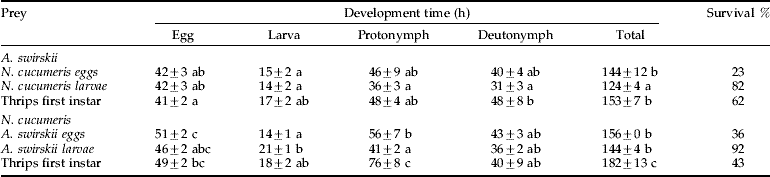
Total development time was faster for A. swirskii than for N. cucumeris (F1,80=12.68, P=0.0006). For both predator species, there were also significant differences in development time depending on prey type (F2,80=0.39, P=0.6764), but no significant interaction occurred between predator species and prey type (F2,80=0.61, P=0.5451). The difference in development time between A. swirskii and N. cucumeris was caused by significantly shorter A. swirskii egg and protonymph stages (table 3; see table 4 for F and P values for each developmental stage). Differences among prey types are only observed for the protonymph stage of N. cucumeris.
Duration of developmental stages in hours (mean±SE) and percent survival until adulthood of A. swirskii and N. cucumeris on a diet of intra-guild (eggs or larvae) or extra-guild (first instar thrips larvae, Frankliniella occidentalis) prey (N=16).

Values in columns and rows followed by different letters are significantly different (α<0.05).
F- and P-values of two-way ANOVAs analyzing the duration of each developmental stage separately for A. swirskii and N. cucumeris (predator species) on a diet of intra-guild or extra-guild prey (prey type) (α<0.05).

Survival to the adult stage was very low (23%) for A. swirskii fed on N. cucumeris eggs (table 3). It was observed that A. swirskii protonymphs that died were not able to feed on eggs. However, in the cases where A. swirskii protonymphs were able to pierce the eggs and consumed the contents, they survived to adults and development time was intermediate. Protonymphs of N. cucumeris were often unable to feed on A. swirskii eggs and thrips, also leading to a lower percentage of immatures surviving until the adult stage.
Choice experiments
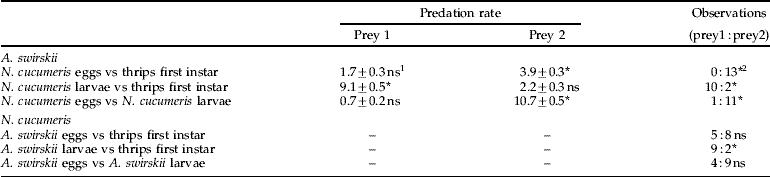
In choice experiments with excess of the two prey types, A. swirskii predated more than expected on N. cucumeris larvae (t=−6.48, P<0.0001) but killed the same number of thrips larvae as expected (t=−0.60, P=0.5545) (table 5). Eggs of N. cucumeris were preyed on as expected when combined with thrips (eggs: t=−1.50, P=0.1449; thrips: t=−5.51, P<0.0001) and N. cucumeris larvae (eggs: t=0.99, P=0.3300; larvae: t=−9.06, P<0.0001) both of which were killed more than expected in these prey combinations. The observations on prey choice (table 5) confirmed these results (egg vs thrips: χ2=13.00, P=0.0003; larva vs thrips: χ2=5.33, P=0.0209; egg vs larva: χ2=8.33, P=0.0039). In contrast, N. cucumeris had no preference between A. swirskii eggs and larvae (χ2=0.69, P=0.4054) or A. swirskii eggs and thrips larvae (χ2=1.92, P=0.1655). However, as in the case of A. swirskii, N. cucumeris preferred to prey on intra-guild prey larvae rather than on thrips larvae (χ2=4.45, P=0.0348).
Predation rate (one day) of Amblyseius swirskii and Neoseiulus cucumeris presented with two prey species/stages (mean±SE), and separate trial on observations on prey choice (prey 1: prey 2).

1 t-test, compared to expected results (half of the predation rates in table 1). If A. swirskii is an indiscriminate predator, predation rates of prey 1 and 2 are not significant (ns). If A. swirskii shows a preference, prey 1 or 2 is significantly different (*) α<0.05.
2 Chi-square test of goodness of fit.
Discussion
Phytoseiid predatory mites are used worldwide in biological control of several different pests, such as thrips, spider mites, broad and cyclamen mites and whiteflies (Helle & Sabelis, Reference Helle and Sabelis1985; McMurtry & Croft, Reference McMurtry and Croft1997). Interspecific predation and cannibalism have been demonstrated in several species of phytoseiid mites (e.g. Croft & Croft, Reference Croft and Croft1996; Croft et al., Reference Croft, Kim and Kim1996; McMurtry & Croft, Reference McMurtry and Croft1997; Walzer & Schausberger, Reference Walzer and Schausberger1998, Reference Walzer and Schausberger1999; Schausberger, Reference Schausberger1999; Montserrat et al., Reference Montserrat, Janssen, Magalhaes and Sabelis2006) and poses a potential problem when several of these predator species are used together in biological control. The results of this study demonstrate mutual intra-guild interactions between A. swirskii and N. cucumeris. The juvenile stages (larva to deutonymph) are especially vulnerable, but not eggs.
Contrary to intra-guild predation theory, where the quality of intra-guild prey and conspecifics is low relative to the quality of extra-guild prey (Polis, Reference Polis1981; Polis et al., Reference Polis, Myers and Holt1989), in this study, intra-guild prey seemed to be of equal or higher quality than extra-guild prey for both predators. Comparing the fitness measurements of predators predating on intra- and extra-guild prey, it was demonstrated that A. swirskii has higher oviposition rates and a faster development time on intra-guild prey (N. cucumeris larvae) than on extra-guild prey (thrips). For N. cucumeris, oviposition rates on intra- and extra-guild prey were equal, but development time was faster on intra-guild prey (A. swirskii larvae). Usually, provision of abundant extra-guild prey has been demonstrated to decrease predation on intra-guild prey (Polis, Reference Polis1981; Polis et al., Reference Polis, Myers and Holt1989; Onzo et al., Reference Onzo, Hanna, Negloh, Toko and Sabelis2005; Zannou et al., Reference Zannou, Hanna, Moraes and Kreiter2005; Meszaros et al., Reference Meszaros, Tixier, Cheval, Barbar and Kreiter2007). However, both A. swirskii and N. cucumeris had a preference for intra-guild prey. Especially A. swirskii preferred N. cucumeris larvae over thrips even when both prey were abundant. This choice might be explained by the high food quality of intra-guild prey. In addition, in the observation choice trials, it was observed that thrips larvae showed defence behaviour, such as jerking the abdomen and producing a drop of rectal fluid in response to predator attack (Bakker & Sabelis, Reference Bakker and Sabelis1989). Due to this defence behaviour, the thrips larvae often escaped predation. Intra-guild prey eggs were only predated in low numbers, resulting in low oviposition rates and low survival during development. In the choice experiments, adult A. swirskii almost never chose to predate on N. cucumeris eggs, while N. cucumeris adults successfully attacked A. swirskii eggs but had no preference for them. Both adult and juvenile predators were observed to have difficulties piercing the eggs of the other predator species with their mouthparts, which corresponds to reports for other phytoseiid mites (Schausberger, Reference Schausberger1997; Schausberger & Croft, Reference Schausberger and Croft1999). From the observations, it seems both predatory mites predate on the first prey they can easily feed on, preferring intra-guild prey larvae because they do not exhibit defence behaviour like thrips larvae and are easier to feed on than intra-guild prey eggs.
Interestingly, the development time of N. cucumeris on thrips larvae was slow and variable, and survival to adult was low. To a lesser extend, the same trend could be observed for A. swirskii. These results can be explained by the difficulties that juvenile predators, especially larvae and protonymphs, had to capture the thrips, probably due to thrips defence behaviour (Bakker & Sabelis, Reference Bakker and Sabelis1989). Similar results were obtained by Wimmer et al. (Reference Wimmer, Hoffmann and Schausberger2008), where less than one third of the juvenile A. swirskii reached adulthood when fed thrips larvae. If thrips were killed by freezing just before offering them to the predators, A. swirskii and N. cucumeris development times were among the fastest (R. Buitenhuis, unpublished data). This indicates that, although first instar thrips larvae have high nutritional value for a developing predator, the difficulty of catching thrips makes them a less suitable food source. In other studies, juvenile phytoseiids have also been observed to have difficulties in overcoming the defences of even the smallest thrips, and may even be unable to attack thrips larvae and, therefore, need to rely on other food sources to complete their development (Sabelis & van Rijn, Reference Sabelis, van Rijn and Lewis1997).
Intra-guild predation can influence coexistence of the two predator species and may affect thrips control in the greenhouse, as has been demonstrated for other biological control agents (Rosenheim & Harmon, Reference Rosenheim, Harmon, Brodeur and Boivin2006; Vance-Chalcraft et al., Reference Vance-Chalcraft, Rosenheim, Vonesh, Osenberg and Sih2007). Mutual intra-guild predation, as observed in this study, potentially increases the negative effects on pest control as compared to a system with one intra-guild predator and an intra-guild prey. However, there is also evidence that intra-guild predation may serve to stabilize the predator's population over time (Polis et al., Reference Polis, Myers and Holt1989), for example by providing an alternative food source when prey is scarce. Predatory mites might experience less intra-guild interactions in the greenhouse or field than in laboratory experiments. Predators that engage in intra-guild predation may be able to coexist by having different foraging strategies or different distributions on the plant, and species dominance also may differ on different crop varieties (McMurtry & Croft, Reference McMurtry and Croft1997). For example, N. cucumeris distribution on sweet peppers was affected by other predators; in the presence of the predatory bug, Orius laevigatus (Fieber), virtually no mites occurred in the flowers (Weintraub et al., Reference Weintraub, Kleitman, Alchanatis and Palevsky2007). Also, habitat structure (Janssen et al., Reference Janssen, Sabelis, Magalhães, Montserrat and van der Hammen2007) or leaf pubescence (Seelmann et al., Reference Seelmann, Auer, Hoffmann and Schausberger2007) can alter intra-guild predation interactions, and some species of phytoseiid mites tend to avoid patches with intra-guild predators using volatiles (Gnanvossou et al., Reference Gnanvossou, Hanna and Dicke2003).
In conclusion, the results of this study indicate a high potential for negative interactions between A. swirskii and N. cucumeris when used together in biological control of thrips. There is need for further experiments investigating these intra-guild interactions on a larger scale in order to determine recommendations for the use of these two predators together in greenhouse crops.
Acknowledgements
We thank Wonhyo Lee and Yun Zhang for technical assistance. This research was supported by Flowers Canada (Ontario) and the Matching Investment Initiative of Agriculture and Agri-Food Canada.