Introduction
Alcohol dependence (AD) is associated with elevated levels of impulsivity (Dick et al. Reference Dick, Smith, Olausson, Mitchell, Leeman, O'Malley and Sher2010; Lejuez et al. Reference Lejuez, Magidson, Mitchell, Sinha, Stevens and de Wit2010), but the genetic and environmental underpinnings of this association remain unclear. It is well known that AD is aggregated within families (Sher et al. Reference Sher, Walitzer, Wood and Brent1991; Merikangas et al. Reference Merikangas, Stolar, Stevens, Goulet, Preisig, Fenton, Zhang, O'Malley and Rounsaville1998), and early adoption studies have indicated that genetic factors influence AD (Goodwin et al. Reference Goodwin, Schulsinger, Hermansen, Guze and Winokur1973; Cloninger et al. Reference Cloninger, Bohman and Sigvardsson1981). Subsequently, a large number of twin studies have estimated the heritability to approximately 40–60% (Hrubec & Omenn, Reference Hrubec and Omenn1981; Kendler et al. Reference Kendler, Heath, Neale, Kessler and Eaves1992, Reference Kendler, Prescott, Neale and Pedersen1997; Heath et al. Reference Heath, Bucholz, Madden, Dinwiddie, Slutske, Bierut, Statham, Dunne, Whitfield and Martin1997; True et al. Reference True, Xian, Scherrer, Madden, Bucholz, Heath, Eisen, Lyons, Goldberg and Tsuang1999; Knopik et al. Reference Knopik, Heath, Madden, Bucholz, Slutske, Nelson, Statham, Whitfield and Martin2004). Several phenotypes have been suggested to increase the risk of developing AD, including subjective response to alcohol intake (Schuckit & Smith, Reference Schuckit and Smith1996; Schuckit, Reference Schuckit2009; Ray et al. Reference Ray, Mackillop and Monti2010), altered striatal dopamine receptor levels (Goldstein et al. Reference Goldstein, Alexoff, Thanos, Volkow, Wang, Begleiter, Porjesz, Fowler, Telang, Wong, Ma and Logan2006; Setiawan et al. Reference Setiawan, Pihl, Dagher, Schlagintweit, Casey, Benkelfat and Leyton2014) and personality traits, such as increased impulsivity (Schuckit, Reference Schuckit2009), but little is known regarding the genetic overlap between these phenotypes and AD.
Impulsivity is a heterogeneous construct, and, in the current study, we adhere to the proposed definition of impulsivity by Moeller et al. (Reference Moeller, Barratt, Dougherty, Schmitz and Swann2001) as ‘a predisposition towards rapid, unplanned reactions to internal or external stimuli without regard to the negative consequences of these reactions to the impulsive individual or to others’. The trait of impulsivity can be assessed by personality questionnaires or neuropsychological tests of response inhibition, delay discounting or decision making (Verdejo-García et al. Reference Verdejo-García, Lawrence and Clark2008). Several lines of research have indicated that increased levels of impulsivity are associated with AD: compared with healthy controls, AD patients have higher scores on personality questionnaires of impulsivity (Ketzenberger & Forrest, Reference Ketzenberger and Forrest2000), as well as impaired performance on an array of neurocognitive tasks of impulsivity (Petry, Reference Petry2001; Finn et al. Reference Finn, Mazas, Justus and Steinmetz2002; Bjork et al. Reference Bjork, Hommer, Grant and Danube2004; Goudriaan et al. Reference Goudriaan, Oosterlaan, de Beurs and van den Brink2006; Lawrence et al. Reference Lawrence, Luty, Bogdan, Sahakian and Clark2009). Furthermore, several studies have shown increased levels of impulsivity in unaffected relatives of AD compared with relatives of controls (Saunders et al. Reference Saunders, Farag, Vincent, Collins, Sorocco and Lovallo2008; Acheson et al. Reference Acheson, Richard, Mathias and Dougherty2011; Kareken et al. Reference Kareken, Dzemidzic, Wetherill, Eiler, Oberlin, Harezlak, Wang and O'Connor2013), suggesting that impulsivity may also confer as a heightened familial vulnerability in the development of AD (de Wit, Reference De Wit2009).
Studies utilizing twin methodology have shown that AD shares genetic factors with other psychiatric disorders characterized by impulsive behaviour, such as conduct disorder (Slutske et al. Reference Slutske, Heath, Dinwiddie, Madden, Bucholz, Dunne, Statham and Martin1998), disordered gambling (Slutske et al. Reference Slutske, Ellingson, Richmond-Rakerd, Zhu and Martin2013) and attention-deficit/hyperactivity disorder (ADHD) (Knopik et al. Reference Knopik, Heath, Jacob, Slutske, Bucholz, Madden, Waldron and Martin2006; Edwards & Kendler, Reference Edwards and Kendler2012). However, it is not clear whether these previously observed genetic overlaps are specific for each disorder or corroborated by a shared genetic overlap between AD and general impulsive behaviour. A putative genetic overlap between AD and impulsivity would increase the understanding of co-morbidity of AD and high-impulsive mental disorders, and would entail several important clinical implications regarding prevention and strategies for the development of novel AD treatment targets.
The current study applies bivariate twin modelling fitting on a large population-based national sample of twins (n = 16 819) to investigate the hypothesized shared genetic overlap between AD and the personality trait of impulsivity, not specific for any mental disorder, found in the general population.
Method
Sample
Twins from the Swedish Twin Study of Adults: Genes and Environment (STAGE), a national prospective sample of twins born in Sweden between 1959 and 1985 (Lichtenstein et al. Reference Lichtenstein, De Faire, Floderus, Svartengren, Svedberg and Pedersen2002), responded online to a survey sent out in 2005. The survey comprised 1300 items covering different health and demographic topics. The survey was sent out to all 43 000 twins in STAGE, and the response rate was 59.6%, resulting in more than 25 000 responders. Zygosity was established using standard physical similarity questions (both twins had to give identical responses) that were validated previously through genotyping (Lichtenstein et al. Reference Lichtenstein, Sullivan, Cnattingius, Gatz, Johansson, Carlström, Björk, Svartengren, Wolk, Klareskog, de Faire, Schalling, Palmgren and Pedersen2006). We included every twin with known zygosity who responded to the AD and/or the impulsivity section, resulting in a final study sample of 16 819 individual twins.
Measures
Each subject was first assessed using the validated CAGE questionnaire (Mayfield et al. Reference Mayfield, McLeod and Hall1974; Bush et al. Reference Bush, Shaw, Cleary, Delbanco and Aronson1987) consisting of four items: (1) ‘have you ever felt you should cut down on your drinking?’; (2) ‘have people annoyed you by criticizing your drinking?’; (3) have you ever felt bad or guilty about your drinking?’; (4) ‘have you ever had a drink first thing in the morning to steady your nerves or get rid of a hang-over (eye-opener)?’. If a subject responded ‘no’ to all four items, then a diagnosis of AD was not given. If a subject responded ‘yes’ to one or more of the items, a total of 29 self-reported items based on Structured Clinical Interview for DSM-IV (SCID-I) questions for lifetime alcohol use disorder (dependence and abuse) were used to assess alcohol-related problems with three response alternatives: ‘yes’, ‘no’, ‘don't know/don't wish to answer’. AD was scored if at least three of seven DSM-IV criteria were positive: (1) development of tolerance, such as an increased amount of the substance necessary for the same effect (‘did you during this period notice you needed to drink more to get the same effect?’) or diminished effect of the same dosage (‘did you notice being less affected by the same amount of alcohol during this period?’); (2) symptoms of withdrawal or avoidance of withdrawal symptoms by means of continued substance use (‘have you felt you needed a drink first thing in the morning (eye opener), to steady your nerves or to get rid of a hangover?’); (3) substance consumption for a longer time or higher amounts than intended; (4) persistent desire to control substance use; (5) great amount of time spent to obtain the desired substance (‘did you spend/have you spent a lot of time drinking, being high, or hung over?’), (6) decrease in social activity due to the substance use; and (7) continued use of the substance despite proven negative effects.
Impulsivity was measured by the impulsiveness scale in the Swedish universities Scale of Personality (SSP) (Gustavsson et al. Reference Gustavsson, Bergman, Edman, Ekselius, von Knorring and Linder2000) The scale consists of seven items: (1) I have a tendency to act on the spur of the moment without really thinking ahead; (2) I often get so excited about new ideas and suggestions that I forget to check if there are any disadvantages; (3) I often embark on things too hastily; (4) I'm the sort of person who takes things as they come; (5) I usually ‘talk before I think’; (6) when I make a decision I usually make it quickly; and (7) I consider myself an impulsive person. Each item had five response alternatives: ‘does not apply at all’, ‘does not apply very well’, ‘neither applies nor does not apply’, ‘applies pretty much’ and ‘applies completely’ corresponding to 1, 2, 3, 4 and 5 points, respectively. The mean impulsiveness scale score was calculated for each subject. The Cronbach's α for the SSP scale of impulsivity was 0.82. See the online Supplementary material for further discussion on psychometric properties of the SSP impulsivity scale.
Statistical analysis
The classical twin study method (Neale et al. Reference Lejuez, Magidson, Mitchell, Sinha, Stevens and de Wit1992) is a natural experiment based on the fact that monozygotic (MZ) twins share all of their genes, while dizygotic (DZ) twins share, on average, 50% of their segregating genes. The total variance of a phenotype can be decomposed into additive genetic factors (A), shared/common environmental factors influencing both twins (C; e.g. socio-economic status of the parent) and non-shared environmental factors affecting one twin but not the other (E; e.g. individual unique traumatic experiences). E also includes measurement error. Because of their genetic similarity, MZ twins have a perfect correlation of 1.0 for A and C, but no correlation for E. The correlation for DZ twins is 0.5 for A because on average they share 50% of their segregating alleles, and 1.0 for C but no correlation for E. Thus, genetic factors are indicated if the phenotypic similarity (measured via twin correlations) between MZ twins is higher than for DZ twins. For the bivariate analysis, we also calculated the cross-twin-cross-trait (CTCT) correlations, i.e. the correlation between AD in twin 1 and impulsivity in twin 2, and vice versa. Larger CTCT in MZ compared with DZ twin pairs suggests that part of the phenotypic correlation between the two phenotypes is explained by common genetic factors.
The current study included two separate analyses. First, univariate model fitting was performed for AD and impulsivity separately. Because AD is a dichotomous phenotype, a liability threshold model was applied for the AD analysis (Neale et al. Reference Neale and Cardon1992). The liability-threshold approach assumes a normally distributed continuum of liability to AD in the population: if an individual has a liability over an estimated threshold a 1 is observed; otherwise a 0 is observed. A fully saturated model was fitted for each phenotype to estimate the means (thresholds for AD), variances and covariances that best fit the observed dataset. Assumption testing in the fully saturated model was performed stepwise by equating means/threshold and variances across twin order, zygosity and sex and at each step perform likelihood ratio χ 2 tests comparing the current nested model with the previous best-fitting model. Age was entered as a covariate, and the regression coefficient for age was tested stepwise as for the assumption testing. Submodels were then fitted with the following combinations of variance components: ACE, AE, E and compared with the fully saturated model. Because sex differences have been reported, we allowed for these in the models. ‘Quantitative sex differences’ refer to allowing the relative fraction of variance within a trait, and covariance between traits, explained by A, C and E, to be different in males and females. This corresponds to letting the magnitude of A, C and E to be separately estimated in males and females, regardless of whether they represent the same genes/environments or not. ‘Qualitative sex differences’ refer to allowing the genetic sources in males and females to differ. This is implemented in the model by allowing the correlation between opposite-sex twins to be lower than expected if the genetic sources were the same in males and females (Neale et al. Reference Neale, Røysamb and Jacobson2006). Three sex-limitation models were fitted to the data for every submodel: (1) full sex-limitation model, which allows for both qualitative and quantitative sex differences; (2) common-effects sex-limitation model, which allows only quantitative sex differences; and (3) null-effects model, in which all parameters are equated across sex thus allowing no sex differences.
Second, bivariate modelling was performed. This model fitting was performed according to the same procedure (fully saturated model, same variance components, sex-limitation models and age as covariate) as for the univariate analysis, but this time to estimate the degree of genetic and environmental overlap between AD and impulsivity. The bivariate model estimates the additive genetic (rA), shared environmental (rC) and non-shared environmental (rE) correlations. A correlation of rA = 1.0 indicates 100% overlap between the additive genetic factors in each phenotype. The bivariate heritability is the fraction of phenotypic covariance explained by genetic factors.
All models were fitted using R (R-Development-Core-Team, 2010) and the structural equation-modelling package OpenMx (Boker et al. Reference Boker, Neale, Maes, Wilde, Spiegel, Brick, Spies, Estabrook, Kenny, Bates, Mehta and Fox2011), where the use of full information maximum likelihood allowed stringent handling of missing data and inclusion of singletons in estimation. The goodness of fit was evaluated by a likelihood ratio χ 2 test, comparing each nested model with the fully saturated model. Akaike's information criterion (AIC; Akaike, Reference Akaike1987) was also computed for each model, and the model with the lowest AIC was considered the best-fitting model.
Results
Sample description
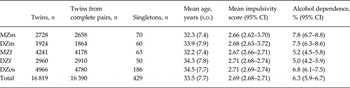
A total of 16 819 twins from incomplete twin pairs (n = 429) and complete twin pairs (n = 16 390) were included in the analyses resulting in 2728 MZ male (MZm) twins, 1924 DZ male (DZm) twins, 4241 MZ female (MZf) twins, 2960 DZ female (DZf) twins and 4966 DZ opposite-sex (DZos) twins. Age, AD prevalence and impulsivity scores across zygosity groups are displayed in Table 1.
Number of twins, age, impulsivity score and alcohol dependence prevalence across zygosity groups

s.d., Standard deviation; CI, confidence interval; MZm, male monozygotic twins. DZm, male dizygotic twins. MZf, female monozygotic twins. DZf, female dizygotic twins. DZos, opposite-sex dizygotic twins.
Twin correlations
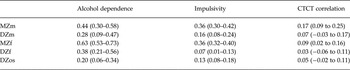
Twin correlations for AD and impulsivity, as well as the CTCT correlations, are shown in Table 2. All MZ correlations were smaller than 1.0, suggesting non-shared environmental factors in both phenotypes (including measurement errors). MZ twin correlations were larger than DZ twin correlations, suggesting genetic effects for both AD and impulsivity. The CTCT correlations were larger in males compared with females, indicating quantitative genetic and environmental differences in the covariation of AD and impulsivity. Furthermore, the MZ CTCT correlations were higher than the DZ CTCT correlations, suggesting genetic influences for the overlap between the two phenotypes.
Twin correlations and CTCT correlations for alcohol dependence and impulsivity

Data are given as correlation (95% confidence interval).
CTCT, Cross-twin-cross-trait. MZm, male monozygotic twins. DZm, male dizygotic twins. MZf, female monozygotic twins. DZf, female dizygotic twins. DZos, opposite-sex dizygotic twins.
Univariate model fitting
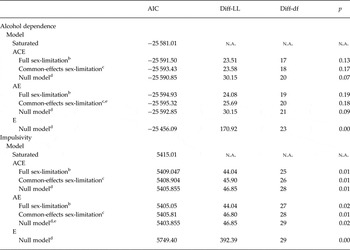
The model fitting results for the univariate analysis of AD are displayed in Table 3. The assumption tests performed showed no difference in thresholds for zygosity, twin order or sex (all p > 0.05). We found a significant effect of age on AD [difference in −2 log likelihood (χ 2) = 141.5; difference in degrees of freedom (df) = 2; p < 0.001], indicating that younger subjects reported higher levels of AD. The regression coefficient of age did not differ between zygosity or twin order but was different across sex. The effect of age was thus accounted for in all subsequent analyses. The best-fitting model was the AE common-effects model, which indicates quantitative, but no qualitative, sex differences. For males, additive genetic factors and non-shared environmental factors explained 44% [95% confidence interval (CI) 31–57%] and 56% (95% CI 43–69%) of the variance, respectively. For females the corresponding estimates were 62% (95% CI 52–72%) for additive genetic factors and 38% (95% CI 28–48%) for non-shared environmental factors.
Model fitting results of univariate analyses of alcohol dependence and impulsivity a

AIC, Akaike's information criterion; Diff-LL, difference in −2log likelihood compared with the saturated model; Diff-df, difference in degrees of freedom compared with the saturated model; p, p value of likelihood ratio test compared with the saturated model; n.a., not applicable; A, additive genetic factors; C, shared/common environmental factors; E, non-shared environmental factors.
a All models are compared with the saturated model. For each model of different variance components (ACE, AE, E), the null model is nested within the common-effects model, which in turn is nested within the full sex-limitation model.
b The full sex-limitation model allows for both quantitative and qualitative sex differences.
c The common-effects sex-limitation model allows only quantitative sex differences.
d The null model allows no sex differences.
e Best-fitting models.
The results of the univariate analysis of impulsivity are displayed in Table 3. The assumption tests performed showed no difference in means or variance across zygosity and twin order (all p > 0.05). There was no difference in means across sex (p > 0.05), but the variance was significantly different between males and females (p < 0.05). Thus, the variance parameters were kept different across sex. We found a significant effect of age on impulsivity (χ 2 = 60.1, df = 2, p < 0.001), indicating that younger subjects reported higher levels of impulsive behaviour. The regression coefficient of age did not differ between zygosity or twin order but was different across sex. The effect of age was thus accounted for in all subsequent analyses. The best-fitting model was the AE null model, which indicates no quantitative and qualitative sex differences. For males and females, additive genetic factors and non-shared environmental factors explained 33% (95% CI 30–36%) and 67% (95% CI 64–70%) of the variance, respectively.
Bivariate model fitting
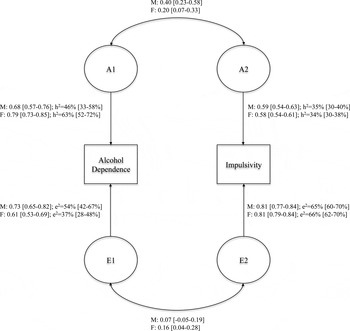
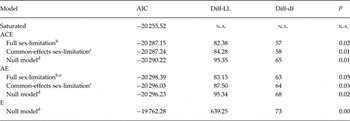
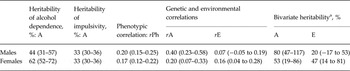
Bivariate twin analysis results are displayed in Table 4. The estimates of the best-fitting AE full sex-limitation model, allowing quantitative and qualitative sex differences, are displayed in Table 5. The estimates for rA and rE were 0.40 (95% CI 0.23–0.58) and 0.07 (95% CI −0.05 to 0.19) for males, while in females the corresponding estimates were 0.20 (95% CI 0.07–0.33) and 0.16 (95% CI 0.04–0.28), suggesting a statistically significant genetic overlap between AD and impulsivity. In opposite-sex DZ twins, the genetic correlation between sexes was estimated to be 0.36 (95% CI 0.22–0.49) compared with the expected 0.50. The phenotypic correlation between AD and impulsivity was 0.20 (95% CI 0.15–0.25) for males and 0.17 (95% CI 0.12–0.22) for females. The bivariate heritability, i.e. the fraction of phenotypic covariance explained by genetic factors (A), was 80% (95% CI 47–117%) and 53% (95% CI 19–86%) for males and females, respectively (Table 5; Fig. 1).
Standardized parameter estimates and proportion of variance in alcohol dependence and impulsivity accounted for by genetic factors (A) and non-shared environmental factors (E) from the bivariate best-fitting AE full sex-limitation-model. Double-headed arrows represent genetic and non-shared environmental correlations. M, Males. F, females; h 2, heritability, i.e. proportion of variance accounted for by genetic factors; e 2, proportion of variance accounted for by non-shared environmental factors. Values in brackets are 95% confidence intervals.

Model fitting results of bivariate analyses of alcohol dependence and impulsivity a

AIC, Akaike's information criterion; Diff-LL, difference in −2log likelihood compared with the saturated model; Diff-df, difference in degrees of freedom compared with the saturated model; p, p value of likelihood ratio test compared with the saturated model; n.a., not applicable; A, additive genetic factors; C, shared/common environmental factors; E, non-shared environmental factors.
a All models are compared with the saturated model. For each model of different variance components (ACE, AE, E), the null model is nested within the common-effects model, which in turn is nested within the full sex-limitation model.
b The full sex-limitation model allows for both quantitative and qualitative sex differences.
c The common-effects sex-limitation model allows only quantitative sex differences.
d The null model allows no sex differences.
e Best-fitting model.
Parameter estimates from the best-fitting univariate AE common-effects model for alcohol dependency, univariate AE null model for impulsivity and bivariate AE full sex-limitation model of alcohol dependence and impulsivity a

Data are given as estimate (95% confidence interval).
A, Additive genetic factors. E, non-shared environmental factors; rPh, phenotypic correlation; rA, genetic correlation; rE, non-shared environmental correlation.
a Bivariate heritability is the fraction of phenotypic correlation explained by genetic and environmental factors.
Discussion
In the present nationwide population-based sample of twins, we found a statistically significant genetic correlation between AD and impulsivity, indicating that the overlap between the two phenotypes can in part be explained by shared genetic factors. This finding has several important clinical implications, including identifying individuals at risk for developing AD and in the development of novel targets for AD treatment. Furthermore, our results increase the understanding of common aetiological pathways between AD and psychiatric disorders characterized by high levels of impulsivity.
Previous twin studies have indicated a genetic overlap between AD and psychiatric disorders characterized by impulsive behaviour, e.g. conduct disorder and ADHD (Slutske et al. Reference Slutske, Heath, Dinwiddie, Madden, Bucholz, Dunne, Statham and Martin1998; Knopik et al. Reference Knopik, Heath, Jacob, Slutske, Bucholz, Madden, Waldron and Martin2006; Edwards & Kendler, Reference Edwards and Kendler2012). Our study strengthens and extends previous findings in two ways. First, the current study comprises a large sample size (n = 16 819), greater than any previous twin study investigating the relationship between AD and impulsivity. Second, in contrast to previous studies we used a single scale designed to measure the normally distributed trait of impulsivity present in the general population, not specific for any psychiatric disorder. We therefore suggest that the previously observed genetic overlaps, as well as the co-morbidity, between AD and psychiatric disorders characterized by increased impulsivity may in part be accounted for by our finding of a genetic overlap between general impulsive behaviour and AD.
Impulsive behaviour is an important component in several psychiatric disorders (Moeller et al. 2001), and thus, impulsivity probably shares genetic factors with other mental diseases and not only AD. Kendler et al. (Reference Kendler, Prescott, Myers and Neale2003) have suggested that at least two genetic pathways underlie the development of AD: one unique for AD and the other a common genetic factor shared with other externalizing syndromes, such as drug abuse, antisocial behaviour and conduct disorder. In light of the present finding, we suggest that impulsive behaviour may in part, through pleiotropic genetic effects, convey the risk of the common genetic factor shared with other externalizing disorders. The specific genes that constitute the observed genetic overlap are not known, but given the importance of both dopamine and noradrenaline in regulating impulsive behaviour (Arnsten & Li, Reference Arnsten and Li2005; Pattij & Vanderschuren, Reference Pattij and Vanderschuren2008), as well as their role in the pathophysiology of AD (Tupala & Tiihonen, Reference Tupala and Tiihonen2004; Weinshenker & Schroeder, Reference Weinshenker and Schroeder2007), we hypothesize that the shared genes may code for proteins involved in catecholamine neurotransmission indicative of a common aetiological pathway between the syndrome of AD and high levels of impulsivity. Future cross-disorder genome-wide association studies are needed to investigate which specific genes comprise the observed genetic overlap.
Our main results are in line with previous reports that have found a genetic correlation between AD- and impulsivity-related personality measures, such as behavioural undercontrol (Slutske et al. Reference Slutske, Heath, Madden, Bucholz, Statham and Martin2002) and constraint (Vrieze et al. Reference Vrieze, Vaidyanathan, Hicks, Iacono and McGue2014). However, previous studies have utilized impulsivity constructs defined a posteriori by principal components analysis of two different personality questionnaires (Slutske et al. Reference Slutske, Heath, Madden, Bucholz, Statham and Martin2002) or constructs including propensity to adhere to traditional moral values (Vrieze et al. Reference Vrieze, Vaidyanathan, Hicks, Iacono and McGue2014), which from a clinical psychiatric perspective may not represent the core feature of impulsivity. The use of a single scale in the present study, designed a priori to measure the normally distributed trait of impulsivity present in the general population, together with our large sample size (n = 16 819), corroborates previous findings and further strengthens the important notion of a genetic association between impulsivity and AD.
Our finding of a genetic overlap between AD and impulsive behaviour has several clinical implications. First, it is well established that AD patients (Dick et al. Reference Dick, Smith, Olausson, Mitchell, Leeman, O'Malley and Sher2010; Lejuez et al. Reference Lejuez, Magidson, Mitchell, Sinha, Stevens and de Wit2010), as well as their healthy unaffected family members (Saunders et al. Reference Saunders, Farag, Vincent, Collins, Sorocco and Lovallo2008; Acheson et al. Reference Acheson, Richard, Mathias and Dougherty2011; Kareken et al. Reference Kareken, Dzemidzic, Wetherill, Eiler, Oberlin, Harezlak, Wang and O'Connor2013), are more impulsive than healthy controls. Our results extend and partially explain the aforementioned clinical observations, by showing that AD and impulsivity share common genetic factors. Second, craving for alcohol is associated with elevated impulsivity (Papachristou et al. Reference Papachristou, Nederkoorn, Havermans, Bongers, Beunen and Jansen2013), and deficits in impulse control worsen treatment outcome and increase risk of relapse to drinking (Bowden-Jones et al. Reference Bowden-Jones, McPhillips, Rogers, Hutton and Joyce2005; Evren et al. Reference Evren, Durkaya, Evren, Dalbudak and Cetin2012; De Wilde et al. Reference De Wilde, Verdejo-García, Sabbe, Hulstijn and Dom2013). In light of our finding, we suggest that impulsive behaviour is a genetically intrinsic component of the clinical manifestations of AD, and recent pharmacological interventions targeting high-impulsive AD patients have indeed shown to be a promising treatment strategy (Voronin et al. Reference Voronin, Randall, Myrick and Anton2008; Joos et al. Reference Joos, Goudriaan, Schmaal, Fransen, van den Brink, Sabbe and Dom2013; Schmaal et al. Reference Schmaal, Joos, Koeleman, Veltman, van den Brink and Goudriaan2013; Khemiri et al. Reference Khemiri, Steensland, Guterstam, Beck, Carlsson, Franck and Jayaram-Lindström2015). Third, the observed genetic overlap highlights the importance of screening and detecting potential alcohol use disorders in highly impulsive patient populations, e.g. ADHD, bipolar disorder and personality disorders (Moeller et al. 2001). Finally, a recent study by Leeman et al. (Reference Leeman, Ralevski, Limoncelli, Pittman, O'Malley and Petrakis2014) found that in healthy social drinkers, impulsive individuals to a higher degree experience greater stimulant effects from alcohol intake. Based on our results, we hypothesize that the same genes underlying impulsive behaviour might also be involved in the reward processing of alcohol, which in turn may predispose to the development of alcohol use disorders. Future clinical studies investigating the association between heredity for AD, impulsivity and subjective effects of alcohol, using neuroimaging paradigms, are needed to further investigate this hypothesis.
In the present study we found a genetic correlation between impulsivity and AD of 0.40 in males and 0.20 in females, with a bivariate heritability of 80% in males and 53% in females. This implies that the overlap between AD and impulsivity is not entirely explained by genetic factors, suggesting that other non-shared environmental factors are important. In addition our finding indicates a sex difference, manifested as greater genetic correlation between AD and impulsivity in men compared with women. It has been previously suggested that AD in males is to a greater extent associated with early onset of disease and impulsive behaviour, while females predominately develop AD later in life with features of negative affect (Cloninger, Reference Cloninger1987). In the National Epidemiologic Survey on Alcohol and Related Conditions (n = 43 093), male AD subjects have significantly higher unadjusted odds ratios for externalizing disorders characterized by impulsive behaviour, such as antisocial personality disorder and drug use disorders, while female AD patients were more likely to have affective and anxiety disorders (Khan et al. Reference Khan, Okuda, Hasin, Secades-Villa, Keyes, Lin, Grant and Blanco2013). Similar findings have been observed also in clinical studies: healthy subjects with a family history of AD are not only more impulsive compared with the subjects without AD family history but this association is also stronger in males compared with females (Saunders et al. Reference Saunders, Farag, Vincent, Collins, Sorocco and Lovallo2008). Collectively, the findings provide evidence that sex is an important factor mediating the association between impulsivity and AD, and warrants consideration in the optimizing of prevention programmes and treatment initiatives.
The heritability estimates for AD were 44% and 62% in males and females, respectively, which are in line with previous studies estimating the heritability as 40–60% (Hrubec & Omenn, Reference Hrubec and Omenn1981; Kendler et al. Reference Kendler, Heath, Neale, Kessler and Eaves1992, Reference Kendler, Prescott, Neale and Pedersen1997; Heath et al. Reference Heath, Bucholz, Madden, Dinwiddie, Slutske, Bierut, Statham, Dunne, Whitfield and Martin1997; True et al. Reference True, Xian, Scherrer, Madden, Bucholz, Heath, Eisen, Lyons, Goldberg and Tsuang1999; Knopik et al. Reference Knopik, Heath, Madden, Bucholz, Slutske, Nelson, Statham, Whitfield and Martin2004). The heritability of impulsivity was 33% for both males and females. In a recently published meta-analysis (n = 27 147) of twin studies of impulsivity, the heritability of self-reported impulsivity was in the range of 20% to 62% (Bezdjian et al. Reference Bezdjian, Baker and Tuvblad2011). The results of the present univariate analyses are thus consistent with previous research, indicating that our sample is comparable with other study populations and further reinforcing the results of our bivariate analysis.
Several important limitations in our study should be considered. First, the measures of AD and impulsivity were based on self-ratings. Thus, it is possible that in-person interviews by experienced clinicians would improve the accuracy of diagnosis and reduce the risk of misclassification. Second, given the response rate of 59.6%, we cannot exclude the possibility of systematic sampling bias. Our estimates of AD lifetime prevalence are within the range of previously observed 12-month-prevalence of AD in the Swedish population (Rehm et al. Reference Rehm, Room, van den Brink and Jacobi2005). Similarly, our estimates of mean impulsivity score on the SST (2.69) are comparable with previously published normative data using the same scale (Gustavsson et al. Reference Gustavsson, Bergman, Edman, Ekselius, von Knorring and Linder2000). To investigate the degree to which missing data were non-random, we compared the prevalence of AD, as well as the impulsivity score, between complete and incomplete twin pairs. For males, there was no significant difference between complete and incomplete pairs regarding impulsivity (p = 0.434), but a small difference regarding AD (p = 0.034). For females, however, the differences between complete and incomplete pairs were highly significant for both AD and impulsivity (p < 0.0001 for both phenotypes), suggesting that female non-completers to a higher degree were more impulsive and at greater risk of fulfilling the AD criteria compared with completers. Furthermore, the non-responders in STAGE are to a higher extent male with increased prevalence of psychiatric disorders, fewer education years, at least one parent not born in Sweden and more past convictions (Furberg et al. Reference Furberg, Lichtenstein, Pedersen, Thornton, Bulik, Lerman and Sullivan2008). Thus, it is possible that our results are not generalizable to females or the most severe cases of AD with higher incidence of psychiatric co-morbidity and negative social consequences. Third, the age of the twins in the study ranged from 20 to 47 years (mean 33.4 years). It is possible that some of the younger subjects were interviewed at an age where they had not yet developed AD. However, data from the National Longitudinal Study of Adolescent Health (n = 15 500) shows that the peak age of onset for AD is 23 years and that onset of AD after 27 years of age is less common (Haberstick et al. Reference Haberstick, Young, Zeiger, Lessem, Hewitt and Hopfer2014). Thus, the diagnostic classification of AD is most probably accurate for the majority of individuals in our sample. Fourth, we did not consider dominance effects in our analyses. However, because the twin correlations and CTCT in DZ were lower than half of MZ, it is not inconceivable that a model including dominance would fit the data well. Therefore, we performed additional analyses including dominance effects. The general interpretation did not change in this analysis (see online Supplementary material).
In conclusion, we have used large-scale population-based twin data to explore whether AD and impulsivity share genetic risk factors. The results of the present study demonstrate a statistically significant genetic correlation between AD and impulsivity and show that common genetic factors partially explain the overlap between these two traits. Future studies utilizing genome-wide association techniques could indicate the specific genes constituting this overlap between AD and impulsivity, which is needed to increase the understanding of the pathophysiology of AD and to advance the development of novel treatment targets.
Supplementary material
For supplementary material accompanying this paper visit http://dx.doi.org/10.1017/S0033291715002652
Acknowledgements
Financial support for this study is provided by grants from the Swedish Alcohol Research Council and The Swedish Society of Medicine (Söderström-Königska Sjukhemmet).
Declaration of Interest
H.L. has served as a speaker for Eli-Lilly and has received a research grant from Shire. The other authors report no biomedical financial interests or potential conflicts of interests.