Introduction
Global estimates suggest there were 36 million people living with dementia in 2010, and this figure is set to increase to 66 million by 2030 and to 115 million by 2050 (Alzheimer's Disease International, 2013). In the United Kingdom (UK), there are likely to be between 670,000 and 800,000 people living with dementia (Matthews et al., Reference Matthews2013), and again this figure is expected to rise toward 1.7 million by 2051 (Knapp and Prince, Reference Knapp and Prince2007). In anticipation of these major global demographic changes, many countries, and in particular, those countries with major economies that are part of the G20, have begun to develop and enact plans to address Alzheimer's disease as a national priority (Rosow et al., Reference Rosow, Holzapfel, Karlawish, Baumgart, Bain and Khachaturian2011). Across the UK, policy priorities have focused on achieving an early diagnosis, and preventing or delaying admission into institutional care (Department of Health (DoH), 2013). This increased emphasis on people affected by dementia living well within the community means that public attitudes toward people affected by dementia have become of increasing importance in the UK as evidenced by, for instance, awareness campaigns launched to build “dementia friendly” communities in order to reduce stigma and improve public attitudes to dementia.
In order to meet the health needs of people living in Bristol and South Gloucestershire, the Clinical Commissioning groups, local authorities, Universities, NHS trusts, and third sector organizations collaborated in 2012 to establish Bristol Health Partners (BHP). The aim of BHP is to address the major public health needs across the city, and in order to achieve this aim, BHP established 18 Health Integration Teams (HITs), one of which focused on developing services for roughly 7,500 people affected by dementia in Bristol and South Gloucestershire (although 4,609 people have a formally recorded diagnosis of dementia in Bristol, it is believed that there is a significant dementia gap of roughly 3,500 people who are undiagnosed (Dementia Prevalence Calculator, 2015)). The dementia HIT continues the interdisciplinary and cross-organizational ethos of BHP by bringing together academics, clinicians, and commissioners with expertise in dementia care in order to achieve the best quality of life for people and families affected by dementia. The aims of the dementia HIT include improving the training and education of staff working in Bristol with people affected by dementia, to promote public awareness of dementia and to improve attitudes across the city toward people who are affected by the illness. As part of their remit, the dementia HIT decided in 2013 to sample attitudes toward dementia across the city.
Attitudes and behavior
There is a large body of evidence indicating a link between attitudes and behavior with, typically, more favorable attitudes resulting in positive responses to the attitude object (Fishbein and Ajzen, Reference Fishbein and Ajzen2010). In the case of dementia, this had been widely explored in relation to professionals working with individuals living with dementia (e.g. Lintern, Reference Lintern2001; Leung et al., Reference Leung, Sezto, Chan, Cheng, Tang and Lam2013; Kokkonen et al., Reference Kokkonen, Cheston, Dallos and Smart2014). Positive attitudes amongst nursing staff working within institutional care have been linked to training, with those staff who had received training having more positive attitudes about people living with dementia (Leung et al., Reference Leung, Sezto, Chan, Cheng, Tang and Lam2013). In turn, positive attitudes toward dementia are associated with the provision of higher quality care by staff (Lintern, Reference Lintern2001; DoH, 2013; Travers et al., Reference Travers, Beattie, Martin-Khan and Fielding2013).
Research into attitudes toward dementia has tended to focus on specific issues such as screening for dementia (Bond et al., Reference Bond, Graham, Padovani, Mackell, Knox and Atkinson2010) or euthanasia (Williams et al., Reference Williams, Dunford, Knowles and Warner2007). Where wider surveys of the attitudes of the general public toward dementia have been undertaken (e.g. McParland et al., Reference McParland, Devine, Innes and Gayle2012), then these suggest that the general public has, at best, a fair to moderate knowledge about dementia, but that there are often misconceptions such as believing dementia to be a normal part of aging. However, many surveys did not make use of validated scales (Cahill et al., Reference Cahill, Pierce, Werner, Darley and Bobersky2015), thus limiting the ability of researchers to make meaningful comparisons across settings, populations, or over time.
Surveying public attitudes toward dementia in Bristol and South Gloucestershire
One widely used measure is the Approaches to Dementia Questionnaire (ADQ, Lintern, Reference Lintern2001). Originally developed for exploring attitudes in staff working with people affected by dementia, the 19-item scale has a score range from 19 to 95 and reflects the influence of the person-centered approach to dementia pioneered by Tom Kitwood (e.g. Kitwood, Reference Kitwood1997). The ADQ is made up of two sub-scales: “Recognition of Personhood” (RoP) (11 items reflecting the extent to which people have a person-centered understanding of dementia or recognize people affected by dementia as unique individuals with the same value as any other person); and “Hope” (eight items indicative of a sense of optimism or pessimism about the abilities and the future of the person affected by dementia). Higher scores indicate more positive attitudes toward people with dementia. Each item uses a five-point Likert scale to measure agreement or disagreement toward the statement. The ADQ has been shown to be consistently reliable and easy to administer and score (Kokkonen et al., Reference Kokkonen, Cheston, Dallos and Smart2014), and has been used to collect data from large samples (Travers et al., Reference Travers, Beattie, Martin-Khan and Fielding2013).
Over the last few years, online surveys have increasingly replaced the use of either interviews or pen and paper questionnaires as a means of collecting data. An online survey has a number of advantages over more traditional forms of evaluation including being efficient and cost-effective to administer (Sommer and Sommer, Reference Sommer and Sommer2001), and allowing participants to access and complete the survey at a time that is convenient to them (Eysenbach and Wyatt, Reference Eysenbach and Wyatt2002). The ADQ has been used as an online survey; a Chinese version of the ADQ reported results from 1,700 care-home staff (Leung et al., Reference Leung, Sezto, Chan, Cheng, Tang and Lam2013).
Aim of this study
The aim of the current study was to carry out a survey of public attitudes toward people affected by dementia in Bristol and South Gloucestershire. As well as being of interest in its own right, this survey would also act as a baseline measure against which changes in attitudes toward people affected by dementia could be reassessed at timely intervals. This is anticipated to provide a gauge against which to measure whether there are changes in local attitudes toward dementia (Sommer and Sommer, Reference Sommer and Sommer2001).
Methods
Ethics
Ethical approval was granted by the University of the West of England (UWE). The online survey was hosted by the Avon and Wiltshire Mental Health Partnership NHS Trust (https://www.oc-meridian.com/AWP/survey/ApproachesToDementia). Participants were informed that the study was being carried out by BHP (with the partner organizations listed).
Alterations to the ADQ
With the permission of the authors of the questionnaire, the wording of some questions of the online version was adapted in order to be consistent with contemporary language in dementia care. In all six of the items were changed (three relating to the Hope and three to the RoP scale). The phrase “dementia sufferers” in items 1 and 6 was replaced by the “people with dementia” while the wording of items 5, 12, 13, and 19 were slightly changed.
Distribution of the survey
People living and working locally were encouraged to complete the online ADQ during a seven-month period between September 2013 and March 2014. The online survey was publicized across the Bristol and South Gloucestershire area through the members of the dementia HIT, including via social media. This survey was open to everyone living in the BHP area including people affected by dementia, staff who worked in dementia care, as well as those who had more limited knowledge of the condition. During this period, paper versions of the ADQ were also distributed: to people attending dementia awareness training, to health champions who were working directly in the community with no specialist knowledge of dementia, and to community groups who were about to start a reminiscence project.
Demographic information
Participants were asked to provide general background information on their age, gender, ethnicity, whether they were living in the Bristol or South Gloucestershire area, whether they have been affected by dementia, and whether they worked with people with dementia.
Participants
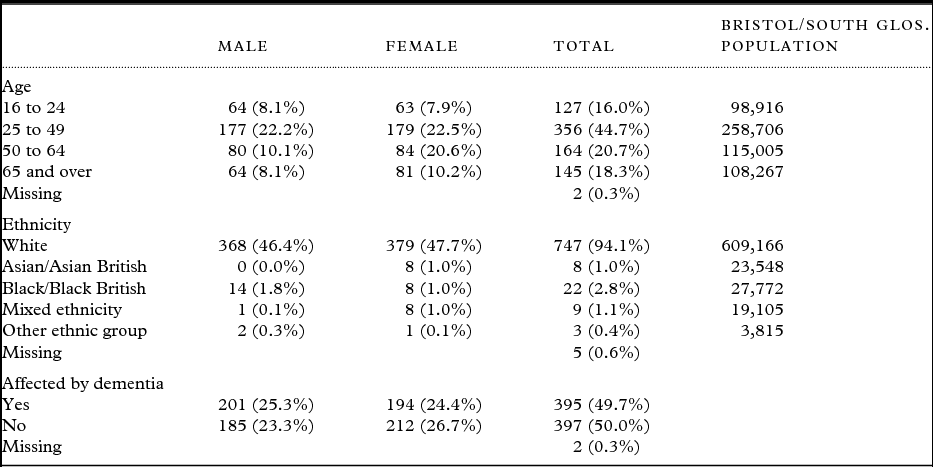
Responses from 2,201 individuals were obtained (online, 1918; paper, 283). The responses of people living outside the Bristol and South Gloucestershire area have been excluded from this analysis. In addition, respondents who identified themselves as having worked with people affected by dementia were also excluded in order to ensure that this sample was representative of the lay public. In all, data from 794 individuals were included (online, 761; paper, 33) in the analysis, as shown in Table 1. Data from this subset was then weighted according to the most recent population statistics from the Office of National Statistics (2015), in order to adjust for the over-representation of some groups (e.g. White females) and an under-representation of other communities (e.g. males of mixed ethnicity) (Gorman et al., Reference Gorman2014).
Demographic data for the sample (n = 794)

Statistical analysis
A series of exploratory and main analyses were conducted on the ADQ data. Demographic data were regrouped into dichotomous variables as some demographic samples had only one individual assigned to the group. Exploratory analysis using χ 2 was then used to establish the representativeness of the sample. For the main analyses, two-sided t-test analyses were performed on the weighted data to explore differences in scale scores between demographic groups in respect to the ADQ responses. Cohen's d was used to quantify effect size. In general, Ellis (Reference Ellis2010) cautiously gives broad rules of thumb for the interpretation of d, to the effect that d < 0.1 indicates a trivial effect, 0.1 < d < 0.3 a small effect, 0.3 < d < 0.5 a moderate effect, 0.5 < d < 0.8 a medium effect, 0.8 < d < 1.3 as large, and d > 1.3 a very large effect.
Results
ADQ internal reliability
The altered scale demonstrated good internal reliability with a Cronbach's α of 0.86 (95% Confidence Interval (CI) 0.85–0.87), and Alphas of 0.77 (95% CI 0.76–0.79) for the Hope and 0.84 (95% CI 0.83–0.85) RoP sub-scales, respectively.
Representativeness check
A series of χ 2 analyses were carried out to explore whether there were differences between participants who either were or were not affected by dementia. No differences were detected in terms of gender (χ 2(1) = 0.001, p = 0.98), age group (those aged under 65 years and those aged 65 years and over) (χ 2(1) = 0.81, p = 0.37), or having worked with someone affected by dementia (χ 2(1) = 1.59, p = 0.21). However, there was a difference between White and non-White participants, with a larger proportion of White individuals (44.8%) reporting being personally affected by dementia than non-White respondents (2.2%), χ 2(1) = 45.53, p < 0.001. In addition, a larger proportion of women reported working with people affected by dementia compared to men (41.2% versus 8.6%, respectively), χ 2(1) = 17.77, p < 0.001.
Exploring demographic differences in responses on the ADQ
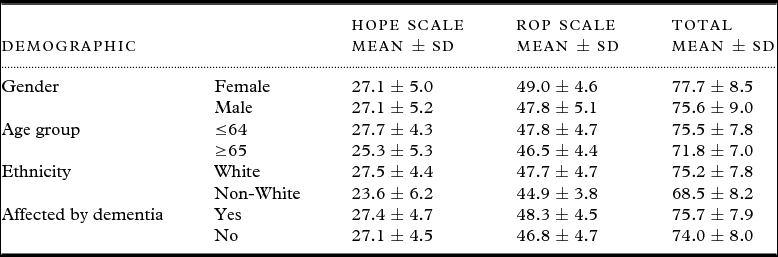
Table 2 shows the weighted descriptive statistics of the ADQ arranged by the demographic background of participants. Whilst overall data indicates a largely positive attitude toward people affected by dementia in the sub-sample (Hope and RoP mean item scores 3.41 and 4.32, respectively, out of a maximum of 5), there may be some differences in attitude based on demographic characteristics (e.g. mean item score of women on the Hope are RoP scale are 3.39 and 4.45, respectively. Men achieved an identical mean score on the Hope scale to women, and a slightly lower average item score of 4.35 on the RoP scale.). In order to explore this, a series of analyses were conducted examining gender, age, ethnicity, and experience with dementia.
Descriptive statistics of ADQ data for people living in the Bristol Health Partners area weighted to account for ethnicity, gender, and age (n = 794)

Note: RoP scale = Recognition of personhood scale.
Gender differences
No differences in scores were found between the genders on the Hope (t(790) = −1.06, p = 0.29, d = 0.08), RoP (t(790) = −1.55, p = 0.12, d = 0.11), or total scores (t(790) = −1.52, p = 0.13, d = 0.11).
Age differences
Younger respondents (those aged under 65 years) scored at a higher level on both the Hope (t(790) = 5.83, p < 0.001, d = 0.50), and the RoP scales (t(790) = 3.03, p = 0.002, d = 0.28) than those aged 65 years and over. Similarly, the total ADQ score was significantly higher for the younger age group compared to the older age group (t(790) = 5.13, p < 0.001, d = 0.47).
Ethnicity differences
Individuals who identified themselves as White scored at a higher level on the Hope (t(789) = 5.46, p < 0.001, d = 0.72) and the RoP scales (t(789) = 3.90, p = < 0.001, d = 0.66) as well as on the total scores (t(789) = 5.44, p < 0.001, d = 0.83) than individuals of non-White ethnic groups.
Differences based on individual's personal experience of dementia
There was a significant difference between individuals who reported having been affected by dementia and those who had not been. People who had been affected by dementia scored higher on the RoP scale (t(792) = 4.57, p < 0.001, d = 0.32) and overall (t(792) = 3.07, p = 0.002, d = 0.22), although there was no difference between these two groups on the Hope scale.
Gender and age differences
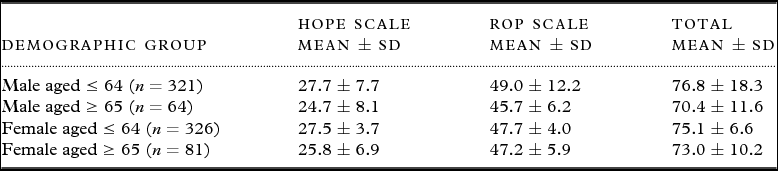
Previous research indicates that gender, age, and experience of dementia are all likely to influence attitudes (Fishbein and Ajzen, Reference Fishbein and Ajzen2010), therefore, a further χ 2 and ANOVA analysis was run to explore potential interactions. Splitting the sample into four demographic subgroups (males aged ≤ 64 years, males aged ≥ 65 years, females aged ≤ 64 years, females aged ≥ 65 years), χ 2 results indicated no differences between demographic groups and personal experience of dementia (χ 2(3) = 1.33, p = 0.72). However, ANOVA results indicated an interaction between gender and age group (F(2,790) = 3.40, p = 0.03). Univariate follow-up tests showed interactions present on the RoP (F(1,789) = 6.69, p = 0.01) and total scores (F(1, 789) = 6.28, p = 0.01), but not the Hope scale (F(1, 789) = 2.97, p = 0.09). Examination of mean scores showed younger men scored slightly higher on average than the other groups on these scales (weighted means are shown in Table 3).
Weighted descriptive statistics of ADQ data by gender and age group

Note: RoP scale = Recognition of personhood scale.
Discussion
In the UK, as elsewhere, a primary focus of public health campaigns in recent years has been to increase the numbers of people being diagnosed with dementia. A major barrier to this is perceived to be that public attitudes to dementia are thought to be largely negative, and, at times view dementia as a stigmatizing condition. Consequently, there have been a number of publically funded campaigns that seek to challenge these views and to reduce stigma. As the preface to a 2012 report by Alzheimer's Disease International states:
It is very important that there is better public awareness and understanding to reduce the stigma associated with dementia. This can happen only with well developed and executed political and public campaigns to support a societal shift towards acceptance and inclusion of people affected by dementia (p2).
It is important, then, to investigate whether media campaigns and other forms of awareness raising are, in fact, having an impact on changing public awareness. This is one of the first surveys of public attitudes toward dementia to use a validated questionnaire such as the ADQ. Typically where large-scale surveys have focused on the general public unvalidated questionnaires were used (e.g. McParland et al., Reference McParland, Devine, Innes and Gayle2012). Where surveys have used validated scales, then these have focused on attitudes of staff working in dementia care rather than the general public (e.g. Lintern, Reference Lintern2001; Moyle et al., Reference Moyle, Murfield, Griffiths and Venturato2011). By contrast, this study provides a baseline of attitudes held by the lay public toward dementia for the Bristol and South Gloucestershire areas, against which we will be able to compare changes over time.
In addition to its role as a baseline measure, a number of elements stand out from this current sampling. Importantly, although we have identified age, ethnicity, and experience of dementia variation in attitudes within the general population in Bristol and South Gloucestershire, nevertheless scores on the ADQ were generally positive, and certainly seem to be comparable with those found amongst dementia care workers. The average item score in this study of 3.41 on the Hope scale and 4.32 on the RoP scale are at a similar level to the reported average item scores of care staff for the Hope scale of 3.66 (Moyle et al., Reference Moyle, Murfield, Griffiths and Venturato2011) and 3.71 (Travers et al., Reference Travers, Beattie, Martin-Khan and Fielding2013), and 4.35 and 4.49 for the RoP scales.
A consistent finding within the research literature is that age plays an important role in mediating a range of attitudes and beliefs about dementia, both for staff working in dementia care, and of the general public. Thus, Leung et al., (Reference Leung, Sezto, Chan, Cheng, Tang and Lam2013) reported staff working in residential homes in Hong Kong who were in their twenties scored at a higher level on the ADQ than did their older colleagues, while Kada et al., (Reference Kada, Nygaard, Mukesh and Geitung2009) found staff within Norwegian nursing homes aged over 50 years of age reported significantly lower hope attitudes than did those aged under 40 years. Similarly, in a survey of public opinion about dementia in Northern Ireland, McParland et al., (Reference McParland, Devine, Innes and Gayle2012) reported older people were more likely to hold stigmatizing views such as being more likely to believe newly diagnosed people with dementia were not able to be able to lead independent lives. This difference in attitudes also seems to be apparent in emotional responses to dementia. A 2014 YouGov poll commissioned by channel five news in the UK found the fear of dementia was particularly strong amongst older people, where dementia was feared even more strongly than cancer (http://www.channel5.com/shows/5-news/features-archived/channel-5-news-poll-people-fear-dementia-warning-more-than-cancer-research, accessed 7th October, 2015). Research also indicates that gender plays a significant role in attitudes toward people affected by dementia, with women having more positive views than men. McParland et al., (Reference McParland, Devine, Innes and Gayle2012) found that across some of their items women had slightly different attitudes to men – for instance, they were a little less likely to agree that “there comes a time when all you can do for someone with dementia is to keep them clean, healthy and safe” and slightly more likely to feel that “people with dementia are not treated like thinking human beings.” Women were also distinctly more reluctant to see residential care as the best option. Given the central role that women play in caring for people with dementia, it is especially important to understand more about the association between gender and attitudes.
In this study, although we found that gender was not significant on its own, there was an interaction between age and gender, with younger men having significantly more positive attitudes than either older men or women of all ages. Although there was no significant difference between the groups on their personal experiences of dementia, we do not know the nature or the quality of these personal experiences. Thus, it may be that even young men with some personal experience of dementia have less experience of providing personal care than women or older people.
Research elsewhere suggests that the impact of personal experience of dementia on attitudes is complex. Thus, McParland et al. (Reference McParland, Devine, Innes and Gayle2012) found that knowing someone affected by dementia was not associated with a more positive attitude toward dementia, although in our study, we did find that personal experience of dementia was significantly associated with a higher RoP score. However, while personal experience may enable people to be more aware of the enduring human nature of people affected by dementia, it does not necessarily mean that people will also be more hopeful about living well with dementia. Thus, having a parent who develops dementia has been associated with greater personal concerns about developing the disease oneself but does not translate into greater levels of anticipatory anxiety about dementia (Cutler and Hodgson, Reference Cutler and Hodgson1996). This is consistent with our finding of no difference between participants with and without personal experience of dementia on the hope scale.
It is likely that there are differences between people from different communities in their knowledge and attitudes toward dementia. Compared to similar Caucasian communities, Chinese people are more likely to believe that Alzheimer's disease is a normal part of aging (Gray et al., Reference Gray, Jimenez, Cucciare, Tong and Gallagher-Thompson2009; Low et al., Reference Low2010), less likely to correctly recognize symptoms of dementia (Low et al., Reference Low2010), and have less knowledge about Alzheimer's disease (Ayalon and Arean, Reference Ayalon and Arean2004). In this study, while we were able to identify that White participants had more positive attitudes toward dementia than non-White participants, disappointingly, due to lack of data, we were not able either to examine interactions between variables, nor to look at a more detailed breakdown by ethnicity.
Study limitations
Although the data collected was weighted in order to make the sample more representative of the Bristol and South Gloucestershire population, there are a number of reasons why the results are not completely representative of the population currently living in the dementia HIT area. For instance, data on educational level was not collected and there was an under-representation of views from people of non-White ethnicity. Furthermore, even though we excluded people who worked in dementia care from our analysis, nevertheless our method of sampling is likely to have meant that people with an interest in dementia from the general population would still have been over-represented.
The online survey was hosted by a Mental Health Partnership NHS Trust and it is possible that this may have influenced participation. However, this trust was only one of a number of organizations which circulated details about the research, so we feel that it was unlikely this had a significant effect on participation. Nevertheless, although the survey was open for a seven-month period, only 794 responses were included in the analysis, when people who worked with people affected by dementia and people outside Bristol were excluded. Moreover, our failure to recruit sufficient people from Black and Minority Ethnic communities to permit a sub-analysis of attitudes does suggest that dissemination of the survey was not as complete as we might have hoped. The HIT is now collaborating with eight Voluntary and Community Sector Organizations representing a range of BME communities on a research study funded by Bristol council which seeks to identify the dementia needs of these communities. More generally, if future surveys, are to increase participation, then it will be necessary to actively seek to recruit more people from BME communities, for instance, by using a Chinese version of the ADQ (Leung et al., Reference Leung, Sezto, Chan, Cheng, Tang and Lam2013). Similarly, although we used paper copies of the adapted form of the ADQ in this study, only 33 of the 283 questionnaires that were returned were included in this study as most participants either did not live in Bristol or South Gloucestershire, or worked with people with dementia. Future surveys, may well need to take a more purposive approach to sampling to ensure a greater balance of participation.
Conclusion
As increasing emphasis in the UK and elsewhere is being placed on promoting public awareness of dementia and overcoming the stigma that has surrounded the condition, it is important to understand and to track changes in public understanding of dementia. The distribution of a slightly modified version of the Attitudes to Dementia Questionnaire across the Bristol and South Gloucestershire area has enabled us to sample person-centered attitudes across the area. Having weighted the data to reflect the diverse nature of the population, our analysis is consistent with research elsewhere such as the finding that younger people tend to have more positive attitudes. Moreover, when considering the impact of age, it was clear that gender also played a role in attitudes – a finding that perhaps merits further research. Finally, having now created a baseline, it will be possible to chart changes in attitudes across time as the work of the dementia HIT continues to grow.
Conflict of interest
None.
Description of authors’ roles
Richard Cheston designed the study, and co-wrote the paper. Jude Hancock facilitated the set-up of the online questionnaire to collect the data, carried out the statistical analysis, and co-wrote the paper. Paul White was responsible for checking the statistical analysis, and commenting on drafts of the paper. Other members of the Bristol and South Gloucestershire dementia HIT have contributed to the development and implementation of the study at different stages, and have commented on the paper during its development.
Acknowledgments
The analysis of data within this study was supported by a grant from Bristol Health Partners. We would like to acknowledge the roles played by past members of the Dementia HIT who were involved in the original design of this study, including Ian Popperwell, Dr Sarah Cullum, and Professor Richard Gray. We would also like to thank Avon and Wiltshire Mental Health Partnership Trust for hosting the online survey and Jan Connett for distributing the paper version. Finally, we would like to acknowledge the institutions affiliated to the Dementia HIT who promoted the survey: University of the West of England; Avon and Wiltshire Mental Health Partnership NHS Trust; Bristol City Council; Bristol Clinical Commissioning Group; North Bristol NHS Trust; South Gloucestershire Clinical Commissioning Group; South Gloucestershire Council; the University of Bristol; Bristol Alzheimer's Society; and University Hospitals Bristol NHS Trust.