INTRODUCTION
Anisakis simplex is a nematode parasite that, in the larval stage, can parasitize many different kinds of fish or cephalopods, being marine mammals the final hosts, in which the adult stage is reached. Man is an accidental host who acquires the larvae by eating raw or undercooked fish. The parasitization of human subjects by the living larvae produces a disease known as anisakiasis giving rise to digestive symptomatology. Allergy to A. simplex has been reported as allergic type I hypersensitivity reaction (urticaria-angioedema, anaphylaxis, and occupational conjunctivitis and asthma) following ingestion or handling of the infected fish (Audicana et al. Reference Audicana, Fernández de Corres, Muñoz, Fernández, Navarro and Del Pozo1995; Del Pozo et al. Reference Del Pozo, Audicana, Diez, Muñoz, Ansotegui, Fernández, García, Etxenagusia, Moneo and de Corres1997; Montoro et al. Reference Montoro, Peterguer, Chivato, Laguna and Cuéllar1997; Añibarro and Seoane, Reference Añibarro and Seoane1998; Armentia et al. Reference Armentia, Lombardero, Callejo, Martín-Santos, Martín-Gil, Vega, Arranz and Martínez1998; Pulido et al. 2000; Scala et al. Reference Scala, Giani, Pirrotta, Guerra, Cadoni, Girardelli, De Pità and Puddu2001).
Nine allergens have been cloned and identified as major or minor allergens from A. simplex (www.allergen.org; www.allergome.org). Ani s 1, a 21 kDa allergen produced in the excretory gland (Gómez-Aguado et al. Reference Gómez-Aguado, Picazo, Caballero, Moneo, Asturias, Corcuera, Casado and Alonso2003), is a good antigen for the diagnosis of hypersensitivity and intestinal anisakiasis because it does not have cross-reaction with other allergens (Moneo et al. Reference Moneo, Caballero, Gómez, Ortega and Alonso2000; Caballero and Moneo, Reference Caballero and Moneo2002; Valls et al. Reference Valls, Pascual and Martín Esteban2003). It has been demonstrated that detection of IgE specifically directed against Ani s 1 has a high accuracy in the diagnosis of anisakiasis (sensitivity, 86%; specificity, 90%) (Caballero and Moneo, Reference Caballero and Moneo2002). Due to the importance of this allergen, Ani s 1 concentration would have to be measured in the extracts used for the clinical diagnosis and immunotherapy in order to guarantee the quality of allergenic products. Monoclonal antibody (mAb)-based assays allow quantification of specific allergen levels affording the sensitivity, specificity and reproducibility required (van Ree, Reference van Ree2004). The aim of this work was to develop, for the first time, a 2-site sandwich ELISA to determine Ani s 1 concentration in A. simplex extracts and provide an alternative procedure to detect Anisakis parasitization in fish foodstuff useful for seafood safety assessments.
MATERIALS AND METHODS
Anisakis simplex extracts
A. simplex larvae were supplied by the Santiago de Compostela University (Parasitology Laboratory, Pharmacy Faculty). The parasites were washed in PBS and harvested by centrifugation at 4000 g for 10 min. Then, they were snap-frozen in liquid nitrogen and ground in a mortar. The proteins were extracted by magnetic stirring (4 h at 4°C) in saline solution. The extract was clarified by centrifugation for 15 min at 3300 g. The supernatant was stored and the pellet was resuspended, extracted and centrifuged under the same conditions. Both supernatants were filtered through glass fibre pre-filters (Millipore Corp., Bedford, MA, USA) and dialysed with an 8000 Da cut-off. Protein content was determined by the Bradford method (Bradford, Reference Bradford1976).
Purification of natural and recombinant Ani s 1
rAni s 1 expressed in E. coli was purified from inclusion bodies solubilized with 6 m guanidine hydrochloride as previously described (Ibarrola et al. Reference Ibarrola, Arilla, Herrero, Esteban, Martínez and Asturias2008). Briefly, the allergen was refolded by dilution and progressive step dialysis followed by oxidative refolding in the presence of cysteine-cystine (5 mm:1 mm) in 50 mm Tris pH 8·0 overnight at 4°C. The monomer was separated from aggregates by means of size exclusion chromatography onto a Sephadex 200 column in an AKTA Prime System (GE-Healthcare, Buckinghamshire, UK). Natural Ani s 1 was purified from A. simplex L3 extract using an immuno-affinity column made with the obtained anti-recombinant Ani s 1 polyclonal antibodies, followed by a final size exclusion chromatography step onto a Superdex S75 column (GE-Healthcare) as previously described (Ibarrola et al. Reference Ibarrola, Arilla, Herrero, Esteban, Martínez and Asturias2008).
Production and purification of Ani s 1-specific antibodies
Polyclonal antibodies were obtained by immunizing a New Zealand rabbit with 5 boosts of 200 μg of rAni s 1 emulsified in complete Freund's adjuvant (Difco Laboratories, Detroit, MI, USA). Serum samples collected 10 days after the last injection were tested and stored at −80°C. For monoclonal antibody production, BALB/c mice were immunized intraperitoneally with 20 μg of Ani s 1 emulsified in complete Freund's adjuvant. In the next boosts the allergen was emulsified in incomplete Freund's adjuvant (Difco), and finally an injection without adjuvant was given 3 days before the fusion. Detailed procedures for the fusion and hybridoma maintenance have been previously described (Arilla et al. Reference Arilla, Asturias, Gómez Bayón, Martínez, Martínez and Palacios1997). Positive hybridomas were identified by ELISA and subcloned by limiting dilution. Isotype detection was done by IsoStrip kit (Boehringer Mannheim, Mannheim, Germany) according to the manufacturer's instructions. Antibodies were purified from rabbit anti-Ani s 1 serum or from hybridoma culture supernatants by affinity chromatography with a Hitrap Protein G (GE-Healthcare). The purified rabbit antibodies were labelled with biotin using the ECL protein biotinylation module™ (GE-Healthcare).
Quantification of Ani 1 by a 2-site sandwich ELISA
Microtitre 96-well plates (Greiner, Frickenhausen, Germany) were coated with 100 μl of mAb 4F2 at 5 μg/ml in phosphate-buffered saline (PBS) overnight at room temperature. After blocking with 200 μl of PBS containing 1% BSA and 0·05% Tween 20 (PBS-B-T), the plates were incubated with a dilution series of natural or recombinant Ani s 1 ranging from 0·004 to 2 μg/ml or A. simplex extracts from 3 to 400 μg/ml and then biotinylated anti-Ani s 1 polyclonal antibodies were added at 0·25 μg/ml. Finally, bound antibodies were detected by incubation with streptavidin-horseradish peroxidase at 0·25 μg/ml (Sigma Chemical Co., St Louis, MO, USA). All the incubations were performed with 100 μl/well in PBS-B-T for 1 h at 37°C and with 3 washes of 200 μl/well of PBS containing 0·05% Tween 20 between successive steps. Wells were incubated for 30 min at room temperature in the dark with 200 μl of freshly prepared enzyme substrate o-phenylenediamine (Sigma), and the colour reaction was stopped by adding 50 μl of 3 m H2SO4. The optical density was measured at 492 nm. Wells without coated mAb, labelled antiserum, or Ani s 1 were included as controls to determine the background for the assay. The Ani s 1 concentration in the crude extracts was determined by interpolating the optical densities of the extracts in the linear portion of the standard curve.
Detection limit, inter-assay and intra-assay variations, and recovery experiments were performed as previously described (Asturias et al. Reference Asturias, Arilla, Aguirre, Gómez Bayón, Martínez, Palacios, Sánchez Gascón and Martínez1999). In the recovery experiments, several extracts of fish (hake), nematodes (Ascaris lumbricoides), crustaceans (shrimp and prawn), and cephalopods (octopus, squid, and cuttlefish) at 1 mg/ml were spiked in the wells of the standard curve and the obtained results were compared to the expected results according inter-assay and intra-assay variations.
Electrophoresis and immunoblotting
Proteins (20 μg of crude extract and 2 μg of purified molecules) were analysed by SDS-PAGE under reducing conditions (Laemmli, Reference Laemmli1970) and stained with Coomassie Brilliant Blue R-250. For immunoblotting experiments, proteins (5 μg of crude extract and 50 ng of purified molecules), after SDS-PAGE, were electrophoretically transferred onto polyvinylidene difluoride membranes (Hybond™-P, GE-Healthcare) which were blocked for 1 h at room temperature with 5% skimmed milk, 0·1% Tween 20 in PBS. Then, the blots were incubated with the mAb 4F2 (0·5 μg/ml) or rabbit anti-Ani s 1 serum, diluted 1:500 000, overnight at 4 °C. After washing, the membranes were incubated for 1 h at room temperature with anti-mouse IgG antibodies (Sigma) or anti-rabbit immunoglobulins (Dako, Copenhagen, Denmark) linked to horseradish peroxidase (1:10 000). After further washes, they were exposed to ECL plus Western Blotting Detection System (GE-Healthcare) for 5 min before being revealed with Hyperfilm™ ECL (GE-Healthcare).
RESULTS
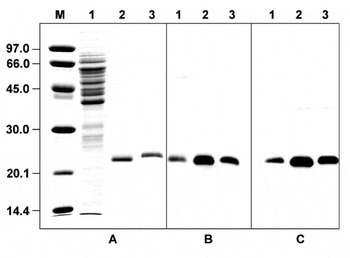
After fusion of spleen cells from BALB/c mice immunized with rAni s 1 and Sp2/0 myeloma cells, hybridomas secreting anti-Ani s 1 antibodies were selected by ELISA. The mAb secreted by 4F2 hybridoma (IgG1 subclass, κ ligh chains) was chosen because it was able to capture Ani s 1 in solution when biotin-labelled polyclonal antibodies detected the formed complexes. Antibody specificities were checked by immunoblotting experiments with A. simplex extracts, showing that both 4F2 mAb and polyclonal anti-serum reacted with a single 21 kDa band in extracts, and also recognized natural and recombinant allergen under reducing conditions (Fig. 1). Immunoblotting experiments using several raw extracts from different origins including an extract of Ascaris lumbricoides gave no positive reaction even after loading 10 times more protein (data not shown). Similarly, immunoblots of raw extract and purified proteins from Anisakis incubated with an irrelevant mAb (anti-Lol p 1) (Arilla et al. Reference Arilla, Ibarrola, Eraso, Aguirre, Martínez and Asturias2001) gave negative results.
Coomassie-stained SDS-PAGE (A) and Western blot immunostained with mAb 5D4 (B) or with rabbit anti-Ani s 1 serum (C) of Anisakis simplex extract (lane 1), nAni s 1 (lane 2), and rAni s 1 (lane 3).

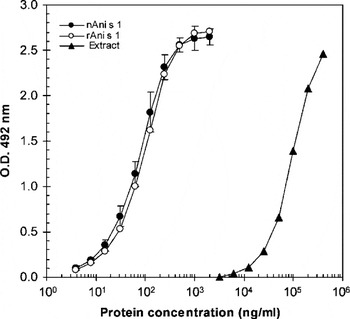
Several assays were performed to determine the minimal antibody concentrations that gave rise to a dose-response curve with the highest sensitivity. These concentrations were 5 μg/ml for 4F2 mAb and 250 ng/ml for biotin-labelled polyclonal antibodies and the curve was established from 4 to 2000 ng/ml. It revealed a sigmoid shape when plotted on a semi-logarithmic scale, being linear in the range from 15 to 250 ng/ml with a coefficient of regression of 0·993 (Fig. 2) and a detection limit of 1·8 ng/ml. The intra-assay coefficients of variation were 6, 10, 8, 5 and 6% at the concentrations of 15·6, 31·2, 62·5, 125 and 250 ng/ml respectively while the inter-assay CVs were 18, 16, 12, 12, and 6% at the same concentrations. The practical working range extended from 8 to 2000 ng/ml because at these concentrations the CVs were <20. The assay was applied to rAni s 1 and the resulting standard curve was statistically similar to that obtained with the natural allergen (Fig. 2). These results, and the 99·7±11·5% recovery obtained, supported the validity of the assay.
Dose-response curves in 2-site sandwich ELISA of nAni s 1, rAni s 1, and of Anisakis simplex extract.

The specificity of the 2-site sandwich ELISA was tested at a protein concentration of 200 μg/ml with extracts from different origins: pollen (Lolium perenne), mould (Alternaria alternata), mite (Dermatophagoides pteronyssinus), insects (Pseudococcus, Tenebrio molitor, Thaumetopoea pytiocampa), annelids (Lumbricus terrestris, Glycera dibranchiata, Paranereis acrata, Nereis diversicolor, Marphysa sanguinea, Sipunculus nudus) and nematode (Ascaris lumbricoides). There was no significant reaction except in the case of Ascaris extract where the assay detected 0·04 mg of an Ani s 1-like protein per gramme of extract. Nevertheless, spiking experiments using 1 mg/ml of A. lumbricoides extract showed that this extract had no significant interference with the assay since the obtained values were within the variability range of the expected values (data not shown).
Ani s 1 content was calculated in 7 different A. simplex extracts by interpolation in the linear portion of the standard curve and ranged between 0·2 and 0·4 mg per gramme of extract with an average of 0·3 and a variation coefficient of 25%. The developed ELISA was applied to track the presence of Ani s 1 in some commercial fish extracts intended for allergy diagnostic uses such as seabream, monkfish, sardine, anchovy, sole, hake, and codfish. Positive results were obtained with raw and boiled extracts of monkfish (2 and 10 ppm, respectively) and codfish (5 and 33 ppm, respectively). Several extracts from organisms involved in the life-cycle of Anisakis larvae were also tested in spiking experiments to assess the specificity of the assay. None of the extracts from crustaceans (shrimp and prawn), and cephalopods (octopus, squid, and cuttlefish) had significant interference with the described assay.
DISCUSSION
The quantification in mass units of major allergens has become an important goal for the standardization of allergen products intended for clinical use. ELISA has the advantage of high sensitivity, reproducibility and reliability, without drawbacks of earlier immunoassays (e.g. radioactivity). Due to those characteristics ELISA is becoming the standard among the allergenic protein quantification techniques. In this study, the combination of 4F2 mAb as capture and biotin-labelled anti-Ani s 1 polyclonal antibody as tracer were applied in a 2-site sandwich ELISA to quantify Ani s 1. Both monoclonal and polyclonal antibodies were highly specific as the immunoblotting analysis of the complete extract demonstrated. This combination was chosen since it yielded the Ani s 1 standard curve with the highest sensitivity (1·8 ng/ml) to be applied to the routine measurement of the Ani s 1 content in production batches of extracts and prick-test solutions. A recombinant Ani s 1 (rAni s 1) with equivalent immunological properties to the natural counterpart has been expressed in Escherichia coli (Ibarrola et al. Reference Ibarrola, Arilla, Herrero, Esteban, Martínez and Asturias2008). Purified nAni s 1 showed a dose-response curve parallel to that of crude A. simplex extracts, suggesting that the assay was measuring the same molecule in the different preparations and that the allergen had not been altered during the purification process. The assay reproducibility was proven by the low intra- and inter-assay CV, to be less than 10% and 20%, respectively. The purification of natural Ani s 1 is laborious and expensive since larvae should be extracted manually from parasitized fishes and the low yield of purified protein obtained (50 μg/g of larvae in this work) makes impossible its use as a routine reagent (Moneo et al. Reference Moneo, Caballero, Gómez, Ortega and Alonso2000). Therefore, rAni s 1 was used as a standard in the developed assay and the resulting curve was statistically similar to that obtained with the natural allergen. Therefore, the recombinant Ani s 1 could become a reference material for a specific Ani s 1 assay because it has several advantages over its natural counterpart. Recombinant Ani s 1 is accurately quantified and can be produced in quantities large enough to develop stability studies and a suitable lyophilization strategy.
The assay did not give any significant reaction with several extracts from different origins. The unique exception was in the case of A. lumbricoides extract where the assay detected 0·1 mg of an Ani s 1-like protein per gramme of extract. Cross-reactivity among ascarids and excretory-secretory antigens from A. simplex had been previously detected but no identification of the antigens involved had been reported (Kennedy et al. Reference Kennedy, Tierneym, Ye, McMonagle, McIntosh, McLaughlin and Smith1988; Lozano et al. Reference Lozano, Martín, Díaz, Mañas, Valero and Campos2004). Nevertheless, this aspect needs more studies since no reaction in immunoblot has been found between the Ani s 1 antiserum or the 4F2 mAb and the ascarid extract, both under reducing and non-reducing conditions.
Allergy to A. simplex has been reported following ingestion or handling of the infected fish (Audicana et al. Reference Audicana, Fernández de Corres, Muñoz, Fernández, Navarro and Del Pozo1995; Del Pozo et al. Reference Del Pozo, Audicana, Diez, Muñoz, Ansotegui, Fernández, García, Etxenagusia, Moneo and de Corres1997; Montoro et al. Reference Montoro, Peterguer, Chivato, Laguna and Cuéllar1997; Añibarro and Seoane, Reference Añibarro and Seoane1998; Armentia et al. Reference Armentia, Lombardero, Callejo, Martín-Santos, Martín-Gil, Vega, Arranz and Martínez1998; Pulido et al. 2000; Scala et al. Reference Scala, Giani, Pirrotta, Guerra, Cadoni, Girardelli, De Pità and Puddu2001). Current diagnosis of A. simplex allergy is based on anamnesis, detection of A. simplex-specific IgE antibodies and cutaneous tests with positive reactivity against A. simplex extracts but negative reactivity to fish extracts (Lorenzo et al. Reference Lorenzo, Iglesias, Leiro, Ubeira, Ansotegui, García and Fernández de Corres2000; Baeza et al. Reference Baeza, Rodríguez, Matheu, Rubio, Tornero, de Barrio, Herrero, Santaolalla and Zubeldía2004). Therefore, the presence of Ani s 1 traces in commercial fish extracts used for allergy diagnostics (monkfish and codfish extracts), detected by the developed ELISA, gives warning of possible misdiagnosis of fish allergies due to positive results when cutaneous or serum tests have been performed with fish extracts made from Anisakis larvae-parasitized raw material. Furthermore, a recent article has described the putative presence of Anisakis proteins in chicken meat due to the high proportion in chicken feed of fishmeal which might possibly be contaminated by this nematode (Armentia et al. Reference Armentia, Martín-Gil, Pascual, Martín-Esteban, Callejo and Martínez2006).
The amount of Ani s 1 found in a single larva is about 244 ng and, taking into account the detection limit of the assay, it could detect as low as 25 larvae per 100 g of fish. Similar infection levels have been found in heavily-infected fish described in a New Zealand survey (Wharton et al. Reference Wharton, Hassall and Aalders1999). Although a higher degree of sensitivity should be reached in order to detect mild and low infection levels, the developed ELISA can constitute a first step for improving current methods for detection of nematodes in fish, especially having taken into account the reported low detection efficiency of candling, the commonly recommended inspection method (Levsen et al. Reference Levsen, Lunestad and Berland2005).
In conclusion, we have described for the first time a 2-site sandwich ELISA, based on a mAb and a specific rabbit antiserum, to determine Ani s 1 concentrations in A. simplex extracts. The described assay is a specific and sensitive method that allows standardization of A. simplex extracts intended for clinical use and could help in the detection of A. simplex parasitization in marketable fish foodstuffs.
This work was supported by Bial-Arístegui and by Grants FIT-090100-2007-76 from the Programa Nacional de Biomedicina (Acción PROFARMA, Ministerio de Industria, Turismo y Comercio, Spain) and IT-2006/0000480 from the Programa INNOTEK (Departamento de Industria, Comercio y Turismo, Gobierno Vasco). J. M. is under the Programa de Intensificación de la Actividad Investigadora del Sistema Nacional de Salud.