Although Dignity Therapy (DT) has been implemented and studied over the past 20 years (Fitchett et al., Reference Fitchett, Emanuel and Handzo2015; Martinez et al., Reference Martinez, Arantzamendi and Belar2017), a detailed training protocol has not been available to facilitate consistency of its implementation. Chochinov, the creator of DT, published a textbook that describes the background, therapeutic process, and evidence regarding DT (Chochinov, Reference Chochinov2012), and there are more than two dozen journal articles with varying information about DT therapist training (Chochinov et al., Reference Chochinov, Hack and McClement2002; Chochinov, Reference Chochinov2012; Fitchett et al., Reference Fitchett, Emanuel and Handzo2015; Martinez et al., Reference Martinez, Arantzamendi and Belar2017). However, there are no specific training details in the literature sufficient to ensure a high degree of consistency in DT implementation. This gap is of particular concern since common challenges faced by researchers include failure to attain intervention fidelity and drift over time (Santacroce et al., Reference Santacroce, Macarelli and Grey2004; Hasson, Reference Hasson2010; Allen et al., Reference Allen, Linnan, Emmons, Brownson, Colditz and Proctor2012). Consistent and effective intervention training has been recognized as imperative for facilitating intervention reproducibility (Bellg et al., Reference Bellg, Resnick and Minicucci2004; Taylor et al., Reference Taylor, Weston and Batterham2015; McGee et al., Reference McGee, Lorencatto and Matvienko-Sikar2018). Consistent intervention delivery is vital to ensure that patients receive the intervention as it was intended and to maintain internal validity (Hasson, Reference Hasson2010). The purpose of this article is to describe a systematized DT training protocol.
DT is an empirically based therapeutic intervention that consists of interview sessions with a trained DT therapist (Chochinov et al., Reference Chochinov, Hack and McClement2002). The purpose of the DT intervention is to provide an opportunity for the individual to tell his/her story in a way that can be captured in a legacy document (Chochinov, Reference Chochinov2012). Important components of this process are the telling of his/her story, being heard by another person (the DT therapist), hearing and editing the story, and receipt of the resulting legacy document, which he/she may give to a significant other if desired. Research has demonstrated that DT participants and their families have reported enhanced sense of meaning and purpose (Fitchett et al., Reference Fitchett, Emanuel and Handzo2015), improved quality of life and sense of dignity (Donato et al., Reference Donato, Matuoka and Yamashita2016), and decreased anxiety (Martinez et al., Reference Martinez, Arantzamendi and Belar2017).
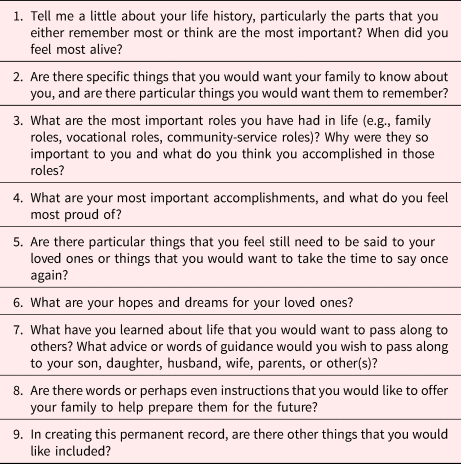
The DT interview (Table 1) leads the individual through a guided review of meaningful elements of his/her life. The role of the therapist is vitally important as he/she guides the individual through the DT questions in a manner that is interactive. Therapists must be responsive to the individual's cues, seamlessly moving into areas the individual deems are important elements of his/her personal story. The therapist must maintain an attitude that is self-reflective and self-aware. Her/his behavior must be kind and respectful, expressing interest in the individual's life experience and compassion for his/her suffering. The therapist should use language that communicates compassion and connects with the person beyond their present frailty or challenges. To do so, the therapist must convey a stance that is respectful, non-judgmental and affirming.
Dignity therapy protocol questions (Chochinov et al., Reference Chochinov, Hack and Hassard2005)

The ultimate goal is to assist the individual to create a legacy document containing his/her story and words of wisdom or key messages that he/she may choose to give to a significant person. The transcript of the DT session will be edited, weaving the patient's interview into a cohesive story. At the start of DT, the individual is asked to consider the person/people with whom he/she would want to share the Legacy Document. While many interviews primarily reflect sentiments such as love, joy, and gratitude, others may be fraught with complexities due to challenging health and psychosocial issues that arise as the individual reviews the elements of his/her life. It is imperative that the therapist training includes sufficient preparation to keep the interview focused on content that is relevant to the purpose of creating a personal legacy.
At the start of our large DT randomized controlled trial (RCT), we recognized the importance of providing a reproducible training protocol for all therapists across the multiple sites to ensure consistency in implementing the DT intervention. An effective training protocol would include the components, process, and materials to support consistent implementation across therapists, across sites, and over time.
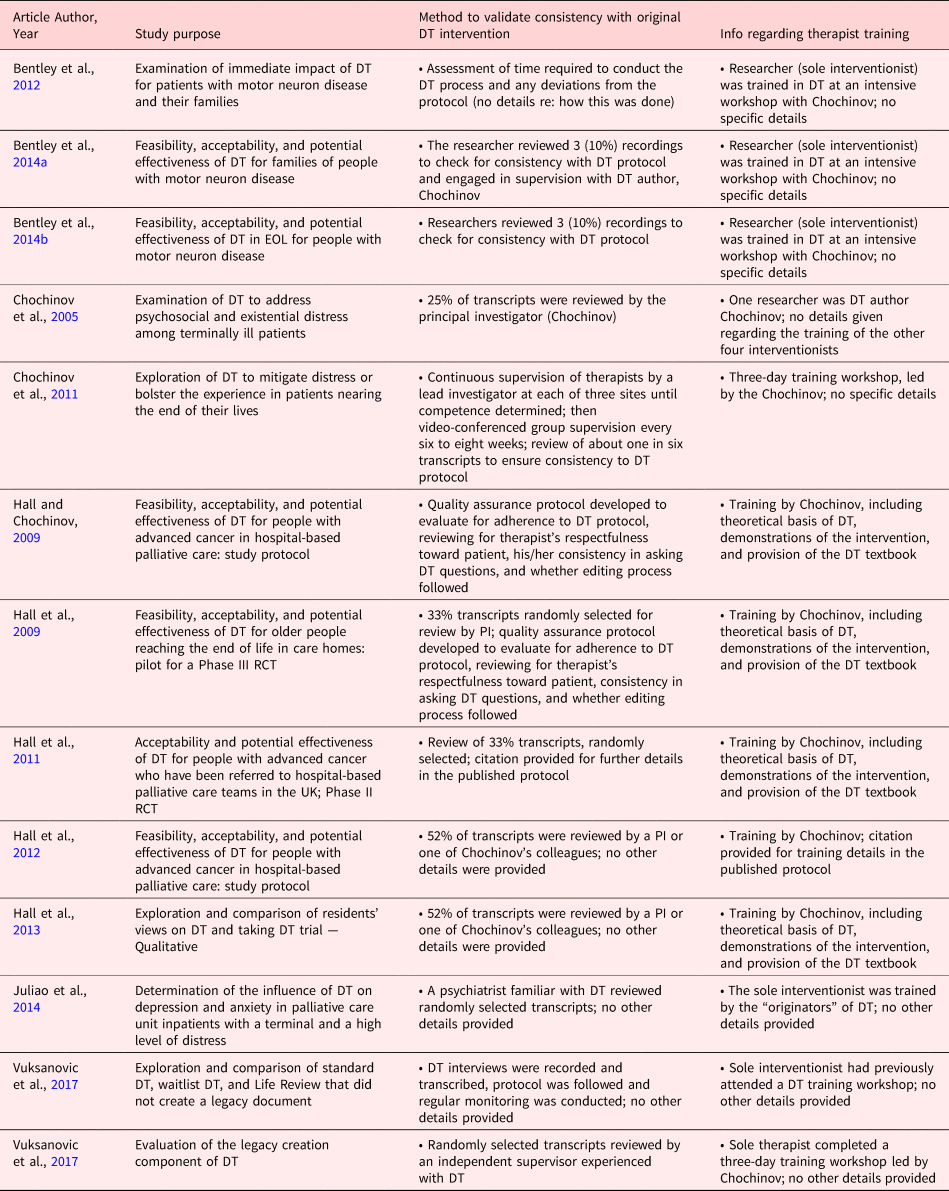
We conducted a systematic review of DT literature to discover what had been reported regarding therapist training. A PubMed search was initiated for “Chochinov” and “Dignity Therapy” (peer reviewed, no time limitation), which resulted in a collection of 77 references. The studies included results from various settings in nine countries over the past two decades (Fitchett et al., Reference Fitchett, Emanuel and Handzo2015; Martinez et al., Reference Martinez, Arantzamendi and Belar2017). After the initial review of all articles, the collection was narrowed to the 35 articles that presented DT interventions. As our goal was to implement consistent training that would facilitate intervention reproducibility, these 35 articles were appraised for details regarding training protocols as well as the strategies researchers implemented to validate consistency with the DT intervention. There were 14 articles that met this search criteria. The terms that authors used to describe evaluation strategies included assessment (Bentley et al., Reference Bentley, Aoun and O'Conner2012), adherence (Hall and Chochinov, Reference Hall and Chochinov2009; Hall et al., Reference Hall, Chochinov and Harding2009; Chochinov et al., Reference Chochinov, Kristjanson and Breitbart2011; Hall et al., Reference Hall, Goddard and Opio2011; Bentley et al., Reference Bentley, O'Connor and Breen2014a; Juliao et al., Reference Juliao, Oliveira and Nunes2014), protocol integrity (Chochinov et al., Reference Chochinov, Hack and Hassard2005), quality assurance (Hall et al., Reference Hall, Goddard and Speck2013) recording of deviations (Hall et al., Reference Hall, Goddard and Opio2012), fidelity (Juliao et al., Reference Juliao, Oliveira and Nunes2014), monitoring (Vuksanovic et al., Reference Vuksanovic, Green and Morrissey2017), and reviewing (Vuksanovic et al., Reference Vuksanovic, Green and Morrissey2017). Table 2 delineates the 13 articles that include some reference to the manner in which DT therapists were trained. While most of the articles indicated that the DT therapists had attended a workshop or trained with Dr. Chochinov, none provided details of the training protocol for the therapists. In summary, although there has been a good deal of research focused on the impact of DT, there is a deficit in recorded details regarding consistency in training therapists (Lindqvist et al., Reference Lindqvist, Threlkeld and Street2015).
Dignity therapy literature review

Recognizing the importance of specificity and consistency in training, we looked to other DT resources. Chochinov's Web site, DignityinCare.ca, does not provide a training protocol. The DT textbook (Chochinov, Reference Chochinov2012) advocates for the importance of training and makes reference to training sessions held at the author's site in Winnipeg, Canada, but does not provide a training protocol. A protocol for comprehensive training is sorely needed for this type of therapy. It is the fine balance of this process — as the therapist poses questions, clarifies, probes the story further, and speaks reflectively — that creates the environment for the positive effects of the intervention to emerge (Schryer et al., Reference Schryer, McDougall and Tait2012). The early implementation of DT was primarily provided by mental health professionals, but in order to provide the intervention more broadly, it is necessary to train others who may not have this same expertise. This makes systematized training particularly imperative.
We established a clearly defined DT training protocol, based on the National Institutes of Health (NIH) four recommended components: (a) provide standardized training and training materials; (b) ensure skill acquisition by use of standardized patients, role play, and an adherence checklist; (c) minimize “drift” over time by reviewing audio-recorded interventions, providing expert supervision and skill “boosters” as needed; and (d) accommodate differences between interventionists by providing specialized support and additional guidance as needed (Bellg et al., Reference Bellg, Resnick and Minicucci2004).
Objective
This article describes a detailed training protocol for the DT intervention that is designed to facilitate consistent and accurate implementation of the interview procedure. The training protocol provides a framework for future DT researchers and clinicians to train the DT therapists who will implement the intervention.
Methods
This detailed training protocol was created as part of a multisite, randomized controlled trial with a stepped-wedge design testing efficacy of DT (Kittelson et al., Reference Kittelson, Scarton and Barker2019). Throughout this report, we refer to the contributions of various team members. The primary trainer and four researchers served as DT experts to provide guidance and support in the training, mentoring, and quality assurance of the intervention implementation. A PhD candidate collaborated in the development of the training protocol and its documentation and then worked as the auditor to analyze the transcripts for quality assurance and communicate findings to the DT experts.
We included seven components in the DT therapist training protocol that addressed the previously mentioned NIH recommendations (a–d): (1) the original DT textbook (NIH a); (2) initial in-person intensive training (NIH a, b); (3) practice interviews (NIH b, c); (4) general and individual feedback (NIH c, d); (5) process tracking form (NIH b, c); (6) a training manual (NIH a, b); and (7) quarterly support sessions (NIH c, d). Protocol components 1 and 2 are based on the annual training that Chochinov presents in Winnipeg. Components 3–7 were developed specifically for the multisite trial. The following sections detail these components.
Original DT textbook
In preparation for the face-to-face initial training, we followed Chochinov's recommendations to provide each therapist-trainee with a copy of the book Dignity Therapy: Final Words for Final Days (Chochinov, Reference Chochinov2012). This DT textbook provided a detailed overview of the background, rationale, and protocol for the DT intervention.
Initial in-person intensive training
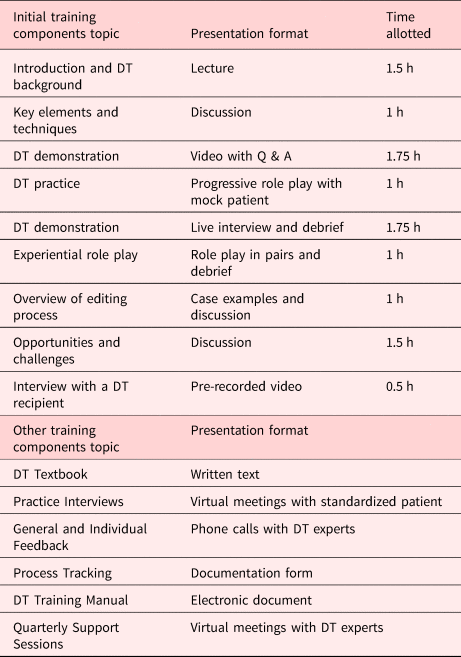
The next training component was Chochinov's two-day in-person intensive therapist training. The primary trainer (HMC) was highly qualified in DT and employed a variety of teaching methods including lecture, discussion, demonstration, multimedia presentation, role play, and work with case examples (Table 3). The agenda was crafted to incorporate activities and content that he deemed vital to facilitate successful DT implementation. Each activity provided an opportunity to practice and demonstrate understanding and achievement of skills for the previous segments in a manner that built progressively as the training advanced.
DT therapist training components

DT, Dignity Therapy.
The training event began with an introduction and background session, to provide the purpose, rationale, and history of DT including its empirical foundation. The trainer led a discussion of the key elements and techniques of the procedure. Next, a previously video-recorded DT interview was presented, so the trainees could observe a complete therapeutic session. Following this, the trainer and mock patient demonstrated the key elements of engaging in and commencing a DT interview, along with teaching the use of a photo album metaphor. This technique invites the DT recipient to imagine looking back through a photo album and describe the experiences that stood out as significant, which he/she would want to share. After sharing memories of this first “picture,” the trainer asked the mock DT recipient to flip through the imaginary album and tell him about the next picture she would want to include as part of constructing her legacy. This method of interviewing guided the DT recipient to translate significant memories into a narrative, facilitating the DT recipient's expression of her story thread.
Following this demonstration, the trainees took turns leading parts of the session with the mock DT recipient. The training sessions each had between four and six trainees that took turns cycling through the interview scenario. After completing their portion of the interview, the trainer provided trainees feedback, offering insights to help guide their development as DT therapists. Had there been more attendees, a mock DT recipient would have been needed for every four to six trainees. Prior to the training, the trainer advised the mock DT recipient to establish a clear and detailed scenario to maintain consistency throughout the exercise. A well-established story assists the person presenting the role so that they can remain consistent in their presentation (Block et al., Reference Block, Brenner and Conigliaro2018). One trainee began with the initial greeting and review of the goals for the session and then another trainee stepped in to lead the next part of the session, and so on until all trainees had an opportunity to practice a small portion of the interview. This activity segued to the trainer demonstrating a pre-arranged session with an actual patient who had agreed to participate in the DT training process. This example provided a thorough presentation of the structure of the intervention. At the end of the session, the trainees had the opportunity to ask questions of both the trainer and the patient.
In the next segment, pairs of trainees engaged in a role play of the DT interview and debriefed about their experiences. Each member of each pair took turns portraying the therapist and the DT recipient, affording them the chance to practice the therapist role and allowing them to gain understanding regarding the potential experience of the DT recipient. This activity allowed the expert trainer to assess the trainees level of understanding (Bellg et al., Reference Bellg, Resnick and Minicucci2004). At times during this experience, trainees encountered dialogue with the “mock patient” that enlightened them to questions they had about the various DT techniques. This offered an ideal time for them to query the trainer.
As the training continued, the trainer provided a general overview of the editing process, using examples from verbatim transcripts and final legacy documents. In this activity, the trainees examined how responses to various questions would later be woven into a cohesive narrative. This led to the discussion of opportunities and challenges of the intervention. Then, a presentation of a pre-recorded video interview with a woman who had received the DT intervention provided a moving description of her experience and the impact that the DT process had upon her and her family. This first-person report helped trainees to see the potential impact of DT for the patients they would encounter.
The in-person training wrapped up with the attendees receiving information regarding the remainder of the training protocol, including the written training manual, an annotated interview transcript, and instruction on use of a process form. Participants were told that they would take part in a standardized mock patient session and that there would be subsequent virtual meetings with DT experts who would review their session transcripts and provide feedback.
Practice interviews
Following this intensive training, another DT expert (DJW) engaged each therapist in a simulation in which she portrayed a standardized mock patient. Carefully prepared standardized patients (SPs) who have a clear and detailed patient story are able to respond with deep authenticity and flexibility to varied interactions with the learners (Lewis et al., Reference Lewis, Bohnert and Gammon2017). Furthermore, SPs who develop a deep connection to the character they portray maintain strong levels of consistency over time, both in story and in affect (Erby et al., Reference Erby, Roter and Biesecker2011; Block et al., Reference Block, Brenner and Conigliaro2018). This session was scheduled as closely as possible following the initial training to provide the therapist-trainees an opportunity to practice their interview skills. The therapist-trainees were required to follow each component of the intervention. This included the initial framing conversation — in which they phoned the mock patient to describe the process, ensure that she understood the intervention, what her goals were in taking part in DT, gather details about the significant people in her life and to whom she would present the completed legacy document. The therapist-trainees then completed a DT interview with the mock patient. In the interview, they had the chance to go “off script” at the beginning or end of the session to ask questions of the mock patient/expert. These interviews were audio-recorded and verbatim transcripts were given to the therapist-trainee for self-reflection before receiving written and verbal feedback from one or two other DT experts who had reviewed the transcript.
General and individual feedback
In addition to the mock patient feedback, the trainer and another of the DT experts reviewed the initial patient/participant transcripts and provided written and verbal feedback to individual therapist-trainees regarding the process and techniques of the therapists, as well as the therapists’ consistency in remaining focused on the creation of a legacy document. Written and verbal individual feedback were provided until the therapist demonstrated competence in adherence to the DT protocol.
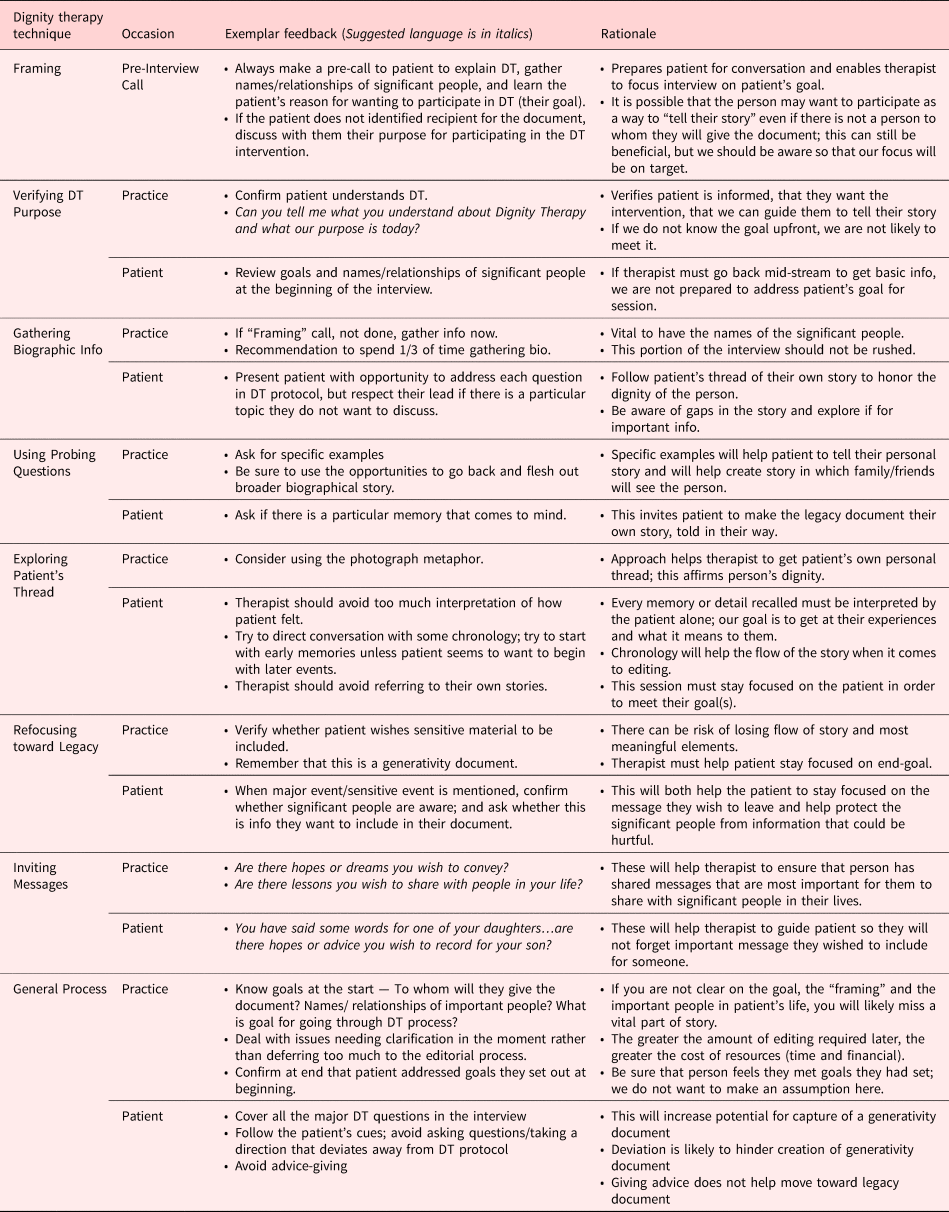
Table 4 displays exemplars of the most significant constructive feedback that experts provided via a group call, affording an opportunity for all trainees to learn from each other's practice sessions. An advantage to this approach was the camaraderie and “ownership” developed through peer-to-peer learning. Individual performance issues, however, were addressed in private conversations.
Expert feedback for therapist-trainees

Verification that each patient understood the purpose of the intervention was emphasized in the individual and group feedback. It was also imperative for the therapist to ask the questions directed by the DT intervention and to avoid turning the focus to topics that were distracting and not pertinent to legacy. The therapist's ability to remain simultaneously neutral yet actively supportive of the patient was another vital skill. It was also imperative for the therapist to use elaborative techniques as defined in the DT textbook (Chochinov, Reference Chochinov2012) to elicit the richness of the individual's story. Furthermore, the therapist was expected to remain empathically attuned to the patient. All of these areas are integral to maintaining consistency of the DT intervention.
Initially, the DT experts reviewed all transcripts and provided feedback to the therapists. Throughout the DT intervention, all transcripts continued to be analyzed by the auditor and those with issues were referred to the DT experts for retraining of the therapists. The primary goal was to support the therapists to focus their interviewing skills toward achieving the goals of the DT intervention. Although it is rare, previous researchers (Kruzinga et al., Reference Kruzinga, Helmich and Schildermann2016) have observed occasions in which care providers who were not accustomed to interview-based interventions (such as DT) have felt the structure inconsistent with their philosophy of care. It was a priority in our study that any therapist who decided to discontinue their involvement would be supported in their decision to withdraw and that the feedback process would provide for them to debrief their challenges.
Process tracking
The DT Contact and Process Tracking Form (Appendix) was provided to guide the therapists during their training so that all components of the interview process were clearly outlined for ease of completion. This guide then continued to be used for all DT patients to safeguard against drift for the duration of the multisite trial.
Training manual
A comprehensive 30-page training manual was developed to provide a detailed step-by-step guide to implementing the DT intervention. It included information regarding which team member was responsible for each step, so as to remove any ambiguity. The detailed instructions covered each step in the procedure, from the initial screening of the potential patient to the delivery of the final legacy document. The DT experts and the auditor were intentional in developing a training manual with examples that the therapists could easily compare to their own practice in order to identify any deviations in their implementation of DT. The manual also provided a clear plan that the therapists could follow to achieve DT protocol consistency.
Included in the manual was an annotated transcript of an exemplar session that the primary trainer had conducted. It provided specific annotation of the interview techniques he used as he guided the patient through the session. This practical demonstration provided a standard after which the therapists could model their own sessions. The manual was revised as needed to incorporate details that the DT experts and the auditor recognized needed clarification or strengthening.
Quarterly support sessions
In line with the NIH recommendation for “skill boosters” for interventionists (Bellg et al., Reference Bellg, Resnick and Minicucci2004), the DT therapist-trainees, DT trainer, and other DT experts attended a quarterly video-conference meeting. This meeting provided the opportunity for the therapist-trainees to participate in peer-to-peer learning as well as to discuss their experiences and challenges and hear from the trainer and experts as needed. These sessions also helped identify and/or prevent protocol drift as the trial progressed.
Early training outcomes
Eighteen DT therapists were trained across six sites to conduct the intervention using the training protocol. The group included 13 chaplains and 5 nurses. Seven of the chaplains and two of the nurses joined the team after the initial training session and were provided access to the video recording of the initial two-day training session; thereafter, their training followed the identical sequence of prior trainees.
Although all therapist-trainees received information regarding the purpose, goals, and requirements for the DT intervention, two chaplains who joined the team subsequently decided that the intervention was not consistent with their spiritual care practice and withdrew from participation as therapists. They reported feeling that the intervention did not fit with their chaplaincy practice. Time conflicts and emergencies had allowed them to attend only intermittently at the initial training and it is not known whether they viewed any of the recorded portions that they missed. These withdrawals emphasize the importance of making sure therapist-trainees understand that DT is an intervention with which protocol adherence is essential.
The DT experts reported that the mock patient interviews generally went well. Compassion for the individual was noted across the interviews. The auditor expressed that the interactions reflected respect for the personhood of the patients. Additionally, to facilitate excellence and efficiency in future DT interviews, the experts provided detailed feedback for the therapist-trainees regarding the interview process and communication.
The feedback was categorized into eight basic techniques for further implementation. The feedback categories included the initial framing conversation in which the therapist-trainees gathered the names/relationships of the patient's significant people, whether the therapist-trainees verified the patient's purpose for participating in DT, the gathering of the patient's biographical information, the use of probing questions, the therapist-trainee's exploration of the patient's story thread, the skill of the therapist-trainee in refocusing toward the legacy document creation, the therapist-trainee's invitation of special messages the patient would want to express to their significant people in their document, and attention to general processes. Table 4 shows exemplars from the feedback in each category as well as the rationale.
Findings
Our careful attention to and frequent evaluation of the process allowed us to fine-tune the procedure until we had developed an integrated training protocol. Our multi-faceted training provided foundational knowledge of the DT intervention, addressed the learning needs of the various therapist-trainees, and enabled reinforcement of learning and skill development, as well as recurrent review of the adherence of our process. Initial in-person (or via video) training with an expert in the intervention was indispensable in communicating the vision, passion, and nuances of DT. Although we would prefer face-to-face initial training for all therapist-trainees, we recognize that just as with our trial, other researchers also encounter situations in which there is unavoidable team member attrition, therefore a contingency plan is necessary to train replacement therapists. Our consideration of this need was especially beneficial as the final live training had to be canceled due to travel limitations related to Covid-19. As we already had a plan in place for distance training, we were able to flex our plans with relative ease and maintain detailed preparation for the therapist-trainees. The video recordings of the in-person training provided the opportunity for the distance-learning therapist-trainees to virtually experience the same information that was presented live. The actual patient demonstrations, both video-recorded and live, allowed the trainees to see the intervention at its best. The didactic and activity portions provided therapist-trainees with the concepts and then allowed them the opportunity to begin practicing the skills. Following both practice and actual interviews, the feedback from the DT experts provided reinforcement of learning and development of interviewing proficiency.
Although trainings for interview-based interventions cannot always be led by the intervention author (we were fortunate in this regard), it is vital that all trainings be led by an expert in the intervention (Bellg et al., Reference Bellg, Resnick and Minicucci2004). Furthermore, although experts with decades of proficiency are not always available to provide mentoring and guidance during the learning process, we assert that expert guidance is necessary (Beidas and Kendall, Reference Beidas and Kendall2010; Hasson, Reference Hasson2010) and every effort should be made to collaborate with experts in the intervention being implemented. A clear understanding of the intervention enables the experts to quickly assess when trainees’ understanding deviates from the original or when intervention consistency is failing. Furthermore, it is our assumption that those who have been invested in a particular intervention — having practiced and researched it — would be more likely to hold a high standard regarding implementation and are in the best position to identify aspects that are imperative and those that are less essential.
As with other life review interventions, there may be challenges related to the health condition of the patient or complex personal/family dynamics (Haber, Reference Haber2006). DT has the added intricacy that the DT therapist is constrained by a 1-h time limit and the awareness that the final document has a specific audience. Providing expert feedback allowed therapist-trainees the opportunity to discuss the challenges and learn the intricacies of therapeutic communication and legacy document creation. This guidance reinforced the DT training, including the importance of questions (Table 1) intended to direct the patient toward an exploration of the experiences he/she found most meaningful in life (Chochinov et al., Reference Chochinov, Hack and Hassard2005; Chochinov, Reference Chochinov2012; Chochinov et al., Reference Chochinov, Cann and Cullihall2012; Fitchett et al., Reference Fitchett, Emanuel and Handzo2015).
The DT Contact and Process Tracking Form and the training manual were vital documents to itemize process steps and to clarify process flow, assisting all team members to adhere to the same procedure. These tools were beneficial for training and necessary for monitoring protocol adherence and assurance of quality interventions.
We recognize that a limitation of this article is that it does not provide final results in terms of achieving fidelity following the implementation of this training protocol; fidelity outcomes will be reported in a separate article. Another limitation in this methodological report is that we did not directly ask each therapist-trainees to report if they had read every training document. It may be helpful for future teams to add this compliance check into their procedures. As two of our therapist-trainees were distracted away from the in-person training by phone calls it became apparent that there is a need for trainees to be adequately relieved of responsibilities in order to be present.
The primary goal of this report is to clearly describe a detailed training protocol for DT. The training components were designed to provide the trainees with a foundation of skills to implement the DT interview regardless of the therapist-trainees’ professional discipline. Toward this objective, a variety of teaching methods was used and opportunities for reinforcement and fine-tuning were provided. The clearly established training protocol promoted structure in which the DT experts could provide oversight and process review. The DT Contact and Process Tracking Form provided a guide for the therapist-trainees and assisted the research team to ensure that each step in the process was conducted and documented.
Discussion
We approached this work with the knowledge that DT has a long history as an intervention that draws on life review practices to facilitate the creation of a legacy document. As we prepared to initiate a multisite DT randomized controlled trial, it was of primary importance to ensure consistent and reproducible training. Our exploration of the literature illuminated gaps regarding a documented training protocol, despite the imperative role that such training plays in maintaining fidelity to the intervention. Although the original DT textbook describes necessary elements of training, there were not sufficient details to ensure replication. Furthermore, subsequent DT researchers provided only limited details of their training procedures. We recognized that a consistent training protocol was imperative for us to ensure that the DT therapists in our study would be prepared to implement the intervention consistently. Furthermore, we recognized that the lack of a detailed training protocol could impair other researchers’ and clinicians’ efforts to effectively replicate the intervention. We rectified this gap with a detailed training protocol for the DT intervention so that implementation would be consistent and accurate as our study progressed from four to six sites.
Our contribution of the Refined DT Training Protocol will enable the broadening of DT implementation with fidelity to the original intervention. This augmentation to the DT training process is vital in a time when resource constraints may require that a variety of clinical disciplines be called upon to step into the role of the DT therapist. This training protocol description establishes details for implementing DT with intervention fidelity. Other researchers and clinicians may utilize this DT therapist training protocol and set of procedures to fortify the rigor of their work. This work is poised to make a notable impact in both research and clinical care. The training protocol delineates important components of therapist training that can readily be replicated and the elements can be adjusted to apply to the training of therapists for other life-review or palliative interview-based interventions.
Acknowledgments
The authors wish to express special thanks to Amelia Greenlee, Virginia Samuels, the Research Coordinators, Editor, Dignity Therapists, and Site Directors. Their contributions to this work are invaluable.
Funding
This research was made possible by Grant Number 5R01CA200867 from the National Institutes of Health (NIH), the National Cancer Institute (NCI), and the National Institute of Nursing Research (NINR). Its contents are solely the responsibility of the authors and do not necessarily represent the official views of the NCI or the NINR. The final peer-reviewed manuscript is subject to the National Institutes of Health Public Access Policy.
Conflict of interest
There are no conflicts of interest to report.
Institutional review board approval information
Information for this methods paper was obtained and developed as part of a study that has been approved by the University of Florida IRB.
Appendix