Many aspects of the German-American encounter during the Second World War remain deeply engraved in the American mind. One of them is the story of the German “werewolves,” Hitler's last underground fighters, who challenged the occupying armies in the war's closing months. The werewolf threat made a lasting impression on American troops and media at the time, and on American collective memory up to today. This article traces how the Nazi insurgents became part of an older mythical narrative that continues to infuse not only American popular culture, but even contemporary elite and political discourse.Footnote 1 One of the more recent examples is Condoleezza Rice and Donald Rumsfeld's effort to compare the Nazi werewolves with the Iraqi insurgents whose attacks have plagued the occupied country since the American invasion.
More than once, the Bush administration compared the Iraq war with the war against Nazi Germany, a comparison that clearly served political purposes. Saddam Hussein was likened to Adolf Hitler, the U.N.'s resolutions on Iraq to Europe's pre-1939 policies of appeasement, and the U.S.'s $87 billion Iraqi aid package to the Marshall Plan that helped rebuild postwar Europe.Footnote 2 Such comparisons were supposed to convey the soothing message that the messy occupation would eventually give way to a stable and democratic country. Just as Hitler's Germany gave way to the prosperous and strategically vital Federal Republic of Germany, Saddam's Iraq would inevitably accept the guiding hand of the United States, democratize, and westernize. Even the violent insurgency that erupted in Iraq from the start of the war and has since intensified was interpreted in light of that comparison. President George W. Bush stressed, “Like the Nazis and the communists before them, the terrorists seek to end lives and control all life. And like the Nazis…, they will be … defeated.”Footnote 3
National Security Advisor Condoleezza Rice and Secretary of Defense Donald Rumsfeld fleshed out the analogy. In several speeches and interviews between August and November 2003, they paralleled the Iraqi insurgency with the National Socialist organization Werwolf. Exactly 100 days after the official end of major combat, Rice declared:
The historical analogy is important. Like the transformation of Europe, the transformation of the Middle East will require a commitment of many years … . There is an understandable tendency to look back on America's experience in postwar Germany and see only the successes. But the road we traveled was very difficult. 1945 through 1947 were especially challenging. The Marshall plan was actually a response to the failed efforts to rebuild Germany in late '45 and early '46. SS officers—called “werewolves”—attacked coalition forces and engaged in sabotage, much like today's Ba'athist and Fedayeen remnants.
This claim was a prelude to an appeal for “patience and perseverance.” Instead of an immediate peace (an increasingly unlikely outcome after every new terrorist act), the American public should expect a tedious but eventually successful process of stabilization in the Middle East.Footnote 4 Donald Rumsfeld gave it a slightly different spin when he highlighted the abject failure of the werewolf movement. He called the Nazi werewolves “dead-enders” who had targeted occupying troops and German collaborators “during and after the defeat of the Nazi regime in Germany.”
Mayors were assassinated… Children as young as ten were used as snipers, radio broadcasts and leaflets warned Germans not to collaborate with the Allies. They plotted sabotage of factories, power plants, rail lines. They blew up police stations and government buildings, and they destroyed stocks of arts and antiques that were stored by the Berlin museum. Does this sound familiar? Like the deaths squads in Iraq they failed to stop the liberation of Germany and they failed in rousing the population of Germany to widespread revolt … . The dead-enders in Germany failed just as the Ba'athists, the terrorists and foreign fighters in Iraq today will fail … . They will be defeated but it will take patience.
Rumsfeld, too, used the analogy to ask for “patience, persistence, and sacrifice” (here on the part of U.S. troops), and to disperse the skepticism of public critics. “There are some today who are surprised that there are still pockets of resistance in Iraq, and they suggest that this represents some sort of failure on the part of the Coalition. But this is not the case,” as proven by the werewolf experience.Footnote 5
This journey into the history of the Second World War did not play out well for Rice and Rumsfeld. Beginning in late August 2003, major newspapers' columns sharply criticized the werewolf analogy. The New York Times, the Los Angeles Times, and the Cox News Service called it “a misreading of history,” a “WW II whopper,” “war stories,” and “almost a deliberate urban myth.” Renowned historians such as Volker Berghahn, Fritz Stern, Jeffrey Herf, and Rebecca Boehling contested the administration's case. Even Perry Biddiscombe, whose work on the werewolves Rumsfeld had obviously borrowed, objected to the comparison. Likewise, experts from army institutions and think tanks—from the Army Military History Institute; the Army College in Fort Leavenworth; the Army War College Museum in Carlisle, Pennsylvania; and the Center for Strategic and International Studies in Washington, D.C.—voiced concerns. These protests zeroed in on the werewolf analogy, but quickly expanded to include broader criticism of U.S. occupation policies in Iraq. Like the administration, analysts drew on the experience of 1945 Germany to compare the Iraq situation unfavorably in terms of pre-war planning, troop strength, cost of the occupation, and fate of the dictator.Footnote 6
Rice and Rumsfeld's comparison thus backfired. It can be understood as an example of misguided propaganda, of history being used for political purposes. But there is a deeper layer to be unearthed. It seems clear why the administration chose post-war Germany as an historical example: the case of the German occupation could counsel patience and assure the public of an eventually positive outcome.Footnote 7 But why did the administration evoke the werewolves? The speechwriters decided to focus on an obvious and oversimplified analogy, probably fully aware of its shortcomings (the real history of the Werwolf movement is well-documented and readily available). Moreover, Rice and Rumsfeld repeated the werewolf story on several occasions, even after the media had targeted it. Rumsfeld reiterated his point several months later in two televised interviews on ABC and at a luncheon with the Korean Business Council. Deputy Secretary of State Richard L. Armitage took up the werewolf analogy at a media roundtable in Slovakia a year later, in September 2004.Footnote 8
This article argues that the administration's continued use of the analogy can only be explained by a particular American fascination with the Nazi werewolves. These politicians deliberately tied their argument to an exotic, mythical narrative in order to make it more appealing. Thus the American myth of “Hitler's werewolves,” which evolved during the Second World War and ever since has led a life of its own, needs to be deconstructed. From the collective memory of war and occupation arose a myth that, over time, became increasingly detached from historical experience and developed into a highly variable ingredient of American mass culture.Footnote 9 First I will focus on the years 1944/1945, on the real threat of a Nazi insurgency and the reactions of the U.S. army and mass media. Second, I will discuss the ways that American elites—in politics, academia, and the military—remembered the werewolves during and after the occupation. Finally, I will trace the ways that popular culture has reworked, told, and retold the werewolf story on celluloid, in the pages of thriller novels, and in computer games right up through the early years of the twenty-first century.
***
How much of a threat did the Nazi insurgents really represent? Most of the details Condoleezza Rice and Donald Rumsfeld mentioned—assassination of mayors, child snipers, and planned sabotage—were essentially correct, but were nevertheless used to paint a distorted picture of the situation in Iraq. For one thing, the German werewolves were nowhere near as well organized or successful as the Iraqi insurgents have been to date. Moreover, the Nazi effort was short-lived and reached its climax before the regime's surrender, whereas the Iraqi insurgency has grown in intensity since the “official” end of the war and shows few signs of abating.
There were basically two German werewolf movements that the Allied forces confronted. The first were special guerrilla units that had been set up within Himmler's SS from the fall of 1944. Several thousand die-hard Nazis were trained in paramilitary camps under the supervision of Hanns Adolf Prützmann and Otto Skorzeny. They were given false identities, uniforms, weapons caches, and instructions on how to commit sabotage behind enemy lines and prevent the German population from collaborating with the Allies. These SS werewolves did not live up to the task when their hour came: the Allied lines advanced too quickly, support from the population was too weak, and orders from the Berlin headquarters were too chaotic. Thus, months of clandestine preparation for partisan warfare resulted in almost nothing. Only one spectacular attack can be traced back to these paramilitary werewolf units: the murder of Franz Oppenhoff, the mayor of the U.S.-occupied city of Aachen, in March 1945—before the end of the war.Footnote 10
The other “werewolves” challenging the Allied troops were unorganized individuals who were drawn in by Joseph Goebbels' last big propaganda campaign. In March 1945, Goebbels had managed to swipe the werewolf concept from Himmler's SS and obtained Hitler's consent for a radio offensive. On April 1, he launched a powerful transmitter named Werwolf. Targeting “the political minority of the tenacious and steadfast” (Unentwegten und Beharrlichen) among the civilian population, he tried to instill “revolutionary spirit” in “freedom fighters” (Freiheitskämpfer) for the National Socialist cause. They were to attack the enemy by every possible means, to engage in sabotage and assassination.Footnote 11 But the overwhelming majority of war-weary Germans turned a deaf ear to Goebbels' appeals, and no genuine underground movement ever formed. The werewolf campaign enjoyed only two examples of limited success. The violence with which the National Socialists turned against “Defaitisten” (i.e., Germans who were collaborating with the Allies) in April 1945 was often labeled Werwolf activity, and Werwolf cliques of local youngsters carried out largely symbolic acts of resistance when they clipped wires and smeared walls with the Wolfsangel (a symbol particular to the werewolf movement, resembling a “Z” lying on its side). Still, most of the sabotage actions registered by the U.S. army were traced back to boys and a few girls aged twelve to eighteen years.Footnote 12 And the number of G.I.s who lost their lives due to werewolf attacks was certainly very small.Footnote 13 On April 24, the werewolf transmitter ceased to broadcast, and in the end, all werewolf activities were forbidden by Hitler's successor, Grand Admiral Dönitz, on the day of the German surrender.
While the werewolves did not constitute much of a real threat, their psychological impact was enormous. Goebbels was right when he speculated on April 2, 1945, “Our werewolf activity now severely intimidated the enemy camp. There is now a definite fear of a guerrilla Germany” (Partisanen-Deutschland). A week later, he rejoiced that the Allies seemed to be taking the issue very seriously.Footnote 14 The propaganda image of the werewolf also succeeded in terrifying the German population. As an undercover CIA agent reported from the region of Reutlingen on April 28, the campaign managed to arouse fear in German civilians. They reportedly associated the werewolf threat with Germanic legends of man-eating wolves and Hermann Loens' widely read best seller Der Wehrwolf which glorified lynching and bloody revenge: “No one in the towns dares to befriend the soldiers for fear of being killed by the members of the Wehrwolf … What previously was the Gestapo is now the Wehrwolf.”Footnote 15
Indeed, Goebbels' initiative evoked considerable anxiety among its two target audiences, the Germans and the Allied enemies. In the Allied camp, neither intelligence officers nor the generals of the U.S. army had reliable information about the potential of a German insurgency. Ever since the invasion in 1944, vaguely formulated intelligence reports had fostered hysterical fears of a never-ending partisan war on German soil. It was a widely held belief that Hitler's followers would continue their fight in an Alpine fortress, the so-called “national redoubt.” There, they would tie up several U.S. army divisions, inflict maximal losses for up to two years, and train underground terrorists to send them out into occupied territory.Footnote 16 The Allies also expected the Germans to refrain from formally surrendering; instead they thought the population would turn to guerrilla warfare. General Dwight D. Eisenhower warned in October 1944, and again in a letter to President Franklin D. Roosevelt on March 31, 1945, that there would be “a continuance of guerrilla fighting and underground resistance in Germany,” “which would require for its suppression a very large number of troops.” Eisenhower envisioned “the organization of an underground army… of ‘werewolves’” aiming at “so terrifying the countryside and making so difficult the problem of occupation that the conquering forces would presumably be glad to get out.”Footnote 17
These gloomy predictions quickly made it into the American press. During the spring of 1945, daily and weekly papers used the Alpine fortress and the werewolf threat to cook up horror scenarios. The Los Angeles Times ran the headlines, “Fury of Nazi ‘Werewolves’ to Be Unleashed on Invaders” and “Nazi Werewolves Threaten ‘Endless War to North Pole,’” while journalists predicted that Hitler might manage “to form a new murder society in chaotic Europe which might take years to stamp out.” The New York Times reported on “tens of thousands of young Nazis” whose fanaticism would foster underground terrorism and wondered “whether gas would be used against these irregulars.” The Chicago Daily News fantasized about a surreal army of “prostitutes, chauffeurs, intellectuals, and businessmen” who, attired in black gloves and masks, would “frighten away the conquerors of the Third Reich before they have time to taste the sweets of victory.”Footnote 18 Thus the American media stoked the fears of politicians and army leaders right down to ordinary G.I.s and their families.
The exaggerated werewolf fear affected not only Allied military strategy (such as Eisenhower's decision to first conquer Berchtesgaden and not Berlin),Footnote 19 but subsequently also American policy in its occupation zone. Because the military government fully expected clandestine warriors among the population and counted on sabotage and attacks by party and Hitler Youth followers, its utmost priority was the safety of the American soldier. During the first months of the occupation, nightly curfews were enacted, meetings of more than five people forbidden, and tens of thousands of POWs and suspicious civilians were held in camps. Eisenhower and his commanders threatened snipers and saboteurs with immediate reprisals. In some towns, mayors were told that every act of sabotage would be punished by burning down houses. The werewolf fear indeed induced a couple of excessive reactions by American troops in the spring of 1945, mainly shootings and hangings of resisters who were caught.Footnote 20 In the eyes of the Americans, the fear that every German could turn out to be a pernicious wolf was so pervasive that even members of German antifascist groups—such as the Antifa-Komitees, which offered U.S. agencies their help in hunting down local Nazis—were labeled as wolves of sorts.Footnote 21 And those Germans bearing ID cards whose photographs wrongly showed the right, instead of the left, ear were suspected to be underground fighters. A June 1945 General Intelligence Bulletin reported that “the right ear is the werewolf ear.”Footnote 22
As an antidote against the werewolves, the Allied forces recommended a consistent policy of non-fraternization. The U.S. Department of War endorsed this policy even though it knew that it would be difficult to sell to American troops. Policy planners generally believed the American G.I. to be naive, friendly, and open-minded, providing an opportunity for German civilians, steeped in nationalism and racism, to socialize with soldiers and ultimately stab them in the back. The result of this mind-set was a detailed non-fraternization propaganda campaign, whose primary goal was to propagate fear of German civilians so soldiers would willingly avoid them. Beginning in fall 1944, all G.I.s embarking for Europe were thoroughly prepared for their encounter with the Germans. First, every soldier had to carry a postcard-sized leaflet entitled “Special Orders for German-American Relations.” It stressed that the Germans were dangerous, merciless, malicious enemies with whom one should never associate. Second, every soldier was given a “pocket guide for Germany” (two million copies were printed). It combined common language phrases and sightseeing tips with stern warnings to avoid fraternization. Special caution was to be taken when dealing with the “trained killers” of the SS and with the fourteen- to twenty-eight-year-olds who had been taught “killing and treachery” by the Hitler Youth (Hitler Jugend, or HJ).Footnote 23 Third, Allied radio stations broadcast ten-second warning spots that called the pretty German girls “booby traps.” One cautioned that “a pretty German girl's melody is the death march … for you”; another that “she'd like to cut your hair off—off at the neck.” Even housewives and children were dangerous, since the Germans in reality were “hyenas,” “murderers,” and “cannibals.”Footnote 24
Perhaps the most effective anti-Werewolf weapon was a short orientation film that was screened for hundreds of thousands of G.I.s in 1945. Made by the successful Hollywood director Frank Capra and based on a script by Theodore Geisel (better known to most Americans as “Dr. Seuss”), the film was named “Your Job in Germany” and successfully played on the fears of the American soldier. It contrasted footage of beautiful girls, folk music, and “mighty pretty scenery” with the supposedly true nature of the Germans: pictures of mutilated and dead U.S. soldiers, victims of German massacres, and piles of corpses in the concentration camps. The G.I.s were admonished not to fraternize, and again SS men and HJ boys were singled out as potential terrorists. The Nazis were not gone, but had merely gone undercover: “Just one mistake may cost you your life. Trust none of them.”Footnote 25
The scary non-fraternization propaganda did indeed catch on, as memoirs of G.I.s and letters from the front show. In June and July 1945, the army's censorship reports revealed that many soldiers and officers felt physically threatened by werewolf cadres and fanatical Hitler youth.Footnote 26 G.I. Sayward Farnum, for one, remembered “the treacherous populations” in Lahntal “which amazed us by cheering us as we entered their towns and then shot us in the back at nightfall.”Footnote 27 His fellow soldier Roscoe C. Blunt slept with a gun under his pillow, watched out for “children with knives and clubs,” and reluctantly prepared to shoot everybody on sight who threatened him—be it a “10-year-old girl” with a rifle. G.I. Leo Bogart in March 1945 observed the “overwhelmingly hostile” attitude of Germans toward the Allies and expected “to meet something of the kind of guerrilla opposition which so confounded the Nazis in the countries they occupied.”Footnote 28 The intelligence officer Frank Manuel vividly recalled the general feeling of spring 1945:
As the first mounds of sacred German soil were occupied by the enemy, a chorus of werewolves echoed through the land. The Werewolf will get you, Yankees. Lily the Werewolf, sister of Lily Marlene, seduces you in the night. Who is she? Wer? Wer? Wer? … She will strike down the isolated soldier in his jeep, the MP on patrol, the fool who goes a-courting after dark, the Yankee braggart who takes a backroad. When night falls on Old Rothenburg, the moon shines over the walls, and the medieval pitched-roof houses in the narrow, crooked, blacked-out streets cast weird shapes on one another. Yankee lover, what is that behind you? The outline of a man or a wolf? Don't turn now.Footnote 29
This passage shows how different elements of the postwar German werewolf myth—which will be examined in detail shortly—were already beginning to take root in American popular consciousness. On the one hand, Manuel relies on the imagery of the gothic novel and the horror film (the moonlit night, medieval buildings, suspicious shadows, the wolf man) to describe the angst of the American soldier. On the other hand, he reveals that the fraternization ban was doomed to fail when it came to German girls. Although there were plenty of rumors about “werewolverines,” most G.I.s still wanted to “fool around with Kraut girls,” as G.I. Leon Standifer recalled in his memoirs.Footnote 30 Unit commanders found that enforcing the ban on fraternization became “a serious discipline challenge.”Footnote 31 From day one, it was hard to convince soldiers that German girls had been more than passive bystanders and indeed represented the collective guilt of a nation.Footnote 32 General Lucius D. Clay, the head of military government, reported on this “‘boy-girl’ problem” in late June 1945 and called attention to the increasing number of violations of the ban: “The only fraternization that really interests the soldiers is going on with the pretty German girl.” Footnote 33 More than anything else, it was the Fräulein problem that spelled the end of the non-fraternization policy; it was progressively loosened starting in July and canceled altogether in September 1945.Footnote 34
As with the fraternization ban, the wider werewolf hysteria fizzled out after a short period. When no serious attacks occurred, G.I.s, generals, and the American media breathed a collective sigh of relief. The soldiers in the American occupation zone quickly learned, as Frank Manuel put it, “it all depends on how you treat the little Michels. If you feed them enough and treat them well, the Werewolf will not get very far.”Footnote 35 Likewise, General George Patton declared in September 1945 “that this threat of werewolves and murder was bunk”: Now that the German “is no longer a regimented fighter his fangs have been drawn.”Footnote 36 The headlines back home conveyed collective relief: “Hitler's Last Failure,” “Nazi Werewolf Effect Called Flop Thus Far,” “Boy Nazis' Howl Worse Than Bite.” The Los Angeles Times reported that the worst werewolves witnessed so far were two Hitler Youth members who had climbed atop buildings and howled in order to disturb the soldiers' sleep.Footnote 37 Like actual wolves, the Germans now appeared to instill fear by howling but were more or less harmless.
***
The werewolf partisan groups thus turned out to be a bluff—and this is the way they are remembered by American experts to this day. The publications of the U.S. Army Historical Division consistently stress that the German underground resistance was negligible, and that there were no major attacks.Footnote 38 Military journals and textbooks rarely mention the werewolf movement, and when they do, they highlight its dismal failure. A 1946 textbook of the Counter Intelligence School remarked, “Little trouble was encountered from this quarter… . By the end of war all indications of the existence of such an organization had disappeared.”Footnote 39 Likewise, an article in the 1950 Military Review spoke of “the aborted German Werewolf,”Footnote 40 and a 1997 contribution remarked, “While this German plan never came to fruition, U.S. forces were inundated with rumors and reports of guerrilla forces operating in-theater for months after the surrender.”Footnote 41 And although experts of the School of Advanced Military Studies touched on the subject several times when they discussed the work of World War II intelligence units, they did not thoroughly analyze the German terror movement. Far from treating the werewolves as an instructive example of an insurgent challenge to U.S. troops, they were mainly interested in discussing the shortcomings of the Intelligence Division and its overreaction to an unsubstantiated threat.Footnote 42 Even the extensive theoretical debate about “counterinsurgency” policies—techniques to prevent latent insurgencies from breaking out, especially in unstable Third World countries—omits the German case and instead concentrates on examples from Greece, the Philippines, and Vietnam.Footnote 43 The failure of the non-fraternization policy seems to have left a deeper impression on U.S. forces than the werewolf threat, judging from the much less strict rules followed during the Iraq war.Footnote 44
Political elites also quickly pushed the werewolf experience to the back of their minds. In the realm of foreign policy, the werewolf history was ignored almost completely. During the Cold War, the focus was on partnership with the West Germans, and recalling werewolf threats would have gone against the grain. Throughout the 1950s, the werewolf metaphor surfaced only twice in foreign policy debates. Interestingly enough, in both cases West Germany brought up the issue and turned it against the Americans in attempts to limit intervention in German affairs. In 1952, it was disclosed that U.S. officials—possibly the C.I.A.—had sponsored and financed a German right-wing group named Bund Deutscher Jugend that prepared itself for guerrilla warfare against the communist enemy, but also endorsed far-reaching neo-fascist aims. In Germany, this revelation led to a judicial investigation and a public outcry; some media attacked the Americans for fostering werewolf tendencies in the fledgling Federal Republic.Footnote 45 The second example is a 1958 speech by the West German foreign minister, Heinrich von Brentano, who accused the former U.S. ambassador to Moscow, George Kennan, of advocating a “werewolf policy” for Germany. In widely publicized lectures, Kennan had proposed to demilitarize a reunified Germany almost completely, a suggestion that Brentano apparently thought to be an inappropriate return to the fearful mindset of the immediate post-war era.Footnote 46
There was only one area where the werewolf hysteria left a real mark: the American-led reeducation of German youth. During the first decade after the war, U.S. agencies went to great lengths to foster westernization and democratization among former Hitler Youth followers. They wanted to prevent what American sociologists had predicted: namely, the dissolution of “fanatical Hitler Youth” into a generation of desperate delinquents. Writing in 1946, the sociologist Howard Becker observed “permanently perverted youngsters, whether called ‘werewolves’ or not” alongside “demoralized, brutalized boys and girls” and recommended “continued United Nations control of the German younger generation” in order to overcome the legacy of Hitler youth and wartime brutalization.Footnote 47 To this end, occupation soldiers were encouraged to organize sports and recreational activities for German children from 1946 on.Footnote 48 The Americans also closely monitored youth organizations that could have given rise to Neo-Nazi tendencies (such as the Edelweiss-Piraten). Here, the fear of the werewolf, particularly in its manifestation as an HJ boy, still loomed in the background.Footnote 49 Overall, however, the werewolf idea quickly lost its hold on American politicians and military strategists alike (at least until George W. Bush's administration).
***
In complete contrast, a very different fate awaited the Nazi werewolves in American popular culture. Movies and cheap novels picked up the motif of the Nazi werewolf, capitalizing on widespread memories of the World War, of collective hysteria and relief. The exotic appellation given to supposed German partisans fascinated Americans, who easily associated the insurgents with the much older myth of the man-wolf. The legendary figure of the werewolf (or lycanthrope)—of the man who temporarily mutates into an aggressive wolf, mutilates, tears up, and eats his fellow men—can be traced back to antiquity, and it played a role in medieval theology and early modern witch trials. During the nineteenth century, werewolf narratives spiced up gothic novels and thus became popular with reading audiences in Britain and America.Footnote 50 But it was undoubtedly the cinema of the twentieth century that exploited the full potential of the werewolf myth. Hollywood had already produced its first box-office hit based on the werewolf motif in 1941, the year the United States entered the Second World War.Footnote 51 “The Wolf Man,” a classic of the horror genre, tells the story of an American who travels to Europe and falls prey to a werewolf.Footnote 52 The film was hugely profitable for Universal Pictures and inspired five more werewolf movies by 1944.Footnote 53 When the German werewolf propaganda led to collective hysteria in 1944 and 1945, American audiences were therefore “prepared” to believe that tens of thousands of G.I.s might be physically threatened by appropriately named insurgents. While Americans obviously knew that the Nazis were not actual monsters, horror movies clearly established associative links. Frank Manuel's recollections, which read like a screenplay, demonstrate that this connection had already begun during the occupation of Germany; many soldiers apparently appropriated the imagery of monster films to work through their fears of the German enemy. In some U.S. army reports predicting guerrilla activity, Germany was even called “Transylvania.”Footnote 54 But even after the occupation ended, the fusion of myth and history continued. Starting in the 1950s, Hollywood seized the opportunity and produced films that appealed to the werewolf experience engraved in many American minds. Although only horror films explicitly tied the lycanthrope narrative to National Socialism, it was actually the war film genre that developed the pattern later taken up by the horror genre.
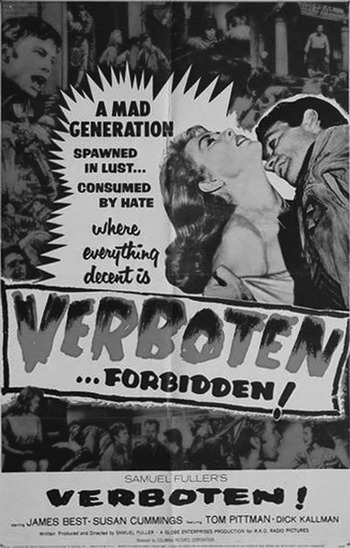
Two war films will illustrate this trend: When Hell Broke Loose with Charles Bronson (1957) and Samuel Fuller's Verboten! (1958). In the former, Bronson plays a brave G.I. in occupied Germany in April 1945. He falls in love with a Fräulein called Ilsa, violates the non-fraternization order, and gets punished. Then we learn that Ilsa's brother is leading a group of heavily armed Nazi werewolves who plan to assassinate General Eisenhower. Fortunately, our machine-gunning G.I. succeeds at the very last moment in preventing the attack and saves “the future of mankind.”Footnote 55 The second film, whose title Verboten! refers directly to the non-fraternization order, displays a remarkably similar plot. This time, the naive G.I. David finds himself trapped in a German town during the last days of the war, and it is the obligatory German sweetheart Helga who hides him from the Nazis and tends to his wounds. After the surrender, they marry, and David works for the military government in town. But Helga's 15-year old brother, surprisingly, belongs to the local werewolves, who not only plot terror attacks and food riots but also ensure the escape of war criminals. Only when Helga takes her brother to the Nuremberg trials can the happy end unfold. Overwhelmed by the evidence against the Nazi regime, the brother is cured and helps to destroy the terror cells in town.Footnote 56
Typical patterns of wartime G.I. experience are emphasized in both films. Germany appears as a country in which every radio blasts Goebbels' propaganda and every second wall is covered with werewolf graffiti. An oversized partisan movement, whose virulence is grossly exaggerated, draws on HJ followers and young SS men—the very groups that were singled out in the non-fraternization campaign. The lead character is the naive American soldier who is looking for love and violates the fraternization ban. But he can never be sure whether the Fräulein he falls for won't turn out to be a werewolf after all. Luckily, the tension is always relieved in a happy ending: the werewolves are defeated, the free world triumphs, and the remaining “good” Germans team up with the Americans. By feminizing Germany, the initial allegation of German collective guilt is dispelled, reinforcing the image of a nation of victims and the prospect of successful democratization.Footnote 57 Roughly the same pattern was repeated in para-literature. Jan Valtin's serial novel Wintertime, which first appeared in the 1950 Ladies' Home Journal before being released as a book, relies on a parallel plot and a similar structure. Set in the moral vacuum of American-occupied Germany, amid Nazi werewolves and displaced Latvians, the hero chases after a girl whose brother is a fugitive fascist saboteur.Footnote 58
Like many gothic novels of the nineteenth century, these war movies also deal with the sexual connotations of the werewolf motif. The transformation from man to wolf that occurs at night and gives way to an outburst of aggression and lust can be read as a tale of temptation, suppressed sexual desire, and forbidden love. The main focus of these films is the American man who is sexually attracted to some sort of forbidden love, usually a German woman whose male relatives have some kind of attachment to the werewolf threat. It is no coincidence that the contemporary film poster for Verboten! tried to play up this aspect (see figure 1).
Copyright 1959 by Rank Film Distributors of America, Inc.; Property of National Screen Service Corporation.

The sexually charged subtext of the werewolf story figured even more prominently in a different vehicle, the horror and monster genre. And it is here that the two threads—the memories of the Nazi insurgency and the supernatural werewolf myth—intersected most closely, most profitably, and ultimately most enduringly, reaching a larger audience than ever before. In the United States, werewolf movies are still immensely popular. During the 1950s, American firms churned out at least one such film a year; in the 1960s and 1970s, the output more than doubled; and the 1980s and 1990s saw approximately three to six werewolf movies a year.Footnote 59 While it is beyond the scope of this article to analyze this genre in its entirety, selective examples demonstrate how collective wartime memories were woven into the traditional werewolf legend. Through this process, the old myth of the werewolf, highly charged with symbolic meaning, was updated and embellished with historical experience. And while the Nazi variation on the myth did not become dominant—most werewolf films rely on standard imagery without roaming into World War II territory—it occurred frequently enough to constitute a unique subgenre.
Horror movies that link the two werewolf threads typically display three characteristic patterns. First, the heroes are young American men who travel to Europe as a group, as the G.I.s did in 1944. Second, a foreign girl is their temptation and ultimately the cause of their doom, just as the non-fraternization campaign preached. And third, the actual werewolves are either male teenagers or appear directly linked to an SS elite (if not to Hitler himself), harkening back to the many times that U.S. soldiers were told to be especially wary of HJ boys and SS men.
Recounting two such films will suffice to underscore these points. One of the more successful recent monster movies—An American Werewolf in Paris from 1997—features three American college students traveling through Europe. One of them is attracted by a mysterious French girl whose brother Pierre is a bloodthirsty werewolf. Tellingly, he leads a pack of young wolf-men who live underground and long to tear up and devour U.S. citizens. Pierre, a Hitler-like figure, informs the viewer about the purpose of his SS-like following: “We have a mission … to purify the world. That's why we pick our victims from the scum of society … , the weak, the stupid, the lazy who breed and multiply, weakening the human race. All my men I have chosen for their loyalty, their dedication to the coming age.” Pierre's ideology is not only racist and elitist but also anti-modern, preaching “a new mankind—pure, free of disease, free from the trappings of technological advance,” and thus close to National Socialist ideas.Footnote 60 The film takes up many of the more conventional topoi of the werewolf myth (the full moon, blood thirst, cannibalism, and so forth) but weaves in aspects of Nazi ideology and insurgency.
The same goes for the horror film Hard Rock Zombies from 1984. Four young male Americans form a rock band and tour the French countryside. An attractive girl invites them over, but her werewolf and zombie relatives proceed to murder all four. After the funeral, the alpha wolf (whose horrible, German-inflected accent has already raised suspicions) tears off his mask and is revealed to be none other than Adolf Hitler himself. The rest of the family, Eva Braun and the couple's children, suddenly appear in SS attire. Finally, the American rockers, restored to life, manage to lock up the whole Hitler clan in a bunker and gas them to death.Footnote 61 Again, interacting with locals proves to be the Americans' undoing, and the boundaries between the legendary and the Nazi werewolf are blurred more than ever. It even makes sense to shift the location from Germany to France, since American G.I.s conquered Nazi-occupied France in the summer of 1944 before they reached Germany—and since Americans often associate France with the feminine, the seductive, and the superficial. After being seduced by French beauty, the ugly German core is revealed.
“Historically” enriched versions of the werewolf myth are not restricted to the movie screen. Pulp novels and computer games also capitalize on the mutual reinforcement of the two symbols of evil—the werewolf and the Nazi. Undoubtedly, the biggest audiences were reached by the immensely popular video games of the Wolfenstein family, which began with 1981's Castle Wolfenstein. Its sequel Wolfenstein 3-D, released to the home computer market in 1992, was a breakthrough hit in the first-person shooter computer game genre and was followed by a spin off (Spear of Destiny) that year. The more recent variants Return to Castle Wolfenstein (2001) and Wolfenstein: Enemy Territory (2003) are technically more advanced but essentially rehash the same premise. The player is a heavily armed American G.I. named B. J. Blazkowicz who escapes confinement in the Nazi fortress “Wolfenstein.” His task is to thwart elaborate Nazi war plans, including biological, chemical, and paranormal warfare, by gunning down all enemies and finally eliminating the Nazi leadership. The Nazis, who have created an “SS Paranormal Division” with numerous mutants and “Über Soldats” for their defense, can also call on armed female elite units who are dressed in tight black leather and are part of an evil coven of witches. These are commanded by the female SS leader “Helga von Bulow” who transforms into a deadly monster in the second chapter of Return to Castle Wolfenstein. There are even some associates of the Kreisau resistance circle who will help Blazkowicz secure victory.Footnote 62 Although the game depicts no actual werewolves, its title refers to wolves, Nazis are linked to supernatural beings, and the plot is clearly tied to the collective memory of the occupation years. The lone G.I., facing a world of vicious Nazi guerrillas in which women can be monsters and SS men are the most dangerous enemies, discovers that he needs to rely on the “good Germans” in order to survive.
Another best-selling computer game that wove in the werewolf thread was Gabriel Knight: The Beast Within (1995). This narrative-style adventure game, which featured live-action video footage, invited players to assume the roles of an American novelist-turned-supernatural freedom fighter and his assistant, who investigate a series of mysterious wolf attacks in the Munich suburbs. The novelist traces the attacks to a secret society of werewolves, run by a magnetic, bisexual German man, and ends up becoming a werewolf after he is bitten in a dark Bavarian forest. His assistant, in the meantime, unravels the tragic mystery of King Ludwig II of Bavaria, whose historically erratic behavior developed after he was turned into a werewolf by one of his male lovers. In the end, the protagonist wins against “the beast within” when he kills the alpha werewolf during a performance of a newly discovered Wagner opera—about werewolves!Footnote 63 Here, it is the desire for German men, not women, that triggers the lycantrophic disease. Although set in the late nineteenth and late twentieth centuries instead of the Nazi era, this game again appealed to collective memories of the war and occupation years by linking Americans abroad, werewolves, and forbidden love with German scenery and history.
Pulp fiction also provides rich evidence of the fusion of war experience and werewolf myth. Authored by one of the most prolific and well-known thriller writers, John Gardner, the novel The Werewolf Trace (1977) links a ghost story with Hitler's last days in the Führerbunker and an Allied intelligence service that hunts down a nine-year-old werewolf boy who is supposedly a reincarnated Hitler.Footnote 64 A thriller by F. Paul Wilson (The Keep, 1981) became a national best seller, a movie, a comic, and even a board game. Here we meet SS men in a fortress in the alpine regions of “Transylvania,” an obvious reference to the much-rumored “national redoubt.” The Nazis are threatened by a supernatural power with werewolf traits, only to later gradually fuse with this power.Footnote 65 A final example is the mass-market paperback The Wolf's Hour by Robert R. McCammon (1989), another New York Times best seller. It tells a slightly different version of the familiar story: the hero is both a special agent for the Allied forces and a lycanthrope, and in the last year of World War II, he helps to defeat the Nazis. In the process of unraveling a secret Nazi plan called the Iron Fist, he falls for a German woman who turns out to be a spy.Footnote 66
The equation of Nazi with werewolf—which has been covered here only very selectively—affects by no means all of American mass culture. Most werewolf narratives for the American market, whether on screen or in print, do not venture beyond traditional patterns such as the full moon, “gothic” architecture, raw meat, and sexual desire. But elements of recent collective historical experience—such as the World War II setting, the Nazi threat, the fraternization ban, and the Fräulein spell—are by now firmly established as additions to the mix, informing a clearly recognizable subgenre. The ways in which the traditional werewolf story fused with the stillborn Nazi insurgency illustrate how an old mythical narrative can be retold, updated, and reinforced. Because the Third Reich has become the ultimate embodiment of evil for many since 1945, its incorporation into an older myth of evil has modernized that myth and left it as relevant and vivid as ever for post-World War generations.
Judging from American popular culture, the German partisan effort of 1944–1945 did have an impact after all, but it stemmed more from the symbolically charged name of the movement than from its real activities. Calling their guerrilla movement “werewolf” was shrewd of the Nazis. By linking their last threat to Hermann Löns' best-selling novel and thus to the literature of the conservative revolution—and to one of the infamous right-wing paramilitary groups of the 1920s—they reached deeply into German collective memory.Footnote 67 By moreover tying into the traditional horror myth of the werewolf and the imagery of the gothic novel, they succeeded in spreading fear across national boundaries and making themselves remembered for decades. Werewolf: the word alone sufficed to send a shiver down American spines and allowed the Nazi insurgents to capture a place in the gallery of evil maintained by American popular culture—because evidently, mass cultures cultivate symbols of evil and threat which ease the strains placed on the collective mind. Popular symbols of evil can help people digest concrete historical experiences. In the aftermath of war, the fusion of the Nazi terrorist and the legendary werewolf served to work through the memories of (Nazi) fear and (fraternization) guilt that many G.I.s had acquired during the defeat and occupation of Germany. Later on, individual memories morphed into much less sharply contoured, increasingly attenuated, but still recognizable patterns of collective memory. The Nazified werewolf began to operate outside the historical context of guerrilla war and evolved into a more generalized signifier for Nazi evil.
Obviously, the usurpation of the Nazi werewolves by popular culture also spills into “highbrow” debates. For instance, most of the historiography dealing with the subject is oriented toward popular audiences. Some authors try to play up the mythical associations of the topic by calling the Nazi regime a “satanic empire” and its followers “children of Satan,” or by assigning chapter titles such as “The Nature of the Beast” or “The Wolf Hunt.”Footnote 68 Others even pass on the unsubstantiated claim of the planned assassination of General Eisenhower.Footnote 69 The inherent attraction of popular symbols makes an impression in politics as well. There is a reason that Condoleezza Rice and Donald Rumsfeld appealed repeatedly to a historically unsuitable werewolf analogy. The werewolf story offered a well-worn connection to mass culture. The administration sought to persuade large audiences less familiar with history than with Hollywood by tapping into the rich reservoir of popular narratives. They brought up an established pattern that had been told many times before in cinema, pulp fiction, and computer games: the struggle against the ultimate evil that threatens the American soldier but will be defeated in a triumph of the free world. They invoked the Hollywood narrative of threat and hysteria, followed by relief and happy ending, in order to convey their vision of a pacified and westernized Iraq. Clearly, the administration judged the persuasive power of the werewolf motif to be much more important than the inconvenient inadequacies of the historical comparison. How else can it be explained that, less than a week before the fiercely contested 2004 presidential election, the Bush campaign once again relied on the wolf motif? In a television advertisement, Bush's public relations strategists warned Americans of the terror threat facing them—using images of a pack of wolves to stand in for foreign insurgents.