Introduction
In addition to eroding and changing the topography of the coast and seafloor, tsunami waves also affect marine ecosystems. These waves can demolish coral reefs, coastal vegetation and mangroves, benthic and infauna invertebrates and even vertebrates such as fish and amphibians (Masuda et al., Reference Masuda, Hatakeyama, Yokoyama and Tanaka2016).
Nevertheless, the impact of a tsunami is not limited to macroscopic marine life, and it also affects microorganisms. So far, few studies have been conducted on the impact of tsunami events on marine microbial ecology (Bhattacharyya et al., Reference Bhattacharyya, Karak, Chakrabarti, Chakraborty, Paul and Tripathi2014; Somboonna et al., Reference Somboonna, Wilantho, Jankaew, Assawamakin, Sangsrakru, Tangphatsornruang and Tongsima2014; Makino et al., Reference Makino, Xu, Nishimura and Isogai2019). The results of these studies mainly indicate that tsunami-induced sediments have more microbial communities of prokaryotes (bacteria and archaea) than non-tsunami-affected sediments (Somboonna et al., Reference Somboonna, Wilantho, Jankaew, Assawamakin, Sangsrakru, Tangphatsornruang and Tongsima2014).
Another group of researchers found that the ingression of tsunami waves in land soils increased soil salinity, and affected microbial communities in the soil (Bhattacharyya et al., Reference Bhattacharyya, Karak, Chakrabarti, Chakraborty, Paul and Tripathi2014).
Some studies have shown that tsunami waves alter the physico-chemical properties of seawater (including oxygen level, light penetration depth, nutrient content, salinity and water turbidity) (Satpathy et al., Reference Satpathy, Mohanty, Prasad, Natesan and Sarkar2008; Haldar et al., Reference Haldar, Raman and Dwivedi2013; Bhattacharyya et al., Reference Bhattacharyya, Karak, Chakrabarti, Chakraborty, Paul and Tripathi2014; Somboonna et al., Reference Somboonna, Wilantho, Jankaew, Assawamakin, Sangsrakru, Tangphatsornruang and Tongsima2014; Kakehi et al., Reference Kakehi, Kamiyama, Kaga, Naiki and Kaga2017). These changes can definitely affect the microbial life in the sea.
Studies of the geology of Mars have suggested the possibility of a shallow and vast ocean in the past (Mahaney et al., Reference Mahaney, Dohm, Costa and Krinsley2010; Iijima et al., Reference Iijima, Goto, Minoura, Komatsu and Imamura2014; Billings, Reference Billings2016; Costard et al., Reference Costard, Séjourné, Kelfoun, Clifford, Lavigne, Di Pietro and Bouley2017, Reference Costard, Séjourné, Lagain, Ormö, Rodriguez, Clifford and Lavigne2019; Di Pietro et al., Reference Di Pietro, Séjourné, Costard, Ciazela and Rodriguez2021).
The possibility of primary microbial life in this ocean has also been considered (Goetz et al., Reference Goetz, Brinckerhoff, Arevalo, Freissinet, Getty, Glavin and Brucato2016; Cabrol, Reference Cabrol2018; Joseph et al., Reference Joseph, Graham, Büdel, Jung, Kidron, Latif and Schild2020; Becker, Reference Becker2021). However, there are still many questions about the ocean and microbial life on early Mars that need further investigation.
The Red Planet has experienced numerous large and small collisions in the past. The effects of these collisions are evident all over the planet. Some of these collisions, such as the Lomonosov crater, are thought to have occurred when there was a vast and shallow ocean in the northern plains.
The collision of these large objects in the northern palaeo-ocean of Mars has certainly caused megatsunamis, and some researchers claim that there is evidence of tsunami-induced sediments on the surface (Billings, Reference Billings2016; Witze, Reference Witze2016; Costard et al., Reference Costard, Séjourné, Kelfoun, Clifford, Lavigne, Di Pietro and Bouley2017, Reference Costard, Séjourné, Lagain, Ormö, Rodriguez, Clifford and Lavigne2019; Stanley, Reference Stanley2020; Di Pietro et al., Reference Di Pietro, Séjourné, Costard, Ciazela and Rodriguez2021). Because tsunami waves on Earth affect marine microbial communities, the effect of Martian megatsunamis on the ancient microbial life on this planet is not unexpected. For this reason, we have addressed this issue in this study.
Many researchers today cautiously discuss about the Martian palaeo-ocean and its shorelines, and despite some geological evidence, the issue of the existence of an ocean on early Mars remains in debate (Schmidt et al., Reference Schmidt, Way, Costard, Bouley, Séjourné and Aleinov2022).
Using geomorphological mapping, Context Camera (CTX), High-Resolution Imaging Science Experiment (HiRISE) and Thermal Emission Imaging System (THEMIS) in the southeast of the Acidalia Planitia (northwest of the Arabia Terra), and the Chryse Planitia, some researchers have claimed that there are geomorphological features of tsunami-induced sediments on Mars. They claim that these sedimentary features are related to two megatsunamis from large collisions in the Martian palaeo-ocean that occurred 3.4 billion years ago (Iijima et al., Reference Iijima, Goto, Minoura, Komatsu and Imamura2014; Rodriguez et al., Reference Rodriguez, Fairén, Tanaka, Zarroca, Linares, Platz and Glines2016; Costard et al., Reference Costard, Séjourné, Kelfoun, Clifford, Lavigne, Di Pietro and Bouley2017).
In this study, we investigate the effect of collision-induced megatsunamis on possible microbial life in the ancient Martian ocean, assuming the presence of an ocean in the northern plains, and the presence of microbial life in it.
Characteristics of tsunami wave propagation in the palaeo-ocean of Mars
Due to the low gravity of Mars, the height of the tsunami waves caused by the large collisions in the northern plains was more than the common terrestrial tsunamis. Because the topography of Mars has changed a lot since the disappearance of the palaeo-ocean, it is impossible to calculate with certainty the propagation characteristics of megatsunami waves on the surface of Mars, and there is a significant error in this regard. However, it appears that the velocity of the megatsunamis waves attained 20 m s−1 in the vicinity of impact craters, and 16 m s−1 near the shoreline (Iijima et al., Reference Iijima, Goto, Minoura, Komatsu and Imamura2014). Megatsunamis are also estimated to be up to 120 m high, and 570 000 km2 area (Billings, Reference Billings2016; Drake, Reference Drake2016; Sumner, Reference Sumner2016).
Distribution of proposed microbial life in the Martian palaeo-ocean
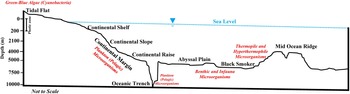
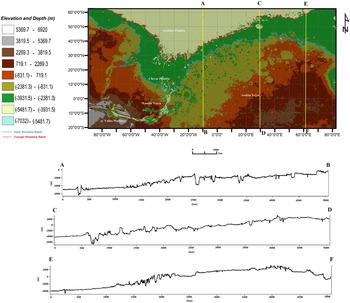
In terrestrial oceans, microbial life is found in the tidal flat, continental margin, oceanic trench, abyssal plain and in the vicinity of mid-ocean ridges (Fig. 1). Nevertheless, the topography of the ancient Martian ocean floor in the Vastitas Borealis basin does not appear to be similar to the topography of the Earth's oceans’ floor. This could be due to the lack of plate tectonics on early Mars (Yin, Reference Yin2012; Costard et al., Reference Costard, Séjourné, Lagain, Ormö, Rodriguez, Clifford and Lavigne2019). For this reason, geomorphological features such as mid-ocean ridges or oceanic trench do not appear to have formed on the Martian palaeo-ocean floor. As a result, the topographic structure of the Martian palaeo-ocean floor must have been simpler than that of Earth's oceans. Nevertheless, at least there should be zones such as the continental margin, and abyssal plain. Of course, large and numerous collisions have caused severe changes in the topography of the palaeo-ocean floor (Fig. 2).
General topography of the Earth's oceans’ floor and the distribution of microbial life in its various zones.

Proposed oceanic basin for the ancient Martian ocean at Vastitas Borealis and its possible shorelines. The proposed ancient ocean floor topography is not similar to the Earth's oceans’ floor, which could be due to the lack of plate tectonics on early Mars and the effects of large collisions. Produced via MOLA digital elevation models (460 m pixel−1), in Esri's ArcGIS® 10.2 software (http://www.esri.com/software/arcgis). Credit: MOLA Science Team, MSS, JPL, NASA.

In various parts of the simple topography of the Martian ocean floor, microbial life could have lived in the abyssal plain as a benthic (or infauna), or alongside black smokers. Some of the possible microorganisms may have been pelagic (planktonic), and living on the continental margin. Others, such as cyanobacteria (green-blue algae), could have lived in the tidal flat of the palaeo-ocean. Of course, it is claimed that there was no spring tide in the ancient Martian ocean (Iijima et al., Reference Iijima, Goto, Minoura, Komatsu and Imamura2014). In this case, cyanobacterial colonies may have formed in the vicinity of the shore.
In this study, we consider a situation similar to the Earth's oceans’ floor for the distribution of microbial life in the ancient Martian ocean, and assume that the proposed microbial life in the Martian palaeo-ocean near the shore, in the form of planktonic on the continental margin, and existed in the form of benthic and infauna on the Martian ocean floor.
Effect of megatsunamis waves on microbial life in the Martian palaeo-ocean
When a Tsunami wave base encounters the oceanic basin floor, it can displace the whole of life forms on the floor, inside sediments, pelagic and even in the tidal flat or shore moving them far distances from their initial location (Robinson and Bernard, Reference Robinson and Bernard2009). Some microorganisms can remain in the palaeo-ocean after the occurrence of megatsunamis. In this case, the change in the physico-chemical properties of seawater (such as salinity, oxygen level, light penetration depth or photic zone and nutrient content) due to the tsunami waves (Satpathy et al., Reference Satpathy, Mohanty, Prasad, Natesan and Sarkar2008; Haldar et al., Reference Haldar, Raman and Dwivedi2013; Bhattacharyya et al., Reference Bhattacharyya, Karak, Chakrabarti, Chakraborty, Paul and Tripathi2014; Somboonna et al., Reference Somboonna, Wilantho, Jankaew, Assawamakin, Sangsrakru, Tangphatsornruang and Tongsima2014; Kakehi et al., Reference Kakehi, Kamiyama, Kaga, Naiki and Kaga2017), can create an extreme environment suitable for the growth of extremophile microorganisms (such as halophiles). But some other microorganisms that would not be compatible with increasing salinity, decreasing temperature or increasing seawater turbidity, would be eliminated.
Life in tsunami sediments and preservation of microbial fossils
Suitable sediments for microbial fossilization
Microbial life does not readily undergo fossilization, and large amounts of clay deposits are required to preserve them as a fossil. For instance, on the Earth, fossils of microorganisms such as Ediacaran period bacteria are well preserved due to their presence in clayey covers. As a result, these clay deposits on Mars can also provide a suitable environment for the preservation of microbial fossils (Joel, Reference Joel2016).
Preservation of microbial fossils in sediments caused by Martian megatsunamis
Thumbprint terrains
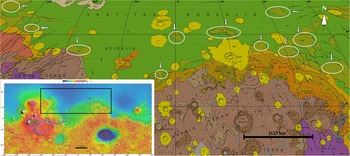
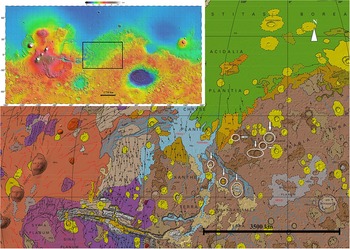
Thumbprint terrains are part of the geomorphological features of the Martian megatsunamis, discovered by geomorphological mapping, CTX and THEMIS imaging in the southeast of the Acidalia Planitia (northwest of the Arabia Terra), and the Chryse Planitia. Due to the high albedo of thumbprint terrains, they appear to be coarse-grained and made of sand, gravel and rock fragments (Costard et al., Reference Costard, Séjourné, Kelfoun, Clifford, Lavigne, Di Pietro and Bouley2017; Di Pietro et al., Reference Di Pietro, Séjourné, Costard, Ciazela and Rodriguez2021) (Fig. 3).
Distribution of tsunami-induced thumbprint terrain deposits in the northern plains, on the geological map of Mars. Courtesy of USGS, 2014 (at a scale of 1 : 20 000 000).

Because tsunami waves carry large volumes of marine sediments and seawater into mainlands, there is definitely marine microbial life in tsunami sediments (Somboonna et al., Reference Somboonna, Wilantho, Jankaew, Assawamakin, Sangsrakru, Tangphatsornruang and Tongsima2014). Nevertheless, in tsunami-induced thumbprint terrain deposits due to an abundance of coarse-grained sediments and deficiency of clay particles, the chances of preserving marine microbial life as a fossil for billions of years are very low.
Boulder fields and ice-rich lobes
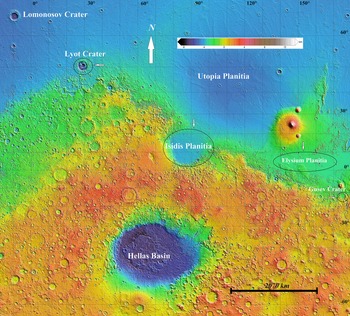
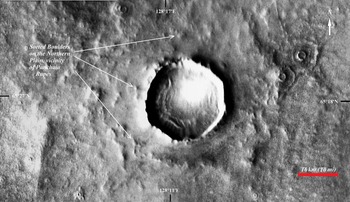
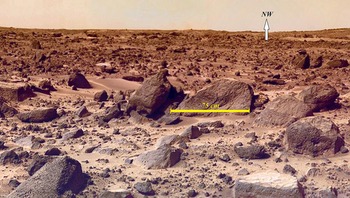
HiRISE images show large metre-sized boulders on the northern plains of Mars. Numerous boulder fields have been identified at the Gusev crater, Isidis and Elysium Planitia (Golombek et al., Reference Golombek, Haldemann, Forsberg-Taylor, DiMaggio, Schroeder, Jakosky and Matijevic2003, Reference Golombek, Huertas, Marlow, McGrane, Klein, Martinez and Cheng2008; Iijima et al., Reference Iijima, Goto, Minoura, Komatsu and Imamura2014; Rodriguez et al., Reference Rodriguez, Fairén, Tanaka, Zarroca, Linares, Platz and Glines2016) (Fig. 4). Some of these bouldery sediments have accumulated concentrically around the impact craters, and upon the proposed marine terraces of the palaeo-ocean (Fig. 5). For this reason, many researchers have suggested that these bouldery sediments are caused by megatsunamis waves (Iijima et al., Reference Iijima, Goto, Minoura, Komatsu and Imamura2014; Rodriguez et al., Reference Rodriguez, Fairén, Tanaka, Zarroca, Linares, Platz and Glines2016) (Fig. 6).
Distribution of boulder fields in the northern plains within the Gusev crater, Isidis and Elysium Planitia. The ice-rich ejecta resides in Lyot crater. Image via Mars Orbiter Laser Altimeter (MOLA). Courtesy of NASA GSFC.

Concentrated large sorted boulders around an impact crater in the northern plains in the vicinity of Panchaia Rupes. Image via THEMIS daytime Infrared. Courtesy of NASA/JPL/Univ. of Arizona.

Boulder field was caused by massive torrential currents at the landing site of the Mars Pathfinder in 1997. The Ares Vallis on the northern plains (19.13°N, 33.22°W). Courtesy of NASA / JPL-Caltech/Popular Mechanics.

Two individual megatsunamis appear to have occurred in the ancient Martian ocean about 3.4 billion years ago, a few million years apart. The first megatsunami caused by a collision occurred in a liquid ocean, and caused the boulder rocks to scatter on the surface of Mars. Nevertheless, the second megatsunami occurred in a frozen ocean (due to the cooling of the Martian climate), scattering ice-rich lobes on the surface of the Red Planet (Drake, Reference Drake2016; Rodriguez et al., Reference Rodriguez, Fairén, Tanaka, Zarroca, Linares, Platz and Glines2016; Sumner, Reference Sumner2016; Di Pietro et al., Reference Di Pietro, Séjourné, Costard, Ciazela and Rodriguez2021). Some impact craters on the northern plains, such as the Lyot crater (48°33′42.7′′N, 18°12′46.7′′E), have the ice-rich ejecta from the second megatsunami (Di Pietro et al., Reference Di Pietro, Séjourné, Costard, Ciazela and Rodriguez2021).
Considering the sedimentological properties required to preserve microbial fossils, it is clear that microorganisms transferred from the ancient Martian ocean have no chance of preservation in boulder fields on the northern plains. Considering that life can survive in frozen oceans and snowball terrestrial planets (or moons) (Sutherland, Reference Sutherland2022), the ice-rich lobes from the second megatsunami in the frozen ocean of Mars can preserve microbial life.
Tsunami palaeo-lakes on Mars
Martian palaeo-lakes that formed in impact craters are mainly of glacial, fluvial, rainfalls and groundwater rise origin (Hargitai et al., Reference Hargitai, Gulick and Glines2018; Zhao et al., Reference Zhao, Xiao and Glotch2020; Boatwright and Head, Reference Boatwright and Head2021).
In lacustrine environments, phyllosilicate clays and evaporite sediments are abundant, which is a suitable sedimentological property for the preservation of microbial fossils (Anderson, Reference Anderson2012; Zhao et al., Reference Zhao, Xiao and Glotch2020).
Nevertheless, there was another group of palaeo-lakes on Mars that were fed directly by tsunami waves (Drake, Reference Drake2016). That is, the craters that are older than the megatsunamis, and existed near the proposed shorelines at the time of the megatsunamis occurrence.
In this case, some of the impact craters near the Chryse Planitia, which are older than the mentioned megatsunamis (3.4 billion years ago), could have been tsunami-induced lakes or pools, which foster the marine microbial life and preserve the fossil signatures.
Another group of tsunami palaeo-lakes can be formed indirectly from runoffs due to outflow channels caused by tsunami waves on mainlands (Boatwright and Head, Reference Boatwright and Head2021).
Some impact units in the vicinity of Chryse Planitia are older than the Early Hesperian, which was more than 3.56 billion years ago. There are more than seven impact craters near the proposed shorelines in the Chryse Planitia older than the Early Hesperian. The mentioned megatsunamis occurred roughly 3.4 billion years ago; as a result, craters near the Chryse Planitia that are approximately the age of Early Hesperian or older, may have been tsunami lakes in the past (Fig. 7).
Some impact craters near the Chryse Planitia are older than the Early Hesperian, which may have been tsunami lakes in the past, that have bred marine microbial life, and preserved it as a fossil. Courtesy of USGS, 2014 (at a scale of 1 : 20 000 000).

Conclusion
Considering the effect of terrestrial tsunamis on marine ecosystems, including microorganisms, and the discovery of some geological evidence of megatsunamis on early Mars, Martian megatsunamis could have influenced the proposed microbial life in the ancient Martian ocean.
Changes in the physico-chemical properties of seawater, and the transfer of microbial life into soils and crateric lakes on the mainlands of early Mars, were among the effects of tsunami waves on microbial life of the Martian palaeo-ocean.
Tsunami waves have also been implicated in the preservation or non-preservation of fossil signatures on early Mars. Tsunami-induced deposits, such as boulder fields and thumbprint terrains, do not have appropriate sedimentological properties for microbial fossilization. Nevertheless, the ice-rich lobes from the tsunami in the frozen palaeo-ocean of Mars in the Early Hesperian, and the tsunami lakes in the vicinity of proposed palaeo-ocean shorelines, have good conditions for the fossilization of marine microbial life of early Mars.
Acknowledgements
The author appreciates the reviewer of this article, Dr Chris McKay, for providing constructive feedbacks to improving and gentrify of article.