


Introduction
Internet-based interventions are a promising approach to increase treatment rates and outcomes for several mental health problems (Andersson, Carlbring and Cuijpers, Reference Andersson, Carlbring and Cuijpers2009). The last two decades witnessed a considerable number of trials on Internet-delivered treatments for various mental disorders. Meta-analyses document the overall efficacy of Internet-based interventions for anxiety disorders and depression (Barak, Hen, Boniel-Nissim and Shapira, 2008; Spek et al., Reference Spek, Cuijpers, Nyklícek, Riper, Keyzer and Pop2007). The Internet-based treatment of anxiety disorders proved particularly beneficial with a mean controlled effect size of d = .97 (Spek, et al., 2007).
Internet-based treatments combine the advantages of low costs, high availability and relative anonymity. Especially for individuals with Social Anxiety Disorder (SAD), Internet-based treatments have the potential to lower the threshold of seeking professional help. SAD is characterized by an intense fear of being criticized, judged or rejected by others. It is one of the most common mental disorders, with an estimated life time prevalence of 12.1% (Kessler et al., Reference Kessler, Berglund, Demler, Jin, Merikangas and Walters2005). Individuals with SAD avoid situations in which they could be judged by others, which can lead to long delays in treatment seeking (Olfson et al., Reference Olfson, Guardino, Struening, Schneier, Hellman and Klein2000). On average, individuals with SAD take 16 years to make initial treatment contact (Wang et al., Reference Wang, Berglund, Olfson, Pincus, Wells and Kessler2005).
To date, four independent research groups have developed and evaluated Internet-based treatments for SAD (Andersson et al., Reference Andersson, Carlbring, Holmström, Sparthan, Furmark and Nilsson-Ihrfelt2006; Berger, Hohl and Caspar, 2009; Botella et al., Reference Botella, Gallego, Garcia-Palacios, Guillen, Banos and Quero2010; Titov, Andrews, Schwencke, Drobny and Einstein, Reference Titov, Andrews, Schwencke, Drobny and Einstein2008). Numerous randomized controlled trials document the efficacy of this new treatment form in SAD (Andersson et al., Reference Andersson, Carlbring, Holmström, Sparthan, Furmark and Nilsson-Ihrfelt2006; Berger et al., Reference Berger, Hohl and Caspar2009; Botella et al., Reference Botella, Gallego, Garcia-Palacios, Guillen, Banos and Quero2010; Carlbring, Furmark, Steczkó, Ekselius and Andersson, Reference Carlbring, Furmark, Steczkó, Ekselius and Andersson2006; Carlbring et al., Reference Carlbring, Gunnarsdóttir, Hedensjö, Andersson, Ekselius and Furmark2007; Titov, Andrews, Johnston, Schwencke and Choi, Reference Titov, Andrews, Johnston, Schwencke and Choi2009; Titov, Andrews and Schwencke, Reference Titov, Andrews and Schwencke2008; Titov, Andrews, Schwencke et al., Reference Titov, Andrews and Schwencke2008; Titov et al., Reference Titov, Andrews, Schwencke, Robinson, Peters and Spence2010). Long-term effects up to 30 months post-treatment have also been established (Berger, Hohl and Caspar, Reference Berger, Hohl and Caspar2010; Carlbring, Nordgren, Furmark and Andersson, Reference Carlbring, Nordgren, Furmark and Andersson2009). The applied interventions mostly consisted of guided cognitive-behavioural self-help programmes. Guided self-help programmes combine psycho-education and exercises with regular feedback from a therapist/clinician or other specifically trained person. Feedback is most often provided weekly via e-mail or telephone.
The availability and costs of Internet-based treatments highly depend on how much therapist time is needed to ensure the efficacy of a certain programme. In the meta-analysis of Spek et al. (Reference Spek, Cuijpers, Nyklícek, Riper, Keyzer and Pop2007) guided treatment programmes yielded higher mean effect-sizes (d = 1.00) than unguided programmes (d = .24–.26). Moreover, in interventions without support, the dropout rates were considerably higher than in interventions with support (Spek et al., Reference Spek, Cuijpers, Nyklícek, Riper, Keyzer and Pop2007). This difference stimulated research to systematically compare guided versus unguided treatment approaches. In the field of Social Anxiety Disorder, five studies directly compared programmes varying in the degree of therapist involvement (Berger et al., Reference Berger, Caspar, Richardson, Kneubuhler, Sutter and Andersson2011; Botella et al., 2010; Furmark et al., Reference Furmark, Carlbring, Hedman, Sonnenstein, Clevberger and Bohman2009; Rapee, Abbott, Baillie and Gaston, Reference Rapee, Abbott, Baillie and Gaston2007; Titov, Andrews, Choi, Schwencke and Mahoney, Reference Titov, Andrews, Choi, Schwencke and Mahoney2008). The majority of these randomized controlled trials found no differences between guided and unguided self-help programmes and indicate that the amount of therapist involvement is not crucial for the efficacy of Internet-based interventions in SAD (Berger et al., Reference Berger, Caspar, Richardson, Kneubuhler, Sutter and Andersson2011; Botella et al., 2010; Furmark et al., Reference Furmark, Carlbring, Hedman, Sonnenstein, Clevberger and Bohman2009). These results contradict the difference between guided and unguided approaches outlined by Spek and colleagues (2007). However, the studies analyzed in Spek's meta-analysis did not differ only in the amount of therapist involvement during the treatment. For instance, in the studies on unguided programmes participants mostly suffered from depression whereas most of the studies on guided approaches investigated anxiety disorders. The need for a therapist could be more pronounced in some disorders (e.g. depression) than in others (e.g. anxiety disorders). Studies also differed regarding the screening procedures. In the majority of studies applying unguided self-help, participants underwent no (Clarke et al., Reference Clarke, Eubanks, Kelleher, O'Connor, DeBar and Lynch2005; Clarke et al., Reference Clarke, Reid, Eubanks, O'Connor, DeBar and Kelleher2002) or only minimal screening procedures (Christensen, Griffiths and Jorm, Reference Christensen, Griffiths and Jorm2004). Trials on guided self-help programmes, on the other hand, applied intense screening methods such as diagnostic interviews (Andersson et al., Reference Andersson, Bergström, Holländare, Carlbring, Kaldo and Ekselius2005, Reference Andersson, Carlbring, Holmström, Sparthan, Furmark and Nilsson-Ihrfelt2006; Carlbring et al., Reference Carlbring, Nilsson-Ihrfelt, Waara, Kollenstam, Buhrman and Kaldo2005; Carlbring, Westling, Ljungstrand, Ekselius and Andersson, Reference Carlbring, Westling, Ljungstrand, Ekselius and Andersson2001; Klein, Richards and Austin, Reference Klein, Richards and Austin2006). Therefore, it is possible that differences in screening methods affect the outcome of Internet-based treatments. Barak et al. (Reference Barak, Hen, Boniel-Nissim and Shapira2008) compared studies using open website programmes with studies using closed websites, in which participants were screened before receiving access to the website. Closed website trials yielded significantly better results than open website trials. Marks and Cavanagh (Reference Marks and Cavanagh2009) point out that “a few minutes or even seconds of informed contact may catalyze continuation and improvement of computer-aided psychotherapy (CP). [. . .] CP is more likely to be used well if recommended by a trusted healthcare professional” (Marks and Cavanagh, Reference Marks and Cavanagh2009, p. 131). Detailed assessment of the mental health problem ensures the suitability of a certain programme. Moreover, diagnostic interviews may hold further benefits for the participants. For example, in a study on the acceptance of diagnostic interviews, Suppiger et al. (Reference Suppiger, In-Albon, Hendriksen, Hermann, Margraf and Schneider2009) found that diagnostic interviews proved helpful for the patients, that patients felt that they were being taken seriously and that the interview helped to establish a positive relationship between interviewer and interviewee. Minero (Reference Minero1999) also found that the majority of patients rated a structured diagnostic interview as helpful. Thus, diagnostic interviews may positively affect the adherence and the outcome in Internet-based treatments.
In the present study, we explore the impact of a diagnostic interview on the efficacy of an Internet-based unguided self-help programme for SAD using a randomized controlled trial design. To this end, we compare the benefits of an Internet-based unguided self-help treatment for SAD when delivered with or without a pre-treatment structured interview by phone.
Method
Participants
Participants were recruited through advertisements in regional newspapers and postings in several Internet forums that provided the address of the study's website. The website presented general information about SAD and its treatment as well as an outline of the study. After registering with their e-mail address, participants obtained detailed information on the theoretical background, the goals and the design of the study and were asked to give written informed consent.
Participants who printed, signed, and returned the informed consent form by mail were asked to complete online versions of the outcome questionnaires. Only participants who scored higher than 22 on the Social Phobia Scale (SPS; Stangier, Heidenreich, Berardi, Golbs and Hoyer, 1999) or higher than 33 on the Social Interaction Anxiety Scale (SIAS; Stangier et al., 1999) were included in the study (Cut-offs: Stangier and Heidenreich, Reference Stangier and Heidenreich1995). We excluded participants in on-going psychological treatment and individuals who indicated suicidal ideation. Potential suicidal ideation was screened for using three items: the suicide item of the Beck Depression Inventory (BDI-II; Hautzinger, Keller and Kühner, 2006) and questions 95 and 96 of the Questionnaire of the Structured Clinical Interview for DSM-IV-Axis II Disorders (SCID-II; Fydrich, Renneberg, Schmitz and Wittchen, Reference Fydrich, Renneberg, Schmitz and Wittchen1997). Questions 95 and 96 refer to former self-mutilations and suicide attempts. Participants who scored ≥1 on the suicide item of the BDI or answered in the affirmative to question 95 or 96 of the SCID-II were contacted by phone and, if necessary, encouraged to contact a local psychiatrist or psychologist.
A total of 668 individuals showed an interest in the study and 217 returned the signed informed consent. Criteria for inclusion were (a) being at least 18 years old; (b) having access to the Internet; (c) a total of >22 on the SPS or a total of >33 on the SIAS; (d) not participating in any other psychological treatment for the duration of the study; and (e) if on prescribed medication for anxiety/depression, dosage had to be constant for 1 month prior to the start of the treatment.
Out of the 217 participants who signed informed consent, 10 did not complete the social phobia measures (SPS and SIAS), 46 were excluded due to potential suicidal ideation, 37 were in on-going psychological treatment, 8 did not exceed cut-off scores on the SPS or SIAS, 2 were excluded due to unstable medication, and 1 was unwilling to participate due to time restraints (see Figure 1). One hundred and thirteen participants met all inclusion criteria and were randomly assigned to the interview group (IG, N = 57) or the non-interview group (NIG, N = 56). Four participants in the IG were not reached for the telephone interview resulting in an N = 53 for the IG.
Flow of participants

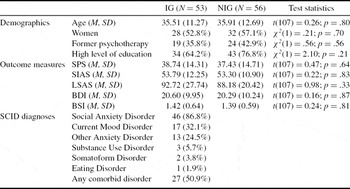
Participants in the study were between 18 and 72 years old. Mean age was 35.1(SD = 11.27) in the interview group and 35.9 (SD = 12.69) in the non-interview group. Table 1 depicts demographic characteristics as well as mean scores of the outcome measures at pre-assessment. Groups did not differ on demographic variables nor on primary and secondary outcome measures at pre-assessment.
Characteristics of participants at pre-assessment

Table I also presents diagnoses for the interview group. Forty-six out of 53 participants in the IG (87%) met the criteria for Social Anxiety Disorder according to DSM-IV. Twenty-seven (51%) of the participants reported at least one other comorbid condition. Nineteen participants in the interview group (35.8%) and 22 participants in the non-interview group (39.3%) did not complete the post-assessment. Four months after the treatment, 23 persons in the IG (43.4%) and 34 persons in the NIG (60.7%) failed to complete the follow-up-assessment. Drop-out rates did not differ between the two groups at post-assessment (χ2(1) = 0.14, p = .84) and at follow-up-assessment (χ2(1) = 3.27, p = .09).
Procedure
The protocol of this study was approved by the Local Ethics Committee of the Faculty of Human Sciences at the University of Bern. After the pre-assessment, a computer algorithm randomly assigned participants to either the interview group or the non-interview group. Participants in the non-interview group received access to the self-help programme after a delay of 3 days. This delay was chosen to roughly match the average time period between pre-assessment and interview in the IG. Participants in the IG were interviewed by phone using the Structured Clinical Interview for DSM-IV-Axis-I Disorders (SCID-I; Wittchen, Wunderlich, Gruschwitz and Zaudig, Reference Wittchen, Wunderlich, Gruschwitz and Zaudig1997). Two advanced Masters students in clinical psychology and the two first authors, who all had been trained in using SCID-I, conducted the interviews. Regardless of the outcome of the interview, participants in the IG received access to the programme immediately after the interview. Interviews lasted between 25 and 100 minutes (M = 47.3, SD = 14.2). The length of the interviews was determined by the amount of symptoms described. Lengths were normally distributed (D(53) = 0.11, p = .17), with 50% of the interviews lasting between 39 and 55 minutes.
Intervention
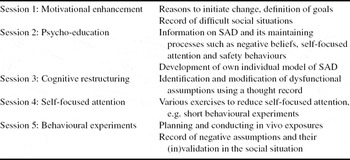
The self-help programme consists of five cognitive-behavioural sessions over 10 weeks. It follows the established cognitive-behavioural model by Clark and Wells (Reference Clark, Wells, Heimberg, Liebowitz, Hope and Schneier1995) and comprises five largely text-based sessions, several exercises and diaries (e.g. negative thoughts record) and the possibility to participate in an online discussion forum. Table 2 describes the five sessions. For a more detailed description see Berger et al. (Reference Berger, Caspar, Richardson, Kneubuhler, Sutter and Andersson2011).
Internet-based cognitive behavioural self-help programme

Each website and session builds upon the previous one, and users only gain access to the next session if the previous sessions and tasks have been completed. However, as many tasks and exercises are repeated, working with the self-help guide is far from a sequential process. At the end of each session, the importance of repetition and practice is emphasized. Participants have the opportunity to share their experiences with the other participants in various ways. In the diaries, participants are asked if they want to anonymously publish their input in the programme. In addition, participants are encouraged to use a discussion forum. Participants had only access to the input of participants of the same treatment condition.
Outcome measures
Primary and secondary outcome measures were administered before, immediately after and four months after the treatment. We used the following social anxiety scales as primary outcome measures of the study: the self-report version of the Liebowitz Social Anxiety Scale (LSAS; Baker, Heinrichs, Kim and Hofmann, Reference Baker, Heinrichs, Kim and Hofmann2002; German version: Stangier and Heidenreich, Reference Stangier and Heidenreich2003), the Social Phobia Scale, and the Social Interaction Anxiety Scale (Mattick and Clarke, Reference Mattick and Clarke1989; German version: Stangier et al., Reference Stangier, Heidenreich, Berardi, Golbs and Hoyer1999). Participants were asked to complete the SPS and the SIAS additionally at week 2 and 6 of the intervention.
As secondary outcome measures, we administered the Beck Depression Inventory (Beck, Steer and Brown, Reference Beck, Steer and Brown1996; German version: Hautzinger et al., Reference Hautzinger, Keller and Kühner2006) and the Brief Symptom Inventory (BSI; Derogatis and Melisaratos, Reference Derogatis and Melisaratos1983; German version: Franke, Reference Franke2000) to assess depression and general distress. We assessed treatment satisfaction with the 8-item Client Satisfaction Questionnaire (CSQ-8; Attkisson and Zwick, Reference Attkisson and Zwick1982; German version: ZUF-8; Schmidt, Lamprecht and Wittmann, Reference Schmidt, Lamprecht and Wittmann1989) at post-treatment. All outcome measures were administered via the Internet, a procedure that showed adequate psychometric properties (Hedman et al., Reference Hedman, Ljotsson, Rück, Furmark, Carlbring and Lindefors2010).
Statistical analyses
Statistical analyses were conducted using SPSS 19. All analyses on primary and secondary outcome measures were calculated as intention-to-treat analyses using a linear mixed models approach. Linear mixed models are appropriate to analyse repeated measure data with many drop-outs (e.g. Chan, Reference Chan2004; Houck et al., Reference Houck, Mazumdar, Koru-Sengul, Tang, Mulsant and Pollock2004). For the SPS and the SIAS, we entered five assessment points (pre-treatment, week 2, week 6, post-treatment, and follow-up) into the analyses. LSAS, BDI and BSI were evaluated at pre-, post- and follow-up-assessment. Separate mixed model analyses were conducted for each outcome measure. Results are reported for the models that best fitted the data according to the −2 Log Likelihood fit index. As could be expected in repeated measures, autoregressive covariance structures best fitted the data. For the SPS, the SIAS and the LSAS, autoregressive covariance structures with homogenous variances proved best. For the BDI and the BSI, autoregressive covariance structures with heterogeneous variances best fitted the data. For the three social anxiety measures (SPS, SIAS, LSAS), alpha levels were Bonferroni corrected (number of comparisons = 3, α <.017).
Effect sizes were calculated for the estimated means and standard deviations (SD = SE×SQRT(N)) of the ITT sample using Cohen's formula based on pooled standard deviations (Cohen, Reference Cohen1988). Clinical significant change at post- and follow-up assessment was calculated based on the completer sample. Clinical significance was determined for the SPS and the SIAS since these are two of the most widely used social anxiety measures. In a first step, reliable change according to the Reliable Change Index (Jacobson and Truax, Reference Jacobson and Truax1991) was determined by using re-test reliabilities reported for the German versions of the questionnaires (Stangier et al., Reference Stangier, Heidenreich, Berardi, Golbs and Hoyer1999). In a second step, cut-off scores were calculated on the basis of Formula ‘c’ reported by Jacobson and Truax (Reference Jacobson and Truax1991). Normative data were taken from a German data set (Lincoln et al., Reference Lincoln, Rief, Hahlweg, Frank, von Witzleben and Schroeder2003). Based on these assumptions, clinically significant change (improved and recovered) for a given participant was defined as showing a pre-post/pre-follow-up change score of 8 or greater and a post/follow-up test score below 21 on the SPS, and a pre-post/pre-follow-up change score of 9 or greater and a post/follow-up test score below 31 on the SIAS.
Results
Adherence
During the 10-week intervention period, participants in the interview group took part in 4.23 (SD = 1.26) out of 5 modules and completed 83.24% (SD = 26.47) of the self-help material. Participants in the non-interview group completed on average 4.02 (SD = 1.54) sessions and 79.13% (SD = 31.85) of the self-help material. These differences were not significant (t(107) = 0.73–0.77, p = .44–.47). On average, participants in the IG spent 8.65 hours (SD = 9.96) using the programme. Participants in the NIG spent significantly less time using the programme (M = 4.23h (3.56); t(107)2.99, p = .004).
Primary outcome measures
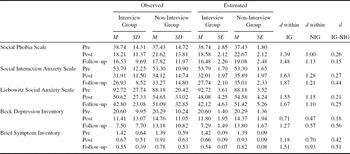
Table 3 presents observed and estimated means and standard deviations/errors for all outcome measures. Separate mixed model analyses for all social anxiety measures revealed that participants in both groups showed a significant decline of social anxiety from pre- to follow-up assessment (SPS: F(274,4) = 38.23, p<.001; SIAS: F(280,4) = 74.21, p<.001; LSAS: F(148,2) = 102.19, p<.001). There were no significant between group differences (SPS: F(117,1) = 0.37 p = .54; SIAS: F(124,1) = 1.49 p = .22; LSAS: F(126,1) = .69 p = .41), nor significant interaction effects of group × time (SPS: F(274,4) = .96 p = .43; SIAS: F(280,4) = 1.70 p = .15; LSAS: F(148,2) = 2.23 p = .11). Within group effect sizes were large in both groups. Participants reported a substantial improvement in social anxiety from pre- to post-assessment (d(IG) = 1.30–1.63; d(NIG) = 1.00–1.28) and from pre- to follow-up-assessment (d(IG) = 1.48–1.87; d(NIG) = 1.10–1.21). Between group effect sizes were small at post-assessment (d = 0.21–0.26), and small to moderate at follow-up-assessment (d = 0.15–0.44), all favouring the interview-group. The CBT self-help programme effectively reduced social fears in both groups. Mixed model analyses did not reveal a significant advantage for the interview group. Nonetheless, effect sizes indicate a trend towards an additional benefit of the pre-treatment telephone interview.
Observed and estimated means and standard deviations/errors for the Interview Group and the Non-Interview Group

Secondary outcome measures
Depression (BDI). The mixed model analysis showed a significant main effect of time (F(111,2) = 34.74, p<.001), no significant group effect (F(105,1) = 2.52 p = .12), and a significant interaction effect of time × group (F(111,2) = 3.64 p = .03). Participants in the interview group showed significantly more improvement from pre- to follow-up assessment than did participants in the non-interview group (see Table 3 for means and standard errors). Between group effect sizes were small at post-assessment (d = 0.18) and moderate at follow-up-assessment (d = 0.56).
General psychopathology (BSI). Results of the mixed model analysis of the BSI indicated a significant decline of general distress from pre- to follow-up-assessment in both groups (main effect of time: F(119,2) = 71.45, p<.001). There was a trend towards a significant group difference (F(106,1) = 3.36 p = .07) that was qualified by a significant interaction effect of time × group (F(119,2) = 3.79 p = .03). The interview group showed more improvement on the BSI from pre- to follow-up-assessment than the non-interview group (see Table 3 for means and standard errors). Between group effect sizes after the treatment and 4 months after the treatment were moderate (dPost = 0.42, dFU = 0.51).
Clinical change
Clinical improvement and recovery were assessed for the completer sample based on the SPS and the SIAS at post-treatment and at follow-up (see Statistical analyses).
At post-assessment, 21 (61.8 %) participants in the IG and 14 (41.1%) participants in the NIG could be classified as improved and recovered according to the SPS (χ2(1) = 2.89; p = .15). The SIAS revealed similar proportions of clinical change in both groups (NIG = 15 (41.1%), NNIG = 15 (41.1%); χ2(1) = 0.00; p > .99).
At follow-up-assessment, 19 (63.3%) participants in the IG and 13 (59.1%) participants in the NIG were classified as improved and recovered according to the SPS (χ2(1) = 0.10; p = .78). Based on the SIAS, the proportion of clinically changed participants was significantly higher in the IG (N = 19 (63.3%)) than in the NIG (N = 7 (31.8%), χ2(1) = 5.04; p = .048).
Treatment satisfaction
After the treatment, participants completed the 8-item client satisfaction questionnaire. The mean score ranged between 1 and 4, with 4 indicating a very high treatment satisfaction. The interview group reported a mean score of M = 3.25 (SD = 0.42); the non-interview group a mean of M = 2.89 (SD = 0.63). This difference in satisfaction was significant (t(66) = 2.81, p = .01) and substantial (d = 0.68).
Mediation analysis
To examine whether the amount of time spent using the programme explained change in social anxiety, we conducted a mediation analysis. We hypothesized that the effect of the SCID interview on change in social anxiety would be mediated by the amount of time spent using the programme. To measure change in social anxiety, a composite score of social anxiety measures (SPS, SIAS, LSAS) was calculated. Following the procedures recommended by Rosnow and Rosenthal (Reference Rosnow and Rosenthal1991), and used by Clark et al. (Reference Clark, Ehlers, Hackmann, McManus, Fennell and Grey2006), the composite score was generated by converting each social phobia scale across all assessment points to z-scores, and then by averaging across the measures. The mediation analysis was conducted on the completer sample (N = 52). We entered group affiliation (IG/NIG) as the independent variable, simple change scores of the social anxiety composite from pre- to follow-up assessment as the dependent variable, and amount of time spent using the programme as mediator. Following the recommendations of Preacher and Hayes (Reference Preacher and Hayes2008), we applied bootstrapping to estimate the confidence interval of the total indirect effect of group affiliation on change in social anxiety through time spent using the programme. According to this procedure, a variable can be classified as a mediator if the corresponding confidence interval does not include zero. The mediation model explained 25% of the variance in social anxiety change (R2 = .25, F(49,2) = 8.20, p < .01). The confidence interval of the total indirect effect did not include zero (Coeff. = 0.17, SE = .10, CI: 0.04–0.46). The amount of time spent using the programme mediated the effect of the SCID interview on change in social anxiety.
Discussion
The present study evaluated the impact of a pre-treatment structured interview on the efficacy of an Internet-based self-help treatment for SAD. Patients were screened with self-report questionnaires and then randomized to either an interview group or a non-interview group. Results showed no significant differences between the two groups on any of the primary social anxiety measures. Both groups improved substantially from pre- to follow-up-assessment. However, the groups differed significantly on secondary outcome measures. Participants in the interview group were less depressed and indicated less general psychopathology than the non-interview group after the treatment. It may be that depressive symptoms are particularly sensitive to the contact with a clinician, a notion that is supported by the superiority of guided approaches in the treatment of depression (Andersson and Cuijpers, Reference Andersson and Cuijpers2009). Another explanation could be that the diagnostic interview could serve as an intervention in itself. Suppiger et al. (Reference Suppiger, In-Albon, Hendriksen, Hermann, Margraf and Schneider2009) report that two-thirds of the clients indicated that the diagnostic interview helped them to better understand their problems. Whereas the self-help programme only targeted symptoms of social anxiety, the diagnostic interview also involved the discussion of depressive symptoms and other symptoms included in our measure of general psychopathology. Thus, the impact of the diagnostic interview could have been especially pronounced in symptom domains only targeted in the diagnostic interview. Furthermore, our data suggest that the beneficial effect of the pre-treatment interview could also be related to its impact on the subsequent use of the self-help programme.
Participants in the interview group spent nearly twice as much time in the programme than participants in the non-interview group. Moreover, the amount of time spent in the programme mediated the relationship between interview and primary outcome. The results suggest that the pre-treatment interview increased the use of the programme which, in turn, improved the outcome. Hence, a pre-treatment interview could have a direct positive effect on symptoms described during the interview and, at the same time, improve adherence to a subsequent self-help treatment. However, it is not easy to explain why the increased use of the self-help programme was particularly related to an improvement on secondary outcomes such as depression. In the present study, effect sizes of primary social anxiety measures suggest a slight advantage of the interview group even if the difference did not prove significant. This effect was more pronounced at 4-month follow-up, indicated by moderate between group effect sizes, and by a significant difference in clinical change assessed by the SIAS (IG: 63.3% vs. NIG: 31.8%). This difference in perceived change of social anxiety may also affect secondary symptoms. A small difference in social anxiety may lead to significant differences in depression and related symptoms. Depressive symptoms are closely related to the concept of hopelessness (Abramson, Metalsky and Alloy, Reference Abramson, Metalsky and Alloy1989; Henkel, Bussfeld, Möller and Hegerl, Reference Henkel, Bussfeld, Möller and Hegerl2002). Hopelessness, in turn, is likely affected by the amount of change in social anxiety symptoms and the related changes in self-view (e.g. Gibbons et al., Reference Gibbons, Crits-Christoph, Barber, Wiltsey Stirman, Gallop and Goldstein2009). A decrease in social anxiety symptoms may cause a decrease of feelings of hopelessness and thus an alleviation of depressive symptoms. Moreover, it may be hypothesized that the pre-treatment interview and the increased use of the programme positively influence common factors such as trust in the approach and the expectancy of positive change. Enhanced credibility of the approach and positive expectancies may be responsible for at least part of the improvement on the depression and global symptom measures.
In their influential meta-analysis, Spek et al. (Reference Spek, Cuijpers, Nyklícek, Riper, Keyzer and Pop2007) reported differences between guided and unguided self-help programmes. This discrepancy was confounded by differences in the conditions treated (depression vs. anxiety disorder) and by varying screening methods. The present study does not support the hypothesis that the differences between unguided and guided self-help can be explained by the difference in screening procedures alone. However, the current study also suggests that results of studies on unguided self-help programmes applying pre-treatment interviews cannot be readily generalized to studies using more economic screening procedures. In the field of Internet-based treatments, with its ever increasing amount of trials using heterogeneous screening methods, this is an important result.
The findings from this study therefore reignite the question of which screening procedures should best be applied in unguided Internet-based self-help treatments. In favour of the broad dissemination of Internet-based treatments, Marks and Cavanagh (Reference Marks and Cavanagh2009) argue for brief effective assessments. In the present study, participants had to exceed cut-off scores on two social phobia measures in order to be included in the study and randomized to one of the groups. Eighty-seven per cent of the participants in the interview group fully met DSM-IV criteria of SAD according to the SCID. Hence, for the large majority of the participants a brief screening with symptom questionnaires seems appropriate, a fact that corresponds with the suggestion of Marks and Cavanagh (Reference Marks and Cavanagh2009). However, the better outcome on secondary measures and the higher treatment satisfaction and adherence in the interview group point to the importance of some kind of pre-treatment contact. A promising approach would be the combination of screening questionnaires with a short interview (delivered face-to face or via telephone). The interview should assess main symptoms and additional mental health problems as well as impeding factors such as suicidal ideation. We assessed suicidal ideation with three screening items and excluded all participants who affirmed one of these items. This screening procedure proved far too sensitive as only one of the 46 excluded participants actually indicated suicidal ideas in the subsequent telephone interview. Brief pre-treatment interviews for all participants could enhance both the sensitivity and the specificity of the screening procedure.
The major limitation of the current study is the high drop-out rate. In both groups, nearly 40% of the participants were lost to post-assessment. This proportion is much higher than those usually reported in unguided self-help trials in SAD (e.g. Furmark et al., Reference Furmark, Carlbring, Hedman, Sonnenstein, Clevberger and Bohman2009; Titov, Andrews, Choi, Schwencke and Johnston, Reference Titov, Andrews, Choi, Schwencke and Johnston2009). In a study applying the identical self-help programme, Berger et al. (Reference Berger, Caspar, Richardson, Kneubuhler, Sutter and Andersson2011) report a drop-out of 3.7% at post-assessment. In contrast to this prior study, the current research design did not include a post-treatment interview. It could be hypothesized that the prospect of speaking with a professional after concluding the treatment enhances the motivation to complete the treatment as well as the post-assessment. In order to strengthen adherence and reduce drop-out we recommend a brief post-treatment interview where symptoms could be re-assessed and further treatment options discussed.
In conclusion, the present study supports the overall evidence of unguided self-help programmes in SAD. A pre-treatment interview does not seem to directly affect primary outcome. At the same time, the pre-treatment interview seems crucial to enhance adherence and to facilitate change on secondary symptoms. Future studies should focus on mechanisms of change in Internet-based self-help treatments, especially those associated with clinician contact. One focus should lie on the repeated assessment and analysis of common mechanisms of change, such as working alliance, outcome expectations, and experience of mastery. Another focus should constitute the examination of specific mechanisms of change, such as the change in safety behaviours, negative thoughts, or attention processes. The self-help material in Internet-based CBT already contains information on these specific mechanisms of change (e.g. negative thought record). The analysis of this material would constitute a first and very feasible step towards a better understanding of what works for whom in Internet-based, cognitive-behavioural self-help.




Comments
No Comments have been published for this article.