A lively debate in economic history and development economics focuses on the role network institutions play in shaping individual incentives, such as occupational choice, migration, and contributions to public goods (Leunig, Minns, and Wallis Reference Leunig, Minns and Wallis2011; Gupta Reference Gupta2014; Wegge Reference Wegge1998; Munshi Reference Munshi2014; Greif and Tabellini Reference Greif and Tabellini2015). A key open question is how network-based societies responded to large-scale exogenous economic shocks. In this article, we examine in the context of late nineteenth-century Kazakhstan, how the indigenous nomadic-pastoralist population responded when faced with a sharp increase in land scarcity caused by large Russian peasant settlement. We focus on the role played by traditional Kazakh clan-network institutions in facilitating or hampering an individual family's responses during this period of rapid change in the relative costs and benefits of alternative production technologies. We exploit a large novel dataset based on information from Russian statistical expeditions in the late nineteenth–early twentieth centuries in the Kazakh steppes. This dataset represents a complete census of the Kazakh population in several provinces in the current-day Northern and Central Kazakhstan and contains information on the clan identity for each family in the census.
More specifically, we analyze the effect of belonging to the same clan on the behavior of (extended) families along three key production dimensions: the length of transhumance (seasonal migration between winter and summer pastures); the rules to organize the production of fodder for winter; and the acquisition of tools used in settled agriculture (iron ploughs and harrows), which was quickly becoming an alternative to nomadic pastoralism. We document a strong clan effect. Controlling for geography (the location of the extended families' winter stop), families that belong to the same clan behave similarly along these three dimensions. While information and production externalities may explain the presence of the clan effect for the length of transhumance and the adoption of new agricultural tools, we argue that intangible clan-level resources (such as norms and values) likely drive the across-clan variation in the rules adopted for organizing the production of fodder for winter.
Our findings reinforce that understanding how individual decisions are influenced by changes in economic conditions (such as rising scarcity of resources, changing relative prices of inputs, or technological change) requires taking into account the influence of the pre-existing social institutions. This social organization “filter” gives rise to heterogeneous trajectories among groups or clans, which might accumulate into persistent differences among otherwise similar families. Moreover, understanding the forces behind the divergent trajectories is crucial, as some forces (for instance, external economies of scale in the old production system) are likely to be transitory, whereas others (such as clan-level norms and values) may be more persistent and have repercussions on economic behavior well beyond the transformation in the traditional economy that we document here.
DATA AND HISTORICAL BACKGROUND
Data Sources
Our main data sources are the statistical materials from the first (and largest) wave of Russian colonial expeditions (Shcherbina Reference Shcherbina1903, Reference Shcherbina1907, Reference Shcherbina1908). In late spring 1896, Russian Czarist administration financed an expedition headed by a prominent Russian statistician, Fedor Shcherbina. The expedition covered 12 provinces in three regions in Western, Northern, and Central Kazakhstan, and overall took seven years to complete (the surveys in the last of the 12 provinces were completed in 1903).Footnote 1
The expedition took place during the summer months (typically from early June to late August, when Kazakh families were on their summer pastures) and surveys were conducted by teams composed of both Russian statisticians and Russian-speaking Kazakh interviewers (most of whom had studied in Russian schools). These data constitute highly detailed agricultural censuses: all households that had their winter stop in these 12 provinces were included in the survey. The main aim was to estimate how much land could be available to host Russian peasant migrants, under the hypothesis that the Kazakh population maintains at least some form of nomadic pastoralism.Footnote 2 The results were published in multiple volumes, each containing a descriptive part and a series of annexes (including the original variables recorded, aggregated at various levels).
The main questionnaire was at the extended family level and was answered by the heads of extended families (typically, the eldest male member, called aqsaqal, or “the white-bearded man”).Footnote 3 It consisted of several sections: demographic and geographic variables, clan identification, and a highly detailed section on livestock and economic activity (pastoralism and agriculture). Importantly, this latter category includes measures of the intensity of nomadic pastoralism (number of days per year spent by the extended family on its winter stop), the organization of haymaking (collectively or on the basis of individual plot ownership), and the ownership of modern agricultural tools (iron ploughs and harrows).
The reliability of the data collected during the expedition has been confirmed by both qualitative and quantitative analysis. The prominent Soviet-period Kazakh historians, Shakhmatov (Reference Shakhmatov1964) and Tolybekov (Reference Tolybekov1971) confirm that the Shcherbina expedition materials are in line with the qualitative evidence on the principal socio-economic characteristics of Kazakhstan for the period under study, reported by other contemporaneous independent sources. Volkova (Reference Volkova1982) presents a full-fledged quantitative analysis in which she studied the correlation of ten principal variables from the Shcherbina expedition data (at the province level) with the same variables coming from administrative records (registered in 1893), and finds that the correlation between variables from the two datasets is very high, thus confirming the quality of the expedition data.
More importantly, the annexes to the expedition data contain genealogical trees that link clans and extended families in the dataset. These trees (called shezhire) are traditionally transmitted by Kazakhs across generations and constitute a key part of the Kazakh culture. We cross checked and complemented the trees reported in the expedition materials with the more recent and current-day Kazakh publications (Vostrov and Mukanov Reference Vostrov and Mukanov1969; Alpysbes Reference Alpysbes2013). Overall, we found few inconsistencies.
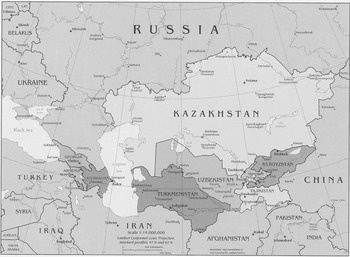
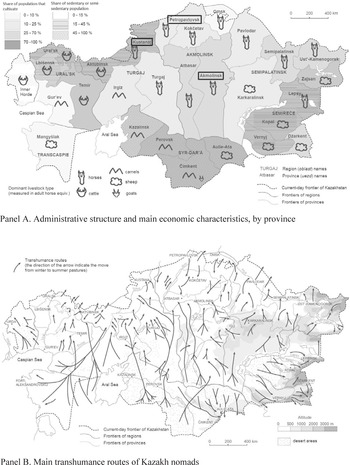
In this article, we use data from three provinces for which we have both the original datasets and the original genealogical trees: Kustanay, Petropavl, and Akmola (see Figure 1 and Panel A of Figure 2). Out of a total of 5,989 extended Kazakh families recorded in these three provinces, we have useable data for 5,103 families (comprising in total over 246,000 individuals).Footnote 4 To build our clan variable we use the name of the clan each family head belonged to. Additionally, we use these clan genealogical trees to make adjustments to the clan variable provided in the family sample.Footnote 5 In total, the 5,103 families in our dataset belong to 496 different clans. On average each clan has 10 families, 85 households, and 496 individuals.
THE GEOGRAPHIC LOCATION OF THE CURRENT-DAY KAZAKHSTAN IN EURASIA

KAZAKHSTAN AT THE END OF THE NINETEENTH CENTURY

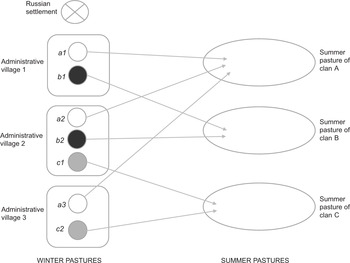
Fundamental for our empirical analysis is the fact that the Russian administration grouped Kazakh extended families into villages on the basis of geographical closeness of their winter stops. As a result, families from different clans were grouped into the same village and families from a given clan were spread across several villages. Figure 3 represents extended families belonging to three hypothetical clans (A, B, and C), defined by their summer pastures. During winter, extended families belonging to the same clan spread over different winter stops (for instance, the families of clan A spread over to winter stops a1, a2, and a3). Given that this pattern is followed by all the clans, and since the Russian administration grouped the extended families on the basis of the geographic location of the winter stops, families from different clans happen to belong to the same administrative units. There are a total of 266 administrative villages in our sample. On average each village groups 19 families, 158 households, and 925 individuals.
REPRESENTATION OF THE TRADITIONAL ECONOMIC ORGANIZATION OF KAZAKHS

Organization of Nomadic Pastoralist Economy
Prior to the mid-nineteenth century, the Kazakh economy was based on subsistence nomadic pastoralism. This production system had been predominant at least since 1000 BCE.Footnote 6 Livestock was at the center of the nomadic pastoralist system. It constituted the main wealth held by families, the key production input, and the principal source of food. Kazakhs mainly held and bred horses, sheep, and goats, and, in some areas, camels (see Figure 2, Panel A). The fundamental characteristic of the Kazakh economy was seasonal transhumance, consisting of changing physical location of the households and its assets four times during the year, once in each natural season (see Figure 2, Panel B). The key reason for this regular back-and-forth movement from summer to winter pastures (with relatively shorter stays on autumn and spring stops) was to guarantee the provision of fodder for the livestock throughout the year.Footnote 7
Kazakh nomads thus rationally adapted to the geography and the climate of the area. Summer pastures in the steppes provided abundant and high quality fodder during the warmer months; however, these areas became inhabitable during the harsh winters with temperatures often falling below −35 degrees Celsius accompanied by strong winds. As a result, Kazakh nomads moved to areas with milder temperatures and better protection from the winds. Distances between the winter and summer pastures were large, often exceeding 200 kilometers one way (Matskevich Reference Matskevich1929; Ferret Reference Ferret2014). The scarcity of good winter pastures (areas close to rivers, lakes, and hills) implied the need to preserve the fodder of the winter pasture for the next year. This need, coupled with the relatively flat landscape in most of the Central and Western Kazakhstan, resulted in long-distance seasonal transhumance of Kazakhs. Even at the end of the nineteenth century, virtually all Kazakh families in the provinces that we study still moved to summer pastures on annual basis.
A weakness of the nomadic pastoralist system was its fragility. Given the harsh climatic conditions and the lack of diversification in production, the nomadic economy was extremely vulnerable to external shocks (e.g., large variations in temperature or disease outbreaks among livestock). Tolybekov (Reference Tolybekov1971, pp. 541–42) reports that approximately 59 percent of total livestock was lost during the harsh winter of 1879/80 in Irghiz and Turgay provinces. Such shocks occurred regularly: the winters of 1850/51, 1855/56, 1879/80, and 1891/92 had large-scale losses of livestock (Tolybekov Reference Tolybekov1971, p. 542). Similarly, in Western Kazakhstan, Larin (Reference Larin1928) reports that massive livestock loss caused by poor climatic conditions was registered in seven winters between 1882 and 1927 (the so-called jut years).
By the end of the nineteenth century, under the influence of Russian migrants several technological changes were under way. Contemporary accounts attest that haymaking started in the Kazakh steppes around 1840s–1850s. Daulbayev (Reference Daulbayev1881), describing the economic organization of the Kazakhs of Kustanay province between 1830 and 1880, writes:
“[Around 1830] they moved regularly during the winter along those rivers from one place to another, with their livestock and families, seeking for forage for their animals, given that no one among them prepared hay for winter and did not do any cultivation… After [the administrative] changes [of 1835–1840s], first the Kazakhs living closest to the Russian settlements, and later also others, taking their Russian neighbors as examples, started to prepare hay for their livestock for winter and to build winter enclosures for their animals.” (Daulbayev Reference Daulbayev1881, pp. 99, 113)
Learning from Russian neighbors is also confirmed by other authors (Katanaev Reference Katanaev1904; Shcherbina Reference Shcherbina1908, pp. 202–208; Kurylev Reference Kurylev1998, pp. 34–35). Crucially, these changes implied that the period of the winter stop could be lengthened, as livestock no longer depended uniquely on the natural grass cover available at the winter pasture. The positive effect of this innovation was that the animals could survive even during the jut year winters.Footnote 8
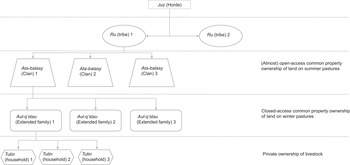
Kazakh society was organized along blood-related clan-based lines.Footnote 9 This organization was structured in several layers (illustrated by Figure 4), each of which played a specific role. The smallest unit was a household consisting of a married couple with several children and, sometimes, other close relatives. The next layer, extended families (the so-called aul-q'stau), consisted of several kin-related households living together during winter. Several extended families were grouped into clans (called ata-balasy). Clans composed larger units or tribes (called ru), which themselves entered into one of the three larger confederations or hordes: Senior, Middle, and Junior (called juz in Kazakh). These upper layers of the social structure (ru and juz) played the role of regulating inter-clan conflicts and managing diplomatic relations with the neighboring countries.
SOCIAL STRUCTURE AND PRE-COLONIAL PROPERTY RIGHTS IN THE KAZAKH SOCIETY IN THE NINETEENTH CENTURY

The extended families were defined by their winter stops, whereas summer pastures were organized on the basis of clans. Property rights on land were defined both at the extended family and at the clan level. Private property rights on land did not exist for individual households; however, households had private property rights on livestock. Winter stops were closed-access common property resources of extended families, whereas summer stops were common property resources at the clan level. In general, access to pastures was carefully regulated within the clan. All clan members did not have the same access to land, and the effective rights of access were to some extent proportional to the status, power, and wealth of individual households (Zimanov Reference Zimanov1958, p. 81; Tolybekov Reference Tolybekov1971).
Russian Resettlement and Colonization
In the first half of the eighteenth century, facing extended wars with their Eastern neighbors (Oirats), Kazakh tribes officially requested to become a protectorate of the Russian Empire. The Kazakhs of the Junior Horde were the first to request this status in 1731, followed by the Middle and Senior Hordes in 1735 and 1748. Through the nineteenth century, the Russian emperors gradually transformed the protectorate status of the Kazakh Steppes into that of a colony, with a series of political and administrative reforms and military interventions. These reforms started in 1822 with the abolition of the khanate of the Middle Horde and terminated in 1868 with the declaration that the entire territory of Kazakhstan was under the control of the Russian Empire (Abuseitova et al. Reference Abuseitova, Abylkhozhin and Klyashtornyj2001, pp. 353–59).
The initial migration of Russians into Kazakhstan that started in the seventeenth century was small but accelerated in the last quarter of the nineteenth century, reaching its peak in the 1910s. It developed in two phases; the second and largest phase led to fundamental structural changes in the Kazakh nomadic economy. This phase started in 1861 (Galiev Reference Galiev2009, p. 223; Demko Reference Demko1969, p. 52) after the abolition of serfdom. Between 1861 and 1889, the first wave of peasant settlers started to arrive into the Steppe. This in-migration was limited and somewhat chaotic. Although these peasants migrated without State encouragement and planning, the Czarist administration tolerated this migration because it eased land pressure in the European part of Russia. The First Resettlement Bill was adopted in 1889. The State now actively encouraged peasant migration into the Kazakh Steppes and tried to regulate it. This bill offered Russian landless peasants land “for free,” in the amount of 15 desyatinas (approximately 16.4 ha) per household, in the Asian part of the Russian Empire (Olcott Reference Olcott1995, p. 87). The Resettlement Administration was then created, and in 1895 the Czarist government organized and financed the statistical expeditions into the Steppe. Finally, after 1906 (the year of the start of Stolypin agrarian reforms), peasant resettlement became an imperial priority and turned into the fully-fledged colonization, aiming at maximizing the use of land resources throughout the Russian empire.
As reported by Demko (Reference Demko1969), in 1897 the Russian-speaking population of the four Kazakh regions directly bordering with Russia (Uralsk, Turgay, Akmolinsk, and Semipalatinsk) comprised 496,000 people, corresponding to 20.6 percent of the total population of these regions. By 1905 this figure increased to 844,000 people, corresponding to 28.9 percent of the total population.
This massive in-migration both discouraged nomadic pastoralism and encouraged sedentary agriculture at winter stops (soil and climatic conditions at summer pastures did not allow crop cultivation).Footnote 10 The large-scale occupation of pasture lands and transhumance routes made nomadic pastoralism more costly, because, as Sedelnikov (Reference Sedelnikov1907) noted:
“Reduction in pastures led to an increasing death of livestock in winter… and this forced weaker and poorer tribes to re-consider their future: given that the previous form of the economy could not provide their subsistence, they had to look for another one that better corresponds to the new situation… And now these tribes sedentize in the north to live there for the entire year, close to and partially under the protection of Russian villages.” (p. 23)
In addition, there was knowledge transfer concerning crop cultivation and the relevant agricultural tools. Demko (Reference Demko1969) mentions that the example of settlers influenced numerous poor Kazakhs, particularly those with relatively small herds, to attempt crop cultivation. Such transfer occurred to a large extent through direct observation:
“[Some Kazakhs] have been stopping by the Russian towns and observing how the Russian ploughed. At first they hired Russian peasants for agricultural work, but when they saw how profitable the agriculture could be, they started to plough themselves. Thus, according to the testimony of the Kazakhs themselves, they started laboring the soil and even now it is practiced under the influence and with the direct participation of the Russian population, […] mostly peasants.” (Tikhonov Reference Tikhonov1903, p. 69)
Russian colonization also substantially modified the property rights on land. Until 1891, the land legally belonged to Kazakh tribes. In that year, the Rulings Concerning the Administration of Akmola, Semipalatinsk, Semirechinsk, Ural, and Turgay Regions (Article 119) declared that the land occupied by nomads was the property of the State (Zimanov Reference Zimanov2005, pp. 500–18). This regulation granted Kazakh nomads with usufruct rights on the land that they occupied for pastures; however, even these rights could be revoked (Article 120). The ruling officially gave the Kazakhs rights equivalent to those of Russian peasants (Article 11). One should note, however, that the formal land titles introduced by the Czarist administration were regularly ignored by colonial settlers; thus, the equality of rights applied only to Kazakhs who conducted cultivation and only to those plots that served for agriculture (Martin Reference Martin2001).
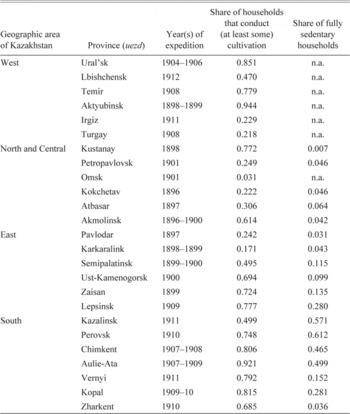
To which extent did Kazakh communities shift to (sedentary) agriculture in this period of peasant settlement? And how much transhumance did remain at the end of the period? On the basis of the Shcherbina expedition materials, Masanov (Reference Masanov2011) constructed, for each province, the share of households that were conducting (at least some) cultivation of crops, as well as the share of households that were fully sedentary (i.e., never leaving their winter stops during the year). These shares, with provinces grouped by geographic area, are presented in Table 1.
CULTIVATION AND SEDENTARIZATION, BY PROVINCE

Source:
Masanov (Reference Masanov2011), Table 12 .
Two interesting facts emerge. First, the extent of cultivation varied substantially both across Kazakhstan and within large geographic areas. For the Northern and Central Kazakhstan, the share of households that conducted some agriculture in Omsk province was barely 3.1 percent, whereas in Kustanay province it was 77.1 percent. Second, this intensity of cultivation was associated with sedentary lifestyle only in the Southern Kazakhstan, which was mostly sedentary even before Russian colonization and is located furthest away from Russian peasant settlements. Even in the provinces immediately adjacent to the current border with Russia (e.g., Kustanay or Petropavlovsk), a tiny proportion (less than 5 percent) of household became fully sedentary. It is thus clear that although cultivation by Kazakhs intensified during Russian settlement, Kazakhs tried to maintain their nomadic-pastoralist lifestyle (even though it is likely that the intensity of nomadism reduced, e.g., Kazakhs remained longer on their winter stops).Footnote 11
The same picture emerges from the detailed history of agriculture in the Kazakh society by Zimanov (Reference Zimanov1958). He argues, on the basis of numerous contemporary sources, that Kazakhs had some knowledge of agricultural techniques (as attested, for instance, already in 1803 by Gaverdovskii Reference Gaverdovskii2007) but that virtually no households (except in the Southern Kazakhstan, along the shores of the Syr Darya River) were regularly cultivating crop land until the second quarter of the nineteenth century. Throughout the nineteenth century, contemporaries observe a gradual increase in the relative importance of the agriculture, starting with the poorer households and involving later also the well-to-do families (Sedelnikov Reference Sedelnikov1907). This process continued, with a much slower increase in the degree of sedentarization well into the twentieth century. On the basis of the 1928 official statistics, Dakhshleiger (Reference Dakhshleiger1966) found that by that time, in the Northern part of Kazakhstan about 25 percent of household was (fully) sedentary, whereas in the Central Kazakhstan this share was still only 7 percent (in the Southern Kazakhstan, the figure stood at 47 percent).
Role of Clans
In Kazakh society, clans fulfilled several key functions. First, the clan played the central role in nomadic production through its coordination of joint transhumance, to and from the summer pasture, and the allocation of property rights on land on the summer pastures. Towards the end of winter, the heads of extended families belonging to the same clan sent messengers to each other, to determine the timing of migration to the summer pasture that they jointly exploited (Chormanov Reference Chormanov1906). The coordinated move to the summer pastures helped organize against possible attacks during the move, facilitated the appropriation of summer pastures (as rights on summer pastures were loosely defined and inter-clan conflicts over their boundaries were quite common), and enabled a clan to exploit economies of scale in caring for the herds (Masanov Reference Masanov2011, p. 408).
Second, the clan provided insurance against shocks to its members. For instance, if a family lost livestock to predators or in a particularly harsh winter, other members of the clan provided the family with some livestock (Vladimirtsov Reference Vladimirtsov1934). The geographic spread between winter pastures of the members of the same clan often was quite large; thus, in case of a climatic shock (a particularly harsh winter weather) in one area, the members of the clan wintering in other areas partially covered the livestock losses of the former. Moreover, the clan provided security and physical protection to its individual members and their wealth: “A person excluded from the interactions with his clan loses all their support, and has no rights among Kazakhs: he and his belongings can be captured by anyone, and there are plenty of those who are at the lookout to attack such individuals left without the clan protection” (Yushkov Reference S.V.1948).Footnote 12 Clan members also contributed to the payment of brideprices during the marriages of individual members (Kislyakov Reference Kislyakov1969, pp. 84–85).
Third, clans played an important role in socialization of younger members into norms of behavior (Masanov Reference Masanov2011, p. 401). This was in part related to the fact that the nomadic lifestyle made formal education difficult. Thus children learned skills through informal interactions with adults and by observing their behavior. Moreover, given the long periods of transhumance, children interacted with members of the clan beyond the extended family to which their households belonged, allowing transmission of clan-specific norms and values.
Finally, the clans also played a political role. The clan-level chiefs and customary judges settled conflicts arising between members of the different clans (for instance, land- or marriage-related disputes) and on some occasions negotiated among them the allocation of summer pastures (Martin Reference Martin2001).
THE CLAN AND AN INDIVIDUAL FAMILY'S CHOICES: CONCEPTUAL DISCUSSION
To analyze the effect of group behavior on individual choices, the economic literature offers a wealth of social-interactions or peer-effect models (for detailed reviews see Manski Reference Manski2000; Brock and Durlauf Reference Brock, Durlauf, Heckman and Leamer2001; Granovetter Reference Granovetter2005; Vives Reference Vives2005; Ioannides Reference Ioannides2012). These models typically predict complementarities in behavior of individuals belonging to the same group. The major concern that arises when bringing the predictions of these models to data is identifying whether the same-group individuals make similar choices because they influence each other or because they are subject to the same shocks or have similar characteristics (which leads to correlated error terms).
In the case of Kazakh clans we argue that two mechanisms lead to complementarities in production decisions: coordination in migration and information transmission. In addition, we argue that common clan-level factors (such as values and norms or relative power) helped lead to similar behavior between clan members.
The coordination of migration decisions is the most obvious explanation for the clan effect on the length of seasonal transhumance.Footnote 13 In the traditional Kazakh economy, the production technology implied that the activities had to be coordinated at the clan level, due to joint transhumance to and from summer pastures. In other words, the traditional technology exhibits production externalities between families belonging to the same clan. The larger the share of the clan member families relying on nomadic pastoralism, the lower is the cost for an individual family of doing the same.
The transmission of information and knowledge about the new technique through the clan network may also have led to simultaneous changes in the production system by members of the same clans. As otherwise physically distant clan members met during transhumance to the summer pasture and spent several months together, they could exchange information about ways of adapting to the changing environment and knowledge about agricultural tools and techniques.
These two channels, coordination in migration and information transmission, belong to the category of “endogenous social effects” (Manski Reference Manski1995), where individual families are directly influenced by the choices of other members of the clan. At the same time, the observed correlation in behavior at the clan level may also be driven by some common factors. Families belonging to the same clan can behave similarly because they face the same constraint or because they have similar characteristics. Thus, one can find a clan effect in the data even without interactions among clan member families.Footnote 14 In our context, access to the common clan-level resources can give rise to such correlated effects. Two types of resources appear particularly relevant. The first is the summer pasture shared by clan member families. Access to relatively better summer pastures (for instance, richer in water sources) would imply a higher relative return from the traditional production system. The second is the set of clan-specific values shared by clan members. Beyond the extended family, socialization occurred essentially within clans where oral transmission of history, norms, and values played a central role. Thus, clan members had a strong sense of clan identity, implying that they shared clan-specific values and norms, which could vary considerably across different clans.Footnote 15
In sum, three main mechanisms can potentially underlie any observed correlation in behavior within clans. First, coordination and production externalities in transhumance naturally imply strong conformity in the choice of production system. Second, information transmission within the clan might decrease the cost of technology adoption for each individual family. Finally, resources shared by the members of the same clan, either tangible (the quality of the summer pasture) or intangible (shared values and norms of the clan) may generate similar behavior at the clan level.
CLANS AND THE ORGANIZATION OF LIVESTOCK PRODUCTION DURING COLONIZATION: EMPIRICAL INVESTIGATION
We now investigate the role of clans for the three key decisions in the livestock production system for which we have information: the length of the yearly stay at the winter stop, haymaking, and the adoption of modern ploughs and harrows to cultivate land. Haymaking was a relatively recent adoption (learned from the Cossacks). The median date of adoption of the practice is 40 years before the survey.Footnote 16 The practice consists in cutting natural grass, drying and storing it to feed livestock during the cold season. Hay plots were located in the vicinity of the winter stops and were the private property of the extended family. While all families were making hay at the time of the survey, they differed in how they organized plot and labor allocation. Specifically, some families allocated hay plots to individual households comprising the family while other families jointly exploited their hay plots.Footnote 17 While, on the one hand, collective production typically suffers from problems of free-riding on labor effort, on the other hand it helps exploit economies of scale in production or to have greater insurance value through income pooling. Haymaking, however, was essentially manual and it is not clear that there were important economies of scale in this activity. Risk pooling or incentive considerations may play a role in understanding the observed heterogeneity, a point we come back to later.
Here we examine whether families of the same clan tend to behave similarly regarding the individualization of hay production at the level of the household.Footnote 18 We also examine land cultivation decisions. In our sample, under the influence of Russian settlers, Kazakhs had only very recently started to cultivate (mainly wheat and barley). In fact, only half of Kazakh families in our sample owned a harrow and a plough, indicating that they practiced agriculture. We are confident that there is a one-to-one relationship between tool ownership and grain cultivation, and we found no evidence of the existence of a tool rental market. We examine whether families belonging to the same kin made similar decisions regarding the adoption of agricultural tools.
Descriptive Evidence
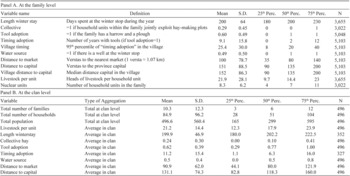
To capture the productive decisions we analyze the duration of a family stay on its winter stop (measured in days). Panel A of Table 2 reveals that although Kazakh families spend on average nearly seven months at their winter stops, 25 percent of families spent less than six months and 25 percent almost eight months or more.Footnote 19 For haymaking, we use information on plot allocation to build the variable Collective that equals one if all households of the family exploit hay plots jointly (and equals zero otherwise). Three arrangements are observed in the data. The most common rule is the complete individualization of production within the extended family (52 percent of the sample), so nuclear households within the extended family are responsible for producing their own hay on land on which they enjoy individual use rights. Twenty-nine percent of extended families produce hay collectively and land is not allocated to individual households. In an intermediate category, 24 percent of extended families use a decentralized production system with yearly land reallocation. We concentrate on the distinction between the collective and the two other (more individualized) modes of production.Footnote 20
DESCRIPTIVE STATISTICS

Source:
Shcherbina “Materialy, vol. 3,” Shcherbina “ Materialy, vol. 5,” Shcherbina “Materialy, vol. 12.”
Finally, to measure adoption (or intensification) of grain cultivation, we rely on the family ownership of a harrow or a plough.Footnote 21 For part of the sample we have information on the number of years the family is plowing land, which provides an indication of the timing of adoption of grain cultivation.Footnote 22 Harrows and ploughs are used by the same extended families, less than 2.5 percent of families own only one of the two tools. When the survey took place, 60 percent of extended families owned a harrow and a plough. Furthermore, families who were plowing land had been doing so for an average of nine years.
Panel B of Table 2 presents descriptive statistics at the clan level. The first three rows reveal that clan are of heterogeneous sizes: at the 25th percentile, clans count as few as three extended families (and 165 members) while at the 75th percentile they include 12 extended families (and 595 members). Wealth, as captured by the average number of heads of livestock by unit, also varies widely across clans: this value doubles from the 25th to the 75th percentile. Finally, similar comparisons between the 25th and the 75th percentile of the other variables indicate that clans exhibit heterogeneous behavior with regard to the length of their winter stay, their mode of haymaking, and their adoption of agricultural tools. A descriptive analysis of the similarity in behavior across families of the same clan or across families of the same village is available in an online appendix.Footnote 23 It reveals both clan specialization and village specialization: families from the same clan or from the same village are more likely to behave more similarly than any two randomly-drawn families in the sample. Also, the geographical pattern of agriculture adoption is correlated to the distance to Russian settlements. In order to isolate the effect of clans from potentially confounding geographical factors, we need to carefully control for geography while measuring the “clan effect.”
Econometric Analysis
We now turn to multivariate analysis in order to estimate the importance of clan effects in the adoption process and organization of production while controlling for confounding factors.
To measure a clan effect we estimate the following reduced form model of family behavior, where Y is either length of stay at the winter stop, the decision to produce hay collectively or the decision to adopt agricultural tools:

The variable ClanYi measures the average value of Y in the clan of family i, excluding family i from the average. The vector Geographyi captures climatic and physical suitability of the family's winter stop to agriculture as well as the proximity of the family to farmers and the vector Livestocki includes variables measuring the family-level resources that are inputs to the production processes.
For the length of transhumance and agricultural tool adoption, we examine whether the clan effect is different in areas where information about farming was more widespread. We estimate the following model:

where AccessInfoi is a proxy for the availability of information about farming for family i.
The estimation of the clan effect in these models is complicated by the classic “reflection problem,” whereby the behavior of an individual family (Yi ) influences the behavior of families of its clan (and thus ClanYi ). Here we rely on generalized spatial two-stage least squares to conduct the estimation.Footnote 24 Letting W denote a clan weight matrix that is row normalized and indicates which families belong to the same clan (W∗Xi simply corresponds to the average value of X among the families composing the clan of family i, excluding family i), the instruments for ClanY are the linearly independent columns of X, W∗X, and W2∗X, where X is the set of control variables (including fixed effects). In other words, we instrument the average value of Y in the clan by the average value of the independent variables (and other moments) in the clan. The idea is to use the fact that each family's behavior is influenced by the control variables, so that the average of family behavior is correlated with the average of these control variables. This estimation strategy thus assumes that clan members' characteristics only influence an individual family's behavior through their effect on clan members' behavior. In Model (2) we use the same set of instruments along with their interaction with AccessInfo.
The vector Geography includes either village fixed effects or district fixed effects along with the distance to the province capital, the distance to trading points and the type of water available at the winter stop.Footnote 25 Isolating clan effects from geographical factors is a key challenge of the empirical analysis. If we imperfectly control for environmental characteristics that affect the return to agriculture and if families of the same clan locate in similar areas, our clan network effect would incorporate the effects of these unobservables.Footnote 26 The inclusion of village fixed effects enables us to (largely) overcome this difficulty. Village fixed effects de facto control for all village-level characteristics and the identification of our clan effect is then based on variation across families living in the same village.Footnote 27 In other words, we examine whether differences in behavior across families living in the same village are correlated with the difference in behavior of their respective clans. Note that while this estimation strategy exploits heterogeneity of clan behavior at the village level and thereby avoids many sources of omitted variable biases, it may underestimate the true network effect as the influence of clan members living in the same village is, in part, absorbed by the village fixed effect. To obtain upper bounds for the clan effect we therefore estimate the model without any fixed effects and with district fixed effects instead of village fixed effects (in both cases, controlling for distance to the capital city and the type of water locally available). To estimate Model (2), we also rely on district fixed effects as our measures of information are defined at the village level (and thus do not vary within villages).
The vector of family resources (Livestock) includes the number of animals owned by the family as well as the number of nuclear units composing the family. These last two variables may be seen as endogenous to the type of production system adopted by the family and we provide estimations without these controls. Finally, to measure the availability of information about agriculture in a village or a province (AccessInfo) we use either the distance of the village to the provincial capital or the length of exposition to the technique measured by the 95th percentile of the number of years the technique has been used in the village.
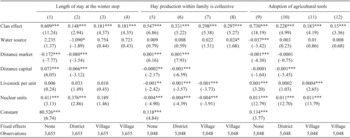
The first four columns of Table 3 present the regression results for the duration of stay at the winter stop. Column (1) to (3) introduce increasingly stringent geographical controls: column (1) simply controls for the distance to the nearest market and the distance to the province capital, column (2) includes district fixed effects, while column (3) includes village fixed effects. As expected, the size of the estimated clan effects decreases when we add fixed effects indicating that part of the observed correlation of behavior across families of the same clan is driven by market access factors. However, the estimated clan effect remains significantly different from zero even with village fixed effects, suggesting that beyond geographical confounding factors, families of the same clan coordinate about the length of stay at the winter stop. The magnitude of the effect is, however, modest. The coefficients in column (3), for example, imply that a given family increases by 0.2 months its stay at its winter stop when the average length of stay in its clan increases by one month. This suggests that, despite a clan's influence, migration durations also remain family specific (or sub-clan specific).
THE CLAN'S INFLUENCE ON A FAMILY'S ECONOMIC DECISIONS

* = Significant at the 10 percent level.
** = Significant at the 5 percent level.
*** = Significant at the 1 percent level.
Notes:
The estimations are performed using a generalized spatial two-stage least squares procedure. Standard errors are clustered at the clan level. The values in parentheses are t-statistics.
Source:
Shcherbina “Materialy, vol. 3,” Shcherbina “Materialy, vol. 5,” Shcherbina “ Materialy, vol. 12.”
Columns 5 to 8 of Table 3 present the results of estimation of Model (1) for hay production. The dependent variable is a binary variable indicating whether the extended family produces hay collectively or not. When we control for district or village fixed effects, the estimated clan effect becomes smaller but remains significantly different from zero and suggests that individual families are strongly influenced by families from the same clan in their choice of collectively producing hay. Within a given village, the propensity of a given family to collectively produce hay is 30 percentage points larger if the average family in its clan collectively makes hay.Footnote 28
Finally, the last four columns of Table 3 present the results for agricultural adoption measured by the ownership of tools at the extended family level. Within a given village, a family has an 18 percentage points higher propensity to adopt tools if an average family in its clan adopts tools. Larger and richer families are also more likely to own tools. As these two variables may be endogenous to the adoption of agriculture, we re-estimate the model dropping them (column (12)). The coefficient on clan effect remains highly significant.Footnote 29
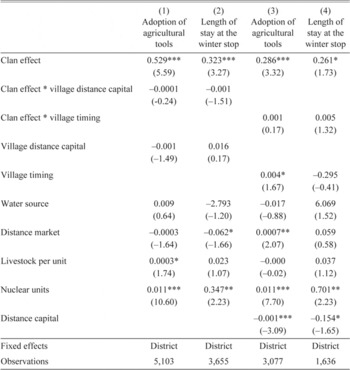
Table 4 presents the results of the estimation of Equation (2), controlling for district fixed effects. Because the availability of information is measured at the village level, we do not use village fixed effects. The coefficient on the interaction between clan effect and the indicator of information is not significant, whether we use the average distance of the village to the province capital or the length of exposure to the technique in the village as indicators of information. In fact, the sign of the interaction indicates that, if anything, the clan effects are slightly smaller in villages further from the province capital or where the technique has been adopted more recently.
THE STRENGTH OF CLAN EFFECT BY ACCESS TO INFORMATION

* = Significant at the 10 percent level.
** = Significant at the 5 percent level.
*** = Significant at the 1 percent level.
Notes:
The estimations are performed using a generalized spatial two-stage least squares procedure. Standard errors are clustered at the clan level. The values in parentheses are t-statistics.
Source:
Shcherbina “Materialy, vol. 3,” Shcherbina “Materialy, vol. 5,” Shcherbina “Materialy, vol. 12.”
In short, the results confirm the existence of a strong clan effect in a family's length of stay at its winter stop, in a family's mode of haymaking, and in a family's decision to adopt agricultural tools. However, we find no evidence that this effect is dampened in areas where information about agricultural production is more widespread.
Explaining the “Clan Effect”: Coordination, Information, and Clan-Level Resources
For the decision about how long to stay at the winter stop, the production externality channel likely plays a major role. Since Kazakh families from the same clan migrate jointly, they have to coordinate on the migration dates (leaving their winter stops in spring and leaving the summer pasture in fall). Not surprisingly, we find a clear clan effect in this decision (columns 1–4 of Table 3). Still (and may be more surprisingly), the results also suggest that there is imperfect coordination in the migration and that the length of migration of individual families from the same clan may differ quite substantially. The clan-level resources may also influence this decision: a clan with better quality of summer pasture (more abundant water sources) may stay longer in transhumance and all the families belonging to this clan are likely to declare a relatively long transhumance period.
For the decisions concerning the family's mode of haymaking, neither the coordination nor the information channels appear relevant. First there is no obvious reason for deliberately coordinating this decision at the clan level since haymaking is organized at the family level. Moreover, given that the technology for producing hay under the three different institutional rules is the same, an information channel is unlikely to matter. The clan effect is then possibly explained by the existence of clan-specific norms regarding cohesion or familism (Banfield Reference Banfield1958). In clans with a higher degree of cohesion, individual households are more likely to internalize the effect of their action on the well-being of other members of their clan and the free-riding problem may thereby be mitigated. In support to this interpretation, secondary sources insist on the existence of strong clan-based identity built around clan specific values and norms of behavior (Masanov Reference Masanov2011).
Finally, regarding the decision to adopt agricultural tools, all three channels could potentially play a role. First, as clans are the main information transmission networks, knowledge about the new technology would be rapidly shared among clan members. However, our empirical results suggest no fading of the clan effect in contexts where information is already abundant (i.e., close to Russian settlements). Thus, the information channel alone is unlikely to explain the clan effect in the adoption decision. Second, the coordination in migration decisions may have spillover effects on the decision to adopt agricultural tools. If sufficiently many families in a given clan acquire good skills in cultivation (and therefore prefer to stay longer at the winter stop), the cost of migration of the other families increases, and these latter may then also switch to cultivation. Finally, if openness to novelty and entrepreneurship figure among the clan values, this might influence the propensity of individual families to adopt the new agricultural techniques.
To summarize, all three channels identified in our conceptual discussion may be relevant in explaining the conformity of behavior within clans. Coordination and production externalities are likely to drive similar behavior regarding the length of stay at the winter stops. The channel of clan-specific norms constitutes the most convincing explanation for the clan effect on a family's decision to produce hay collectively. Finally, we cannot rule out that information about new technologies travel through clan networks; however, we find that this explanation alone is unlikely to drive the clan effect.
CONCLUSION
Land settlement often implied large-scale changes in the constraints faced by indigenous populations. On the basis of evidence from the late nineteenth–early twentieth century Kazakhstan, in an earlier article (Aldashev and Guirkinger Reference Aldashev and Guirkinger2012) we have studied the effect of increased resource scarcity during the Russian settlement on excess female mortality and the resulting gender bias in the Kazakh population. In this article, we continue this broader research agenda by finding that traditional clan-based institutions and social structure were central in determining the adaptation to such changes. Because of clan influence, families of Kazakh nomads facing similar economic conditions made diverging decisions concerning sedentarization, organization of hay production, and adoption of new agricultural tools. The clan influence likely played through multiple channels: coordination and externalities at the clan level in production under nomadic pastoralism, information transmission about new agricultural techniques and tools, and the clan-level resources, both tangible (quality of summer pastures) and intangible (clan's attachment to traditional values).
These findings have interesting implications concerning our understanding of the role of social structure and “slow-moving institutions” (Roland Reference Roland2004) in the long-run economic development. Traditional institutions in developing countries often serve to overcome market imperfections (Munshi Reference Munshi2014). However, if the economic environment rapidly changes, and these slow-moving institutions persist, they also influence individual trajectories in the new environment. Our findings indicate that clan-specific norms and clan identity may remain an important determinant of individual families' outcomes, even if purely economic channels such as external economies of scale fade away over time.
The observers of the current-day Kazakhstan argue that clans continue to play an important role in the society and the national politics, even after 70 years of Soviet rule, during which governments tried to undermine clan-based institutions by all means (Schatz Reference Schatz2004). A promising avenue for future work is to reconstruct the processes through which clan institutions persisted. Such work, although challenging, is feasible (our data can serve as a starting point, given that it contains clan names) and would require tracking the wealth (or another economic outcome measure) of individual clans over time through the past century.
Beyond the focus on clan network institutions, our findings might also contribute to the debate on the role of pre-colonial institutions in the long-run development (Gennaioli and Rainer Reference Gennaioli and Rainer2007; Michalopoulos and Papaioannou Reference Michalopoulos and Papaioannou2013; Acemoglu, Reed, and Robinson Reference Acemoglu2014), as well as to the literature focusing on the effect of changes in the relative scarcity of resources on the living standards and the well-being of the indigenous people (Carlos and Lewis Reference Carlos and Lewis2001, Reference Carlos and Lewis2010; Moradi Reference Moradi2009).
Finally, our study complements the economic historians' work on Czarist Russia. Most of the studies (e.g., Nafziger Reference Nafziger2010; Dennison Reference Dennison2011; Chernina, Dower, and Markevich Reference Chernina, Dower and Markevich2014; Markevich and Zhuravskaya Reference Markevich and Zhuravskaya2015) focus on the institutional changes in the early twentieth-century Russia. With the exception of Timur Natkhov (Reference Natkhov2015), scarce attention has been paid to the economic history of Russian colonization, despite Russia being one of the largest colonial empires.