


Methohexitone ceased to be available commercially in the UK in 1999. At that time it was the drug of choice for the induction of anaesthesia in electroconvulsive therapy (ECT) (Special Committee on ECT, 1995). Many anaesthetists chose propofol as its replacement because it is a non-barbiturate drug that is metabolised rapidly and causes less haemodynamic change than methohexitone. Some psychiatrists were concerned about the use of propofol because they observed that its use was associated with shorter seizures. This raised the concern that induction with propofol might compromise the therapeutic efficacy of ECT. Randomised, controlled comparisons of induction with propofol and methohexitone have not supported this concern: see Martin et al (Reference Martin, Cooper and Parikh1998) for a review of the literature. Nevertheless, some practitioners remain concerned about the use of propofol and there continue to be anecdotal reports of difficulties in the induction of seizures that are attributed to the use of propofol. Seizure duration itself has never been shown to be related to the therapeutic efficacy of ECT (Reference ScottScott, 1989), but if the shorter seizures observed with propofol were associated with a rise in seizure threshold this might be a cause for concern. The extent to which the electrical dose exceeds the seizure threshold has been shown to be related to the therapeutic efficacy of ECT in the treatment of depressive illness (American Psychiatric Association, 2001). No study of the initial seizure threshold in ECT has ever compared induction with methohexitone and propofol. A prospective study is now impossible, and this prompted the study reported here.
Method
The index card records at the ECT clinic at the Royal Edinburgh Hospital contain information on treatments from January 1991 onwards. These were searched by hand up to and including the records for December 2000 to identify patients who had undergone both induction with methohexitone and induction with propofol in separate courses of ECT. Methohexitone became unavailable in July 1999. The further inclusion criterion was the initial prescription of a bilateral electrode placement. Exclusion criteria were the intake of an anti-epileptic or mood stabilising drug (excluding lithium carbonate) and ECT in the previous 6 months. Twenty patients satisfied the initial inclusion and exclusion criteria.
Treatment was always given using a machine from the Ectron 5A series and therefore the characteristics of electrical stimulation were standard throughout the study. Empirical measurement of the initial seizure threshold was carried out routinely at the clinic, and the treatment protocol has been described before (Special Committee on ECT, 1995). Four patients had to be excluded from the study because the treatment protocol was not followed sufficiently closely to give an accurate measurement of initial seizure threshold at one of the courses. Two other patients had to be excluded because they were subsequently prescribed an anti-epileptic or mood stabilising drug. One patient had to be excluded because she was switched to a unilateral electrode placement. Seizure duration was recorded routinely and measured from the end of electrical stimulation to the end of generalised convulsive muscular activity.
Neither initial seizure threshold nor initial seizure duration was normally distributed, and non-parametric statistics have been used throughout.
Results
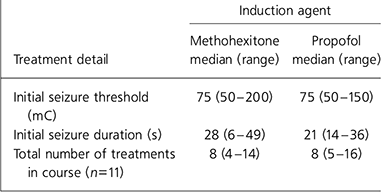
The sample consisted of 13 patients, 6 men with a median age of 38 (range 27-67) years, and 7 women with a median age of 51 (range 30-79) years. About half of the people in the sample (n=6) suffered from recurrent depressive disorder in which the treated episodes were severe. Five of the patients suffered from a manic—depressive psychosis and the treatments were prescribed for severe depressive episodes; one patient who suffered from a manic—depressive psychosis was treated each time for mania. One patient suffered from a depressive episode in a schizoaffective disorder. The median length of time between treatment courses was 25 (range 10-71) months. Table 1 shows that the median initial seizure thresholds were identical, 75 mC (Wilcoxon matched-pairs signed ranks test, n=9, t=19, critical value 6, not significant). The median initial seizure duration with threshold stimulation was 25% shorter when propofol was used (n=12, t=8, critical value 10, two-tailed P=0.02).
A within-subject comparison of methohexitone and propofol induction of electroconvulsive therapy (n=13)
| Induction agent | ||
|---|---|---|
| Treatment detail | Methohexitone median (range) | Propofol median (range) |
| Initial seizure threshold (mC) | 75 (50-200) | 75 (50-150) |
| Initial seizure duration (s) | 28 (6-49) | 21 (14-36) |
| Total number of treatments in course (n=11) | 8 (4-14) | 8 (5-16) |
Two patients decided to stop one of the courses of ECT prematurely; one man with hypomania withdrew consent and one woman with depression went on holiday. The total number of treatments was therefore based on the 11 patients who completed the prescribed courses of treatment. The median total numbers of treatments in the course were also identical (n=8, t=14, critical value 4, not significant).
Discussion
This was not the first study to confirm the impressions of practitioners that seizure duration is shorter when propofol is used as the induction agent (see Reference Martin, Cooper and ParikhMartin et al, 1998). The novel finding from this study was that this can occur without any commensurate increase in the initial seizure threshold in bilateral ECT. The median initial seizure threshold with propofol induction was identical to the median value found in an earlier study of 100 depressed patients treated with the same ECT machine in whom methohexitone was the induction agent (Reference Dykes and ScottDykes & Scott, 1998). The findings add to the evidence that seizure duration and seizure threshold are only modestly correlated in ECT (Reference Scott and BoddyScott & Boddy, 2000). That the shorter seizures were not associated with a higher seizure threshold makes it less likely that propofol compromises the therapeutic efficacy of ECT. The lack of a difference in the total number of prescribed treatments lends support to this.
Methohexitone is still not available in our clinic and a retrospective comparison is all that is feasible. The strengths of this study are that it was conducted on a representative sample from one clinic over a defined period, and had a within-subject design. Its major limitation is that it lacked the statistical power to conclude confidently that the two induction agents were equivalent in their effect on the seizure threshold. The study would have been strengthened if cerebral seizure activity had been measured directly by electroencephalography, but this was not available routinely in the clinic. There are other reasons to be cautious in the interpretation of the findings. It was beyond the scope of the study to assess the effects of concurrent psychotropic drug treatment, or the effect of increasing age over the period of the study (age is positively correlated with the initial seizure threshold). Measures of clinical outcome normally seen in treatment studies were not available.
The clinical implication is that the study has added to the evidence that the shorter seizures observed after induction with propofol need not compromise the therapeutic efficacy of ECT.
Declaration of interest
None.
Acknowledgements
We thank Staff Nurse Rena Good of the ECT clinic at the Royal Edinburgh Hospital for her help with the study. We also thank Alex Celini, Research Assistant for the Royal College of Psychiatrists' Special Committee on ECT, for preparing the manuscript.


 Open access


eLetters
No eLetters have been published for this article.