

Although Sergei Prokofiev considered himself primarily as an opera composer, and his exercises in the genre spanned the course of his life, criticism and scholarship have not always accorded many of these works the attention they deserve.Footnote 1 While War and Peace has been studied in considerable detail, and probably has the claim to be his most widely performed stage work, the others have been less discussed and are more rarely seen on stage. This is particularly the case with The Fiery Angel, which has been described variously as ‘a pretentious yawn popular with those easily titillated by a modernism consisting of screaming meemies onstage and blaring ostinatos in the pit’,Footnote 2 or as a sincere adaptation of a symbolist parodic novel.Footnote 3 Contemporary scholarship is only now acknowledging the links between The Fiery Angel and his later work.Footnote 4 This reception is perhaps due to Angel's complicated compositional history – Prokofiev would compose two full versions of the opera and leave sketches for a third – and to its musical and dramatic complexity. Indeed, the opera sits stylistically at an uneasy juncture between late nineteenth-century Wagnerism and modernistic musical effects, just as the symbolist novel on which it is based not only posed as an authentic historical text but also functioned as a thinly veiled autobiography.
These complexities in compositional history and musical style notwithstanding, two recent scholarly developments help us to shed new interpretive light on one of Prokofiev's most startling yet enigmatic stage works. First, newly unearthed biographical material concerning the decade in which Prokofiev wrote and revised Angel allows us to re-evaluate the opera in relation to the great personal changes the composer went through during this period. Second, new considerations of how we look at narrative and narration in operatic discourse invite us to find fresh perspectives on this musically complex work. This article will combine the two approaches to argue that the religious conversion that Prokofiev underwent during the years he composed and revised The Fiery Angel can be traced in the second version of the opera. I suggest that the way in which Prokofiev uses the orchestra – its instrumentation and its situating of voices – privileges the point of view of the character (Ruprecht) whose spiritual journey ironically mirrors that of Prokofiev himself during the mid- to late 1920s.
In this way, I consider biographical material alongside theories of operatic narration for a radical – rather than reductive or deterministic – interpretation. If the literary Fiery Angel was itself an example of an author fictionalising his own experiences, with the protagonist standing in for the author, then the second version of Prokofiev's operatic adaptation invites a similar reading. The revisions to the opera focus on the tenor role of Ruprecht, and his point of view as captured by the orchestra mirrors Prokofiev's own attitudes towards the supernatural following his conversion to Christian Science. Though Ruprecht's point of view largely directs the opera's narrative perspective, he is not the narrator of the work; rather, via the orchestration and manipulation of leitmotifs, Prokofiev himself becomes that narrator.
Symbolism and science
Before developing these claims about Prokofiev's role in the operatic Fiery Angel, I will first briefly set out the autobiographical roots of the opera's literary source and the ironic parallels between the worldview from which the novel emerged and the spiritual beliefs Prokofiev developed as he worked on his adaptation. The opera was adapted from the eponymous 1908 novel by Valery Bryusov, which was in turn based on a real-life love triangle between the author, the poet Andrey Bely and the writer and literary salon hostess Nina Petrovskaya; these autobiographical allusions are, however, obscured by manifestations of demons and the supernatural. The novel relates the tale of a young knight named Ruprecht, who meets and falls in love with a maiden named Renata, who is tormented by visions of demons. Renata believes her former lover, Count Heinrich, is the earthly incarnation of a ‘fiery angel’ called Madiel, who appeared to her regularly in her youth. After a long journey during which the pair consult sorcerers, cast spells and are visited by Mephistopheles, Renata commits herself to a convent. Her visions continue, and she is found guilty of witchcraft by the Inquisition and condemned to death at the stake. To further distract from the novel's real-life source, Bryusov marketed it as a translation of a supposedly authentic sixteenth-century German manuscript.Footnote 5
Russian symbolists such as Bryusov conceptualised a world beyond the material plane as either inoy svet (literally, ‘other world’) or realiora (‘“more real” world’), and saw art and the imagination as ways to forge connections between events in the material world and events in the world beyond.Footnote 6 They rejected the Aristotelian view of art as mimesis because in their practice fictional events and real events existed on a single plane. Zhiznetvorchestvo – the fusing of art and life – would allow Russian symbolists to practise art in everyday life quite literally and to escape the trappings of the material world.Footnote 7 In addition to artistic practice, the doctrine involved elaborate games of make-believe, experimentation with narcotics and involvement with the occult. It was from this milieu that Bryusov extracted the material for the novel – and his imitation of sixteenth-century German prose was so convincing that many reviewers believed his claim that it was an authentic text.Footnote 8 Nina Petrovskaya, the real-life inspiration for Renata, believed Bryusov to have dark powers, as he dabbled in the occult.Footnote 9 Her fascination with the idea of transcending material reality became an obsession and she shared Bryusov's belief that ‘art is no mere instrument, but a cosmic reality’.Footnote 10 Poet and critic Vladislav Khodasevich lamented that through the practice of life-creation ‘the history of the Symbolists turned into a history of broken lives’.Footnote 11
Prokofiev accepted that Bryusov's novel was based on an authentic medieval text until as late as 1926, when Boris Demchinsky, who had greatly shaped the first draft of the opera's libretto, informed Prokofiev of the work's autobiographical context.Footnote 12 Though Prokofiev had originally been drawn to what he described as the ‘orgies’ of the source material,Footnote 13 during the course of the 1920s he underwent a spiritual awakening that led to his conversion to Christian Science.Footnote 14 By the time he finished the opera, the Prokofiev of the late 1920s had become disenchanted with the novel's descriptions of Black Masses, necromancers and the titular fiery angel. His diary shows his jubilation and relief when he finally finished its composition.Footnote 15
For Prokofiev the radical idealism of Christian Science was fundamentally opposed to the supernatural elements of The Fiery Angel, yet Christian Science and Russian symbolism share a central belief in the existence of ‘other worlds’ beyond the strictly material. Though Christian Science rejects the supernatural, its belief in transcending the material realm through mental discipline can be seen as analogous to Russian symbolist practices: both seek the materiality of the here-and-now and access to other worlds. By adapting a work of Russian symbolism while converting to Christian Science, then, Prokofiev inadvertently and ironically combined art and life: the system of beliefs from which his creative work arose mirrored that which he sought to practice.
Christian Scientist doctrine preaches that the real world is purely spiritual and the material world an illusion manifested by sin. Through mental discipline and ‘mind-healing’, practitioners believe they can access the ‘true’ world.Footnote 16 Evil and disease are the creation of humanity's sinfulness, and do not actually exist – nor does the supernatural. The (immortal) human soul is both an individual entity and part of a unified divine spirit; therefore, as Leon Botstein has argued, ‘the creations of the individual could bolster the sense of the reality of the divine spirit within the human community’.Footnote 17 Through such creative endeavours, Christian Scientists paid particular attention to music, believing that it mirrored the divine.Footnote 18 Prokofiev's own work could thus be considered as participating in the larger Christian Scientist project of reflecting the universal divine in the everyday, inspiring others to throw off the shackles of the material world and join Christian Scientists on the true, higher plane of purely spiritual existence. In seeking to use art, the imagination and the mind to transcend the material world, Christian Science follows the same path as Russian symbolism, despite their seeming disparities.
Faith and narration
Prokofiev converted to Christian Science sometime around 1924, between finishing the first version of The Fiery Angel the previous year and beginning revisions for a second version that he would finish in 1927. This radical religious conversion can, I argue, be traced through Prokofiev's revisions to the opera, which turn the opera effectively into an artistic manifesto of his new worldview. Central to my analysis is the idea that an opera can and often does express a particular narrative viewpoint in a similar way to a purely literary work.Footnote 19 The most obvious method is the explicit, fully characterised narration of a fictional person onstage, such as Captain Vere in Benjamin Britten's Billy Budd. Yet such examples are few and far between, and as Carolyn Abbate's landmark study Unsung Voices suggested, operas are not ‘narratives’ as such because they typically lack this kind of fictional narrator.Footnote 20 Scholars including Michael Halliwell and Edward Cone accept the concept of the orchestral narrator in the music of Wagner, however, in which they detect some kind of fictional entity separate from the implied author of the opera and its real creators.Footnote 21 Many Wagner scholars, following Cone, see the role of the orchestral narrator as something akin to the chorus in Greek tragedy – not responsible for the fictional act of presenting the opera, but rather commenting on the action and providing information the characters do not have through complex leitmotivic systems.Footnote 22 More recently, however, Nina Penner has provided a new method for applying philosophical theories of narration to opera and musical theatre studies, which I adapt to shed light on the second version of Angel.Footnote 23
Of particular interest for Penner are case studies where the music orientates the audience to a character's point of view, a phenomenon in literature that Gregory Currie terms ‘character-focused narration’ and which Penner is the first to apply to opera studies.Footnote 24 In opposition to Gérard Genette, the narrative theorist most commonly cited by musicologists, ‘point of view’ in Currie's schema is not limited to purely visual perception.Footnote 25 Rather, Currie proposes that it ‘arises from an agent's limitations of access to and capacity to act on the world’.Footnote 26 In other words, point of view encompasses a character's thoughts, actions, perceptions, habits, biases, knowledge, beliefs, values and desires – what Currie refers to as ‘the totality of an agent's psychological states’.Footnote 27 Character-focused narration is therefore narration according to a particular character's unique point of view. The narrator remains a separate entity: Currie insists character-focused narration does not involve the narrator taking on the focal character's point of view.Footnote 28 The narrator is free to choose which aspects of a character's point of view to represent and can of course provide ironic commentary that reveals its limitations.
In her application of these narrative theories to opera and musical theatre, Penner stakes a new claim for the role of the orchestra. Where Abbate concludes in her discussion of the horn call scene in Act II of Tristan und Isolde that the orchestral music expresses Isolde's point of view because we in the audience ‘hear – with Isolde’,Footnote 29 Penner broadens this interpretation of audience alignment with an onstage character's aural perceptions. She argues that ‘a more reliable way of isolating a particular character in an opera and aligning spectators with his or her point of view is by using the music to provide access to the character's thoughts and emotions’.Footnote 30 Furthermore, while Abbate concludes her discussion of Isolde and the horn calls by arguing that Isolde is the author of this music, Penner points to how this claim conflates the two distinct questions of who is the character whose point of view orientates the narrative perspective, and who is the narrator.Footnote 31 Instances of orchestral commentary foreshadowing and moments when the music contradicts a character's words are to Penner ‘more coherently understood as issuing from the work's real-life author’ – that is, the composer.Footnote 32 Understanding such instances where the orchestra seems to possess information that the characters onstage do not and reach out to involve the audience in this knowledge therefore requires looking beyond the onstage characters towards some external narrative agent. Instead of interpreting this as a fictional entity, Penner argues convincingly that in most cases of orchestral narration – particularly where such narration involves leitmotifs – we can interpret the composer as its source.
The second version of Prokofiev's The Fiery Angel provides a particularly compelling illustration of Penner's theories of character-focused narration and composer-as-narrator. With the exception of brief interludes at the beginning of Act III, the middle of Act IV and the beginning of Act V, Ruprecht is physically present onstage for the entire work. Part of the reason behind Ruprecht's pervasive onstage presence lies in the fact that Bryusov's Ruprecht is a first-person narrator, but this is not the only explanation. In comparison with the first operatic version, Ruprecht of the second version is significantly more prominent in the surrounding orchestral music, primarily through Prokofiev's use and manipulation of leitmotifs that correlate to Ruprecht's character and state of mind – and which are meant to be audible as such to the listener. Something changed between the first and second versions that compelled Prokofiev to emphasise Ruprecht's state of mind throughout the work, orientating the listening audience to his perception of events around him. I argue that this re-orientation of narrative viewpoint within the opera can be traced to Prokofiev's spiritual conversion and that his use of the leitmotif system in particular enables him to comment on the operatic narrative.
Of course, operatic narration does not have to happen consistently, or manifest as a single type; it can be present and absent, and sometimes both at the same time. Indeed, I am not claiming that the second operatic version of The Fiery Angel is narrated entirely from Ruprecht's point of view, but rather that it privileges Ruprecht's impressions and perceptions – as I will show. Instead of dispensing entirely with theories of leitmotivic narration and orchestra-as-narrator, character-focused narration provides a new perspective on how these techniques function within a larger operatic work. While I will argue that the second version of The Fiery Angel privileges Ruprecht's point of view, I will do so by focusing on moments where the orchestra acts as a kind of fictional narrator (à la Cone), by referring to a structured system of leitmotifs (à la Abbate) and by analysing how Prokofiev manipulates these techniques to allow the audience glimpses into Ruprecht's state of mind.
What follows is one reading of the difference between Prokofiev's first and second versions of The Fiery Angel: that his personal journey towards faith in Christian Science influenced the revision process and is reflected in the second version of the work. By comparing key scenes and changes to characters in the two versions, I will show how Prokofiev's adjustments in plot, characterisation, and vocal and orchestral music in the second version both favour Ruprecht's particular point of view and invite us to recognise Prokofiev himself as the narrator of the opera. In other words, I propose that Ruprecht's point of view and process of characterisation can be compared to Christian Scientist belief, and I interrogate aspects of Christian Science that align with key themes in The Fiery Angel to argue that Prokofiev-as-narrator presents the second version of the opera as a tale of spiritual transformation. My goal with this analysis is not to reinvent The Fiery Angel as an allegory for Prokofiev's own conversion, but rather to explore correlations between the seemingly contradictory belief systems held by Prokofiev and by his characters. In doing so, I offer a case study for a new way of exploring narrativity and point of view in operatic music.
Revising and refocusing
In terms of plot and dramaturgy, the first and second versions of The Fiery Angel differ in several crucial ways that influence the audience's understanding of narrative viewpoints.Footnote 33 One of the greatest changes involves the onstage presence of Count Heinrich/Madiel. In the first version, Heinrich appears as an onstage singing presence at the beginning of Act III, rejecting Renata's pleas to be reunited. In the revision, Prokofiev removed this scene and began Act III with Renata lamenting outside Heinrich's door. Heinrich does appear on stage in the revision, but only as a mute character in a red spotlight ‘resembling the Fiery Angel’, according to Prokofiev's stage directions.Footnote 34 Prokofiev also rewrote the entirety of Act II. In the first version, Act II takes place at the residence of the necromancer Agrippa of Nettesheim, where Ruprecht encounters a frightened merchant and a mocking chorus of Agrippa's four students before finally meeting the sorcerer himself. Prokofiev excised almost the entirety of this material for the revision, which begins with Renata casting a spell to find Heinrich. A supernatural scene in which Renata's ‘little demons’ make knocking sounds on the walls of her room – and terrify Ruprecht into believing her – happens here, rather than as the finale for Act I in the first version. Ruprecht goes to Agrippa's house on the advice of bookseller Jakob Glock, a new character, and the role of Agrippa was rewritten for high tenor (the original was for baritone).
Prokofiev made the most significant changes to the finale of the opera. The second version of Act V is significantly longer than the first: the role of the Inquisitor and the chorus of possessed nuns are both expanded. Three ostinato passages in a loose rondo form occupy the majority of Renata's exorcism and trial and culminate in a six-part chorus for the nuns, which recapitulates earlier music including Renata's leitmotif. The opera ends dramatically on a fortissimo major third (D♭–F) following Renata's condemnation. The first version, while still employing some of the orchestral dramatics found in the second version, seems comparatively restrained, and concludes with a deathbed duet between the condemned Renata and Ruprecht. The revision denies the audience this conventional ending, stopping at the climactic moment of the plot without offering any resolution.
Besides these larger changes, Prokofiev made many small expansions to material from the first version and added some new characters here and there. This confirms Prokofiev's satisfaction with much of the music he originally composed: while he may have distanced himself from the subject matter post-conversion, he clearly admired his musical work and strove to preserve as much of it as possible. The result is two versions of an opera that share many musical similarities, but whose libretti and dramatic arcs emerged from two distinct readings of the original novel. It was also during this period of revision that Prokofiev discovered the novel's autobiographical nature and that it was not an authentic sixteenth-century text; these discoveries would surely have additionally shaped his reading and re-reading of the novel.
The abandoned sketches for Prokofiev's proposed third version in 1930 outline what would have been a dramatically different Angel again. Prokofiev planned to break down the long acts into shorter vignettes, particularly Act II, whose two scenes would become seven scenes with orchestral interludes. While the plot would remain focused on the love triangle between Ruprecht, Renata and Heinrich/Madiel, the roles of Jakob Glock, Agrippa of Nettesheim and the nameless Fortune-teller of Act I would be greatly expanded. Musical sketches show an increased attention to symbolic leitmotifs and ideas for using electronic feedback and amplification as dramatic effects: had it been completed, this version may have gone even further than the second version in terms of narrativity.Footnote 35 Prokofiev abandoned this revision after its rejection by the Metropolitan Opera, but some of the new musical ideas reappeared later, most notably in his Third Symphony and the ballet Romeo and Juliet.Footnote 36 However, Prokofiev's musical recycling should not be understood as part of the music-as-narrative argument: Simon Morrison points out ‘the subjects of ballet and opera are not entirely dissimilar’,Footnote 37 and the manuscript score for the Third Symphony precisely notes its operatic borrowings, seemingly in an invitation to read the symphony as yet another re-reading of the source narrative.Footnote 38
Locating how Prokofiev's conversion to Christian Science might have affected The Fiery Angel is made significantly easier by the two complete versions of the score and the sketches for the third version: his conversion occurred between composition of the first two. However, I want to avoid assertions of authorial intent. While Prokofiev's diaries and letters provide a critical window onto the composer's state of mind during the creation of The Fiery Angel, there is no evidence to suggest that he deliberately brought Christian Science thinking into the revision process. The diaries reveal the composer's struggle towards the end of 1927 in reconciling his faith and the material, but Prokofiev never unequivocally states their interdependence.
Indeed, character-focused narration plays a critical role in keeping Prokofiev's biography distinct from the second version of The Fiery Angel. Ruprecht remains an autonomous character in both first and second versions, but he acquires much greater presence in the second. Therefore, by asserting that the second version is aligned to Ruprecht's point of view, my aim is to establish similarities between what Ruprecht experiences and comes to believe and what Christian Scientists teach and believe. Analysing moments where Ruprecht's psychology strongly influences audience perceptions of the events on stage will prove fruitful in arguing that notwithstanding Prokofiev's declared intentions, Christian Science thinking influenced The Fiery Angel as it is now known and performed.
Character-focused narration: a musical proposition
In revising the first version of Angel, Prokofiev elaborated a network of leitmotifs, which are sometimes revealed and sometimes obscured by surrounding orchestral music: alongside the opera's plot, this use of leitmotifs calls to mind romantic supernatural operas such as Meyerbeer's Robert le diable and Gounod's Faust. Whereas Rita McAllister considers the first version of the opera ‘the genre of the Gothic novel transposed to the operatic stage’, she argues that the second version blurs the line between reality and unreality and ‘constitute[s] a stylisation and “supernaturalisation” of the previous plot’.Footnote 39 Simon Morrison describes this supernaturalisation as a separation of the opera's musical structure from what is audible to the listener: the traditional leitmotivic structure of the score becomes increasingly obscured by layers of ostinato and other orchestral interference.Footnote 40 The leitmotifs in the second version take similar roles to those in Wagner's operas, serving at times to illustrate a character's personality, reveal conflict between characters and, critically, to provide information the characters do not yet possess. Through the use and manipulation of leitmotifs, Prokofiev's orchestra functions similarly to a Wagnerian orchestra, which often acts as a narrative entity.Footnote 41 As we will see, there are compelling reasons to ascribe this narrative voice to Prokofiev himself.
Ruprecht's leitmotif is present only in the orchestral music surrounding him, never sung by the character himself, and becomes one of the ways in which the audience is able to track his psychological state. First appearing at the very beginning of the opera, it is a bombastic cadential gesture suggesting A minor in the horns and woodwinds, sounding as traditional and masculine as Ruprecht himself (Ex. 1). The motif is gradually manipulated as Ruprecht becomes more unsettled by the events around him and more involved with the supernatural. In this, its role is unchanging: it describes Ruprecht's mental state at key points in the opera.
Ruprecht's motif (Act I).

Unlike Ruprecht's leitmotif, Renata's leitmotif is insistently present in both her vocal music and that of other characters. In fact, the motif seems to function less as a representation of Renata herself and more as a representation of her hysteria.Footnote 42 It is a six-note group of E and C minor trichords and is manipulated according to who is singing it (Ex. 2).
Renata's motif (Act I).

When Renata sings the motif, its rhythmic structure is often displaced, as at figure 14 where the first pitch of the six-note group falls off the beat, and the melody is sometimes embellished with non-diatonic pitches. When Ruprecht sings it – as at figure 12 when he asks, ‘Is anyone in need of my protection?’ – the motif is presented as a complete unit. In the orchestra, the motif remains the same throughout the opera, illustrating Renata's obsessive thoughts about the Fiery Angel and representing her recurring visions of spirits and demons.
A secondary motif in Renata's music is associated with Madiel, and appears both when she speaks of the Angel and when she speaks of Heinrich. It comprises a pattern outlining a minor third from f to a♭, which is then inverted and transposed up an octave in a complete melodic sentence that usually sounds when Renata sings Madiel's name (Ex. 3).
Madiel/Heinrich motif (Act I).
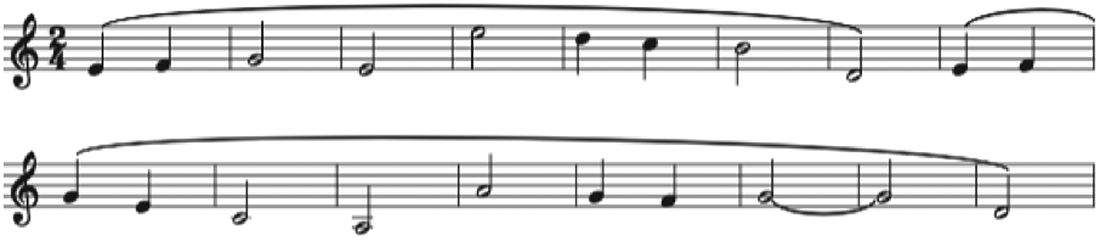
Another four-note motif appears in the love duet in Act II (Ex. 4), developed from the first half of Renata's leitmotif (e2–f♯2–g2) and a mirror inversion of part of Madiel's leitmotif (g1–f1–e1–g1, inverting to e1–f♯1–g1–e2). This motif accompanies Ruprecht's repeated pledges to help Renata, its extension and variation revealing the deep devotion he feels for her and her plight.
Love motif (Act II).

Lastly, Prokofiev uses two motifs to indicate the presence of the supernatural: first, a chromatic scale in quavers spanning a tenth, and second, a tritone figure resolving to a perfect fourth. The chromatic motif first appears in the Fortune-teller's vocal part at the end of Act I, and the tritone figure is first played at the beginning of the opera. These figures do not change throughout the opera, but provide the structural reinforcement necessary to indicate the supernatural. Indeed, the chromatic motif functions in typical Wagnerian fashion to inform the audience and unsettle the characters onstage.
The motif system is the structural backbone for Prokofiev's orchestral music, but the presence of a motif does not always illuminate Ruprecht's point of view. Rather, the motifs provide reference points in the surrounding wall of orchestral sound, anchoring the increasingly clamorous orchestration to a particular character or idea. In fact, the motifs provide an additional layer of reference beyond The Fiery Angel's score: Rita McAllister and Simon Morrison have convincingly shown that the Angel motifs were derived from Prokofiev's adolescent opera Maddalena (1911/13).Footnote 43 This intertextual reference to Prokofiev's earlier work is reminiscent of Wagner's quotations and allusions to Tristan und Isolde in Die Meistersinger, albeit on a lesser level – audiences would not have recognised Prokofiev's allusions as they might recognise Wagner's. As Penner illustrates, this kind of self-quotation invites us to collapse the distinction between narrator and author. As the orchestra's opinions on who deserves the title of Meistersinger align with Wagner's own aesthetic principles, so too do the orchestra's opinions on the nature of Renata's possession and the reality of the supernatural in The Fiery Angel match Prokofiev's own religious convictions.Footnote 44 As will be developed in later examples, these concurrences allow us to understand Prokofiev himself as the narrator of the opera.
Ruprecht's first encounter with Renata plays a crucial role in establishing his personality and his first impressions of Renata, which are then shared by the audience. From the very beginning of the opera, whose opening notes are Ruprecht's leitmotif, the audience is firmly connected with Ruprecht: the audience effectively enters into the action alongside him as he comes onstage. According to Prokofiev's original stage directions, Ruprecht literally opens the door to Renata, who is first heard as a frightened voice in a locked room. The audience never gets a chance to form an independent impression of Renata's character: the stage directions describe her as ‘beside herself in terror … half undressed, her dishevelled hair hangs loose’.Footnote 45 The details in these notes indicate Renata should be portrayed as hysterical and possessed, and it is only as Ruprecht's opinion of her begins to change that the audience can see beyond this stereotype.
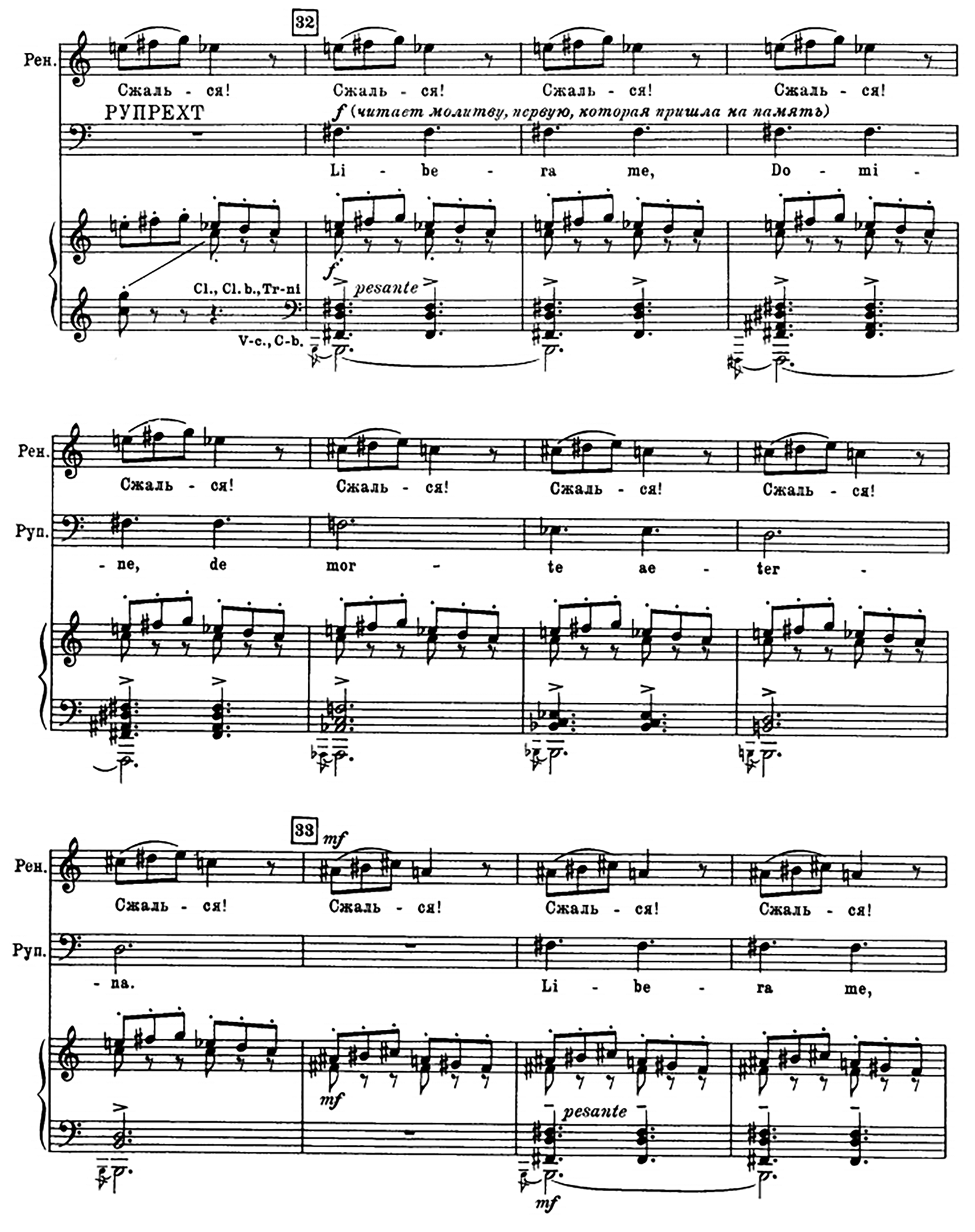
Prokofiev did not change much in this scene for the second version of the opera, but he expanded immensely Renata's first monologue during her hallucination and the orchestral textures. In the second version, Renata's panicked chanting at rehearsal figures 6 to 12 affects Ruprecht, whose vocal line echoes her leitmotif back to her. As Renata becomes more upset at figures 18 to 20, she repeats a four-note cell of her leitmotif (e2–f♯2–g2–e♭2) thirty-seven times while the violins repeat the full leitmotif forty-nine times. This correlates with Ruprecht's first impression of her as insane, and he begins to pray using a fragment from the rites of exorcism (‘Libera me Domine de morte aeterna’) (Ex. 5). As Ruprecht prays, Prokofiev transposes the trichords of Renata's leitmotif gradually down to Ruprecht's tonality: Ruprecht's music literally overcomes Renata's hallucination, illustrating that faith is strong enough to defeat her visions. However, having succeeded in calming Renata, Ruprecht is still sceptical as to whether she was really experiencing a demonic possession: according to Prokofiev's instructions, Renata's demons never appear onstage, so Ruprecht and the audience have only her word that they were ever there. The soaring romanticism of Renata's monologue about her life and experiences with Madiel confuse further – ‘could the Devil truly possess’ such a ‘tender and gentle face’?Footnote 46 While Ruprecht is undoubtedly drawn to Renata, he is still unsure whether to believe her. The contrast between her two monologues is so great and so shocking to Ruprecht that Renata appears delusional rather than truly possessed.
Ruprecht's prayer and Renata's vision in Act I.
Indeed, Ruprecht's first impressions of Renata were that she was simply delusional, and both he and the audience become further convinced that she is the classic example of a beautiful yet deluded maiden. However, the Innkeeper describes Renata as a heretic whose dark dealings are the direct cause of her current suffering, warning Ruprecht against further association with her, and a Labourer echoes the ends of Renata's phrases as if in a trance and (superficially at least) suggesting a supernatural influence. But the orchestration follows the Innkeeper's lines, implying that even though the Innkeeper might believe she is possessed, the Labourer is merely mocking her. In any case, Ruprecht is entirely unaffected by their comments. His unaltered motif reappears in the orchestra, and at this point he is clearly far more interested in Renata's physical charms than in her mental or spiritual state.
Ruprecht's no-nonsense attitude towards the supernatural is highlighted by his reaction to the Fortune-teller at the end of Act I. In the first version, this scene is almost comical: the Fortune-teller seems to be a con artist while the Innkeeper watches her with scepticism.Footnote 47 In the second version, Prokofiev preserves this ironic tone, but manipulates the music to suggest there may be something more sinister going on. Renata interrogates the Fortune-teller about methods of divination, revealing herself to be very familiar with occult practices. The Labourer, watching from the background, remarks, ‘Thus the snake-charmer whistles for the snakes’, while the first violin runs up a triplet quaver scale.Footnote 48 At this point, the humour takes a sudden dark turn: in telling Renata's fortune, the Fortune-teller describes a vision of blood and death, her vocal line marked by tritone leaps and chromaticism. Ruprecht reacts in immediate horror, threatening to stab the Fortune-teller ‘like a fish’.Footnote 49 This contrasts sharply with his earlier, calmer response to Renata's vision; Ruprecht, and by extension the audience, is clearly unsettled by the Fortune-teller's sudden change from benevolent con artist to visionary – and the orchestration encourages the audience to have the same reaction.
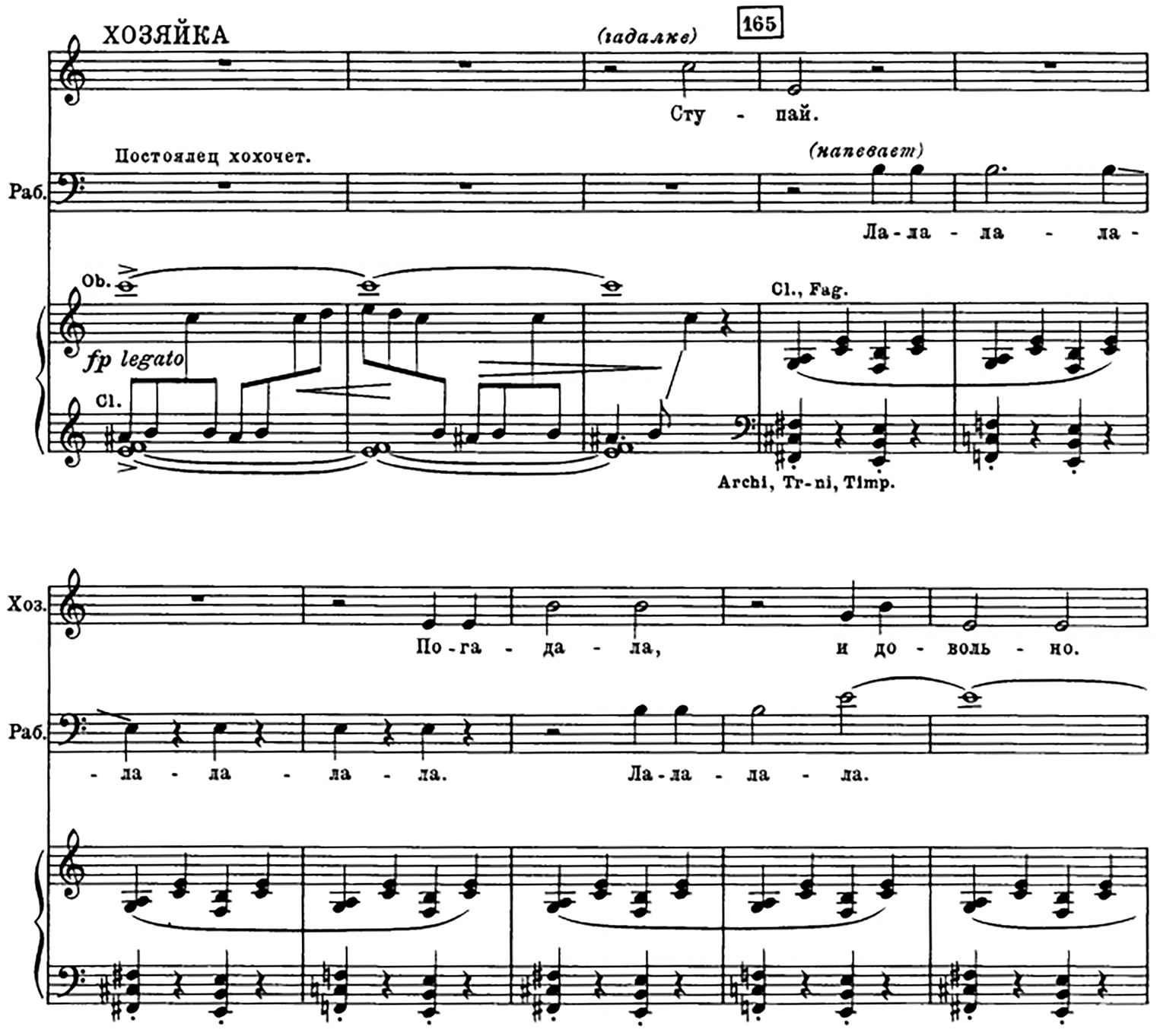
The Labourer's remarks throughout this scene play a significant role not only in disrupting Ruprecht's equilibrium but also in foreshadowing events to come. He mocks the Fortune-teller throughout her monologue, and openly insinuates that the she has manipulated them.Footnote 50 At figure 165, the Labourer begins to sing a nonsensical ‘la-la-la’ ostinato on pitches b and e, accompanied by a similar pattern on F and F♯ in the orchestra (Ex. 6). This ostinato imitation of the snake-charmer's whistle both recalls Renata's hallucination and will recur throughout the opera at moments of supernatural menace, most particularly in the Act V finale. But while Ruprecht certainly hears the Labourer's comments throughout the scene, it is less clear whether he also notices this ostinato pattern or whether it is audible only to the audience.
The Labourer's ostinato, end of Act I.
The question ‘who hears?’ is often asked in discussion of narrative in opera. Abbate and Currie each advance the (generally accepted) idea that the characters on operatic stages are not aware that they are singing, and therefore cannot hear the music around them.Footnote 51 While there are many instances where audience and onstage characters apparently do ‘hear’ the same musical cues, such as the offstage chorus in the final scene of Meyerbeer's Les Huguenots, there are no such clear-cut examples in The Fiery Angel.Footnote 52 But instead of asking ‘who hears?’, a more productive question might be whether such moments when the perceptions of audience and onstage characters align also orient the audience to a particular character's point of view. In the preceding example from The Fiery Angel, it is sufficient to note that Ruprecht hears the Labourer's ‘la-la-la’ imitation of a snake charmer's whistle: that the music of this utterance will recur throughout the opera is best understood as part of the developed system of leitmotifs.
Placement of a scene within a larger plot structure can be critical in affecting how characters perceive the events onstage. The same material takes on new significance if it is repositioned in a sequence of events. By moving a scene from one point in the opera to another without making significant changes to the material, Prokofiev gave audiences a stronger insight into Ruprecht's state of mind, allowing them to understand just how far he is willing to go in order to help Renata.
In Bryusov's novel, one of Ruprecht's first encounters with the supernatural is his first night with Renata, when strange knocking sounds resonate from behind the wall of their room. Bryusov-as-Ruprecht describes:
As we were immersed in darkness and silence, almost as if into some black depth, suddenly from behind the wall came a single, strange cracking knock. I looked around in surprise, for, except we two, there was no one in the room, and I at first said nothing. But after some time, when that same knock was repeated, I quietly asked Renata: ‘Do you hear that knock? What could it be?’ Renata replied in an indifferent voice, ‘It is nothing. It happens all the time. It is the little ones.’ I asked her again, ‘What little ones?’ She calmly answered, ‘Little demons.’Footnote 53
In the first version of the opera, Prokofiev places this scene in roughly the same location as in Bryusov's novel: the Act I finale. Renata has already recounted to Ruprecht her love for the fiery angel Madiel and Ruprecht has witnessed her in the grip of demonic possession, yet Ruprecht is interested in her from a purely romantic point of view. Indeed, the scene takes place directly after Ruprecht unsuccessfully attempts to seduce Renata. Positioned thus, the supernatural effect of the scene is somewhat diminished. It is only as Ruprecht attempts to converse with the knocking sounds that they begin to seem more plausible: the knocks ‘answer’ Ruprecht's questions rather than randomly sound.Footnote 54 Prokofiev gives each participant in this dialogue contrasting orchestration – piano tremolo chords underlie Ruprecht's tentative questionings, while the knocks are surrounded with loud chromatic flourishes. By the time the knockings fade and Ruprecht still finds no human source for them, he has come to believe that Renata is indeed possessed and vows: ‘I will uncover the secrets of magic, and I will force the demons to leave you!’Footnote 55 The scene plays a crucial role in opening Ruprecht's mind to the possible existence of supernatural creatures, yet only insofar as they are something to be conquered in order to win Renata's love.
The same scene, with minimal musical elaborations, takes place near the conclusion of Act II in the second version of the opera, and provides a different perspective on Ruprecht's psyche. Earlier in the act, Ruprecht watches Renata cast a spell, and complains how her obsession with finding Heinrich has made them ‘two outcasts’ in Cologne. So far, so similar: Ruprecht humours Renata while remaining somewhat distant from her attempts to contact supernatural beings. However, a new vignette illustrates Ruprecht's own attempt to master the supernatural. A dialogue with bookseller Jakob Glock shows that Ruprecht, far from disbelieving the powers of magic, is actively seeking to learn magic from cabalistic texts. In this context, the ‘knocking scene’ seems less out of place: it could be seen as a result either of Renata's spell or of Ruprecht's more academic attempts to harness magical forces. This material, new to the second version, illustrates how Ruprecht himself has become caught up in Renata's delusions, ‘stumbling from confusion to confusion’.Footnote 56 Where in the first version the ‘knocking scene’ served to catalyse Ruprecht's desire to rid Renata of her demons, in the second version the very same music serves to reinforce Ruprecht's belief that he is on the right path, seeking out a magical means of releasing Renata from her delusions. Having tangible contact with the supernatural galvanises Ruprecht into fresh determination to master occult forces and banish Renata's demons.
The audience's understanding of the truth of the knocking scene shifts from the first to the second version, in line with Ruprecht's own changing impressions. In the first version, the suddenness of the scene does not entirely convince that demons are truly knocking on the walls: placed so soon after Renata's hysterics, it manifests another aspect of her delusions. In the second version, however, surrounded by spell-casting and books of magic, the knocking becomes more organic, part of a natural sequence of events. Having followed Ruprecht from passive observation of magic to active attempts to understand it, the audience is encouraged to believe that the knocking is real. In the second version, Renata's ‘little demons’ propel Ruprecht even further: the scene ends with Ruprecht, on the advice of Glock, seeking to consult with a mysterious necromancer called Agrippa of Nettesheim, whose links to the supernatural are presented rather ambiguously in the second version.Footnote 57
This ambiguity around Agrippa's true nature in the second version reflects Ruprecht's uncertainty regarding the reality of magic. Earlier in the act, the audience watches Ruprecht watch Renata cast spells, doubting along with him that her sorcery will succeed. Ruprecht's attempts to understand magic more academically are encouraged by Glock, whose music is marked by the same chromatic motif already associated with supernatural knowledge. The knocking sounds and Glock's advice inspire Ruprecht to seek out Agrippa, yet he still views magic as something to be learned from a book or a teacher: he wants above all to know if magic is real. From the beginning of his duet with Agrippa, the orchestration is far too agitated for the banal pleasantries the pair exchange, and it only becomes more frantic as the conversation continues. In the percussion, the bass drum sounds triplet rhythms reminiscent of the demonic knocking, though this can hardly be heard above attacca rhythms in the strings and uncomfortably high melodies in the woodwinds. The orchestra sounds almost out of control, with the chromatic ‘supernatural’ motif passing between instrumental parts, traversing the entire orchestra. The contrast between the almost academic discussion about the nature of magic and the orchestral music means that the orchestra takes on a narrative role external to the drama. The dense chromaticism here and in the ‘knocking scene’ represents what Prokofiev himself described as ‘the empty and terrifying dead end to which magic leads’.Footnote 58 This statement is the strongest evidence yet for Prokofiev's presence as the narrator: the impenetrable wall of sound developed in the orchestra here and in the opera's finale represent the futility of seeking out supernatural sources. Magic is a false road to transcendence – only by a triumph of willpower can one access spiritual truth. Prokofiev develops this theme throughout the next act of the opera: Ruprecht is first forced to acknowledge the supernatural in order to strengthen his will; only then is he able to reject it.
Following the vivid musical depiction of magic as a ‘terrifying dead end’, Act III turns to Renata's identification of Count Heinrich as the angel Madiel. The two versions of the opera deal with the question – and, critically, Ruprecht's understanding of it – in very different ways. The first version adheres much more closely to the source novel: Count Heinrich is emphatically not the angel Madiel but a human being, uninterested in Renata's plight. He appears onstage and sings a brief duet with Renata at the beginning of Act III; he does not recognise her at first, then firmly rejects her when he does. It is clear that Heinrich believes Renata to be possessed – he emphatically repeats ‘Get away from me! You are from the devil!’Footnote 59 He also denies her belief that he is the angel Madiel, though indirectly: ‘I do not even have the right to forgive you’, he claims.Footnote 60 The entire passage is drafted with the same insistent chromaticism that featured in Act II, particularly surrounding Renata's vocal line. Tellingly, Prokofiev does not employ the leitmotif associated with Madiel anywhere in Heinrich's music: although Renata links the two characters, the music is clear that Heinrich is not Madiel.
Prokofiev excised this brief dialogue in the second version of the opera, focusing less on the exchange between Renata and Heinrich and more on Ruprecht's reaction to it. By removing Heinrich from the stage and leaving Renata to report to Ruprecht what he has said, Prokofiev further calls into question the reliability of Renata's statements. Because the audience did not witness the conversation, it cannot entirely trust that Renata is truthfully reporting Heinrich's words. Indeed, Renata here seems far more unstable even than in her visions at the beginning of the opera. Her vocal line is made up almost entirely of minor thirds and semitones, repeating in patterns that are insistently doubled in the orchestra.Footnote 61 Ruprecht's gentle words seem to calm both Renata and the orchestra as his praying does in Act I scene 1, but as Renata begins to insist that Ruprecht kill Heinrich, the music becomes more agitated again. Renata calls for Madiel, and Heinrich makes his only onstage appearance, ‘resembling a fiery angel’.Footnote 62
Musically, it is still unclear whether Heinrich is Madiel because Ruprecht has not quite decided whom to believe. The Madiel leitmotif is not present, but Heinrich's otherworldly appearance is underlined with the same chromatic motif heard at Agrippa's house, allowing the orchestra to warn that all is not as it seems. However, Ruprecht is unimpressed by Renata's sudden outburst of hysteria: the orchestral music stops fully as he tries to remind her how Heinrich rejected her. But as Renata and the music continue to cycle through the same hysteria, Ruprecht is suddenly affected: ‘It is as if my soul is filled with the black smoke of an explosion’, he tells her.Footnote 63 Unlike in the first scene, Ruprecht's music cannot calm Renata's, and he himself is gradually influenced by her beliefs.
The entr'acte following this scene musically illustrates a duel between Ruprecht and Heinrich and establishes that Ruprecht has been influenced by Renata in his perceptions of Heinrich. A long chromatic passage provisionally establishes a B minor tonic, supported by the lower brass, strings and woodwinds, which intone a motif on the dominant associated with Ruprecht. This phrase repeats a semitone higher and overlaps with a motif associated with Madiel in the upper voices, suddenly establishing a D major tonic (Ex. 7). Up to this point in the opera, this motif has appeared only in Renata's vocal music, and only when she speaks of Madiel and Heinrich. The motif's strong association with Renata and her belief that Heinrich is Madiel makes its presence in the duel disconcerting – it has never appeared in Ruprecht's music. Its placement here, not in association with Renata but ‘with the actions of the physical man Heinrich whom the physical man Ruprecht is fighting’, seems to indicate that Ruprecht now accepts Renata's claim as true.Footnote 64 The sudden appearance of the Madiel motif in the music strongly connected with Ruprecht serves both to illustrate the duel musically and to show Ruprecht's sudden weakening. As the Madiel motif sounds again, the woodwinds try to re-intone Ruprecht's motif, but it becomes fainter with each passing bar. By the end of the scene, the bassoons alone play a distorted version of the first part of Ruprecht's motif, with the intervals chromatically altered; in the upper voices, the chromatic ‘supernatural’ motif sounds triumphantly. The physically wounded Ruprecht has also collapsed mentally; the music tells the audience that Ruprecht no longer believes he is battling a mortal man.
The duel, first intonation of the Madiel motif.

The duel with Heinrich marks a turning point for Ruprecht: having at last accepted Renata's identification of Heinrich as Madiel, Ruprecht begins to despair that he will ever free Renata from the forces controlling her. If Acts II and III illustrate Ruprecht's journey towards belief in supernatural forces, Act IV illustrates his journey towards disillusionment with the task he has set himself and with his love for Renata. Act IV remains more or less the same in the first and second versions, with a few expansions in the opening duet with Renata. This similarity is telling. Despite being less action-driven than the other acts, Act IV sets up Ruprecht's psychology for the final reckoning in Act V.
Renata's attitude towards Ruprecht in Act IV undergoes a marked change, and her sudden rejection of Ruprecht is an enormous blow to his ego. Having claimed she loved him as he lay wounded after the duel with Heinrich, Renata now says she spoke ‘in insanity and despair, for what else could I do?’Footnote 65 Her response to Ruprecht's professions of love is to declare that he is lying, and in a reversal of fortune, she suggests it is Ruprecht who is possessed by a devil. She sends him away using the exact language she used against the demons in Act I; this recalls Ruprecht's first impression that Renata was crazy and serves to remind both Ruprecht and the audience of that fact.Footnote 66 Renata also physically attacks Ruprecht before fleeing, just as she did in Act I. The relationship has become fully cyclical, and Ruprecht is seemingly unable to let go of his feelings for her. Having cast spells, sought out the advice of necromancers and duelled fiery angels for Renata's sake, Ruprecht recognises that Renata has trapped him in the same supernatural hell she herself experiences.
The following scene is one of the strangest in the opera, and one of the most difficult to reconcile with the rest of the plot. However, it can be considered as a logical progression from Ruprecht's earlier consultation with Agrippa, and an illustration of his increasing disillusionment with Renata's world. Prokofiev's stage directions instruct Mephistopheles and Faust to appear at the moment Renata sings the line ‘You are possessed by a devil!’ to Ruprecht.Footnote 67 Critically, Prokofiev instructs that ‘their appearance does not draw attention’ from the arguing couple; clearly, only the audience is meant to notice, and to take Faust and Mephistopheles's sudden entry as naturally as possible.Footnote 68 Much as the trio of skeletons in the Agrippa–Ruprecht duet affirm to the audience that there are supernatural events surrounding Ruprecht, the appearance of Mephistopheles and Faust also reminds the audience just how deeply Ruprecht has become trapped in this dark world. While Ruprecht is offstage for the beginning of a slapstick scene featuring Faust and Mephistopheles in a tavern, he returns in time for the apotheosis: Mephistopheles swallows a serving boy whole as a reaction to the boy's poor service, only to conjure him out of a bin when the tavern keeper complains. The pair's friendliness towards Ruprecht indicates that they have arrived specifically to help Ruprecht out of his current predicament; their appearance in the opera seems to be to intercede on his behalf.
Morrison is right to identify this scene as dramatically unmotivated and impossible to reconcile as part of Renata's psychosis, but he does not consider that the scene might be illustrative of Ruprecht's point of view.Footnote 69 Having been rejected by the woman he loves, Ruprecht's feelings of doubt and disgust with Renata's world of demons and angels are clearly returning. The coarse humour of the scene can be attributed to Ruprecht's now-jaded viewpoint on the entire affair: Ruprecht begins to view all the spells he cast and magicians he consulted as part of an elaborate scam. Having failed to win Renata's love through both the traditional knightly means of duelling his rival and the less typical means of seeking a magic spell to vanquish her demons, Ruprecht now considers the cost of it all: ‘My entire soul’, he tells Mephistopheles, ‘is like a broken viol.’Footnote 70 The psychological effects of his experiences with Renata make the ultimate supernatural visitor – the devil himself – seem a buffoon to Ruprecht. Besides illustrating Ruprecht's point of view, the way in which Prokofiev depicts Mephistopheles illustrates a Christian Scientist view towards the demonic: a distraction from the hard work of strengthening one's inner will. This conflation of point-of-view narration and external narration suggest that Ruprecht himself can be interpreted as a stand-in for any person undergoing a spiritual conversion, and it is telling that here the role of focal character seems indistinguishable from that of narrator.
The second version's attention to Ruprecht's point of view is most noticeable in the changes Prokofiev made to the opera's finale; these revisions also serve to strengthen an interpretation of the opera as a narrative of spiritual conversion. The second version ends in the middle of a mass hallucination and inquisition in the convent where Renata is now a postulant, and it gathers together all the strands of supernatural experience Renata and Ruprecht have witnessed throughout the opera. The Inquisitor demands that Renata reveal the source of her visions, but she admits she does not know whether her fiery angel is a visitation from heaven or from hell. Immediately, the walls and floor of the convent shake with knocking noises just like those Renata and Ruprecht experienced in Act II. Renata meekly tells the Inquisitor, ‘Father, those are my spirits’, and begins the trial that will lead to her condemnation as a heretic.Footnote 71
Prokofiev accompanies the trial and mass hysteria with three ostinato patterns that fall into a loose rondo form from figures 521 to 545.Footnote 72 This repetitive, almost mechanical orchestration seems to suggest that Renata's fate is predetermined, but the structure also recalls Renata and Ruprecht's first meeting in Act I on a grand scale. The chorus of nuns breaks into six parts at figure 545 (Ex. 8), each assigned one of three sections of Renata's leitmotif: it is the same process as Renata's first monologue in Act I, but expanded for chorus.Footnote 73 Taking on the role of Ruprecht in this version of Act I writ large, the Inquisitor declaims a Latin prayer beginning at figure 575, but it does not have the same calming effect on the nuns, who declare that the Inquisitor himself is a follower of the devil.Footnote 74 In response, the Inquisitor sentences Renata to death at the stake, and the opera ends.
The chorus of nuns (vocal parts), Act V.

Ruprecht, Mephistopheles and Faust do not take part in the scene, but appear in an upper gallery halfway through the mass hysteria. Their abrupt appearance means Ruprecht only sees the chaos and not the events that led up to it. The extravagance of the nuns’ suffering and Renata's own hysterical shouting at the spirits is strongly reminiscent of Ruprecht's first meeting with her, but rather than feel pity, Ruprecht tries to flee.Footnote 75 A mocking Mephistopheles (‘Look! Isn't that the one who put your viol out of tune?’) holds Ruprecht hostage, and they remain a silent presence until the curtain falls.Footnote 76 Far from playing the courtly knight and saving Renata, Ruprecht finds himself literally under the power of his own set of supernatural creatures, helpless and seemingly unwilling to intervene. Indeed, it is as if the Inquisitor's exorcism is being performed on Ruprecht, not on Renata; from this point onwards, the scene loses its power to affect him, and he watches silently until the end. There is a sense of voyeurism here. Like a naughty child forced to confront his mistake, Ruprecht is compelled by Mephistopheles and Faust to watch the result of his obsession with Renata; in so doing, they help him out of that same obsessive passion.
The sheer scale of the Act V music impresses itself upon the audience as an impermeable wall of sound, difficult to make sense of and impossible to understand from one listening. Overwrought and noisy, the nuns’ hysteria and the Inquisitor's condemnation are frightening, and the sudden end of the opera confuses rather than illuminates. Having followed Ruprecht's point of view throughout the opera, it is reasonable to assume the audience once again hears the scene through Ruprecht's ears, particularly after he appears onstage. Just as Mephistopheles appears clownish because Ruprecht perceives him as such, the end of the act appears preordained and inscrutable because that is how Ruprecht observes it. Ruprecht has passed through a cycle of belief and unbelief, from a sceptical unbeliever in the occult, to an active practitioner, to a passive victim of his own curiosity. In this sense, the abrupt ending illustrates Ruprecht's own attitude towards the events onstage – as he literally opened the door on Renata at the beginning of the opera, he now figuratively shuts it.
The end of the opera, though abrupt, completes a cycle, illustrating musically the journey Ruprecht has made. Prokofiev concludes the opera on a rising semitone sequence spanning an octave from d♭1, sprinkled with fragments of Renata's leitmotif. The harmonies constructed around this sequence progress up a minor third, from B♭ major/B minor around figure 590 to the final sounding major third on D♭ major. This inverts a gesture from the opening of the opera, which shifts a major third from B♭ major/A minor to D major.Footnote 77 As Morrison astutely notes, ‘the inversion of tonal registers upsets the order of things, making the benevolent malevolent, the heavenly hellish’.Footnote 78 If we understand the opera as a narrative of spiritual conversion, this inversion also represents the Christian Scientist perspective: heaven and hell are irrelevant, because transcendence is reached through personal willpower alone. Ruprecht can no longer recognise the difference between natural and supernatural, and neither does he care. His final mute rejection of Renata's world marks his spiritual rebirth.
By contrast, the ending of the first version is conventional, almost clichéd: in its sheer ordinariness the first version finale lacks the emotive power of the revision. Ruprecht, still desperately in love with Renata, finds her dying following the events of the Inquisition. As he repeats his professions of love, Renata calls out for Madiel, and dies claiming to see him before her. Enter Mephistopheles, who mocks Ruprecht's feelings for the now-deceased maiden and advises him to depart swiftly for America ‘and leave this thing behind you’.Footnote 79 Ruprecht wearily agrees, and the curtain falls. The music for this scene is drafted sketchily, with many crossings-out and unharmonised melodies. Though Prokofiev lavishly signed the final page of music and noted the date and place of completion (13 January 1923, Ettal, Bavaria), his dissatisfaction with this finale is obvious. At some point in the revision process, Prokofiev returned to these pages and struck single, slashing lines across them. For a composer as thrifty with his work as Prokofiev, re-using and re-composing sections for other pieces, his decision to simply delete the scene is striking but dramaturgically convincing. Ending the opera with such a conventional deathbed duet would minimise the effect of the inventive music that came before it and make it a far less intriguing work.
In rejecting a conventional ending, Prokofiev denies the audience the Aristotelian catharsis expected in a traditional tragedy; instead, the opera's abrupt ending leaves the audience with more questions than answers. Dropping the curtain at the very moment of the opera's denouement gives the work a modernist twist despite its nineteenth-century trappings of leitmotivic structure and attempts at courtly love. The thirds relationship of the opening and closing harmonies serves to trap the audience in a potentially endless loop. Prokofiev leaves the audience as unsettled as Ruprecht, with no guidelines to determine the real from the unreal. Like Ruprecht, we must make our own determination.
Conclusion
Ruprecht's journey throughout the course of the operatic Fiery Angel mirrors the spiritual journey experienced by converts to Christian Science. At the beginning of the opera, Ruprecht is a traditional Christian, whose prayers seem to liberate Renata from her demonic experiences. His feelings for Renata – seemingly a mixture of romantic desire and pity – lead Ruprecht to believe her story and seek out magic to help her find Madiel and free her from the demons that haunt her. As the opera progresses, Ruprecht's own experiences with magic and the supernatural lead him to recognise the futility of his quest, and as he falls deeper into the occult and meets Mephistopheles, Ruprecht begins to view Renata with a more jaded eye. He watches the chaos at the nunnery in silence, turning away rather than trying to free Renata from the Inquisitor. To a Christian Scientist, Ruprecht's rejection of the ultimate demonic manifestation – Mephistopheles and a mass possession – represents the first step towards enlightenment: the rejection of the existence of evil.
Just as Ruprecht rejects Renata and her world, Valery Bryusov himself rejected symbolism. Though he had been the main founder of the movement in Russia, in his later years Bryusov would turn away from symbolist practices. Without its founding father and high priest, the entire movement lost momentum and eventually collapsed.Footnote 80 While written well before Bryusov's rejection of the movement, the last line of the novel disparages the occultism and insistent ritualism of the height of symbolist practice:
But with the strictest confidence I can now swear an oath before my conscience, that I will never again so blasphemously give up this immortal soul of mine, invested in me by the Creator, into the power of one of its creatures, no matter how seductive it may be, and that I will never, no matter how difficult the circumstances of my life, turn to the assistance of divination and forbidden knowledge condemned by the Church, and I will not try to cross that sacred edge separating our world from the dark world where spirits and demons hover. The Lord our God, who sees all and the depths of the heart, knows the purity of my oath. Amen.Footnote 81
While not entirely rejecting the existence of evil as a Christian Scientist would, the literary Ruprecht's investment in the state of his soul mirrors the Christian Scientist focus on the revelation of truth in the universal presence of the divine.
Prokofiev himself perfectly analysed Ruprecht's spiritual journey in August 1926 when reflecting on Christian Science teachings:
God sends man only such trials as a man has it in his power to withstand; as a result of such trials man either becomes stronger or atones for sins, or both. The kind of ‘trial by ordeal’ that a man is unable to withstand is not in fact a trial sent by God at all, but simply a concatenation of random circumstances emanating from the world of human imaginings.Footnote 82
That his own process of trial and spiritual revelation mirrored that of his operatic hero seems never to have occurred to Prokofiev, for in later diary entries the composer only expresses irritation with and alienation from the surface material of The Fiery Angel. But at its core, Ruprecht's journey through the darkest evils and final rejection of them is a journey of spiritual awakening perfectly calibrated to the Christian Scientist worldview.
The original idea for this article emerged from my desire to reconsider what many scholars of Russian music believe to be a parodic or facetious work, and in so doing to test the practical application of Penner's theory of operatic narration to an opera whose history makes interpretation difficult. Re-examining The Fiery Angel through this theoretical framework has shed new interpretive light on a difficult work and shows how these strategies can be used by other opera historians to answer further questions about the nature of operatic storytelling, particularly as it applies to different genres and time periods. Although Prokofiev never definitively stated that Christian Science influenced the second version of The Fiery Angel, we can at least hypothesise how the composer's experience of conversion to Christian Science influenced and became manifest in the operatic Ruprecht of the second version, a character who becomes a reflection of both his literary creator and the émigré composer who transported him to the operatic stage.



