Over the past decade, increased focus has been placed on the readiness of local, regional, and national health care infrastructures to respond to large-scale events with medical casualties.Reference Kaji, Koenig and Lewis 1 Attention at the logistical level has been appropriately aimed at surge capacity and the three S's: staff, stuff, and structure,Reference Kaji, Koenig and Bey 2 as well as system. Concern for severely ill and critically injured patients surging into intensive care units (ICUs) has prompted the convening of expert panels and reviews to facilitate discussions and help frame important concepts.Reference Devereaux, Christian, Dichter, Geiling and Rubinson 3 , Reference Sprung, Zimmerman and Christian 4
Conventional weapons, specifically bombs, remain the most likely causes of terrorism-related large-scale events.Reference Frykberg 5 Data from the extensive Israeli experience with such blast injuries has shown that victims tend to have multiple injuries and often require critical care.Reference Peleg, Aharonson-Daniel and Stein 6 , Reference Aharonson-Daniel, Waisman, Dannon and Peleg 7 Consequently, ICUs become a particularly scarce resource during terror incidents.Reference Einav, Aharonson-Daniel, Weissman, Freund and Peleg 8 A better understanding of the allocation of ICU resources in the setting of blast trauma may be beneficial for both helping to tailor ICU triage protocols and refining ICU usage estimates for planning and modeling event response.
The current study aims to provide insight into ICU resource utilization arising from blast injuries at the beginning of the patients' hospital-based trauma care. Specifically, we explored the accuracy of the ICU triage authorities in determining the initial need for admission to ICUs, comparing the settings of blast-injured and other trauma-injured victims. In particular, we assessed whether blast-injured victims were more likely to be triaged to an ICU for a short period of observation, a practice that would need to be re-examined in disaster planning.
METHODS
In this retrospective cohort study, all the records in the Israel National Trauma Registry (INTR) were reviewed between October 1, 2000, and December 31, 2005, a period selected specifically to include the second intifada. The INTR captured all visits of patients suffering traumatic injuries who survived to admission or transfer to participating centers. Pediatric patients were included.
Of the 23 hospitals in Israel, the INTR included all 6 level I trauma centers. At the beginning of the study period, it also included 2 level II trauma centers, adding 2 more such centers during the study period (1 in 2001 and 1 in 2003); all included centers were urban and academic. At each site, trained data abstractors entered patient data based on their prehospital and hospital records. All data were centralized at the Israel National Center for Trauma and Emergency Medicine Research, where they underwent standardized quality and validity checks. The vast majority of victims of multiple casualty incidents (MCIs), especially those with injury severity scores of 16 or greater, were in the database.
Demographic details, nature of injuries (including injury severity score and number of body regions injured), treatment (including dates and times of admission to and discharge from hospital units), and outcome were obtained from the INTR. Patients were considered blast injured if they were given International Classification of Diseases, Ninth Revision, Clinical Modification (ICD-9-CM) external cause of injury codes E990.0, E991.3, E991.9, or E993. 9 The number of body regions injured was derived from the ICD-9-CM codes. First, the codes were divided into 5 regions using the Barell injury diagnosis matrixReference Barell, Aharonson-Daniel and Fingerhut 10 : head and neck, spine and back, torso (not including spine and back), extremities, and unidentifiable by site (ie, systemic or otherwise not included in the other regions). The number of injured regions was then summed, so that a maximum of 5 regions could be injured. If no codes were entered for a particular patient, that variable was considered missing.
ICUs in Israel are closed: the ICU attending physician makes the decision to admit a patient to the ICU. In MCIs, however, the MCI medical manager (usually the hospital's trauma director) decides the ICU admission. No protocol has been established for determining ICU eligibility. Secondary triage is performed by a team made up of both the MCI medical manager and the ICU attending physician. At the conclusion of the MCI (ie, when normal operations have resumed), the ICU attending physician resumes the role of deciding when to discharge patients from the unit.
Patients were considered to have been initially admitted to the ICU if they were sent to an ICU directly from the emergency department (ED). The initial ICU admission was considered necessary if it met any of the following criteria: the initial ICU stay lasted longer than 16 hours; the patient was brought from the ICU to an operating room (OR); the patient died within 48 hours of arrival to the hospital; or the patient underwent intubation. Thus, a patient who did not undergo intubation and was discharged from the ICU but not to an OR within 16 hours of arrival at the hospital and who did not die within 48 hours of arrival at the hospital was considered an unnecessary ICU admission. Conversely, any patient initially admitted to a non-intensive care setting (hereafter, “floor”) but who died or was admitted to an ICU within 48 hours of hospital admission was considered a missed ICU admission. Although our primary concern was unnecessary initial (short-stay) ICU admissions, we needed to define what constituted a missed initial ICU admission to provide context and to calculate, for example, the likelihood ratios.
Patients who did not undergo intubation and were initially admitted to an ICU but transferred to another hospital within 16 hours of the ICU admission were not able to be categorized. Similarly, patients initially admitted to the floor who were transferred to another hospital within 48 hours of hospital admission could not be categorized.
We conducted a subanalysis comparing blast-injured patients in MCI versus non-MCI settings. During the study period, however, the INTR did not include whether a patient was involved in an MCI. Also, no consensus has been reached regarding the definition of an MCI for research purposes, so we selected the following criteria to define an MCI: If at least 4 blast-injured patients had injury severity scores greater than or equal to 16 and were admitted to the same hospital within a 2-hour window, then all blast-injured patients who arrived at that hospital during that same window of time were considered to have been involved in an MCI. The criteria were developed before the data were analyzed.
We also conducted several analyses to assess the sensitivity of our results to our definitions: The minimum ICU time was changed from 16 hours to 8 and 24 hours; patients transferred to other hospitals from the ICU before the defined endpoint were assumed to have either needed or not needed initial ICU admission; all other patients who could not be categorized (having been transferred or having missing data) were assumed to have been categorized correctly or not; and the MCI definition was changed from 4 to 8 patients per 2-hour window.
Finally, we investigated the patients sent directly from the ED to an OR and from there directly to the ICU who would have been considered unnecessary initial ICU admissions under the definition described here.
The data were analyzed using SAS 9.2 (SAS Institute). Sensitivity, specificity, positive and negative predictive values (PPV and NPV, respectively), and positive and negative likelihood ratios (LR+ and LR−, respectively) were used to evaluate the accuracy of the initial ICU triage decision; 95% confidence intervals were also computed, using exact methods. Characteristics of specific groups were tabulated: dichotomous data were given as percentages, whereas ordinal and continuous data were expressed as medians with interquartile ranges (IQRs).
The data were taken from the existing, de-identified INTR data, and no individual patients are discussed. This research was thus considered exempt from a Helsinki committee review.
RESULTS
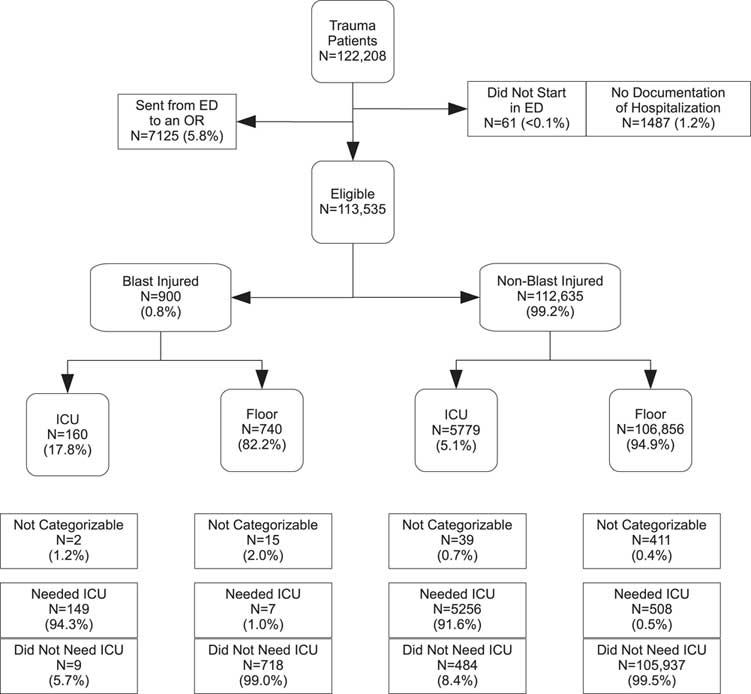
A total of 122 208 patients were entered into the INTR during the study period (Figure), of whom 61 (<0.1%) did not start in the ED and 1487 (1.2%) had no documentation of admission (including 1091 who were transferred to other hospitals from the ED). An additional 7125 patients (5.8%) were sent directly from the ED to an OR. Of the remaining 113 535 patients, 900 (0.8%) had suffered a blast injury. The injuries were war- or terrorism-related in 99.8% of blast cases, and in 0.7% of non-blast cases.
Flow Diagram Shows Patient Enrollment Into the Study, Initial Triage Destination (Intensive Care Unit or Floor), and Appropriateness of the Initial Triage Destination Among the Categorized Patients.

Of the 900 blast-injured patients, 160 (17.8%) were sent from the ED to the ICU and 740 (82.2%) were sent from the ED to the floor. Among the 112 635 non-blast-injured patients, 5779 (5.1%) were sent from the ED to the ICU and 106 856 (94.9%) were sent from the ED to the floor.
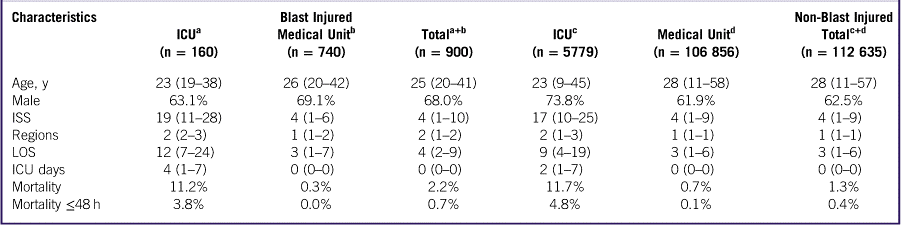
The patients were characterized and categorized by mechanism of injury and their initial admission location (Table 1). Of the patients initially admitted to the floor, 11 (1.5%) of the blast-injured and 790 (0.7%) of the non-blast-injured patients required at least 1 admission to the ICU before their discharge from the hospital. The overall mortality was 2.2% among the blast-injured patients, and 1.3% among the non-blast-injured patients. (The blast-injured group had a higher overall mortality, as compared to the non-blast-injured group, in spite of the blast-injured group having lower mortality in both ICU and floor settings [Table 1]. This is because a much higher percentage of blast-injured patients (17.8% vs 5.1%) were in the ICU group, which experienced a higher mortality rate.)
Summary Information for Blast-Injured and Non-Blast-Injured Subjects by Observed Initial Admission Location (ICU or Floor)

Abbreviations: ICU, intensive care unit; ICU days, total number of days in the ICU; ISS, injury severity score; regions, number of affected body regions (see text); LOS, length of hospital stay.
Age, ISS, regions, LOS, and ICU days are given as medians with interquartile ranges. Male (gender), mortality, and mortality within 48 h are given as percentages.
a Missing: 1 age, 4 ISSs, 4 regions, 2 ICU days.
b Missing: 7 ages, 20 ISSs, 4 regions, 4 LOSs, 4 mortalities, 4 mortalities ≤48 h.
c Missing: 32 ages, 1 male, 27 ISSs, 25 regions, 58 LOSs, 46 ICU days, 70 mortalities, 57 mortalities ≤48 h.
d Missing: 503 ages, 26 males, 466 ISSs, 187 regions, 223 LOSs, 7 ICU days, 302 mortalities, 245 mortalities ≤48 h.
For each group, the true need for initial ICU admission was determined (Figure). All of the patients admitted to the floor who were not able to be categorized were transferred to other hospitals. In absolute terms, 9 of the 883 categorized blast-injured patients (1.0%) and 484 of the 112 185 categorized non-blast-injured patients (0.4%) were triaged inappropriately to the ICU. These patients represented 5.7% (9 of 158) and 8.4% (484 of 5740) of the initial ICU admissions in the blast and non-blast settings, respectively.
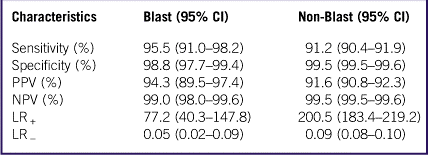
The numbers shown in the Figure were then rearranged into standard 2×2 tables, from which were calculated the test characteristics (Table 2). The test was the triage officers' decisions regarding need for initial ICU admission, given our definition of the gold standard. The sensitivity was higher in the blast setting, whereas the specificity was higher in the non-blast setting. The LR+ was 2.6 times higher (ie, better) in the non-blast setting (200.5 vs 77.2), and the LR− in the blast setting was half as high (ie, better) than that observed in the non-blast setting (0.05 vs 0.09).
Test Characteristics of Triage Officers’ Abilities to Determine Initial Need for ICU Placement After Blast and Non-Blast Trauma

Abbreviations: ICU, intensive care unit; LR+, likelihood ratio positive; LR−, likelihood ratio negative; NPV, negative predictive value; PPV, positive predictive value.
Table 3 describes those patients who were considered to have been placed initially and unnecessarily in the ICU. In examining Tables 1 and 3, no particular factors definitively differentiated the patients observed to have been sent to the ICU from those who were sent initially and unnecessarily to the ICU. Specifically, among the blast-injured, patients sent unnecessarily and initially to the ICU versus those sent appropriately to the ICU were less often male, tended to have lower ISSs, and have 3 as opposed to 2 affected body regions; a trend toward longer hospitalization was also noted. The non-blast-injured patients sent unnecessarily and initially to the ICU versus those sent appropriately to the ICU tended to be younger, to have lower ISSs, and to have 1 as opposed to 2 affected body regions.
Summary Information for Blast-Injured and Non-Blast-Injured Subjects Initially and Unnecessarily Triaged to ICU a

Abbreviations: ICU, intensive care unit; ICU hours, length of initial ICU stay; ISS, injury severity score; regions, number of affected body regions (see text); LOS, length of hospital stay.
Age, ISS, regions, LOS, and ICU days are given as medians with interquartile ranges. Male (gender), mortality, and mortality within 48 h are given as percentages.
a See text for criteria that define true need for initial triage to an ICU.
b Missing: 1 age, 4 ISSs, 4 regions, 3 LOSs, 4 mortalities, 4 mortalities ≤48 h.
The blast-injured patients were then divided into MCI and non-MCI categories. Using the 4 severe victims per 2-hour window definition, 47.6% (n=428) of the 900 blast-injured patients were considered to have been involved in an MCI. Of the 428 blast-injured MCI patients, 422 (98.6%) were admitted to the hospital's ICU or floor and were categorized: 67 (15.9%) were appropriately admitted initially to the ICU; 351 (83.2%) were appropriately admitted initially to the floor; 2 (0.5%) were inappropriately admitted initially to the ICU; and 2 (0.5%) were inappropriately admitted initially to the floor.
Among the 472 blast-injured non-MCI patients, 461 (97.7%) were admitted to the hospital's ICU or floor and categorized: 82 (17.9%) were appropriately admitted initially to the ICU; 367 (79.6%) were appropriately admitted initially to the floor; 7 (1.5%) were inappropriately admitted initially to the ICU; and 5 (1.1%) were inappropriately admitted initially to the floor. In the blast-injured MCI group, the sensitivity, specificity, LR+, and LR− were 97.1%, 99.4%, 171.4, and 0.03, respectively; in the blast-injured non-MCI group, they were 94.3%, 98.1%, 50.4, and 0.06, respectively.
The sensitivity analyses, including changing the minimum length of ICU stay that defined an appropriate ICU admission, revealed no unexpected shifts in the results. For example, the ratio of the LR+ in the blast versus the non-blast settings ranged from 2.4 to 3.0 under the various scenarios considered.
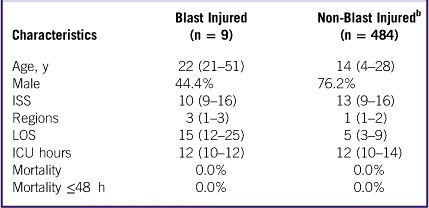
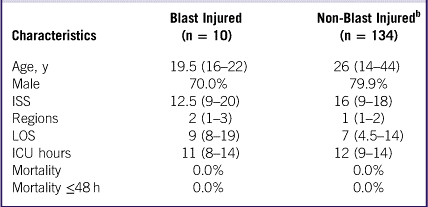
Finally, we investigated the patients sent from the ED to the ICU after first being brought to an OR, where the ICU visit was defined as being unnecessary (Table 4). Among the blast-injured patients were 10 ICU admissions (of 337 patients sent initially to an OR; 3.0%) that were considered unnecessary. Among the non-blast-injured patients were 134 ICU admissions (of 6788 patients sent initially to an OR; 2.0%) that were considered unnecessary.
Summary Information for Blast-Injured and Non-Blast-Injured Subjects Sent From the ED to an OR, Then Unnecessarily Admitted to an ICUFootnote a

Abbreviations: ED, emergency department; ICU, intensive care unit; ICU hours, length of initial ICU stay; ISS, injury severity score; regions, number of affected body regions (see text); LOS, length of hospital stay; OR, operating room.
Age, ISS, regions, LOS, and ICU days are given as medians with interquartile ranges. Male (gender), mortality, and mortality within 48 h are given as percentages.
a See text for criteria that define true need for ICU.
b Missing: 2 ages, 1 ISS, 1 region, 2 LOSs, 2 mortalities, 2 mortalities ≤48 h.
DISCUSSION
Careful consideration is required for assigning (and denying) ICU beds to patients on a daily basis. This process becomes especially difficult in the setting of overwhelming need for a limited resource, such as in the disaster setting.Reference Devereaux, Christian, Dichter, Geiling and Rubinson 3 , Reference Sprung, Zimmerman and Christian 4 While in all likelihood the triage process may never be perfect, it can be improved by understanding the current system and its limitations under various conditions. Our investigation of appropriate initial (non-short stay) ICU admissions comparing blast and non-blast trauma settings disclosed some important differences, although the triage officers' test characteristics were generally quite respectable.
The triage officers in the blast setting detected and admitted to the ICU a higher percentage of patients who needed initial intensive care (ie, the sensitivity was higher in the blast setting, with less critical care undertriage). Conversely, the decisions by the triage officers in the non-blast setting had a higher specificity, implying that a lower percentage of patients who did not require an initial ICU stay were sent to the ICU for brief (<16 h) periods (ie, less critical care overtriage). If the performance in the non-blast setting—the overwhelming majority of which is non-MCI—is compared with that in the non-MCI blast setting, we find that these trends persist.
If the decisions of the triage officers responsible for the initial ICU triage of blast-injured victims had the same specificity as in the non-blast-injured setting, only 3 instead of 9 inappropriate short-stay ICU admissions for blast injuries would have occurred. The contrast would have been even greater if the lower specificity associated with blast injury were applied to the non-blast injured patients: all else being equal, an additional 833 patients would have been inappropriately sent to the ICU for a short stay, so that only 80% of the patients sent to the ICU initially would have been appropriately triaged there. From personal, anecdotal experience, we have known of situations in which having available even 1 or 2 beds in the ICU can substantially reduce a bottleneck in the ED.
Particular combinations of sensitivity and specificity yield likelihood ratios, which relate how a test result should revise one’s beliefs about the odds a patient has a particular condition.Reference Jaeschke, Guyatt and Sackett 11 The considerably lower (although still high) LR+ in the blast setting indicates that the triage officer does relatively less well in triaging to the ICU only those casualties who require initial non-short stay ICU-level care, as compared to the non-blast setting. However, because the prevalence or prior odds of (true) need for initial ICU-level care is much higher in the blast setting (prevalence: 17.7% vs 5.1%), the effect is obscured: our raw data demonstrated that 5.7% of the blast-injured victims sent initially to the ICU were considered inappropriately triaged to the ICU, whereas 8.4% of the non-blast-injured victims sent to the ICU were inappropriately triaged there.
However, if the prevalence of (true) need for initial ICU-level care were 8% in both blast and non-blast settings, then 13% of the initial ICU admissions among the blast-injured and 5% of the initial ICU admissions among the non-blast-injured would have been considered inappropriate short stays. The likelihood ratios demonstrate the discrepancies in triage officers' abilities between the blast and non-blast settings more readily; these discrepancies would not be recognized if just the rate of over- or undertriage were considered.
Admitting patients to the ICU for short observational periods may make sense during normal ICU operations. In the setting of an MCI or a disaster, however, in spite of the controlled chaos and emotionally charged environment often surrounding large-scale events,Reference Devereaux, Dichter and Christian 12 , Reference Romig 13 it is prudent to reconsider using the ICU for persons who would likely require only short observation periods. Protocols for identifying these people before they are sent to the ICU (whether as triage mistakes or for brief observation), and for rapidly discharging such patients who are already in the ICU, should be activated when multiple victims from an MCI or disaster are expected. Making available ICU beds for patients in critical condition is likely more important than using those ICU beds to observe patients for whom it is initially unclear how the natural history of their condition will progress. Unfortunately, our data offer little insight into factors that may help differentiate patients who truly need initial ICU-level care from those who do not.Reference Christian, Joynt and Hick 14
Because the ICU is a resource for which various sources compete (ie, ED, OR, floor, transfers from other hospitals, and patients already in the ICU), a reappraisal of the protocols or systems used to assign ICU beds, especially during MCIs, should address each of these sources. Our findings showed that of the 19 patients in the blast setting who were sent initially and unnecessarily to the ICU from either the ED or from the ED via the OR, half (53%) were from an OR. In the non-blast trauma setting, less than a quarter (22%) of the unnecessary ICU admissions came from an OR. Nevertheless, protocols limiting ICU admission may need to be more lenient in smaller centers (eg, level III) where the possibility of undertriage may be of greater concern.
Given unlimited resources, outcomes can be maximized by increasing sensitivity, which usually has the untoward but seemingly tolerable effect of lowering specificity. However, because resources are in fact limited, especially in MCIs, overtriage also has the effect of expending valuable resources on patients who do not require them, to the detriment of those who could have benefited from them. This tension between maximizing an individual's outcome and remaining cognizant of the potential needs of all the patients is not new to the MCI setting. More than 25 years ago, Frykberg and Tepas noted that increasing overtriage was associated with increasing mortality among those critically injured (which they termed critical mortality).Reference Frykberg and Tepas 15 Given imperfect triage methods, improving the allocation of critical resources in MCIs to those who truly need them requires finding the right balance between these competing goals.
To address the reality that the ICU is a scarce resource during MCIs (and often during everyday hospital operations), protocols for ICU admission have been proposed and tested, with recent impetus stemming from the novel H1N1 influenza pandemic.Reference Christian, Hamielec and Lazar 16 , Reference Guest, Tantam, Donlin, Tantam, McMillan and Tillyard 17 Our data suggest that such protocols should also be considered in the blast setting, and should take into account patients from various sources.
It is interesting that while blast-injured victims are more often inappropriately placed initially in the ICU, some natural correction occurs in the MCI setting: the LR+ is more than 3 times as high in the blast-MCI setting as compared to the blast-non-MCI setting (171.4 vs 50.4), although it is still not as high as that in the non-blast setting. The LR− also shows some improvement in the MCI setting (0.03 vs 0.06). We emphasize, however, that the numbers of patients who were initially admitted to an inappropriate location were quite small in this subanalysis.
If it is anticipated that such protocols would not be followed closely in a disaster setting (eg, due to emotional involvement during terrorist attacks), then the test characteristics presented here may be used to better model and predict the actual system response to victim surge.
Limitations
Our definition of true need for initial ICU-level care, which was developed specifically to identify patients who would and would not have benefited from an initial ICU stay, was applied retrospectively to a registry. This approach presented an important limitation to our study, as we did not know for which patients ICU-level care was requested and denied. Also, we were not privy to the factors involved in the initial ICU triage decisions. For instance, patients who were considered futile ICU admissions because of the severity of their disease may have been triaged to the floor, whereas they might otherwise have been sent to the ICU. Further, it is possible that some denials of ICU admission were for lack of resources.
In addition, we did not know whether a very brief ICU stay (<16 h) provided sufficient resuscitation or stabilization to then allow a particular patient to receive additional treatment, or to convalesce, on the floor. However, our findings were not substantially different using a cutoff period of less than 8 hours to define a short ICU stay. Moreover, we used several sensitivity analyses to ensure that our definitions were not overly sensitive to the 16-hour cutoff and to determine the impact of the patients who could not be categorized, although the latter analyses assumed non-differentiality between study groups.
While some may disagree with our definition of true need for ICU level care, its simplicity and relevance to the study question (ie, that of initial, short-stay ICU observation) make it readily applied and assessed. Furthermore, while we acknowledge that a black-and-white definition seems contrary to the grayness of real-world experience, we believe that research based on reasonable definitions can still offer important insights into patient care.
CONCLUSIONS
Triage officers were better at sending to the ICU only those patients who require initial intensive care in the non-blast setting, as compared to the blast setting; this finding was obscured by a much greater overall need for ICU-level care in the blast setting. Implementing triage protocols in the emotionally charged blast setting may help reduce the number of patients sent initially to the ICU for brief periods, thus making this valuable resource more available.
Funding and Support