The 2008 general election was the first presidential election conducted in Washington State almost exclusively through the vote-by-mail system. Joining its neighbor to the south, Washington became the second US state to conduct its election in this manner. In both Oregon and Washington State much of the focus, both in the media and among political professionals and academics, has been on whether this system increases total voter turnout and which groups are more likely to vote with voting by mail compared to traditional voting done in polling places.
However, one important aspect of voting by mail has remained relatively unexamined by all parties: when voters return their ballot. Because voters can return their ballot immediately after they receive it, candidates now must not only reach potential voters and engage them before they turn in their ballots, which could be as early as two and a half weeks before the campaign is over, but candidates must do this without knowing whether those people have already voted. In effect, a rolling deadline exists: campaigns must reach voters before they have voted, and any expenditure of campaign resources after ballots have been cast is wasted. Simply put, campaigning on Election Day (or the day before) is moot if the majority of voters have already cast their votes.
In Washington State, vote by mail has been described as a cost-effective alternative to setting up polling places and maintaining thousands of distinct election sites around the state (Karp and Banducci Reference Karp and Banducci2000; Washington Secretary of State, n.d.). This cost savings was a primary reason the majority of county auditors—who are responsible for conducting the elections—were supportive of switching to vote by mail. In addition, proponents have argued that vote by mail increases voter turnout by decreasing many of the costs associated with voting. Among the studies on vote-by-mail's affects on voter turnout, researchers have found the system increases turnout—especially among those already predisposed to vote—in low-stimulus elections, such as primaries or local contests (Karp and Banducci Reference Karp and Banducci2000). Similarly, other researchers have found vote by mail increases voter turnout by making voting easier and keeping some voters, such as long-term residents and partisans, as part of the electorate (Berinsky, Burns, and Traugott Reference Berinsky, Burns and Traugott2001). Moreover, because people can fill out the ballot in a time and place that is convenient to them, the process might encourage people to complete the entire ballot. Voting by mail, therefore, may also reduce voter fatigue and increase the chances that voters will not abstain from marking their preferences on issues and candidates further down on the ballot (Southwell Reference Southwell2009). It also appears that those who vote by mail are similar to nonvoting registered voters with regards to demographic characteristics, but tend to be better educated and more informed than nonvoters (Southwell and Burchette Reference Southwell and Burchette2000).
Despite the cost advantages and potential increases in turnout, voting by mail is not a panacea, and some people question the impact voting by mail could have on a community. Voting simultaneously on Election Day could be an important aspect of the democratic process by creating a communal event. “The public affirmation of voting together openly on the same day is quite different in meaning from the private transaction of filling out and mailing in an absentee ballot” (Thompson Reference Thompson2004, 58). Because of the voting-by-mail system, Washington and Oregon voters do not have the opportunity to see neighbors and friends and come together at polling stations in schools and libraries while publicly demonstrating their civic participation. However, others claim voting at home can foster debate and encourage more discussion if people vote together in their homes compared to being isolated in a voting booth (Richey Reference Richey2005). Other concerns about voting by mail focus on ensuring ballot security and preventing fraud.
However, one aspect of voting by mail and the loss of simultaneous voting that has not been examined is how this could affect campaigning. To explore this issue, using data from the Spokane County Elections during the 2008 general election, this study analyzes whether certain groups of people are more likely to vote at certain times.
A CLOSER LOOK AT SPOKANE COUNTY
Located on the eastern border of Washington State, Spokane County is the fourth most populated county in Washington State, with 470,000 residents, and it has the second most populated city, Spokane, with 207,000 residents. The county also is home to a few suburbs, the largest being Spokane Valley with 90,000, and a number of smaller farming communities. With several hospitals, universities, and financial institutions, Spokane County serves as the medical, educational, and commercial hub for eastern Washington, northern Idaho, western Montana, and parts of British Columbia. With a median age of 36.1, the average resident is younger than both the median of the state of Washington and the United States (American FactFinder 2009a). The county also has a lower per household income and fewer college graduates compared with both the state as a whole and the nation. Finally, the county also has fewer racial and ethnic minorities than the state or the nation (2009b). Although as a region eastern Washington is often described as being conservative, the politics is relatively diverse.
Like many other parts of the nation, there is a strong urban/rural split with regard to ideology and variations in political orientation based on income and age. The city of Spokane has a strong Democratic presence with both state representatives and the state senator winning their contests by approximately a 2:1 margin in the 2008 election. Rural areas and smaller communities, however, are conservative and tend to support Republicans. In addition, some of the more suburban areas tend to contain more swing voters where both parties remain competitive. This competition was highlighted by several close races in the 2008 election. For example, the state's 6th Legislative District, which wraps around the western portion of the city of Spokane and urban parts of unincorporated Spokane County, had the two most competitive races in the state. In one of the races, the Democratic candidate won by 4,000 votes, while in the other race the Republican won by 64 votes out of approximately 70,000 votes cast. That election was not the only competitive campaign that occurred that year. Washington State experienced a rematch of the previous governor's race between Democratic incumbent Christine Gregoire and Republican Dino Rossi. Because the 2004 contest was decided by 231 votes after two recounts, that race was expected to be exceptionally close again as both sides and their affiliates spent almost $44 million in the campaign. Moreover, the state's voters were also considering an initiative concerning physician-assisted suicide, all of which occurred against the backdrop of the presidential campaigns of Barack Obama and John McCain. Most likely because of this, the state had its highest level of registered voters turning out to vote (or, more accurately, mailing in their ballots) in more than 50 years, with 84.6% of registered voters submitting ballots while 85.8% of registered Spokane County voters voting.
VOTE BY MAIL IN WASHINGTON STATE
Originating in 1915 when the state General Assembly provided people who could not make it to the polls with the ability to vote by mail, voting through the postal service is not a new phenomenon in Washington State (Secretary of State 2007). Since then, the state periodically made changes to the vote-by-mail law to increase access to the system by allowing counties to make precincts with less than 200 people exclusively vote-by-mail (1965), providing for people to request to vote-by-mail ballots without requiring them to provide a reason why they would not be able to vote in person (1975) and allowing older voters and those with disabilities to request that their ballots be permanently sent to them rather than being required to make that request for each election (1985) (Secretary of State 2007). Finally, in 2005 the state permitted all 39 Washington counties to conduct all elections exclusively through the mail. With the advent of the vote-by-mail system, the 2008 general election was unlike any voters in Spokane County had ever experienced before. Although the system had been used in previous elections in the county, it had never been implemented in a year with the presidential and gubernatorial election.
Functionally, the vote-by-mail system operates through the Spokane County Elections Division, which begins mailing ballots 20 days before the election to all registered voters at their homes. At their convenience voters can either pay for postage and mail back their ballots via the US Postal Service, drop their ballot off at the elections office, or return them to voter drop boxes located throughout the county (which ensures that the ballots are returned to the elections office free of charge, and, therefore, not subjecting the voter to a poll tax). Another option is for voters is to bring their ballots to a Voter Service Center on Election Day and vote there if they prefer or if they need assistance. These ballots are turned into the County Auditor who verifies the voter's signature against the records and marks the date and time the ballot was received thereby creating a public record of the individual who voted, their address, age, and the time the ballot was turned in.
WHEN PEOPLE VOTED
Unlike other states' electoral rules where everyone votes at the same time, a critical question for candidates and their campaigns in a vote-by-mail system is when should campaign resources be used to maximize their effect on the election? In exploring this question, this study looks at the time most ballots were received by the elections division and for any patterns that emerged in the 2008 election regarding who voted when.
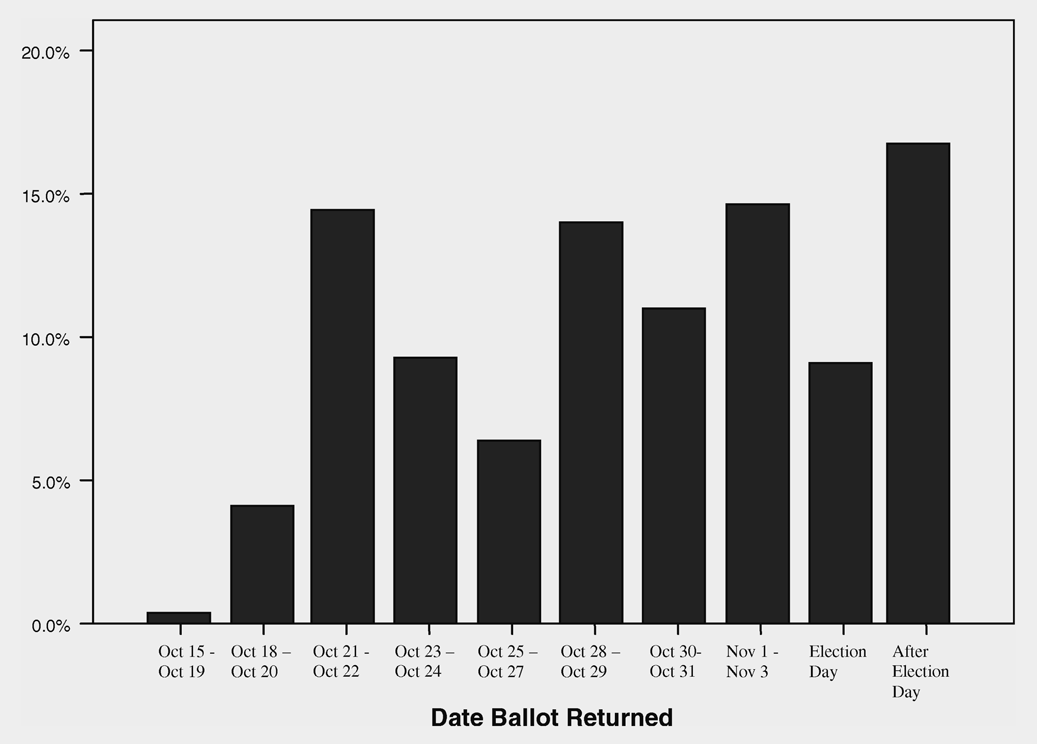
Initially, the majority of voters did not wait until Election Day to return their ballots to the state, and a majority of voters actually turned in their ballots long before the campaign was over. As shown in figure 1, in Spokane County, almost 75% of voters returned their ballots before Election Day, and almost half of the voters had returned their ballots before October 29, six days before the election.
Date Ballot Returned for Spokane County Voters by Percent

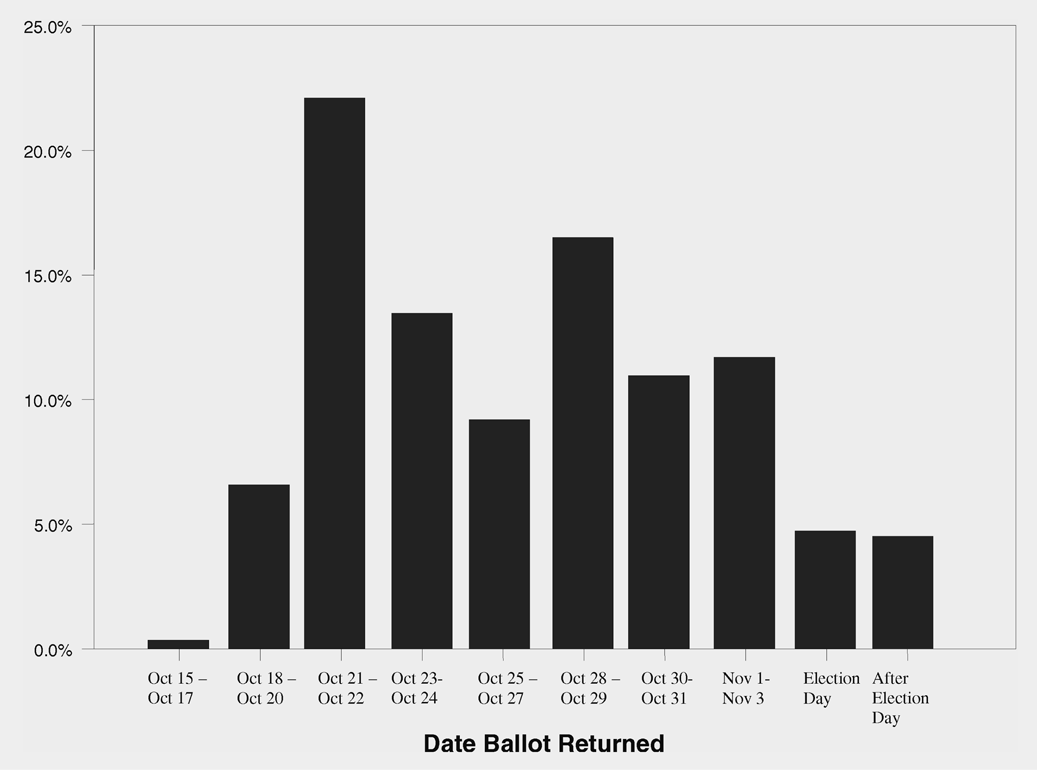
Rather than seeing most voters hold their ballots until Election Day, the elections division received ballots in four major waves. The first wave came on October 21 and 22, the Tuesday and Wednesday two weeks before Election Day. During these two days 12.2% of all voters returned their ballots. The next major wave of ballot returns came on October 28 and 29, when 11.8% of the voters turned in their ballots. On the Monday before Election Day, 12.4% of the ballots were turned in, and, finally, the elections division received 14.2% of the ballots after Election Day.Footnote 1 Although there were some important implications concerning the fact that a majority of Spokane County voters voted a week before the election, note that there were major differences concerning who voted when. Like the decision to vote, dramatic differences among different age groups are shown regarding when they voted. As demonstrated in figure 2, among those voters 65 years or older there is a strong tendency to return the ballot earlier, while younger voters appear to hold their ballots until later in the campaign.
Date Ballot Returned for Spokane County Voters over the Age of 65, by Percent

In total, approximately 23% of the voters 65 and older turned in their ballots on October 21 and 22, almost two weeks before the campaign concluded, and more than 60% of the older voters had returned their ballots when there was a week to go in the campaign. This finding is in stark contrast to how long the youngest voters in Spokane County held on to their ballots. Of those voters under the age of 30, there is a strong tendency to not vote until very close to Election Day.
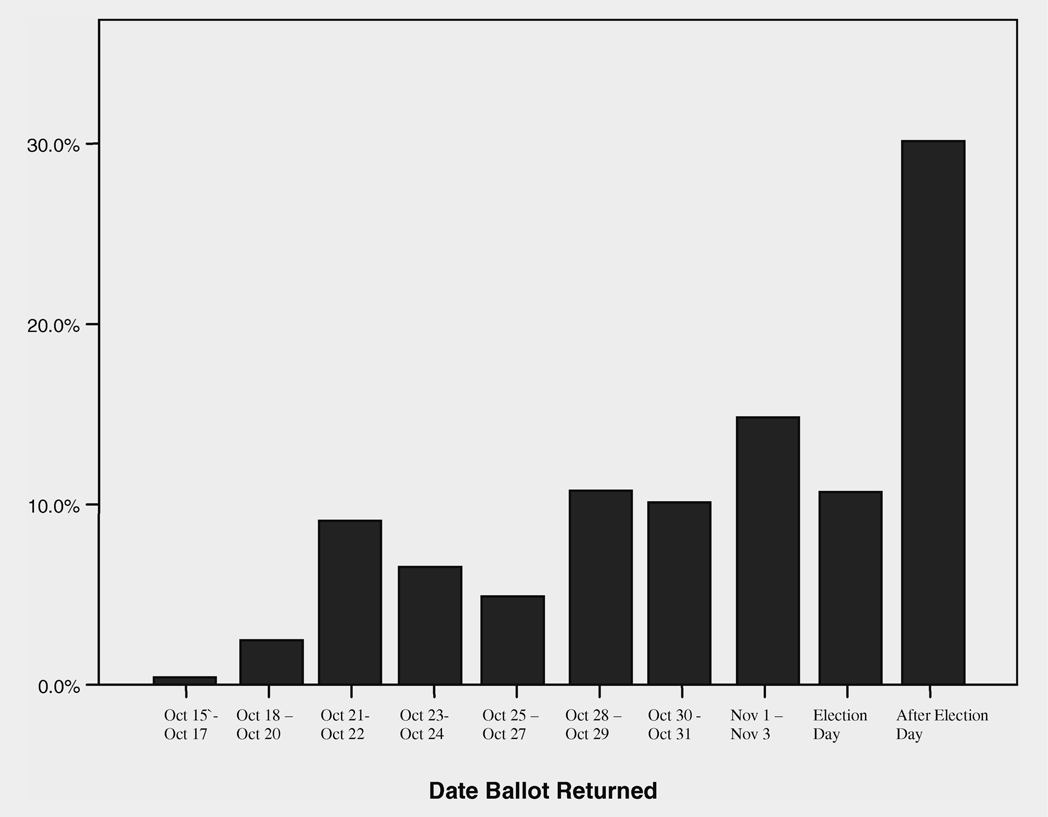
As seen in figure 3, among Spokane County voters under the age of 30, almost 40% returned their ballots on or after Election Day. An additional 13% turned in their ballots on the Monday before Election Day, meaning that the majority of young people held on to their ballots until the last weekend before submitting their vote. This pattern continues with those between the ages of 30 and 49 turning in their ballots, generally, slightly before those under the age of 30 and voters from 50 to 64 years of age turning in their ballots after those who are older. Simply put, the younger a voter in Spokane County was, the longer they held on to their ballot.
Date Ballot Returned for Spokane County Voters under the Age of 30, by Percent

OTHER FACTORS IN THE DECISION TO VOTE EARLY
Although a very strong relationship between the decision to vote early and age exists, it is is not the only reason for voting early. This decision could be a factor of other variables such as geographic location, partisanship of specific precincts, and the sex of the voter. Using a multivariate OLS regression analysis, the variables that most significantly explain the decision of when to vote in the 2008 general election are explored.Footnote 2 Specifically, this study examines the age of the voters, their sex, where the voter lives, and the partisan make-up of their precinct.Footnote 3 To determine this, the analysis uses a dummy variable to code for sex and geographic region including the city of Spokane, Spokane Valley (the second largest city in the county), and other outlying, largely rural incorporated areas. In addition, this study attempts to determine if partisanship played any role in the decision to vote early. Because the data from the election department does not indicate the voters' candidate preferences, partisanship must be estimated by aggregate data. Using precinct-level election return results, variables are created to determine the partisanship of their neighborhoods.
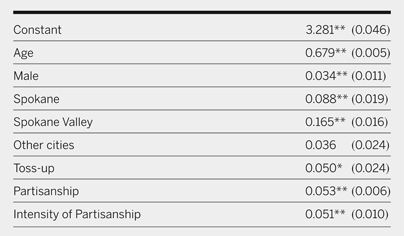
First, as seen in table 1, as noted earlier the most powerful predictor of voting early in Spokane County in 2008 was age. Those voters who were 65 years and older were more likely to vote early compared to younger voters. Second, all other things being equal, voters in the major cities in Spokane County tended to vote earlier than those who lived in unincorporated Spokane County. In additional, men were also slightly more likely to vote early compared to women. Some significant findings regarding partisanship and the decision to vote earlier emerged. Those living in highly partisan precincts were associated with voting earlier in the campaign compared to those who live in areas where both parties were equally represented. Specifically, living in a highly Democratic precinct was associated with turning in a ballot earlier compared with those who live in other precincts.
Variables in When People Voted in Spokane County

R2 = 0.070; N = 218,918
* p < 0.05;
** p < 0.01
Standard deviations in parenthesis
CONCLUSION
Because the vote-by-mail system is relatively new, no comprehensive research regarding the decision of when to vote exists. As such there are no readily available hypotheses concerning why older voters might vote before younger voters. Because 2008 is the first major election almost exclusively conducted in Washington State with the vote-by-mail system, it is impossible to know if this trend is unique to the particular circumstances of this election, or if this is part of a general pattern. However, the fact that different types of people tend to turn in the ballots at different times has serious consequences for how campaigns should be conducted in a vote-by-mail system.
In total, nearly 44,500 voters, or 19%, of all of the voters in Spokane County voted two weeks before Election Day and almost 106,500 voters (48.5% of the total) had cast their ballot with one week left to go in the campaign. What this means for candidates and their campaigns is that the final weekend push of heavy campaigning—on the streets, in malls, and on the radio and television—might not be an effective use of their resources. This may be especially true given the fact that campaigns traditionally target those people who are presumed to vote (older, wealthier individuals). Among this group, the vast majority who were planning to vote already have cast their vote. In other words, many campaigns might be campaigning when, and to whom, the election is effectively over.
Moreover, it might have significant implications for the campaigns if any dramatic events occurred that could alter the dynamics of the campaign. After ballots are cast, they are effectively banked for the candidate and cannot be changed. If something occurred toward the end of the campaign that could cause people to rethink their support for a candidate—such as the disclosure of a scandal or an “October surprise”—those voters could not change their selection. Because a majority of voters, at least in Spokane County, turned in their ballots well before Election Day, the possibility remains that information disclosed in the campaign that could alter the campaign could come too late because voters have voted.
In the end, the wisest course of action for campaigns might be to either selectively target demographic groups during the campaigns—reaching older voters earlier and younger voters later—or by maintaining a constant amount of commercials throughout the time ballots remain outstanding.
APPENDIX
-
Variable description
-
Male: Male = 1; Female = 0
-
Age: Age 65 and older = 4; Age 50–64 = 3; Age 30–49 = 2; Age 18–29 = 1
-
Spokane: Residing in the City of Spokane = 1; Otherwise = 0
-
Spokane Valley: Residing in the City of Spokane Valley = 1; Otherwise = 0
-
Other cities: All incorporated areas in Spokane County excluding Spokane and Spokane Valley = 1; Otherwise = 0
-
Partisanship: A five-point scale based on precinct level voting returns. Precincts where Democratic presidential candidate Barack Obama and Democratic gubernatorial candidate Christine Gregoire both receive more than 60% of the vote (Strongly Democratic) = 2; Precincts where Obama and Gregoire both receive between 50.1% and 60% of the vote (Democratic) = 1; Precincts where the vote is split between the Democratic and Republican candidates for governor and president (toss-up) = 0; Precincts where Republican presidential candidate John McCain and Republican gubernatorial candidate Dino Rossi both receive between 50.1% and 60% of the vote (Republican) = −1; Precincts where McCain and Rossi both receive more than 60% of the vote (Strongly Republican) = −2
-
Intensity: Strongly Republican and Strongly Democratic precincts = 2; Republican and Democratic precincts = 1; toss-up precincts = 0