


Introduction
The Farm Fresh Food Box (F3B) strategy is a market innovation that hybridizes direct-to-consumer (DTC) and short value chain models with the goals of expanding producer sales, stabilizing rural retail businesses and improving rural food access (Smith et al., Reference Smith, Wang, Chase, Estrin and Kim2019). In F3B, area farms offer weekly boxes of pre-packed produce at retail sites that are unable to maintain produce sections due to perishability, low sales volume and lack of infrastructure (Greco, Reference Greco2020). In-store advertising attracts customers, who pre-order F3B at the retail site or online on a week-to-week basis for later pick-up. Box contents change throughout the agricultural season to move product that is most abundant and exceeds the quantity that can be sold through the farmer's markets or community-supported agriculture (CSA) enterprises (Kolodinsky et al., Reference Kolodinsky, Sitaker, Chase, Smith and Wang2020).
Because rural consumers may have difficulty accessing fresh, local food, the F3B strategy aims to address the dearth of healthy foods at local stores and remove barriers that prevent customer participation in other DTC market channels. F3B helps consumers gain convenient access to fresh local produce without significant cost or up-front commitment to purchase for the entire season (Smith et al., Reference Smith, Greco, Van Soleon Kim, Sitaker, Chase, Estrin and Kolodinsky2018).
This article contributes to the limited body of research on food box models by identifying benefits and barriers of the F3B strategy for consumers in a rural context, comparing these findings to existing research on food box programs and other DTC market channels, and discussing implications for future model adjustment.
Literature review
Rural community food access
Rural residents often lack access to fresh and affordable produce (Blanchard and Lyson, Reference Blanchard and Lyson2006; Liese et al., Reference Liese, Weis, Pluto, Smith and Lawson2007), putting them at higher risk of obesity and chronic diseases (Andreyeva et al., Reference Andreyeva, Middleton, Long, Luedicke and Schwartz2010; Bailey, Reference Bailey2010). Few studies explore rural consumers' perceptions about how well food retailers recognize and respond to their needs (Smith and Morton, Reference Smith and Morton2009). In one study of food access among low-income rural residents, participants reported that food vendors did not meet their needs and that the food in some stores was of poor quality (Andress and Fitch, Reference Andress and Fitch2016). Another study found that physical access to fresh produce was of lesser concern to rural residents than cost; price and affordability were more likely to influence where they shopped (Ramirez et al., Reference Ramirez, Diaz Rios, Valdez, Estrada and Ruiz2017).
The spread of national supermarket chains, dollar stores and e-commerce directly threatens rural retailers by undercutting prices and altering consumer shopping habits (Donahue, Reference Donahue2018; Rothstein, Reference Rothstein2019). Consequently, many small communities have lost their neighborhood grocer (O'Brien, Reference O'Brien2008). Making monthly shopping trips to a large supermarket, supplemented with smaller purchases, known as out-shopping, has been documented as a rural food access pattern that poses health risks (Hawes and Lumpkin, Reference Hawes and Lumpkin1984; Jilcott et al., Reference Jilcott, Hurwitz, Moore and Blake2010a; Mullis and Kim, Reference Mullis and Kim2011; Yousefian et al., Reference Yousefian, Leighton, Fox and Hartley2011), as fewer trips to the grocery store might indicate lower produce consumption (Jilcott et al., Reference Jilcott, Hurwitz, Moore and Blake2010a). Out-shopping also impacts rural small businesses as revenues shift from local to outside businesses (Pinard et al., Reference Pinard, Shanks, Harden and Yaroch2016).
The challenges faced by rural grocers have resulted in variable food access in rural communities, making it harder for consumers to buy fresh, healthy produce (Kaufman, Reference Kaufman1998; Morton et al., Reference Morton, Bitto, Oakland and Sand2005; Blanchard and Lyson, Reference Blanchard and Lyson2006; Hendrickson et al., Reference Hendrickson, Smith and Eikenberry2006; Richards and Smith, Reference Richards and Smith2006; Liese et al., Reference Liese, Weis, Pluto, Smith and Lawson2007; Smith and Morton, Reference Smith and Morton2009; Jilcott et al., Reference Jilcott, Liu, Moore, Bethel, Wilson and Ammerman2010b). As more small retailers go out of business, rural residents find themselves with diminished access to a diverse array of healthy foods, and consequently consume fewer fruits and vegetables (Rose and Richards, Reference Rose and Richards2004; Timperio et al., Reference Timperio, Ball, Roberts, Campbell, Andrianopoulos and Crawford2008; Zenk et al., Reference Zenk, Schulz and Odoms-Young2009; Andreyeva et al., Reference Andreyeva, Middleton, Long, Luedicke and Schwartz2010; Hanson et al., Reference Hanson, Garner, Connor, Jilcott Pitts, McGuirt, Harris, Kolodinsky, Wang, Sitaker, Ammerman and Seguin2019).
The F3B strategy aims to shift rural consumer food dollars away from large commercial centers and industrial agriculture and bring them back to rural retailers and farms. To do this, F3B links small farms that typically sell through DTC venues with rural stores in a short values-based supply chain (VBSC). Both DTC and VBSC are part of the alternative food networks (AFN) strategy, which emerged in response to the many externalities of a globalized food system (Valchuis et al., Reference Valchuis, Conner, Berlin and Wang2015). In VBSCs, the embedded value of the food is conveyed at each step of the supply chain, with business relationships between partners marked by transparency and trust. VBSC have the potential to enhance the viability of mid-scale farms while preserving jobs and rural economies (Stevenson et al., Reference Stevenson, Clancy, King, Lev, Ostrom and Smith2011; Hardesty et al., Reference Hardesty, Feenstra, Visher, Lerman, Thilmany-McFadden, Bauman, Gillpatrick and Rainbolt2014).
Alternative food networks: benefits and barriers
Qualities associated with foods produced in AFNs include better nutritional quality and taste, use of sustainable growing practices and the prioritization of community economic well-being and farmer livelihoods (Murdoch et al., Reference Murdoch, Marsden and Banks2000; Sage, Reference Sage2003; Selfa and Qazi, Reference Selfa and Qazi2005; Sitaker et al., Reference Sitaker, Kolodinsky, Jilcott Pitts and Seguin2014; Valchuis et al., Reference Valchuis, Conner, Berlin and Wang2015). A substantial body of evidence shows that AFNs offer opportunities for consumers to re-connect to their food, by actively helping them obtain healthy, fresh, seasonal, high-quality food while also supporting local farmers. Farmers' markets and CSA have demonstrated their capacity to build trust and a sense of community by promoting social connections between shoppers and food producers (Peters, Reference Peters1997; Kirwan, Reference Kirwan2004; Hunt, Reference Hunt2007; Block et al., Reference Block, Thompson, Euken, Liquori, Fear and Baldwin2008; Cox et al., Reference Cox, Holloway, Venn, Dowler, Hein, Kneafsey and Tuomainen2008; Morgan et al., Reference Morgan, Severs, Hanson, McGuirt, Becot, Wang, Kolodinsky, Sitaker, Pitts, Ammerman and Seguin2018).
Nevertheless, AFNs are exclusionary. Previous research documents CSA member demographics as primarily white, affluent and college-educated (Innis, Reference Innis1994; Henderson, Reference Henderson1999; Jilcott et al., Reference Jilcott, Liu, Moore, Bethel, Wilson and Ammerman2010b). Kolodinsky and Pelch's (Reference Kolodinsky and Pelch1997) study found that income had a positive correlation with CSA membership. In Kane and Lohr's (Reference Kane and Lohr1997) study, over half of the CSA members earned at least $50,000 per year; roughly one-fifth earned at least $100,000 per year. Both studies found college-educated people were more likely to belong to a CSA than those without a college degree (Kane and Lohr, Reference Kane and Lohr1997; Kolodinsky and Pelch, Reference Kolodinsky and Pelch1997).
Consumers face several barriers when shopping at AFN venues: additional travel time to pick-up local produce, prohibitive up-front costs of CSAs, perceived higher cost and elitism of local foods (McEntee and Agyeman, Reference McEntee and Agyeman2010). Vassalos et al. (Reference Vassalos, Gao and Zhang2017) found high cost and limited variety among the main reasons for not joining a CSA. Kane and Lohr (Reference Kane and Lohr1997) reported that CSA subscribers commonly complained about the volume of produce and the demand membership placed on their time.
The F3B strategy aims to address several barriers to AFN participation for rural residents. Social and geographic barriers are addressed by selling through a familiar, acceptable and conveniently located retail site. Like a CSA, F3B customers must pick their box up from a central distribution site, but without a season-long commitment or up-front payment. Thus, F3B has the potential to improve access to local foods in rural communities and help farmers and retailers gain a new consumer base through addressing common barriers to AFN participation. It is crucial to understand the role that consumers play in AFNs to assess the success of F3B in achieving these goals.
The role of consumers in AFNs
DTC markets are characterized by small scale and localness, but these values are challenged by a conventional food system that promotes ideals of low cost, convenience and a predictable food supply. These values are at odds with each other and have created contradictory consumer expectations (Forssell and Lankoski, Reference Forssell and Lankoski2017). Consumers want a broad selection of quality, sustainably grown local foods, but they want it to be inexpensive. Many CSAs contend with members who chafe at receiving bags with produce they may not be familiar with; in quantities they did not request. Addressing ‘consumer demands’ is a significant operational challenge for many CSA farms (Groh and McFadden, Reference Groh and McFadden1997).
CSA farmers have adapted to consumer demand in part by allowing CSA members to choose (customize) the produce they receive. Galt et al. (Reference Galt, Bradley, Christensen and Munden-Dixon2019) found that this had no significant effect on CSA retention, even though former members said they dropped the CSA because the product mix did not meet their needs. Galt suggested that former members wanted a greater selection of non-seasonal produce, which was unrealistic because farmers could not provide it, thus creating a ‘CSA customization paradox’.
Galt et al. (Reference Galt, Bradley, Christensen and Munden-Dixon2019) identified ‘CSA people’, a consumer type that in purchasing a CSA goes against strongly held social norms. These norms include expecting year-round availability of produce; a belief that more choice leads to greater satisfaction; allocating fewer hours to housework; habitually eating away from home and consuming more processed foods; and being financially unwilling or unable to pre-pay relatively large sums of money for produce. ‘CSA people’ tended to be more forgiving when CSA shares did not meet expectations and continued to participate even when resources were reduced. The factors that influenced this resilience included the understanding that farming is difficult, valuing how CSAs benefit farmers and the environment, and experiencing these benefits as also being positive, personally (Galt et al., Reference Galt, Bradley, Christensen and Munden-Dixon2019). Effective communication between producers and consumers was deemed critical to the making of ‘CSA people’, because it facilitated understanding that led to long-term commitment and tolerance among consumers, and encouraged them to consider their wider behavior and practices (Cox et al., Reference Cox, Holloway, Venn, Dowler, Hein, Kneafsey and Tuomainen2008).
There is more research on consumers' experiences with CSAs than with food boxes. However, existing food box studies explore the role of education and communication and cite lack of convenience and expense as common reasons consumers discontinued food box programs. These findings align with Galt's description of the strongly held social norms that discourage CSA participation such as the desire for year-round availability of produce and being financially unwilling or unable to participate. The primary difference between the CSA and the food box is that the food box does not require any long-term financial commitment while the CSA requires the member to pay upfront to enjoy a regular share. Thus, food box participants might have fewer strongly held social norms to counter in order to participate in the program.
Previous food box research
Miewald et al. (Reference Miewald, Holben and Hall2012) outlined the impacts of a low-cost, pay-as-you-go food box program on food insecurity. The program distributed 400 boxes through several community-based depots in Vancouver, B.C. Its primary goal was to provide an alternative to the charitable food system, using a community food security approach to increase access to fresh produce. Consumer surveys showed that participants who are stuck with the food box program had higher fruit and vegetable intake compared to non-participants and early dropouts. Inconvenience and expense were commonly reported as reasons for discontinuation.
Zorbas et al. (Reference Zorbas, Mccartan, De Mel, Narendra, Tassone, Yin and Palermo2018) described a produce box scheme in a disadvantaged Australian community without fruit and vegetable retail options. Food box consumers identified four important factors affecting implementation and uptake: logistics, marketing strategies, consumer experience and a community-centered approach. Zorbas argued that it was important to raise public awareness through targeted marketing, use an easy-to-use online ordering platform and have convenient pickup service. Zorbas also emphasized the importance of identifying pick-up logistics based on capacity, time, day and traffic going through the retail area.
Torjusen et al. studied consumer perceptions of three organic food box schemes, two in Norway and one in Denmark. Subscribers reported changes in both food attitudes and behaviors when they incorporated contextualized information into their food purchase decisions, and when they cooked and ate a more seasonal diet. The authors theorized that food box schemes that include food-system learning and support changes in food practices can potentially aid the development of local and organic food systems (Torjusen et al., Reference Torjusen, Lieblein and Vittersø2008). Box schemes that emphasize information and communication can also increase the proximity and understanding between different actors in the food system.
The present study contributes to the current literature by examining an innovative market channel that meets the need for better access to fresh, local produce in rural communities. This article will identify benefits and barriers of the F3B strategy, compare these findings to existing consumer research on food box programs and other AFNs, discuss the implications for future model adjustment, and assess the extent to which the F3B strategy met the goal of providing fresh, local produce for rural consumers that may face barriers to accessing other market channels for produce.
Methods
Farm Fresh Food Box model
The F3B project is a tri-state collaboration of extension and research partners from three states; two on the West Coast and one in the Northeast United States. In Spring of 2017, one West Coast state and Northeast state extension partner engaged at least three farmer–retailer pairs to trial a full-season F3B pilot project. A total of three farms and three retailers were recruited in the Northeast and three farms and four retailers in the West Coast. In 2018, extension professionals were responsible for re-matching retail outlets to each farm, considering retail outlet proximity to farm and previous availability of fresh produce. Extension professionals also facilitated project logistics between farm and store partners, providing tailored marketing materials, and technical support throughout the season. The extension and research teams worked collaboratively to develop research instruments to assess project outcomes and challenges, including surveys, tracking spreadsheets and semi-structured qualitative interviews (see Greco, Reference Greco2020 for further information).
Analysis
Each F3B sold included a paper survey, which consumers could complete and return either to the store (2017 and 2018) or by mail using a self-addressed and pre-stamped envelope included in the box (2018). In 2017 and 2018, 643 F3Bs were sold, and 58 surveys returned (9.0% response rate). In 2017, 16 surveys were returned (7.2% response rate), and in 2018, 42 surveys (9.9% response rate). Forty-three percent of survey respondents were repeat consumers of two or more boxes. Since we cannot calculate an exact response rate, we characterize this study as descriptive, but not representative. With very little published literature describing food box consumers, this research expands the field (Fox et al., Reference Fox, Crask and Kim1988; Yammarino et al., Reference Yammarino, Skinner and Childers1991; Church, Reference Church1993; Shih and Fan, Reference Shih and Fan2009).
The survey included categorical, short answer, Likert scale and open-ended questions. Topics included purchase location, previous F3Bs purchased and demographic information, as well as consumer attitudes, diffusion of innovation indicators, perceived access of locally grown foods and changes in behavior. Based on Penchansky and Thomas' 5 Dimensions of Access, respondents were asked to rate their agreement on the availability, affordability, acceptability and accommodation of F3B, with prompts such as ‘It was easy to try’, ‘I could afford to try it’ and ‘It fits the way I usually eat/plan meals/shop for food’ (Penchansky and Thomas, Reference Penchansky and Thomas1981). Based on Rogers' five factors that influence the adoption of innovation, respondents were asked to rate their agreement on the relative advantage, compatibility, complexity, trialability and observability of F3B with prompts such as ‘I could afford to try it’, ‘It was easy to try’, ‘It fits the way I usually eat/plan meals/shop for food’, ‘It is less expensive compared to other places I buy fresh produce’ (Rogers, Reference Rogers1995). The responses to these questions were used to judge the benefits and barriers of F3B to respondents, and respondent perceptions of F3B in comparison to other DTC options. Quantitative responses were analyzed as both continuous and transformed categorical variables.
For open-ended questions (e.g., ‘what did you like most about the F3B’), one author conducted open coding based on major themes, which a different author then coded for agreement and intercoder reliability. Codes were collaboratively defined, and all codes were discussed and agreed upon.
Respondents were separated into two categories, those who typically purchase produce through a CSA (n = 25) and those who do not (n = 18). This categorization was based on a survey question about where they typically get fresh produce (only 43 out of 58 respondents answered this question). Satisfaction with different aspects of F3B was stratified by the two consumer groups.
Results
Socio-demographic characteristics of the sample
The demographic profile of the 58 respondents answering the survey in 2017 and 2018 align with the findings of previous DTC market channel studies (Russell and Zepeda, Reference Russell and Zepeda2008; Landis et al., Reference Landis, Smith, Lairson, Mckay, Nelson and O'Briant2010; Cohen et al., Reference Cohen, Gearhart and Garland2012). Our respondents primarily identified as white, female and belonging to households without children (Table 1). Though previous studies found that CSA members have an average age in the 30s or 40s, in our study, the majority (64.2%) of respondents were 55 and older (median age, 63 years).
Sample descriptive statistics

Benefits and barriers of F3B to respondents
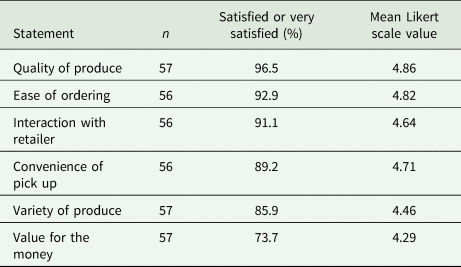
The majority of respondents were satisfied with every aspect of the F3B (Table 2). The highest rates of satisfaction pertained to box contents (quality and variety) and logistical aspects (ease of ordering, retailer interactions and pick-up convenience). Slightly lower rates of satisfaction were expressed regarding price, item quantity and pick-up convenience.
Respondents' satisfaction with F3B

Nearly all respondents were satisfied with produce quality, a characteristic frequently mentioned by respondents when asked what they liked most about F3B. ‘Quality’, interpreted subjectively, referred to perceived freshness, taste and appearance of the produce. One respondent enthused that they liked, ‘All the beautiful and delicious vegetables’, while another noted the: ‘Top quality clean produce’. Of note, no respondent mentioned quality when reflecting on what they liked least about F3B.
Most respondents were satisfied with the variety of F3B produce (Table 2) and many mentioned this when referring to what they liked most (n = 11). However, one respondent said the ‘Lack of variety of this week's menu’ was their least-liked characteristic. More commonly, respondents expressed dissatisfaction with specific items they received (‘Peppers! I can't eat them so I have to give them away.’, ‘Eggplant (sad face)’) but also mentioned items they liked most (‘Fresh carrots!’, ‘Cantaloupe!’).
Respondents' attitudes toward new or unfamiliar vegetables also differed. Eight respondents expressed an adventurous attitude and seemed to enjoy the surprise and challenge of farmer-selected F3B contents. As one respondent declared: ‘I rose to the challenge of eating everything received’, while another stated it was ‘Fun to see what was in the box’. However, several respondents wanted more information about these ‘surprise’ vegetables. As one succinctly stated: ‘I would of [sic] loved to have seen a list of the veggies that I received. I wasn't sure what one thing was.’
Respondents frequently mentioned convenience when discussing what they liked most about F3B. For example, many liked being able to order an F3B on a week-to-week basis, and sometimes contrasted this with the convenience of DTC options. As one respondent said, ‘I liked being able to continue supporting [the farm], since I had previously been a CSA member but couldn't travel to the farm this year to get the food.’ For this person, F3B allowed them to continue consuming local food despite barriers to CSA participation. Another said they most liked that F3B gave them ‘all the veggies I want, 0 wasted ‘weird’ CSA veggies’. Considering that F3B was not customizable, this finding was interesting.
Inconveniences associated with the F3B pick-up process or communication were what respondents liked least; this mostly referred to problems at the farm and store level rather than issues with the overall F3B strategy. As one respondent said, ‘The weekly system wasn't consistent in terms of emails from the farm or location to get the food and timing in the store.’ Another said F3B was ‘not as convenient to pick-up as shopping at grocery store’ but did not expand on what made the model less convenient.
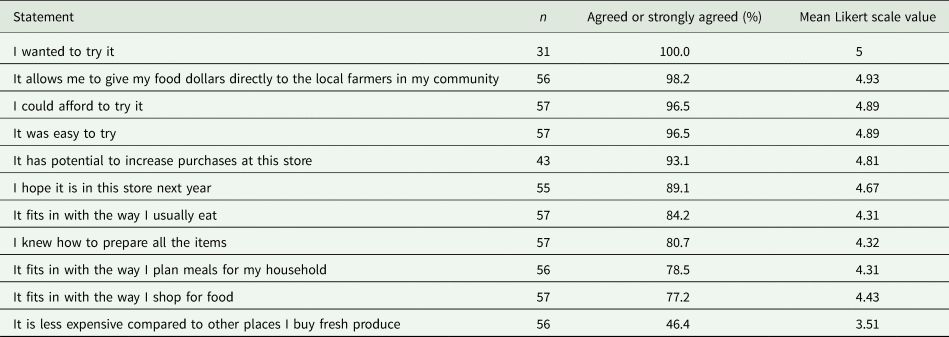
A lower percentage of respondents were satisfied with value for the money, though this still represented nearly three-quarters of the respondents (Table 2). Most agreed with the statements ‘I could afford to try it’ and ‘It was easy to try’ (Table 3). However, less than half agreed that F3B was less expensive compared to other places to purchase fresh produce (Table 3). Responses to open-ended questions about what respondents liked least about F3B helped explain and contextualize the relatively lower percentage of respondents who reported satisfaction with F3B value. Multiple respondents mentioned quantity: ‘For the price there was not much or not enough of the same thing.’ This indicates the respondent's awareness of the quantity of vegetables they received in relation to price, both generally and in terms of specific items. Interestingly, there were both positive and negative statements about the number of people the F3B would feed. One respondent said F3B contained, ‘not too much food (just enough for a week for 2 people)’, while another said that a ‘Whole box would not serve more than a 2–3 family if all items were combined’. Respondents with smaller families were pleased with the lack of food waste, but those with larger families felt they needed more produce.
Respondents' opinions about the F3B

On a scale from 1 to 5, please indicate your agreement with the following statements about the Food Box, with 1 = strongly disagree and 5 = strongly agree.
Respondent perceptions of F3B in comparison to other DTC options
One of the stated goals of the F3B strategy was to reach consumers who are unable to access healthy foods at local stores and face barriers to participation in other DTC market channels. To assess this, respondents were separated into two categories: those who typically purchase produce through a CSA (n = 25), and those who do not (n = 18). Interestingly, non-CSA consumers had higher rates of satisfaction with almost all aspects of F3B compared to CSA consumers. Most of these findings were not statistically significant (Table 4), with the exception of satisfaction with pick-up convenience: 76.5% of non-CSA consumers were satisfied compared with 96% of CSA customers.
Respondent satisfaction with F3B based on previous CSA purchases

On a scale from 1 to 5, please rate your satisfaction with the Food Box, with 1 = very dissatisfied and 5 = very satisfied.
Less than half of all respondents agreed with the survey statement that F3B ‘is less expensive than other places I buy fresh produce’ (Table 3). Respondents tended to mention other DTC food options when responding to what they liked most, implying that F3B compared favorably with other DTC options. Only one respondent compared F3B to the grocery store negatively under the ‘Like Least’ open-ended question. Several respondents expressed appreciation for not having to make long-term commitments.
Regarding the cost of F3B compared to other market channels, one respondent stated: ‘More expensive than buying from a store but I don't mind supporting the farm (smiley face)’. This respondent clearly wanted to support local farmers, perhaps because they had previously purchased produce through DTC channels. Using Galt et al.'s (Reference Galt, Bradley, Christensen and Munden-Dixon2019) theory of ‘CSA people’, this respondent was resilient against the perceived relatively higher price, because she valued other aspects of F3B, such as benefits to the farmer. Another person stated: ‘seemed to not be as much food as I could have purchased directly at the Farmer's Market’. This comparison was notable because this respondent did not see F3B as a superior alternative to other DTC channels in terms of value.
All non-CSA respondents agreed that F3B was easy to try and that they could afford to try it. Non-CSA and CSA respondents were similar in their agreement with statements about how F3B matched their lifestyle, except for the statement ‘It fits in with the way I usually eat’ (Table 5). Here, 77.8% of non-CSA respondents agreed, in comparison to 96% of CSA respondents (P = 0.07, trending toward statistically significant).
Respondent agreement with statements on F3B based on previous CSA purchases

Discussion
Overall, the majority of respondents expressed satisfaction with every aspect of F3B. Respondents were especially enthusiastic about produce quality. Many also enjoyed the variety and ‘surprise’ of discovering the box contents. F3B was viewed as a convenient option for obtaining fresh local produce. Further, the findings suggest that F3B may have reached a new demographic: while only 5% of respondents were first-time DTC consumers, 42% had never purchased a CSA. It may be that F3B is different enough—in cost, perceived availability or freedom from commitment—to attract those consumers that would not choose to purchase a CSA.
Overall, the similar rates of satisfaction and agreement between non-CSA and CSA consumers indicate that F3B met respondents' needs, even if they had no prior experience with a CSA. The only statistically significant difference was that a lower percentage of non-CSA than CSA respondents were satisfied with pick-up convenience. This aligns with Galt et al.'s (Reference Galt, Bradley, Christensen and Munden-Dixon2019) findings that ‘CSA people’ were more resilient to perceived inconveniences that ‘non-CSA people’, because they value its collective benefits.
Being able to order F3B on an as-needed basis was an aspect that respondents found to be convenient. Several also appreciated that F3B required no long-term commitment, in contrast to a CSA. Since respondents were most inconvenienced by implementation issues at the farm and store level, it may be useful to apply the advice of Zorbas et al. (Reference Zorbas, Mccartan, De Mel, Narendra, Tassone, Yin and Palermo2018): to make sure sufficient team capacity and resources are in place and find a suitable pick-up point. However, while logistics and efficiency are important for farmers and retailers implementing F3B, it should be acknowledged that small farms and stores may be challenged by limited staff and minimal infrastructure. Consumers may be more forgiving of perceived inconveniences if they understand the nature of the limited resources of the retail site and the farm. Effective communication between producers and consumers can encourage the understanding that leads to long-term commitment and tolerance amongst consumers (Cox et al., Reference Cox, Holloway, Venn, Dowler, Hein, Kneafsey and Tuomainen2008). Introducing a new avenue of communication into the F3B strategy, such as a newsletter from farms, may help consumers be more resilient to perceived inconveniences.
All respondents were satisfied with F3B contents, particularly the quality of the vegetables. The main areas of dissatisfaction surrounding F3B contents had to do with wanting more or less of specific vegetables. This expectation of a predictable, abundant, year-round supply of food highlights a need for more widespread consumer education about the realities of small-scale farming and seasonality. The open-ended responses reveal respondents' desire for more information about F3B items, including storage instructions and recipes. Minimally, information on vegetable names and descriptions should be provided, along with cooking and storage tips.
Respondents mentioned that price was what they liked least about F3B, especially in relation to quantity. Multiple respondents believed that either the quantity of produce should be increased, or the price should be lowered. This reflects the findings of Miewald et al. (Reference Miewald, Holben and Hall2012), who found the most common reasons consumers discontinued the food box program were inconvenience and expense. However, lowering the price of F3B is not feasible for the farmer, who must make a living from selling their produce. The fact that one respondent felt F3B contained enough food for two people while another felt it was insufficient illuminates a potential area for adjustment to the model: consumers could customize the size and quantity of F3B contents based on the needs of their family. Customized boxes may increase the rates of satisfaction with the value of F3B without exploiting the farmer through lowered prices.
CSA and non-CSA respondents were similar in their agreement with statements about F3B, except for ‘It fits in with the way I usually eat’. Here, significantly less non-CSA respondents agreed. This difference may be due to norms promoted by the conventional food system, such as convenience; a predictable, abundant, year-round supply of food; less time allocated to housework; the belief that more choice leads to greater satisfaction; and habitually eating away from home and eating more processed foods (Forssell and Lankoski, Reference Forssell and Lankoski2017; Galt et al., Reference Galt, Bradley, Christensen and Munden-Dixon2019). CSA consumers are already going against these norms by participating in a market channel that requires them to pre-pay large sums of money for produce, is less convenient and is more expensive than a supermarket, but non-CSA consumers likely have different habits. People who purchase CSAs are more likely to be accustomed to preparing and cooking fresh vegetables from scratch (Allen et al., Reference Allen, Rossi, Woods and Davis2017). Torjusen et al. (Reference Torjusen, Lieblein and Vittersø2008) found that subscribers make changes in both food practice and attitudes through the use of more contextualized information about the food purchased. If box schemes are organized with an emphasis on the unique characteristics of locally grown food and the benefits of buying through a VBSC, understanding between different actors in the food system will increase.
Today, educating consumers about AFNs, VBSC and small-scale, local farming is especially relevant due to the impact of COVID-19 on food systems. Shopping at supermarkets is no longer the most convenient option—and for some, it is dangerous. This has resulted in a behavioral change in consumers, driving more people than ever to seek out local foods in their communities (Kolodinsky et al., Reference Kolodinsky, Sitaker, Chase, Smith and Wang2020). It is likely that F3B would be an even more appealing option than the CSA due to the convenience and low commitment. Providing information about F3B farms and the benefits of buying local foods will increase the likelihood of reaching a new consumer base, particularly due to increasing desire for supermarket and industrial food alternatives.
There are some limitations to this study. Non-response and self-selection bias may be responsible for the generally positive survey responses; those who purchased but did not like F3B may have not participated in the survey. Due to time and cost limitations of the grant, we do not have demographic data on the population who participated in the program to compare to the demographics of the survey respondents. Findings are based on a relatively small sample size, potentially impacting the generalizability of the results. The geographic generalizability of this research is limited because the strategy was only implemented in three states. This also made it difficult to analyze some of the survey data categorically, and likely contributed to the lack of statistical significance of almost all cross-tabulation analyses. Although the demographic profile of our respondents as primarily white and female, these findings are similar to demographics in other AFN studies.
Conclusions
The F3B strategy creates a new market channel between farmers and consumers and represents a major innovation that aims to enhance the development of rural entrepreneurship; develop new and creative economic and social opportunities for rural community vitality through innovative business opportunities and strategies; and promote the sustainability of small and medium-sized farms and rural communities.
High rates of satisfaction were reported with every aspect of F3B. In general, respondents were satisfied with F3B contents, especially with vegetable quality. Although most respondents enjoyed the variety provided in the box, they would benefit from additional information about weekly F3B contents. Some respondents expressed dissatisfaction with the price and relative quantity, and less than half perceived F3B to be a relatively cheaper way to purchase fresh produce. Regardless, most respondents were satisfied with the value of F3B. The main identified areas for model improvement are providing an increased emphasis on information and education, and an option to adjust the size of F3B based on perceived quantity needs.
The results of this study show the F3B strategy had mixed success with improving food access for rural residents. While a small percentage of respondents had never participated in a DTC market channel before, almost half of the respondents were not CSA consumers. F3B represents a step in the right direction in expanding access to local foods by increasing convenience (through pick-up locations) and reducing financial commitment (by allowing single box purchases). While most of the respondents had previously purchased produce through a DTC channel, almost half had never purchased a CSA and were satisfied with the convenience and contents of F3B, and mostly satisfied with the value. It is a difficult balance to make local food more accessible for a broader base of consumers while ensuring that the farmers and retailers are not being exploited through unfair expectations that have been promoted through the conventional food system. This study also highlights the importance of providing opportunities for communication between farmers and consumers to increase understanding of the difficulties of farming and resiliency against associated inconveniences with local food consumption.
Future research is needed to understand how to effectively deliver local food to populations with limited access to fresh produce. It is difficult to judge the overall success of an F3B strategy without incorporating data from consumers in addition to farmers and retailers, whose perspectives are necessary when making adjustments to future renditions of the F3B model. Research should continue in the communities where this model is being adopted, especially due to the recent economic and consumer behavior changes related to COVID-19.
Acknowledgements
We would like to thank the farmers, retailers and food box consumers who took part in this research, as well as our extension partners.
Financial support
This work is supported by the Innovation for Rural Entrepreneurs and Communities project no. VT-0075CG from the USDA National Institute of Food and Agriculture. USDA had no role in the design, analysis or writing of this article. Jane Kolodinsky is the Principle Investigator for Farm Fresh Food Boxes study.