Introduction
Early patterns of gut colonization may predispose children to disease risk later in life.Reference Penders, Stobberingh, van den Brandt and Thijs 1 , Reference Saavedra and Dattilo 2 The most dramatic developmental changes in the lower gut microbiome occur over the 1st year of life as bacterial burden increases and the assemblage becomes more anaerobic and shifts largely to fermentative metabolism.Reference Palmer, Bik, DiGiulio, Relman and Brown 3 , Reference Koenig, Spor and Scalfone 4 Despite changes in the gut microbiome occurring as a result of common early-life events (e.g. introduction of solid foods; weaning from breastfeeding/formula; transition to cow’s milk), sometime between ages 1 and 3 years the bacterial community becomes compositionally stable and largely resembles that of the adult gut microbiome.Reference Palmer, Bik, DiGiulio, Relman and Brown 3 – Reference Penders, Thijs and Vink 7 While there is growing research into the developing gut microbiome, there remains the need to study other potential prenatal or early-life determinants of the infant gut microbiome.Reference Azad, Konya and Maughan 8
Approximately 35% of pregnant women carry group B strep (GBS; Streptococcus agalactiae) vaginally and/or anorectally.Reference Dillon, Gray, Pass and Gray 9 While this is usually asymptomatic for the mother, there are serious, potentially devastating implications for neonatal health, including sepsis, pneumonia and meningitis, if it is transmitted to the neonate. Risk of such complications, particularly early-stage complications (i.e. within 1st week of life), has been markedly reduced with GBS screening and intrapartum prophylactic antibiotic use guidelines for those that screen positive. 10 , 11 These guidelines have not been without controversy. For instance, the number needed to be screened to reduce one early-stage complication is large, and there is little evidence that the guidelines prevent late-onset complications.Reference Sheehy, Davis and Homer 12 Furthermore, the use of peripartum antibiotics, which would include GBS prophylaxis in the intrapartum period, may negatively impact the developing neonatal gut microbiome and place that child at risk for other future diseases.Reference Bedford Russell and Murch 13
Little is known, however, about the role of GBS in the developing human microbiota. In the relatively limited published studies, there is conflicting evidence on whether pregnant women carrying GBS have differences in the vaginal microbiome. Kubota et al. Reference Kubota, Nojima and Itoh 14 examined the vaginal microbes in 4025 pregnant women 22–36 weeks of gestation in Japan; 408 (10.1%) women were GBS positive (GBS+). GBS+ women had fewer bacterial strains recovered and had lower percentages of anaerobes, fungi and Lactobacillus than GBS negative (GBS−) women.Reference Kubota, Nojima and Itoh 14 In a study of 623 healthy pregnant women, vaginal swabs were taken at gestational age 35–40 weeks and a culture-based approach used to identify specific isolates of the vaginal microbiome; women with GBS had frequent co-isolation of Candida albicans.Reference Bayo, Berlanga and Agut 15 In contrast, in a small study of 42 pregnant women (15 GBS+) conducted in Poland, there were no qualitative or quantitative differences in vaginal and rectal bacteria by GBS status.Reference Brzychczy-Wloch, Pabian and Majewska 16 Finally, in a study of 26 newborns with GBS+ mothers who received antibiotic prophylaxis and 26 newborns with GBS− mothers without antibiotic use, Aloiso et al. demonstrated that antibiotic prophylaxis for GBS resulted in decreased bifidobacteria counts in newborn stool (6–7 days of age).Reference Aloisio, Mazzola and Corvaglia 17
If the presence of GBS alters the vaginal microbiome of pregnant women, this potentially may also influence early-life microbial exposures encountered during birth, the development of the infant gut microbiome, and risk of future disease of the offspring. Thus, the aim of this study was to determine if maternal prenatal GBS carrier status, accounting for intrapartum antibiotic treatment, was associated with differences in the early-life gut microbiota of offspring in the racially and socioeconomically diverse Wayne County Health, Environment, Allergy and Asthma Longitudinal Study (WHEALS) birth cohort.Reference Havstad, Wegienka and Zoratti 18 , Reference Wegienka, Havstad and Joseph 19
Methods
WHEALS recruited pregnant women with due dates from September 2003 through December 2007, and who were seeing a Henry Ford Health System (HFHS) obstetrics practitioner at one of five clinics to establish a birth cohort.Reference Havstad, Wegienka and Zoratti 18 , Reference Wegienka, Havstad and Joseph 19 All women were in their second trimester or later, were aged 21–49 years, and were living in a predefined geographic area in western Wayne County that included the western portion of the city of Detroit as well as the suburban areas immediately surrounding the city. All participants provided written, informed consent and study protocols were approved by the Institutional Review Board at HFHS.
Stool specimens and sequencing of the gut microbiota
Home visits with participants were conducted targeting infant ages 1 and 6 months. Families were asked to retain the most recent soiled diaper prior to the home visit. These early-life specimens have been frozen since the day of collection at −80°C. The data for this analysis was generated for another study where stool specimens for gut microbiota analysis were selected on the basis of (1) having outcome data from the 2-year research clinic visit; (2) having a paired dust specimen available; and (3) family still actively participating in the study. When available, the stool specimen from the 6 month visit was selected for analysis; specimens from the 1 month visit were chosen when a 6 month visit sample was unavailable.
A total of 308 stool specimens from 308 subjects (i.e. a single specimen per subject) meeting these criteria were selected for microbiota analysis; the V4 region of the bacterial 16S rRNA gene was successfully sequenced in 298 stool specimens (130 from 1 month visits and 168 from 6 month visits) using the Illumina MiSeq (San Diego, CA) platform. Stool specimens from the 1 month visit were collected at a mean±standard deviation (s.d.) of 39.7±18.9 days and stool specimens from the 6 month visit were collected at a mean±s.d. of 211.0±34.2 days. Throughout, ‘1 month’ and ‘6 month’ specimens are used as labels of the intended time period of specimen collection.
Sequence data was processed in QIIME; operational taxonomic units (OTUs) were defined at 97% sequence similarity using open reference OTU picking.Reference Caporaso, Kuczynski and Stombaugh 20 The median sequence read depth was 316,200 (interquartile range=90,700; minimum=202,367; maximum=577,700). To account for the variation in read depth across sample, samples were rarefied to the minimum read depth. As rarefying the data once may result in an unrepresentative sampling of the bacterial community present (particularly when many rare taxa are present), each sample was rarefied multiple times (n=100 per sample) and the most representative sub-sampling, defined as that which exhibited the minimum average Euclidean distance from itself to all other sub-samplings for a given sample, was chosen to represent the bacterial community composition of that sample in downstream analyses.
GBS status
As part of routine prenatal care, GBS screening was conducted according to Centers for Disease Control and Prevention (CDC)/American Congress of Obstetricians and Gynecologists/ American Academy of Pediatrics guidelines in place at the time of WHEALS. 10 Briefly, between 35 and 37 weeks of gestation, a swab of the vagina and perianal region was obtained and cultured for GBS. Women who were GBS culture positive were then identified as requiring treatment with intrapartum antibiotics during labor. Maternal prenatal electronic medical records were abstracted and results from the GBS screening recorded. Infants were identified as colonized by GBS if at least one sequence read from an OTU represented by the species Streptococcus agalactiae was detected in their stool. Infant GBS-associated disease was identified using ICD-9 codes (041.0; 041.02; 038.0; 320.2) and defined as early-onset (0–6 days) or late-onset (7–89 days).
Covariate measurement
Maternal date of birth, race, marital status, number of previous births (parity) and current breastfeeding (at 1 month) were self-reported. Maternal prenatal and delivery medical records were abstracted to obtain height and weight at first prenatal care visit, antibiotic and antifungal use, mode of delivery, gestational age at delivery, infant birth weight and infant gender. Antibiotic use during pregnancy was defined as systemic antibiotic use (ingestion, intravenous, intramuscular) at any time during pregnancy, and antifungal use was defined as use of a vaginally applied antifungal medication any time during pregnancy.Reference Wegienka, Havstad and Zoratti 21 Antibiotic use during delivery was defined as any antibiotic given within 2 days before or on the date of delivery. Maternal body mass index at first prenatal care visit was defined as maternal weight (in kg) divided by maternal height (in m2). Gender- and gestational-age adjusted birth weight Z-scores were calculated using the US population as a reference.Reference Oken, Kleinman, Rich-Edwards and Gillman 22
Statistical methods
Maternal and neonatal characteristics were compared by maternal GBS status using a χ2 or Fisher’s exact test for discrete characteristics and a Wilcoxon rank sum test for continuous characteristics. There are known gut microbiota compositional changes over the first year of life;Reference Palmer, Bik, DiGiulio, Relman and Brown 3 , Reference Koenig, Spor and Scalfone 4 thus, all analyses were stratified by research visit (i.e. 1 or 6 month visit). Permutational multivariate analysis of variance (PERMANOVA) as implemented in the R veganReference Oksanen, Guillaume Blanchet and Kindt 23 package was used to assess compositional differences in the microbiota by maternal GBS status and other covariates of interest, using Unweighted and Weighted UniFrac as well as Canberra dissimilarity metrics.Reference Chen 24 , Reference Lozupone and Knight 25 These measures were chosen as they represent both phylogenetic measures (i.e. the UniFrac metrics, which take into account evolutionary relationships between sequences) and a non-phylogenetic measure (i.e. the Canberra metric, which is based on OTU counts). The Unweighted UniFrac measure considers the presence/absence of an OTU (giving equal consideration to both common and rare OTUs), while the Weighted UniFrac further incorporates information on the abundance of OTUs (emphasizing the impact of more common OTUs).Reference Chen, Bittinger and Charlson 26 In each PERMANOVA analysis, 10,000 Monte Carlo permutations were utilized. Alpha diversity indices of bacterial richness (number of unique OTUs present), evenness (relative distribution of OTUs in a community), and Inverse Simpson’s diversity were estimated using QIIME and the R veganReference Oksanen, Guillaume Blanchet and Kindt 23 package to further characterize the microbiota by GBS status, with tests of association between these measures and GBS status conducted using Wilcoxon rank sum tests. Individual bacterial OTUs were tested for differential abundance using a zero-inflated negative binomial model, or a standard negative binomial model in cases where the zero-inflated models failed to converge. Tests were performed unadjusted and adjusted for maternal race, antifungal use in pregnancy and intrapartum antibiotics. Multiple testing was corrected for using the False Discovery Rate (FDR) q-values,Reference Storey and Tibshirani 27 where a q-value<0.05 (equivalent to a false discovery rate threshold of <5%) was considered statistically significant. Except where otherwise noted, all analyses were carried out using the R programming language (version 3.1.1, R Foundation for Statistical Computing, Vienna, Austria).
Results
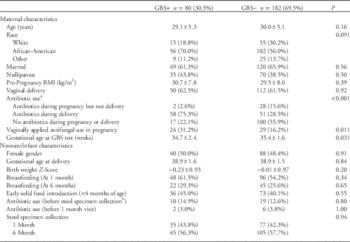
A total of 298 infants had gut microbiota profiles available. Several women did not have prenatal medical record abstraction (n=10) and 26 women had missing GBS data in their prenatal records; thus, 36 women were excluded from the analysis. We compared the 262 women in the analytic sample to the 36 women excluded from the analytic sample; among basic maternal and neonate characteristics (Table 1 variables), only mean gestational age at delivery was different in women who were and were not included in the analytic sample (38.9±1.5 v. 37.9±2.4 weeks, respectively; P=0.019).
Descriptive characteristics of maternal-child pairs, stratified by maternal group B Streptococcus (GBS) colonization

BMI, body mass index.
Data are n (%) or mean±s.d.
a Mututally exclusive categories.
b Before specimen collection for 1 month stools or before 1 month visit for 6 month stools.
We compared children with 1 month v. 6 month stool (i.e. independent children) to evaluate any systematic differences. No factor (Table 1 variables) was statistically significant (all P>0.05) except for antibiotic use before stool specimen collection. Children with 6 month stool specimens had more antibiotic exposure before stool specimen collection (22.4%) compared with 2.9% in those with 1 month stool specimen collection (P<0.001). However, when exposure times were standardized by restricting to antibiotic use before the 1 month visit in both groups, there were no differences in rates of very early life antibiotic use (P=0.73).
A total of 80 (30.5%) women were GBS+. Table 1 presents characteristics of the analytic sample by maternal GBS colonization. Mean gestational age at GBS test was lower in GBS+ (34.7±2.4 weeks) compared with GBS− (35.4±1.6 weeks) women (P=0.031). There were suggestive racial differences in maternal GBS colonization, where African American women were more likely GBS+ (P=0.091). As expected, GBS+ women were significantly more likely to have received antibiotics during delivery than GBS− women (58 (75%) v. 51 (29%), P<0.001). Among the 80 GBS+ women, 58 (75%) used antibiotics during delivery, 2 (3%) used antibiotics during pregnancy but not delivery, and 17 (22%) never used antibiotics during pregnancy or delivery (three unknown). GBS+ women who delivered vaginally were more likely to use antibiotics during delivery compared with GBS+ women who delivered via C-section, though these differences did not reach statistical significance (39 (83%) v. 19 (63%), respectively; P=0.093). GBS+ women were also more likely to have used a vaginally applied antifungal medication during pregnancy (P=0.011). One infant developed late-onset GBS, accompanied by pneumonia, at age 7 days.
Maternal GBS status and the infant gut microbiota
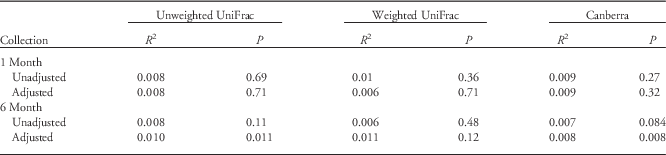
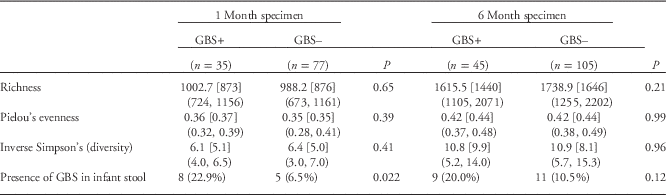
There was no evidence that maternal GBS status was associated with microbial composition in the specimens from the 1 month visit either before or after covariate adjustment (Table 2). However, after adjusting for maternal race, prenatal antifungal use, and intrapartum antibiotics, there was evidence maternal GBS status explained a portion of the observed variation in gut microbiota composition in specimens from the 6 month visit (Table 2). Both the Canberra metric (R 2=0.008, P=0.008), which is the non-phylogenetic measure and the unweighted UniFrac metric (R 2=0.010, P=0.011), which is the phylogenetic measure, suggested that GBS status was statistically significantly associated with gut microbiota composition in specimens from the 6 month visit (Table 2). There were no differences in the alpha diversity metrics at 1 or 6 months by maternal GBS status (Table 3). There was no difference in the association between maternal GBS status and microbial composition stratified by mode of delivery or breastfeeding (data not shown).
Association of maternal group B Streptococcus (GBS) colonization with infant gut microbial composition by collection time-point, unadjusted and adjusted for maternal race, antifungal use in pregnancy and intrapartum antibiotics

P is the permutational multivariate analysis of variance P-value.
R 2 is proportion of variance of the gut microbiota composition explained.
Gut microbiota alpha diversity indices or infant group B Streptococcus (GBS) colonization at 1 and 6 month specimen collection by maternal GBS colonization

Data are mean [median] (25th, 75th percentile) or N (%).
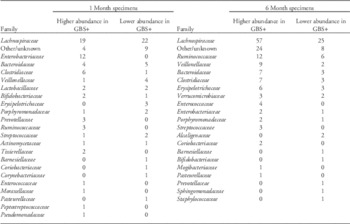
In both 1 and 6 month specimens, in models adjusted for maternal race, prenatal antifungal use and intrapartum antibiotics, we found evidence of differences in individual OTUs by GBS status. The count of the number of statistically significant OTUs within a family are presented by specimen timing in Table 4. In the 1 month specimens, there were a total of 121 differential OTUs (q<0.05), 65 of which were in significantly higher abundance in infants of GBS+ mothers, and 56 of which were in significantly lower abundance in infants of GBS+ mothers (Table 4; see Supplementary Table S1 for specific OTUs). In the 1 month specimens, infants of GBS+ mothers had higher abundances of specific Clostridiaceae and Enterobacteriaceae OTUs and were relatively depleted of Veillonellaceae OTUs compared with infants of GBS− mothers. In the 6 month specimens, there were a total of 201 differential OTUs (q<0.05), 140 of which were in significantly higher abundance in infants of GBS+ mothers, and 61 of which were in significantly lower abundance in infants of GBS+ mothers (Table 4; see Supplementary Table S2 for specific OTUs). Infants of GBS+ mothers had higher abundances of specific Clostridiaceae, Ruminococcoceae, and Enterococcaceae OTUs compared with infants of GBS− mothers.
Number of discriminatory operational taxonomic units (OTUs) found to be significantly different (q<0.05) in relative abundance in infant stool specimens at 1 month or 6 months based on maternal group B Streptococcus (GBS) status, after adjusting for maternal race, prenatal antifungal use and intrapartum antibiotic use

Family is presented in order of overall abundance (higher to lower), by time of specimen.
We conducted a sensitivity analysis examining the association of GBS status, stratified by intrapartum antibiotic use. In women who used intrapartum antibiotics, there was no evidence that GBS was associated with infant gut microbiota in either the 1 or 6 month specimen (all P>0.18). In contrast, there was marginal evidence that among women without intrapartum antibiotic use, GBS status was associated with compositionally distinct microbiota at 6 month visit only (Unweighted UniFrac R 2=0.014; P=0.10).
Maternal GBS and evidence for GBS colonization in the infant
Infants born to GBS+ mothers were more likely to have GBS detected in their stool (Table 3); this was statistically significant for specimens from the 1 month visit. The association between maternal GBS status and GBS colonization in the infant gut in the 1 month specimen varied by delivery mode; in the specimens from the 1 month visit, children born vaginally to GBS+ mothers were more likely to be colonized with GBS than children born vaginally to GBS- mothers (P=0.016) whereas there was no association in children born via C-section (P=1.0). Among GBS+ mothers, there was no difference by breastfeeding in infant GBS colonization in stool from the 1 month (11.8% v. 33.3% in those who breastfed v. not; P=0.23) or 6 month visits (25.8% v. 8.3% in those who breastfed v. not; P=0.41). Similarly, among GBS+ mothers, there was no statistically significant difference by antibiotic use during delivery in infant GBS colonization in stool from the 1 month (23.1% v. 25.0% in those who did v. did not receive antibiotic during delivery; P=1.00) or 6 month visits (15.6% v. 36.4% in those who did v. did not receive antibiotic during delivery P=0.20).
Discussion
To our knowledge, this is the first study to examine the association between maternal GBS status, adjusted for intrapartum antibiotic use, and the infant gut microbiota. There was evidence that maternal GBS status was associated with gut microbiota composition in infant stool specimens collected at ~6 months of age. In our sample, infant gut GBS colonization in specimens from the 1 month visit was associated with maternal GBS status, indicating that maternal transmission of GBS to her infant occurs and persists for several weeks postnatally.
In our study, we detected taxonomic differences by maternal GBS status in specimens from the 6 month visit. Specifically, infants of GBS+ mothers had higher abundances of certain Clostridiaceae, Ruminococcoceae, and Enterococcaceae OTUs. These taxonomic differences may represent groups of taxa that both co-exist and compete with GBS and therefore result in abundance shifts dependent on maternal GBS status.Reference Ling, Li and Liu 29 , Reference Bryant, Cheng and Caughey 30 Interestingly, in the 1 month specimen, children of GBS+ mothers also had higher abundances of Clostridiaceae OTUs compared with children of GBS− mothers. Clostridiaceae, which are members of the Firmicutes phylum, have been shown to be enriched in children at risk for diseases such as celiac diseaseReference Olivares, Neef and Castillejo 28 and in children with food allergy.Reference Ling, Li and Liu 29 Future studies examining if maternal GBS status is associated with differential risk of disease in offspring, and whether this is mediated via alterations in the gut microbiome, are needed.
Approximately 30% of our mothers were GBS+, which is consistent with previously reported rates of GBS carriage of ~35%.Reference Dillon, Gray, Pass and Gray 9 As described elsewhere,Reference Bryant, Cheng and Caughey 30 African-American women were more likely to be GBS+. There was a slight statistical difference in week of GBS testing by GBS positivity (34.7±2.4 weeks in GBS+ and 35.4±1.6 weeks in GBS− mothers); whether this is a real difference that may be influenced by changes in the vaginal microbiome over pregnancy or is simply chance requires further study. Women who were GBS+ were more likely to have used antibiotics and antifungals during pregnancy. GBS during pregnancy, although often asymptomatic, can cause urinary tract infectionReference Winn 31 which may lead to antibiotic use during pregnancy. Bayo et al. Reference Bayo, Berlanga and Agut 15 describe that C. albicans is often co-isolated with GBS in pregnant women, which may explain the higher rate of antifungal use in this group.
In our sample of GBS+ mothers, there was evidence in the medical record that 75% were treated with antibiotic prophylaxis during delivery, which is consistent with previously reported rates of ~74.5% in a study conducted in ItalyReference Berardi, Rossi and Creti 32 and slightly lower than multi-state rates in the United States of 85%.Reference Van Dyke, Phares and Lynfield 33 It is possible that some use of antibiotic prophylaxis during delivery was missed during medical record transcription and/or abstraction and thus we may be subject to some misclassification error in our analysis. However, missed opportunities to further reduce risk of early-onset GBS in neonates via appropriate use of intrapartum antibiotic use is of concern, with efforts underway by CDC and others to institute electronic reminders for appropriate adherence to GBS guidelines.Reference Schrag and Verani 34 Interestingly, in our study, among GBS+ mothers, rates of GBS colonization in infant stool did not statistically significantly differ by antibiotic use during delivery, although rates of colonization were slightly lower at the 6 month study visit among infants whose mothers received antibiotics during delivery (15.6% v. 36.4%).
Intrapartum penicillin administration, which is a typical regimen for mothers who are GBS+ or GBS status unknown, has been associated with only minimal differences in the infant gut microbiome at age 3 days.Reference Jaureguy, Carton and Panel 35 Specifically, in a study of 50 mother-child pairs (25 antibiotic exposed) that used a culture-based approach to quantify the gut microbiota, infants exposed to intrapartum penicillin were less likely to have Clostridium species than non-intrapartum antibiotic exposed children but there were no differences in aerobic bacteria or amoxicillin-resistant Enterobacteria.Reference Jaureguy, Carton and Panel 35 In a study of 13 term infants (three exposed to intrapartum antibiotics), infants exposed to intrapartum antibiotics had statistically significant enriched numbers of enterobacteriacea and lower numbers of Bacteriodaceae; in this study, differences by intrapartum antibiotic use became apparent only in later samples (e.g. infant age 30 days) but was not detected in earlier samples.Reference Arboleya, Sanchez and Milani 36 A recent study by Aloisio et al. Reference Aloisio, Mazzola and Corvaglia 17 demonstrated that in infants (age 6–7 days) born to GBS+ mothers using antibiotics, compared with infants of GBS− mothers not using antibiotics, there was a decrease in bifidobacteria counts. At both 1 and 6 month visits, infants of GBS+ mothers also had differences in Bifidobacteriaceae in our study. Differential timing of the stool specimen collection, microbiota measurement technique (e.g. Aloisio used real-time PCRReference Aloisio, Mazzola and Corvaglia 17 compared with sequencing in the current study) and different comparison groups, however, makes direct comparison of our findings to those of previous studies challenging.
While the sources of exposure of infants to GBS may vary (e.g. nosocomial, community), vertical transmission from the mother to infant may be the most common.Reference Berardi, Rossi and Creti 32 , Reference Berardi, Rossi and Lugli 37 In the current study, mothers who were GBS+ were more likely to have infants with GBS present in their stool from the 1 month visit. When stratified by mode of delivery, this association remained only among vaginally born children, indicating that at least some of the GBS transmission from mother to baby likely takes place at the time of delivery. Hickman et al. Reference Hickman, Rench, Ferrieri and Baker 38 (1999) have similarly shown that GBS colonization at 24–48 h post-birth (in infants born to GBS+ mothers) is less common in C-section born infants. Previous studies have demonstrated that mode of delivery is a key determinant of the infant gut microbiota; the skin, gut and oral bacterial communities of newborns delivered vaginally resemble their mother’s vaginal microbiome whereas those born by C-section have bacterial communities more closely resembling maternal skin.Reference Dominguez-Bello, Costello and Contreras 39 Differences in microbiome composition by delivery mode appear to persist into infancy.Reference Azad, Konya and Maughan 8
After adjusting for maternal race, prenatal antifungal use and intrapartum antibiotics, GBS status explained ~0.8–1% of the variation in the infant gut microbiota from the 6 month visit, depending on the metric used. Mode of delivery and breastfeeding are considered the strongest determinants of the infant gut microbiome composition;Reference Penders, Thijs and Vink 7 these factors explain 1.4–2.5% and 1.3–2.6% of the variation in the 6 month gut microbiota in this sample of WHEALS children, respectively. Thus, although GBS explains only ~1% of the variation in the gut microbiota at the 6 month visit in WHEALS, given the large amount of variation within the gut microbiota, it is relatively consistent with even the largest known determinants of the infant gut microbiota.
Strengths and limitations
There are several limitations to note for this study. Women were screened for GBS according to standard clinical protocols, however, late third-trimester screening for GBS compared with intrapartum testing is associated with a ~10% false negative rate, thus we may be underestimating the burden of GBS+ at the time of delivery.Reference Towers, Rumney and Asrat 40 We were unable to account for timing/duration of intrapartum antibiotic use in our analysis. There are mixed conclusions regarding the efficacy of the timing and duration of intrapartum antibiotic use in preventing the vertical transmission of GBS.Reference Illuzzi and Bracken 41 , Reference Berardi, Rossi and Guidotti 42 There may be differences in the infant gut microbiota among GBS+ women due to differences in the prophylaxis strategy employed that we were unable to account for in the current study. A major strength of the current study was the use of sequencing to measure the infants’ gut microbiota. Sequencing, compared with a culture-based approach, allows for an unbiased survey of the entire bacterial community. However, further studies examining metagenomic content of these communities is necessary to fully understand the functional implications of the observed compositional differences. The racial diversity and size of our study sample is also important.
In summary, we found that maternal GBS status is associated with compositional differences in the infant gut microbiota from specimens collected at approximate age 6 months, which may represent groups of taxa that both co-exist and compete with GBS and therefore result in abundance shifts dependent on maternal GBS status. Whether these changes influence a child’s future risk for adult disease requires additional study.
Acknowledgments
None.
Financial Support
This study was supported by the National Institutes of Health (R01 AI050681, R01 HL113010 and P01 AI089473) and the Fund for Henry Ford Hospital.
Conflicts of Interest
None.
Ethical Standards
The authors assert that all procedures contributing to this work comply with the ethical standards of the relevant national guidelines on human experimentation in the United States of America and with the Helsinki Declaration of 1975, as revised in 2008, and has been approved by the Institutional Review Board at Henry Ford Health System.
Supplementary Material
To view supplementary material for this article, please visit http://dx.doi.org/10.1017/S2040174415001361