1. Introduction
Addiction can be operationally defined as the continued making of maladaptive choices, even in the face of the explicitly stated desire to make a different choice (see the Diagnostic and Statistical Manual of Mental Disorders [DSM-IV-TR], American Psychiatric Association 2000; International Classification of Diseases [ICD-10], World Health Organization 1992). In particular, addicts continue to pursue drugs or other maladaptive behaviors despite terrible consequences (Altman et al. Reference Altman, Everitt, Robbins, Glautier, Markou, Nutt, Oretti and Phillips1996; Goldstein Reference Goldstein2000; Koob & Le Moal Reference Koob and Le Moal2006; Lowinson et al. Reference Lowinson, Ruiz, Millman and Langrod1997). Addictive drugs have been hypothesized to drive maladaptive decision-making through pharmacological interactions with neurophysiological mechanisms evolved for normal learning systems (Berke Reference Berke and Wang2003; Everitt et al. Reference Everitt, Dickinson and Robbins2001; Hyman Reference Hyman2005; Kelley Reference Kelley2004a; Lowinson et al. Reference Lowinson, Ruiz, Millman and Langrod1997; Redish Reference Redish2004). Addictive behaviors have been hypothesized to drive maladaptive decision-making through interactions between normal learning systems and the reward distribution of certain behaviors (Custer Reference Custer1984; Dickerson & O'Connor Reference Dickerson and O'Connor2006; Dowling et al. Reference Dowling, Smith and Thomas2005; Parke & Griffiths Reference Parke and Griffiths2004; Redish et al. Reference Redish, Jensen, Johnson and Kurth-Nelson2007; Wagenaar Reference Wagenaar1988). However, how those interactions drive maladaptive decision-making remains a key, unanswered question.
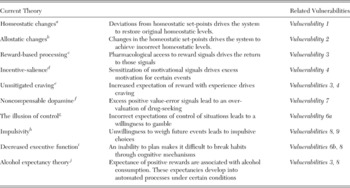
Over the last 30 years, a number of theories have been proposed attempting to explain why an agent might continue to seek a drug or maladaptive behavior. These theories can be grouped into the following primary categories: (1) opponent processes, based on changes in homeostatic and allostatic levels that change the needs of the agent (Becker & Murphy Reference Becker and Murphy1988; Koob & Le Moal Reference Koob and Le Moal1997; 2001; Reference Koob and Le Moal2005; 2006; Solomon & Corbit Reference Solomon and Corbit1973; Reference Solomon and Corbit1974); (2) reward-based processes and hedonic components, based on pharmacological access to hedonically positive signals in the brain (Kalivas & Volkow Reference Kalivas and Volkow2005; Volkow et al. Reference Volkow, Fowler and Wang2003; Reference Volkow, Fowler, Wang and Swanson2004; Wise Reference Wise2004); (3) incentive salience, based on a sensitization of motivational signals in the brain (Berridge & Robinson Reference Berridge and Robinson1998; Reference Berridge and Robinson2003; Robinson & Berridge Reference Robinson and Berridge1993; Reference Robinson and Berridge2001; Reference Robinson and Berridge2003; Reference Robinson and Berridge2004); (4) non-compensable dopamine, based on a role of dopamine as signaling an error in the prediction of the value of taking an action, leading to an overvaluation of drug-seeking (Bernheim & Rangel Reference Bernheim and Rangel2004; Di Chiara Reference Di Chiara1999; Redish Reference Redish2004); (5) impulsivity, in which users make rash choices, without taking into account later costs (Ainslie Reference Ainslie1992; Reference Ainslie2001; Ainslie & Monterosso Reference Ainslie and Monterosso2004; Bickel & Marsch Reference Bickel and Marsch2001; Giordano et al. Reference Giordano, Bickel, Loewenstein, Jacobs, Marsch and Badger2002; Odum et al. Reference Odum, Madden and Bickel2002); (6) situation recognition and categorization, based on a misclassification of situations that produce both gains and losses (Custer Reference Custer1984; Griffiths Reference Griffiths1994; Langer & Roth Reference Langer and Roth1975; Redish et al. Reference Redish, Jensen, Johnson and Kurth-Nelson2007; Wagenaar Reference Wagenaar1988); and (7) deficiencies in the balance between executive and habit systems, in which it becomes particularly difficult to break habits through cognitive mechanisms either through over-performance of the habit system (Robbins & Everitt Reference Robbins and Everitt1999; Tiffany Reference Tiffany1990) or under-performance of flexible, executive, inhibitory systems (Gray & McNaughton Reference Gray and McNaughton2000; Jentsch & Taylor Reference Jentsch and Taylor1999; Lubman et al. Reference Lubman, Yücel and Pantelis2004) or a change in the balance between them (Bechara Reference Bechara2005; Bickel et al. Reference Bickel, Miller, Yi, Kowal, Lindquist and Pitcock2007; Everitt et al. Reference Everitt, Dickinson and Robbins2001; Everitt & Wolf Reference Everitt and Wolf2002). (See Table 1.)
Theories of addiction

Related References:
a. Solomon and Corbit (Reference Solomon and Corbit1973; Reference Solomon and Corbit1974); Koob and Le Moal (Reference Koob and Le Moal1997; 2001; Reference Koob and Le Moal2005; 2006).
b. Kalivas and Volkow (Reference Kalivas and Volkow2005); Volkow et al. (Reference Volkow, Fowler and Wang2003, Reference Volkow, Fowler, Wang and Swanson2004); Wise (Reference Wise2004).
c. Berridge and Robinson (Reference Berridge and Robinson1998; Reference Berridge and Robinson2003); Robinson and Berridge (Reference Robinson and Berridge1993; Reference Robinson and Berridge2001; Reference Robinson and Berridge2003; Reference Robinson and Berridge2004).
d. Bernheim and Rangel (Reference Bernheim and Rangel2004); Di Chiara (Reference Di Chiara1999); Redish (Reference Redish2004).
e. Ainslie (Reference Ainslie1992; Reference Ainslie2001); Ainslie and Monterosso (Reference Ainslie and Monterosso2004); Bickel and Marsch (Reference Bickel and Marsch2001); Reynolds (Reference Reynolds2006).
f. Custer (Reference Custer1984); Griffiths (1994); Langer and Roth (Reference Langer and Roth1975); Redish et al. (Reference Redish, Jensen, Johnson and Kurth-Nelson2007); Wagenaar (Reference Wagenaar1988).
g. Everitt and Wolf (Reference Everitt and Wolf2002); Everitt et al. (Reference Everitt, Dickinson and Robbins2001); Nelson and Killcross (Reference Nelson and Killcross2006); Robbins and Everitt (Reference Robbins and Everitt1999).
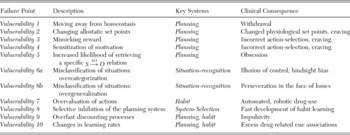
Although each of these theories has been attacked as incomplete and unable to explain all of the addiction data, the theories are not incompatible with each other. We argue, instead, that each theory explains a different vulnerability in the decision-process system, capable of driving the agent to make an addictive choice. Thus, the set of theories provides a constellation of potential causes for addictive choice behavior. Each different drug of abuse or maladaptive behavior is likely to access a subset of that constellation of potential dysfunction. Individual differences are likely to define the importance of each vulnerability for an individual's dysfunction. Successful treatment depends on treating those vulnerabilities that are driving the individual's choice. The identification of addiction as vulnerabilities in the biological decision-making system means that understanding addiction will require an understanding of how animals (including humans) make decisions.
The understanding of decision processes has come together in recent years to form a unified theory of decision-making arising from multiple interacting systems (Cohen & Squire Reference Cohen and Squire1980; Daw et al. Reference Daw, Niv and Dayan2005; Dickinson Reference Dickinson1980; Reference Dickinson1985; Nadel Reference Nadel, Schacter and Tulving1994; O'Keefe & Nadel Reference O'Keefe and Nadel1978; Packard & McGaugh Reference Packard and McGaugh1996; Redish Reference Redish1999; Squire Reference Squire1987). Briefly, a decision can arise from a flexible planning system capable of the consideration of consequences or from a less flexible habit system in which actions are associated with situations (Daw et al. Reference Daw, Niv and Dayan2005; Redish & Johnson Reference Redish and Johnson2007). Behavioral control can be transferred from one system to the other depending on the statistics of behavioral training (Balleine & Dickinson Reference Balleine and Dickinson1998; Colwill & Rescorla Reference Colwill and Rescorla1990; Killcross & Coutureau Reference Killcross and Coutureau2003; Packard & McGaugh Reference Packard and McGaugh1996). Both systems also require a recognition of the situation in which the agent finds itself (Daw et al. Reference Daw, Courville and Touretzky2006; Redish et al. Reference Redish, Jensen, Johnson and Kurth-Nelson2007; Redish & Johnson Reference Redish and Johnson2007). These processes provide multiple access points and vulnerabilities through which the decision process can be driven to make maladaptive choices.
2. Scope of the work
Addiction is a complex phenomenon, with causes that can be identified from many perspectives (Volkow & Li Reference Volkow and Li2005a; West Reference West2001), including social (Davis & Tunks Reference Davis and Tunks1991), environmental (DeFeudis Reference DeFeudis1978; Dickerson & O'Connor Reference Dickerson and O'Connor2006; Maddahian et al. Reference Maddahian, Newcomb and Bentler1986; Morgan et al. Reference Morgan, Grant, Gage, Mach, Kaplan, Prioleau, Nader, Buchheimer, Ehrenkaufer and Nader2002), legal (Dickerson & O'Connor Reference Dickerson and O'Connor2006; Kleber et al., Reference Kleber, Califano, Demers, Lowinson, Ruiz, Millman and Langrod1997; MacCoun Reference MacCoun1993), as well as psychological and neurobiological (Goldman et al. Reference Goldman, Brown, Christiansen, lsn and lsn1987; Reference Goldman, Boca, Darkes, Leonard and lsn1999; Heyman Reference Heyman1996; Reference Heyman2000; Koob & Le Moal Reference Koob and Le Moal2006; Redish Reference Redish2004; Robinson Reference Robinson2004; Robinson & Berridge Reference Robinson and Berridge2003; Tiffany Reference Tiffany1990), economic (Ainslie Reference Ainslie1992; Reference Ainslie2001; Becker & Murphy Reference Becker and Murphy1988; Bernheim & Rangel Reference Bernheim and Rangel2004; Hursh Reference Hursh1991; Hursh et al. Reference Hursh, Galuska, Winger and Woods2005), and genetic (Crabbe Reference Crabbe2002; Goldman et al. Reference Goldman, Oroszi and Ducci2005; Hiroi & Agatsuma Reference Hiroi and Agatsuma2005) perspectives. All of these perspectives have explanatory power as to the causes of addiction, and all of them provide suggested methods of treatment of addiction. However, a thorough treatment of addiction from all of these perspectives is beyond the scope of a paper such as this one. In this target article, we address an explanation for addictive decisions based on animal learning theory, the neuroscience of learning and memory, human decision-making, and neuroeconomics, which we argue have converged on a unified theory of decision-making as arising from an interaction between two learning systems (a quickly learned, flexible, but computationally expensive-to-execute planning system and a slowly learned, inflexible, but computationally inexpensive-to-execute habit system).
2.1. Our goals
The goal of this target article is to lay out a novel explanation for addiction as “vulnerabilities” in an established decision-making system. Although many of the vulnerabilities that we describe can be identified closely with current theories of addiction (see, e.g., Table 5), those theories have generally arisen from explanations of specific experiments and have all been attacked as incomplete. Our article is the first to identify them as “failure points” in a unified decision-making system. This theory has implications for the taxonomy of addiction, both drug-related and behavioral, as well as implications for prevention and treatment. These implications are addressed at the end of the article.
Although we do not directly address the social, environmental, or policy-level theories, we believe that our proposed framework will have implications for these viewpoints on addiction. For example, changes in drug price, taxes, legality, and level of policing can change the costs required to reach the addictive substance or behavior (Becker et al. Reference Becker, Grossman and Murphy1994; Grossman & Chaloupka Reference Grossman and Chaloupka1998; Liu et al. Reference Liu, Liu, Hammit and Chou1999). The presence of casinos can provide cues triggering learned associations (Dickerson & O'Connor Reference Dickerson and O'Connor2006). Acceptability of use and punishments for use will affect the relationship between rewards and costs (Goldman et al. Reference Goldman, Brown, Christiansen, lsn and lsn1987; Reference Goldman, Boca, Darkes, Leonard and lsn1999). Genetics will shape the person's vulnerabilities to the potential failure points noted further on and will have to be an important part of the individual's treatment plan (Goldman et al. Reference Goldman, Oroszi and Ducci2005; Hiroi & Agatsuma Reference Hiroi and Agatsuma2005).
Before proceeding to the implications of this theory, we first need to lay out the unified model of the decision-making system (sect. 3). As we go through the components of this system, we point out the identifiable vulnerabilities as they arise. In section 4, we then return to each identified vulnerability in turn and discuss the interactions between that vulnerability and specific drugs and problematic behaviors. In section 5, we discuss the implications of this theory for individual susceptibility to addiction, for multiple pathways to relapse, and for the necessity of making available multiple appropriately guided treatment regimens. In section 6, we turn to social, political, and clinical implications, lay out open questions, and suggest future directions for addiction research. Finally, we include an appendix reviewing the known effects of six drugs and problematic behaviors, discussed in the light of the vulnerabilities identified in this article (A: cocaine; B: opiates; C: nicotine; D: alcohol; E: caffeine; and F: gambling).
3. Making decisions
Theories of how animals make decisions have been developed over the last 50 years in the fields of economics (Ainslie Reference Ainslie1992, Reference Ainslie2001; Becker & Murphy Reference Becker and Murphy1988; Bernheim & Rangel Reference Bernheim and Rangel2004; Bickel & Marsch Reference Bickel and Marsch2001; Glimcher & Rustichini Reference Glimcher and Rustichini2004; Petry & Bickel Reference Petry and Bickel1998), psychology and neuroscience (Daw Reference Daw2003; Glimcher Reference Glimcher2003; Hastie Reference Hastie2001; Herrnstein Reference Herrnstein1997; Heyman Reference Heyman1996; Kahneman et al. Reference Kahneman, Slovic and Tversky1982; Kahneman & Tversky Reference Kahneman and Tversky2000; Sanfey et al. Reference Sanfey, Loewenstein, McClure and Cohen2006; Slovic et al. Reference Slovic, Fischhoff and Lichtenstein1977), and machine learning (Sutton & Barto Reference Sutton and Barto1998). These literatures have converged on the concept that decisions are based on the prediction of value or expected utility of the decision.Footnote 1 These terms can be defined as the total, expected, future reward, taking into account the probability of receiving the reward and any delay before the reward is received. In these analyses, costs are typically included as negative rewards, but they can also be included separately in some formulations. If the agent can correctly predict the value (total discountedFootnote 2 reward minus total expected cost) of its actions, then it can make appropriate decisions about which actions to take. The theories of addiction that have been proposed (Table 1) all have the effect of changing the prediction of value or cost in ways that make the agent continue to repeatedly return to seeking of the addictive drug or maladaptive behavior.
There are two potential methods from which one can derive the value of taking some action (Bernheim & Rangel Reference Bernheim and Rangel2004; Daw et al. Reference Daw, Niv and Dayan2005; Redish & Johnson Reference Redish and Johnson2007; Sutton & Barto Reference Sutton and Barto1998): forward-search and caching. In the first case (forward-search), one considers the possible consequences of one's actions – the agent realizes that if it takes this action in this situation, this will occur, and it will get this reward, but if it does something else, there will be different consequences, and it will get a different reward. In the other case (caching), the agent has learned to associate a specific action with a given situation – over time, the agent has learned that the best thing to do in this situation is to take this action. The forward-search system takes time to execute (because one has to mentally trace down possible paths), but is very flexible. That flexibility means that it is safe to learn quickly. Learning potential consequences of one's actions does not commit one to an action; rather it opens the possibility of considering the consequences of an action before selecting that action. In contrast, the caching system is very fast to execute (because one simply has to retrieve the best action for a given situation), but is very rigid. That inflexibility means that it would be dangerous to learn the stimulus-action relationships stored in the habit system too quickly.
This dichotomy can be related to the question of when to stop a search process (Nilsson et al. Reference Nilsson, Shapiro, Gage, Olton and Bjorklund1987; Simon Reference Simon1955). Incomplete search processes may be available in which temporarily cached values are accessed to cut off parts of the search tree, similar to heuristic search processes studied in the classic artificial intelligence literature (Nilsson et al. Reference Nilsson, Shapiro, Gage, Olton and Bjorklund1987; Rich & Knight Reference Rich and Knight1991; Russell & Norvig Reference Russell and Norvig2002). Similarly, one can imagine that only some of the potential paths are searched in any decision. Finding an optimal solution takes time, and there is a tradeoff between search time and the optimality of the solution found (Simon Reference Simon1955). From an evolutionary perspective, a quickly found, acceptable solution may be more efficient than a slowly found optimal solution (Gigerenzer Reference Gigerenzer2001; Gigerenzer & Goldstein Reference Gigerenzer and Goldstein1996; Simon Reference Simon1955). A true caching system, however, does not entail a search process and should not be considered to be equivalent to a single step of the search process (Daw et al. Reference Daw, Niv and Dayan2005; Gigerenzer Reference Gigerenzer2001). A single step of the search process would identify the consequence of that step, allowing changes in that consequence to change performance without relearning. In contrast, the caching system compares a stored value with an action taken in a given situation and does not identify the consequence during performance, which means that it cannot change its reactions to changes in the value of that consequence. This distinction can be seen in the devaluation literature, discussed further on.
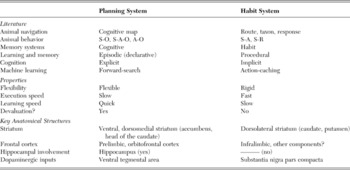
A number of literatures have converged on a division between learning systems that match these two systems. In the animal navigation literature, these two systems are referred to as the cognitive map and route systems,Footnote 3 respectively (O'Keefe & Nadel Reference O'Keefe and Nadel1978; Redish Reference Redish1999). In the animal learning-theory literature, these systems can be identified as three separate systems, a Pavlovian learning system (situation-outcome,  ), an instrumental learning system (action-outcome,
 ), and a habit learning system (
 ).Footnote 4
They have also been referred to as cognitive and habit learning systems (Mishkin & Appenzeller Reference Mishkin and Appenzeller1987; Poldrack & Packard Reference Poldrack and Packard2003; Saint-Cyr et al. Reference Saint-Cyr, Taylor and Lang1988; Yin & Knowlton Reference Yin and Knowlton2006), and match closely the distinction made between declarative and procedural learning (Cohen & Eichenbaum Reference Cohen and Eichenbaum1993; Cohen & Squire Reference Cohen and Squire1980; Redish Reference Redish1999; Squire Reference Squire1987; Squire et al. Reference Squire, Cohen, Nadel, Weingartner and Parker1984) and between explicit and implicit learning systems (Clark & Squire Reference Clark and Squire1998; Curran Reference Curran1995; Doyon et al. Reference Doyon, Laforce, Bouchard, Gaudreau, Roy, Poirer, Bedard, Bedard and Bouchard1998; Ferraro et al. Reference Ferraro, Balota and Connor1993; Forkstam & Petersson Reference Forkstam and Petersson2005; Knopman & Nissen Reference Knopman and Nissen1987; Reference Knopman and Nissen1991; Nissen et al. Reference Nissen, Knopman and Schacter1987; Willingham et al. Reference Willingham, Nissen and Bullemer1989), as well as between controlled and automatic processing theories (Kahneman & Frederick Reference Kahneman, Frederick, Gilovich, Griffin and Kahneman2002; Schneider & Chein Reference Schneider and Chein2003; Schneider & Shiffrin Reference Schneider and Shiffrin1977). We argue that these diverse literatures have converged on a pair of decision-making systems, which can be understood as (1) a flexible, cognitive, planning system and (2) a rigid, automatic, habit-based system.
This dichotomy is related to the historical debate on “expectancies” in the classic animal learning theory literature (Bolles Reference Bolles1972; Hull Reference Hull1943; Reference Hull1952; Munn Reference Munn1950; Tolman Reference Tolman1938; Reference Tolman1939; Reference Tolman1948). Tolman (Reference Tolman1938; Reference Tolman1939; Reference Tolman1948) argued that animals maintain an expectancy of their potential future consequences (including an expectancy of any rewarding component), and that this provided for latent learning effects as well as fast changes in choices in response to changes in provided needs, whereas Hull (Reference Hull1943; Reference Hull1952) argued that animals learn simple associations of stimuli and responses, allowing for the slow development of automation (Carr & Watson Reference Carr and Watson1908; Dennis Reference Dennis1932). As noted by Guthrie (Reference Guthrie1935; see Balleine & Ostlund Reference Balleine and Ostlund2007; Bolles Reference Bolles1972), one implication of Tolman's cognitive expectancies theories would be a delay in choosing. Just such a delay is seen in early learning, particularly in tasks that require the planning system. At choice points, rats faced with difficult decisions pause and vicariously sample the different choices before committing to a decision (Brown Reference Brown1992; Meunzinger Reference Meunzinger1938; Tolman Reference Tolman1938; Reference Tolman1939). This “vicarious trial and error” (VTE) behavior is abolished with hippocampal lesions (Hu & Amsel Reference Hu and Amsel1995), and is related to hippocampal activity on hippocampal-dependent tasks (Hu et al. Reference Hu, Xu and Gonzalez-Lima2006). Recent neural ensemble recording data have found that hippocampal firing patterns transiently represent locations ahead of the animal at choice points during VTE-like behaviors (Johnson & Redish Reference Johnson and Redish2007). Once tasks have been overtrained, these VTE movements disappear (Hu et al. Reference Hu, Xu and Gonzalez-Lima2006; Munn Reference Munn1950; Tolman Reference Tolman1938), as do the forward representations (Johnson & Redish Reference Johnson and Redish2007), suggesting that VTE may be a signal of the active processing in the planning system (Buckner & Carroll, Reference Buckner and Carroll2007; Johnson & Redish Reference Johnson and Redish2007; Tolman Reference Tolman1938; Reference Tolman1939).
These two systems mirror the classical two-process theory in psychology (Domjan Reference Domjan1998; Gray Reference Gray1975) and the more recent distinction between stimulus-stimulus (SS,  ), stimulus-outcome (SO, SAO,
 ), action-outcome (AO,
 ), and stimulus-response or stimulus-action (SA,
 ) (Balleine & Ostlund Reference Balleine and Ostlund2007; Dickinson Reference Dickinson1985) (see Table 2). The first (
 ) entails the recognition of a causal sequence but does not entail an actual decision. The second (
 ) is classical Pavlovian conditioning and entails an action taken in response to a situation in anticipation of a given outcome (Domjan Reference Domjan1998; Pavlov Reference Pavlov1927; Rescorla Reference Rescorla1988). The third (
 ) is classical instrumental conditioning (Balleine & Ostlund Reference Balleine and Ostlund2007; Domjan Reference Domjan1998; Ferster & Skinner Reference Ferster and Skinner1957) and entails an action taken to achieve an outcome, even in the absence of an immediate stimulus. It is important to note, however, that action-outcome associations do still include stimuli in the form of the context (actions are not taken at all times but rather only within certain facilitating contexts).Footnote 5 The fourth (
 ) entails an association between a situation and an action and denotes habit learning (Domjan Reference Domjan1998; Hull Reference Hull1943; Reference Hull1952).
Learning theory and decision-making

These four associations can be differentiated in terms of their expectancies (Table 2).  associations entail an expectancy of an outcome, but with no decision, there is no necessary further processing of that outcome, although there is likely to be an emotional preparation of some sort. If an animal can do something to prepare for, produce, or change that outcome, then the association becomes one of situation-action-outcome (
 ). If there is no immediate stimulus triggering the action, then the association becomes an
 association. Because
 associations continue to include a contextual gating component, the
 association is truly an
 association. Although there are anatomical reasons to separate
 from
 associations (Balleine & Ostlund Reference Balleine and Ostlund2007; Ostlund & Balleine Reference Ostlund and Balleine2007; Yin et al. Reference Yin, Knowlton and Balleine2005), for our purposes, they can be treated similarly: they both entail an expectancy of an outcome that must be evaluated to produce an expectancy of a value. This means they both require a planning component and can be differentiated from habit learning in which situations are directly associated with actions (
 ). In the
 association, situation-action pairs entail a direct expectancy of a value, which can then drive the action, even in the absence of a recognition of the outcome.
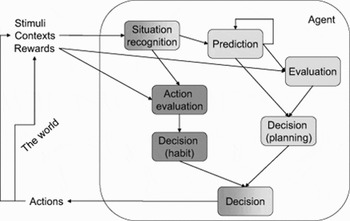
Following this distinction, we categorize these four association systems into three decision systems: an observation system, which does not make decisions and will not be discussed further; a planning system, which takes a given situation (derived from stimuli, context, or a combination thereof), predicts an outcome, and evaluates that outcome; and a habit system, which takes a given situation (derived from stimuli, context, or a combination thereof) and identifies the best remembered action to take.
These systems, of course, exist within overlapping and interacting structures (Balleine & Ostlund Reference Balleine and Ostlund2007; Corbit et al. Reference Corbit, Muir and Balleine2001; Dayan & Balleine Reference Dayan and Balleine2002; Devan & White Reference Devan and White1999; Kelley Reference Kelley1999a; Reference Kelley1999b; Voorn et al. Reference Voorn, Vanderschuren, Groenewegen, Robbins and Pennartz2004; Yin et al. Reference Yin, Knowlton and Balleine2006; Yin & Knowlton Reference Yin and Knowlton2006). The flexible planning system involves the entorhinal cortex (Corbit & Balleine Reference Corbit and Balleine2000), hippocampus (O'Keefe & Nadel Reference O'Keefe and Nadel1978; Packard & McGaugh Reference Packard and McGaugh1996; Redish Reference Redish1999), the ventral and dorsomedial striatum (Devan & White Reference Devan and White1999; Martin Reference Martin2001; Mogenson Reference Mogenson and Bandler1984; Mogenson et al. Reference Mogenson, Jones and Yim1980; Pennartz et al. Reference Pennartz, Lee, Verheul, Lipa, Barnes and McNaughton2004; Schoenbaum et al. Reference Schoenbaum, Setlow and Ramus2003; Yin et al. Reference Yin, Knowlton and Balleine2005), prelimbic medial prefrontal cortex (Jung et al. Reference Jung, Qin, McNaughton and Barnes1998; Killcross & Coutureau Reference Killcross and Coutureau2003; Ragozzino et al. Reference Ragozzino, Detrick and Kesner1999), and orbitofrontal cortex (Davis et al. Reference Davis, Donahue, Discenza, Waite and Ramus2006; Padoa-Schioppa & Assad Reference Padoa-Schioppa and Assad2006; Schoenbaum et al. Reference Schoenbaum, Setlow and Ramus2003; Reference Schoenbaum, Roesch and Stalnaker2006a; Reference Schoenbaum, Setlow, Saddoris and Gallagher2006b; Schoenbaum & Roesch Reference Schoenbaum and Roesch2005). The habit system involves the dorsolateral striatum (Barnes et al. Reference Barnes, Kubota, Hu, Jin and Graybiel2005; Packard & McGaugh Reference Packard and McGaugh1996; Schmitzer-Torbert & Redish Reference Schmitzer-Torbert and Redish2004; Yin & Knowlton Reference Yin and Knowlton2004; Reference Yin and Knowlton2006), the infralimbic medial prefrontal cortex (Coutureau & Killcross Reference Coutureau and Killcross2003; Killcross & Coutureau Reference Killcross and Coutureau2003) as well as the parietal cortex (DiMattia & Kesner Reference DiMattia and Kesner1988; Kesner et al. Reference Kesner, Farnsworth and DiMattia1989) (see Table 3).
Two systems

3.1. Transitions between decision systems
Behavior generally begins with flexible planning systems but, for repeated behaviors, can become driven by the less-flexible (but also less computationally expensive) habit systems. Examples of this development are well known from our experiences. For example, the first time we drive to a new job, we need a travel plan; we pay attention to street-signs and other landmarks. But after driving that same trip every day for years, the trip requires less and less attention, freeing up resources for other cognitive processes such as planning classes, papers, or dinner. The flexible system, however, generally remains available, as when road construction closes one's primary route to work and one now needs to identify a new route. Errors can exist within both systems, as for example, a misjudged plan or a trip so automatic, that if one is not paying attention, one might accidentally find oneself having driven to work even though one planned to go somewhere else. This interaction is well-studied in the animal literature, including the overlaying of planning by habit systems (Dickinson Reference Dickinson1980; Hikosaka et al. Reference Hikosaka, Nakahara, Rand, Sakai, Lu, Nakamura, Miyachi and Doya1999; Packard & McGaugh Reference Packard and McGaugh1996; Schmitzer-Torbert & Redish Reference Schmitzer-Torbert and Redish2002), restoration of planning in the face of changes (Gray & McNaughton Reference Gray and McNaughton2000; Isoda & Hikosaka Reference Isoda and Hikosaka2007; Sakagami et al. Reference Sakagami, Pan and Uttl2006), and conflict between the two systems (Gold Reference Gold2004; McDonald & White Reference McDonald and White1994; Packard Reference Packard1999; Poldrack & Packard Reference Poldrack and Packard2003; Redish et al. Reference Redish, Rosenzweig, Bohanick, McNaughton and Barnes2000).
Four well-studied examples in the animal literature are the transfer of place strategies to response strategies in the plus-maze (Chang & Gold Reference Chang and Gold2004; Packard & McGaugh Reference Packard and McGaugh1996; Yin & Knowlton Reference Yin and Knowlton2004), the development of the regularity of behavioral paths (Barnes et al. Reference Barnes, Kubota, Hu, Jin and Graybiel2005; Jog et al. Reference Jog, Kubota, Connolly, Hillegaart and Graybiel1999; Schmitzer-Torbert & Redish Reference Schmitzer-Torbert and Redish2002), the disappearance of devaluation in animal learning studies (Adams & Dickinson Reference Adams and Dickinson1981; Balleine & Dickinson Reference Balleine and Dickinson1998; Colwill & Rescorla Reference Colwill and Rescorla1985; Tang et al. Reference Tang, Pawlak, Volodymyr and West2007), and the inhibition of habitual responses in go/no-go tasks (Gray & McNaughton Reference Gray and McNaughton2000; Husain et al. Reference Husain, Parton, Hodgson, Mort and Rees2003; Isoda & Hikosaka Reference Isoda and Hikosaka2007).
In the plus-maze, animals are trained to take an action that can be solved either by going to a specific place (Tolman et al. Reference Tolman, Ritchie and Kalish1946) or by taking an action in response to being placed on the maze (Hull Reference Hull1952). These algorithms can be differentiated by an appropriately designed probe trial (Barnes et al. Reference Barnes, Nadel and Honig1980; Packard & McGaugh Reference Packard and McGaugh1996; Restle Reference Restle1957). Rats on this task (and on other similar tasks) first use a place strategy, which then evolves into a response strategy (McDonald & White Reference McDonald and White1994; Packard & McGaugh Reference Packard and McGaugh1996; Yin & Knowlton Reference Yin and Knowlton2004). Place strategies depend on hippocampal, as well as ventral and dorsomedial striatal integrity, while response strategies depend on dorsolateral striatal integrity (Packard & McGaugh Reference Packard and McGaugh1996; Yin & Knowlton Reference Yin and Knowlton2004; Reference Yin and Knowlton2006; Yin et al. Reference Yin, Knowlton and Balleine2005).
In tasks in which animals are provided a general task with specific cases that change from day to day or session to session, animals can learn the specific instantiations very quickly. In these tasks, behavioral accuracy improves quickly, followed by a slower development of a regularity in the actions taken by the animal (rats, Jog et al. Reference Jog, Kubota, Connolly, Hillegaart and Graybiel1999; Schmitzer-Torbert & Redish Reference Schmitzer-Torbert and Redish2002; monkeys, Hikosaka et al. Reference Hikosaka, Nakahara, Rand, Sakai, Lu, Nakamura, Miyachi and Doya1999; Rand et al. Reference Rand, Hikosaka, Miyachi, Lu and Miyashita1998; Reference Rand, Hikosaka, Miyachi, Lu, Nakamura, Kitaguchi and Shimo2000; humans, Nissen & Bullemer Reference Nissen and Bullemer1987; Willingham et al. Reference Willingham, Nissen and Bullemer1989). In these tasks, the early (accurate, flexible, and slower) behavior is dependent on hippocampal integrity and correlated to hippocampal activity (Ferraro et al. Reference Ferraro, Balota and Connor1993; Johnson & Redish Reference Johnson and Redish2007; Knopman & Nissen Reference Knopman and Nissen1987), whereas later (also accurate, but inflexible and faster) behavior is dependent on dorsolateral striatal integrity and correlated to dorsolateral striatal activity (Barnes et al. Reference Barnes, Kubota, Hu, Jin and Graybiel2005; Doyon et al. Reference Doyon, Laforce, Bouchard, Gaudreau, Roy, Poirer, Bedard, Bedard and Bouchard1998; Hikosaka et al. Reference Hikosaka, Miyashita, Miyachi, Sakai and Lu1998; Jackson et al. Reference Jackson, Jackson, Harrison, Henderson and Kennard1995; Jog et al. Reference Jog, Kubota, Connolly, Hillegaart and Graybiel1999; Knopman & Nissen Reference Knopman and Nissen1991).
The implication of multiple decision-making systems on the calculation of value can also be seen in the effect of these two decision systems on changes in the valuation of a reward (Adams & Dickinson Reference Adams and Dickinson1981; Balleine & Dickinson Reference Balleine and Dickinson1998; Colwill & Rescorla Reference Colwill and Rescorla1985; Dickinson Reference Dickinson1980; Reference Dickinson1985). Classically, these differences are measured by (1) training an agent to take an action (or a sequence of actions) to receive a reward R, and then, (2) changing the value of reward R to the agent, usually in a different context. The value of a reward can be changed by providing excess amounts of the reward (satiation, Balleine & Dickinson Reference Balleine and Dickinson1998) or by pairing the reward with an aversive stimulus, such as lithium chloride (devaluation, Adams & Dickinson Reference Adams and Dickinson1981; Colwill & Rescorla Reference Colwill and Rescorla1985; Holland & Rescorla Reference Holland and Rescorla1975; Holland & Straub Reference Holland and Straub1979; Nelson & Killcross Reference Nelson and Killcross2006; Schoenbaum et al. Reference Schoenbaum, Roesch and Stalnaker2006a). Finally, (3) the agent is provided the chance to take the action. If the action-selection process takes into account the current value of the reward, then the agent will modify its actions in response to the change, but if the action-selection process is an association between the situation and the action (hence does not take into account the value of the reward), the agent will not modify its response. Lesions to ventral striatum (Corbit et al. Reference Corbit, Muir and Balleine2001; Schoenbaum et al. Reference Schoenbaum, Stalnaker and Roesch2006c) and prelimbic medial prefrontal cortex (Killcross & Coutureau Reference Killcross and Coutureau2003) or orbitofrontal cortex (Ostlund & Balleine Reference Ostlund and Balleine2007; Schoenbaum et al. Reference Schoenbaum, Roesch and Stalnaker2006a; Reference Schoenbaum, Setlow, Saddoris and Gallagher2006b) discourage devaluation, whereas lesions to dorsolateral striatum (Yin et al. Reference Yin, Knowlton and Balleine2004; Yin & Knowlton Reference Yin and Knowlton2004; Yin et al. Reference Yin, Knowlton and Balleine2006) and infralimbic cortex (Coutureau & Killcross Reference Coutureau and Killcross2003; Killcross & Coutureau Reference Killcross and Coutureau2003) encourage devaluation processes. Lesions to entorhinal cortex (Corbit & Balleine Reference Corbit and Balleine2000) and dorsomedial striatum (Adams et al. Reference Adams, Kesner and Ragozzino2001; Ragozzino et al. Reference Ragozzino, Jih and Tzavos2002a; Reference Ragozzino, Ragozzino, Mizumori and Kesner2002b; Yin et al. Reference Yin, Knowlton and Balleine2005) disrupt flexibility in the face of predictability changes (contingency degradation), whereas lesions to dorsolateral striatum do not (Yin & Knowlton Reference Yin and Knowlton2006).
It is important to note that not all transitions need be from planning strategies to habit strategies. Because planning strategies are flexible and learned quickly, while habit-based strategies are more rigid and learned more slowly, many tasks are solved in their early stages through the planning system and in their late stages through the habit system (Dickinson Reference Dickinson1980; Hikosaka et al. Reference Hikosaka, Nakahara, Rand, Sakai, Lu, Nakamura, Miyachi and Doya1999; Packard & McGaugh Reference Packard and McGaugh1996; Restle Reference Restle1957). But the habit system can also learn in the absence of an available planning system (Cohen & Squire Reference Cohen and Squire1980; Day et al. Reference Day, Weisend, Sutherland and Schallert1999; Knowlton et al. Reference Knowlton, Squire and Gluck1994; Mishkin et al. Reference Mishkin, Malamut, Bachevalier, Lynch, McGaugh and Weinberger1984). Under appropriate conditions, well-developed automated responses can be overridden by controlled (planning-like) systems as in go/no-go tasks (Goldman et al. Reference Goldman, Rosvold and Mishkin1970; Gray & McNaughton Reference Gray and McNaughton2000; Isoda & Hikosaka Reference Isoda and Hikosaka2007; Iversen & Mishkin Reference Iversen and Mishkin1970) or reversal learning (Hirsh Reference Hirsh1974; Mackintosh Reference Mackintosh1974; Ragozzino et al. Reference Ragozzino, Jih and Tzavos2002a). Which system drives behavior at which time depends on parameters of the specific task (Curran Reference Curran1995; McDonald & White Reference McDonald and White1994; O'Keefe & Nadel Reference O'Keefe and Nadel1978; Redish Reference Redish1999) and may even differ between individuals under identical experimental conditions. In many cases, identical behaviors can be driven by the two systems, and only specialized probe trials can differentiate them (Barnes Reference Barnes1979; Curran Reference Curran2001; Hikosaka et al. Reference Hikosaka, Nakahara, Rand, Sakai, Lu, Nakamura, Miyachi and Doya1999).
3.2. The planning system
The planning system requires recognition of a situation and/or context S, identification of the consequences of taking action a in situation S (recognition of a means of achieving outcome O), and the evaluation of the value of achieving outcome O. This system selects the most appropriate action by considering the potential consequences of that action. The key behavioral parameters involved in this system are fast storage and slow retrieval. As noted earlier, retrieval within this system can be slow because the calculation of value at each step requires processing through the consideration of possibilities. Because the consideration of possibilities does not commit one to a single choice, this system is flexible in its behavioral choices. Because the value of taking action a in situation S is calculated from the value of achieving expected outcome O, which is calculated online from the current needs of the agent, if the desire (need) for the outcome is changed (even in another context), the value calculation can reflect that change.
Computationally, the planning system is likely to require three interacting components: a situation-recognition component, which classifies the complex interaction of contexts and stimuli to identify the situation in which the animal finds itself; a prediction component, which calculates the consequences of potential actions; and an evaluative component, which calculates the value of those consequences (taking into account the time, effort, and probability of receiving reward).
The situation-recognition component entails a categorization process, in which the set of available cues and contexts must be integrated with the agent's memory so as to produce a classification of the situation. This system is likely to arise in cortical sensory and association systems through competitive learning (Arbib Reference Arbib1995; Grossberg Reference Grossberg1976; Redish et al. Reference Redish, Jensen, Johnson and Kurth-Nelson2007; Rumelhart & McClelland Reference Rumelhart and McClelland1986). Mathematically, the cortical recognition system can be modeled with attractor network dynamics (Durstewitz et al. Reference Durstewitz, Kelc and Gunturkun1999; Reference Durstewitz, Seamans and Sejnowski2000; Kohonen Reference Kohonen1984; Laing & Chow Reference Laing and Chow2001; Redish Reference Redish1999; Seamans & Yang Reference Seamans and Yang2004; Wilson & Cowan Reference Wilson and Cowan1972; Reference Wilson and Cowan1973), in which a partial pattern can be completed to form a remembered pattern through recurrent connections within the structure (Hebb Reference Hebb1949/2002; Hertz et al. Reference Hertz, Krogh and Palmer1991; Hopfield Reference Hopfield1982). This content addressable memory provides a categorization process transforming the observed set of cues to a defined (remembered) situation that can be reasoned from (Redish et al. Reference Redish, Jensen, Johnson and Kurth-Nelson2007).
The prediction component entails a prediction of the probability that the agent will reach situation s t+1, given that it takes action a in situation s t: P(s t+1|s t, a). This functionality has been suggested to lie in the hippocampus (Jensen & Lisman Reference Jensen and Lisman1998; Reference Jensen and Lisman2005; Johnson & Redish Reference Johnson and Redish2007; Koene et al. Reference Koene, Gorchetchnikov, Cannon and Hasselmo2003) or frontal cortex (Daw et al. Reference Daw, Niv and Dayan2005). The hippocampus has been identified with stimulus-stimulus associations (Devenport Reference Devenport1979; Reference Devenport1980; Devenport & Holloway Reference Devenport and Holloway1980; Hirsh Reference Hirsh1974; Mackintosh Reference Mackintosh1974; White & McDonald Reference White and McDonald2002), episodic memory (Cohen & Eichenbaum Reference Cohen and Eichenbaum1993; Ferbinteanu & Shapiro Reference Ferbinteanu and Shapiro2003; Ferbinteanu et al. Reference Ferbinteanu, Kennedy and Shapiro2006; Squire Reference Squire1987), flexible behavior (Devenport et al. Reference Devenport, Devenport and Holloway1981b; Gray & McNaughton Reference Gray and McNaughton2000), including flexible navigation behavior (the cognitive map, i.e., spatial associations between stimuli; O'Keefe & Nadel Reference O'Keefe and Nadel1978), as well as in sequence learning (Agster et al. Reference Agster, Fortin and Eichenbaum2002; Cohen & Eichenbaum Reference Cohen and Eichenbaum1993; Fortin et al. Reference Fortin, Agster and Eichenbaum2002; Levy Reference Levy1996; Levy et al. Reference Levy, Sanyal, Rodriguez, Sullivan and Wu2005) (see Redish [1999] for review). Similar functionality has been proposed to lie in the frontal cortex (Daw et al. Reference Daw, Niv and Dayan2005), which has long been associated with the ability to recategorize situations (Baddeley Reference Baddeley1986; Clark & Robbins Reference Clark and Robbins2002; Dalley et al. Reference Dalley, Cardinal and Robbins2004; Isoda & Hikosaka Reference Isoda and Hikosaka2007; Jentsch & Taylor Reference Jentsch and Taylor1999; Quirk et al. Reference Quirk, Garcia and González-Lima2006; Rushworth et al. Reference Rushworth, Buckley, Behrens, Walton and Bannerman2007) with the storage of delayed events (Baddeley Reference Baddeley1986; Fuster Reference Fuster1997; Goldman-Rakic et al. Reference Goldman-Rakic, Funahashi and Bruce1990) and the anticipation of reward (Davis et al. Reference Davis, Donahue, Discenza, Waite and Ramus2006; Fuster Reference Fuster1997; Watanabe Reference Watanabe2007), as well as with sequence planning (Averbeck & Lee Reference Averbeck and Lee2007; Kolb Reference Kolb, Kolb and Tees1990; Mushiake et al. Reference Mushiake, Saito, Sakamoto, Itoyama and Tanji2006; Owen Reference Owen1997).
The evaluative component allows the calculation of value with each predicted outcome. Anatomically, the evaluative component is likely to include the amygdala (Aggleton Reference Aggleton1993; Dayan & Balleine Reference Dayan and Balleine2002; Phelps & LeDoux Reference Phelps and LeDoux2005; Rodrigues et al. Reference Rodrigues, Schafe and LeDoux2004; Schoenbaum et al. Reference Schoenbaum, Setlow and Ramus2003), the ventral striatum (nucleus accumbens) (Daw Reference Daw2003; Kelley Reference Kelley1999a; Reference Kelley1999b; Kelley & Berridge Reference Kelley and Berridge2002; Mogenson Reference Mogenson and Bandler1984; Pennartz et al. Reference Pennartz, Groenewegen and Lopes da Silva1994; Stefani & Moghaddam Reference Stefani and Moghaddam2006; Wilson & Bowman Reference Wilson and Bowman2005) and associated structures (Tindell et al. Reference Tindell, Berridge and Aldridge2004; Reference Tindell, Smith, Pecina, Berridge and Aldridge2006), and/or the orbitofrontal cortex (Feierstein et al. Reference Feierstein, Quirk, Uchida, Sosulski and Mainen2006; Padoa-Schioppa & Assad Reference Padoa-Schioppa and Assad2006; Plassmann et al. Reference Plassmann, O'Doherty and Rangel2007; Sakagami & Pan Reference Sakagami and Pan2007; Schoenbaum et al. Reference Schoenbaum, Setlow and Ramus2003; Reference Schoenbaum, Roesch and Stalnaker2006a; Volkow et al. Reference Volkow, Fowler and Wang2003). Neurons in the ventral striatum show reward correlates (Carelli Reference Carelli2002; Carelli et al. Reference Carelli, Ijames and Crumling2000; Carelli & Wondolowski Reference Carelli and Wondolowski2003; Lavoie & Mizumori Reference Lavoie and Mizumori1994; Martin & Ono Reference Martin and Ono2000; Miyazaki et al. Reference Miyazaki, Mogi, Araki and Matsumoto1998) and anticipate predicted reward (Martin & Ono Reference Martin and Ono2000; Miyazaki et al. Reference Miyazaki, Mogi, Araki and Matsumoto1998; Schultz et al. Reference Schultz, Apicella, Scarnati and Ljungberg1992; Yun et al. Reference Yun, Wakabayashi, Fields and Nicola2004). Neurons in the ventral pallidum are associated with the identification of hedonic signals (Tindell et al. Reference Tindell, Berridge and Aldridge2004; Reference Tindell, Smith, Pecina, Berridge and Aldridge2006). Both the hippocampus and prefrontal cortex project to ventral striatum (Finch Reference Finch1996; McGeorge & Faull Reference McGeorge and Faull1989; Swanson Reference Swanson2000), and ventral striatal firing patterns reflect hippocampal and prefrontal neural activity (Goto & Grace Reference Goto and Grace2005a; Reference Goto and Grace2005b; Kalivas et al. Reference Kalivas, Volkow and Seamans2005; Martin Reference Martin2001; Pennartz et al. Reference Pennartz, Lee, Verheul, Lipa, Barnes and McNaughton2004). Neurons in the orbitofrontal cortex encode parameters relating the value of potential choices (Padoa-Schioppa & Assad Reference Padoa-Schioppa and Assad2006; Schoenbaum & Roesch Reference Schoenbaum and Roesch2005).
These structures all receive strong dopaminergic input from the ventral tegmental area. Neurophysiologically, dopamine signals in the ventral striatum – measured by neural recordings from dopaminergic projection neurons (Schultz Reference Schultz1998; Reference Schultz2002) and from voltammetry signals in the ventral striatum itself (Roitman et al. Reference Roitman, Stuber, Phillips, Wightman and Carelli2004; Stuber et al. Reference Stuber, Wightman and Carelli2005) – show increased firing to unexpected rewards and to unexpected cues predicting rewards. In computational models of the habit system, these signals have been hypothesized to carry value-prediction error information (see further on). Much of the data seems to support a similar role for dopamine from ventral tegmental sources (de la Fuente-Fernandez et al. Reference de la Fuente-Fernandez, Phillips, Zamburlini, Sossi, Calne, Ruth and Stoessl2002; Ljungberg et al. Reference Ljungberg, Apicella and Schultz1992; Roitman et al. Reference Roitman, Stuber, Phillips, Wightman and Carelli2004; Stuber et al. Reference Stuber, Wightman and Carelli2005; Ungless et al. Reference Ungless, Magill and Bolam2004). However, detailed, anatomically instantiated computational models are not yet available for the planning system. Theories addressing dopamine's role in the planning system have included motivation and effort (Berridge 2006; Berridge & Robinson Reference Berridge and Robinson1998; Reference Berridge and Robinson2003; Niv et al. Reference Niv, Daw, Joel and Dayan2007; Robbins & Everitt Reference Robbins and Everitt2006; Salamone & Correa Reference Salamone and Correa2002; Salamone et al. Reference Salamone, Correa, Mingote and Weber2005; Reference Salamone, Correa, Farrar and Mingote2007) and learning (Ikemoto & Panksepp Reference Ikemoto and Panksepp1999; Reynolds et al. Reference Reynolds, Hyland and Wickens2001). An important open question, however, is to what extent dopamine is carrying the actual signal of motivation (Berridge Reference Berridge2007) and to what extent dopamine's effects are dependent on corticostriatal synapses (Anagnostaras et al. Reference Anagnostaras, Schallert and Robinson2002; Li et al. Reference Li, Acerbo and Robinson2004; McFarland & Kalivas Reference McFarland and Kalivas2001; McFarland et al. Reference McFarland, Lapish and Kalivas2003; Nicola & Malenka Reference Nicola and Malenka1998; Reynolds & Wickens Reference Reynolds and Wickens2002). Finally, dopamine in the prefrontal cortex has also been hypothesized to have a role in controlling the depth of the categorization process (Durstewitz et al. Reference Durstewitz, Kelc and Gunturkun1999; Reference Durstewitz, Seamans and Sejnowski2000; Redish et al. Reference Redish, Jensen, Johnson and Kurth-Nelson2007; Seamans et al. Reference Seamans, Gorelova, Durstewitz and Yang2001; Seamans & Yang Reference Seamans and Yang2004; Tanaka Reference Tanaka2002; Reference Tanaka2006).
Neuropharmacologically, these systems, particularly the ventral striatum, are also highly dependent on mechanisms involving opioid signaling. Opioid signaling has been hypothesized to be involved in hedonic processes (Berridge & Robinson Reference Berridge and Robinson1998; Reference Berridge and Robinson2003; Kelley et al. Reference Kelley, Bakshi, Haber, Steininger, Will and Zhang2002). Consistent with these ideas, Levine and colleagues (Arbisi et al. Reference Arbisi, Billington and Levine1999; Levine & Billington Reference Levine and Billington2004) report that opioid antagonists directly interfere with the reported qualia of hedonic pleasure in humans eating sweet liquids, without interfering in taste discrimination. We have suggested that the multiple opioid receptors in the mammalian brain (μ, κ, δ; De Vries & Shippenberg Reference De Vries and Shippenberg2002; Herz Reference Herz1997; Reference Herz1998) are associated with an evaluation process identifying positive (euphorigenic, signaled by μ-opioid activation) and negative (dysphorigenic, signaled by κ-opioid signaling) evaluations (Redish & Johnson Reference Redish and Johnson2007). Whereas μ-receptor agonists are rewarding, euphorigenic, and support self-administration, κ-receptor agonists are aversive, dysphoric, and interfere with self-administration (Bals-Kubik et al. Reference Bals-Kubik, Herz and Shippenberg1989; Chavkin et al. Reference Chavkin, James and Goldstein1982; De Vries & Shippenberg Reference De Vries and Shippenberg2002; Herz Reference Herz1997, Reference Herz1998; Kieffer Reference Kieffer1999; Matthes et al. Reference Matthes, Maldonado, Simonin, Valverde, Slowe, Kitchen, Befort, Dierich, Meur, Dolĺe, Tzavara, Hanoune, Roques and Kieffer1996; Meyer & Mirin Reference Meyer and Mirin1979; Mucha & Herz Reference Mucha and Herz1985).Footnote 6
We have also proposed that part of the evaluation mechanism occurring during the search process (calculating the expected value from the agent's needs and the expected outcomes given a  relation) may also involve the opioid system (Redish & Johnson Reference Redish and Johnson2007). This would predict a release of μ-opioid agonists (e.g., enkephalins) in anticipation of extreme rewards. Rats placed in a drug-associated location show a dramatic increase in released enkephalin in the nucleus accumbens relative to being placed in a saline-associated compartment, presumably in anticipation arising from the drug-associated compartment (Mas-Nieto et al. Reference Mas-Nieto, Wilson, Cupo, Roques and Noble2002).Footnote 7
3.2.1. Potential vulnerabilities in the planning system
The planning system provides potential failure points in changes in the definition of the perceived needs N of the animal, in incorrect identification of satisfaction of that need (mimicking reward), in incorrect evaluation of the expected value of the outcome, and in incorrect search of the  relationships themselves, as well as a potential failure point in misclassification of situations.
Vulnerability 1: Homeostatic changes: Changing the definition of the needs N
Vulnerability 2: Allostatic changes: Changing the definition of the needs N
Organisms have evolved to maintain very specific levels of critical biological parameters (temperature, hormonal levels, neurotransmitter levels, etc.) under large challenge variations. Because these specific levels (“set-points”) can change under contextual, biological, social, and other factors, such as with a circadian or seasonal rhythm, some authors have suggested the term allostasis over the more classic term homeostasis, reserving homeostasis for a constant set point (Koob & Le Moal Reference Koob and Le Moal2006). Drugs and other manipulations can change the needs of an animal either by moving the system away from the homeostatic set-point itself (say, in a withdrawal state after drug use), requiring drugs to return the system to homeostasis, or by changing the system's desired set-point itself, thus requiring drugs to achieve the new inappropriate set-point (Koob & Le Moal Reference Koob and Le Moal2006). In either case, these changes will change the perceived needs of the agent, and will thus change the evaluated value of expected outcomes.
Vulnerability 3: Overvaluation of the expected value of a predicted outcome – mimicking reward
As noted earlier, the planning system requires a component that directly evaluates the expected outcome. This evaluation process is, of course, a memory process that must take into account the history of experience with the expected outcome. This means that there must be a biological signal that recognizes the value of outcomes when the agent achieves the outcome itself (thus satisfying the perceived need). This signal is likely to be related to the qualia of euphoric pleasure and dysphoric displeasure (Berridge & Robinson Reference Berridge and Robinson1998; Reference Berridge and Robinson2003). We can thus identify this signal with subjective hedonic signals. It is likely that when the agent searches the consequences of the potential  action-sequence, the same evaluative process would be used, which could implicate these same signals in craving (Redish & Johnson Reference Redish and Johnson2007). This signal is likely to be carried in part by endogenous opioid signals (Berridge & Robinson Reference Berridge and Robinson1998; Reference Berridge and Robinson2003; Kelley et al. Reference Kelley, Bakshi, Haber, Steininger, Will and Zhang2002), potentially in the ventral basal ganglia (Tindell et al. Reference Tindell, Berridge and Aldridge2004; Reference Tindell, Smith, Pecina, Berridge and Aldridge2006). Additionally, the memory of value depends on the remembered values of experiences, which tend to be remembered as generally more positive than they really were due to biases in representation (Kahneman & Frederick Reference Kahneman, Frederick, Gilovich, Griffin and Kahneman2002; Schreiber & Kahneman Reference Schreiber and Kahneman2000). Social factors can also affect remembered values of actual dysphoric events (Cummings Reference Cummings2002; Goldman et al. Reference Goldman, Boca, Darkes, Leonard and lsn1999; Jones et al. Reference Jones, Corbin and Fromme2001).
Vulnerability 4: Overvaluation of the expected value of a predicted outcome in the planning system
In fact, any mechanism by which the value of a predicted outcome is increased will have vulnerabilities leading the planning system to over-value certain outcomes. At this point, computational models of the planning system are insufficiently detailed to lead to specific predictions or explanations of the mechanisms by which outcomes are over-valued, but experimental evidence has suggested a role for dopamine release in the nucleus accumbens as a key component (Ikemoto & Panksepp Reference Ikemoto and Panksepp1999; Robinson & Berridge Reference Robinson and Berridge1993; Roitman et al. Reference Roitman, Stuber, Phillips, Wightman and Carelli2004; Salamone et al. Reference Salamone, Correa, Mingote and Weber2005; see Robinson & Berridge Reference Robinson and Berridge2001; Reference Robinson and Berridge2003, for reviews). The orbitofrontal cortex has also been implicated in the evaluation of potential rewards (Padoa-Schioppa & Assad Reference Padoa-Schioppa and Assad2006; Sakagami & Pan Reference Sakagami and Pan2007; Schoenbaum & Roesch Reference Schoenbaum and Roesch2005), and incorrect signals arriving from the orbitofrontal cortex could also drive overvaluation of expected drug- or behavior-related outcomes (Kalivas & Volkow Reference Kalivas and Volkow2005; Schoenbaum et al. Reference Schoenbaum, Roesch and Stalnaker2006a; Volkow et al. Reference Volkow, Fowler and Wang2003). Changes in activity in the orbitofrontal cortex (Stalnaker et al. Reference Stalnaker, Roesch, Franz, Burke and Schoenbaum2006; Volkow & Fowler Reference Volkow and Fowler2000) and the ventral striatum (Carelli Reference Carelli2002; German & Fields Reference German and Fields2007b; Peoples et al. Reference Peoples, Uzwiak, Gee and West1999) are likely to play important roles in this vulnerability.
Vulnerability 5: Incorrect search of
 relationships
 relationships
The prediction component of the planning system is also a memory process, requiring the exploration of multiple consequences from situation S. If a drug or other process were to increase the likelihood of retrieving a specific  relationship, then one would expect this to limit the set of possibilities explored, which would appear as a cognitive blinding to alternatives (Redish & Johnson Reference Redish and Johnson2007). Because action-decisions in the planning system must be made through the comparison of available alternatives, this vulnerability would also mean that when an agent is returned to situation S, it would be more likely to remember the availability of outcome O than other potential outcomes, which would make it more likely to remember the high value associated with outcome O (see Vulnerabilities 3 and 4), and thus more likely to experience craving in situation S. This craving would then lead to a recurring search of the same
 path, which would appear as a cognitive blinding or obsession. This process could also lead to an increase in attention to drug-related cues, which has been seen in both alcohol and heroin addicts (Lubman et al. Reference Lubman, Peters, Mogg, Bradley and Deakin2000; Schoenmakers et al. Reference Schoenmakers, Wiers, Jones, Bruce and Jansen2007).
Vulnerability 6: Misclassification of situations
In order to retrieve an  relation, the agent must recognize that the situation it is in is sufficiently similar to a previous one to successfully retrieve the relation, predict the outcome, and evaluate it. The
 relations are, of course, dependent on the predictability of the outcome for a given situation, and therfore are sensitive to contingency degradation, in which the predictability of an outcome from a given situation-action pair is decreased (thus changing the
 relationship; Corbit & Balleine Reference Corbit and Balleine2000; Corbit et al. Reference Corbit, Ostlund and Balleine2002; Devenport & Holloway Reference Devenport and Holloway1980). These relationships can be misunderstood either by over-categorization, in which two situations that are actually identical are miscategorized as different, or by over-generalization, in which two situations that are actually separate are miscategorized as the same.
Over-categorization. Thus, for example, if gambling losses are not recognized as occurring in the same situation as previous gambling wins, an agent can potentially (incorrectly) learn two  relations, one leading from situation S 1 to a winning outcome and one leading from situation S 2 to a losing outcome. If the agent can identify cues that separate situation S 1 from situation S 2, then it will (incorrectly) predict that it can know when it will achieve a winning outcome. This has been referred to as “the illusion of control” (Custer Reference Custer1984; Griffiths Reference Griffiths1994; Langer & Roth Reference Langer and Roth1975; MacKillop et al. Reference MacKillop, Anderson, Castelda, Mattson and Donovick2006; Redish et al. Reference Redish, Jensen, Johnson and Kurth-Nelson2007; Wagenaar Reference Wagenaar1988).
Over-generalization. An inability to recategorize situations (by recognizing actual changes) can lead to the perseveration of responses and an inability to switch responses in the face of failures and losses. Many drug users and pathological gamblers show failures to reverse or switch action-selection choices in response to novel adverse conditions (Bechara et al. Reference Bechara, Dolan, Denburg, Hindes, Andersen and Nathan2001; Clark & Robbins Reference Clark and Robbins2002; Everitt et al. Reference Everitt, Baldacchino, Blackshaw, Swainson, Baker, Hunter, Carthy, Booker, London, Deakin, Sahakian and Robbins1999; Grant et al. Reference Grant, Contoreggi and London2000; Jentsch et al. Reference Jentsch, Olausson, Garza and Taylor2002; Verdejo-Garcia et al. Reference Verdejo-Garcia, Rivas-Pérez, López-Torrecillas and Pérez-Garcia2006). Developing abilities to recategorize situations has been suggested as one means of treating addictions (McCaul & Petry Reference McCaul and Petry2003; Sylvain et al. Reference Sylvain, Ladouceur and Biosvert1997). Simulated agents with deficiencies in the ability to recategorize cues find difficulty in breaking cue-addiction associationsFootnote 8 (Redish et al. Reference Redish, Jensen, Johnson and Kurth-Nelson2007).
3.3. The habit system
In contrast to the complexity of the planning system, the habit system entails a simple association between situation and action. Thus, the habit system requires recognition of a situation S, and a single, identified action to take within that situation. This simplicity allows the habit system to react quickly. However, this simplicity also makes the habit system rigid. A learned association essentially commits the agent to take action a in situation S. This means that it would be dangerous to store an association that was not reliable. Therefore, habit associations should only be stored after extensive experience with a consistent relation.
In contrast to the planning system, the habit system does not include any consideration of the potential outcome (i.e., there is no O term in the  relation; Table 2). Therefore, in contrast to the planning system, the habit system does not include a prediction of available outcomes and cannot evaluate those potential outcomes online. Hence, it cannot take into account the current perceived needs (desires) of the agent. The habit system is still sensitive to the overall arousal levels of the agent. Thus, a hungry rat will run faster and work harder than a satiated rat (Bolles Reference Bolles1967; Munn Reference Munn1950; Niv et al. Reference Niv, Daw, Joel and Dayan2007). However, because the habit system does not reflect the current desires of the agent, the habit system will not modify responses when a reward is devalued. Similarly, the habit system cannot select multiple actions in response to a single situation.Footnote 9 This means that in navigation, the habit system can only take a single action in response to a given situation. For example, a rat with a damaged planning system cannot decide to turn left for water when it is thirsty on one day and turn right for food when it is hungry on the next day.Footnote 10
Computationally, there are very good models of how the habit system might work. These models have generally been based on the temporal difference instantiation of reinforcement learning (Daw Reference Daw2003; Daw et al. Reference Daw, Niv and Dayan2005; Reference Daw, Courville and Touretzky2006; Dayan et al. Reference Dayan, Kakade and Montague2000; Doya Reference Doya2000b; Montague et al. Reference Montague, Dayan and Sejnowski1996; Redish Reference Redish2004; Schultz et al. Reference Schultz, Dayan and Montague1997; Suri & Schultz Reference Suri and Schultz1999; Sutton & Barto Reference Sutton and Barto1998). In the simplest version of this model, each situation-action pair is associated with a value (termed Q(S, a); Sutton & Barto Reference Sutton and Barto1998).Footnote 11 When an agent takes an action from a situation, the agent can compare the expected value of taking action a in situation S (i.e., Q(S, a)) with the observed value (the reward received minus the cost spent plus the value of being in the state the agent ended up in):

where R(t) is the reward observed, C(t) the cost spent,  the most value one can get from the situation the agent finds itself in (S new), and Q(S old, a) is the estimated value of taking action a in the situation the agent was in (S old). By updating Q(S old, a) by δ, the agent moves its estimate Q(S old, a) closer to its true value; γ is a discounting parameter (γ<1) which ensures that the time required to reach future rewards is taken into account (Daw Reference Daw2003; Sutton & Barto Reference Sutton and Barto1998). These models can be trained to learn complex situation-action sequences.
The slow development of a habit association has been most studied in contrast to the fast planning system. Lesions or inactivation of the dorsolateral striatum (Yin & Knowlton Reference Yin and Knowlton2004; Yin et al. Reference Yin, Knowlton and Balleine2004; Yin et al. Reference Yin, Knowlton and Balleine2006) and the infralimbic cortex (Coutureau & Killcross Reference Coutureau and Killcross2003; Killcross & Coutureau Reference Killcross and Coutureau2003) prevent the loss of devaluation with experience. Lesions or inactivation of the dorsolateral striatum (McDonald & White Reference McDonald and White1994; Packard & McGaugh Reference Packard and McGaugh1992; Reference Packard and McGaugh1996; Potegal Reference Potegal1972; White & McDonald Reference White and McDonald2002; Yin & Knowlton Reference Yin and Knowlton2004) or the parietal cortices (DiMattia & Kesner Reference DiMattia and Kesner1988; Kesner et al. Reference Kesner, Farnsworth and DiMattia1989) shift rats from response strategy to map strategies in navigation tasks.
As in the planning system, the habit system requires a situation-recognition component, in which the set of cues and contexts is integrated with the agent's memory to classify the situation, to allow retrieval of the correct  association. As with our discussion in the planning system, we suggest that cortical sensory and association systems classify situations through competitive learning processes (Arbib Reference Arbib1995; Grossberg Reference Grossberg1976; Redish et al. Reference Redish, Jensen, Johnson and Kurth-Nelson2007; Rumelhart & McClelland Reference Rumelhart and McClelland1986). Although there are no neurophysiological data suggesting that this situation categorization system is anatomically separate from that used for the planning system, the identification of the habit system with networks involving dorsal and lateral aspects of striatum, and the planning system with networks involving more ventral and medial aspects of striatum, suggest that the specific cortical systems involved may differ. The
 association itself, including the mechanisms by which the situation signals are finally categorized to achieve a single action decision, have been hypothesized to include the afferent connections from cortex to dorsolateral striatum (Beiser et al. Reference Beiser, Hua and Houk1997; Houk et al. Reference Houk, Adams, Barto, Houk, Davis and Beiser1995; Samejima et al. Reference Samejima, Ueda, Doya and Kimura2005; Wickens Reference Wickens1993; Wickens et al. Reference Wickens, Reynolds and Hyland2003).
Neuropharmacologically, the habit system receives strong dopamine inputs from the substantia nigra pars compacta (SNpc). The dopamine signal has been well studied in the primate (Bayer & Glimcher Reference Bayer and Glimcher2005; Ljungberg et al. Reference Ljungberg, Apicella and Schultz1992; Mirenowicz & Schultz Reference Mirenowicz and Schultz1994; Schultz Reference Schultz1998; Reference Schultz2002; Waelti et al. Reference Waelti, Dickinson and Schultz2001). Like the dopamine neurons in the ventral tegmental area, dopamine neurons in SNpc increase firing in response to unexpected increases in expected value (via unexpected rewards or via cues that lead to an increased expectation of reward), and decrease firing in response to unexpected decreases in value (via lack of expected reward or via cues that lead to a decrease in the expectation of reward). This signal has been identified with the value-error signal δ in the temporal difference reinforcement learning algorithm (Barto Reference Barto, Houk, Davis and Beiser1995; Montague et al. Reference Montague, Dayan, Person and Sejnowski1995; Reference Montague, Dayan and Sejnowski1996; Schultz et al. Reference Schultz, Dayan and Montague1997), which can provide dopamine a role in training up  associations. Dopamine has been shown to be critical to the learning of habitual
 associations (Faure et al. Reference Faure, Haberland, Fran and Massioui2005). However, the role of dopamine in learning and performance is still controversial (Berridge Reference Berridge2007; Cagniard et al. Reference Cagniard, Beeler, Britt, McGehee, Marinelli and Zhuang2006; Frank et al. Reference Frank, Seeberger and O'Reilly2004; Niv et al. Reference Niv, Daw, Joel and Dayan2007).
Cellularly, neurons in the dorsal striatum have been found to represent key parameters of the temporal difference reinforcement learning algorithm: for example, situation-action associations (Barnes et al. Reference Barnes, Kubota, Hu, Jin and Graybiel2005; Carelli & West Reference Carelli and West1991; Daw Reference Daw2003; Gardiner & Kitai Reference Gardiner and Kitai1992; Hikosaka et al. Reference Hikosaka, Nakahara, Rand, Sakai, Lu, Nakamura, Miyachi and Doya1999; Hikosaka et al. Reference Hikosaka, Nakamura and Nakahara2006; Jog et al. Reference Jog, Kubota, Connolly, Hillegaart and Graybiel1999; Kermadi et al. Reference Kermadi, Jurquet, Arzi and Joseph1993; Kermadi & Joseph Reference Kermadi and Joseph1995; Matsumoto et al. Reference Matsumoto, Hanakawa, Maki, Graybiel and Kimura1999; Miyachi et al. Reference Miyachi, Hikosaka, Miyashita, Kárádi and Rand1997; Schmitzer-Torbert & Redish Reference Schmitzer-Torbert and Redish2004; Tremblay et al. Reference Tremblay, Hollerman and Schultz1998); reward delivery (Daw Reference Daw2003; Schmitzer-Torbert & Redish Reference Schmitzer-Torbert and Redish2004; White & Hiroi Reference White and Hiroi1998;); and value signals (Daw Reference Daw2003; Kawagoe et al. Reference Kawagoe, Takikawa and Hikosaka2004; Nakahara et al. Reference Nakahara, Itoh, Kawagoe, Takikawa and Hikosaka2004). These signals develop in parallel with the development of automated behaviors (Barnes et al. Reference Barnes, Kubota, Hu, Jin and Graybiel2005; Itoh et al. Reference Itoh, Nakahara, Hikosaka, Kawagoe, Takikawa and Aihara2003; Jog et al. Reference Jog, Kubota, Connolly, Hillegaart and Graybiel1999; Samejima et al. Reference Samejima, Ueda, Doya and Kimura2005; Schmitzer-Torbert & Redish Reference Schmitzer-Torbert and Redish2004; Tang et al. Reference Tang, Pawlak, Volodymyr and West2007), through an interaction with dopamine signals (Arbuthnott & Wickens Reference Arbuthnott and Wickens2007; Centonze et al. Reference Centonze, Gubellini, Picconi, Calabresi, Giacomini and Bernardi1999; Picconi et al. Reference Picconi, Centonze, Håkansson, Bernardi, Greengard, Fisone, Cenci and Calabresi2003; Reynolds & Wickens Reference Reynolds and Wickens2002). Functional imaging data from humans playing sequential games show similar correlates to value, δ, and other parameters of these models (McClure et al. Reference McClure, Berns and Montague2003; Reference McClure, Laibson, Loewenstein and Cohen2004; O'Doherty Reference O'Doherty2004; O'Doherty et al. Reference O'Doherty, Dayan, Schultz, Deichmann, Friston and Dolan2004; Seymour et al. Reference Seymour, O'Doherty, Dayan, Koltzenburg, Jones, Dolan, Friston and Frackowlak2004; Tanaka et al. Reference Tanaka, Doya, Okada, Ueda, Okamoto and Yamawaki2004a).
3.3.1. Potential vulnerabilities in the habit system
The primary failure point of the habit system is the overvaluation of a habit association through the delivery of dopamine (Bernheim & Rangel Reference Bernheim and Rangel2004; Di Chiara Reference Di Chiara1999; Redish Reference Redish2004). As with the planning system, a misclassification of the situation can also provide a potential vulnerability in the habit system (see Vulnerability 6).
Vulnerability 7: Overvaluation of actions
With natural rewards, once the value of the reward has been correctly predicted, the value-error term δ is zero and learning stops (Rescorla & Wagner Reference Rescorla, Wagner, Black and Prokesy1972; Schultz & Dickinson Reference Schultz and Dickinson2000; Waelti et al. Reference Waelti, Dickinson and Schultz2001). However, when dopamine is produced neuropharmacologically, sidestepping the calculation of δ, each receipt of the drug induces a positive δ signal, the value associated with taking action a in situation S continues to increase, producing an overvaluation (Redish Reference Redish2004). Because the  association is a habitual, automatic association, choices driven by
 relationships will be unintentional, robotic, perhaps even unconscious.
3.4. Interactions between planning and habit systems
Generally, the planning system is engaged early; but with experience, behavioral control in repetitive tasks is transferred to the habit system. This has been observed in the navigation (O'Keefe & Nadel Reference O'Keefe and Nadel1978; Packard & McGaugh Reference Packard and McGaugh1996; Redish Reference Redish1999), animal conditioning (Balleine & Dickinson Reference Balleine and Dickinson1998; Dickinson Reference Dickinson1985; Yin et al. Reference Yin, Knowlton and Balleine2006), and human learning (Jackson et al. Reference Jackson, Jackson, Harrison, Henderson and Kennard1995; Knopman & Nissen Reference Knopman and Nissen1991; Poldrack et al. Reference Poldrack, Clark, Paré-Blagoev, Shohamy, Moyano, Myers and Gluck2001) literatures. However, in tasks which require behavioral flexibility, behavioral control can remain with the planning system, even in highly trained animals (Gray & McNaughton Reference Gray and McNaughton2000; Killcross & Coutureau Reference Killcross and Coutureau2003; McDonald & White Reference McDonald and White1994; Morris et al. Reference Morris, Garrud, Rawlins and O'Keefe1982; White & McDonald Reference White and McDonald2002).
For many tasks, both systems can drive behavior in the absence of the other (Cohen & Squire Reference Cohen and Squire1980; Nadel Reference Nadel, Schacter and Tulving1994; O'Keefe & Nadel Reference O'Keefe and Nadel1978; Squire Reference Squire1987), but some tasks can only be solved by one system or the other. For example, the water maze requires a flexible response to reach a hidden platform and requires hippocampal integrity to be learned quickly (Morris et al. Reference Morris, Garrud, Rawlins and O'Keefe1982; for a review, see Redish Reference Redish1999). If the flexibility of the required response is decreased (by, for example, starting the animal in the same location each trial), then the hippocampus no longer becomes necessary to reach the platform (Eichenbaum et al. Reference Eichenbaum, Stewart and Morris1990). Other tasks, such as mirror-writing or the serial reaction time task, require the slow recognition of regularities in situation-action associations, and they are learned at similar speeds by patients with damaged and intact planning systems (Cohen & Squire Reference Cohen and Squire1980; Ferraro et al. Reference Ferraro, Balota and Connor1993; Knopman & Nissen Reference Knopman and Nissen1987). Patients with damaged lateral striatal systems are impaired on these habit-based tasks (Doyon et al. Reference Doyon, Laforce, Bouchard, Gaudreau, Roy, Poirer, Bedard, Bedard and Bouchard1998; Ferraro et al. Reference Ferraro, Balota and Connor1993; Knopman & Nissen Reference Knopman and Nissen1991; Smith et al. Reference Smith, Brandt and Shadmehr2000; Yin & Knowlton Reference Yin and Knowlton2006). For some tasks, the planning system can “train up” the habit system, potentially through replay events occurring during subsequent sleep states (Buzsáki Reference Buzsáki1996; Hoffmann & McNaughton Reference Hoffmann and McNaughton2002; Marr Reference Marr1971; Pavlides & Winson Reference Pavlides and Winson1989; Redish Reference Redish1999; Redish & Touretzky Reference Redish and Touretzky1998; Wilson & McNaughton Reference Wilson and McNaughton1994). This transfer of information between systems can explain observations of incomplete retrograde amnesia with certain lesions (consolidation, Cohen & Squire Reference Cohen and Squire1980; Nadel & Bohbot Reference Nadel and Bohbot2001; Nadel & Moscovitch Reference Nadel and Moscovitch1997; Redish Reference Redish1999; Squire Reference Squire1987) but predicts that “consolidated memories” will be less flexible than unconsolidated memories (Redish & Touretzky Reference Redish and Touretzky1998).
The question of which system drives behavior when the two are put into conflict has only begun to be addressed computationally (Daw et al. Reference Daw, Niv and Dayan2005) and experimentally (Isoda & Hikosaka Reference Isoda and Hikosaka2007), but there is a large literature on behavioral inhibition, in which a changed, novel, or potentially dangerous or costly behavior is inhibited (Gray & McNaughton Reference Gray and McNaughton2000). This system seems to involve the prefrontal (Sakagami et al. Reference Sakagami, Pan and Uttl2006) and/or the hippocampal system (Gray & McNaughton Reference Gray and McNaughton2000), depending on the specific conditions involved. Whether the interaction entails the planning system overriding a developed habit (Gray & McNaughton Reference Gray and McNaughton2000) or an external system that mediates control between the two (Isoda & Hikosaka Reference Isoda and Hikosaka2007) is still unresolved. Whether such an external mediator can be identified with executive control (presumably, in the prefrontal cortex, Baddeley Reference Baddeley1986; Barkley Reference Barkley2001; Barkley et al. Reference Barkley, Edwards, Laneri, Fletcher and Metevia2001) is still a matter of open research.
Vulnerability 8: Selective inhibition of the planning system
The habit system is inflexible, reacts quickly, “without thinking,” whereas the planning system is highly flexible and allows the consideration of possibilities. The habit and planning systems consist of different anatomical substrates. Pharmacological agents that preferentially impair function in structures involved in the planning system or preferentially enhance function in structures involved in the habit system would encourage the automation of behaviors. A shift back from habits to planned behaviors is known to involve the prefrontal cortex (Dalley et al. Reference Dalley, Cardinal and Robbins2004; Husain et al. Reference Husain, Parton, Hodgson, Mort and Rees2003; Isoda & Hikosaka Reference Isoda and Hikosaka2007; Iversen & Mishkin Reference Iversen and Mishkin1970), and has been hypothesized to involve executive function (Barkley Reference Barkley2001; Barkley et al. Reference Barkley, Edwards, Laneri, Fletcher and Metevia2001; Tomita et al. Reference Tomita, Ohbayashi, Nakahara, Hasegawa and Myashita1999). If pre-existing dysfunction exists within the inter-system control or if pharmacological agents disrupt this inter-system control, then the agent would develop habits quickly and would have difficulty disrupting those established habits. This vulnerability is distinguishable from the specific planning and habit vulnerabilities by its disruption of function of the planning system and/or its disruption of the inter-system conflict resolution mechanism. Thus, the other vulnerabilities affecting the planning system lead the planning system to make the incorrect choice; Vulnerability 8 makes it difficult for the planning system to correct a misguided habit system (Bechara Reference Bechara2005; Bechara et al. Reference Bechara, Dolan, Denburg, Hindes, Andersen and Nathan2001; Bickel et al. Reference Bickel, Miller, Yi, Kowal, Lindquist and Pitcock2007; Gray & McNaughton Reference Gray and McNaughton2000; Jentsch & Taylor Reference Jentsch and Taylor1999; Lubman et al. Reference Lubman, Yücel and Pantelis2004; Verdejo-Garcia et al. Reference Verdejo-Garcia, Rivas-Pérez, López-Torrecillas and Pérez-Garcia2006).
3.5. Summary: Decision-making systems
The decision-making system in the mammal is hypothesized to consist of two subsystems: a planning system, based on the evaluation of potential possibilities (e.g.,  relationships), and a habit system, based on the association of specific actions with specific situations (e.g.,
 associations), both of which require a situation-recognition system, in which observed cues are categorized into situations (e.g., the S terms in the previous formulations). Correct decision-making depends on the integrity of each of these systems (see Figure 1).
Structure of decision making in mammalian agents. Components of the more flexible, planning-based system are shown in light gray; components of the less flexible, habit-based system are shown in dark gray. Components involved in both are shown in gradient color.

3.6. Additional failure points
The eight vulnerabilities identified so far are certainly an incomplete list of the potential failure points of the decision-making system. The description of the decision-making system is, by necessity, incomplete. For example, we have not addressed the question of discounting and impulsivity. Nor have we addressed the question of learning rates.
Vulnerability 9: Over-fast discounting processes
Both the planning and habit systems need to take into account the probability and the delay before an expected goal will be achieved (Ainslie Reference Ainslie1992; Reference Ainslie2001; Mazur Reference Mazur2001; Stephens & Krebs Reference Stephens and Krebs1987). In the planning system, this can be calculated online from the expected value of the expected goal given the searched sequence; in the habit system, this would have to be cached as part of the stored value function. The specific mechanism (and even the specific discounting function) are still a source of much controversy (for a review, see Redish & Kurth-Nelson [in press] in Madden et al. [in press]), but the long-term discounting of future rewards is well established. If an agent discounts too strongly, it will overemphasize near-term rewards and underemphasize far-future costs. Because addictions often involve near-term pleasures and far-future costs, faster-than-normal discounting could drive an agent to underestimate the far-future costs and to choose those near-term pleasures. A number of studies have found that addicts discount faster than non-addicts (Alessi & Petry Reference Alessi and Petry2003; Bickel & Marsch Reference Bickel and Marsch2001; Kirby et al. Reference Kirby, Petry and Bickel1999; Madden et al. Reference Madden, Petry, Badger and Bickford1997; Madden et al. Reference Madden, Bickel and Jacobs1999; Odum et al. Reference Odum, Madden and Bickel2002; Petry Reference Petry2001; Petry & Bickel Reference Petry and Bickel1998; Petry et al. Reference Petry, Bickel and Arnett1998; Vuchinich & Simpson Reference Vuchinich and Simpson1998).
Vulnerability 10: Changes in learning processes
Other unincorporated components include changes in learning processes (such as over-attention to cues or learning rates being too high or too low). More detailed models of each of the systems will be required before it will be possible to make strong claims about the consequences of such a potential failure point.
However, the hypothesis put forward in this paper that addiction is a consequence of falling victim to vulnerabilities (failure modes) in the decision-making system lays out a research paradigm with important consequences both for what (and how) research questions should be addressed as well as for drug-treatment paradigms and drug-control policies.
These vulnerabilities in the decision-making system may arise from individual predisposition (either due to genetic or social/environmental factors) as well as from drug- or behavior-driven interactions with the decision system. In the second half of this article, we address the interactions and implications of each of the previously identified vulnerabilities with drugs and behaviors of abuse as well as the policy and treatment consequences of the theory.
4. Addiction as vulnerabilities in decision-making
The unified framework for decision-making described above has potential access points through which it can be driven to make maladaptive choices, particularly choices which entail seeking of certain drugs or behaviors. Ten key vulnerabilities can be directly identified with this unified decision-making system as outlined earlier. They are summarized in Table 4 and related to the current theories in Table 5.
Failure modes in the decision-making system provide a taxonomy of vulnerabilities to addiction

Note. Because Vulnerability 6 affects the situation S term in both planning and habit systems, we identify it as affecting “situation-recognition.” Vulnerability 8 affects the interaction between the planning and habit systems. Vulnerabilities 9 and 10 can affect components of the planning and habit systems. Detailed models of the effects of these last two vulnerabilities on the systems are as yet unavailable.
Relation between identified vulnerabilities and current theories of addiction
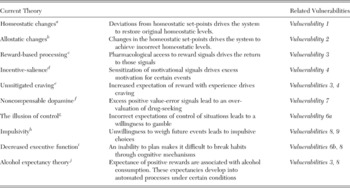
aBecker and Murphy (Reference Becker and Murphy1988); Harris & Gewirtz (Reference Harris and Gewirtz2005); Koob and Le Moal (Reference Koob and Le Moal2006).
bBecker and Murphy (Reference Becker and Murphy1988); Koob and Le Moal (Reference Koob and Le Moal1997; 2001; Reference Koob and Le Moal2005; 2006); Solomon and Corbit (Reference Solomon and Corbit1973; Reference Solomon and Corbit1974).
cKalivas and Volkow (Reference Kalivas and Volkow2005); Volkow et al. (Reference Volkow, Fowler and Wang2003; Reference Volkow, Fowler, Wang and Swanson2004); Wise (Reference Wise2004).
dBerridge and Robinson (Reference Berridge and Robinson1998; 2003); Robinson and Berridge (Reference Robinson and Berridge1993; Reference Robinson and Berridge2001; Reference Robinson and Berridge2003; Reference Robinson and Berridge2004).
eDrummond (Reference Drummond2001); Goldman et al. (Reference Goldman, Brown, Christiansen, lsn and lsn1987; Reference Goldman, Boca, Darkes, Leonard and lsn1999); Halikas (Reference Halikas, Lowinson, Ruiz, Millman and Langrod1997); Hommer (Reference Hommer1999).
fBernheim and Rangel (Reference Bernheim and Rangel2004); Di Chiara (Reference Di Chiara1999); Redish (Reference Redish2004).
gCuster (Reference Custer1984); Griffiths (Reference Griffiths1994); Langer and Roth (Reference Langer and Roth1975); Redish et al. (Reference Redish, Jensen, Johnson and Kurth-Nelson2007); Sylvain et al. (Reference Sylvain, Ladouceur and Biosvert1997); Wagenaar (Reference Wagenaar1988).
hAinslie (Reference Ainslie1992; 2001); Ainslie and Monterosso (Reference Ainslie and Monterosso2004); Bickel and Marsch (Reference Bickel and Marsch2001); Giordano et al. (Reference Giordano, Bickel, Loewenstein, Jacobs, Marsch and Badger2002); Odum et al. (Reference Odum, Madden and Bickel2002).
iBickel et al. (Reference Bickel, Miller, Yi, Kowal, Lindquist and Pitcock2007); Everitt et al. (Reference Everitt, Dickinson and Robbins2001); Everitt and Wolf (Reference Everitt and Wolf2002); Nelson and Killcross (Reference Nelson and Killcross2006); Robbins & Everitt (Reference Robbins and Everitt1999).
jGoldman et al. (Reference Goldman, Brown, Christiansen, lsn and lsn1987; 1999); Jones et al. (Reference Jones, Corbin and Fromme2001); Oei and Baldwin (Reference Oei and Baldwin2002).
Some of these failure modes exist as prior conditions, making an agent more vulnerable to the addictive process, whereas other failure modes are driven by direct interactions with the drugs themselves.
4.1. Vulnerability 1: Deviations from homeostasis
A classic example of deviations from homeostasis that will produce changing needs is the well-known “crash” after the euphoria of an opiate experience (Koob & Le Moal Reference Koob and Le Moal2006). These negative effects can occur after even a single dose of morphine (Azolosa et al. Reference Azolosa, Stitzer and Greenwald1994; Harris & Gewirtz Reference Harris and Gewirtz2005; Koob & Le Moal Reference Koob and Le Moal2006). Such a negative affect would drive an agent to attempt to compensate by returning to the positive qualia occurring during the drug use. Deviations from homeostasis also lead to the well-known withdrawal symptoms (Altman et al. Reference Altman, Everitt, Robbins, Glautier, Markou, Nutt, Oretti and Phillips1996; Lowinson et al. Reference Lowinson, Ruiz, Millman and Langrod1997) seen in reaction to nicotine (Benowitz Reference Benowitz1996; Hanson et al. Reference Hanson, Allen, Jensen and Hatsukami2003; Hughes & Hatsukami Reference Hughes and Hatsukami1986), alcohol (Kiefer & Mann Reference Kiefer and Mann2005; Littleton Reference Littleton1998; Moak & Anton Reference Moak, Anton, McCrady and Epstein1999), opiates (Altman et al. Reference Altman, Everitt, Robbins, Glautier, Markou, Nutt, Oretti and Phillips1996; Koob & Bloom Reference Koob and Bloom1988; Schulteis et al. Reference Schulteis, Heyser and Koob1997), and caffeine (Daly & Fredholm Reference Daly and Fredholm1998; Evans Reference Evans, Tarter, Ammerman and Ott1998) addictions.
4.2. Vulnerability 2: Changes in allostatic set-points
Drug use, particularly repeated drug use, can also produce changes in the set-point itself (referred to as “changes in allostasis,” most likely through long-term changes in receptor levels and changes in levels of endogenous ligands released during normal behaviors; Koob & Le Moal Reference Koob and Le Moal2006). Animals given prolonged access to drugs, particularly access over many days to long periods of drug availability, develop greatly increased drug-intake levels (Ahmed & Koob Reference Ahmed and Koob1998; Reference Ahmed and Koob1999). This has been hypothesized to arise from developing allostatic changes (Ahmed & Koob Reference Ahmed and Koob2005; Koob & Le Moal Reference Koob and Le Moal2006).
Pharmacologically, chronic nicotine use changes levels of cholinergic receptors in the brain (Flores et al. Reference Flores, Dávila-García, Ulrich and Kellar1997; Marks et al. Reference Marks, Pauly, Gross, Deneris, Hermans-Borgmeyer, Heinemann and Collins1992). Chronic alcohol use changes function and expression of gamma-aminobutyric acid (GABAA) and N-methyl-D-aspartate (NMDA) receptors (Hunt Reference Hunt, Tarter, Ammerman and Ott1998; Littleton Reference Littleton1998; Valenzuela & Harris Reference Valenzuela, Harris, Lowinson, Ruiz, Millman and Langrod1997). Repeated cocaine (Hurd & Herkenham Reference Hurd and Herkenham1993; Steiner & Gerfen Reference Steiner and Gerfen1998), alcohol (Ciraulo et al. Reference Ciraulo, Piechniczek-Buczek and Iscan2003), and opiate (Cappendijk et al. Reference Cappendijk, Hurd, Nylander, van Ree and Terenius1999; Weissman & Zamir Reference Weissman and Zamir1987) treatment all produce changes in endogenous opioid release and in opiate receptor expression. Many smokers titrate the number of cigarettes smoked throughout the day, ensuring a relatively constant blood-plasma level of nicotine (Schmitz et al. Reference Schmitz, Schneider, Jarvik, Lowinson, Ruiz, Millman and Langrod1997).
These neurobiological changes change the identified needs of the agent, and thus imply changes in the evaluation of expected outcomes of drug-taking (or abstinence), which will change action-selection in the planning system.Footnote 12 This vulnerability is identifiable by changes in long-term set-points of physiological variables.
4.3. Vulnerability 3: Overvaluation of the expected value of a predicted outcome – mimicking reward
The planning system requires a signal that directly evaluates the successful achievement of a perceived need (thus leading to the qualia of pleasure). A number of authors have suggested that this may reside within the opiate system (Berridge & Robinson Reference Berridge and Robinson2003; Redish & Johnson Reference Redish and Johnson2007). μ-Opiate agonists (such as heroin, morphine, etc.) are generally highly euphorigenic (Jaffe et al. Reference Jaffe, Knapp, Ciraulo, Lowinson, Ruiz, Millman and Langrood1997; Mark et al. Reference Mark, Woody, Juday and Kleber2001; Meyer & Mirin Reference Meyer and Mirin1979). Even though exogenously delivered μ-opiate agonists (such as heroin or morphine) are not a true reward that the system evolved to recognize, they can mimic the reward system and trick the system into believing that it just received a strong reward, which it will learn to return to. Drugs accessing this vulnerability are likely to be highly euphorigenic, particularly with initial use. Heroin and morphine produce profound euphoria very quickly after injection (Koob & Le Moal Reference Koob and Le Moal2006). This reward signal will be stored in memories associated with the planning system, which would lead to the recall of highly euphoric signals when the planning system recognizes a path to achieve these reward-mimicking drugs. This vulnerability is recognizable by strong craving when agents recall those euphoric events.
4.4. Vulnerability 4: Overvaluation in the planning system
As reviewed earlier, the planning system consists of recognition (memory), search through, and evaluation of  relationships. A fundamental vulnerability of this relationship is in the valuation of the outcome, which is calculated from the level of “need” and the “value” of the outcome satisfying that perceived need, presumably learned through dopaminergic signals (Robinson & Berridge Reference Robinson and Berridge1993; Reference Robinson and Berridge2001; Reference Robinson and Berridge2003; Reference Robinson and Berridge2004) projecting to the ventral striatum and orbitofrontal cortex. Dopamine firing patterns in the ventral tegmental area (projecting to the ventral striatum and orbitofrontal cortex) indicate changes in the amount of expected or just-received reward (Pan et al. Reference Pan, Schmidt, Wickens and Hyland2005; Roesch et al. Reference Roesch, Calu and Schoenbaum2007; Schultz Reference Schultz2002; Schultz et al. Reference Schultz, Dayan and Montague1997), analogous to the δ signal required for the Q-learning algorithm described in the habit system. Although no computational theories are as yet available describing how these dopaminergic signals translate into changes in evaluation in the planning system, voltammetry recordings from the ventral striatum have shown dopamine signals occurring before both cued and self-initiated actions leading to drug receipt (Phillips et al. Reference Phillips, Stuber, Heien, Wightman and Carelli2003; Roitman et al. Reference Roitman, Stuber, Phillips, Wightman and Carelli2004; Stuber et al. Reference Stuber, Roitman, Phillips, Carelli and Wightman2004; Reference Stuber, Wightman and Carelli2005). These changes presumably modulate the cortico- and hippocampo-ventral-striatal synapses, both during learning (Thomas et al. Reference Thomas, Beurrier, Bonci and Malenka2001) and during performance (Goto & Grace Reference Goto and Grace2005a; Reference Goto and Grace2005b; Lisman & Grace Reference Lisman and Grace2005; Yun et al. Reference Yun, Wakabayashi, Fields and Nicola2004).
Other researchers have suggested that this evaluation process may arise in the orbitofrontal cortex (Padoa-Schioppa & Assad Reference Padoa-Schioppa and Assad2006; Plassmann et al. Reference Plassmann, O'Doherty and Rangel2007; Schoenbaum et al. Reference Schoenbaum, Roesch and Stalnaker2006a) and that overvaluation in the orbitofrontal cortex can lead to overvaluation of expected rewards (Kalivas & Volkow Reference Kalivas and Volkow2005; Volkow et al. Reference Volkow, Fowler and Wang2003). In rats with a past history of cocaine intake, the orbitofrontal cortex becomes less capable of predicting adverse outcomes than in normal rats (Stalnaker et al. Reference Stalnaker, Roesch, Franz, Burke and Schoenbaum2006), implying a potential difficulty in identifying negative consequences. Nevertheless, an overvaluation of expected drug outcomes would produce craving (Redish & Johnson Reference Redish and Johnson2007) and an increased likelihood of taking actions leading to those expected drug outcomes (German & Fields Reference German and Fields2007a).
4.5. Vulnerability 5: Incorrect search of relationships
 relationships
As noted earlier, the prediction component of the planning system is also a memory process, requiring the exploration of multiple consequences from a given situation S. This prediction process has been suggested to require the hippocampus (Jensen & Lisman Reference Jensen and Lisman1998; Reference Jensen and Lisman2005; Johnson & Redish Reference Johnson and Redish2007) and the prefrontal cortex (Daw et al. Reference Daw, Niv and Dayan2005), but the specific mechanism is still unknown.
Although the specific mechanisms of storage and access of  relationships are unknown within the hippocampus and prefrontal cortex, Vulnerability 5 can occur due to maladaptive and often subtle modifications of system storage and access functions rather than system failure. These systemic modifications may occur as a result of changes in the cell morphology within these areas and plasticity mechanisms within the hippocampus and prefrontal cortex. A number of addictive substances produce such changes. Both hippocampus and prefrontal cortex receive dopaminergic inputs, which are known to change the sensitivity to synaptic plasticity (Huang et al. Reference Huang, Kandel, Vashavsky, Brandon, Qi, Idzerda, McKnight and Bourtchouladze1995; Seamans & Yang Reference Seamans and Yang2004) and to modulate representations (Kentros et al. Reference Kentros, Agnihotri, Streater, Hawkins and Kandel2004; Seamans & Yang Reference Seamans and Yang2004) and performance (Arnsten et al. Reference Arnsten, Cai, Murphy and Goldman-Rakic1994; Murphy et al. Reference Murphy, Arnsten, Goldman-Rakic and Roth1996). Similarly, morphine and other opiate agonists increase synaptic spine formation in cell culture (Liao et al. Reference Liao, Lin, Law and Loh2005) and development (Hauser et al. Reference Hauser, McLaughlin and Zagon1987; Reference Hauser, McLaughlin and Zagon1989). Long-term drug exposure also increases the spine formation in the hippocampus and prefrontal cortex in vivo (Robinson & Kolb Reference Robinson and Kolb1999; Robinson et al. Reference Robinson, Gorny, Mitton and Kolb2001; Reference Robinson, Gorny, Savage and Kolb2002). These changes may affect the prediction process, possibly driving it to preferentially search the drug-related potential choices, which would appear clinically as an over-sensitivity to drug-related cues and obsessive consideration of choices leading to drug receipt.
4.6. Vulnerability 6: The illusion of control
When faced with reward distributions that change over time, agents can react in one of two ways: The agent can identify itself as being in a new situation with a different reward distribution, or the agent can identify itself as being in the same situation, but change the expectation of the likelihood of receiving reward. If the agent incorrectly classifies the same situation as different or different situations as the same, the agent may find itself making incorrect decisions.
Misclassification of situations has been primarily identified as a potential cause for problem gambling, in which agents incorrectly identify a statistically unlikely sequence of wins as a separate situation from more-commonly experienced losses (Custer Reference Custer1984; Langer & Roth Reference Langer and Roth1975; Redish et al. Reference Redish, Jensen, Johnson and Kurth-Nelson2007; Wagenaar Reference Wagenaar1988). This provides the agent with the illusion that certain cues can identify winning situations while other cues identify losing situations (referred to as the “illusion of control”; Langer & Roth Reference Langer and Roth1975; Redish et al. Reference Redish, Jensen, Johnson and Kurth-Nelson2007; Sylvain et al. Reference Sylvain, Ladouceur and Biosvert1997; Wagenaar Reference Wagenaar1988). Problem gamblers tend to have experienced a statistically unlikely sequence of wins followed by devastating losses (Custer Reference Custer1984; Wagenaar Reference Wagenaar1988). This misclassification may arise from excessive recognition of cue changes between the winning and losing experiences (Redish et al. Reference Redish, Jensen, Johnson and Kurth-Nelson2007). Problem gamblers are often observed to “explain away” losses by post hoc identification of differences in cues between the losses and memories of wins (also referred to as “hindsight bias”; Custer Reference Custer1984; Dickerson & O'Connor Reference Dickerson and O'Connor2006; Wagenaar Reference Wagenaar1988). Similarly, near misses, in which gamblers lose but come close to the winning situation, encourage continued play (Parke & Griffiths Reference Parke and Griffiths2004). These near misses may provide illusory support for the hypothesis that certain noisy cues have a relationship to the predictability of the reward.
4.7. Vulnerability 7: Overvaluation in the habit system
In the habit ( ) system, phasic (bursting) dopamine signals are correlated with the value-prediction error signal δ, needed by the temporal difference reinforcement learning algorithm to learn situation-action sequences (Barto Reference Barto, Houk, Davis and Beiser1995; Daw Reference Daw2003; Montague et al. Reference Montague, Dayan, Person and Sejnowski1995; Reference Montague, Dayan and Sejnowski1996). With natural rewards, as the value-prediction system learns to predict those rewards correctly, the value-prediction compensates for the reward, and dopamine at the time of correctly predicted reward decreases to zero with learning (Schultz Reference Schultz1998). Drugs that produce dopamine neuropharmacologically (like cocaine or amphetamine) will bypass that value-compensation system, providing a constant “better-than-expected” δ signal. This non-compensable dopamine signal leads to overvaluation in the
 system (Bernheim & Rangel Reference Bernheim and Rangel2004; Redish Reference Redish2004). Cocaine and many other abused drugs produce large increases of dopamine pharmacologically throughout the striatum (Ito et al. Reference Ito, Dalley, Robbins and Everitt2002; Kuhar et al. Reference Kuhar, Ritz, Sharkey, Clouet, Asghar and Brown1988; Roitman et al. Reference Roitman, Stuber, Phillips, Wightman and Carelli2004; Stuber et al. Reference Stuber, Wightman and Carelli2005). This mechanism can lead to the formation of habits, which have been suggested as a key process in late stages of drug addiction (Altman et al. Reference Altman, Everitt, Robbins, Glautier, Markou, Nutt, Oretti and Phillips1996; Di Chiara Reference Di Chiara1999; Everitt & Robbins Reference Everitt and Robbins2005; Robbins & Everitt Reference Robbins and Everitt1999; Tiffany Reference Tiffany1990). Clinically, such users would be unlikely to show strong craving and would manifest a robotic drug use, without conscious planning or statements of drug-seeking. Habit-based drug use could well be uncorrelated to the qualia of pleasure.
4.8. Vulnerability 8: Selective inhibition of the planning system
Exposure to drugs can shift the normal balance between systems, emphasizing one system over the other. For example, pretreatment with amphetamine shifts rats to preferentially use systems that do not show devaluation (i.e., habit-based over planning-based systems) (Nelson & Killcross Reference Nelson and Killcross2006). Alcohol, as another example, has been hypothesized to preferentially impair hippocampal (Hunt Reference Hunt, Tarter, Ammerman and Ott1998; White Reference White2003) and prefrontal (Oscar-Berman & Marinkovic Reference Oscar-Berman and Marinkovic2003) function, which would shift the normal balance from the planning to the habit systems. Dickinson et al. (Reference Dickinson, Wood and Smith2002) found that alcohol-seeking in rats is driven primarily by  mechanisms and does not show devaluation. Similarly, Miles et al. (Reference Miles, Everitt and Dickinson2003) found that including cocaine in a sucrose solution prevents devaluation. Such distinctions would appear as a fast increase in habitual responses over planning-based responses.
Following from the hypothesis that prefrontal (executive) systems are involved in the shift from habit back to planning systems (Baddeley Reference Baddeley1986; Barkley Reference Barkley2001; Barkley et al. Reference Barkley, Edwards, Laneri, Fletcher and Metevia2001; Dalley et al. Reference Dalley, Cardinal and Robbins2004; Isoda & Hikosaka Reference Isoda and Hikosaka2007), deficits in this executive system would lead to a difficulty in breaking habits (Bechara et al. Reference Bechara, Dolan, Denburg, Hindes, Andersen and Nathan2001; Jentsch & Taylor Reference Jentsch and Taylor1999; Lubman et al. Reference Lubman, Yücel and Pantelis2004). Following from the hypothesis that extinction follows from a reinterpretation of situations (Bouton Reference Bouton2002; Capaldi Reference Capaldi1957; Quirk et al. Reference Quirk, Garcia and González-Lima2006; Redish et al. Reference Redish, Jensen, Johnson and Kurth-Nelson2007), this would suggest a difficulty in extinguishing drug-taking. It is certainly possible to extinguish drug-taking in animals (Kalivas et al. Reference Kalivas, Peters and Knackstedt2006; Olmstead et al. Reference Olmstead, Lafond, Everitt and Dickinson2001), but those extinguished behaviors are particularly susceptible to relapse and reinstatement (McFarland & Kalivas Reference McFarland and Kalivas2001; Shalev et al. Reference Shalev, Grimm and Shaham2002). Whether it is more difficult to extinguish some drug-taking behavior in certain agents due to selective inhibition of the planning system or excitation of the habit system is still unknown. Agents falling victim to this vulnerability would show a particularly strong, uncontrolled relapse, likely cue-dependent, and possibly independent of explicitly identified cravings.
4.9. Vulnerability 9: Overfast discounting
As reviewed earlier, there is strong evidence that addicts discount faster than non-addicts (Bickel & Marsch Reference Bickel and Marsch2001; Reynolds Reference Reynolds2006). An important question that is still unresolved is whether these faster discounting factors exist as preconditions or develop with experience. Impulsivity shows a strong heritability that has been hypothesized to underlie a pre-existing factor in addiction (Kreek et al. Reference Kreek, Nielsen, Butelman and LaForge2005). Impulsivity has been identified with changes in neuromodulators, particularly serotoninFootnote 13 (Chamberlain et al. Reference Chamberlain, Muller, Robbins and Sahakian2006); changing serotonin levels can lead to online changes in discounting rates (Schweighofer et al. Reference Schweighofer, Tanaka, Asahi, Okamoto, Doya and Yamawaki2004; Tanaka et al. Reference Tanaka, Schweighofer, Asahi, Okamoto and Doya2004b). (Computationally, serotonin has been explicitly modeled as controlling the discounting factor in temporal-difference learning; Doya Reference Doya, Hatano, Okada and Tanabe2000a; Reference Doya2002.) Many drugs of abuse, such as cocaine, directly affect serotonin levels (Paine et al. Reference Paine, Dringenberg and Olmstead2003; Ritz et al. Reference Ritz, Lamb, Goldberg and Kuhar1987), while in other substances, such as alcohol, self-administration levels reflect serotonin levels (Chastain Reference Chastain2006; Valenzuela & Harris Reference Valenzuela, Harris, Lowinson, Ruiz, Millman and Langrod1997). It is currently unknown whether the excess discounting seen in addicts is a pre-existing condition or a consequence of the addictive process itself (Reynolds Reference Reynolds2006). As with many of these vulnerabilities, it is possible to have a positive feedback, in which pre-existing conditions support the entrance to addiction (Kreek et al. Reference Kreek, Nielsen, Butelman and LaForge2005; Perry et al. Reference Perry, Larson, German, Madden and Carroll2005; Poulos et al. Reference Poulos, Le and Parker1995), and then post-addictive consequences arising from pharmacology or experience exacerbate it (Paine et al. Reference Paine, Dringenberg and Olmstead2003).
4.10. Vulnerability 10: Changes in learning rates
The decision-making system reviewed earlier depends on learning associations among situations, outcomes, and actions. These systems depend on specific learning rates. Neuromodulators such as acetylcholine and dopamine have been hypothesized to control learning rate parameters (Doya Reference Doya, Hatano, Okada and Tanabe2000a; Reference Doya2002; Gutkin et al. Reference Gutkin, Dehaene and Changeux2006; Hasselmo Reference Hasselmo1993; Hasselmo & Bower Reference Hasselmo and Bower1993; Yu & Dayan Reference Yu and Dayan2005). Pharmacological substances that manipulate these learning rates can produce enhanced associations, leading to overdeveloped expectations or habits. For example, nicotine enhances the presence of already available phasic dopaminergic signals in vitro (Rice & Cragg Reference Rice and Cragg2004). Following from a hypothesized role of phasic dopamine signals in identifying high-value associations to be stored (Montague et al. Reference Montague, Dayan and Sejnowski1996; Schultz et al. Reference Schultz, Dayan and Montague1997), this would predict that nicotine would enhance small learning signals, further increasing the likelihood of making cue-related associations. Although there is as yet no direct evidence for a general role of nicotine in learning, if nicotine did generally enhance learning signals, this would make smokers particularly susceptible to cue-driven associations (Chiamulera Reference Chiamulera2005). Multiple drugs taken simultaneously may interact with each other, and drugs may interact with natural rewards as well.
5. Drugs and the taxonomy of vulnerabilities
The 10 vulnerabilities listed here provide a taxonomy of potential problems with decision processes.Footnote 14 Because neuromodulators (such as acetylcholine, serotonin, norepinephrine, and dopamine) are involved throughout the decision-making system (learning  relations, storing and evaluating
 relations, recognition of situations S, etc.), drugs of abuse are unlikely to access only one subsystem. Because there are differences in these vulnerabilities, any specific drug is also unlikely to access all 10 vulnerabilities. Because behavioral control involves the entire decision-making systems, behavioral problems such as gambling are likely to arise from an interaction of vulnerabilities. Although each vulnerability can drive an agent to return to the addictive choice, each vulnerability also produces a characteristic symptomology and can thus be separately identifiable within an agent.
Different drugs are likely to access different vulnerabilities. For example, whereas opiates are generally euphorigenic on initial use (Koob & Le Moal Reference Koob and Le Moal2006; Vulnerability 3), nicotine is often dysphoric on initial use (Heishman & Henningfield Reference Heishman and Henningfield2000; Perkins Reference Perkins2001; Perkins et al. Reference Perkins, Grobe, Weiss, Fonte and Caqquila1996; making Vulnerability 3 unlikely). However, continued use of nicotine can produce strong allostatic changes (Benowitz Reference Benowitz1996; Koob & Le Moal Reference Koob and Le Moal2006; Vulnerability 2), which produce a very strong need to return levels to normal (Fiore Reference Fiore2000). Nicotine also produces increases in the firing of dopaminergic neurons (Balfour et al. Reference Balfour, Wright, Benwell and Birrell2000; Dani & Heinemann Reference Dani and Heinemann1996; Pidoplichko et al. Reference Pidoplichko, DeBiasi, Williams and Dani1997), which suggests that it can also accesses the  overvaluation vulnerability (Vulnerability 7). Cocaine use automates particularly quickly (Miles et al. Reference Miles, Everitt and Dickinson2003) and produces a very strong cued relapse (Altman et al. Reference Altman, Everitt, Robbins, Glautier, Markou, Nutt, Oretti and Phillips1996; Childress et al. Reference Childress, Ehrman, Rohsenow, Robbins, O'Brien, Lowinson, Ruiz and Millman1992; Reference Childress, Hole, Ehrman, Robbins, McLellan and O'Brien1993; O'Brien et al. Reference O'Brien, Childress, McLellan, Ehrman, O'Brien and Jaffe1992), suggesting that it also accesses the
 overvaluation vulnerability (Redish Reference Redish2004; Vulnerability 7), presumably through its direct effects on dopamine (Kuhar et al. Reference Kuhar, Ritz, Sharkey, Clouet, Asghar and Brown1988; Ritz et al. Reference Ritz, Lamb, Goldberg and Kuhar1987; Stuber et al. Reference Stuber, Roitman, Phillips, Carelli and Wightman2004; Reference Stuber, Wightman and Carelli2005). However, chronic cocaine use can also produce long-term changes in μ- and κ-opiate receptor levels (Shippenberg et al. Reference Shippenberg, Chefer, Zapata and Heidbreder2001), suggesting it can also access the allostatic vulnerability (Vulnerability 2). The appendix provides more details on drugs and the potential vulnerabilities involved with each.
5.1. Individual vulnerabilities
One of the main thrusts of addiction research right now is the question of why some people become addicted and some do not (Deroche-Gamonet et al. Reference Deroche-Gamonet, Belin and Piazza2004; Koob & Le Moal Reference Koob and Le Moal2006; Tarter et al. Reference Tarter, Ammerman and Ott1998; Volkow & Li Reference Volkow and Li2005b). These individual differences arise from an interaction between the genetics of the individual, the development environment (social and physical), the developmental stage of the individual, and the behavioral experience with the addictive substance (Koob & Le Moal Reference Koob and Le Moal2006; Kreek et al. Reference Kreek, Nielsen, Butelman and LaForge2005; Volkow & Li Reference Volkow and Li2005a; Reference Volkow and Li2005b). Laying out the complete details of individual vulnerabilities are beyond the scope of this article (and are in large part still unknown), but the multiple-vulnerabilities hypothesis put forward here suggests a plan of attack to the problem. Addiction research has been historically aimed at problems with a single drug (e.g., nicotine, heroin, alcohol, etc.) or at unifying parameters across drugs (e.g., the role of dopamine). The multiple-vulnerabilities hypothesis suggests that we should look, instead, at the potential vulnerabilities within the natural learning system.
These vulnerabilities are likely to depend on a number of specific individual parameters. For example, imagine an individual who was particularly sensitive to rewards and punishments. That individual would be more susceptible to Vulnerability 3 in which a drug of abuse produced a euphorigenic signal. Imagine an individual who was more likely to treat a slightly new situation as new. Such an individual would be more susceptible to Vulnerability 6 in which wins and losses are not matched. Or imagine an individual in which the effect of nicotine on dopamine was increased. Such an individual would receive a strong dopamine kick with each puff of a cigarette and become particularly vulnerable to Vulnerability 7. Perhaps, in some individuals, nicotine produces excessive dopamine release (Vulnerability 7), leading to a habit-like addiction, whereas in others, nicotine produces allostatic changes (Vulnerability 2), leading to a maintenance-of-levels addiction. Other individuals may have neither of these vulnerabilities, leaving them more resistant to becoming addicted to nicotine.
5.2. Interactions among vulnerabilities
The failure points identified here are not mutually exclusive; they can co-occur. For example, excess dopamine delivered simultaneously to the ventral striatal regions (hypothesized to be involved in the planning system), to the dorsal striatal regions (hypothesized to be involved in the habit system), and to the frontal cortices and hippocampus (hypothesized to be involved in situation-categorization mechanisms) could drive an individual into a host of vulnerabilities. Increased dopamine in the planning system has been hypothesized to lead to increased motivational salience (Robinson & Berridge Reference Robinson and Berridge2001; Reference Robinson and Berridge2003; Reference Robinson and Berridge2004; Vulnerability 4). Increased dopamine to the habit system has been hypothesized to lead to overvaluation of  associations (Bernheim & Rangel Reference Bernheim and Rangel2004; Redish Reference Redish2004; Vulnerability 7). Increased dopamine to the situation-categorization system has been hypothesized to change the stability of categorization systems (Redish et al. Reference Redish, Jensen, Johnson and Kurth-Nelson2007; Seamans & Yang, Reference Seamans and Yang2004; Vulnerability 6). Thus, a single effect of a single drug can access multiple failure points.
Drugs can also produce multiple effects, which can lead to multiple vulnerabilities all leading to maladaptive decisions. For example, cocaine, amphetamine, and methamphetamine pharmacologically block the dopamine transporter (Kuhar et al. Reference Kuhar, Ritz, Sharkey, Clouet, Asghar and Brown1988; Ritz et al. Reference Ritz, Lamb, Goldberg and Kuhar1987) leading to increases in dopamine in the ventral striatum (Stuber et al. Reference Stuber, Wightman and Carelli2005), but long-term exposure also leads to changes in dopamine receptor levels (Letchworth et al. Reference Letchworth, Nader, Smith, Friedman and Porrino2001; Porrino et al. Reference Porrino, Daunais, Smith and Nader2004a; Reference Porrino, Lyons, Smith, Daunais and Nader2004b), to a decrease in dopamine release caused by other mechanisms (Martinez et al. Reference Martinez, Narendran, Foltin, Slifstein, Hwang, Broft, Huang, Cooper, Fischman, Kleber and Laruelle2007), and to changes in long-term depression (LTD) and long-term potentiation (LTP) in ventral (Thomas et al. Reference Thomas, Beurrier, Bonci and Malenka2001) and dorsal (Nishioku et al. Reference Nishioku, Shimazoe, Yamamoto, Nakanishi and Watanabe1999) striatum. But long-term exposure to cocaine also produces changes in opioid-receptor distributions (Shippenberg et al. Reference Shippenberg, Chefer, Zapata and Heidbreder2001). Each of these effects can lead to an agent falling victim to a different vulnerability, which can lead to separate mechanisms driving maladaptive decisions.
Similarly, nicotine has multiple access points throughout the brain (Ikemoto et al. Reference Ikemoto, Qin and Liu2006). Repeated nicotine use can lead to allostatic changes in response to the flooding of the system with cholinergic agonists (Benowitz Reference Benowitz1996; Koob & Le Moal Reference Koob and Le Moal2006), but it also leads directly to dopamine release (Pidoplichko et al. Reference Pidoplichko, DeBiasi, Williams and Dani1997), increases the effect of glutamatergic inputs to the ventral tegmental area (Mansvelder & McGehee Reference Mansvelder and McGehee2000), and strengthens the effect of already present phasic dopaminergic signals (Rice & Cragg Reference Rice and Cragg2004). This combination of vulnerabilities could lead to the subject falling victim to Vulnerability 2 (allostasis), to Vulnerability 7 (overvaluation in the habit system), and to Vulnerability 10 (increased learning rates of drug-related cues) simultaneously. Treatment of only the allostatic component (such as through nicotine replacement therapy, Hanson et al. Reference Hanson, Allen, Jensen and Hatsukami2003; Rose et al. Reference Rose, Herskovic, Trilling and Jarvik1985) would not treat the simultaneous problem arising from the other vulnerabilities.
The fact that these vulnerabilities can interact implies interactions between drugs which can lead to polydrug abuse. Drugs may be synergistic in their effects on a single vulnerability or they may involve multiple vulnerabilities simultaneously. Cocaine and heroin both affect the opiate system, and allostatic changes made in response to one drug may affect the neurobiological response to another (Leri et al. Reference Leri, Bruneau and Stewart2003). Nicotine enhances already present dopaminergic signals (Rice & Cragg Reference Rice and Cragg2004), thus the presence of nicotine (potentially changing learning rates, Vulnerability 10) may enhance the ability of other drugs to drive dopamine-produced overvaluation in the planning (Vulnerability 4) or habit systems (Vulnerability 7). Similarly, amphetamine can sensitize cue-driven motivational signals (Wyvell & Berridge Reference Wyvell and Berridge2000), which may explain some of the interaction between cocaine and methamphetamine addiction and sexual behavior (Schneider & Irons Reference Schneider and Irons2001). Our theory suggests that polydrug abuse arises from the same causes as drug abuse: Interactions between the agent's environment (drugs, cues, and experience) and the agent's internal decision-making system (genetics, planning, and habit systems) lead to the agent falling victim to vulnerabilities in the decision-making system, leading to the continued use of problematic drugs and behaviors.
We are not the first to suggest that decisions to take drugs or to gamble can arise as a consequence of multiple processes. These multiple-process theories are generally discussed in terms of a transition sequence from more cognitive, “planned” processes to less cognitive, more “automatic” processes. For example, Everitt and Robbins (Reference Everitt and Robbins2005) suggest a transition sequence of “actions to habits to compulsion.” Oei and Baldwin (Reference Oei and Baldwin2002) suggest a transition in alcohol consumption from a controlled process to a more automatic habit-based process.
In contrast, it is our contention that there are many paths through these vulnerabilities. It is not always a transition from flexible planning strategies to automated habitual strategies.
Animal experiments have found numerous methods through which animals can appear to lose control over drug-taking, including escalation due to extended exposure to drug availability (Ahmed & Koob Reference Ahmed and Koob1998; Reference Ahmed and Koob1999; Reference Ahmed and Koob2004; Reference Ahmed and Koob2005; Vanderschuren & Everitt Reference Vanderschuren and Everitt2004), incubation by separation after exposure to drugs (Bossert et al. Reference Bossert, Ghitza, Lu, Epstein and Shaham2005; Grimm et al. Reference Grimm, Hope, Wise and Shaham2001), relapse due to stress (Shaham et al. Reference Shaham, Erb and Stewart2000; Shalev et al. Reference Shalev, Highfield, Yap and Shaham2000), relapse due to reinstatement (de Wit & Stewart Reference de Wit and Stewart1981; McFarland & Kalivas Reference McFarland and Kalivas2001), and even that susceptibility time-courses can change between individuals due to unknown (potentially genetic) factors (Deroche-Gamonet et al. Reference Deroche-Gamonet, Belin and Piazza2004; Goldman et al. Reference Goldman, Oroszi and Ducci2005; Hiroi & Agatsuma Reference Hiroi and Agatsuma2005; Ranaldi et al. Reference Ranaldi, Bauco, McCormick, Cools and Wise2001).
Agents can show addictive decisions through vulnerabilities in planning systems or through vulnerabilities in habit systems or through vulnerabilities in the interaction between them. Our suggestion is that there are many vulnerabilities in the decision-making system and thus many ways for an agent to become addicted. This means that there are many transition sequences as well.
5.3. Transitions
Clinically, the transition to addiction is usually described in terms of three stages: initial exploratory or trial use, subsequent maintenance of drug use associated with the beginning of strong desires (craving), followed in some users by a strong, habitual use in which the user loses control of the drug use (Altman et al. Reference Altman, Everitt, Robbins, Glautier, Markou, Nutt, Oretti and Phillips1996; Everitt & Robbins Reference Everitt and Robbins2005; Kalivas & Volkow Reference Kalivas and Volkow2005; Lowinson et al. Reference Lowinson, Ruiz, Millman and Langrod1997; Oei & Baldwin Reference Oei and Baldwin2002; Robbins & Everitt Reference Robbins and Everitt1999). This sequence can be described as a path through the vulnerabilities of the decision systems: once the drug or behavior has been sampled, it will be repeated due to euphorigenic, pharmacological, or socially positive effects. Euphorigenic effects will drive repeated use due to associated reward signals (Vulnerability 3). Pharmacological effects will drive repeated use due to fast homeostatic changes (Vulnerability 1). It is also possible for drugs that are not euphorigenic to be driven by associated socially positive associations, such as has been hypothesized for tobacco (Bobo & Husten Reference Bobo and Husten2001; Cummings Reference Cummings2002), alcohol (Bobo & Husten, Reference Bobo and Husten2001; Goldman et al. Reference Goldman, Brown, Christiansen, lsn and lsn1987; Reference Goldman, Boca, Darkes, Leonard and lsn1999), and caffeine (Greden & Walters Reference Greden, Walters, Lowinson, Ruiz, Millman and Langrod1997), which we might categorize under Vulnerability 3. However, repeated use will lead to potentiation of the  relationship in the planning system (Vulnerability 4) and to the development of allostatic changes (Vulnerability 2), which will lead to strong desires and craving. With sufficient habitual use, actions leading to drug use can become over-valued in the habit system through increased value associated with an
 relationship (Vulnerability 7). This sequence parallels many examples of normal learning, proceeding from ventral to dorsal striatal systems (Balleine & Dickinson Reference Balleine and Dickinson1998; Everitt et al. Reference Everitt, Dickinson and Robbins2001; Haber et al. Reference Haber, Fudge and McFarland2000; Letchworth et al. Reference Letchworth, Nader, Smith, Friedman and Porrino2001; Packard & McGaugh Reference Packard and McGaugh1996).
This sequence will not be followed by all individuals or via all drugs of abuse. The timeline with which individuals make these transitions from vulnerability to vulnerability likely depends on a complex interaction between the genetics, development, and drug experience of the individual. We do not expect all addicts to take the same path through this maze of vulnerabilities.
Just as different tasks entail different interactions between planning and habit systems (some tasks entail transitions from planning to habit, other tasks always require the planning system, other tasks require the habit system, and other tasks can entail transitions from habit to more flexible planning systems), we expect different agents (with different genetics, different experiences, etc.) to take different paths through these vulnerabilities. In addition, just as some tasks entail an overlaying of automated habit-like strategies on top of planning-based strategies (e.g., Packard & McGaugh Reference Packard and McGaugh1996), treating the habit-based vulnerability of a patient may uncover earlier planning-based vulnerabilities. Other agents can show addictive decisions through vulnerabilities in habit or interactive systems without ever passing through planning systems. It is also possible that habit-based addictive decisions may shift to planning-based addictive decisions (e.g., when obstacles are put into place). We argue that, in order to understand and treat the issue of addiction, we need to know not only where the patient is in his or her trajectory through these vulnerabilities, but also which vulnerability (vulnerabilities) the patient has fallen victim to.
5.4. Relapse
The fundamental issue with addiction is that of relapse, which can be defined as drug-seeking or the making of the addictive choice, even after a period of abstinence.
Relapse has been studied both clinically by measuring populations remaining abstinent from drug use and in animals identifying the return to responding for drug after forced removal (extinction, forced abstinence). In humans, relapse can occur after re-exposure to the drug, to cues associated with drug-taking and drug-seeking, and to stress (Self & Nestler Reference Self and Nestler1998; Shalev et al. Reference Shalev, Grimm and Shaham2002). Relapse to behavioral addictions (such as gambling) has not been studied in the same detail, but we have suggested that gambling addiction may be related to the reinstatement of responding seen after extinction of normal rewards (Redish et al. Reference Redish, Jensen, Johnson and Kurth-Nelson2007, see also Bouton Reference Bouton2002; Reference Bouton2004). In animals, a return to responding can occur due to acute re-exposure to the drug, to cues associated with drug-taking and drug-seeking, and to stress (Bossert et al. Reference Bossert, Ghitza, Lu, Epstein and Shaham2005; Kalivas et al. Reference Kalivas, Peters and Knackstedt2006; Shaham et al. Reference Shaham, Shalev, Lu, de Wit and Stewart2003). The validity of the reinstatement paradigm as a model of abstinence and relapse is still controversial (Kalivas et al. Reference Kalivas, Peters and Knackstedt2006; Katz & Higgins Reference Katz and Higgins2003); nevertheless, the reinstatement paradigm can provide an understanding of mechanisms by which relapse could occur (Epstein & Preston Reference Epstein and Preston2003).
All of the vulnerabilities noted earlier can potentially drive relapse to the addictive behavior, but the path to relapse will differ depending on the vulnerabilities involved.
For example, relapse driven via homeostatic needs (Vulnerability 1) should occur through the natural time-course of the homeostatic change. Relapse driven through allostatic needs (Vulnerability 2) can be driven by changes in physiological set-points, driven in part by cues or by circadian or other rhythmic changes. The natural time-course of these changes can be seen in some smokers who show a circadian time-course of craving (Benowitz Reference Benowitz1996; Perkins Reference Perkins2001; Schmitz et al. Reference Schmitz, Schneider, Jarvik, Lowinson, Ruiz, Millman and Langrod1997). Allostatic set-points driving expectation can also be cue-driven (Ehrman et al. Reference Ehrman, Ternes, O'Brien and McLellan1992; Hunt Reference Hunt, Tarter, Ammerman and Ott1998; Meyer & Mirin Reference Meyer and Mirin1979; Siegel Reference Siegel1988). Experienced users can show preparation tolerance with cues associated with heroin (Meyer & Mirin Reference Meyer and Mirin1979; O'Brien et al. Reference O'Brien, Testa, O'Brien, Brady and Wells1977; Siegel Reference Siegel1988). Similarly, alcohol users show fewer coordination deficits under the influence of alcohol in alcohol-associated environments (such as bars) than in non-alcohol-associated environments (such as offices) (Hunt Reference Hunt, Tarter, Ammerman and Ott1998). A number of authors have suggested that relapse under stress may be due to cue-driven deviations from homeostatic set-points (Ahmed & Koob Reference Ahmed and Koob1997; Shaham et al. Reference Shaham, Erb and Stewart2000; Shalev et al. Reference Shalev, Highfield, Yap and Shaham2000; Weiss et al. Reference Weiss, Ciccocioppo, Parsons, Katner, Liu, Zorrilla, Valdez, Ben-Shahar, Angeletti and Richter2001).
Relapse caused by expectation (overvaluation in the planning system, Vulnerabilities 3 and 4) can be identified by “craving.” Such relapse can be triggered by a recall of an  association, in which the agent recognizes an action-sequence that can get the agent from the situation the agent is currently in (S) to an over-valued outcome (O). The recognition can be cue-driven or may arise spontaneously, but in either case will entail an expectancy of the outcome. As noted earlier, correct decision-making within the planning component requires a search of multiple possibilities. It is likely that once a pathway to a highly valued outcome is recognized, the search will keep returning to that possibility, producing cognitive blinding and obsession (Vulnerability 5). Both craving and obsession are common to pre-relapse conditions in some (but not all) patients (Altman et al. Reference Altman, Everitt, Robbins, Glautier, Markou, Nutt, Oretti and Phillips1996; Childress et al. Reference Childress, McLellan, Ehrman and O'Brien1988; Grant et al. Reference Grant, Potenza, Hollander, Cunningham-Williams, Nurminen, Smits and Kallio2006; MacKillop & Monti Reference MacKillop, Monti, Miller and Kavanagh2007; O'Brien Reference O'Brien2005; Sayette et al. Reference Sayette, Shiffman, Tiffany, Niaura, Martin and Shadel2000).
Note that our theory predicts that craving should be clinically separable from relapse: Because the planning system is flexible, recognition of a path to an outcome (in our theory, craving is recognition of a path to a high-valued outcome) does not necessarily lead to taking that path. Thus, craving can occur without relapse. Because the habit system does not include recognition of an outcome, in our theory, it does not produce craving. Thus, relapse caused by overvaluation in the habit system (Vulnerability 7) may be robotic, without craving, perhaps without even conscious recognition (Everitt & Robbins Reference Everitt and Robbins2005; Robbins & Everitt Reference Robbins and Everitt1999). (Retrospectively, the addict may believe he or she craved the drug, whether or not any actual craving occurred prospectively; Sayette et al. Reference Sayette, Shiffman, Tiffany, Niaura, Martin and Shadel2000.)
Multiple vulnerabilities can cause a relapse to the addictive choice, but the pathway to that relapse may be different, depending on the vulnerability involved. Therefore, prevention of relapse will also depend on treating the vulnerabilities involved.
5.5. Treatment
Each vulnerability drives the decision-making process towards the addictive choice and provides a potential access-point for the addiction to relapse, but each vulnerability is a different failure-point of the decision process and leads decision-making to error through a different mechanism. Thus, each vulnerability is likely to require a different treatment regimen. This concept (of different treatments for different vulnerabilities) has enjoyed some recent success and been used to explain historical treatment failures. For example, in a recent study (Grant et al. Reference Grant, Potenza, Hollander, Cunningham-Williams, Nurminen, Smits and Kallio2006), significant success was found in treating a subset of pathological gamblers that showed strong urges (craving). Irvin and colleagues (Irvin & Brandon Reference Irvin and Brandon2000; Irvin et al. Reference Irvin, Hendricks and Brandon2003) suggest that the well-documented decreasing success of smoking cessation in tobacco studies is due to the presence of available over-the-counter cessation-aid products and thus a changing distribution of smokers participating in the studies.
Treatment of the homeostatic deviations and allostatic changes in nicotine through nicotine replacement therapy has been extremely successful (Balfour & Fagerström Reference Balfour and Fagerström1996; Benowitz Reference Benowitz1996; Hanson et al. Reference Hanson, Allen, Jensen and Hatsukami2003; O'Brien Reference O'Brien2005; Rose et al. Reference Rose, Herskovic, Trilling and Jarvik1985). However, long-term relapse after these treatments is notoriously high (Balfour & Fagerström Reference Balfour and Fagerström1996; Hanson et al. Reference Hanson, Allen, Jensen and Hatsukami2003; Monti & MacKillop Reference Monti, MacKillop, Miller and Kavanagh2007). This is likely a consequence of the fact that nicotine replacement therapy does not address the other vulnerabilities involved in nicotine addiction (e.g., Vulnerability 7).
Treatment of the planning vulnerabilities (Vulnerabilities 3, 4, and 5), which lead to excess expectation of positive outcomes (see above) and may be identifiable through craving and obsession (Redish & Johnson Reference Redish and Johnson2007), may depend on blocking the misevaluation process. Opiate antagonists have been used to reduce craving in alcohol addictions (Kiefer & Mann Reference Kiefer and Mann2005; O'Brien et al. Reference O'Brien, Volpicelli and Volpicelli1996) and in gambling (Grant et al. Reference Grant, Potenza, Hollander, Cunningham-Williams, Nurminen, Smits and Kallio2006). Many heroin abusers on naltrexone report no craving (Meyer & Mirin Reference Meyer and Mirin1979; O'Brien Reference O'Brien2005, but see Halikas Reference Halikas, Lowinson, Ruiz, Millman and Langrod1997 for another view). Whether this is due to controlling allostatic effects (Koob & Le Moal Reference Koob and Le Moal2006) or to the blocking of craving and the recognition of future rewards (O'Brien Reference O'Brien2005) is still unresolved. Naltrexone treatment of cocaine addicts failed to find a significant effect on craving (Schmitz et al. Reference Schmitz, Stotts, Rhoades and Grabowski2001). It is clear that there is still work to be done to completely elucidate the specific relationship among clinically tested treatments, the qualia identified as craving, and the potential vulnerabilities identified in this article.
Treatment of each vulnerability requires a regimen specifically designed to address that vulnerability. For example, the homeostatic and allostatic vulnerabilities (Vulnerabilities 1 and 2) likely require pharmacological treatment to rebalance the system. Overvaluation in the planning system (Vulnerabilities 3, 4, and 5) likely requires treatment to change the recall and re-evaluation processes, either through pharmacological means or through cognitive behavioral re-training, or some combination of the two. Overvaluation and over-strengthening in the habit system (Vulnerabilities 7 and 8) likely require mechanisms with which to strengthen alternative choices available in the planning system. Miscategorization of situations (Vulnerability 6) likely requires treatments aimed at executive function and its role in re-categorizing situations. Although we have not proposed specific treatments for any of these vulnerabilities, it is our contention that these failure modes are treatable and that treatments aimed at these specific modes are more likely to be successful than general treatments aimed at the general addicted population.
In general, we propose that the clinical treatment of addiction should not be addressed to the general addicted population, or to specific drugs of abuse. Instead, we propose that treatment should first entail the identification of which vulnerabilities have been triggered within the individual, and then treatment should be addressed to the specific constellation of vulnerabilities into which the addicted patient has fallen.
6. Future work is still needed
The thesis of this review is that addiction arises from vulnerabilities inherent in the decision-making system within the brain. Susceptibility to these vulnerabilities arises through an interaction among the genetics of the individual, the development environment, the social milieu, and the behavioral experience of the individual. We have outlined several vulnerabilities that arise from current theories of the mammalian decision-making system. However, it is important to note that the understanding of that decision-making system is still incomplete.
Exactly what differentiates the planning and habit systems is still being debated (e.g., Daw et al. Reference Daw, Niv and Dayan2005; Dayan & Balleine Reference Dayan and Balleine2002; Redish & Johnson Reference Redish and Johnson2007). Detailed computational models of the habit system have been developed (Montague et al. Reference Montague, Dayan and Sejnowski1996; Samejima et al. Reference Samejima, Ueda, Doya and Kimura2005; Suri & Schultz Reference Suri and Schultz1999, but see Berridge Reference Berridge2007, for an alternate view), including how those systems could produce addiction-like behavior (Bernheim & Rangel Reference Bernheim and Rangel2004; Redish Reference Redish2004). But computational models of the planning system are still in their earliest stages (Daw et al. Reference Daw, Niv and Dayan2005; Johnson & Redish Reference Johnson and Redish2005; Zilli & Hasselmo, Reference Zilli and Hasselmo2008). How these systems interact to produce behavior is still unknown.
A number of open questions still remain. For example, the decision-making theories discussed in this article are primarily about reinforcement (delivery of unexpected reward) and disappointment (non-delivery of expected reward). The role of aversion (delivery of punishment) and relief (non-delivery of expected punishment) in these decision-making systems is still unresolved. Negative symptoms clearly play important roles in addiction (Gawin Reference Gawin1991; Jaffe Reference Jaffe, O'Brien and Jaffe1992; Koob & Le Moal Reference Koob and Le Moal2001; 2005; 2006; O'Brien et al. Reference O'Brien, Childress, McLellan, Ehrman, O'Brien and Jaffe1992). How to incorporate those negative symptoms beyond homeostatic (Vulnerability 1) and allostatic (Vulnerability 2) effects is still unclear. Detailed decision-making models in the face of aversion and relief may help elucidate these issues. The fear-conditioning and extinction literature (Domjan Reference Domjan1998; Myers & Davis Reference Myers and Davis2002; Reference Myers and Davis2007) and the roles of the amygdala (Paré et al. Reference Paré, Quirk and Ledoux2004; Phelps & LeDoux Reference Phelps and LeDoux2005; Rodrigues et al. Reference Rodrigues, Schafe and LeDoux2004) and prefrontal cortex (Milad & Quirk Reference Milad and Quirk2002; Quirk et al. Reference Quirk, Garcia and González-Lima2006) therein are likely to be important starting points for these models.
Similarly, the key parameters that underlie individual differences are still unknown, including whether those key parameters are genetic, environmental, or some combination thereof (Kreek et al. Reference Kreek, Nielsen, Butelman and LaForge2005; Volkow & Li Reference Volkow and Li2005b). Models of decision-making can provide candidate variables that may vary across the population, which may change susceptibilities to specific vulnerabilities and would lead to individual reactions to drugs of abuse or potentially addictive behaviors.
The key social definition of a problem addiction relates to the cost to the individual and to society of the addiction. Whereas methamphetamine addiction is a terrible burden on society and thus leads to extreme measures taken to prevent it, caffeine addiction leads to a minor inconvenience to an individual and little or no burden on society. In part, we believe that these differences arise from the different vulnerabilities impacted by these drugs. Problem gambling is often classified as an addiction due in large part to the extreme costs paid by “addicted” individuals. Whether other behaviors, such as shopping or Internet use, should be counted as addictions is an open question (Holden Reference Holden2001). In this article, we have proposed a new framework for understanding addiction. This new framework provides a new definition of addiction itself as decisions made due to failure modes in the decision-making system. How serious each failure mode is, whether it should be treated, and how it should be treated, are clinical and policy issues that need to be addressed in the future.
The list of vulnerabilities laid out in this target article are certainly incomplete. There are likely to be other processes beyond decision-making that can drive errors, including errors in probability recognition (Kahneman et al. Reference Kahneman, Slovic and Tversky1982), different responses to gains and losses (Kahneman & Tversky Reference Kahneman and Tversky2000), and errors in memory itself (Schacter Reference Schacter2001). We have not fully explored the potential interactions between the decision-making vulnerabilities, nor have we fully explored the interaction between decision-making vulnerabilities and other memory-based errors.
Clinically, we cannot yet relate these potential vulnerabilities to other action-selection and decision-making disorders such as obsessive-compulsive disorder, Tourette's syndrome, depression, mania disorders, anxiety disorders, impulsivity disorders, and so on. However, we believe that the paradigm laid out in this article (taking a basic-science understanding of action-selection and decision-making and identifying failure modes) is likely to be fruitful for understanding many other psychiatric disorders beyond addiction.
More importantly, however, we do not yet have specific clinical instruments with which to identify the presence or absence of each vulnerability within an individual, nor do we have specific clinical treatments (pharmacological, behavioral, or otherwise) to suggest. Our hope, however, is that the framework laid out in this article and the identification of these vulnerabilities can lead to research aimed at identification and treatment.
More work elucidating an understanding of the mammalian decision-making system is clearly needed, but we believe that the current understanding of this system can already illuminate addictive processes. It is our belief that an interaction between basic science research on decision-making, basic science research on the neurophysiological effects of addictive substances and behaviors, and the clinical consequences of addiction will illuminate both processes and will provide new avenues for the treatment of addiction.
ACKNOWLEDGMENTS
We thank Daniel Smith, John Ferguson, Jadin Jackson, Zeb Kurth-Nelson, Serge Ahmed, Warren Bickel, Boris Gutkin, Jon Grant, Suck-Won Kim, Antonio Rangel, Steven Grant, Bernard Balleine, Geoff Schoenbaum, and Matthijs van der Meer for helpful discussions. This work was supported by a Sloan Fellowship to A. David Redish, by a Career Development Award from the University of Minnesota TTURC to Redish (NCI/NIDA P50 DA01333), and by a graduate fellowship from the Center for Cognitive Sciences at the University of Minnesota to Adam Johnson (T32HD007151).
APPENDIX
The vulnerabilities hypothesis laid out in this target article provides a taxonomy of addictive processes. This means that it should be possible to characterize the effects of drugs of abuse (and problematic behaviors) in terms of these vulnerabilities in the decision-making system. In this appendix, we address the clinical and neurophysiological effects of known drugs of abuse in the light of the vulnerabilities identified in the text: cocaine and psychostimulants (A), opiates (B), nicotine (C), alcohol (D), and caffeine (E). Finally, we discuss problem gambling (F).
A. Cocaine and the psychostimulants
The primary neurobiological effect of cocaine and the psychostimulants is to produce large increases of dopamine pharmacologically, by blocking dopamine reuptake (cocaine, Chen et al. Reference Chen, Tilley, Wei, Zhou, Zhou, Ching, Quan, Stephens, Hill, Nottoli, Han and Gu2006; Kuhar et al. Reference Kuhar, Ritz, Sharkey, Clouet, Asghar and Brown1988; Ritz et al. Reference Ritz, Lamb, Goldberg and Kuhar1987)Footnote 15 or releasing dopamine-containing vesicles (amphetamine, Sulzer et al. Reference Sulzer, Sonders, Poulsen and Galli2005). These can be measured quantitatively throughout the dorsal and ventral striatum, and continue to appear, even after cocaine is well predicted (Ito et al. Reference Ito, Dalley, Robbins and Everitt2002; Roitman et al. Reference Roitman, Stuber, Phillips, Wightman and Carelli2004; Stuber et al. Reference Stuber, Wightman and Carelli2005). This dopamine release bypasses the brain's computational systems, which direct when and how dopamine should be released (Schultz Reference Schultz1998; Reference Schultz2002). This non-compensable dopamine release (Di Chiara Reference Di Chiara1999) has been hypothesized to lead to an overvaluation within the habit system (Bernheim & Rangel Reference Bernheim and Rangel2004; Redish Reference Redish2004; Vulnerability 7). However, cocaine also leads to dopamine release in the ventral striatum (Ito et al. Reference Ito, Dalley, Howes, Robbins and Everitt2000; Roitman et al. Reference Roitman, Stuber, Phillips, Wightman and Carelli2004; Stuber et al. Reference Stuber, Wightman and Carelli2005), which can lead to development of overvaluation in the planning system as well (Vulnerability 4).
Cocaine intake also produces transient euphoric highs (Balster Reference Balster1973; Gold Reference Gold, Lowinson, Ruiz, Millman and Langrod1997; Volkow et al. Reference Volkow, Fowler and Wang2003), which implies a component that can mimic reward (Vulnerability 3), followed by a very strong post-high crash (Gawin Reference Gawin1991; Koob & Le Moal Reference Koob and Le Moal2006), which may imply a role of homeostatic mechanisms (Vulnerability 1). One potential issue is that psychostimulants can enhance performance of simple tasks and are sometimes used in reaction to fatigue and boredom (Koob & Le Moal Reference Koob and Le Moal2006), again implying a potential vulnerability in the relief of homeostatic deviations (Vulnerability 1). With repeated use, users become tolerant to dosages and the subjective high becomes harder to reach with a given dose (suggesting a role for allostasis, Koob & Le Moal Reference Koob and Le Moal2006; Vulnerability 2).
Cocaine craving is extremely cue-sensitive, in that cues associated with cocaine use lead to strong cravings (Childress et al. Reference Childress, McLellan, Ehrman and O'Brien1988; Reference Childress, Ehrman, Rohsenow, Robbins, O'Brien, Lowinson, Ruiz and Millman1992; O'Brien et al. Reference O'Brien, Childress, McLellan, Ehrman, O'Brien and Jaffe1992), involving memory circuits including the hippocampus, ventral striatum, and orbitofrontal cortex (Childress et al. Reference Childress, Mozley, McElgin, Fitzgerald, Reivich and O'Brien1999; Garavan et al. Reference Garavan, Pankiewicz, Bloom, Cho, Sperry, Ross, Salmeron, Risinger, Kelley and Stein2000; Grant et al. Reference Grant, London, Newlin, Villemagne, Liu, Contoreggi, Phillips, Kimes and Margolin1996; Volkow et al. Reference Volkow, Fowler and Wang2003). These circuits are key components of the planning system and suggest an involvement of excess  associations, possibly driven by dopamine in the limbic structures (implying a role for Vulnerabilities 4 and 5). However, cocaine craving can be separated from drug-seeking behavior (Dudish-Poulsen & Hatsukami Reference Dudish-Poulsen and Hatsukami1997), suggesting that, for some patients, drug-seeking depends on the non-craving-producing vulnerabilities. Anecdotal descriptions suggest the presence of cue-induced “robotic” relapse in the absence of identified craving (Altman et al. Reference Altman, Everitt, Robbins, Glautier, Markou, Nutt, Oretti and Phillips1996, implying a role for Vulnerability 7).
Some researchers have found that cocaine-seeking is goal-directed (Olmstead et al. Reference Olmstead, Lafond, Everitt and Dickinson2001), implying an involvement of the planning system (Vulnerabilties 1 to 5). However, cocaine and amphetamine have long been associated with motor stereotypies associated with habit-system structures such as the dorsal striatum (Johanson & Fischman Reference Johanson and Fischman1989; Koob & Le Moal Reference Koob and Le Moal2006), implying an involvement of Vulnerability 7. Other researchers have found that prior treatment with amphetamine can lead to a faster development of automated behaviors, even during navigation and food-seeking (Nelson & Killcross Reference Nelson and Killcross2006; O'Tuatheigh et al. Reference O'Tuatheigh, Salum, Young, Pickering, Joseph and Moran2003), implying an involvement of Vulnerability 8. That many vulnerabilities are accessed by cocaine may be one of the reasons why successful treatment has been so elusive.
B. Opiates
Opiates have been noted as a drug of choice since ancient times (Koob & Le Moal Reference Koob and Le Moal2006). Modern opiates include the processed forms of the opium poppy, including opium, morphine, heroin, meperidine (Demerol), oxycodone (OxyContin), and codeine. Abused opiate drugs are all strong agonists of the μ-opioid receptor (Jaffe et al. Reference Jaffe, Knapp, Ciraulo, Lowinson, Ruiz, Millman and Langrood1997; Negus et al. Reference Negus, Henriksen, Mattox, Pasternak, Portoghese, Takemori, Weinger and Koob1993; van Ree et al. Reference van Ree, Gerrits and Vanderschuren1999), in contrast to drugs that have strong κ-agonist properties (Jaffe et al. Reference Jaffe, Knapp, Ciraulo, Lowinson, Ruiz, Millman and Langrood1997).
Five components of the reaction to opioid intake have been identified (Koob & Le Moal Reference Koob and Le Moal2006): a euphoric rush of intense pleasure, often characterized by analogy to sexual orgasm, followed by a general feeling of well-being, followed then by a detached, separated state which can include virtual unconsciousness, and finally, a fade back to an appearance of normality. This is then followed by a fifth, highly dysphoric withdrawal state (Jaffe et al. Reference Jaffe, Knapp, Ciraulo, Lowinson, Ruiz, Millman and Langrood1997; Koob & Le Moal Reference Koob and Le Moal2006).
The presence of the intense euphorigenia suggests a relationship to Vulnerability 3. The development of tolerance and the presence of a withdrawal state suggest a potential implication of Vulnerability 2. The fact that the withdrawal can occur after only a single use (Azolosa et al. Reference Azolosa, Stitzer and Greenwald1994; Harris & Gewirtz Reference Harris and Gewirtz2005; Koob & Le Moal Reference Koob and Le Moal2006) suggests the presence of homeostatic changes (Vulnerability 1) as well as long-term allostatic changes (Vulnerability 2). However, relapse can also occur well after all identified withdrawal symptoms have subsided (Shalev et al. Reference Shalev, Grimm and Shaham2002).
One potential explanation for relapse long after obvious withdrawal symptoms have faded is changes in expectations arising from associations with environmental stimuli (Meyer & Mirin Reference Meyer and Mirin1979). Homeostatic expectation can also be cue-driven (Ehrman et al. Reference Ehrman, Ternes, O'Brien and McLellan1992; Meyer & Mirin Reference Meyer and Mirin1979; Siegel Reference Siegel1988). Experienced users can show preparation tolerance with cues associated with heroin (Meyer & Mirin Reference Meyer and Mirin1979; O'Brien et al. Reference O'Brien, Testa, O'Brien, Brady and Wells1977; Siegel Reference Siegel1988). However, opiate addicts are not generally described as “robotic” (Altman et al. Reference Altman, Everitt, Robbins, Glautier, Markou, Nutt, Oretti and Phillips1996), and opiate addiction generally involves a strong craving component (Meyer & Mirin Reference Meyer and Mirin1979). These data suggest that the environmental stimuli are more related to  associations, rather than
 associations, implying a stronger involvement of the planning system (Vulnerabilities 4 and 5) than of the habit system (Vulnerability 7).
Many studies have reported that heroin delivery leads to dopamine activity in vitro (Johnson & North Reference Johnson and North1992) and dopamine release in the accumbens shell in vivo (Caillé & Parsons Reference Caillé and Parsons2003; Hemby et al. Reference Hemby, Martin, Co, Dworkin and Smith1995; Kiyatkin Reference Kiyatkin1994; Kiyatkin & Rebec Reference Kiyatkin and Rebec1997; Tanda et al. Reference Tanda, Pontieri and Chiara1997; Wise et al. Reference Wise, Leone, Rivest and Leeb1995; Xi et al. Reference Xi, Fuller and Stein1998). Although cocaine and psychostimulants always increase dopamine levels in the nucleus accumbens and striatum, no matter how well predicted (Stuber et al. Reference Stuber, Wightman and Carelli2005), Hemby et al. (Reference Hemby, Martin, Co, Dworkin and Smith1995) have reported that heroin only increases dopamine in unpredicted conditions. This finding, however, has not been replicated by other labs (Caillé & Parsons Reference Caillé and Parsons2003; Wise et al. Reference Wise, Leone, Rivest and Leeb1995; Xi et al. Reference Xi, Fuller and Stein1998) which have found that heroin self-administration does increase dopamine levels in the nucleus accumbens. Kiyatkin and Rebec (Reference Kiyatkin and Rebec1997; Reference Kiyatkin and Rebec2001) report an increase in dopamine in the nucleus accumbens on initiation of self-administration, in preparation for self-administration, and in response to presentation of a heroin-associated cue, but a sudden drop in response to the actual delivery of heroin during self-administration maintenance. This sequence is very similar to that seen in the lever-press for food (Kiyatkin & Gratton Reference Kiyatkin and Gratton1994; Schultz Reference Schultz1998; Reference Schultz2002), but very different from cocaine (Roitman et al. Reference Roitman, Stuber, Phillips, Wightman and Carelli2004; Stuber et al. Reference Stuber, Wightman and Carelli2005). Kiyatkin (Reference Kiyatkin1994) also reports that passive delivery of heroin led to long-term increases in dopamine similar to that reported by Hemby et al. (Reference Hemby, Martin, Co, Dworkin and Smith1995). Recently Georges et al. (Reference Georges, Moine and Aston-Jones2006) found no effect of morphine on dopamine cells in vivo in morphine-dependent rats. We suggest that re-examining these data in light of the hypothesized roles of the dopamine and opiate systems (Berridge & Robinson, Reference Berridge and Robinson1998; Reference Berridge and Robinson2003; Montague et al. Reference Montague, Dayan and Sejnowski1996; Redish, Reference Redish2004; Redish & Johnson Reference Redish and Johnson2007; Schultz Reference Schultz1998; Reference Schultz2002; and see target article earlier) may be fruitful, and we believe that these data suggest that opiate addiction is not likely to involve Vulnerability 7.
C. Nicotine
Nicotine is the primary addictive substance in tobacco products, including cigarettes, as well as smokeless tobacco products (Schmitz et al. Reference Schmitz, Schneider, Jarvik, Lowinson, Ruiz, Millman and Langrod1997). Nicotine is extremely addictive, with a very large proportion of teenagers who sample cigarettes eventually succumbing to long-term regular use (Russell Reference Russell1990). The neurobiological effects of nicotine are well reviewed elsewhere (Benowitz Reference Benowitz1996; Koob & Le Moal Reference Koob and Le Moal2006) and therefore not reviewed here. Nicotine treatment has primarily been through prevention education (Fiore Reference Fiore2000; Schmitz et al. Reference Schmitz, Schneider, Jarvik, Lowinson, Ruiz, Millman and Langrod1997) and nicotine replacement therapy (Balfour & Fagerström Reference Balfour and Fagerström1996; Benowitz Reference Benowitz1996; Hanson et al. Reference Hanson, Allen, Jensen and Hatsukami2003; O'Brien Reference O'Brien2005; Rose et al. Reference Rose, Herskovic, Trilling and Jarvik1985). However, replacement therapy is susceptible to relapse (Balfour & Fagerström Reference Balfour and Fagerström1996; Fiore Reference Fiore2000; Hanson et al. Reference Hanson, Allen, Jensen and Hatsukami2003), and current treatments are becoming less successful over time, possibly due to differences in the population still smoking (Irvin & Brandon Reference Irvin and Brandon2000; Irvin et al. Reference Irvin, Hendricks and Brandon2003).
Nicotine is, however, dysphoric on initial use (Heishman & Henningfield Reference Heishman and Henningfield2000; Perkins Reference Perkins2001; Perkins et al. Reference Perkins, Grobe, Weiss, Fonte and Caqquila1996). Thus, it is unlikely to access Vulnerability 1 or Vulnerability 3. However, attitudes towards nicotine products can drive positive views of use, which may lead to social pressures that can support initial usage (Cummings Reference Cummings2002).
Nicotine also leads to very large changes in allostatic levels of acetylcholine, dopamine, and other neuromodulators (Flores et al. Reference Flores, Dávila-García, Ulrich and Kellar1997; Koob & Le Moal Reference Koob and Le Moal2006; Marks et al. Reference Marks, Pauly, Gross, Deneris, Hermans-Borgmeyer, Heinemann and Collins1992), which would access Vulnerability 2. These allostatic effects may be due to changes in levels of cholinergic receptors in the brain (Flores et al. Reference Flores, Dávila-García, Ulrich and Kellar1997; Koob & Le Moal Reference Koob and Le Moal2006; Marks et al. Reference Marks, Pauly, Gross, Deneris, Hermans-Borgmeyer, Heinemann and Collins1992). Deviations from allostatic levels lead to very powerful withdrawal effects (Schmitz et al. Reference Schmitz, Schneider, Jarvik, Lowinson, Ruiz, Millman and Langrod1997), which presumably reflect changes in the perceived needs of an agent, which would lead to strong cravings aimed at restoring those deviations. These deviations can be seen in a daily cycle in the reaction to the initial cigarette of the day (Perkins et al. Reference Perkins, Grobe, Weiss, Fonte and Caqquila1996). It is likely that nicotine replacement therapy can affect these allostatic levels, which may suggest that replacement therapy is treating Vulnerability 2.
However, nicotine increases the activity of dopamine neurons through the activity of nicotinic acetylcholine receptors on dopamine neurons (Mansvelder & McGehee Reference Mansvelder and McGehee2002; Pidoplichko et al. Reference Pidoplichko, DeBiasi, Williams and Dani1997). In addition, nicotine increases the effectiveness of associated dopaminergic signals (Rice & Cragg Reference Rice and Cragg2004). These effects could lead to non-compensable value-prediction-error signals (Redish Reference Redish2004), which would suggest that nicotine use is likely to access Vulnerability 7. This vulnerability would lead to excess cue-related triggers. Nicotine shows a particularly high cue-related susceptibility to relapse (Chiamulera Reference Chiamulera2005; Kenny & Markou Reference Kenny and Markou2005; LeSage et al. Reference LeSage, Burroughs, Dufek, Keyler and Pentel2004). Extinction and behavioral treatments potentially aimed at Vulnerability 7 have had limited success so far (Monti & MacKillop Reference Monti, MacKillop, Miller and Kavanagh2007; Schmitz et al. Reference Schmitz, Schneider, Jarvik, Lowinson, Ruiz, Millman and Langrod1997). Providing valuable alternatives has had some success (Higgins et al. Reference Higgins, Alessi and Dantona2002).
D. Alcohol
Alcohol has long been identified as a drug of abuse, and it may be one of the first drugs to have been regularly abused by humans (Goodwin & Gabrielli Reference Goodwin, Gabrielli, Lowinson, Ruiz, Millman and Langrod1997). The neurobiological effects of alcohol are well reviewed elsewhere (Hunt Reference Hunt, Tarter, Ammerman and Ott1998; Koob & Le Moal Reference Koob and Le Moal2006; Valenzuela & Harris Reference Valenzuela, Harris, Lowinson, Ruiz, Millman and Langrod1997) and hence not reviewed here. Alcohol has extensive neurobiological effects, both in terms of acute effects on membrane lipids and on ion channels as well as long-term changes in expression of GABAA and NMDA receptors (Hunt Reference Hunt, Tarter, Ammerman and Ott1998; Littleton Reference Littleton1998; Valenzuela & Harris Reference Valenzuela, Harris, Lowinson, Ruiz, Millman and Langrod1997). This may be indicative of allostatic changes (Vulnerability 2). Supporting these hypotheses, alcohol intake leads to very strong withdrawal symptoms (Goodwin & Gabrielli Reference Goodwin, Gabrielli, Lowinson, Ruiz, Millman and Langrod1997; Hunt Reference Hunt, Tarter, Ammerman and Ott1998), both in terms of acute intake (e.g., a hangover, Swift & Davidson Reference Swift and Davidson1998, suggesting an involvement of Vulnerability 1) and after chronic, long-term intake (Saitz Reference Saitz1998, suggesting involvement of Vulnerability 2).
Much of the theoretical drive behind an understanding of alcohol addiction has arisen from the relationship between cognitive expectancies and alcohol consumption (“alcohol expectancy theory”; Goldman et al. 1987; Reference Goldman, Boca, Darkes, Leonard and lsn1999; Jones et al. Reference Jones, Corbin and Fromme2001). These expectancies can be related to the “if-then” cognitive component of the planning system. Thus, early consumption can be due to positive expectations in the planning system (Vulnerability 3). There is a strong interaction between alcohol and the endogenous opioid systems (Herz Reference Herz1997). Some success has been found from pharmacological treatment with opioid antagonists such as naltrexone in alcoholic subjects, particularly in reducing craving (O'Brien et al. Reference O'Brien, Volpicelli and Volpicelli1996; Sinha & O'Malley Reference Sinha and O'Malley1999). Alcohol addiction shows a strong cue-driven craving and desire (Childress et al. Reference Childress, Hole, Ehrman, Robbins, McLellan and O'Brien1993; Hunt Reference Hunt, Tarter, Ammerman and Ott1998; MacKillop & Monti Reference MacKillop, Monti, Miller and Kavanagh2007; Sinha & O'Malley Reference Sinha and O'Malley1999), suggesting involvement of the planning system. Alcohol users show fewer coordination deficits under the influence of alcohol in alcohol-associated environments (such as bars) than in non-alcohol-associated environments (such as offices), suggesting a cue-driven preparation due to expectation of alcohol intake (Hunt Reference Hunt, Tarter, Ammerman and Ott1998). However, Dickinson et al. (Reference Dickinson, Wood and Smith2002) found that alcohol intake did not show devaluation even when a comparably trained food-reward did, suggesting a developing involvement of the habit system. Some theories of alcohol consumption have been explicitly tied to the transition from cognitive to automatic learning (Oei & Baldwin Reference Oei and Baldwin2002). Neurobiologically, the effects of heavy drinking are concentrated on hippocampal and prefrontal cortical function (Devenport et al. Reference Devenport, Devenport and Holloway1981a; Hunt Reference Hunt, Tarter, Ammerman and Ott1998; Oscar-Berman & Marinkovic Reference Oscar-Berman and Marinkovic2003; White Reference White2003), which may lead to an imbalance between the planning and habit systems (Vulnerability 8).
Genetic effects on alcoholism have been well studied (Dick et al. Reference Dick, Jones, Saccone, Hinrichs, Wang, Goate, Bierut, Almasy, Schuckit, Hesselbrock, Tischfield, Foroud, Edenberg, Porjesz and Begleiter2006; Herz Reference Herz1997; Stewart & Li Reference Stewart and Li1997), in particular, in the relationship between genes involved in negative consequences of drinking alcohol (Nurnberger & Bierut Reference Nurnberger and Bierut2007). Not surprisingly, people who experience more negative consequences during early drinking experiences are less likely to become addicted to alcohol (Goldman et al. Reference Goldman, Boca, Darkes, Leonard and lsn1999).
Alcohol addiction is clearly a spectrum disorder, with a wide variety of paths to dependence (Nurnberger & Bierut Reference Nurnberger and Bierut2007). Alcohol intake stimulates dopaminergic neurons in the ventral tegmental area (VTA) and substantia nigra; however, these effects are dependent on the intermediate release of opioid peptides (Di Chiara Reference Di Chiara1997). It is an interesting (and open) question whether the dopamine release due to alcohol intake is more akin to the non-compensable effect of cocaine (Stuber et al. Reference Stuber, Wightman and Carelli2005, suggesting influence of Vulnerability 7; Redish Reference Redish2004) or to the compensable effect of food (Schultz Reference Schultz1998, suggesting influence of Vulnerability 3; Redish & Johnson Reference Redish and Johnson2007).
E. Caffeine
Although caffeine is often not treated as a typical drug of abuse (Koob & Le Moal Reference Koob and Le Moal2006), and is not regulated legally at this time, it does have strong psychopharmacological effects and has been identified as leading to a measurable drug-dependence (Daly & Fredholm Reference Daly and Fredholm1998; Evans Reference Evans, Tarter, Ammerman and Ott1998; Greden & Walters Reference Greden, Walters, Lowinson, Ruiz, Millman and Langrod1997). The most noticeable affect of caffeine related to abuse is the well-identified caffeine withdrawal syndrome (Evans Reference Evans, Tarter, Ammerman and Ott1998; Nehlig Reference Nehlig1999), which can last for several days once caffeine intake has been stopped. However, after that, there is a very low level of subsequent relapse, and neither craving for caffeine nor robotic automatic caffeine-ingestion behaviors appear. Subjects showing strong withdrawal symptoms are significantly more likely to self-administer caffeine than subjects not showing strong withdrawal symptoms, suggesting that the re-establishment of homeostasis underlies much of the caffeine addiction. This suggests that the primary effect of caffeine is due to easily reversible homeostatic (Vulnerability 1) or allostatic (Vulnerability 2) effects. Evidence suggests that large doses of caffeine can lead to dopamine release in both accumbens and caudate nucleus, but only in doses much higher than typically seen in human consumption (Nehlig Reference Nehlig1999; Nehlig & Boyet Reference Nehlig and Boyet2000). This suggests that caffeine is unlikely to access the other vulnerabilities, which may explain the ease with which caffeine intake can often be stopped.
F. Gambling
Although gambling does not entail direct pharmacological manipulation of the decision-making system, it has been suggested to share many properties with the pharmacological addictions (Dickerson & O'Connor Reference Dickerson and O'Connor2006; Potenza et al. Reference Potenza, Kosten and Rounsaville2001), in large part because it entails obvious (and often explicitly acknowledged) problematic decision-making (Dickerson & O'Connor Reference Dickerson and O'Connor2006; Potenza Reference Potenza2006; Raylu & Oei Reference Raylu and Oei2002; Toneatto et al. Reference Toneatto, Blitz-Miller, Calderwood, Dragonetti and Tsanos1997; Walker Reference Walker1992a). Because the primary argument of our unified framework is that addiction entails vulnerabilities in decision-making, we argue that pathological gambling can also be explained within this framework.
The key to pathological gambling has been suggested to lie in distortions in estimates of the value of certain decisions. Agents in general show deficits and distortions in probability estimates, particularly in the difference between probabilities of wins and losses in the face of noisy variables (Dickerson & O'Connor Reference Dickerson and O'Connor2006; Griffiths Reference Griffiths1994). These deficits may lead to the process known as the “illusion of control” in which agents believe they can control probabilistic situations due to a miscalculation of predictability relationships between cues and outcomes (Langer & Roth Reference Langer and Roth1975; Sylvain et al. Reference Sylvain, Ladouceur and Biosvert1997). This can lead to “hindsight bias,” in which gamblers explain away losses through the back identification of differential cues (Custer Reference Custer1984; Wagenaar Reference Wagenaar1988). A number of researchers have argued that these may be the key to the process of “chasing” in which gamblers try to recapture losses by risking larger and larger gambles (Dickerson & O'Connor Reference Dickerson and O'Connor2006; Lesieur Reference Lesieur1977; Wagenaar Reference Wagenaar1988). These descriptions suggest that a large part of the gambling addictive process is due to Vulnerability 6 (Redish et al. Reference Redish, Jensen, Johnson and Kurth-Nelson2007).
As noted by Parke and Griffiths (Reference Parke and Griffiths2004), an effective way to create a near miss in a gambling context is to manipulate the “trail” by which the gambler completes the process (Dickerson & O'Connor Reference Dickerson and O'Connor2006). This can provide the user with additional cues to identify the situations categorized, providing the user with (incorrect) support for the hypothesis that there is a controllable sequence of situations, which, if the gambler could only control correctly, would lead to the win. Over the last several decades, manufacturers have changed lottery cards, video poker, and slot machines to add additional complexity, providing additional variables and additional cues (Dickerson & O'Connor Reference Dickerson and O'Connor2006; Parke & Griffiths Reference Parke and Griffiths2004), which would increase the likelihood of misclassification of situations (Redish et al. Reference Redish, Jensen, Johnson and Kurth-Nelson2007).
This classification component plays a role in both the planning and the habit components, and therefore, we can expect gamblers to potentially show key aspects of the planning or the habit systems or both. Gamblers with problems associated with inputs to the planning system may show the signs of planning system deficits, including explicit expectations, craving, and complex, planned behaviors. Gamblers with problems associated with inputs to the habit system may show a more robotic, less self-recognized gambling behavior. Whether these differences translate to differences in preferred games is unknown but may be a testable avenue for future research.
The opiate antagonists naltrexone (Potenza et al. Reference Potenza, Kosten and Rounsaville2001) and nalmefene (Grant et al. Reference Grant, Potenza, Hollander, Cunningham-Williams, Nurminen, Smits and Kallio2006) are effective in the short-term treatment of gambling addiction, but only in subjects with strong gambling urges (i.e., craving, thus suggesting an involvement of the planning system over the habit system). No effective treatment has yet been found for pathological gamblers who do not show strong urges (i.e., suggesting a primary involvement of the habit system over the planning system).
Whether other vulnerabilities (such as an over-release of dopamine with monetary wins) can also lead to pathological gambling is still unknown, but a number of researchers have suggested that there are multiple pathways to pathological gambling (Dickerson & O'Connor Reference Dickerson and O'Connor2006).
 , which prevents confusion with R as indicating reward. In addition, much of the psychology literature is phrased in terms of “stimulus” rather than “situation,” but we prefer the term situation because that indicates the recognition of context, cue, and interactions between cues, all of which are critical for appropriate behavior. In the machine learning literature, “situation” is referred to as “state” (Daw et al.
 associations only occur within a context, they too contain situation S components and should probably also be identified as
 . Contexts can be differentiated from cueing stimuli in that contextual information changes slowly relative to the time-course of action-selection, whereas conditioning stimuli change quickly. Thus, contextual stimuli cannot be seen as driving actions, but actions are still only taken from within identified situations. We do not explore this issue further here, but note that our concept of situations includes categorizations derived from both contextual and driving stimuli.