Introduction
Obstructive airway symptoms are common, particularly within the paediatric population, with up to 12 per cent of 4–5 year old children snoring on a regular basis.Reference Robb, Bew, Kubba, Murphy, Primhak and Rollin1 Indeed, obstructive symptoms were described in more than 20 per cent of all patients who underwent tonsillectomy in the past 12 months at our institution (a tertiary referral unit for paediatric ENT). The majority of snoring children have benign disease with no impairment of oxygenation, ventilation or disruption to normal sleep. However, a proportion will have obstructive sleep apnoea (OSA).
Obstructive sleep apnoea is a disorder of breathing during sleep characterised by recurrent episodes of partial or complete upper airway obstruction, causing hypopnoea and apnoea, and increasing the work of breathing.Reference Robb, Bew, Kubba, Murphy, Primhak and Rollin1, Reference Schwengel, Sterni, Tunkel and Heitmiller2 The consequences of OSA range from sleep disruption and behavioural problems to cor pulmonale.Reference Robb, Bew, Kubba, Murphy, Primhak and Rollin1, Reference Schwengel, Sterni, Tunkel and Heitmiller2 Obstructive sleep apnoea affects 1–3 per cent of children,Reference Schwengel, Sterni, Tunkel and Heitmiller2–Reference Mitchell5 and is one of the principal indications for adenotonsillar surgery in children in the UK.6 Adenotonsillar surgery alleviates symptoms in 75–80 per cent of patients with OSA,Reference Robb, Bew, Kubba, Murphy, Primhak and Rollin1, 6 and reportedly improves behaviour in these children.Reference Mitchell5 Additionally, studies have shown a significant objective quality-of-life benefit, both in the short and long term.Reference Mitchell5, Reference Randhawa, Cetto, Chilvers, Geogalas and Narula7
Diagnosis of OSA is made most accurately by the use of overnight polysomnography.Reference Mitchell5 This, however, is both costly and time consuming, and in the UK management decisions are made predominantly on clinical grounds.Reference Robb, Bew, Kubba, Murphy, Primhak and Rollin1 Further investigations, including overnight pulse oximetry or polysomnography, tend to be reserved for those cases in which a diagnosis of OSA remains in doubt following clinical history and examination. Such investigations may also be performed in patients deemed ‘at risk’, such as those under two years of age, those weighing less than 15 kg, and those with underlying syndromes or significant coexisting medical conditions. Overnight pulse oximetry may be useful in determining the more severe cases that require post-operative support. Hence, there is an argument for routine investigation of patients with OSA, though given the high numbers of patients involved this would be difficult to achieve with the available resources at most centres.
Rates of post-operative respiratory complications following adenotonsillar surgery for OSA vary within the literature, ranging from 6.4 per centReference Statham, Elluru, Buncher and Kalra8 to 27 per cent.Reference Schechter9 Younger children with severe obstructive symptoms or co-morbidities are at a greater risk of complications.Reference Rosen, Muckle, Goding, Mahowald and Ullevig10 Current recommendations reflect this, stating that children who are otherwise well and with mild obstructive symptoms may be treated in a district general hospital setting, but those with additional risk factors should be referred on to specialist centres with greater facilities for post-operative care.Reference Robb, Bew, Kubba, Murphy, Primhak and Rollin1 Given that the cohort of patients undergoing surgery within a specialist centre are often at greater risk of complications, there is a tendency to request high dependency unit beds in advance for these patients. High dependency units offer a higher level of nursing care, with a one-to-one or two-to-one patient to nurse ratio. Continuous positive airway pressure (CPAP) is available should it be required, and there is constant monitoring of heart rate and oxygen saturations. However, the practice of advance booking high dependency unit beds leaves elective cases at risk of cancellation if no such beds are available.
This study aimed to assess the utilisation of high dependency unit beds for patients undergoing adenotonsillectomy for OSA symptoms at our institution (a tertiary referral unit for paediatric ENT). In addition, it aimed to investigate the predictive value of pre-operative overnight pulse oximetry in determining the need for high dependency unit care in the post-operative setting.
Materials and methods
Patients were identified from the high dependency unit admissions register at the Alder Hey Children's Hospital for the period January 2008–January 2010. The study comprised patients who had undergone elective adenotonsillectomy, adenoidectomy or tonsillectomy for obstructive symptoms. Emergency cases were excluded, as were patients who had undergone additional airway procedures.
Case notes were reviewed to establish the reason for high dependency unit admission, to determine whether patients had undergone a pre-operative sleep study or overnight pulse oximetry, and to identify any post-operative desaturations and/or oxygen requirements. Demographic data, including age, gender and co-morbidities, were also extracted. For those patients who underwent pre-operative overnight pulse oximetry, the presence and severity of pre-operative desaturation was identified. A desaturation was defined as a drop in oxygen saturation level of greater than 4 per cent below normal baseline or below 90 per cent, with no evidence of wakefulness or movement artefact. Clusters of desaturations to 4 per cent or more below baseline were considered to be significant, in keeping with previous studies in the literature.Reference Brouillette, Morielli, Laemanis, Waters, Luciano and Ducharme11, Reference Nixon, Kermack, Davis, Manoukian, Brown and Brouillette12 Pulse oximetry was performed and documented in the immediate post-operative period and for the first night post-operatively.
Results
Eighty-two patients were admitted to the high dependency unit following elective adenotonsillectomy, adenoidectomy or tonsillectomy for OSA in the time period from January 2008 to January 2010. Ten of these patients underwent additional airway procedures and hence were excluded from the study. Case notes were not retrievable for a further six patients and these were therefore also excluded. A total of 66 patients had a full data set and fulfilled the inclusion criteria.
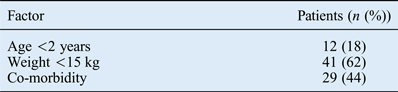
The proportions of adenotonsillectomy, adenoidectomy and tonsillectomy procedures performed on our study cohort are depicted in Figure 1. Mean patient age at time of operation was 3.7 years (range, 10 months to 18 years). In total, 57 patients (86 per cent) were considered high risk because of age (under 24 months), weight (less than 15 kg), or associated co-morbidities that included neuromuscular and cardiac defects (Table I). It was not possible to determine any demographic or ethnic predictors of complications from our results.
Patients undergoing each surgical procedure for obstructive sleep apnoea.

Factors determining high operative risk, and proportion of patients
Nineteen patients were considered high risk for multiple factors; therefore, n > 66.
Pre-operative overnight pulse oximetry was performed on 39 patients (59 per cent), of which 32 were considered high risk. Nine sleep studies were normal, whilst 30 showed oxygen desaturations. The nine children with normal pre-operative pulse oximetry still required adenotonsillectomy as there was clinical evidence of sleep-disordered breathing; hence they suffered sleep disturbance with arousal. Included in these nine patients was one child who received home oxygen pre-operatively, and two children with cardiac and lung disorders on home CPAP.
Seventeen patients experienced significant post-operative desaturations as defined previously. Eleven of these patients had undergone pre-operative pulse oximetry, and this was abnormal in all 11 patients (Figure 2). The remaining patients who experienced significant post-operative desaturations had not undergone pre-operative sleep study. Of the 17 patients who experienced significant post-operative desaturations, only 1 patient required CPAP, whilst the others required supplemental oxygen only.
Patients with and without post-operative desaturations, according to pre-operative sleep study.
Eighteen patients required high dependency unit care in the post-operative setting, eight of whom experienced significant post-operative desaturations (4 per cent or more below baseline). One patient required CPAP, whilst the remaining seven received supplemental oxygen and close monitoring only. Of the eight patients with post-operative desaturations, five had confirmed desaturations on pre-operative sleep studies, whilst the remaining three had not had sleep studies performed. Of the remaining 10 patients who required high dependency unit care, 3 experienced non-respiratory complications such as post-operative bleeding and bradycardia, whilst the remaining 7 required a higher level of care because of their pre-operative functional status. Regarding the latter seven patients, three required high dependency unit or intensive care pre-operatively, whilst four required home oxygen or home CPAP pre-operatively, and therefore also received it post-operatively.
There was no documentation for those patients who experienced respiratory compromise, suffering from pulmonary oedema, right ventricular compromise or pulmonary hypertension. Unfortunately, we do not have information regarding the duration of respiratory compromise, or the time taken to return to baseline function.
Discussion
Obstructive airway symptoms are common, particularly within the paediatric population. Adenotonsillectomy remains the mainstay of treatment for those patients with clinically significant symptoms. Patients who undergo such surgery are known to be at high risk for the development of post-operative respiratory complications,Reference Statham, Elluru, Buncher and Kalra8, Reference Schechter9 and this risk increases further in the presence of factors such as younger age, severity of symptoms and co-morbid illness.Reference Rosen, Muckle, Goding, Mahowald and Ullevig10 In our study, 26 per cent of patients experienced significant desaturations in the post-operative period. This is in keeping with the literature, where quoted figures range from 6.4 per centReference Statham, Elluru, Buncher and Kalra8 to 27 per cent.Reference Schechter9 Our figure is at the higher end of this range, and this may reflect the fact that our institution is a tertiary referral centre treating higher risk cases. Current recommendations advise that patients with additional risk factors such as co-morbid illness, low weight (less than 15 kg) and young age (younger than two years) are referred to a tertiary centre for care rather than undergoing treatment in a district general hospital setting.Reference Robb, Bew, Kubba, Murphy, Primhak and Rollin1 Accordingly, 86 per cent of patients in our study were considered to be at higher risk of respiratory complications, and not suitable for treatment within a district general hospital setting.
Despite recommendations being in place to guide the referral of at risk patients to tertiary care, there is little in the literature to aid identification of those patients likely to require an increased level of post-operative care.Reference Robb, Bew, Kubba, Murphy, Primhak and Rollin1 Blenke et al. attempted to develop criteria for elective paediatric intensive care admission following OSA tonsillectomy, but were unable to produce guidelines.Reference Blenke, Anderson, Raja, Bew and Knight13 These authors instead concluded that careful clinical assessment by an ENT surgeon and senior paediatrics anaesthetist was sufficient to plan post-operative care. Rieder and Flanary investigated the use of pre-operative polysomnography for predicting those patients likely to develop post-operative complications, but were unable to find any correlation between the severity of symptoms and the post-operative course of these patients.Reference Rieder and Flanary14 They also commented that the pre-operative polysomnography findings and recommendations had little bearing on the management of patients in the post-operative period. Rieder and Flanary concluded that the high cost of performing pre-operative polysomnography meant that its routine use for paediatric patients prior to adenotonsillectomy could not be clinically justified.Reference Rieder and Flanary14
Several studies have found overnight pulse oximetry to be useful for the diagnosis of OSA. Brouillette et al. found overnight pulse oximetry to have a 97 per cent predictive value at diagnosing OSA.Reference Brouillette, Morielli, Laemanis, Waters, Luciano and Ducharme11 Nixon et al. developed a validated severity scoring system to identify those patients with severe OSA, with higher pulse oximetry scores correlating to more severe disease.Reference Nixon, Kermack, Davis, Manoukian, Brown and Brouillette12 In addition, Nixon et al. found that post-operative respiratory complications were more common with increasing oximetry score, and concluded that the scoring system may be used to help identify those at greater risk of complications post-operatively. Furthermore, Wilson et al., who investigated the ability of pre-operative sleep study to identify those children at risk of respiratory complications, suggested that pre-operative sleep study could be useful for identifying high risk patients.Reference Wilson, Lakheeram, Morielli, Brouillette and Brown15 This is supported by our results, wherein 11 of the 17 patients who experienced significant post-operative desaturations were identified by pulse oximetry as having pre-operative desaturations; pre-operative pulse oximetry had not been performed on those for whom desaturations were not predicted. One could hypothesise that pulse oximetry studies may have been positive in these latter patients also. In our study, therefore, pre-operative overnight pulse oximetry was 100 per cent sensitive at predicting post-operative desaturations and may thus have a role in identifying those patients for whom a high dependency unit bed should be arranged in advance.
• Up to a quarter of children undergoing adenotonsillectomy for obstructive sleep apnoea (OSA) develop respiratory complications post-operatively; some require high dependency unit care
• This study investigated the predictive value of pre-operative overnight pulse oximetry for post-operative high dependency unit care
• Pre-operative overnight pulse oximetry was 100 per cent sensitive at predicting post-operative desaturations
• Pre-operative overnight pulse oximetry may aid utilisation of high dependency unit beds for OSA patients undergoing adenotonsillectomy
Interestingly, of the 66 patients in our study, only 18 patients required high dependency unit care post-operatively, 12 of whom experienced respiratory compromise. Eight of the patients who required high dependency unit care had post-operative desaturations for which supplemental oxygen and close monitoring was required. Although the remaining 10 patients were managed in a high dependency unit setting, the level of care they required could have been provided on a ward with appropriate nursing numbers. The small number of patients who required a higher level of care is in keeping with the literature. Specifically, studies indicate that although post-operative respiratory complications occur relatively frequently, they much less commonly require intervention, and do not often require high dependency unit care.Reference Walker, Whitehead and Rowley16–Reference Tweedie, Bajaj, Ifeacho, Lloyd-Thomas and Albert18 This suggests that the practice of routinely booking high dependency unit beds for all patients undergoing adenotonsillectomy for OSA in our institution is perhaps unnecessary and should be rationalised. The cancellation of procedures due to a lack of high dependency unit beds is not an unfamiliar scenario for surgeons; this is clearly detrimental, not only to the patient but to National Health Service resources. We acknowledge that the specificity of overnight pulse oximetry is low, and its use as a screening tool to identify higher risk cases may continue to lead to the overbooking of high dependency unit beds. However, its use would help to rationalise the number of high dependency unit beds booked in advance and therefore help to reduce cancellations.
Conclusion
The ability to predict those adenotonsillectomy patients likely to require high dependency unit care in the post-operative period would enable selective and appropriate booking of beds. In our study, pre-operative desaturation on sleep study was a predictor of post-operative desaturations. Whilst the majority of these patients would be suitable for post-operative ward care, some might be considered to be at higher risk; the availability of a high dependency unit bed should be ensured in such cases. The practice, in our institution, of admitting all post-operative cases without other co-morbidity to the high dependency unit is therefore unnecessary and costly, and increases the risk of procedure cancellation. We now routinely review all OSA tonsillectomy cases and the associated pulse oximetry results with anaesthetists in order to predict and plan high dependency unit admissions.