Introduction
The question of why states comply or fail to comply with international legal rules strikes at the heart of debates in both international law (IL) and international relations (IR) over whether and how international institutions matter. The literature is divided between what might be called norm-based and instrumentalist models (Keohane, Reference Keohane1997; Hathaway, Reference Hathaway2005). For IL scholars who focus on the normative characteristics of law, states feel an internalized obligation to comply with international rules, which exert an independent ‘compliance pull’ (Franck, Reference Franck1990; Chayes and Chayes, Reference Chayes and Chayes1995; Koh, Reference Koh1997). This view resonates with constructivist work in IR on the social bases of compliance with rules and norms (Finnemore, Reference Finnemore2000; Lutz and Sikkink, Reference Lutz and Sikkink2000; Checkel, Reference Checkel2001). The norm-based perspective is generally optimistic: compliance is the default behavior.
Instrumentalists, on the other hand, view the compliance decision as based on rational calculations of self-interest. States create law to reflect their interests and subsequently comply only when significant deviations in behavior are not required (Downs et al., Reference Downs, Rocke and Barsoom1996). The Realist variant of this rationalist logic denies that international law and institutions have any independent effect on the actions of states; compliance occurs either when it is costless or when powerful states promote it (Morgenthau, Reference Morgenthau1985; Mearsheimer, Reference Mearsheimer1994/95; Goldsmith and Posner, Reference Goldsmith and Posner2005). Instrumentalists are thus more pessimistic when it comes to the expected frequency and range of conditions for compliance.
In his book How International Law Works, Andrew Guzman (Reference Guzman2008) attempts to bring instrumentalism and optimism together. He shows that even with restrictive rational-choice assumptions – states are selfish maximizers with no particular affection for international law and its legitimacy – we can nevertheless tell a theoretical story for why states often comply. Guzman’s theory rests on three mechanisms that provide an incentive to comply: reciprocity (the fear of tit-for-tat non-cooperation by others), retaliation (the fear of punishment by others), and reputation (the need to be viewed as trustworthy in order to find cooperative partners in the future). The impact of reputation receives top billing. Even when reciprocity and retaliation are insufficient on their own to induce compliance, the reputational benefits from compliance, or the costs of a damaged reputation from noncompliance, can sometimes override the short-term payoff to be gained by violation.
Guzman’s theory is partly synthetic, bringing together arguments from Neoliberal IR theory and economics on how actors can sustain cooperation through repeated interaction (Axelrod, Reference Axelrod1984; Oye, Reference Oye1986), and how a concern for reputation creates an incentive to comply when violations are known (Keohane, Reference Keohane1984; Milgrom et al., Reference Milgrom, North and Weingast1990). It is also innovative in important respects. First, while the IR literature was developed in the context of more nebulous concepts such as regimes and institutions, Guzman applies these theories specifically to the arena of international law, including both treaties and custom. Second, he expands the theory of reputation far beyond existing work. While IR and IL scholars frequently resort to reputational arguments, neither field has outlined a comprehensive theory of how reputation supports law. Guzman joins other scholars who have recently discussed reputation in the context of international commitments (Simmons, Reference Simmons2000; Downs and Jones, Reference Downs and Jones2002; Tomz, Reference Tomz2007), but he outlines a wider range of implications, addressing such issues as treaty design, customary law, the strategic manipulation of reputation over time and, of course, compliance.
Reputation is no panacea, however. While How International Law Works provides a solid foundation for understanding why rational states might comply with international law, the book’s bottom line is in fact fairly pessimistic in the end – echoing Realist themes as much as Neoliberal ones. If reputation dynamics are the central mechanism behind rational compliance, the theory leaves open a wide range of scenarios where compliance should not occur.
This essay is an effort to partially counter these gloomy conclusions. I argue that Guzman, in fact, undersells the extent to which states have an incentive to comply because he does not appreciate the range of possibilities for effective enforcement in the form of sanctioning by other states, that is, the imposition of material costs for the purpose of inducing compliance.Footnote 1 Bringing enforcement more squarely into the picture suggests additional reasons for compliance that are entirely consistent with rationalist assumptions. While retaliation is presented in the book as one possible mechanism for inducing compliance, it is downplayed in three ways. First, Guzman focuses almost exclusively on bilateral scenarios for retaliation, dismissing multilateral settings as essentially hopeless because potential sanctioners face a collective action problem. Second, he does not identify the full range of benefits that accrue to a state that sanctions a violator. Third, he underestimates the role that institutions can play in inducing compliant behavior by reducing the material and political costs incurred by a sanctioner. By taking the strategic incentives of a potential sanctioning state more seriously, I outline possibilities for enforcement – and thus reasons for compliance – that are entirely consistent with rationalist assumptions but not developed in How International Law Works.
The next section explains why reputation alone does not take us far enough in understanding compliance. I then consider retaliation as presented by Guzman and recast the enforcement problem in terms of what I label the sanctioners’ dilemma, which captures the strategic problem facing aggrieved states that would benefit as a group from enforcement but have difficulty supplying it. I outline a range of conditions under which we might expect enforcement to be effective – that is, when the sanctioners’ dilemma is overcome – and argue that these conditions are especially likely to hold in the shadow of international institutions.
Guzman’s largely Realist conclusions
Guzman suggests three pillars as a rationalist basis for compliance: reciprocity, retaliation, and reputation. The first two, however, are quite limited in their usefulness, according to Guzman’s arguments (Reference Guzman2008: 174, 212). Reciprocal noncompliance, in particular, is only helpful in a narrow range of situations. It is ineffective if the violator cannot be excluded from the benefits of the agreement – as in public goods problems – or if the state responding to the violation cannot reasonably suspend its own compliant behavior. For example, it would not be credible for a state to threaten to mistreat its own population in response to another state’s human rights violations. Retaliation is also a fairly weak pillar according to Guzman, mainly because the costs to the retaliating state of trade sanctions, military intervention, and other coercive tools are often prohibitive (2008: 46). Moreover, as a general rule, reciprocity and retaliation are most useful in bilateral relationships and do not function well in a multilateral context (2008: 138, 141, 212).
Given these problems, Guzman emphasizes the third pillar to explain compliance: ‘What remains is a reputational concern’ (2008: 141). Guzman is certainly correct that his book considers reputation in more detail and provides ‘a more complete theory’ of reputation’s impact on international law than any previous work (2008: 73). But how far does reputation take us on Guzman’s account? In the end, the implications for compliance – the frequency and range of conditions under which it occurs – are not very hopeful.
Guzman’s bottom-line conclusion regarding reputation is that a state ‘will comply if the reputational gain from compliance exceeds the increase in the nonreputational payoffs available if it violates its commitment’ (2008: 75), where nonreputational payoffs represent all of the incentives a state has to violate an agreement. So to ask when noncompliance will occur is to ask when nonreputational payoffs are high or when reputational gains are low. According to Guzman, nonreptuational payoffs are large when high-stakes issues, such as important security interests, are on the table (2008: 112–113). As for the second condition, some states have little interest in maintaining or developing their reputation because they are aggressive types and do not anticipate relying on credible promises in the future (2008: 111–112). Others, such as ‘pariah’ states, have such a poor reputation already that they have little to lose by degrading it further through noncompliance (2008: 81). In all of these cases, nonreputational payoffs trump reputation concerns.
Clashing reputations and uncertainty also threaten the robustness of the reputation mechanism. A desire to build or maintain a reputation for toughness, resolve, or being a good ally, all of which have been the subject of a considerable literature (Mercer, Reference Mercer1996; Keohane, Reference Keohane1997; Miller, Reference Miller2003), might override the value of a reputation for compliance, leading to violations (Guzman, Reference Guzman2008: 115–116). In addition, different forms of uncertainty – regarding a potential complier’s preferences and past actions or the interpretation of legal rules – weakens the effect of reputation by making it difficult for other actors to draw inferences about the relevant state’s reputation. ‘The result’, Guzman concludes, ‘is that some states that would have complied may breach because the reputational sanctions are reduced’ (2008: 97).
The theory thus makes a strong case that reputation concerns can induce compliance, but does not paint a very impressive picture of reputation’s causal importance – the range of conditions and frequency with which reputation drives compliance when there are countervailing incentives. In the end, Guzman is able to conclude only that reputation is ‘relevant’ to the compliance decision. ‘Like all influences’, he notes, ‘compliance reputation operates at the margin – putting a thumb on the scale in favor of compliance’ (2008: 117). This is more consistent with skeptical views of reputation offered by Downs and Jones (Reference Downs and Jones2002) and Goldsmith and Posner (Reference Goldsmith and Posner2005), which is perhaps surprising given that Guzman’s goal is to present a reputation-based theory of compliance.
Of course, Guzman’s attention to establishing the limitations and scope conditions of his reputation argument is commendable. The implication, however, is that rationalists are on fairly thin ice if they hope to build an optimistic theory of compliance primarily on the basis of reputation. Another pillar is needed.
The sanctioners’ dilemma
I now consider the possibilities for effective enforcement, which may be a more important part of a rationalist theory of compliance than Guzman’s discussion of retaliation implies.Footnote 2 I build on many of Guzman’s insights on retaliation and reputation but take these arguments further – and come to somewhat more optimistic conclusions.
Guzman outlines two complications that often prevent effective retaliation. The first, as noted above, is that retaliation is costly to the sanctioner, such that retaliatory threats are often not credible. The second problem comes in the multilateral context, where free-rider incentives make individual states even less likely to bear the burden of enforcement (Guzman, Reference Guzman2008: 66–67, 138). While all states that are parties to the relevant treaty or that benefit from the customary rule stand to gain from compliance, only those that sanction bear the cost, creating a collective action problem.
This is an example of a broader phenomenon when it comes to defending community rules. In Jon Elster’s (Reference Elster1989: 41) formulation, ‘Punishment is almost invariably costly to the punisher, while the benefits from punishment are diffusely distributed over all members. It is, in fact, a public good.’ I refer to this problem as the sanctioners’ dilemma. While all actors would be better off finding a way to punish a violator, thereby inducing compliance, no single state has an incentive to do so, leaving all of them worse off. The dilemma is especially acute in the relative anarchy of international politics, where decentralized enforcement is the only viable option.
While Guzman emphasizes the immediate material costs of sanctioning, I would argue that the potential political costs are an equally important consideration. When states engage in coercive actions, other members of the community (beyond the target) are likely to feel threatened and may ascribe a variety of motives to the behavior. As Hedley Bull (Reference Bull1977: 69) notes, ‘Because of the low degree of consensus or solidarity among states, actions which the state committing them sees as self-help or rule-enforcement are frequently not viewed as such by international society at large.’ As Guzman clearly demonstrates, there is often significant uncertainty over states’ intentions and behavior, and over the law itself (2008: 91–100). The sanctioner, therefore, must convince other states that its actions are a form of enforcement in defense of legal rules rather than an aggressive pursuit of more selfish goals.
If this effort is unsuccessful, other states can respond by imposing a variety of costs on the sanctioner, both short-term (such as opposition to the policy itself, reciprocal noncompliance in other shared regimes, and other forms of balancing) and over the long run (including a diminished reputation and loss of ‘soft power’) (Thomas, Reference Thomas2001: 35–36; Nye, Reference Nye2004). Even powerful states – those most likely to enforce international law – are subject to and concerned with such political costs when they act (Walt, Reference Walt2005; Thompson, Reference Thompson2009).
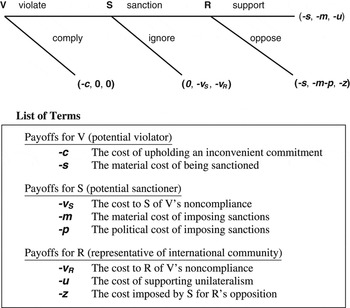
The strategic obstacles to enforcement are thus more complex than Guzman’s treatment of retaliation implies. The sanctioners’ dilemma can be illustrated with the game tree depicted in Figure 1. This simple, complete-information game helps us isolate the key strategic dynamics and understand when successful sanctioning will occur.
The sanctioners’ dilemma

State V is the potential violator; state S, a powerful state with a strong interest in maintaining the cooperative status quo, is the potential sanctioner; and state R is a representative member of the international community that must decide whether to support or oppose the sanctioner’s actions. The game begins with state V, which finds its cooperative commitment inconvenient (i.e. compliance entails some short-term political cost) and faces a choice to either violate or comply. If V complies, it pays a price, c, for upholding its commitment, while the other actors receive their status quo cooperative payoff, normalized to zero. If V violates, then state S faces a choice of whether to retaliate or ignore the violation. If S ignores, V receives zero as its payoff for opting out and avoiding the price of compliance. S and R suffer costs, vS and vR, for allowing this violation to continue – representing some reduced provision of a good or a domestic political backlash for being cooperative while others are cheating.
The game gets more interesting if S chooses to sanction, in which case V pays the material cost of being sanctioned, s, and S pays the material cost of providing the sanction, m. If s > c, sanctions successfully induce compliance by V because violation is no longer the more attractive option. If R opposes the action, this has no effect on V’s payoffsFootnote 3 but, crucially, it means that S must pay both the material cost of sanctions and a political cost, p.
R values the compliance by V that S’s threat of sanctions has the potential to produce but, if sanctioning actually occurs, R may not be sure if S’s actions are justified. If R views S’s policy as a legitimate enforcement of international law, it wants to offer support, but if R thinks S’s actions are purely selfish or even threatening to the international community, it has an incentive to oppose such unilateral aggression. The possible downside of support is captured in the u term, which is the political cost imposed on a government by its domestic audience or the international community if it supports an action that others deem unilateral or unlawful; u takes on a greater value when legal rules lack clarity or when V’s behavior is ambiguous. The downside of opposition is that it could create problems in the context of R’s bilateral relationship with S. This possibility is represented by the z term in R’s payoff; its magnitude depends on the types of leverage that S has over R in terms of trade, foreign aid, military assistance, and other sources of R’s dependence on S. R must therefore navigate between the dangers of supporting unilateral behavior and the potential backlash from upsetting a powerful state. Note that if z is positive but less than u, the relative values of p and u-z become important, as S has an incentive to propose a deal to R: If you support my policy (saving me the value of p), I will not impose costs on you (specifically, costs that exceed the value of u-z).
We can readily see, through the logic of backward induction, that S’s behavior is a function of R’s and that V’s behavior is, in turn, a function of S’s and R’s. V will not violate if sanctions are more costly than compliance. But sanctions must be cost-effective to be credibly employed, so the crux of the strategic problem lies with S’s decision. Under what conditions will S decide to sanction? If the cost to S of V’s violation is less than the material cost of sanctions (if vS < m), then sanctioning will never occur and noncompliance results (the potential political costs of sanctions are irrelevant). This reflects Guzman’s point that retaliation is often impractical because it is costly for the sender.
However, in any case where vS > m, then p becomes the critical variable. In this important and politically interesting set of cases, the outcome will depend on the size of p (the magnitude of the political costs if sanctions are opposed) and on S’s anticipation of whether these costs will be imposed or not (which is a function of u and z). S will always sanction when it anticipates support from R (when u < z). But even in the face of opposition, it will sanction if the value of p is low enough. Specifically, if the cost to S of V’s violation is greater than the combined material and political costs of sanctions (if vS > m + p), then sanctioning will occur – and it will be successful as long as s > c. Moreover, if p > u-z then S can cut a side-deal for R’s support, a possibility that increases the range of conditions for successful sanctions. In sum, as long as the value of V’s compliance exceeds the material costs of imposing sanctions, S will sanction when it anticipates either support from R or lower-cost opposition, but will not sanction when it anticipates higher-cost opposition.
This strategic model allows us to consider more explicitly the situation facing a potential sanctioning state and to investigate the possibilities for decentralized enforcement. If a violation is important enough to a potential sanctioner, it has an incentive to supply enforcement and will do so under a variety of conditions. The next section builds from the model to make an argument that these conditions are plausibly met in many situations.
The calculus of enforcement
The discussion surrounding the sanctioners’ dilemma game indicates that two sets of factors increase the chance of sanctioning. The first set relates to the benefit to state S of achieving compliance and avoiding violations (largely captured in the vS term), while the second set relates the costs of sanctioning, both material and political (captured in the m and p terms), which are a function of the international community’s reaction (reflected in R’s payoffs).
The benefits of sanctioning
On the benefits side, there are indeed times when individual states, usually rich and powerful ones with a stake in maintaining the status quo, have an incentive to unilaterally provide a public good to the international community. As Snidal (Reference Snidal1985: 581) notes in his discussion of hegemonic stability theory, ‘This outcome will be most likely when some single state, the hegemonic power, is sufficiently large relative to the others that it will capture a share of the benefit of the public good larger than the entire cost of providing it.’ While this argument is usually applied to the provision of economic and security stability, such stability often includes the enforcement of legal rules. The international community in these cases is a ‘privileged group’ (Olson, Reference Olson1965) because the benefits of compliance (vS) are so high for a single state.
The possibility that the benefits of compliance will offset the costs of sanctions becomes even more plausible if we consider the potential long-term benefits of enforcing compliance. What if the game is repeated? Keohane (Reference Keohane1984) argues that states obey regime rules because regimes are so difficult to create and replace; thus, noncompliance risks dissolving the entire regime and sacrificing the long-term benefits it provides. The same logic can be applied to enforcement. In a repeated game, even where agents change their partners over time and with only modest assumptions about information, ‘community enforcement’ can be sustained. In other words, even agents that care only about their own utility and do not care about a rule for its own sake have an incentive to punish those who violate social rules, for fear that violations will spread and cooperation will break down (Kandori, Reference Kandori1992). When a sanctioner contemplates taking action, it takes into account the long-term benefits supplied by the relevant law, not just the benefits of compliance in the case at hand.
A third factor to consider is the reputational benefit to S of sanctioning a law violator. Many of Guzman’s insights about the reputational incentives for the complier (state V) can be extended to the sanctioner. State S may receive a reputational payoff as a defender of international law and may be able to build up ‘reputational capital’ by doing so repeatedly over time. This capital could be spent on future violations or on enforcement actions that are more questionable (in terms of the model, R’s cost u would be reduced as support of S becomes more acceptable). In fact, reputation might be especially effective at promoting sanctions in precisely the situations where Guzman is most skeptical of retaliation as a pillar of compliance – the multilateral context. Guzman argues convincingly that reputational benefits accrue most quickly in multilateral settings because information spreads more readily (Guzman, Reference Guzman2008: 72). Rather than stifling retaliation due to free-rider problems, then, multilateral settings might provide the most attractive reputational opportunities to would-be retaliators.
Going further, there are reasons to believe that the reputational gains to a sanctioner are even greater than those to a complier. States have and value many reputations beyond that for compliance, including a reputation for defending one’s interests and for toughness in the face of challengers. Indeed, it might be in an actor’s interest to pay the price of confronting even a relatively unthreatening challenger if doing so deters future challengers; this is the logic for how the famous ‘chain store paradox’ can be overcome through a reputation mechanism (Kreps and Wilson, Reference Kreps and Wilson1982). For example, Alt et al. (Reference Alt, Calvert and Humes1988) argue that a hegemonic state may have an incentive to engage in costly coercive actions as an investment in its reputation for toughness, one that makes coercion cheaper in the future. The power of the reputation logic in the context of enforcement is that, by punishing a violator, a state can at once boost its benevolent reputation, as a defender of international law, and its ‘less savory’ (Keohane, Reference Keohane1997: 497) reputation for being tough and assertive. Supplying enforcement is one of the rare cases where these seemingly divergent reputational incentives are not in conflict.
Finally, there may be domestic political incentives to engage in enforcement actions. Guzman downplays domestic factors by treating states as unitary, but their inclusion is common in rational-choice theorizing on international cooperation (Milner, Reference Milner1997; Schultz, Reference Schultz2001).Footnote 4 Just as governments face domestic pressure to comply with international law (Dai, Reference Dai2007), they also face pressure to enforce rules that affect important domestic constituents. What Miles Kahler (Reference Kahler2000: 675) refers to as domestic ‘compliance constituencies’ not only encourage their own government’s compliance but also ‘encourage imposition of sanctions on other governments that violate legal commitments’. All of these factors create a positive political benefit for state S if it sanctions a noncompliant state, replacing or offsetting the feared political costs that plague enforcement.
The costs of sanctioning
Turning to the cost side of the equation, successful enforcement is most viable when the material and political costs of sanctioning are low. This is most likely to be the case when the sanctioner is much more powerful than the noncompliant state, rendering the material costs insignificant, and when the violation is egregious and obvious, making international support unproblematic.
Thinking in more general terms, a key implication of Figure 1 is that the actions of state R, representing the international community, are pivotal for determining the costliness of sanctions. R must discern whether S’s actions are a justifiable response to a violation of law and has an interest in doing so accurately – in order to promote reasonable sanctioning, but also to deter unreasonable sanctioning that might threaten international community interests. The worst-case scenario – the crux of the dilemma – occurs when S engages in reasonable sanctioning but R views the situation as ambiguous and, fearing the costs of unilateralism (u), opposes the policy. On the other hand, the dilemma disappears if there is widespread agreement on the situation at hand.
For these reasons, the costs of sanctioning are most likely to be low when it is conducted in the shadow of an institution. This will automatically be the case if the rules fall under the umbrella of an international organization or a less formal body (such as the various committees that monitor human rights treaties). But institutional effects also become relevant if the sanctioner seeks the approval of an international organization for its actions, thus drawing the institution in.
Institutions provide three types of information that make R more likely to support S, thereby reducing the political costs of sanctioning. First, they provide clarification when rules are ambiguous, thereby resolving ‘conflicts of interpretation’ (Smith, Reference Smith2000: 138). Second, by providing transparency and monitoring, institutions help identify behavior as noncompliant (Chayes and Chayes, Reference Chayes and Chayes1995; Mitchell, Reference Mitchell1998). Third, institutions help supply information on the motivations of states that interact within and through them (Wallander, Reference Wallander1999). More specifically for our purposes, since working through an institution is costly for the sanctioner, imposing conditions, increasing public scrutiny, and delaying action, doing so signals to the international community that it is a relatively trustworthy and benign type (Kydd, Reference Kydd2001; Thompson, Reference Thompson2006). All of these information functions have received attention in the literature – but the emphasis has been on cooperation and compliance decisions rather than on the enforcement decision.
In general, highly legalized institutions are more effective at performing these functions. Formal tribunals, for example, are especially credible at clarifying rules, behavior and intentions (Abbott and Snidal, Reference Abbott and Snidal2000: 427; Guzman, Reference Guzman2008: 52). Nevertheless, we know that even modest centralized information provision by an informal institution can fundamentally alter the cooperative incentives of social actors (Greif, Reference Greif1989; Milgrom et al., Reference Milgrom, North and Weingast1990). The international community has an interest in coordinating around a common response to the actions of a powerful state (since each state has little influence on its own), and even a weak institution can generate rules and provide assessments of behavior that serve as focal points for such coordination.Footnote 5 Thus, the incentives of a sincere sanctioner – one engaged in legitimate enforcement of law – are likely to be altered in a pro-enforcement direction in a variety of institutional settings.
Even if the main function of institutions is to reduce the political costs faced by a sanctioner, they may also reduce material costs to the extent that they promote active multilateral support. While in the model I assume that there is a constant material cost, m, paid by the sanctioner whether its policy is opposed or not, we know from experience that support from the international community can sometimes reduce the material costs of taking action through burden sharing. Thus, when the United States, backed by the Security Council, took the lead in reversing Iraq’s invasion of Kuwait, it received a vast array of in-kind and cash contributions. The prospect of lower material costs further increases the probability that a state will take on the burden of providing decentralized enforcement of international law.
Conclusion
How International Law Works offers the most comprehensive statement to date of why rational states create and comply with international law, especially due to reputational concerns. However, despite Guzman’s effort to carve out ‘a vibrant and important role for international law’ (Guzman, in this volume: 285–293), he also delineates a wide variety of conditions under which reputation does not operate effectively, rendering his bottom-line conclusions less optimistic than one might hope. Given the acknowledged limits of the reputational mechanism for inducing compliance, in this essay I make a case for focusing more attention on the possibilities for effective enforcement of law by states. Guzman addresses enforcement, in the form of retaliation, but argues that it only works in a relatively narrow range of bilateral settings. Indeed, individual states are often reluctant to sanction rule violators because doing so is costly and because they seek to free-ride on the efforts of others. I develop these points into what I call the sanctioners’ dilemma: the international community as a whole has an interest in punishing violators but no one state has an incentive to do so.
On closer inspection, I argue that the cost-benefit calculus of a potential sanctioner is not as grim as one might think. I outline various benefits of inducing compliance and offer reasons to believe that the costs of imposing sanctions, both material and political, can be minimized, especially in the shadow of institutions. Recovering state-on-state enforcement as a plausible mechanism for compliance is crucial in light of the limitations of other mechanisms, and also because it is the absence of enforcement that often leads skeptics of international law to argue that it is not really ‘law’. The more viable enforcement is, the more law-like and predictable international law becomes.
I suspect that so many IR and IL scholars are, like Guzman, skeptical of decentralized enforcement as a compliance mechanism partly because it is so often the ‘dog that didn’t bark’. Actual sanctioning is usually off the equilibrium path and therefore rare, so we have a tendency to underestimate how often it matters (Drezner, Reference Drezner2003). Indeed, in my simple game theory model, where all of the actors know each other’s payoffs and past moves, sanctioning should never occur because any credible threat of a sanction deters violation in the first place. In the real world of uncertainty and miscalculation, incidents of economic and military sanctions obviously do occur but usually in the most difficult and messy cases, where the implicit and explicit threat of punishment has not worked. Drawing inferences from such cases is misleading and, indeed, ignores the primary appeal of the sanctioning mechanism and of coercion more generally: when it works best, it operates in the background and is costless to the state employing it.
A potential implication of my argument is that the dichotomy between the ‘managerial’ and ‘enforcement’ schools of compliance, which has received so much attention in the literature (Chayes and Chayes, Reference Chayes and Chayes1995; Downs et al., Reference Downs, Rocke and Barsoom1996; Tallberg, Reference Tallberg2002), is overstated. Each side is right to a degree: Enforcement is sometimes necessary for meaningful cooperation, but it is almost always decentralized and its viability partly depends on the presence and design of institutions, which shape the incentives of potential sanctioners. Enforcement, in other words, can be managed to some extent (see Abbott and Snidal, Reference Abbott and Snidal1998: 26, 27).
In the end, many of the questions raised in the compliance literature are empirical ones. As the literature on compliance evolves, IR and IL scholars should continue to refine existing theories, as Guzman has done from a rationalist perspective, but we should also focus on devising research strategies that can help us adjudicate among causal mechanisms and get to the bottom of the compliance puzzle.
Acknowledgements
I am grateful to Burcu Bayram, Andy Kydd, Duncan Snidal and two anonymous reviewers for very helpful comments on earlier versions.