Introduction
The first surviving records of suicidal deaths in Ireland derive from the 1851 Census of Ireland. This Census provides detail on causes of deaths, including those by suicide, the demographic characteristics of the deceased, and method of suicide.
This paper analyses and presents details of those deaths returned as suicidal in this Census. For the later years of the 19th century details of deaths returned as suicidal have been extracted from the Annual Reports of the Registrar-General. Because of under-reporting of suicide, accurate estimation of death rates over these years are difficult to establish, and therefore may have resulted in changes in the incidence of suicide.
Methods
In Ireland coroners’ records should be adequate sources of information on deaths, including suicides, from the 18th century onwards. These would have been compiled locally on a county basis. Many were destroyed when the Public Record Office, in the Four Courts, Dublin, was blown up in 1922. Unfortunately, apart from some surviving records for most counties between 1835 and 1837 giving name of deceased, date of inquest and cause of death, transferred from Crown and Peace Offices and held in the National Archive, few records from the first-half of the 19th century exist and these are mainly for early 19th century Carlow.
In the Census of Ireland 1851, Part Five, tables of death, extensive detail is given concerning suicides from 1841 to1851. Records which might have given information on suicidal deaths were contained in the 1861 census, but these were destroyed in the afore-mentioned destruction in the Four Courts in 1922. The next available source is from the process of civil registration, including deaths, inaugurated in 1864. These sources have been reviewed by Walsh (Walsh, Reference Walsh1976).
Results
Suicide in Ireland from 1841 to 1851
In the census of 1841, Sir William Wilde in his report on the tables of death calculated that there were 755 suicides in the 10-year period from 1831 to 1840. Males were in the majority and most were by hanging. In calculating population rates the estimated annual populations provided by the Sixteenth Annual Report of the Registrar-General have been employed. In the decennium 1831 to 1840 the estimated population grew from 7767 to 8155 million. Assuming that the 755 suicides were equally distributed over the decennium and applying the estimated 1836 population of 7 980 637 as a midpoint divisor one arrives at an annual suicide rate per 100 000 of 0.95 for these 10 years. Of course one has to take into account that Wilde may have classified as accidental deaths that were in reality suicidal.
There were 869 deaths recorded as suicides from 6th January1841 to 30th March 1851 in the census report for 1851. Of these 591 (68%) were male. In addition, 10 208 deaths were returned as unspecified accidents, 7833 (77%) of them male. The population of Ireland, 8 199 853 in 1841, fell by death and emigration in the wake of the Great Famine to 6 514, 473 million in 1851. In the calculation of annual rates the Registrar-Generals’ estimate already referred to have been employed (Table 1).
Suicide by year 1841–1851

Numbers and rates per 100 000 population.
In addition to deaths reported as suicides there were 233 deaths, 144 male and 89 female, returned as from poisoning. A further 10 208 deaths were returned as ‘accidental, unspecified’ as to cause, 7833 of them were male.
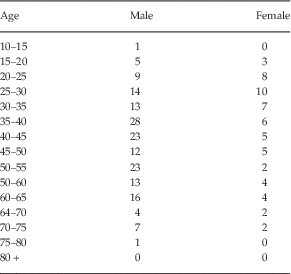
The age and sex of 227 (26%) of the 869 suicides were specified as in Table 2.
Age and sex of 227 suicides

In the remaining 422 male and 220 female suicides, age was unspecified. Although in only a quarter of suicides was age returned the age peaked at 35–40 years.
In total, 250 suicide deaths (180 male and 70 female) occurred in Civic Districts, 556, (368 male and 188 female) in Rural Districts, 61 (41 male and 20 female), in hospitals and two males and no females in workhouses.
Suicide was returned in 841of the 869 deaths as the consequence of an inquest. Inquests were not held in another five sudden or violent deaths reported as suicide by the Constabulary to the Inspector General of that force, four of them in civic districts and one in a rural district, two each by drowning or cutting and one by hanging.
Method of suicide
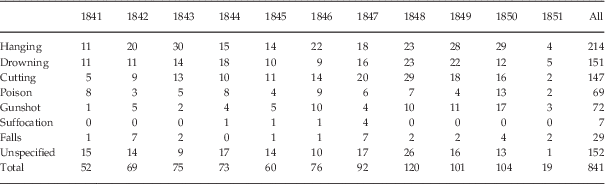
For those deaths returned as suicides by inquest the sex, age and method of suicide (Table 3) was supplied by year of suicide.
Inquest suicides (method by year)

Hanging accounted for a quarter of suicidal deaths, drowning for 18% and cutting for 17%. Between them these three methods contributed 60% of deaths. There was no noticeable change in method over the years surveyed (Table 4).
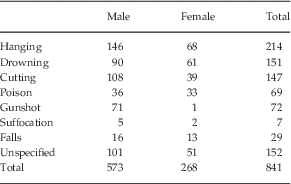
Method by sex

Of those deaths assigned method gunshot accounted for 12% of male deaths but only one female died by this method. Cutting accounted for 19% of male deaths and 14% of female suicides. Hanging was commonest for both genders – a quarter of male and 23% of females. Drowning cost 16% of male deaths and 23% of female suicides.
Suicide in Ireland from 1852 to 1863
Because of the destruction of the 1861 census no data on suicide are available until civil registration began in 1864.
Suicide in Ireland from 1864 to 1899
With the establishment of civil registration in Ireland in 1864 the annual reports of the Registrar-General of births, deaths and marriages supplied information on deaths by suicide although the format of their presentation changed over the period covered.
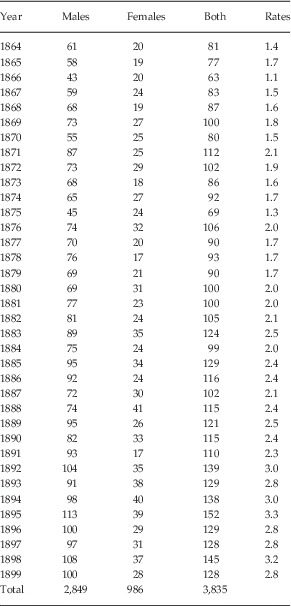
Herewith in Table 5 are numbers and rates per 100 000 population by gender for each year from 1864 to 1899.
Suicide in Ireland (1864–1899) by year and gender, numbers and rates per 100 000 population

Thus nationally from 1864, the first year of civil registration, to 1899, there were 3835 deaths returned as suicide. Over the years covered reported suicide rates doubled.
From 1864 up to and inclusive of 1888 suicidal deaths by method and gender were supplied for 2427 suicides, whereas in 1889 and 1890 method was supplied by both genders combined. After 1890 suicides by method were not returned. The method by sex of the 2427 for which this is available is given in Table 6.
Methods from 1864 to 1888 by gender

Numbers and percentages
Thus hanging was commonest at almost a third followed by cutting and then drowning.
Suicides in public and private Irish lunatic asylums from 1850 to 1899
The sources of this information derives from the Annual Reports of the Inspectors of Lunacy in Ireland The first mention of suicide taking place in an asylum was in 1850 and is recorded in the fifth Inspectorial Report. It was stated to be the first suicide in public asylums for many years. It concerned a female who suspended herself from a ladder during the night. Apart for stating that an ‘assistant’ was discharged as a consequence no further details, such as in which asylum that it occurred were supplied.
There were 166 recoded suicides in asylums from 1850 to 1899. Of these, gender was recorded in 130 cases, 84 (65%) of them were male compared with 72% nationally. Between 1864 and 1899 there were 146 suicides in asylums out of a total of 3835 nationally, constituting 3.7% of suicides in this period of the 119 for whom gender was assigned 84 (68%) were male. Of those suicides for which method could be assigned from Inspectorial reports, 40 were by hanging, 10 by drowning, eight each by self-strangulation and cutting, four by fire setting, three by poisoning, by railway train two each by jumping and self-suffocation.
Discussion
The data returned in this paper are subject to a number of limitations and reservations. Suicide may be underestimated at all periods because of misclassification as accidents and for other reasons (Brugha & Walsh, Reference Brugha and Walsh1978), and there is evidence that under-reporting was constant during the 19th century, particularly the first decade recorded here, 1841–1850, and in the early years of civil registration from 1864 (Walsh, Reference Walsh1976). Under-reporting of deaths was a constant concern of Registrars-General throughout the 19th century (Registrar-General, 1880) and persisted well into the following century (Verriere, Reference Verriere1979). For example, Dean & Mulvihill (Reference Dean and Mulvihill1999) reported that in Mayo, as late as 1992, 11.5% of deaths were unregistered. Whether suicidal death were more likely than non-violent deaths to be unreported appears likely. It may be argued that during the time surveyed here the reporting of suicide rather than suicide itself increased. However, Brugha & Walsh (Reference Brugha and Walsh1978) concluded from an examination of coroners’ records from 1900 to 1904 ‘that changes in official suicide statistics accurately reflect changes in the true rate’. There is no reason to believe that the position before 1900 was in any way different. It is therefore legitimate to conclude that what evidence we have indicates a fairly consistent increase, despite under-reporting of suicide numbers throughout the second-half of the 19th century. At all times males rates have exceeded female rates.
Up to 1888 (the last year for which method was supplied), hanging was the commonest method of suicide accounting for up to 30% of deaths with cutting and drowning being equal second causes. As might be expected death by gunshot was almost exclusively a male prerogative.
As far as asylum suicides are concerned one is dependent on those recorded in the Annual Reports of the Inspectors of Lunacy that have their own deficiencies and possible omissions. In some instances such as in the 1882 report, three deaths are reported as being violent without specification as to whether some were suicide. And in other years no suicides were recorded which need not necessarily mean that no asylum suicides occurred in that year.
In the late 19th century, asylum suicide caution cards were devised for patients believed to be at high risk of suicide and were to accompany such patients at all times but there is virtually no information in the Inspectorial reports concerning their usage and utility. Coroners’ inquests with a jury were usual, but not ubiquitous in cases of asylum deaths and in at least one instance in the Richmond Asylum, the Board of Governors deplored that an inquest had not taken place. In another case the Governors requested that the Inspectors carry out an enquiry; in others the Inspectors did so spontaneously. In one instance, a coroner’s jury castigated Governors for being grossly negligent in not providing ‘sufficient night watch’; in another, the Inspectors were highly critical of the coroner’s enquiry regarding it as a mere formality with no real intent at getting to the true facts of the case.
In many cases of investigation, no blame was apportioned to attendants for not preventing death. In others, attendants were considered to be negligent and dismissed or in a small number of cases demoted and fined.
The proportion of nationally recorded suicides that occurred in asylums was 3.7%. This compares with 5.7% in the decade 1983–1992 (Corcoran & Walsh, Reference Corcoran and Walsh1999). Virtually all of the 19th century asylum suicides took place on the premises. However, seven patients evaded staff when out exercising, four of whom hung themselves from trees with three drowning themselves in neighbouring rivers. Three escaped from inpatient care, two of whom laid themselves on a railway line and one jumped in front of a passing train. In contrast, in the series reported by Corcoran & Walsh (Reference Corcoran and Walsh1999) only 26% died on hospital premises, the majority were either absent with leave or went missing without it.
In some cases suicide occurred shortly after admission and some patients were noted to be at risk because of prior attempts. Suicide occurred in patients deemed to have recovered and in some longer stay residents in whose cases there was no perception that suicide might be a likely event.
Supplementary material
For supplementary material/s referred to in this article, please visit http://dx.doi.org/10.1017/ipm.2016.35
Acknowledgements
None.
Financial Support
This research received no specific grant from any funding agency or from commercial or not-for-profit sectors.
Conflict of Interest
None.
Ethical Standards
The authors assert that all procedures contributing to this work comply with the ethical standards of the relevant national and institutional committee on human experimentation with the Helsinki Declaration of 1975, as revised in 2008. The study protocol was approved by the institutional review board of each participating institution.