Trees of the family Dipterocarpaceae dominate the emergent canopy of most lowland rain forests in Asia (Ashton et al. Reference ASHTON, GIVNISH and APPANAH1988). The family is, therefore, one of the most ecologically important in South-East Asia. Shorea curtisii Dyer ex King is the most common tree species in the hill dipterocarp forests of Peninsular Malaysia (Burgess Reference BURGESS1975, Symington Reference SYMINGTON and Barlow2004), and is considered a key species for the dynamics of such forests. Currently, most Malaysian hill forests are selectively logged. Trees over 50 cm dbh are harvested, and any subsequent harvests depend on the remaining smaller trees. Such selective logging takes no account of seedling regeneration. Hence, subsequent timber harvests rely on trees derived from the seedlings that are already present and future seeds produced by the residual trees (Appanah & Mohd. Rasol Reference APPANAH and MOHD. RASOL1994). Existing seedlings of S. curtisii in the forest, therefore, play a significant role in the dynamics of the hill forest. However, the conditions that constitute a suitable habitat for S. curtisii seedling establishment and survival remain unknown.
Mature S. curtisii trees are abundant on ridges (Burgess Reference BURGESS1975), and the distance over which seeds of the species can be dispersed is comparatively short (Symington Reference SYMINGTON and Barlow2004). Thus, it is expected that seedlings establish at sites near mother trees on ridges. Indeed, pole-sized trees (5–15 cm dbh) are found on ridges along with mature trees (Niiyama et al. Reference NIIYAMA, ABDUL RAHMAN, KIMURA, TANGE, IIDA, QUAH, CHAN and APPANAH1999). In this case, juveniles are located near the mother trees, but it is impossible to determine whether this is a result of topographic conditions, distance from the mother tree or a combination of the two. Moreover, the distribution of small seedlings has not been described previously.
Turner (Reference TURNER1990) found that survival rate of S. curtisii seedlings was higher in gaps than under the canopy, but did not take into account topography or distance from the mother tree.
In the present study, we aimed to identify suitable habitats for S. curtisii seedlings by examining a study plot with wide environmental variation, including a topography ranging from ridge to valley, variation in the distances from mother trees, and in light conditions.
The study was conducted at the Semangkok Forest Reserve, Selangor, Malaysia. The reserve is located about 60 km north of Kuala Lumpur and about 10 km south of Fraser's Hill. A typical hill dipterocarp forest has developed on the ridge and steep slope around Semangkok (Putz Reference PUTZ1978). Selective logging was carried out in part of the reserve in 1988. We established a 4-ha (100 × 400 m) study plot within the selectively logged forest in 1994. The felling intensity was 10% of the total basal area (BA) of all tree species larger than 5 cm dbh (total BA was c. 35 m2 ha−1 before and 31.5 m2 ha−1 after the logging operation).
The mean annual rainfall at the nearest meteorological station (Kuala Kubu Bharu, 15 km south-west of the plot) is 2414 mm and the mean annual minimum and maximum temperatures are 21.9 °C and 33 °C, respectively (Saifuddin et al. Reference SAIFUDDIN, RAHIM and MUHANMAD FARID1991). The altitude of the study plot ranges from 515 to 600 m asl.
In 2006, we recorded the spatial distribution of S. curtisii individuals taller than 30 cm in 5 × 5-m quadrats within the 4-ha plot. We measured dbh of any individuals with a diameter greater than 5 cm, and counted the number of seedlings between 30 cm and 130 cm tall. We considered that the mother tree of each seedling was the nearest individual with a dbh greater than 30 cm. Appanah & Mohd. Rasol (Reference APPANAH and MOHD. RASOL1990) found that small dipterocarp trees (> 25 cm dbh) could fruit in the logged forest. However, we adopted 30 cm dbh as a threshold for mother trees, since smaller S. curtisii trees fruit very rarely in the reserve (R. Azizi & K. Niiyama unpubl. data).
To estimate the transmittance of diffuse sunlight in each quadrat, hemispherical photographs were taken at 451 observation points positioned at 10-m intervals throughout the plot, 130 cm above the ground. The diffuse transmittance (standard overcast model) of each point was calculated using the RGBFisheye software (http://www1.gifu-u.ac.jp/~ishidam/RGBFisheye02.htm; Ishida Reference ISHIDA2004). The values for each quadrat were interpolated by inverse distance weighting, since spatial distribution of the diffuse transmittance was strongly clustered (Moran's I Index = 0.3, Z Score = 8.44, P < 0.01, by Spatial Autocorrelation Tool of ArcGIS9.3).
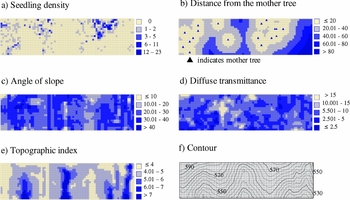
We used a Bayesian approach for the analysis; a random-effect Poisson regression model was fitted using the Markov Chain Monte Carlo (MCMC) procedure in the OpenBUGS software (Thomas et al. Reference THOMAS, HARA, LIGGES and STURTZ2006). Spatial autocorrelation of unknown factors was taken into account in the model by a spatially structured error based on Conditional Autoregressive formulation (CAR). The number of seedlings less than 130 cm tall was used as the dependent variable, and four environmental factors served as the predictor variables, namely: distance from the mother tree (m), diffuse transmittance (%), Topographic Index (TI; also known as the Wetness Index), and angle of slope (degrees). The TI of each quadrat was calculated by: ln (a/tan (beta)); where a is the area of the hill slope per unit contour length that drains through a specific quadrat and tan (beta) is the local slope angle in that quadrat. TI was calculated using the software Grass 6.4.0 (Open Source Geospatial Foundation Project. http://grass.osgeo.org). In advance of model fitting, we standardized the distributions of all predictor variables by z-transformation, so that the mean and standard deviation of every predictor variable became zero and one, respectively. The MCMC procedure was run for 20 000 iterations after a burn-in period of 10 000 iterations. To check the convergence of MCMC, we ran three chains and calculated the Gelman–Rubin convergence statistic as modified by Brooks & Gelman (Reference BROOKS and GELMAN1998) using the ‘bgr diag’ module in the OpenBUGS software (Thomas et al. Reference THOMAS, HARA, LIGGES and STURTZ2006). There were 738 seedlings in the 4-ha plot; 90.7% of these were within 30 m of the mother tree, and 97.6% within 40 m (Figure 1a, b). The slope ranged from 1.3° to 44.4° (Figure 1c). Generally, the forest floor was comparatively dark, 35.7% of the quadrats had a diffuse transmittance of less than 5%, and the highest value was 24.6% (Figure 1d). TI was a good descriptor of the topography, i.e. lower TI values were associated with the ridge, and higher values with the valley (Figure 1e, f).
Spatial distribution of variables included in the model developed for examining seedling density, and contour map of the 4-ha (100 × 400 m) study plot in Semangkok Forest Reserve; seedling density (individuals per 25 m2) (a), distance from the mother tree (m) and the distribution of the mother trees (b), angle of slope (°) (c), diffuse transmittance (standard overcast model, %) (d), Topographic Index (e) and contour map (m asl) (f). The size of each grid square is 5 m × 5 m.

We considered that a coefficient within the model was ‘significant’ at the 5% level, if the 95% credible interval did not contain the value zero. The statistically significant coefficients in the fitted model were distance from the mother tree, diffuse transmittance and TI (Table 1); the coefficient of the angle of slope was not significant. The significant coefficients were all negative, so the density of the seedlings tended to be high close to the mother tree, in locations with low TI values (i.e. ridges or comparatively drier places), and in comparatively dark places. Distance from the mother tree and TI had a greater influence than diffuse transmittance on seedling density (Table 1).
Summary of significant coefficients for the random-effect Poisson regression model for the seedling density in the Semangkok Forest Reserve. Abbreviations: posterior mean (Mean), standard deviation (SD), the error introduced by the random sampling procedure (MC error), lower limit of 95% credible intervals (Val2.5), posterior median (Median), upper limit of 95% credible intervals (Val97.5) and the total number of random sampling of three chains (Sample). (−) denotes negative coefficients with 95% credible intervals not overlapping 0.

Distance from the mother tree and TI both made a significant contribution to the model (Table 1). This means that seedling density was high close to the mother trees on the ridge. These results are not surprising because mature S. curtisii trees are abundant on the ridge (Burgess Reference BURGESS1975), and the dispersal distance of the species is comparatively short (Burgess Reference BURGESS1975, Symington Reference SYMINGTON and Barlow2004). However our study indicates that both topographic conditions and distance from the mother trees are statistically significant. Previously, no study had determined which of these two factors was more important, or whether they contributed equally. In addition, we found that seedling density was very low more than 40 m from the mother tree. Whitmore (Reference WHITMORE1984) noted that S. curtisii trees were abundant on ridge crests, which were likely to be dry and nutrient-poor. Delissio & Primack (Reference DELISSIO and PRIMACK2003) found that dipterocarps were less affected by severe drought than some non-dipterocarps. Maruyama et al. (Reference MARUYAMA, TOMA, ISHIDA, MATSUMOTO, MORIKAWA, ANG, YAP and IWASA1997) found that water use efficiency of S. curtisii seedlings was comparatively high relative to 19 tropical tree species examined. Turner et al. (Reference TURNER, BROWN and NEWTON1993) suggested that ectomycorrhizal associations might be of great importance to dipterocarp seedling growth under low nutrient conditions. Alexander et al. (Reference ALEXANDER, AHMAD and LEE1992) found that S. leprosula seedlings growing naturally in the forest had ectomycorrhizas 20 d after germination, however, seedlings isolated from contact with the roots of mature Shorea trees remained uninfected in the field for up to 6 mo. Therefore, we consider that S. curtisii seedlings have a competitive advantage on the ridge because they can withstand water stress and nutrient shortage (Burgess Reference BURGESS1975), and because microsites for seedling establishment were restricted by the short seed dispersal distance. The restricted distribution of the ectomycorrhizas around the mother tree might also contribute to the restricted seedling distribution.
We found that diffuse transmittance was negatively correlated with seedling density and this relationship was statistically significant. This seems to conflict with the results of a study demonstrating that the survival rate of S. curtisii was higher in gaps than under the canopy (Turner Reference TURNER1990) and that, of the 18 Shorea species, S. curtisii is relatively light-demanding (Aiba & Nakashizuka Reference AIBA and NAKASHIZUKA2005). However, Turner (Reference TURNER1990) also recorded higher mortality in gaps than under the canopy during the dry months. Maruyama et al. (Reference MARUYAMA, TOMA, ISHIDA, MATSUMOTO, MORIKAWA, ANG, YAP and IWASA1997) reported that the net photosynthetic rate of S. curtisii was comparatively low (meaning it is comparatively shade tolerant) among tropical tree species. Turner & Newton (Reference TURNER and NEWTON1990) suggested that Shorea leaves were more susceptible to damage from high temperatures in large gaps than pioneer species such as Trema. These data suggest that S. curtisii seedlings prefer the light compared to the rest of the genus, but need to avoid drought or high temperatures caused by strong sunlight in dry conditions. To avoid death from drought or lethal leaf temperature, therefore, seedlings may need to become established in relatively dark places on the ridge. However, diffuse transmittance contributed less to the model than either distance from the mother tree or TI (Table 1).
We conclude that microsites suitable for the establishment of S. curtisii seedlings are limited by topography, distance from the mother tree and light conditions; the first two factors are most important. Seedling density was high at locations within 40 m of the mother trees on the ridge. Hence, if logging is carried out in S. curtisii dominated forests, seed trees should be retained at intervals of a maximum of 40 m, and felling in valleys should be avoided unless the species is abundant. Moreover, it might be better for forest managers to avoid creating large canopy gaps, which may reduce the density of S. curtisii seedlings.
ACKNOWLEDGEMENTS
We thank Drs Shamsudin Ibrahim, S. Nakamura and T. Gotoh for project management, and Mrs Azizi Ripin, Sharizal Samudin, Mohd Afendi Abd Ghani and Abd Razak Abd Rahman for assistance in the field. We also thank Drs K. Niiyama, M. Shibata, D. Hoshino and Mr G. Hitsuma for valuable comments on earlier versions of the manuscript. The study was partly supported by the JIRCAS-FRIM joint project entitled ‘Improvement of selective logging techniques for the conservation of biodiversity in hill dipterocarp forests of the Peninsular Malaysia’.