A grave, although made by several material and immaterial constituent layers including, for instance, objects, architectural structures, funerary rituals and remembrance acts (Kellehear Reference Kellehear2007) is pragmatically intended as a place or a container for the body of the deceased.Footnote 1 In the logic of burial assemblage, the body (as corpse/identity/accumulation of social relations) has been seen as the element that provides the raison d’être for the burial itself; the other elements of the burial are considered secondary additions, intended as radiating projections supporting the body-nucleus. This has created an imbalance in the logic of indexing the different constituents of the grave itself. Therefore, scholars have usually tended to dichotomize the ensemble of the grave into two broad different categories: on the one hand, there is the body (as the real ontological centre of the burial itself) and, on the other hand, all of the other countable objects, which were influential or created especially for shaping the mortuary ideology. Such a dichotomy between human remains and other objects, and their relative contextual isolation, was already grounded from the early days of archaeological documentation, where the two units were usually separated from each other for the pragmatic purposes of recording and interpretation. For instance, in the Roman Period cemetery of Hawara in the Egyptian Fayum Oasis, Flinders Petrie proceeded to remove (the famous) painted portraits, masks and painted shrouds from their mummies, splitting the burial unit in several separate parts, with the bodies, and above all the skulls, destined for a very different fate than the body coverings (Riggs Reference Riggs2014, 41–76, esp. 60). The ‘uncanny’ nature of the Egyptian mummy has accentuated such a dichotomy, since the exceptional preservation of the human body, including facial features, has had the result of uprooting bodies from the archaeological context in favour of an association with ethnographic material (as demonstrated by Riggs Reference Riggs2016). The separation of bodies and objects is intensified by a distinction deeply ingrained into social sciences between ‘animate subjects that belong to the cultural world’ and ‘inanimate objects that are part of the material world’ (Sofaer Reference Sofaer2006, 62), where ‘cultural’ is associated with the biological/animation and ‘material’ with lifelessness (see also Holliday Reference Holliday2004 and Schiffer Reference Schiffer1987 for the distinction between cultural and non-cultural—i.e. natural—processes in site formation). Although, in the first instance, the ‘body’ may be intuitively associated with the animate subject and the cultural world, it does not have clear-cut boundaries, since it suffers from the dual—often counteractive—biological/cultural overlay (Butler Reference Butler1993, 1–23). Therefore, a human body tended to be perceived as composing two opposite elements: a physical body and a spiritual or intellectual soul/mind (cf. Benthien Reference Benthien2002; Shilling Reference Shilling, Borić and Robb2008). The dualistic approach was based on two often separated and undialectical disciplines: a) human biology which is grounded in the empirical science-based documentation of sexing, ageing, diet, genetic, pathology, metric variations; and b) social theory, which perceives the body as a more fluid element shaped by social-cultural elements (Sofaer Reference Sofaer2006, 1–11; on the dialogue between these disciplines, see Armelagos Reference Armelagos2003; Hallam et al. Reference Hallam, Hockey and Howarth1999). From the naturalistic perspective, once dead, the body becomes a sort of empty shell deprived of its spiritual connections and therefore without agency power in the living world. From the cultural point of view, vacant corpses are perceived as the results of the accumulation of social relations exercised during life (Fowler Reference Fowler, Stutz, Tarlow and Ekengren2013; Turner Reference Turner and Mascia-Lees2011); therefore, their reinsertion into the social context by other living people is dictated by functional and affective scopes (Binford Reference Binford and Brown1971; Fowler Reference Fowler, Hamilakis, Pluciennik and Tarlow2002; Meskell Reference Meskell and Montserrat1998; Tarlow Reference Tarlow1999; critique in Robb Reference Robb, Stutz, Tarlow and Ekengren2013). Although recently the hybrid concept of ‘biological objects’ applied to dead bodies has tried to dominate and explain the contradictory nature of the human body (Ingold Reference Ingold1998, 35; Sofaer Reference Sofaer2006, 69), it actually has had the opposite effect and reinforced even more the separation between the body's uniqueness and the associated objects in a burial.
Therefore, such a dichotomy has often led archaeology towards autonomous and separate analyses of the two units: objects on one side and bodies on the other. The development of disciplines mainly based on the analysis of human remains (archaeothanatoloy, forensic bioarchaeology, osteoarchaeology, funerary taphonomy: Duday Reference Duday, Gowland and Knüsel2006; Knüsel Reference Knüsel2010; Schotsmans et al. Reference Schotsmans, Márquez-Grant and Forbes2017) seems to compensate for the large attention paid to the objects by archaeology, but not to generate a full integration. However, even in the attempts of dialogue among the two units, scholars tended to impose a hierarchical, vertical relationship between the body and the object (Ekengren Reference Ekengren, Stutz, Tarlow and Ekengren2013), generating unidirectional focuses either on the grave equipment, isolating the human remains, or vice versa on the human remains, overshadowing analysis of the surrounding features. The presence of multiple bodies and disparate funerary equipment in a single grave generates a certain degree of ambiguity and difficulty in structuring the context, because it juxtaposes horizontal, multi-directional perspectives (Duncan & Schwarz Reference Duncan, Schwarz, Osterholtz, Baustian and Martin2014): the role of a new body entering among older bodies and objects, and of the multiple bodies and objects themselves (also in terms of an internal relative chronology: cf. Goldstein Reference Goldstein, Chapman, Kinnes and Randsborg1981). Taphonomic approaches to multiple burials have been intended more to produce empirical observations and analytic analyses of the archaeological and osteological contexts (Duday Reference Duday2009; Loendorf Reference Loendorf1998), rather than generating methodologically structured information. As a consequence, they have failed to provide a common, standardized and unambiguous language for the diversity of cases (cf. Boulestin & Duday Reference Boulestin, Duday, Mordant and Depierre2005; Knüsel Reference Knüsel2014, 43–5). Duday attempted to provide a definition of some basic terms, distinguishing between ‘plural burials’, a generic term for several individuals in the same structure (Leclerc & Tarrête Reference Leclerc, Tarrête and Leroi-Gourhan1998), ‘multiple burials’ for several bodies deposited simultaneously in the same structure, and ‘collective burials’ for depositions staggered over a long period of time in the same structure (Duday Reference Duday, Raoult and Drancourt2008, 50; followed by Castex & Blaizot Reference Castex, Blaizot, Schotsmans, Márquez-Grant and Forbes2017, 284–94). However, researchers continue to refer to burials containing more than one individual using a fluctuating scientific terminology: double, twin, triple, plural, mixed, mass, mass bundle, multiple, pattern, ossuary, group and collective burials (Sprague Reference Sprague2005, 73–4, with bibliography; Stoodley Reference Stoodley, Lucy and Reynolds2002).
Definition of ‘multiple’+‘burial’
In dictionaries and encyclopaedias, the locution multiple burial/grave indicates a single funerary structure where two or more individualsFootnote 2 (or interments) are buried together. Already from the outset of any analysis, a clear-cut archaeological definition of ‘grave’, and even more of the term ‘burial’, is elusive (Knüsel & Robb Reference Knüsel and Robb2016, 657; Sprague Reference Sprague2005, 60). Although constantly employed, the term ‘burial’ can be highly misleading, since it merges together the dualism of mechanical and cultural languages, where layers of immateriality (social relations, acts, gestures, rituals) overlap with the tangible parts of an interment (physical spaces, structures, deceased bodies). The term ‘burial’ has been explained as the ‘result of a series of ritualised practices performed in relation to death’ (Oestigaard & Fahlander Reference Oestigaard, Fahlander, Oestigaard and Fahlander2008, 2), which does not necessarily imply the generation of material evidence, even though ‘burial’ can refer to the construction of a grave or the presence of a body. Therefore, in order to release the concept of ‘burial’ from its immaterial confines, the term ‘grave’ is more suitable to indicate –from a solely structural point of view– any tangible space (‘feature’) used to accommodate the deceased, which can range from a simple hole dug in the ground to a shrine (Knüsel & Robb Reference Knüsel and Robb2016, 657). In addition, the use of the prenominal attributive adjective ‘multiple’ increases semantic confusion, above all in Egyptological literature, where there are no specific studies on the subjectFootnote 3 (cf. Grajetzki Reference Grajetzki, Grallert and Grajetzki2007; Reference Miniaci and NyordMiniaci forthcoming a; Seidlmayer Reference Seidlmayer1990, 398–430). The degree of variation between different types of burials is remarkable, yet the term ‘multiple burial’ is often used unconstrainedly, without further specification other than the mere numerical relationship: number of ‘individual(s) per structure’. Does funerary architecture alone represent the watershed between single and multiple graves? Should not age, nature of death, and time also play a role in accounting for the number of deceased in a grave? For instance, a mother buried with her child can be hardly considered a multiple burial in the same way as a grave containing three adult corpses. Furthermore, burials with dozens or hundreds of individuals are structurally different from interments comprising a handful of persons. Therefore, within the large corpus of ‘multiple burials’, deep conceptual differences can be highlighted as a result of the differences in the methodologies used to associate one or more bodies within a grave.
In seeking to generate a more inclusive and flexible set of terms for different types of multiple burials, I focus here on ancient Egypt, which offers an abundance of organic material preservation (including coffins) and of written sources (including names and genealogies). These two factors, in combination with the wealth of archaeological records, provide a solid foundation from which to establish the boundaries of each category. I look particularly at the period 1800–664 bc (corresponding to the late Middle Kingdom to the Third Intermediate Period), a broad time period in which multiple burials became more widespread across the whole country and were more visible at all social levels, reaching the uppermost segments of society and, in certain instances, the royal court. In the preceding time span (3200–1800 bc = Early Dynastic–Middle Kingdom) ancient Egyptians privileged individual burials to a greater degree.
The parameters behind a multiple burial assemblage
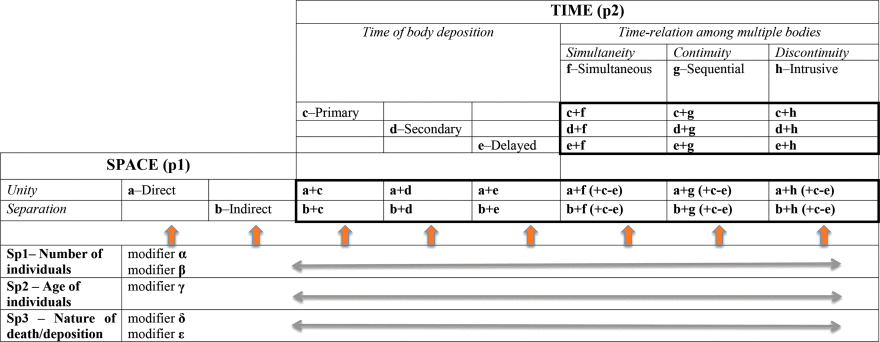
I identify here two main parameters which may influence how bodies come to be associated together in a single feature: p1) architecture of the feature; p2) temporality (see Table 1). Three other sub-parameters may alter or recast points p1–p2: sp1) number of individuals; sp2) age of individuals; sp3) nature of death/deposition. I am aware that any attempt at classification can generate models and theory that overlook historical reality and that cannot be applied without reference to localized systems of meaning (Morris Reference Morris1991, 147–8): each single case is subject to specific contingencies of everyday life, or is tied to broad cultural variations from one region to another, from one epoch to another, from one social level to another. Nonetheless, the isolation of theoretical patterns for body distribution inside multiple interments may lead scholars to move away from a static dichotomy, single body versus multiple bodies, towards greater recognition of the variations in multiple body assemblages and of their meanings (cf. Waterman & Thomas Reference Waterman and Thomas2011). Different religious, social and economic reasons may lie behind a burial demography that reflects the mortuary programmes of a society (Osterholtz et al. Reference Osterholtz, Baustian, Martin, Osterholtz, Baustian and Martin2014). The further development of theoretical frameworks may also contribute to comparative exploration of the rationale behind bodies’ association in different cultures and times. For instance, Osterholtz noticed an increase in multiple individuals in single graves during the Protostoric Bronze Age III (1300–1050 bc) in Cyprus, perhaps connected with the use of lineage or family-based tombs (Osterholtz Reference Osterholtz2015, 259). At approximately the same time, between the end of the New Kingdom and the Third Intermediate Period (eleventh century bc), Egypt saw broad use of multiple burials across all its territory. Although at first sight these two phenomena could be chronologically related, the type of association of bodies in the two cases is completely different, as the logic behind the multiple burials in Egypt is driven by reduced economic power and a contraction of building activity, leading towards the re-use of older structures (Taylor Reference Taylor and Wendrich2010).
The type of possible combinations of multiple burials according to the main parameters (space and time) and sub-parameters (sp1–sp3).

Parameters p1–p2
p1: Architecture (types a–b)
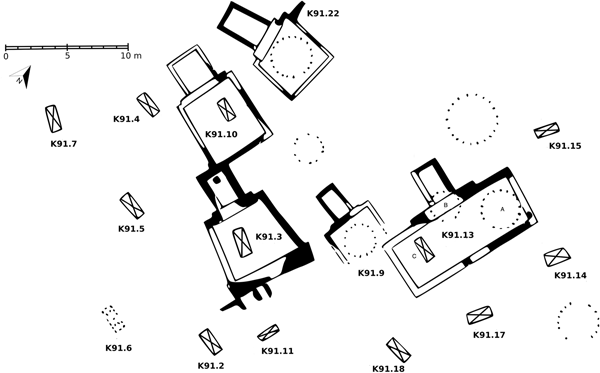
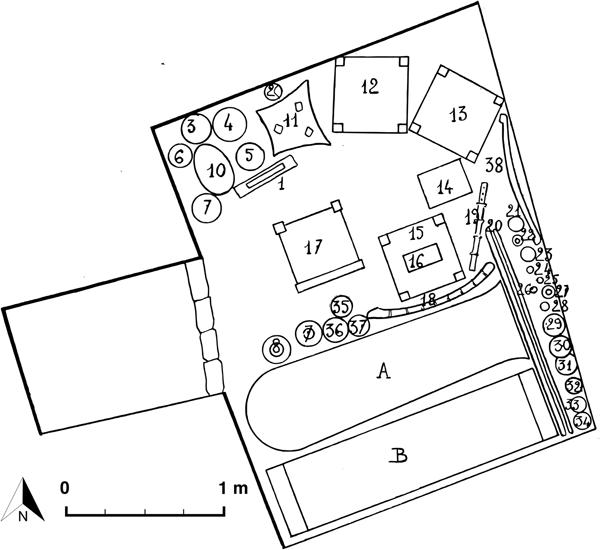
The architecture of the grave is the essential element that may create a strong divide across different types of burials. Architectural isolation represents the conditio sine qua non for multiple burial definition, i.e. more bodies in an individual grave. However, architectural isolation is variably changing according to the frame of reference. For instance, in area A in the floodplain of Dra Abu el-Naga hill (Thebes, modern Luxor) are a number of 1600–1500 bc graves cut into the ground and structured around ‘free-standing’ chapels, called by the excavators ‘Freistehende Grabbauten’. They have been often identified as multiple burials. However, although shaft graves are clearly all grouped under a common architectonic structure—a free-standing chapel, which acts as a cult as well as symbolic benchmark—the graves are all built separately with their own entrance, and each displays a different ratio in the number of individuals and array of burial equipment; thus, each has its own individual relationship ‘number of individuals per grave’ (Polz Reference Polz2007, 239–45; Fig. 1). This example and similar cases go far beyond the concept of the multiple burial, since stricto sensu a ‘cemetery’ should also be considered as a multiple burial, as it marks a common cult and symbolic environment.
Free-standing chapels and burials in the area A in the floodplain of Dra Abu el-Naga hill (Thebes, modern Luxor). (Drawing: Miriam Colella, after Polz et al. 1995, 209, Abb 1.)

Therefore, the multiple burials shall be characterized by architectural isolation in se and the number of individuals should be counted in each separate grave. By ‘architectural isolation’ is intended any coherent form of structure built with the purpose of separating the body and its funerary equipment from the surrounding environment. As in ancient Egypt body protection is often an integral part of the burial equipment, it cannot be considered an architectural feature: wooden coffins, textiles, wrappings, mud and pottery containers, for instance, are conceived to be a natural supplement of the architectural structure (whether a pyramid or a simple pit dug into the ground).
Even in isolated architectural features, there could be ambiguous cases: for instance, a single grave with one entrance (such as a shaft) can lead to several, but separate, burial chambers, each containing a single deceased person. Here the minimum requirement for classification as a multiple burial changes according to the point of view: external = several bodies grouped under a single structure; internal = bodies in a single structure clearly separated from each other by defined underground architecture. Therefore, I propose that a distinction should be made between a) ‘direct multiple burials’ and b) ‘indirect multiple burials’.
Direct multiple burial (type a)
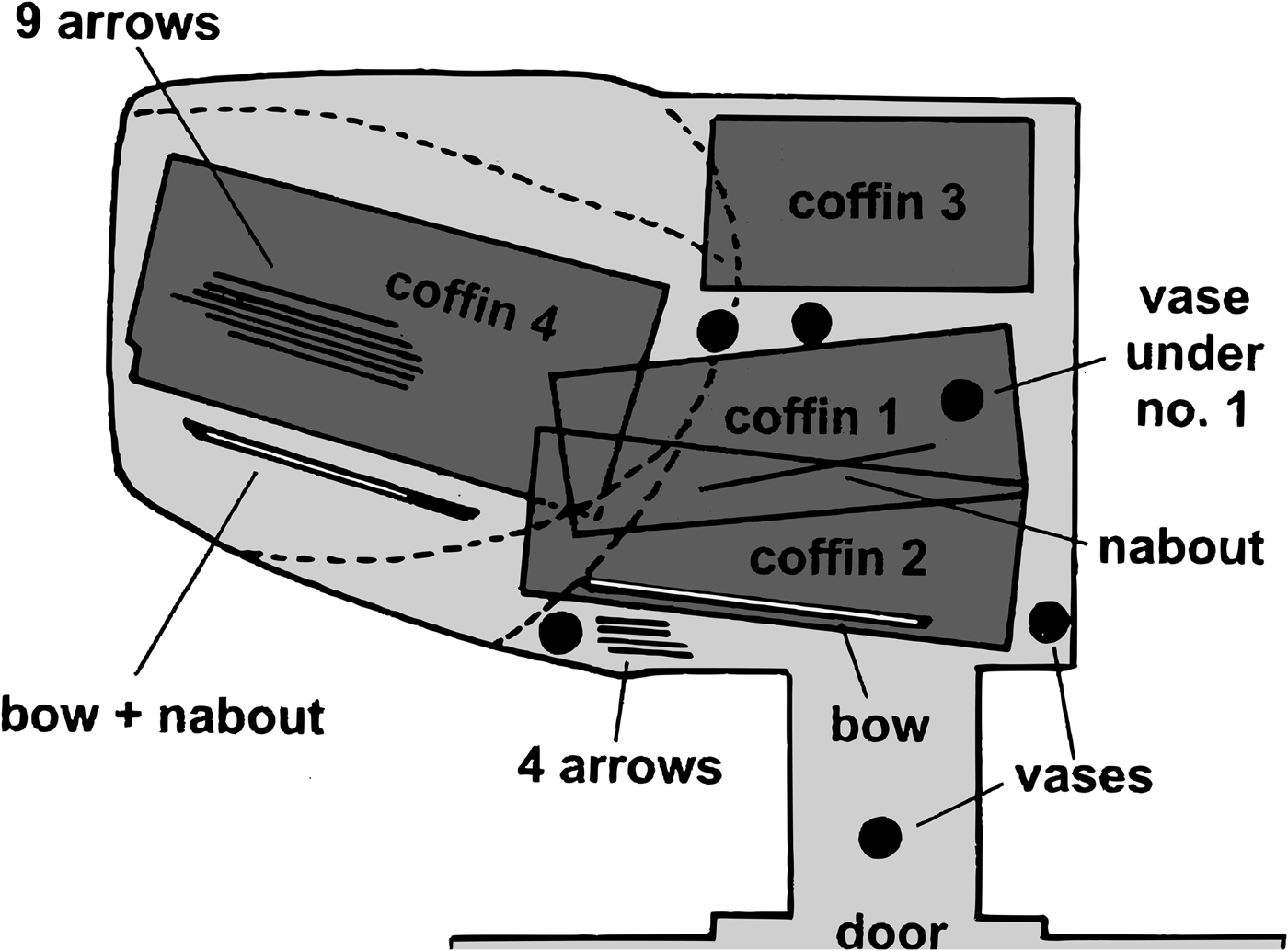
‘Direct multiple burials’ indicate more than one body grouped in a single funerary space, which is not only architectonically but also ideologically and intentionally well separated from other burial spaces. For instance, Hogarth's tomb 19 in the cemetery at Sheikh Abu Togh (Asyut) comprises a small independent rock-cut chapel leading to a large burial chamber arranged on two levels, one at the same height as the chapel floor and another sunk slightly below that level (Zitman Reference Zitman2010, vol. I, 108; vol. II, 29, plan 10). According to the archaeological context and excavator's information, four coffins were discovered in a single burial place, three of which lay one on top of the other (Fig. 2). The four burials all belong to a narrow sequential time span (cf. type g) from c. 2150 to 2000 bc, and no traces of later disturbance (contra type h) after the last interment were found.
Plan of Hogarth's tomb XIX at Assiut. (Drawing: Miriam Colella, after Zitman Reference Zitman2010, II, 29, plan 10.)

Indirect multiple burial (type b)
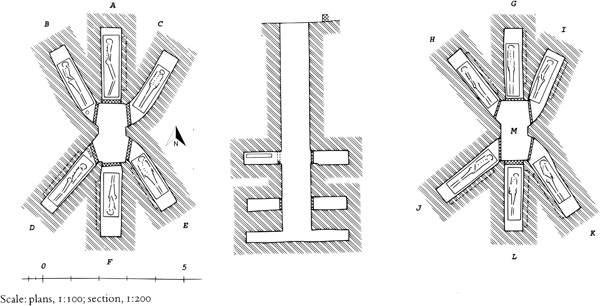
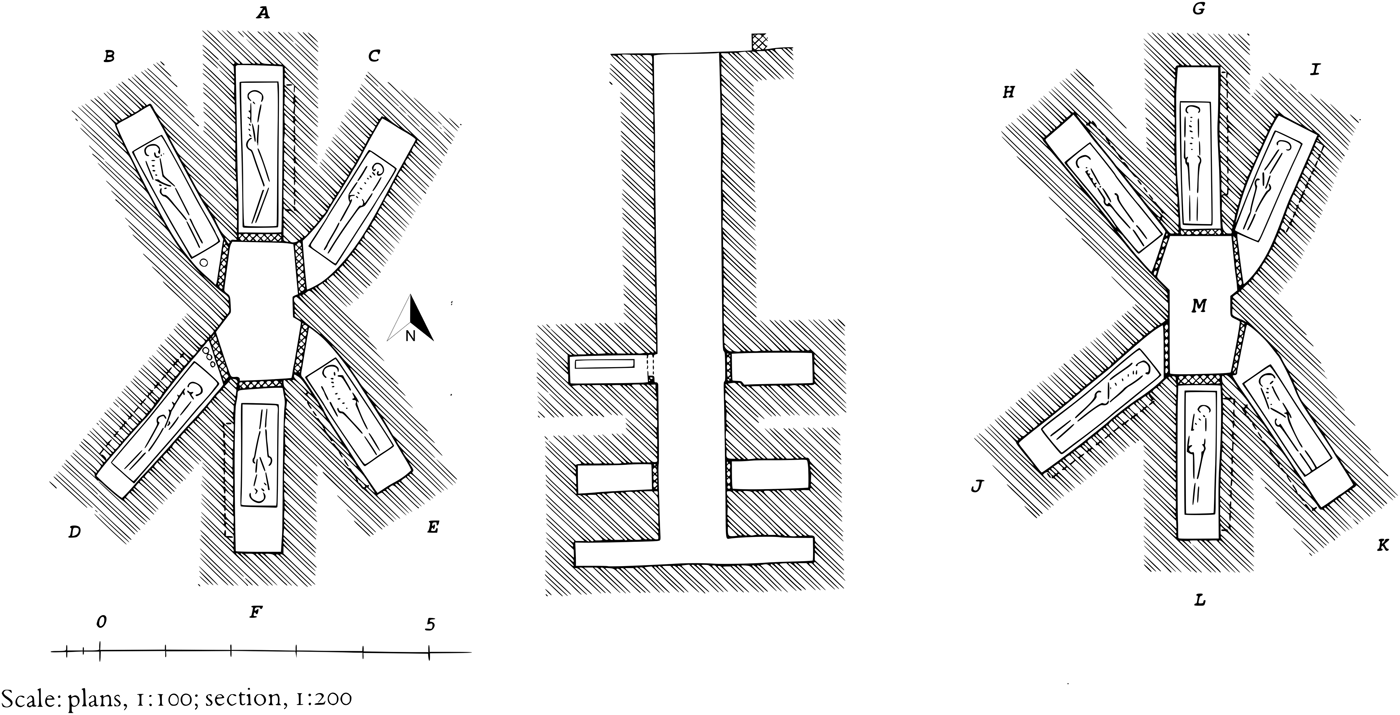
‘Indirect multiple burials’ feature individual interments, which may be separated from each other by an architectural element (such as a door, a wall, earth, or any type of blockade), but which are, nonetheless, intentionally and ideologically connected within a unique funerary space. Thus, this type of multiple interment, while maintaining the conceptual idea of multiple burials, nevertheless achieves isolation of the bodies. For instance, tomb 954 at Lisht (at the geographical entrance to the Fayum) consists of a single shaft entrance and, radiating from the shaft on each of three different levels, an arrangement of six compartments, each accommodating a single body, thus altogether allowing room for 18 individuals (Fig. 3). The blocking of the two upper levels was found still intact and the burials undisturbed, while the six compartments of the bottom level, clearly created to accommodate human bodies like those above, were for unknown reasons left vacant and unused (Arnold Reference Arnold2007, 83, pl. 159c–e). The empty compartments indicate that the structure was originally conceived as a multiple burial place, although with an explicit separation of the bodies in the underground rooms.Footnote 4
Plan of tomb 954 at Lisht. (Drawing: Miriam Colella, after Arnold Reference Arnold2007, pl. 159c–e.)
p2: Temporality (types c–h)
Temporality is one of the key factors that regulate funerary processes. An essential division, which involves temporality, is made between ‘primary’ (type c) and ‘secondary’ (type d) burials.
Primary burial (type c)
In ‘primary burials’ the individuals are deposited in their original place of interment and they were not moved or otherwise manipulated afterwards.
Secondary burial (type d)
In ‘secondary burials’ the individuals had been moved from their original interment location and re-deposited in a different place (Andrews & Bello Reference Andrews, Bello, Knüsel and Gowland2006, 17; Boz & Hager Reference Boz, Hager, Osterholtz, Baustian and Martin2014, 18–20; Knüsel Reference Knüsel2014, 46–8; Osterholtz et al. Reference Osterholtz, Baustian, Martin, Osterholtz, Baustian and Martin2014, 8–9). For instance, three individuals, one female adult and two children, were deposited, presumably as primary interments, in one of the graves of the South Tombs Cemetery at Amarna (the main city during the reign of Akhenaton, 1349–1332 bc); together with them was a fourth individual (female: Ind. 90), buried as a disarticulated assemblage of bones, ‘padded out with mud-brick, pottery and a roll of matting to restore its shape’ (Stevens Reference Stevens2017, 115, fig. 13). The way in which individual no. 90 was found indicates that it was buried, unearthed, and buried again (at least for a second time); according to Anna Stevens, who excavated in the cemetery, individual no. 90 was possibly relocated in the South Tombs Cemetery at the time when other family (?) members had died (Stevens Reference Stevens2017, 115).
To these main temporal aspects can be added also a third division, which straddles primary and secondary depositions: ‘delayed’ burials (type e). The lapse occurring from the death of the individual and the act of interment in the grave can also be protracted in time. In ancient Egypt, this type of burial is rather widespread due to the common use of mummification practices, which necessarily require delayed interment of individuals (Ikram & Dodson Reference Ikram and Dodson1998; Marshall & Lichtenberg Reference Marshall and Lichtenberg2013).
Although the division between ‘primary’, ‘secondary’, and ‘delayed’ burials is effective also for multiple interments (see below), there are other temporal elements that affect the composition and assemblage of multiple depositions. Grouped inhumations in individual graves (direct/indirect, according to their architectural arrangements, see above) stress three temporal aspects: simultaneity (type f), continuity (type g) and discontinuity (type h).
Simultaneous multiple burial (type f)
Simultaneity stresses chronological immediacy; burials have entered the same funerary space at the same time, in an episodic multiple usage of the same grave. In this case, a direct connection is most probably intended between the burials.
Primary simultaneous multiple burial (type f.1). For instance, in the northern Delta site of Tell el-Balamun, zone III, at the southern end of the transverse room of shaft no. 21, lay two individuals wearing crude face masks made of gold foil, while in the other areas of the same room were other individuals each with a circular hole in the front of their skull just above the forehead. The excavators suggested that they were ‘systematically, or even ritually’ killed by a blow with a blunt instrument in an act connected to the deaths of the individuals wearing the gold masks (Abd el-Malek Ghattas Reference Abd el-Malek Ghattas1982, 45–9).Footnote 5 These burials may be defined as ‘simultaneous multiple burials’ as they stress temporal immediacy, a single spot on the timeline: burials containing two or more individuals interred at the same time; this might be by randomness or by a coincident death-event, such as a common disease or a ritual killing. Primary simultaneous multiple burials imply that the individuals died at the same time and were immediately buried in the original intended location. Therefore, the relations between the individuals may be more intermingled, due, for instance, to the same nature of death (see also below, modifier δ) or shared family/social bonds.
Secondary simultaneous multiple burial (type f.2)
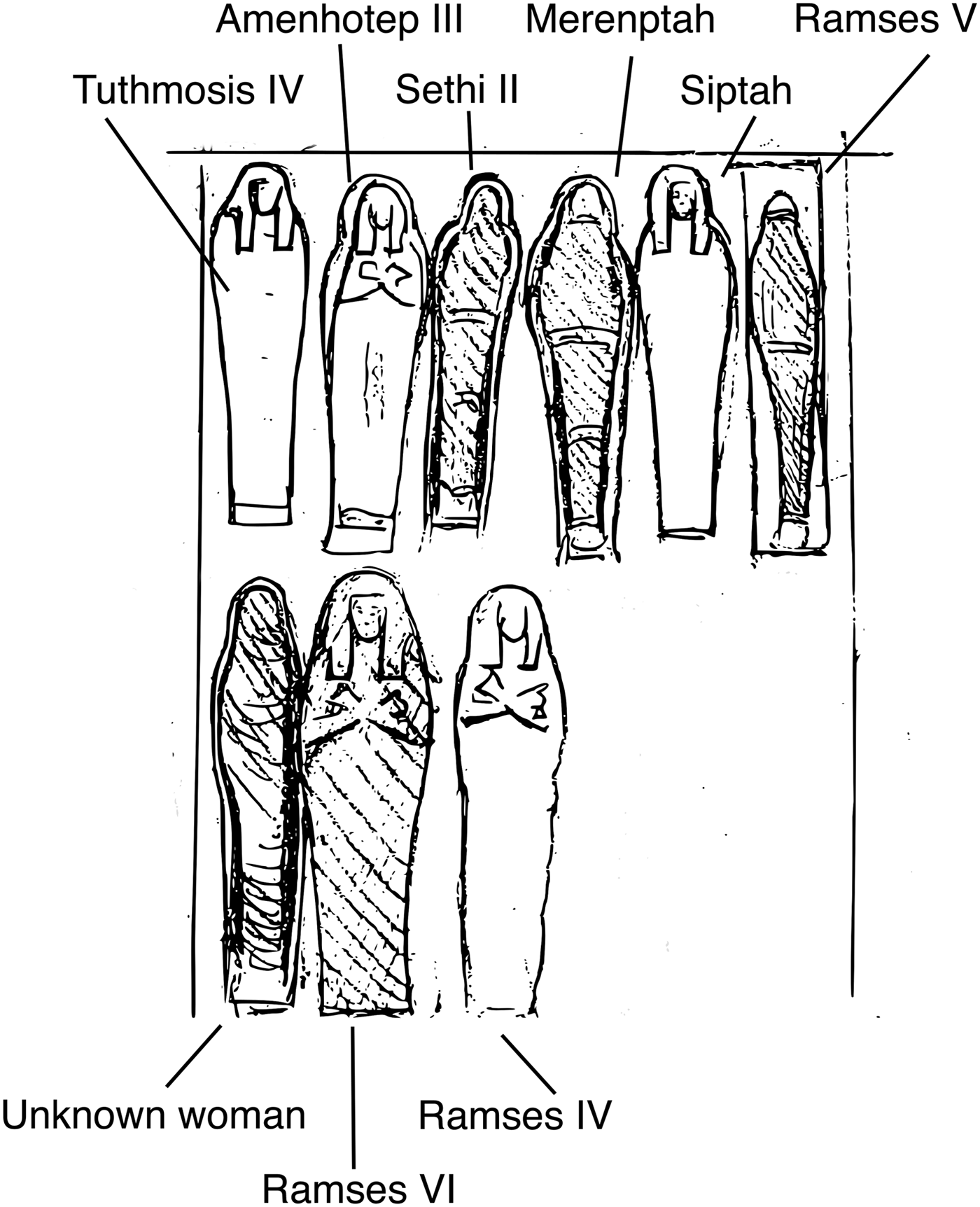
Simultaneous multiple burials could also have been the result of planned or emotional events and, by necessity, intentionally grouped together individuals some time after their death. For instance, walled inside one of the side rooms (Jb) of king Amenhotep II's burial chamber (KV 35, Valley of the Kings, Thebes, Luxor) were the bodies of eight pharaohs (Tuthmosis IV, Amenhotep III, Sethi II, Merenptah, Siptah, Ramses IV, V, and VI) and an unknown female individual, all gathered from various tombs and earlier caches on a single occasion (see Figure 4; Piacentini & Orsenigo Reference Piacentini and Orsenigo2005, 136; Reeves & Wilkinson Reference Reeves and Wilkinson1996, 198–9). The individuals all clearly belonged to different periods, since their chronological sequence is very well documented in written sources (spanning from 1400 to 1137 bc), so they did not die contemporaneously, yet the action of the reburial was simultaneous, made at a single point in time by the Theban priests who tried to save these mummies from the widespread robberies taking place in Thebes between 1069 and 950 bc (Miniaci Reference Miniaci, Pernigotti and Zecchi2007; Strudwick Reference Strudwick and Creasman2013). This type of burial may be classified as ‘secondary simultaneous multiple burials’, as it relocates non-simultaneously dead individuals to a different place from their original burial location.
Sketch plan of contents of the side rooms (Jb) of king Amenhotep II's tomb (KV 35). (Drawing: Miriam Colella.)

Delayed simultaneous multiple burial (type f.3)
Beyond Egyptian archaeology, in the case of Tonto Basin Salado (ad 1280–1450, central Arizona), some deceased community members were kept for a period of time in specialized rooms and eventually buried together in a single grave (Loendorf Reference Loendorf1998). In this case, it is more appropriate to use the definition ‘delayed simultaneous multiple burials’, as the time of death of individuals may not be exactly the same, and accordingly this may also affect the type of relation between the individuals. A similar scope can be drawn from work of Stevens (Reference Stevens2017) for the suburban cemeteries of Amarna (especially for the North Tombs Cemetery), where the large number of multiple burials may tentatively suggest that bodies were being collected over the course of a few days and buried in the same grave.
Sequential multiple burial (type g)
Some single graves containing multiple bodies were re-opened at some distance in time after their first closure, in order to allow a second, third, or even more new interments to be made into existing graves, in a continuous, long-term usage of the grave. In this case, the temporal stress is on chronological proximity; consequently, the lapse of time between the original interment and the subsequent reopening(s) should not be too long, otherwise the consecutiveness of the action will have been lost (see below, type h). Two of the main aspects that sequential multiple burials intend to highlight are the intentionality of the re-use of the same funerary space and a common link or a direct connection between the burials. During their excavations of 1910–14 in an area of western Thebes (Luxor), Carter and Carnarvon discovered an unusually large saff-tomb, labelled C37 (Fig. 5; Carnarvon & Carter Reference Carnarvon and Carter1912, 38, 51, pl. 55; Miniaci Reference Miniaci2011, 92–101) containing a large number of burials (64 coffins in total: Miniaci Reference Miniaci2011, 84–9). The latest chronological limit for these burials is the reign of Hatshepsut/Thutmosis III (1479–1425 bc), when the tomb was definitively sealed during the construction of the Deir el-Bahari valley temple complex (Miniaci Reference Miniaci, Miniaci and Grajetzki2016). During this phase the whole of the tomb complex was extensively occupied (including non-normative areas: niche, pit, corridors, passages) by a high number of depositions, which belong to a broad common cultural phase (Miniaci Reference Miniaci, Taylor and Vandenbeusch2018). At the end of the corridor is a room (C) in which a vertical pit (D) gives access to three different underground funerary chambers (F and E). Pit D was piled from bottom to top with 18 coffins (Carter's nos. 41–59, excluding no. 54). One of the upper coffins (no. 53) contained two scarabs, one bearing the name of Hatshepsut's daughter Neferure and the other the prenomen of Tuthmosis III (1479–1425 bc), while one of the lowest coffins (no. 59) contained two scarabs inscribed with the names of Tuthmosis II (1492–1479 bc) and Tuthmosis I (1504–1492 bc). The sequence of deposition in the shaft seems to indicate a progressive filling from the time of Tuthmosis I until the reigns of Hatshepsut and Thutmosis III, when the structure stopped functioning. Thus, it is clear that the burials did not enter the tomb in a single moment, but they were sequentially introduced into the structure (1504 > 1492 > 1479 > 1425 bc).
Plan of saff tomb C 37. (From Carnarvon & Carter Reference Carnarvon and Carter1912, pl. 55.)

Intrusive multiple burial (type h)
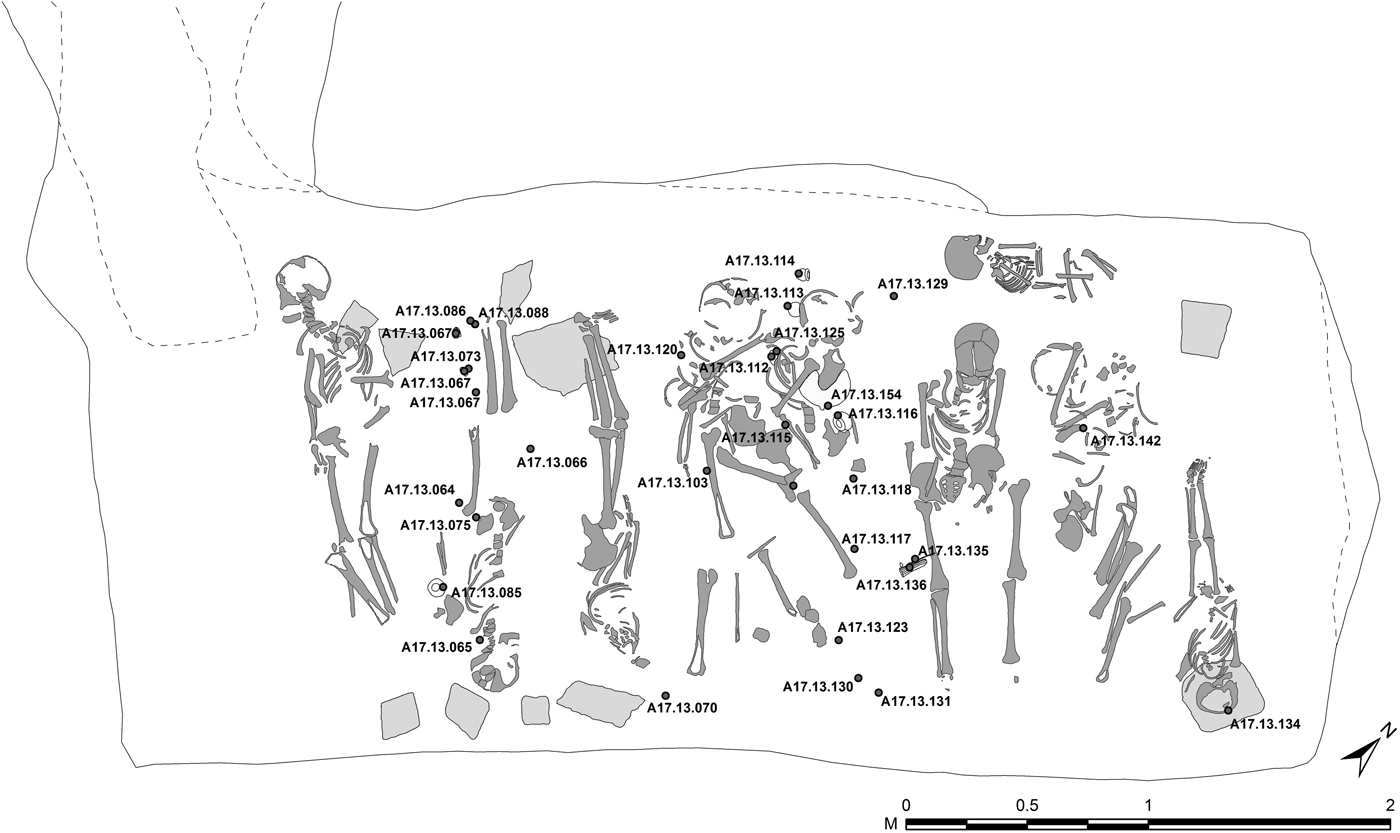
Those interments which entered the grave, either accidentally or voluntarily, after a considerable amount of time from its final closure/sealing can be labelled ‘intrusive multiple burials’; they stress factors of chronological discontinuity of use. Most of the burials which entered the grave long after its first closure have no direct relationship to the original owner or earlier occupants. The practise of intrusive multiple burials is attested in all societies and above all in Egypt, where they are especially attested around the early first millennium bc (1069–664 bc) (Taylor Reference Taylor and Wendrich2010). At this time, a probable decrease in resources led to a reduction in construction of funerary monuments and gave rise to a massive re-use of previous graves. For instance, one of the underground rooms (I) of the tomb belonging to the funerary priest Huy (TT14, Thebes, Luxor), who lived during the reign of the king Ramses II (1279–1213 bc), was occupied by at least five individuals who were buried there more than 200 years (1069–945 bc) after Huy had his tomb built. These individuals occupied non-normative areas, such as the antechamber of funerary room (J) of Huy, where they were deposited above a layer of mud resulting from a flood sealing the burial chamber itself (Betrò et al. Reference Betrò, Miniaci and Del Vesco2012, 28–34). Nonetheless, intrusive multiple burials may also stress indirect links with the place of deposition, such as the type of site, the ideological importance of the person, proximity to other burials, etc. (cf. Wickholm Reference Wickholm, Oestigaard and Fahlander2008, for an ideological re-use of Middle and Late Iron Age cemeteries in Finland and Estonia). For instance, in Theban tomb A17, near the Temple of Amenhotep II (Consonni Reference Consonni, Miniaci and Grajetzki2016), a first phase of use dating to 2055–2000 bc is followed by a phase of disuse or abandonment which lasted for almost half millennium, and by a phase of re-occupation in 1550–1500 bc (Fig. 6). Although no immediate elements of continuity between the phases of occupation can be recognised, such a custom follows a precise pattern attested elsewhere in the Theban necropolis: initial use in early–mid Middle Kingdom (2055–2000 bc)→phase of disuse/abandonment→reuse in the Second Intermediate Period (1650–1500 bc) (Miniaci Reference Miniaci, Miniaci and Grajetzki2016). Therefore, a clear linking element might be perceived or suggested, such as an attempt to establish a fictional relationship (?) (cf. the construction of important administrative buildings near or above earlier burials at Cyprus, Osterholtz Reference Osterholtz2015, 60, 260).
Plan of chamber E, with positions of the burials and of the grave goods of the early Middle Kingdom. Tomb A17 in the area of the Temple of Millions of Years of Amehotep II, Luxor-West Bank. (Courtesy Dr A. Sesana - CEFB; GIS and data processing: A. Consonni, E. Croce, T. Quirino.)

Sub-parameters sp1–sp3
sp1. Number of individuals
When faced with a high number of individuals in the same funerary feature, scholars have often felt the need to distinguish this type of burial from the rest of the multiple burials, adopting the term ‘mass burials’. However, the meaning of the term has varied according to different traditions and cases (Barker et al. Reference Barker, Alicehajic, Naranjo Santana, Schotsmans, Márquez-Grant and Forbes2017, 256–7). The main guidelines for the identification of mass burials have often been given by the presence of a minimum number of bodies (Schmitt Reference Schmitt, Haglund and Sorg2002, 277–92; Skinner Reference Skinner1987, 267–87) and their organization in the grave (in disordered state, i.e. amassed, cf. Jessee & Skinner Reference Jessee and Skinner2005). For instance, Knüsel and Robb tend to describe a mass grave as a large number of individuals placed tightly together, often in layers and sometimes in a disordered state (Knüsel & Robb Reference Knüsel and Robb2016, 657). Haglund (Reference Haglund, Haglund and Sorg2002), instead, simply defines a mass grave as ‘a mass of bodies (organised or disorganised) in intimate contact with each other and deposited in the same grave’. The inconsistency and variability of the definition is mainly due to the fact that it has been not developed within a methodological framework; it would repay more careful distinction. This may be done on a purely numerical base, not on an empirical or assumptive base, but following the methods suggested by linguistic anthropology.
Double burial (modifier α)
Since ancient times, two has been perceived as an entity different from the multitude, as exemplified by the familiar use of dual in the lexicon of various ancient and modern languages (Indo-European; Afro-Asiatic; Uralic, Kiowa-Tanoan, Micronesian, and Australian: Acquaviva Reference Acquaviva and Aronoff2017). In the linguistic anthropology approach, the structure of a language is often perceived not as arbitrary, but rather governed by cognitive constraints (Dimmendaal Reference Dimmendaal and Bonvillain2015): therefore, the grammatical use of the dual may mirror an ingrained natural semantic categorization that straddles the singular and the plural, precisely referring to two of the entities (either objects or persons). When a burial contains two individuals, the concept of multiple burials is not automatically fulfilled, and the term ‘double burial’ should be privileged over multiple burials.
Mass burial (modifier β)
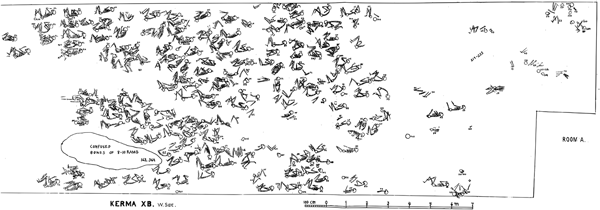
In the same numerical logic, there are pluralities that go beyond the countable, whose size is conceptualized as too large for individual enumeration. The semantic logic of ‘mass burials’ is not contained in the sheer size (more or less than x individuals) but in the ultimate accessibility of countable individuals (Acquaviva Reference Acquaviva and Aronoff2017). For instance, in Nubia, during the Classic Kerma Period (c. 1750–1500 bc), very large grave mounds shaped as earthen cylindrical tumuli contained several hundred individuals buried all together in their corridors (Fig. 7), who probably were slain on the occasion of the death of the main owner of the tumulus (Adams Reference Adams1977, 202–4; Reisner Reference Reisner1923, 137ff; van Dijk Reference van Dijk and Bremmer2007, 144–46; cf. Testart Reference Testart2004). Although these burials may be conceptually classified as type f ‘simultaneous multiple burials’, they are customized by the modifier β based on numerical perception, therefore they can be classified as ‘simultaneous mass burials’ (combination of type f [base] + modifier β), where a large number of individuals are buried together at the same time.
Plan of room A, Tumulus XB, Corridor B. (Drawing: Miriam Colella from Reisner Reference Reisner1923, pl. 24.)

sp2. Age of individuals
Agglutinating burial (modifier γ)
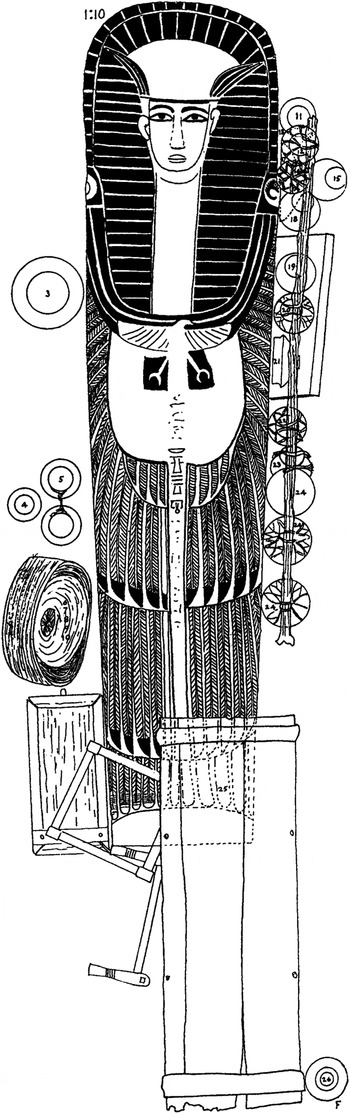
We may consider the possibility that age can be used to gain worthwhile perspectives in the study of multiple burials. Already, at a cross-cultural level in archaeology and anthropology, Peter Ucko noticed that infant and child burials follow common patterns that distinguish them from adult ones (Ucko Reference Ucko1969, 270–71). Apart from the case of female individual buried with infant/s in utero, where those involved in the burial may not necessarily be aware of the foetus, an individual buried with one or more infants is a combination that deviates from the concept of multiple burials. Often this can be associated with some obstetric calamity, where complications relating to the birth may have led to the death of both the female individual and the infant/s. However, even when their deaths do not happen simultaneously, pairing adult individual and infant/s in a single grave has often been interpreted as one of the most basic social concerns (Finlay Reference Finlay2000, 418; Quirke Reference Quirke2016, 594–604). Given the special status of infants in society and their close association with adult lives (Crawford Reference Crawford1991; Reference Crawford1999; Waterman & Thomas Reference Waterman and Thomas2011), I adopted a term, ‘agglutinating’, taken from linguistics, in order to show the ‘unmarked plural character’ of the burials containing infant/s beside the body of an adult individual. Each infant in the burial may be labelled as the ‘singulative element’, borrowing again from linguistics, where it identifies the ‘single referent from a mass noun’ (Acquaviva Reference Acquaviva and Aronoff2017). For instance, in the northernmost area of the Theban necropolis, north of the entrance to the Valley of the Kings (Luxor), Flinders Petrie found the burial of a young female individual, who probably lived during the years 1600–1550 bc. A small rectangular whitewashed box containing the burial of an infant was lying over the foot of her coffin (Fig. 8; Petrie Reference Petrie1909, 6–10, pls. 22–29). Even in the absence of DNA analysis of the human remains, the likelihood that the two individuals are related is high and they may form a unit. Archaeometric analysis carried out on the grave goods, and in particular on the jewellery, revealed that the child's burial equipment shares many features with that of the adult, such as manufacture, form and composition (Tate et al. Reference Tate, Eremin, Troalen, Guerra, Goring and Manley2009; Troalen et al. Reference Troalen, Tate and Guerra2014). In this case, using the plain term ‘multiple burial’ can be misleading for a reader, when it represents an ‘agglutinating burial’ (an individual and a singulative element).
Plan of the so-called Qurna queen burial, north of the entrance to the Valley of the Kings. (From Petrie Reference Petrie1909, pl. 22.)

sp3. Nature of death/deposition
Death assemblages may be based also on the nature of the death of the individuals, i.e. multiple individuals (buried in the same funerary structure) who share the same manner and background for their demise.
Bound burial (modifier δ). While the simultaneous multiple burials (type f) stress the deposition of multiple individuals in a single episode, this does not necessarily imply that all individuals shared the same mode and manner of death. When the reason for demise is given by natural catastrophes, conflicts, epidemics, genocides, famine, or a disaster (cf. Loe et al. Reference Loe, Boyle, Webb and Score2014), the rationale behind this type of multiple burial is not only time (p2) and number (sp1) (although these are essential elements in the equation), but mainly the nature of death. For instance, in the Deir el-Bahari cliffs at Thebes, one of the graves (no. 507) carved into the rock contained the burials of about 60 individuals, all wrapped in linen. Inscriptions written on the linen, wounds evident on the bodies and the burial equipment (bows and arrows) suggest that they were soldiers who lived in the earliest years of the Twelfth Dynasty (c. 1960–1930 bc) and who must have died at the same time, under particular circumstances, such as a battle or a war (Winlock Reference Winlock1945; Franke Reference Franke1988, 102). In this case, we are facing a ‘bound simultaneous mass burial’ (combination of: type f [base] + modifier β+modifier δ).
Stored burial (modifier ε). When human remains have become indistinguishable due to mixing of elements, either intentionally or unintentionally, they are usually referred to in funerary archaeology jargon as ‘commingled burials’. However, the fragmented, disarticulated and disturbed burials represent only one aspect of the funerary assemblage, which may or may not affect relations between the individuals and objects in the grave (see Osterholtz et al. Reference Osterholtz, Baustian, Martin, Osterholtz, Baustian and Martin2014). For instance, mass burials can be artificially created by post-depositional human intervention, as in the case of ossuary burials. In this case, the nature of death cannot always be traced back (see the borderline case-study of Srebrenica as discussed in Barker et al. Reference Barker, Alicehajic, Naranjo Santana, Schotsmans, Márquez-Grant and Forbes2017, 264–6). Therefore, in this instance, it is not the nature of death, which cannot always be recognized, that plays a key role in the classification of multiple interments, but the external anthropic action (Sprague Reference Sprague2005, 74). Therefore, when agentive human action creates a non-simultaneous reburial of multiple individuals for the purpose of storage or depot, without consideration of social bonds, time and mode of death, the label ‘stored multiple burials’ may be more appropriate (Walthall Reference Walthall1999, 4).
Renegotiation of the role of the body (and funerary equipment) in different types of multiple burials
The richness of data pertaining to Egyptian funerary archaeology, in particular, has contributed to strengthening the subconscious projection within Egyptian mortuary studies that individuals buried themselves (cf. Parker Pearson Reference Parker Pearson1993), overshadowing the potential complexities inherent in the composition of burials and their links to the living. As a consequence, studies have often privileged: a) a segregation of the underground world from that of the living; b) a convergence on the individuality of single bodies, often markedly defined by written texts, associated grave goods, body containers such as coffins, etc., including those found in a multiple burial context; c) an imperative correlation between objects and the identity (including belief) of the deceased, creating a 1:1 ‘objects = deceased’ relation.
a) Segregation
Funerary architecture and its burial composition cannot be perceived in isolation from the living world (Baines & Lacovara Reference Baines and Lacovara2002, 21–22; Harrington Reference Harrington2012; cf. Milledge Nelson Reference Milledge Nelson and Bray2003). The impact of a deceased individual on the living did not cease with his/her death, but continued afterwards, influencing the actions and the relations of the living. Tombs and their dwellers are not entirely separable from the political, social and economic aspects of life (Parker Pearson Reference Parker Pearson1999, 193–7).
With the closure of the grave, all the objects in the burial, although they may be typologically separated from each other, became a unique part of the world of the dead, targeting a common objective to evoke social identities and images of death through memories and through the materiality of its constituents, including architecture, bodies, artefacts and rituals (Ekengren Reference Ekengren, Stutz, Tarlow and Ekengren2013, 134). Although imbued with social relations and identity (re)-constructions, human (dead) bodies are subject to the same analytical processes as other artefacts, sharing the same materiality network, which crosses the biological boundaries between animals, artefacts and people (Sofaer Reference Sofaer2006). Exactly like other ‘inanimate objects’, human bodies have direct agency in shaping and transforming people's lives (Ingold Reference Ingold1996; Kopytoff Reference Kopytoff and Appadurai1986; Williams Reference Williams and Williams2003); therefore the boundaries between dead bodies and objects break down as they are mutually entangled in a complex network of relations inside the logic of burial assemblage (Jones Reference Jones2002; Knappett Reference Knappett2002; Reference Knappett2013; Latour Reference Latour2005). Therefore, bodies and objects in a burial are part of a common material assemblage and their materiality does not differentiate one from the other (Brück Reference Brück and Brück2001; Fowler Reference Fowler2004). The practice of sequential multiple burials (type g) reinforces the transformation of dead bodies into part of the burial equipment, subtracting centrality from the role of the body (Crawford Reference Crawford, Crawford and Shepherd2007, 89) and disrupting the narrative tied to individual biographies (Gosden & Marshall Reference Gosden and Marshall1999). The passage of time can objectify the value of the body itself. The social context in which the body was placed slowly fades out and, with this process, the body also loses its affective and sensorial links, increasing an ‘artefactual’ perception.
In late Middle Kingdom Egypt (1800–1650 bc), the increase and spread of sequential multiple burials (type g) influenced the range of objects to be deposited inside the burial, as each new incoming interment met the funerary equipment and bodies from previous interments. This new aspect of the tomb was focusing on temporal continuity: a continuous sequence of individuals buried in the same place (i.e. identity of ancestors and tangible presence of the dead). Accordingly, rituals for individual eternity (basis of an individual stasis) were contracted, resulting in a reduction of the equipment created especially for the burial (Bourriau Reference Bourriau and Quirke1991): the individuality and stasis of the eternal ritual for the deceased were replaced by motion and communality of multiple depositions. A new selection of objects coming from daily life started entering the tomb as part of the funerary equipment: ivory wands connected with the birth processes, small figurines of animals and humans, feeding cups, musical instruments, walking sticks, small chairs, writing tools (Grajetzki Reference Grajetzki2014, 156–67; Miniaci Reference Miniaci, Miniaci, Betrò and Quirke2017; Reference Betrò, Miniaci, Taylor and Vandenbeusch2018; Miniaci & Quirke Reference Miniaci and Quirke2009; Quirke Reference Quirke2015, 213); a kind of ‘infiltration’ of the domestic sphere in the funerary domain. The widespread use of sequential multiple burials completely changed the perception of the grave itself, so that it became a sort of ‘collective memory container’ (Hamilakis Reference Hamilakis2017; Oestigaard & Goldhahan Reference Oestigaard and Goldhahan2006).
b) Convergence
Scholars have usually tended towards rather polarized perceptions of single and collective burials and towards large-scale, rather than micro-level, evaluations of their significance, particularly as regards the widespread change from one burial type to another. Elsewhere, I have connected the increase of multiple burials at the end of the Middle Kingdom (1800 bc), within a system previously based mainly on individual graves, with a profound reorganization of society, which aimed at emphasizing more actively aspects of cohesion and continuity within a—perhaps—larger corporate group (Reference Miniaci and NyordMiniaci forthcoming a; cf. Cauwe Reference Cauwe2001; Keswani Reference Keswani2004). In a similar scope, Kristiansen (Reference Kristiansen and Spriggs1984) attributed the shift from the collective ‘Megalithic Culture’ burials in Neolithic Denmark to the ‘Single Grave Culture’ (4000–2800 bc→2800–2400 bc) to the transition of a cultivation-based hierarchical society to a more mobile pastoral one. However, scholars have rarely focused on the internal characteristics of multiple burials. The method proposed here has the potential to direct attention to the multifaceted meaning inside multiple burials themselves. A body's association in a single grave is not a uniform and inflexible act, set up in an atemporal and univocal context, but it contains divergent social, economic, political, cultural, historical and religious implications: the same range of implications that may be drawn from the opposition single-multiple burials. The placing of multiple bodies ‘can hardly fail to be significant’ (Morris Reference Morris1991, 150), as it constitutes a political (since it is deliberate, but not necessarily always intentional) mnemonic selection of certain components and the segregation of others: ‘a way of conceptualizing time through its materiality’ (Hamilakis Reference Hamilakis2017).
Stevens has recently shown the different levels of comprehension that can open when research moves towards a more analytical dissection of the multiple burial context itself. At Amarna (1349–1332 bc), two large, non-elite pit-grave cemeteries have recently been excavated. At the North Tombs Cemetery the rate of multiple burials runs close to 40 per cent, while they are much rarer in the South Tombs Cemetery. However, the difference should not be reduced only to the ratio of single burials versus multiple burials, as the nature of the multiple interments from one cemetery to another also varies. At the South Tombs Cemetery, the graves accommodating multiple burials tend to be cut wider than average, with the individuals laid out side-by-side, wrapped separately in simple matting coffins. This cemetery has a normal demographic profile and was perhaps organized largely by family groups, leading to the suggestion that the multiple burials may be family interments (although other explanations are possible). It is difficult to assess whether the individuals were interred at the same time, given the simplicity of the burial architecture—pit graves cut into sand—and the disruption of the archaeological record by looting. At the North Tombs Cemetery, the multiple burials have a different character. These graves are often cut only slightly wider than single interments, although sometimes longer than seems necessary. The bodies (mostly two, but up to at least five) are tightly packed, and sometimes wrapped together in the same burial mat, in layers on top of each other (Stevens Reference Stevens2017, 119). Except for one instance when sand layers have been recorded between the corpses, that may indicate consecutiveness in the deposition of the bodies, the general arrangement of these burials points towards a classification as primary simultaneous burials (type f.1). A primary simultaneous burial type may derive from an epidemic or other human large-scale event, such as war, conditions that, at least in terms of the latter, are not verified for Amarna. Nonetheless, the North Tombs Cemetery displays a restricted demographic profile, dominated by adolescents and young adults, which might point to the cemetery accommodating one or more labourers’ communities. Family burial groups are not obvious, given the constrained age profile, but could be present in restricted form. At this particular cemetery, the multiple burials seem to reflect factors other than, or additional to, family closeness in death: people perhaps living away from their core families, probably working to maintain the city, dying because of inadequate living conditions and buried in a grave pre-cut for hosting deceased persons who share the time of death (Stevens Reference Stevens2017, 119–20; Stevens & Dabbs Reference Stevens and Dabbs2018).
c) Imperative correlation
Often, as anthropologists have warned, objects in a tomb tend to mirror the society in which individuals lived more than the buried individuals themselves. Some items placed in the tomb could have been completely unfamiliar to the deceased; for instance, gifts presented by mourners (Ucko Reference Ucko1969, 262–80). The association of objects inside a multiple grave must also be revised according to individual cases.
The idea inherited from Jens Jakob Asmussen Worsaae, founder of modern scientific archaeology (Reference Worsaae1843), that the grave is the result of a single event in time, can no longer be maintained. Invisible alterations often happened directly at the time of interment, such as misappropriation of objects during the funeral/deposition or involuntary damage to the corpse during interment (Näser Reference Näser, Stutz, Tarlow and Ekengren2013). A closed or intact context in funerary archaeology does not represent a magical moment where history stopped running and archaeologists are able to retrieve a pristine past ‘as it truly was’ (the ‘Pompeii premise’: Schiffer Reference Schiffer1985, 18–41; Sommer Reference Sommer, Stäuble and Wolfram2012, 15–34). Even perfectly intact closed contexts reveal only a partial and fractured history, altered over time in deposition, resulting in omission and destruction (Hurcombe Reference Hurcombe2014). If an individual chose to re-use part of an earlier grave, however close or distant in time, it would have been difficult not to disturb previous burial(s).Footnote 6 In Egyptian archaeology, however, signs of disturbance are too often carelessly translated as a result of ‘plundering action’. While archaeologists might attempt to identify a precise time when the burial of a single individual occurred, becoming disassociated from its human cycle and isolated in its context, the same cannot be said when dealing with multiple burials, where often several different periods of disturbance may occur. The simple operation of reopening a grave necessarily implies alteration, dispersal and the destruction of a previous context, making it difficult to separate what might be missing from what might not have been included. Accordingly, the nature of the disturbance varies according to the type of multiple burial.
Bearing in mind the above, in principle, primary undisturbed simultaneous multiple burials (type f.1) show no signs of disturbance, except for those generated at the time of interment, which potentially saw movement or breakage of objects/corpses, or due to natural taphonomic causes, such as the gradual dismembering and disarticulation of the body resulting from the defleshing process.
The sequential use of a structure for multiple individuals and for a prolonged (but limited) time span (type g) may involve minor and major tampering, misappropriation and reshuffling of the artefacts and bodies, but not necessarily voluntary destruction or removal of the previous contexts.Footnote 7 For instance, grave no. 1379 in the Eastern Necropolis at Deir el-Medina (Thebes, Luxor, 1550–1450 bc), which hosted the bodies of one male and one female individual (according to Bruyère), was found sealed and intact, and not subsequently intruded upon by robbers. Despite this, the original burial context had been interrupted, the mummy of the male individual showing signs of having been unwrapped and hurriedly restored after the funeral, and the mummy of the female individual robbed of its jewellery (Fig. 9; Bruyère Reference Bruyère1937, 170–75, figs. 95–97). Other easily movable objects may also have been voluntarily taken and removed from the original burial equipment.
Plan of tomb 1379 at Deir el-Medina, eastern necropolis, Thebes. (Drawing: Miriam Colella, after Bruyère Reference Bruyère1937, fig. 95.)

In the British Museum, 36 objects can be attributed to the ‘late Middle Kingdom’ tomb G62 found by Petrie at Abydos (Reference Miniaci and RegulskiMiniaci forthcoming b). In the absence of precise archaeological information provided by the excavator at the time of discovery, the range of objects apparently seems to belong to a heavily disturbed context: some elements are clearly missing, such as the handle of the mirror and the lids of some toilet vessels. However, most of the objects belong to a narrow chronological frame, which extends from the late Middle Kingdom (1800–1650 bc) to the mid Second Intermediate Period (1650–1600 bc). The entire range of objects from G62 closely echoes the funerary equipment included in other sequential multiple burials of the same period, notably those from Abydos 416 (Kemp & Merrillees Reference Kemp and Merrillees1980, 105–60); Abydos E 1 (Tooley Reference Tooley, Miniaci and Grajetzki2015); Lisht Pit 466 (Quirke Reference Quirke2016, 157–9); and possibly Lisht Pit 885 (Quirke Reference Quirke2016, 176: note that no human remains are recorded for this structure). The absence of objects dating to earlier or later periods seems to indicate that G62 did not re-use an earlier context and did not suffer from later intrusions/re-use (cf. type h). In the case of sequential multiple burials, artefacts are not always clearly related to a single space, to a single identity and to a precise time, as they have not all been deposited at the same point in the past.Footnote 8 Therefore, the atomic individuality of burial equipment (as perceived by modern scholars) tends to fade out; types of objects grouped together no longer correspond to a definite point in time, to a homogenous segment of society and to a uniform culture (although a single interment also rarely corresponds to single moment in time: see Lillios Reference Lillios1999; Sherrat Reference Sherratt, Maran and Stockhammer2012; Ucko Reference Ucko1969).
Conclusion
In conclusion, a systematic assessment of the manner in which multiple individuals are associated in a single grave can lead to a rethink of social strategies for mortuary practices within a society, involving both objects and humans. The main impulse for the creation of these categories is to find a way through the vast array of inconsistent terminology used in funerary archaeology. The overall aim is to extract a theoretical approach and precise set of methods from a robust dataset that can find application beyond the borders of ancient Egypt, in order to shed new light both on the interpretation of the archaeological context (including the evaluation of the burial equipment) of multiple burials and on social and political transformations over time and space. The categories have been created in order to be both universal and flexible, since they are based on two permanent universal coordinates (time and architectural space) with the addition of variable modifiers of value. I identified three essential sub-parameters that are flexible and can, where appropriate, modify the two base parameters (the number and age of the individuals and the nature of death/deposition), but other factors may be taken into consideration or added to this list, as in the case of the North Cemetery at Amarna, where the age of the deceased played a significant role. The fluid combination of stable parameters and flexible sub-parameters creates universal and combinable cross-cultural categories, which can be applied to a wide range of cases and societies.
Acknowledgements
I am deeply indebted to Wolfram Grajetzki, Juan Carlos Moreno García, Rune Nyord and Anna Stevens for reading through earlier drafts of this paper, providing thoughtful commentary. I am grateful to Paul Whelan for improving and checking the English; any mistakes or omissions are my own. Finally, I would like to thank the two anonymous reviewers for their insightful critiques, which greatly improved the structure of the article.