Introduction
In recent years, there has been research on whether corruption is what drives people to the streets. There are several scientific articles dealing with corruption and public protests across world continents such as Latin America or Asia (Sun Reference Sun1991; Gingerich Reference Gingerich2009; Machado et al. Reference Machado, Scartascini and Tommasi2011; Khandekar and Reddy Reference Khandekar and Reddy2015; Avenburg Reference Avenburg2017). In post-communist Europe, however, such research is absent, so it is necessary to fill the gap in current research and test the possible impact of corruption on protest activities in this area.Footnote 1
After the fall of the communist regimes, there was a significant increase in voter turnout during the first democratic elections due to the initial enthusiasm for the democratic system and, above all, expectations of major reforms that were not possible under the previous regime. However, this enthusiasm quickly faded due to the shock therapy and widespread corruption, which resulted in a decrease in the standard of living for many. Consequently, disillusionment occurred in post-communist countries. This situation led to citizens not voting in elections because of dissatisfaction with the political situation, not wanting to participate in the political system, and not having trust in politicians (Bohrer et al. Reference Bohrer, Pacek and Radcliff2000; Kostadinova Reference Kostadinova2003, Reference Kostadinova2009; Mason Reference Mason2003; Hutcheson Reference Hutcheson2004; McAllister and White Reference McAllister and White2008).
Although corruption and post-revolutionary developments have led to the disillusionment and resignation of political participation, in recent years corrupt activities in many countries have led to street protests. In Bulgaria, for example, between 2013 and 2014 there were public protests in an attempt to stop the appointment of oligarch Belyan Peevski as head of the secret service oversight body. In Romania, demonstrations began in 2015 and continued over time to defend democratic institutions and the separation of powers. In Slovakia, extensive demonstrations between 2011 and 2012 took place in response to the improper use of state wiretapping powers. Subsequently, the death of a journalist investigating the link between the political and business elite regarding machinations with EU funds also led to public protest activities (Dimitrova Reference Dimitrova2018, 266). The question is, however, whether it is possible to deduce some trends from these protest activities and, thus, whether the perception of corruption in general affects the approval of these activities.
In this study, post-communist Europe is represented by seven countries for which data from the International Social Survey Programme are available for both perceptions of corruption and the approval of protest meetings and demonstrations. The seven countries are the former Union of Soviet Socialist Republics states of Lithuania and Latvia, former Soviet satellites the Czech Republic, Slovakia and Hungary, and states arising after the collapse of Socialist Yugoslavia, Croatia and Slovenia.
This article has two objectives. The first is to examine the involvement of politicians in corruption (perception of corruption) and public opinion on the approval of public protest meetings and demonstrations in the seven countries under study. The second objective is to find out whether there is a link between the perception of corruption and the approval of protest activities, and, if so, in what way corruption affects the approval of protest activities.
The theoretical section of this article defines corruption and its possible impacts. The methodological part explains the procedure of analysis and the operationalization of variables. Finally, the results are presented and conclusions are drawn.
Theory
Corruption can be defined as a type of illegal and profit-seeking behaviour by public officials that has serious implications for society (Jin Reference Jin2016, 307). The theoretical argument in relation to corruption and protest activities is that participation or approval of such public events in which people can express their opinion is mainly caused by grievances with the government and dissatisfaction with its policy. That is, if political representation cannot effectively fight corruption, people will protest, remind it or directly make demands on how to fight corruption. Potentially even stronger motives for participating or approving of protest meetings and demonstrations include anger and dissatisfaction with the politicians involved in corruption activities or their responses to corruption scandals (Machado et al., Reference Machado, Scartascini and Tommasi2011, 345).
Key to this article is the concept of demonstrations as defined by Charles Tilly. Although demonstration and public protest meetings are non-violent, they have the hidden potential for outbreaks of violence.
Typical features of demonstrations are: (1) an organized meeting in a visible, public, and ideally symbolic place; (2) participants join some politically relevant part of the population, while expressing sympathy for certain claims, opinions, programme, etc.; and (3) the last sign is a collective commitment to make demands and a disciplined form of expression.
Tilly further divides demonstrations into raising the existence of claims (the participant demonstrates his or her right to exist/identity and ability to act in his or her favour) and the programme claims (sympathy or resistance from the participants to any proposal or programme) (Tilly Reference Tilly2003, 201). This article uses the second type of demonstration because anti-corruption demonstrations or public meetings carry primarily programme claims. People demand the resignation of corrupt politicians or offer solutions on how to stop corruption within the country.
Demonstrations or protest meetings can take the form of peaceful public gatherings, boycotts, various challenges or petitions, road blockages, to those gatherings that promote interests most loudly, such as violent actions and riots.Footnote 2 Violence in demonstrations is linked to the resistance to unpopular proposals and measures by the public authorities (in this case, resistance to political corruption in the country). Although most demonstrations are peaceful, a significant minority still produces violent clashes (Tilly Reference Tilly2003, 204–205). Demonstrations and public protest meetings also have the potential to contribute to the resignation of heads of state. For instance, in Latin America, where people tend to actively protest, a number of anti-corruption demonstrations have already resulted in the resignation of several presidents (Hochstetler Reference Hochstetler2006; Pérez-Liñán Reference Pérez-Liñán2007; Balán Reference Balán2011).
The hypotheses are as follows:
Hypothesis 1: The more politicians are perceived to be corrupt, the more likely it is that citizens will approve of public protests.
Hypothesis 2: The more politicians are perceived to be corrupt, the more likely it is that citizens will approve of demonstrations.
Methodology and Data
This research was conducted with individual-level data from surveys. ‘The Role of Government V’ module from the International Social Survey Programme provides questions on both corruption and protest activities (ISSP Research Group, 2018).Footnote 3
Models
Since the research was carried out with quantitative data, statistical methods are used. Specifically, linear regression analysis was used. This research attempts to capture the specific situation in each individual country; therefore country-specific regression models were made for each of the seven selected countries.
Dependent Variables
Because there are two models, there are also two dependent variables. The first is the approval of public protest meetings. The second is the approval of demonstrations. Respondents were asked whether organizing public meetings to protest against the government should be allowed (possible answers range from ‘Definitely not allowed’ to ‘Definitely allowed’). The same applies to the question of whether organizing protest marches and demonstrations should be allowed (possible answers range from ‘Definitely not allowed’ to ‘Definitely allowed’).
Independent Variables
The independent variable represents the perception of corruption among politicians. Respondents answered the question: ‘In your opinion, how many politicians are involved in corruption?’ Answers range from ‘Almost none’ to ‘Almost all’.
Control Variables
Several control variables were also included in the regression models (see Appendix 1). These are standard socioeconomic variables such as gender, age, education, place of living and employment.
Results
Figure 1 shows that all seven countries have only a small percentage of respondents who think that almost none of their politicians are involved in corruption. This is of course alarming in itself when the public generally perceives its elected representatives as corrupt. Percentages begin with the ‘A few’ answer, with respondents giving this answer most frequently in Hungary, but this frequently only accounts for about 20% of respondents. The Czech Republic ranks second with almost 20% answering ‘A few’. In other states, those answering ‘A few’ are rather negligible. Most respondents that replied ‘Some’ politicians are corrupt come from the Czech Republic and Slovakia. ‘Quite a lot’ was the answer given by more than 50% of all respondents in Lithuania and Slovenia. Only in these two countries did one answer strongly prevail. In other countries, the values for this response exceed 40%. Only in the Czech Republic is the response more than 30%. The Czech Republic and Latvia have the lowest negative responses, with 16% of respondents having said that almost all politicians are involved in corruption. In the remaining countries, more than 20% of respondents chose this response. However, the most corrupt politicians in post-communist countries are found in Croatia, where nearly 40% of respondents believe that almost all politicians are involved in corruption.
Perception of corruption. This figure shows respondents’ answers to the question ‘In your opinion, about how many politicians in (selected country) are involved in corruption?’ The data were collected in 2016. There were five possible answers. The data are given as a percentage of the total number of valid responses. Source: The International Social Survey Programme. Processing: author.

Figure 2 shows that the public in all seven of the selected post-communist countries favours organizing public meetings to protest against the government. The highest approval was found in Croatia where 54% of respondents chose ‘Definitely allowed’. In the case of Croatia, it is possible to find a link with the previous chart, as this is the country where most respondents thought that most politicians are corrupt. Croatia also has the largest number of people approving public meetings against the government, which means public meetings against politicians.
Approval of public protest meetings. This figure shows respondents’ answers to the question ‘Which do you think should be allowed and which should not be allowed? Organizing public meetings to protest against the government’. The data were collected in 2016. There were four possible answers. The data are given as a percentage of the total number of valid responses. Source: The International Social Survey Programme. Processing: author.

In all other countries, the values for ‘Definitely allowed’ are around 40%. Only in Slovenia were respondents more reticent, answering ‘Probably allowed’ most frequently at 64% of responses. ‘Probably allowed’ represented around 40% of the responses in the other countries aside from Croatia, where it was 30% due to respondents predominantly answering ‘Definitely allowed’.
Answers that do not endorse public protest meetings were significantly fewer in all seven countries. The answer ‘Probably not allowed’ was around 10% in each state. ‘Definitely not allowed’ was an answer given most in Latvia, but it still only represented 9% of responses. For the other countries, the answer ‘Definitely not allowed’ was marginal, most notably in the Czech Republic, where only 2% are totally non-approving of public protest meetings.
Figure 3 demonstrates that most respondents in all seven post-communist countries approve organizing demonstrations compared with those who think that demonstrations or protest meetings should not be allowed. However, the consensus is not as high compared with the approval of protest meetings. For example, no positive answer received an absolute majority, as was the case with Croatia for protest meetings. The response ‘Definitely allowed’ represents 40% of responses in all countries except Slovenia. There is a certain restrained attitude in this country concerning both protest meetings and demonstrations. In Slovenia, only 22% answered ‘Definitely allowed’. By contrast, the answer ‘Probably allowed’ in Slovenia, at 65%, prevails. It is the only country where one answer received the majority of responses. In the other countries, 40% of respondents approve of the organization of demonstrations.
Approval of demonstrations. This figure shows respondents’ answers to the question ‘Which do you think should be allowed and which should not be allowed? Organizing protest marches and demonstrations’. The data were collected in 2016. There were four possible answers. The data are given as a percentage of the total number of valid responses. Source: The International Social Survey Programme. Processing: author.

Regarding positive responses in other countries, values for ‘Probably allowed’ were around 15% across states. Czechs answered ‘Probably allowed’ most frequently among the countries, but this still only represents 20% of responses. By contrast, only 11% of Hungarians answered ‘Probably allowed’. For the ‘Definitely not allowed’ answer, values across countries are even lower. In Lithuania, for example, no one answered that they do not approve of organized demonstrations. The largest percentage of respondents who wholly disapprove of these demonstration is in Croatia, with a value of only 12%.
Each regression model represents one of the seven selected post-communist countries. From all seven regression models, it is clear that the independent variable representing the involvement of politicians in corruption is statistically significant for each country (see Table 1). Only in the case of the Czech Republic is the independent variable statistically weak. Overall, it is possible to confirm its influence on the dependent variable, representing the approval of public protest meetings directed against the government.
Approval of public protest meetings

Note: The table shows the Beta coefficient values. *** Standard errors in parentheses, *p < 0.05, **p < 0.01, ***p < 0.001. Dataset is weighted by WEIGHT provided by ISSP. Source: Author’s calculations.
In all seven models, the independent variable ‘political involvement in corruption’ negatively correlates with the dependent variable approving public protest meetings. The more politicians are perceived to be corrupt, the more likely the respondent will approve of the organization of public meetings protesting against the government.
Hypothesis 1: The more politicians are perceived to be corrupt, the more likely it is that citizens will approve of public protests, can be confirmed.
Regarding the control variables, these were only statistically significant in some models.
The gender variable was statistically significant only for Croatia and Slovakia. In these countries, women were more likely to approve of public protest meetings than men.
Age was found to be significant for Croatia, the Czech Republic and Slovakia. While in Croatia the organization of protest meetings against the government is more likely to be approved by older respondents, in the Czech Republic and Slovakia protests are more likely to be approved of by younger people.
The education variable was statistically significant for all countries except Slovakia. In the cases where it was significant, greater education levels positively correlated with a greater likelihood to approve of organized protest meetings against the government.
Place of living was statistically significant in only three countries, Latvia, Slovakia and Slovenia. People from cities were more likely to approve of public protest meetings compared with respondents from rural areas.
The employment variable was statistically significant for Croatia, Slovakia and Slovenia. Public protest meetings were approved of by people who were economically productive.
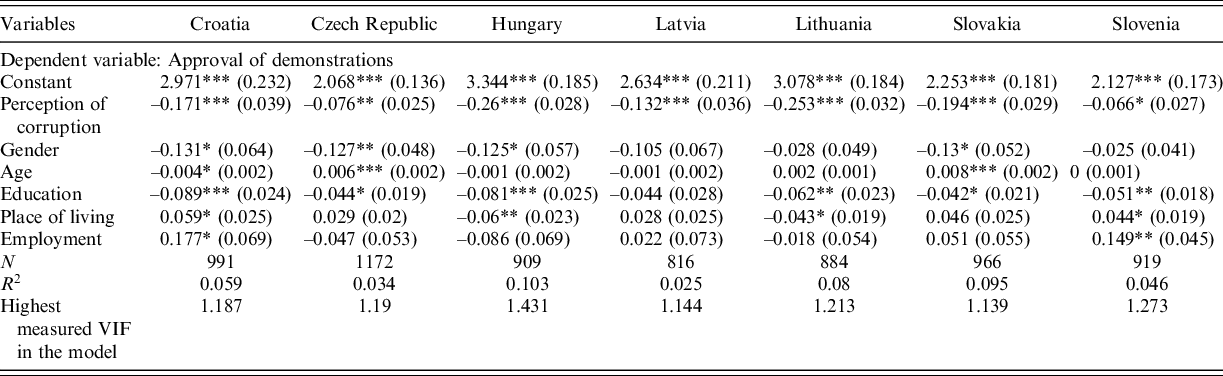
The independent variable of political corruption was statistically significant in all seven modelled models regarding the dependent variable representing demonstration approval (see Table 2). Moreover, in all seven post-communist countries, this independent variable acts on the dependent variable in the same direction: the more politicians are perceived to be corrupt, the more likely the respondent will approve of demonstrations.
Approval of demonstrations

Note: The table shows the Beta coefficient values. *** Standard errors in parentheses, *p < 0.05, **p < 0.01, ***p < 0.001. Dataset is weighted by WEIGHT provided by ISSP. Source: Author’s calculations.
Hypothesis 2: The more politicians are perceived to be corrupt, the more likely it is that citizens will approve of demonstrations, can also be confirmed.
Regarding the control variables, there was not any variable that would be significant in all models.
The gender variable was found to be significant for Croatia, the Czech Republic, Hungary and Slovakia. Everywhere this variable works in the same direction. Women are more approving of demonstrations compared with men.
The age variable reflects the situation of previous models with a dependent variable representing the approval of public protest meetings, because even in models with a variable representing demonstration, this control variable the same effect. In Croatia, demonstrations are more approved of by older respondents, while in the Czech Republic and Slovakia this type of public event is supported more by younger people.
The control variable representing education was found significant in all models, but Latvia. In the six states where education is significant, greater education is positively associated with greater approval of demonstrations.
Place of living was statistically significant in four countries. In Croatia and Slovenia, people from cities are more likely to approve of demonstrations. In Hungary and Lithuania, by contrast, rural residents are more likely to approve of demonstrations.
The final control variable, representing employment, was statistically significant in only Croatia and Slovenia. Economically productive Croats and Slovenes are more likely to approve of demonstrations in public places.
Conclusions
The first aim of this article was to evaluate the perception of corruption among politicians in seven post-communist countries. Furthermore, the article examined whether the citizens of the seven states approve of the organization of public protest meetings and the organization of demonstrations.
First, more than half of the respondents in six countries (all but the Czech Republic) believe that ‘Quite a lot’ to ‘Almost all’ politicians are involved in corruption. These two choices received the most responses, indicating that politicians in these countries are generally perceived as corrupt. Around 80% of respondents in all seven countries mostly or fully approve of the organization of public meetings as a form of protest against the government. Around 70% of respondents mostly or fully approve of the organization of demonstrations. In both cases, this demonstrates that the vast majority of the public in post-communist countries favour these unconventional and mass forms of political participation.
The second objective of the article was to find out whether there is a relationship between corruption and the approval of protest activities, and if so, in what way.
The results of the regression models reveal that the independent variable was statistically significant in relation to the dependent variable in all cases. There is therefore a relationship between the perception of corruption among politicians and the approval of public protest actions. In all cases, corruption had a negative effect on the two forms of political participation studied. The more politicians, according to the public, are involved in corruption, the more the public approves of organizing protest meetings and demonstrations.
This same research could be done for Western democracies and then compared with the results of this research. European states that were not affected by communism had a different historical development, and corruption had less impact on their societies, as there were no massive privatization processes accompanied by corruption scandals, which ultimately led to the disillusionment of the population. Therefore, there could be a significant difference between Eastern and Western European countries. Further research may also include other forms of corruption beyond perceptions of political corruption. Post-communist countries are characterized by a robust state administration whose structures were largely inherited from previous regimes. It is also possible to test the impact of corruption at the level of civil servants to see whether perceptions of corruption or the experience of corruption – for example, when a civil servant demands a bribe from a citizen – has greater effects on support for political protests and demonstrations.
Funding
This article was supported by the Philosophical faculty of the University of Hradec Králové. Specific research grant ‘Corruption in relation to political participation and trust’.
About the Author
Milan Školník is an internal PhD student of the Department of Political Science, University of Hradec Králové. His current research focuses on corruption, public administration, and political participation.
Appendix 1. Variables in the models

Source: International Social Survey Programme: Role of Government V – questionnaire.