Introduction
In developed countries, there is usually an inverse association between socioeconomic status and fertility (Balakrishnan, Reference Balakrishnan1993; Abma et al., Reference Abma, Chandra, Mosher, Peterson and Piccinino1997; Baerlocher, Reference Baerlocher2007; Skirbekk, Reference Skirbekk2008). In settings with low infant and childhood mortality and means to control births, women and couples with higher socioeconomic status are thought to channel their resources into raising fewer children more effectively, i.e. the hypothesis of a trade-off of quality for quantity (Becker, Reference Becker1991; Van Bavel, Reference Van Bavel2006).
Within the United States, Utah has the highest fertility of any state. Based on 2003 birth rates, United States women have an average of 2.0 births during their lives, while Utah women have 2.6 (Martin et al., Reference Martin, Hamilton, Sutton, Ventura, Menacker and Munson2005). A majority of people in Utah are members of the Church of Jesus Christ of Latter-day Saints (LDS Church, also known as the Mormon Church) (Kosmin & Lachman, Reference Kosmin and Lachman1993). The LDS Church has been described as pronatalist, strongly emphasizing the value of children and of motherhood (Heaton, Reference Heaton1986).
As compared with the United States generally, Utah has a slightly higher mean household income as of 2007 (Utah: US$55,220; US: US$50,740). The percentage of people in Utah below the federal poverty level is lower than the United States average as of 2007 (Utah: 9.8%; US: 13.0%). Utah also has a higher level of completed education as measured in persons 25 and over who have completed high school (Utah: 87.7%; US: 80.4%) and who have bachelor's degrees (Utah 26.1%; US: 24.4%) (US Census, 2000).
In this paper, data were utilized from the 1996 Utah Health Status Survey (Utah Health Status Survey, 1998), which included a supplementary module on fertility, to investigate the relationship between two indicators of socioeconomic variables (education and household income), religious affiliation and activity, and children ever born among married women. The Utah Health Status Survey is ideal to address this question because of the inclusion of all these variables in a single population-based survey.
The purpose of this study was to investigate the relationship of socioeconomic status, religious status (particularly the LDS religion) and marital fertility in the State of Utah. The analysis was restricted to married women of reproductive age. The following three hypotheses were tested:
1. Increasing income/education is associated with lower fertility for the population overall.
2. The inverse association between income/education and fertility will be attenuated or reversed for individuals who are members of the LDS Church. The degree of attenuation or reversal will be greater for individuals who are active members than for those who are less active members.
3. The expected association between income will persist if an instrumental variable for income is used that is not related directly to fertility; i.e. eliminating simultaneous equations bias.
Methods
Data were used from the 1996 Utah Health Status Survey Questionnaire (UHSS), conducted by the Utah Department of Health. The survey, which was designed to provide a representative sample of Utah's population, was a weighted probability sample of approximately 6300 households disproportionately stratified by the twelve local health departments that cover the state. A single-stage, non-clustered, equal probability of selection telephone calling design was used. Data were collected by the Gallup organization by incorporating a telephone survey instrument into a computer-assisted random digit dialling software program (SURVENT). Supervised interviews were conducted by trained interviewers across six sites; interviews were conducted in Spanish when appropriate. Up to fifteen attempts were made to contact each household and (after a survey respondent was identified) another fifteen attempts were made to complete the interview. The survey was conducted with one randomly selected adult in each household. Depending on the question topic, the respondent was asked about either, (1) all household members, (2) the survey respondent only, (3) a randomly selected household member or (4) the household as a whole. The 1996 UHSS core module contained data on 20,718 individuals and collected information on a range of topics including household income, race, educational status, employment status, religion and frequency of attendance at religious services for most adult respondents. The 1996 UHSS survey response rate was 66.3%.
The 1996 UHSS contained a supplemental module on fertility. This module was administered if the household respondent was a woman aged 18–55 years, or if the respondent was a married man whose wife was a woman aged 18–55 years. Data from this module were available for 617 women, 490 of whom were married. There has been no module on fertility in the UHSS since 1996, so these were the most recent data available that would serve the purposes of this study. Analysis was restricted to married women.
The following variables were used for the analysis:
• Children ever born. This is the dependent variable and is the number children ever born at the time of the interview.
• Education. The number of years of schooling completed at the time of the survey.
• Income. Annual household income for the year preceding the interview.
• Religion. Respondents were asked two questions about their religious affiliation and their frequency of church attendance. Their responses were used to categorize respondents into three groups: (1) active member of the LDS Church (LDS member and attended church weekly or more often); (2) less active member of the LDS Church (LDS member but who attends church less frequently than once a week); and (3) non-LDS (all other respondents). The latter category includes individuals with a religious affiliation other than the LDS Church as well as persons with no religious affiliation.
• Age. Age of woman in years at the time of the interview.
• Employment status. The survey asked how many hours a woman worked for pay during a typical week in the year before the interview. This was dichotomized to measure whether a woman was in full-time employment or not.
Ordinary least squares (OLS) regressions were estimated to predict the number of children ever born. The independent variables included income, education, active LDS, less active LDS, age, employment status and when appropriate, interaction terms between SES variables and the religion dummy variables. Education (seven ordinal categories) and income (eight interval categories) were analysed alternatively as categorical or as continuous variables. Poisson regressions were also estimated and yielded qualitatively similar findings (results not shown).
The economics literature often models the ‘demand’ for children as a function of various prices and income. This is a large body of work that cannot be adequately summarized here. However, from this literature, there is an important aspect for modelling the association between income and fertility that was introduced in the analysis strategy. Specifically, for cross-sectional studies, there are potential problems of endogeneity: family income may affect fertility but fertility may also affect family income (Hotz et al., Reference Hotz, Klerman, Willis, Rosenzweig and Stark1997). An OLS regression model that considers only one of these causal models may therefore be mis-specified.
In this analysis, income itself is an endogenous variable. This means that a separate regression exists that would treat income as a dependent variable. Given that income and fertility may affect each other, the income equation has an error term that is probably correlated with the error term from the fertility equation. One standard solution to this problem is to replace observed income (as an independent variable) with its predicted value in the fertility equation using two-stage least squares regression. The predicted value for income is based on a set of independent variables, so-called instrumental variables. This is done by estimating OLS regressions with income as the dependent variable and the instrumental variables as the independent variables. The instrumental variables are exogenous variables with respect to income but which have no or little direct effect on the fertility (whose error term is correlated with income). The predicted values of income are then entered as an independent variable in the fertility equation instead of the measured income.
For this analysis, an instrumental variable was used and derived from relatively stable characteristics that affect income but with weak or no effects on fertility. The best candidates were dummy variables representing each of the counties in Utah (since there is wide variation in income by county) and a race dummy (non-Hispanic, White versus all Other). For Utah and these 1996 data, these variables prove to be satisfactory instrumental variables for this analysis.
Results
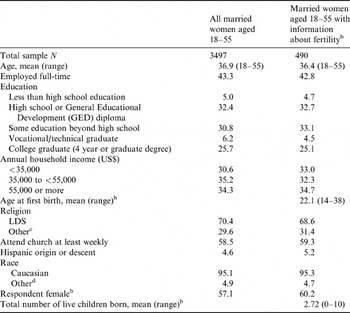
Characteristics of the sample are described in Table 1. In general, this is a highly educated population of women (25.7% college graduates), with median household income in the range of US$35,000 to US$55,000 per year (in 1996 dollars). A majority is White (95%), LDS (70%) and attend church at least weekly (58%). Characteristics were similar for all married women aged 18–55 in the sample (n=3497), compared with married women aged 18–55 with complete information in the fertility module of the UHSS (n=490).
Characteristics of married women sampled in the 1996 Utah Health Status Surveya

a All characteristics are percentages except where otherwise indicated. Percentages may not total to 100% because of rounding.
b Each respondent to the household survey gave information on one or multiple individuals in his or her household. The records in the data are by person rather than by household. Fertility questions were asked only if the respondent was herself a woman between ages 18 and 55 inclusive, or a man married to a woman between ages 18 and 55 inclusive. As a result, 619 women fitted one of these two categories, of which 490 represented currently married women.
c For all married women aged 18–55, other religion includes Protestant (7.3%), Catholic (6.9%), Other (6.5%) and no religion (8.9%), with essentially identical distribution for the subset of women with information about fertility outcomes.
d For all married women aged 18–55, other race includes American-Indian (1.2%), Asian (0.7%), African-American (0.2%) and Mixed or Other (2.7%), with very similar distribution for the subset women with information about fertility outcomes.
The mean number of children ever born to each woman (across all ages) was 2.72 (range 0–10). In preliminary univariate analysis, age was significantly linearly correlated to fertility. Full-time employment status was negatively correlated with fertility. Preliminary univariate analysis suggested no significant difference among different non-LDS religious categories in relation to fertility, so religion was operationalized as a variable of active LDS, less active LDS and other religion (including no religion), as described above.
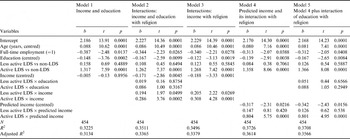
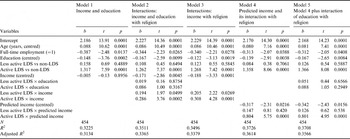
The results of the OLS regression models are displayed in Table 2. A model with no interactions (Model 1) illustrates the basic associations between age, SES, religion and fertility. Women with higher levels of education (treated as a continuous variable) had fewer children while those who were active LDS members had significantly more. Household income (treated as a continuous variable) was not significantly associated with the number of children born. Woman's age was positively associated with number of children born whereas women in full-time paid employment had significantly fewer children.
Estimates of the effects of income, education, employment and religion on fertility among married women in Utah, 1996
Method: ordinary least squares with robust errors.
Model 1 is elaborated to include interaction terms between the religion variables and the SES measures. For these equations, the interval level variables (education and income) have been centred before the construction of the multiplicative interaction terms. No significant interactions were found for education and religion (Model 2). However, there is a significant interaction involving income and religion. Because the relevant variables have been centred, the main effects for the religion dummies reflect their effects at the mean income level. Accordingly, it was found that active LDS members have 1.26 more children than non-LDS women, where this comparison is evaluated at the mean income level. No significant difference is detected for less active LDS women. The main effect of income, given the interaction terms in the model, is interpreted to mean the influence of income for the omitted religion category. Therefore, increasing income among non-LDS members is associated with fewer children born (b=−0.171). This income effect is different for active and less active LDS members as indicated by the two income interactions. The interaction terms show that the fertility effect of income for less active LDS members is different from non-LDS members (p=0.0499) but it becomes slightly positive (−0.171+0.194=+0.023). This shift in the effect of income on children is most pronounced for active LDS members. The difference in the effects of income on fertility between active LDS and non-LDS members is more significant (p=0.0002) and the regression parameter is decidedly positive (−0.171+0.286=+0.115).
Given the insignificant interaction effects between education and religion on fertility, Model 2 was reformatted by dropping these interaction terms (Model 3). While the point estimates of the remaining regression parameters change slightly, the same pattern linking income and religion to fertility can be observed as was reported for Model 2.
To address the endogeneity issue, the analyses were repeated thus far using a two-stage procedure least squares. This procedure involved estimating a separate equation where income was specified as the dependent variable using dummy variables representing county of residence and race. This equation generated a predicted income measure that breaks the correlation between income and the error term in the fertility equation. The predicted income from the first regression, instead of measured income, was then used in the regression models for fertility. This specification generated results shown in Models 4 and 5, which are similar to those shown in Models 1 and 3. Again, the fundamental result remained: increasing income among active LDS members is associated with increasing fertility while rising income suppresses the number of children born among non-LDS respondents.
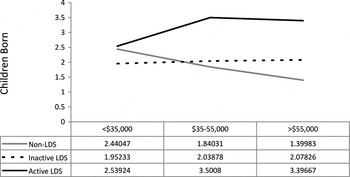
In alternative analyses, the models shown in Table 2 were replicated, substituting categorical specifications of education and income. No substantively different results were found for education. However, for income, there was evidence of a threshold effect for the interaction with active LDS status, as displayed in Fig. 1, which is based on an employed woman of average age in the sample (36.4 years). Among active LDS women, a woman with an annual household income between US$35,000 and US$55,000 would have about one more child than a woman with a lower total household income (3.5 total versus 2.5); while a woman with a household income above US$55,000 would have about 0.1 fewer children than a woman in the middle income category (3.4). There appeared to be no such threshold effect for inactive LDS status (weakly positive association with total children across the three categories), or for non-LDS status (strongly negative association with total children across the three categories). All other variables in the models with categorical income had about the same effects, and the results were robust also for categorical predicted income (data not shown).
Association between income and religious affiliation and total fertility (children born) in married women in the 1996 Utah Health Status Survey. Based on an employed woman of mean age in the sample (36.4 years).

Discussion
The results confirm that active members of the LDS Church have significantly higher levels of fertility in the State of Utah than less active and non-LDS members. For active LDS women, increasing household income up to a threshold of US$55,000 in 1996 (with about 65% of the sample in the lower and middle income categories) was strongly associated with more children, not fewer as is found in most often developed countries (Baerlocher, Reference Baerlocher2007). Unfortunately, the structure of the survey did not include any income categories beyond this threshold, so the nature of the relationship could not be examined across the income of the approximately 35% above the upper threshold.
Recent literature has found more diversity in the relationship between education, income and fertility than has been traditionally assumed. For example, a Canadian study found a mildly positive association between lifetime fertility and education (McIntosh, Reference McIntosh1999). A study using the United Nations' human development index (based on life expectancy, income and education) found a slight increase in total fertility in 18 out of 26 countries that have recently exceeded a threshold index measure of 0.9 (Myrskyla et al., Reference Myrskyla, Kohler and Billari2009). Nevertheless, for most populations, there remains a strong negative association between education, income and fertility, consistent with the quantity–quality trade-off hypothesis (Becker, Reference Becker1991; Van Bavel, Reference Van Bavel2006).
These results from Utah are consistent with those found in at least some other highly religious women in mixed populations. For example, Adsera found that practising Catholic women in Spain had significantly higher fertility than non-practising Catholic women or women who were not religiously affiliated (Adsera, Reference Adsera2006, Reference Adsera2007).
The UHSS is based on a randomly selected sample of Utah households. There is always a possibility that due to the nature of the survey design (telephone) and response rate (66.3%) (1998), biases may arise as they relate to this investigation. To assess whether biases might affect the results, the study's sample was compared with statistics for the State of Utah. In terms of race, the UHSS sample comprises 95.1% White, 4.6% Hispanic, 1.2% American-Indian and 0.2% African-American. This distribution compares favourably with 89.2%, 9.0%, 1.3% and 0.8%, respectively, for persons of all ages in the Utah Census conducted a few years later (US Census, 2000). Similarly, 34.2% of households in the study's sample reported income over US$50,000 per year, as compared with 45% of households of all ages in the Utah Census (US Census, 2000); for women aged 25–34, there were 95.0% high school graduates and 25.7% college graduates in the study's sample versus 87.7% and 26.1%, respectively, in the Utah Census for women 25 and older (US Census, 2000). With regard to LDS religious affiliation, the study's sample (70.4%) was comparable to the overall Utah population in 1993 (69.2%) (Kosmin & Lachman, 1993). The demographic characteristics of the women with fertility data (n=490) were nearly identical to those of all married women aged 18–55 (n=3497), suggesting that the criteria for including the fertility module did not introduce significant bias.
An earlier analysis of the 1996 UHSS data also examined women's parity, stratified by religious affiliation, religious activity and education (Merrill et al., Reference Merrill, Lyon and Jensen2003). That analysis demonstrated that active LDS women had the highest mean parity (2.7), as compared with less active LDS women and active and less active women of other religions. Among active LDS women, there was no decrease in parity for increasing education attainment, whereas among other women, there was a negative correlation between educational attainment and parity. These findings were true across age groups of women, except for women in the youngest age group. The investigators did not analyse income, nor did they include whether a woman was employed full time. In the present study, when education was included without income in the study's models, the findings were the same, but when income was included and the associated interactions, education was no longer predictive of parity.
The results are also similar to those found by Heaton in a 1981 demographic survey of LDS adults randomly sampled from LDS Church membership records in the United States and Canada (n=6031 households, n=2215 for married women aged 18–55 with fertility data) (Heaton, Reference Heaton1986). For the outcome of total number of children ever born (among LDS women only), Heaton found similar positive correlations for church attendance, income, temple marriage (a marker of higher religious involvement), parents' religiosity, and a negative correlation for age at marriage. He also found a weak but significant negative correlation for women's education. He did not investigate interactions, nor did he have a direct comparison group. This study's results are consistent overall with this prior analysis, confirming that active LDS status has a significant impact on fertility, and is probably the major factor accounting for the high fertility in Utah.
The remarkably strong and consistent relationship of LDS status, particularly active LDS status, with fertility is further confirmation of the pronatalist stance of the LDS faith (Heaton, Reference Heaton1986). Among active LDS women, the traditional hypothesis of a quantity–quality trade-off is not supported. The pronatalist stance of the LDS faith suggests a different calculus for LDS women of low to middle total household income, namely that where more economic resources are available, these can be used to raise more children.
At higher household income levels, it seems that the quantity–quality trade-off hypothesis may hold some sway among active LDS women, but that the pronatalist stance of the LDS faith still holds remarkable influence relative to non-LDS women. Other data will be required to explore the mechanisms at work: whether the LDS influence attenuates an increase in expenditure per child with rising income, or whether it encourages a shift of resources from other goods and services towards raising children (or some combination of both).