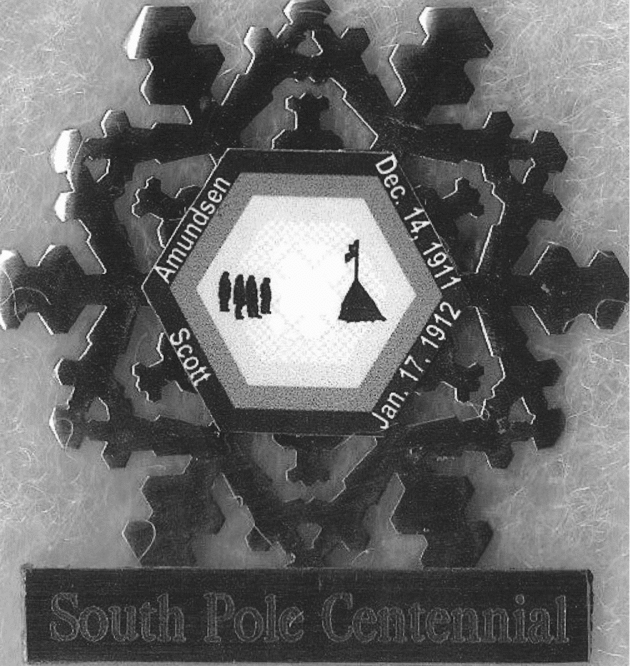
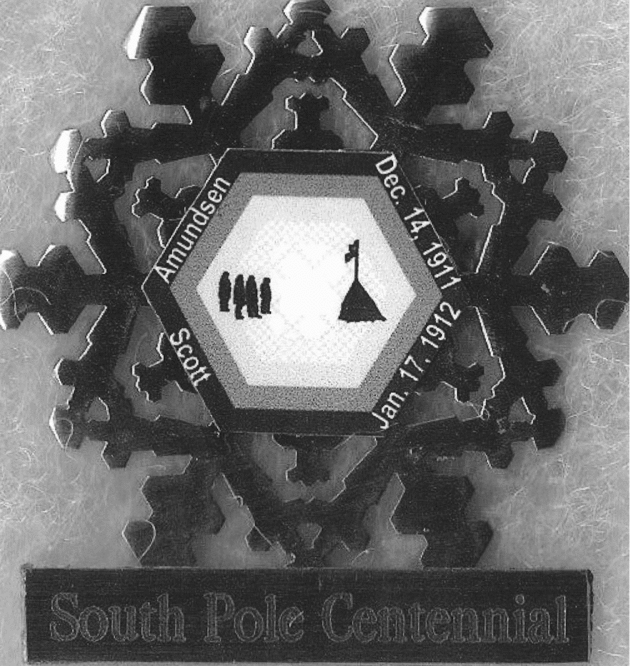
The Antarctican Society, based in the United States, has produced a medallion (Fig. 1) in recognition of the centennial of the discovery of the South Pole by Roald Amundsen and Captain Robert Falcon Scott, in 1911 and 1912, respectively. This item is representative of both expeditions.
South Pole centennial medallion.
The Antarctican Society was formed in 1960 as a not-for-profit educational society by those with interests and experience in Antarctica. A newsletter resulted, published at irregular intervals, and continues to this day.
The centerpiece of the medallion is a replica of a snowflake, and the core is an historic scene from the South Pole itself, the Norwegian tent with four of Amundsen's party standing nearby. The hexagonal rim around the scene includes the names Amundsen and Scott and their arrival dates at the South Pole. The medallion was created by sculptor Jack Chase of Jericho, Vermont, and glaciologist Tony Gow, recipient of the Seligman Crystal, selected one of Wilson A. Bentley's (1931) photomicrographs of snowflakes for this model. Chase used laser cutting techniques to produce the stainless steel medallion.
The centennial medallion was produced in two forms, one with a pin on the back for fastening onto a coat, and the other with an 18-inch necklace for wearing around the neck. The medallion pictured has an actual width of 1.75 inches (4.5 cm). Further information about the medallion is available from the Antarctican Society, Box 325, Port Clyde, Maine 04855 U.S.A. (www.antarctican.org).