Conscientiousness, a personality trait that reflects an individual's general tendency to be organized and disciplined, is associated consistently with positive health outcomes (Roberts et al. Reference Roberts, Walton and Bogg2005b ). Those who score higher in Conscientiousness, for example, are less likely to develop obesity (Jokela et al. Reference Jokela, Hintsanen, Hakulinen, Batty, Nabi, Singh-Manoux and Kivimäki2013), have fewer chronic diseases (Weston et al. Reference Weston, Hill and Jackson2015), and ultimately tend to live longer (Chapman et al. Reference Chapman, Fiscella, Kawachi and Duberstein2010). This protective association of Conscientiousness extends to cognitive outcomes. Across older adulthood, for example, Conscientiousness is associated with less cognitive decline (Luchetti et al. Reference Luchetti, Terracciano, Stephan and Sutin2016) and is found consistently to be protective against Alzheimer's disease and other dementias (Wilson et al. Reference Wilson, Schneider, Arnold, Bienias and Bennett2007; Duberstein et al. Reference Duberstein, Chapman, Tindle, Sink, Bamonti, Robbins, Jerant and Franks2011). Across different populations, various measures of personality, and varying follow-up intervals, Conscientiousness emerges as a reliable protective factor against dementia.
Although the broad domain of Conscientiousness as a predictor of dementia has been well established (Terracciano et al. Reference Terracciano, Stephan, Luchetti, Albanese and Sutin2017), less is known about how more specific aspects of this trait, referred to as facets of Conscientiousness, are associated with dementia risk. Facet-level analyses are critical because these more specific aspects of personality may have greater predictive power for outcomes of interest and reveal which aspect of a heterogeneous trait increases risk (Paunonen et al. Reference Paunonen, Haddock, Forsterling and Keinonen2003). Only one previous study has tested the association between facets of Conscientiousness and dementia risk (Terracciano et al. Reference Terracciano, Sutin, An, O'Brien, Ferrucci, Zonderman and Resnick2014). This study found that individuals who saw themselves as organized (order facet), responsible (dutifulness/responsibility facet), disciplined (self-discipline/self-control facet, and capable (competence facet) were at lower risk of dementia.
The current research builds on this previous study in several ways. First, we use a larger, more diverse sample. Such a sample allows us to determine the robustness of the initial evidence and, more importantly, examine whether these associations hold across demographic groups or whether demographic characteristics, including age, sex, race, ethnicity, and education, moderate the association between the facets and dementia risk. Second, in addition to risk of dementia, we test for an association with risk of cognitive impairment not dementia (CIND), which is a more mild impairment compared with dementia that is highly prevalent in the older adult population. Third, we examine whether these associations persist after accounting for health-risk behaviors, common comorbidities, and genetic risk associated with both personality and cognitive impairment.
Method
Participants and procedure
Participants were drawn from the Health and Retirement Study (HRS). HRS data are available from here: http://hrsonline.isr.umich.edu. A measure of the facets of Conscientiousness was first included in HRS in the 2008 Leave-Behind Questionnaire that was part of the enhanced face-to-face interview administered to half of the HRS sample; the other half of the sample first received the facet measure in 2010; these two subsamples were combined as baseline. At every 2-year assessment in HRS, participants completed the modified Telephone Interview for Cognitive Status (TICSm; Crimmins et al. Reference Crimmins, Kim, Langa and Weir2011). Participants were selected for analysis if they completed the measure of the facets of Conscientiousness and scored in the non-impaired range on the TICSm (see below) at the baseline personality assessment. A total of 11 181 participants (61% female) had the relevant personality and cognitive data to be included in the analysis. Compared with participants who completed at least one cognitive assessment across the follow-up, those who had information on the facets and scored within the range of normal cognition at baseline but who did not have a second assessment of cognition (n = 737) were older, had fewer years of education, were more likely to be male, less likely to be Hispanic, and scored lower on industriousness and responsibility (all ps < 0.05). There were no differences in the other four facets of Conscientiousness or by race.
The authors assert that all procedures contributing to this work comply with the ethical standards of the relevant national and institutional committees on human experimentation and with the Helsinki Declaration of 1975, as revised in 2008.
Measures
Facets of Conscientiousness
Participants completed a 24-item measure of six facets of Conscientiousness (Roberts et al. Reference Roberts, Chernyshenko, Strark and Goldberg2005a ). Four items measured each of six facets: self-control (e.g. ‘I rarely jump into something without first thinking about it.’), order (e.g. ‘I hardly ever lose or misplace things.’), industriousness (e.g. ‘I have high standards and work toward them.’), traditionalism (e.g. ‘I support long-established rules and traditions.’), virtue (e.g. ‘If the cashier forgot to charge me for an item, I would tell him/her.’), and responsibility (e.g. ‘I carry out my obligations to the best of my ability.’). Participants rated each item on a scale from 1 (strongly disagree) to 6 (strongly agree). The median alpha across the six scales was 0.51.
Cognitive status
Participants completed the modified Telephone Interview for Cognitive Status (TICSm) every 2 years in the HRS. The total TICSm score is the sum of performance on three cognitive tasks: immediate and delayed recall of 10 words (range 0–20 points), serial 7 subtraction (range 0–5 points), and backward counting (range 0–2 points). The total possible score is 27 points. Based on this total score, participants were classified into one of three groups at each assessment: Participants who scored between 12 and 27 on the TICSm were classified as normal, participants who scored between 7 and 11 were classified as CIND, and participants who scored 6 or less were classified in the dementia group. These cutoffs have been validated previously against a comprehensive neuropsychological assessment and clinical diagnosis of dementia (Langa et al. Reference Langa, Plassman, Wallace, Herzog, Heeringa, Ofstedal, Burke, Fisher, Fultz, Hurd, Potter, Rodgers, Steffens, Weir and Willis2005; Crimmins et al. Reference Crimmins, Kim, Langa and Weir2011). Further, the TICSm in the HRS has been used to track national trends in dementia (Langa et al. Reference Langa, Larson, Crimmins, Faul, Levine, Kabeto and Weir2017).
Covariates
In addition to standard socio-demographic covariates (age, sex, race, ethnicity, education), additional analyses included clinical and behavioral covariates that have been associated with both personality and cognitive impairment. Clinical covariates were obesity (BMI ⩾ 30; yes/no) and reported physician diagnosis of hypertension (yes/no) and diabetes (yes/no). Behavioral covariates included frequency of moderate physical activity (ranging from hardly ever or never to more than once a week) and smoking status (yes/no). All covariates were measured at baseline. Finally, a subset of participants (n = 7542) had genetic information available on their APOE risk status. Any ε4 risk variant (i.e. ε2/ε4, ε3/ε4, ε4/ε4) was contrasted against all other variants.
Statistical approach
We used Cox proportional hazard models to test whether the facets of Conscientiousness were associated with risk of dementia. The facets measured at the 2008–2010 baseline were entered separately as predictors of incident dementia over the follow-up period (2010–2014 for the 2008 baseline assessment and 2012–2014 for the 2010 baseline assessment), controlling for demographic factors known to increase risk of dementia (age, sex, race, ethnicity, and education). Time was coded in years from the year of the personality assessment and coded as time-to-incidence. Cases were censored at the last available cognitive assessment at which the participant did not score in the dementia range. Additional analyses controlled for the clinical and behavioral covariates associated with dementia risk (obesity, diabetes, hypertension, physical activity, smoking). In a third analysis, we included all six facets in the model simultaneously to test whether the facets had independent associations with dementia risk. We repeated this analytic strategy for risk of CIND: CIND was entered as the outcome in the Cox regression, time was coded in years from year of the baseline personality assessment to the year of CIND, and cases were censored at the last available cognitive assessment at which the participant did not score in the CIND range. Participants who developed dementia were excluded from the CIND analyses. The proportionality assumption was met for all traits across the two outcomes except for order predicting dementia and virtue predicting CIND (see below). Finally, we tested whether the associations between the facets and risk of any cognitive impairment (TICSm < 12) were moderated by age, sex, race, ethnicity, education, and APOE risk status by including an interaction between the facet and each of these factors.
Results
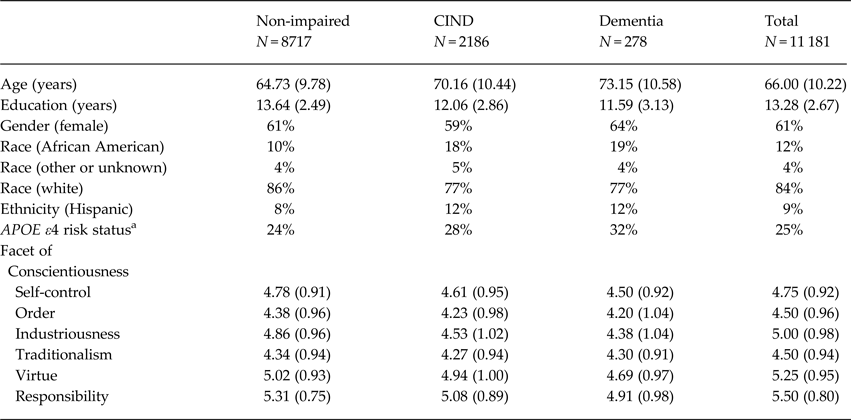
From the sample who scored within the normal range at baseline (N = 11 181), across the up to 6-year follow-up, a total of 278 participants had a TICSm score that fell below the threshold for dementia during the follow-up period (M follow-up = 4.56 years, s.d. = 1.22; range = 2–6 years) and a total of 2186 participants had a TICSm score that fell within the range of CIND during the follow-up period (M follow-up = 4.27 years, s.d. = 1.36; range = 2–6 years). Descriptive statistics for all study variables are shown in Table 1. Consistent with past literature (Alzheimer's Association, 2017), those who developed dementia were older, had fewer years of education, were less likely to be white non-Hispanic, and more likely to be an APOE ε4 carrier.
Baseline demographic characteristics and APOE ε4 risk status of the full sample and by cognitive status at follow-up

CIND, cognitive impairment not dementia.
Total N = 11 181.
a n = 7542.
Risk of dementia
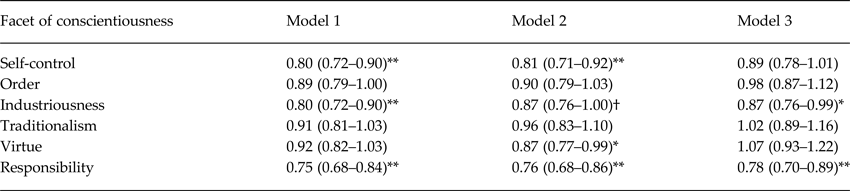
The survival analysis revealed that three of the six facets of Conscientiousness were associated with an increased risk of dementia over the follow-up (Table 2, Model 1). Specifically, for every standard deviation increase in either self-control or industriousness, there was an approximately 20% decreased risk of dementia, and for every standard deviation increase in responsibility, there was a nearly 35% decreased risk of dementia. The results were similar when the clinical and behavioral covariates were included in the analysis, with the exception that the association for industriousness was reduced to p = 0.05 (Model 2). When including all six facets of Conscientiousness in the same model (Model 3), the association between both industriousness and responsibility and risk of dementia remained significant. The results were similar when controlling for APOE risk status (results not shown). Finally, order was not significant in the primary analysis, but the test of the proportionality assumption indicated non-proportional risk associated with this trait. Supplemental analysis indicated that scoring very low on this trait (in the bottom 10% of the distribution) was associated with greater risk of dementia [HR = 1.53, 95% confidence interval (CI) 1.09–2.13].
Facets of Conscientiousness and risk of incident dementia

N = 11 181; n = 278 cases of incident dementia. Coefficients are hazard ratios (95% confidence intervals) from Cox regression. Model 1 is the association between each facet of Conscientiousness entered separately and risk of incident dementia controlling for age, sex, race, ethnicity, and education. Model 2 is Model 1 plus the inclusion of obesity, diabetes, hypertension, physical activity, and smoking as additional covariates. Model 3 is Model 1 when all six facets are entered simultaneously.
†p = 0.05.
*p < 0.05.
**p < 0.01.
Risk of CIND
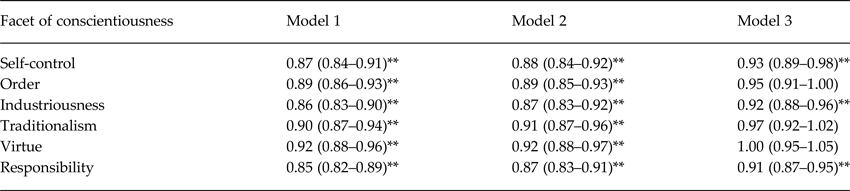
All six facets of Conscientiousness were associated with risk of CIND (Table 3, Model 1), and all associations held when controlling for the clinical and behavioral covariates (Model 2): All six facets were protective against CIND and persisted after controlling for common clinical and behavioral risk factors as well as the demographic factors. For the facets that did not have a significant association with dementia in the first set of analyses, it is of note that the associations were of similar magnitude for risk of CIND. The greater number of participants who developed CIND provided greater statistical power that rendered these associations significant. When all six facets were included in the same model, the same facets that predicted risk of dementia predicted risk of CIND, independent of the other facets (Model 3). That is, self-control, industriousness, and responsibility were independently associated with CIND risk. The associations between the facets of Conscientiousness and risk of CIND were also independent of APOE risk status (results not shown). Finally, the test of the proportionality assumption indicated non-proportional risk between virtue and risk of CIND. Supplemental analysis indicated that scoring very low on this trait (in the bottom 10% of the distribution) was associated with greater risk of dementia (HR = 1.31, 95% CI 1.15–1.49).
Facets of conscientiousness and risk of incident cognitive impairment not dementia (CIND)

N = 10 894; n = 2186 cases of incident CIND. Coefficients are hazard ratios (95% confidence intervals) from Cox regression. Model 1 is the association between each facet of Conscientiousness entered separately and risk of incident cognitive impairment not dementia controlling for age, sex, race, ethnicity, and education. Model 2 is Model 1 plus the inclusion of obesity, diabetes, hypertension, physical activity, and smoking as additional covariates. Model 3 is Model 1 when all six facets are entered simultaneously.
*p < 0.05.
**p < 0.01.
Moderators
Finally, we examined whether the association between the facets and risk of any impairment (either dementia or CIND) was moderated by socio-demographic factors or APOE risk status. Four of the six facets were moderated by age: Although protective for everyone, self-control (HRinteraction = 1.07, 95% CI 1.03–1.12, p = 0.002), traditionalism (HRinteraction = 1.06, 95% CI 1.02–1.10, p = 0.005), virtue (HRinteraction = 1.08, 95% CI 1.04–1.12, p = 0.000), and responsibility (HRinteraction = 1.09, 95% CI 1.05–1.13, p = 0.000) had a stronger protective association among the relatively younger than older participants in the sample. Similarly, although protective for both men and women, traditionalism (HRinteraction = 0.92, 95% CI 0.85–0.99, p = 0.045) and responsibility (HRinteraction = 0.92, 95% CI 0.86–0.99, p = 0.032) were more protective for women. Likewise, although protective for participants at all levels of education, industriousness (HRinteraction = 0.95, 95% CI 0.92–0.98, p = 0.001) and responsibility (HRinteraction = 0.96, 95% CI 0.93–0.98, p = 0.007) were more protective at higher levels of education. Finally, order and self-control were protective for white and non-Hispanic participants but not for African American (HRinteraction = 1.18, 95% CI 1.06–1.32, p = 0.002) or Hispanic (HRinteraction = 1.13, 95% CI 1.01–1.27, p = 0.047) participants, respectively; and, although protective for everyone, the protective association of industriousness was stronger among non-Hispanic than Hispanic participants (HRinteraction = 1.12, 95% CI 1.01–1.24, p = 0.046). There were no significant interactions between any of the facets and the APOE genotype.
Discussion
Previous research on the association between personality and risk of dementia has found consistently that individuals who score higher in Conscientiousness are protected from cognitive impairment (Wilson et al. Reference Wilson, Schneider, Arnold, Bienias and Bennett2007; Duberstein et al. Reference Duberstein, Chapman, Tindle, Sink, Bamonti, Robbins, Jerant and Franks2011; Terracciano et al. Reference Terracciano, Sutin, An, O'Brien, Ferrucci, Zonderman and Resnick2014, Reference Terracciano, Stephan, Luchetti, Albanese and Sutin2017). The present research looked more specifically at which aspects of this broad trait are particularly protective. We found that individuals who see themselves as able to control their behavior, hard working, and responsible are less likely to develop dementia and CIND, as defined by a performance measure of cognition, and that these associations persist after controlling for socio-demographic characteristics, common clinical and behavioral risk factors, and one common genetic risk factor. This research indicates that in addition to genetic, clinical, and behavioral risk factors, specific aspects of an individual's personality traits predict risk of mild and severe cognitive impairment in older adulthood.
The results point to certain aspects of Conscientiousness associated with protection against dementia. The facet of responsibility in particular was associated robustly with protection against both dementia and CIND. Roberts et al. (Reference Roberts, Chernyshenko, Strark and Goldberg2005a ) describe individuals who score high on responsibility as those who ‘like to be of service to others, frequently contribute their time and money to community projects, and tend to be cooperative and dependable’ (p. 122). Of note, of the facets of Conscientiousness associated with dementia risk, this facet has the strongest interpersonal component. Compared with industriousness and self-control, which are more oriented toward intrapersonal striving and self-regulation, responsibility specifically has an interpersonal orientation toward being accountable and helpful to others. For individuals who score high in responsibility, the internal need to regulate behavior to be accountable to others may contribute to greater social engagement that helps protect cognition (Wang et al. Reference Wang, Karp, Winblad and Fratiglioni2002). It may also lead to engaging in more prosocial and fewer health-risk behaviors associated with risk of cognitive decline. Finally, individuals who score higher in this facet have greater efficacy to handle daily stressors, which may contribute to lower stress overall (Gartland et al. Reference Gartland, O'Connor and Lawton2012) that is ultimately protective against impairment. Although we could not test these speculations in the current study, our results point to a promising avenue for future research into the interpersonal mechanisms that link a disposition toward responsibility and dementia risk.
In addition to responsibility, two other facets, self-control and industriousness, were protective against both dementia and CIND. Self-control is a fundamental component of Conscientiousness that involves the ability to monitor and regulate one's behavior and to not give in to temptation (Costa & McCrae, Reference Costa and McCrae1992). Starting from childhood, self-control contributes to healthier choices and outcomes. Children who score higher in self-control, for example, are less likely to smoke (Daly et al. Reference Daly, Egan, Quigley, Delaney and Baumeister2016), abuse drugs (Elam et al. Reference Elam, Wang, Bountress, Chassin, Pandika and Lemery-Chalfant2016), or engage in other high-risk behaviors (Dir et al. Reference Dir, Coskunpinar and Cyders2014). This protective association continues into adulthood with more positive health-related and other life outcomes (Moffitt et al. Reference Moffitt, Arseneault, Belsky, Dickson, Hancox, Harrington, Houts, Poulton, Roberts, Ross, Sears, Thomson and Caspi2011, Reference Moffitt, Poulton and Caspi2013). The present research indicates that a trait orientation toward greater self-control is likewise associated with maintaining healthier cognitive function well into older adulthood, a pathway that may be mediated, in part, by the healthier behaviors these individuals engage in across the lifespan. Industriousness, the tendency to be ‘hard working, ambitious, confident, and resourceful’ (p. 119; Roberts et al. Reference Roberts, Chernyshenko, Strark and Goldberg2005a ), was also associated with better cognitive outcomes. Similar to self-control, industriousness is an intrapersonal orientation generally associated with more positive outcomes, including better education and economic outcomes (Roberts et al. Reference Roberts, Chernyshenko, Strark and Goldberg2005a ) that may help build reserve as the brain ages.
The only other study on the facets of Conscientiousness and risk of dementia found individuals who see themselves as capable, organized, responsible, and disciplined are at lower risk of dementia (Terracciano et al. Reference Terracciano, Sutin, An, O'Brien, Ferrucci, Zonderman and Resnick2014). A direct comparison with this previous study, however, is difficult because each study defined, and thus measured, the facets in slightly different ways. For example, the industriousness facet in the current research encompasses aspects of the trait, such as competence and achievement striving, which are considered as separate facets on other measures of Conscientiousness. Even if not directly comparable, the results of the current research are broadly consistent with this previous study and suggest that across different ways of measuring the facets of Conscientiousness, the aspects of this trait related to responsibility/dutifulness and self-control/self-discipline are particularly protective.
Trait Conscientiousness might provide some psychological reserve, similar to cognitive reserve, which helps protect the individual against cognitive impairment. The concept of cognitive reserve suggests that cognitive engagement – whether higher education, occupational complexity, leisure activities, etc. – provides a reserve that helps the brain maintain function even in the presence of neuropathology (Stern, Reference Stern2012). Specific aspects of Conscientiousness might help support this resilience and prolong functional independence (Roy et al. Reference Roy, Ficarro, Duberstein, Chapman, Dubovsky, Paroski, Szigeti and Benedict2016). For example, individuals who score high on self-control/self-discipline tend to have structured lives and a predictable environment. A stable environment may help to keep the individual functional for longer because he/she will know how to effectively move through it even as cognition starts to decline. Likewise, a tendency to follow through on obligations (high responsibility) may both foster strong interpersonal connections that help maintain cognition and promote greater cognitive activity that helps to delay the onset of clinical symptoms of dementia. Future work is needed to provide empirical evidence for these speculations.
It is of note that the association between the facets and risk of dementia were not fully accounted for by common behavioral and clinical risk factors that are associated with both personality and dementia risk. Factors such as low education, cigarette smoking, and physical inactivity, are estimated to account for up to about one-third of the world's cases of Alzheimer's disease (Norton et al. Reference Norton, Matthews, Barnes, Yaffe and Brayne2014). To the extent that personality is also associated with education (Sutin et al. Reference Sutin, Stephan, Luchetti, Robins and Terracciano2017), smoking (Terracciano & Costa, Reference Terracciano and Costa2004), and physical inactivity (Sutin et al. Reference Sutin, Stephan, Luchetti, Artese, Oshio and Terracciano2016; Sutin & Terracciano, Reference Sutin and Terracciano2016), the dementia risk associated with personality may be due to the shared vulnerability between personality and these behavioral and clinical risk factors. Accounting for these factors, however, only slightly reduced the association between the facets and risk of cognitive impairment. This finding suggests that the risk associated with personality persists after accounting for shared risk factors and that other processes associated with personality may be responsible for the increased risk of impairment.
The results also persisted after accounting for APOE risk status. The ε4 allele of the APOE gene is associated with an up to 15-fold increased risk of Alzheimer's disease (Farrer et al. Reference Farrer, Cupples, Haines, Hyman, Kukull, Mayeux, Myers, Pericak-Vance, Risch and van Duijn1997). Similarly, in the present analyses, the presence of any ε4 allele was associated with increased risk of both dementia and CIND. Including this genetic risk in the model with personality, however, did not alter the association between the facets and risk of either dementia or CIND. This pattern suggests that the association between the facets and risk of impairment is independent of this common genetic risk factor. It is still possible, however, that other genetic factors may contribute to this association. We also did not find evidence of an interaction between APOE risk status and any of the facets on impairment risk. Previous research suggested that APOE risk status may modify the relation between specific traits and dementia risk (Dar-Nimrod et al. Reference Dar-Nimrod, Chapman, Franks, Robbins, Porsteinsson, Mapstone and Duberstein2012), although not all find evidence of this moderation (Terracciano et al. Reference Terracciano, Sutin, An, O'Brien, Ferrucci, Zonderman and Resnick2014).
In addition to risk of dementia, several facets were also associated with risk of a more mild cognitive impairment. Mild cognitive impairments, such as CIND, have been implicated as an intermediary stage between normal functioning and significant impairment (Gauthier et al. Reference Gauthier, Reisberg, Zaudig, Petersen, Ritchie, Broich, Belleville, Brodaty, Bennett, Chertkow, Cummings, de Leon, Feldman, Ganguli, Hampel, Scheltens, Tierney, Whitehouse and Winblad2006) and cognitive decline more generally (Machulda et al. Reference Machulda, Pankratz, Christianson, Ivnik, Mielke, Roberts, Knopman, Boeve and Petersen2013), and can limit function (Jekel et al. Reference Jekel, Damian, Wattmo, Hausner, Bullock, Connelly, Dubois, Eriksdotter, Ewers, Graessel, Kramberger, Law, Mecocci, Molinuevo, Nygård, Olde-Rikkert, Orgogozo, Pasquier, Peres, Salmon, Sikkes, Sobow, Spiegel, Tsolaki, Winblad and Frölich2015) even if most individuals with mild impairments do not go on to develop dementia. These findings add to the growing evidence base that personality is not only associated with significant impairment but also with more mild impairments (Wilson et al. Reference Wilson, Schneider, Arnold, Bienias and Bennett2007) and thus may be one early predictor of who is likely to become impaired.
Some demographic characteristics moderated the relation between the facets and risk of cognitive impairment. Interestingly, most moderators suggested a difference in degree of protection rather than kind. That is, in most cases, the facet was protective for both groups (or across the continuum) but was more protective in one group than the other. For example, responsibility was protective for both men and women but was slightly more protective for women. These results are broadly consistent with what is found at the domain level – Conscientiousness tends to be protective for all (Terracciano et al. Reference Terracciano, Stephan, Luchetti, Albanese and Sutin2017). On the other hand, it is difficult to interpret findings that show that facets are protective in one group but not another. Interactions are difficult to replicate, and replication is critical to separate chance findings from real differences. Testing and reporting such interactions, however, are necessary to build the literature to be able to identify true differences.
The present research had several strengths, including a large and relatively diverse sample, a detailed measure of the facets of Conscientiousness, and an assessment of both dementia and CIND. Limitations include a relatively short follow-up period. The short follow-up increases the risk that the results may be due to reverse causality rather than a prospective association. That is, as individuals become cognitively impaired, the disease process may impact personality and thus the association could be driven by the disease. Evidence to date (Wilson et al. Reference Wilson, Schneider, Arnold, Bienias and Bennett2007; Duberstein et al. Reference Duberstein, Chapman, Tindle, Sink, Bamonti, Robbins, Jerant and Franks2011; Terracciano et al. Reference Terracciano, Sutin, An, O'Brien, Ferrucci, Zonderman and Resnick2014, Reference Terracciano, Stephan, Luchetti, Albanese and Sutin2017), however, suggests that the association between Conscientiousness and risk of dementia is not stronger with shorter follow-up or in older samples. Further, brain neuropathology is unrelated to Conscientiousness (Terracciano et al. Reference Terracciano, Iacono, O'Brien, Troncoso, An, Sutin, Ferrucci, Zonderman and Resnick2013), which some have argued as evidence against reverse causality (Wilson et al. Reference Wilson, Schneider, Arnold, Bienias and Bennett2007). More research is needed to definitively rule out this possibility for the facets, but evidence from domain-level personality speaks against reverse causality.
A second significant limitation is that the TICSm is a performance-based measure of cognitive function and not a diagnosis of cognitive impairment or dementia. As such, this study is limited by this brief measure of cognitive function rather than a clinical diagnosis. There is often a trade-off between obtaining large, diverse samples and detailed assessments of participants. It would be ideal to have a clinical evaluation on all HRS participants, but such an undertaking would be prohibitively expensive and time consuming. A performance-based measure will undoubtedly misclassify some participants. Still, even with this measurement error, the TICSm has been used successfully to track trends in dementia incidence over time (Langa et al. Reference Langa, Larson, Crimmins, Faul, Levine, Kabeto and Weir2017). In addition, the associations between personality traits and dementia as categorized by the TICSm are similar to those when a dementia is diagnosed by clinical consensus (Terracciano et al. Reference Terracciano, Sutin, An, O'Brien, Ferrucci, Zonderman and Resnick2014, Reference Terracciano, Stephan, Luchetti, Albanese and Sutin2017). The TICSm thus seems to be capturing meaning variability in cognition and its relation to personality. A third limitation is that there was some evidence of selective attrition for the industriousness and responsibility facets. Attrition, however, may not necessarily limit generalizability (Salthouse, Reference Salthouse2014). Finally, it is possible that a third variable (e.g. a genetic variant other than APOE) accounted for the association between the facets and cognitive impairment and it would be useful to obtain objective measures of the covariates rather than the self-reported measures used here.
In sum, the present research indicates that the specific facets of responsibility, industriousness, and self-control are robust predictors of lower risk of cognitive impairment and dementia. Identifying aspects of Conscientiousness that are the most protective is a step toward a more nuanced and detailed understanding of how processes related to Conscientiousness protect against cognitive decline and also indicate who is most at risk. Such information informs both basic research and clinical settings to improve cognitive outcomes in older adulthood.
Supplementary material
The supplementary material for this article can be found at https://doi.org/10.1017/S0033291717002306
Acknowledgements
Research reported in this publication was supported by the National Institute On Aging of the National Institutes of Health under Award Number R01AG053297 and R03AG051960. The content is solely the responsibility of the authors and does not necessarily represent the official views of the National Institutes of Health.
Declaration of Interest
None.