INTRODUCTION
Grass silage is the main forage fed to growing cattle in Northern Europe. Quality and yield of grass silage can vary greatly, having a large economic effect at farm level. Actions taken at harvesting and ensiling determine digestibility, dry matter (DM) concentration and fermentation quality of the grass silage. These factors are known to have a large effect on intake potential of grass silage for dairy cows (Huhtanen et al. Reference Huhtanen, Rinne and Nousiainen2007). For growing cattle, the importance of digestibility is demonstrated by Steen et al. (Reference Steen, Gordon, Dawson, Park, Mayne, Agnew, Kilpatrick and Porter1998) and Huuskonen et al. (Reference Huuskonen, Huhtanen and Joki-Tokola2013a ), while less information is available about the need to control silage fermentation by silage additives.
Voluntary feed intake in cattle has a great impact on animal performance and energy intake is the most important variable affecting growth performance of cattle (Huuskonen & Huhtanen Reference Huuskonen and Huhtanen2015). Improving fermentation quality of silage has been shown to increase feed intake and performance. In finishing steers, Agnew & Carson (Reference Agnew and Carson2000) observed that steers offered grass silage with an additive (a blend of ammonium hexamethanoate, ammonium hexapropionate and octanoic acid) showed higher daily DM intake (DMI) and higher daily carcass gain than those offered silage without the additive. Also, Winters et al. (Reference Winters, Fychan and Jones2001) observed higher DMI and higher live-weight gain (LWG) when either formic acid or inoculant was used in ensiling a low DM (197 g/kg) grass silage.
Increasing size of farms and demand for high labour efficiency in ensiling systems have been the major reasons for technological development, such as pre-wilting and harvesting techniques related to it (Huhtanen et al. Reference Huhtanen, Jaakkola and Nousiainen2013). Effluent losses and the risk of clostridial fermentation decreases with increasing silage DM content but at the same time wilting may increase nutrient losses during drying, impair microbiological quality of silage and expose the silage to aerobic deterioration (Huhtanen et al. Reference Huhtanen, Jaakkola and Nousiainen2013). In favourable harvesting conditions, wilting grass to a DM content of 300 g/kg supports achievement of relatively good fermentation quality and feeding value without additives (Heikkilä et al. Reference Heikkilä, Saarisalo, Taimisto and Jaakkola2010). Nevertheless, in spite of the low butyric acid and ammonia nitrogen (N) content of untreated bale silage having relatively high DM content (380 g DM/kg), the use of inoculants or formic-acid-based additive improved the production and sensory quality of milk (Heikkilä et al. Reference Heikkilä, Toivonen, Tupasela and van Arendonk1997), which demonstrates that fermentation parameters of high DM silage insufficiently describe the value of silage in animal production. One suggested explanation is the better amino acid balance of additive treated silages (Winters et al. Reference Winters, Fychan and Jones2001).
Relative to dairy cows there are few reports available where high DM silages treated with different additives have been fed to growing and finishing bulls. Therefore, the objective of the present experiment was to study the effects of two silage additives compared with a control silage without any additive on intake, animal performance and carcass characteristics of growing and finishing dairy bulls. The study included both Nordic Red (NR) and Holstein (HO) bulls, which are the two most frequently used breeds in Finnish beef production (Huuskonen Reference Huuskonen2014). It was hypothesized that the use of additives would increase the feed intake of the bulls and increasing intake might improve gain and carcass traits. Based on on-farm data sets (Huuskonen et al. Reference Huuskonen, Pesonen, Kämäräinen and Kauppinen2013b ; Huuskonen Reference Huuskonen2014) it was hypothesized that the use of the NR breed would improve carcass conformation score compared with HO breed. Furthermore, it was hypothesized that there would be no interactions between the additive treatments and breed on growth performance and carcass characteristics.
MATERIALS AND METHODS
Animals and housing
A feeding experiment was conducted in the experimental barn of the Natural Resources Institute Finland (Luke) in Ruukki, Finland starting in January 2015 and ending in September 2015. Animals were managed according to Finnish legislation regarding the use of animals in scientific experimentation. The experiment was conducted using 45 pure NR and 45 pure HO bulls. All animals, with an initial live-weight (LW) of 290 (±24·5) kg, were purchased from commercial herds. At the start of the feeding experiment the animals were on average 251 (±10·0) days old.
During the feeding experiment, the bulls were housed in an uninsulated barn in pens (10·0 × 5·0 m2; five bulls in each pen), providing 10·0 m2 per bull. The rear half of the pen area was a straw-bedded lying area and the front half was a feeding area with a solid concrete floor. A GrowSafe feed intake system (model 4000E; GrowSafe Systems Ltd., Airdrie, AB, Canada; see validation studies: e.g. DeVries et al. Reference DeVries, von Keyserlingk, Weary and Beauchemin2003; Mendes et al. Reference Mendes, Carstens, Tedeschi, Pinchak and Friend2011) was used to record individual daily feed intakes so that each pen contained two GrowSafe feeder nodes. The bulls had free access to water from a water bowl (one bowl per pen) during the experiment.
Feeds, feeding and experimental design
Experimental silages were produced at the experimental farm of Luke in Ruukki (64°44′N, 25°15′E) and harvested from timothy (Phleum pratense) stands (on 18 June and 6 August 2014, primary growth and regrowth, respectively). The stands were cut by mower conditioner (Elho 280 Hydro Balance, Oy Elho Production Ab, Pännäinen, Finland) and harvested with an integrated round baler wrapper (McHale Fusion 3, McHale, Ballinrobe, Co. Mayo, Ireland) approximately 24 h after cutting.
Three different additive treatments were used:
-
1. Control treatment without additives (CON).
-
2. A commercial additive containing sodium benzoate (200 g/kg), potassium sorbate (100 g/kg) and sodium nitrite (50 g/kg) (Safesil/Ab Hanson & Möhring, Halmstad, Sweden) applied at a rate of 3·4 kg/t of fresh forage (SALT).
-
3. A commercial additive containing formic acid (589 g/kg), propionic acid (199 g/kg), ammonium formate (43 g/kg) and potassium sorbate (25 g/kg) (AIV ÄSSÄ/Eastman Chemical Company, Oulu, Finland) applied at a rate of 5·8 kg/t of fresh forage (ACID).
At the beginning of the feeding experiment both NR and HO bulls were randomly allotted to pens (animals from the same breed were housed together), which were then randomly allotted to three feeding treatments (CON, SALT, ACID; three NR pens and three HO pens per treatment; 30 bulls per treatment). The diets included experimental silages (600 g/kg DM), rolled barley grain (385 g/kg DM) and mineral-vitamin mixture (15 g/kg DM). The primary growth of timothy was fed during the early part of the feeding experiment (135 days) and regrowth during the late part of the experiment (124 days). Thus, the whole feeding experiment lasted 259 days.
The bulls were fed a total mixed ration ad libitum (proportionate refusals of 5%). Mineral and vitamin composition of the mineral-vitamin mixture (Kasvuape E-Hiven, A-Rehu Ltd., Seinäjoki, Finland) is fully described by Huuskonen et al. (Reference Huuskonen, Pesonen and Honkavaara2017). Two HO bulls (one SALT and one ACID) were excluded from the study due to pneumonia and one HO bull (SALT) due to several occurrences of bloat. There was no reason to suppose that the diets had caused these problems.
Feed sampling and analysis
During the feeding experiment, silage sub-samples were taken twice a week, pooled over periods of 4 weeks and stored at −20 °C prior to analyses. Thawed samples were analysed for DM, ash, crude protein (CP), neutral detergent fibre (NDF) exclusive of residual ash, silage fermentation quality (pH, water-soluble carbohydrates (WSC), lactic and formic acids, ethanol, volatile fatty acids (VFA), soluble and ammonia N content of total N) and digestible organic matter (DOM) in DM (D-value). Barley sub-samples were collected weekly, pooled over periods of 8 weeks and analysed for DM, ash, CP and NDF.
The DM concentration was determined by drying at 105 °C for 20 h. Samples for chemical analyses were dried at 60 °C for 16 h and milled using a sample mill (Sakomylly KT-3100, Koneteollisuus Ltd., Helsinki, Finland) and a 1 mm sieve. Oven DM concentration of silages was corrected for the loss of volatiles according to Huida et al. (Reference Huida, Väätäinen and Lampila1986). The ash concentration was determined by ashing at 600 °C for 2 h. Nitrogen content was determined by the Dumas method (AOAC method 968·06; AOAC 1990) using a Leco FP 428 nitrogen analyser (Leco, St Joseph, MI, USA). Crude protein content was calculated as 6·25 × N content. Concentration of NDF was determined according to Van Soest et al. (Reference Van Soest, Robertson and Lewis1991) using sodium-sulphite, without amylase for forages and presented ash-free. The silages were analysed for D-value as described by Huhtanen et al. (Reference Huhtanen, Nousiainen and Rinne2006). The pepsin-cellulase solubility values were converted to in vivo digestibility using correction equations (different equations for primary growth and regrowth) based on a data set comprising Finnish in vivo digestibility trials (Huhtanen et al. Reference Huhtanen, Nousiainen and Rinne2006).
Fresh silage samples were analysed for fermentation quality. Lactic acid was analysed according to Haacker et al. (Reference Haacker, Block and Weissbach1983), VFA according to Huhtanen et al. (Reference Huhtanen, Blauwiekel and Saastamoinen1998), WSC according to Somogyi (Reference Somogyi1945) and ammonia N according to McCullough (Reference McCullough1967). Soluble N was measured from water extract using the Kjeldahl method (AOAC method 984·13) with a Foss Kjeltec 2400 Analyser Unit (Foss Tecator AB, Höganäs, Sweden). Formic acid of the silages was measured using a commercial kit (Cat. No. 979732; Boehringer Mannheim GmbH, Mannheim, Germany). Ethanol content of the silages was measured using an enzymatic kit (Cat. No. 981680; KONE Instruments Corporation, Espoo, Finland) and the selective clinical chemistry analyser Pro 981489 (KONE Instruments) according to application instructions given by KONE.
The metabolizable energy (ME) concentration of the silages was calculated as 0·016 × D-value (MAFF 1984). The ME concentration of barley was calculated based on concentrations of digestible crude fibre, CP, crude fat and nitrogen-free extract described by Luke (2017). Crude fibre and crude fat concentrations and digestibility coefficients were taken from the Finnish Feed Tables (Luke 2017). The values of metabolizable protein (MP) and the protein balance in the rumen (PBV) were calculated according to the Finnish feed protein evaluation system (Luke 2017) in which MP describes the amount of amino acids absorbed from the small intestine and PBV describes the balance between the dietary supply of rumen-degradable protein (RDP) and the microbial requirements for RDP. The relative intake potential of silage DM (SDMI index) was calculated as described by Huhtanen et al. (Reference Huhtanen, Rinne and Nousiainen2007).
Slaughter procedures and carcass quality measurements
Bulls were weighed on 2 consecutive days at the beginning of the experiment, in the middle of the experiment when silages were changed and before slaughter. All bulls were slaughtered on the same day and the target for average carcass weight was 330–335 kg, which is the average carcass weight for slaughtered dairy bulls in Finland (Huuskonen et al. Reference Huuskonen, Pesonen, Kämäräinen and Kauppinen2013c ; Huuskonen Reference Huuskonen2014). The LWG was calculated as the difference between the means of the initial and final LW divided by the number of growing days. The estimated rate of carcass gain was calculated as the difference between the final carcass weight and the carcass weight at the beginning of the experiment divided by the number of growing days. The carcass weight at the start of the experiment was assumed to be 0·50 × initial LW based on earlier studies (unpublished data).
The animals were slaughtered at Atria Ltd. commercial slaughterhouse in Kauhajoki, Finland. After slaughter, the carcasses were weighed hot. The cold carcass weight was estimated as 0·98 of the hot carcass weight. Dressing proportions were calculated from the ratio of cold carcass weight to final LW. The carcasses were classified for conformation and fatness using the EUROP quality classification (EC 2006). For conformation, development of the carcass profile, in particular the essential parts (round, back, shoulder), was taken into consideration according to the EUROP classification (E: excellent, U: very good, R: good, O: fair, P: poor). Each level of the conformation scale was sub-divided into three sub-classes to produce a transformed scale ranging from 1 to 15, with 15 being the best conformation. For fat cover degree, the amount of fat on the outside of the carcass and in the thoracic cavity was taken into account using a classification range from 1 to 5 (1: low, 2: slight, 3: average, 4: high, 5: very high).
Statistical methods
The results are shown as least squares means. The data were subjected to analysis of variance using the SAS GLM procedure (version 9.4, SAS Institute Inc., Cary, NC, USA). The statistical model used for feed intake, growth performance and carcass traits was:
 $$y_{ijkl} = \mu + \alpha _i + \gamma _j + (\alpha \times \gamma )_{ij} + \theta _{ijl} + \beta x_{ijk} + e_{ijkl}$$
where μ is the intercept and e ijkl is the residual error term associated with l th animal. α i , γ j and (α × γ) ij are the effects of i th diet (CON, SALT, ACID) and j th breed (NR, HO) and their interaction, respectively, while θ ijl is the effect of pen. The effect of pen was used as an error term when differences between treatments (diet, breed and their interaction) were compared because treatments were allocated to animals penned together. Initial LW was used as a covariate (βx ijk ) in the model for intake, gain and feed conversion parameters. When the dressing proportion, carcass conformation and carcass fat score were tested, carcass weight was used as a covariate.
Differences between treatments were tested using orthogonal contrasts: (i) NR v. HO, (ii) CON v. additives (SALT + ACID), (iii) SALT v. ACID, (iv) interaction between breed and (ii) and (v) interaction between breed and (iii). As the interactions between breed and feeding treatments were not statistically significant, the P-values of the interactions are not presented.
RESULTS
Feeds
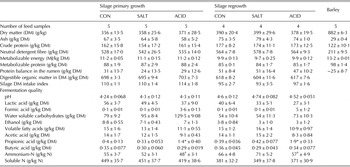
Chemical composition and feeding values of the experimental silages are presented in Table 1. The herbages were wilted rapidly so relatively high average DM contents (362 and 389 g/kg for primary growth and regrowth, respectively) were achieved. Silage ME content was on average 11·2 and 9·8 MJ/kg DM, CP content 159 and 175 g/kg DM and DM intake index 111 and 95 for primary growth and regrowth, respectively. There were only minor differences in chemical composition and feeding values between the additive treatments (Table 1). Barley grain used in the present experiment had typical chemical composition and feed values, corresponding to the average values in the Finnish Feed Tables (Luke 2017).
Chemical composition and feeding values of the grass silages and barley grain (mean ± s.d. ) used during the feeding experiment

CON, timothy silage without additives; SALT, timothy silage with sodium benzoate, potassium sorbate and sodium nitrate-based additive; ACID, timothy silage with a mixture of mostly formic acid and propionic acid-based additive.
* Amount of propionic acid applied in additive (3·08 g/kg DM) exceeds the amount measured.
† Amount of ammonium-N applied in additive (5·5 g/kg N) is not taken into account.
The fermentation characteristics of all silages were good as indicated by the low pH value and the low concentrations of ammonia N in total N and total fermentation acids (Table 1). All silages were restrictively fermented with high residual WSC concentration and relatively low lactic acid concentration. There were some differences in fermentation characteristics among the additive treatments. The ACID silage contained slightly less lactic acid and acetic acid and more WSC compared with CON and SALT silages (Table 1).
Feed and nutrient intake
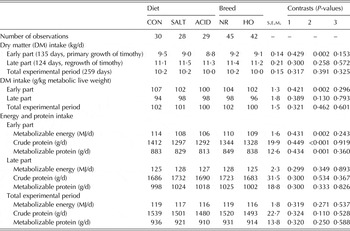
The feeding experiment lasted in total 259 days. During the early (135 days) and late (124 days) part of the feeding experiment the primary growth and regrowth of timothy was used, respectively. Breed did not affect feed or nutrient intake of the bulls during the early or late part or total experimental period (Table 2). By contrast, additive treatments affected intake parameters. During the early part of the experiment total DMI of the CON bulls was 7% higher (P < 0·01) and DMI per metabolic LW 6% higher (P < 0·01) than those of the SALT and ACID bulls. Furthermore, energy intake was 7% (P < 0·01), CP intake 9% (P < 0·001) and MP intake 8% (P = 0·001) higher in the CON bulls compared with the SALT and ACID bulls. There were no differences between the SALT and ACID treatments in feed or nutrient intake during the early part of the feeding experiment.
Feed and component intake of the bulls

s.e.m., standard error of the mean; CON, timothy silage without additives (600 g/kg DM), rolled barley (385 g/kg DM) and mineral-vitamin mixture (15 g/kg DM); SALT, timothy silage with sodium benzoate, potassium sorbate and sodium nitrate-based additive (600 g/kg DM), rolled barley (385 g/kg DM) and mineral-vitamin mixture (15 g/kg DM); ACID, timothy silage with a mixture of mostly formic acid and propionic acid-based additive (600 g/kg DM), rolled barley (385 g/kg DM) and mineral-vitamin mixture (15 g/kg DM); NR, Nordic Red; HO, Holstein.
Orthogonal contrasts, 1, NR v. HO; 2, CON v. additives (SALT + ACID); 3, SALT v. ACID.
During the late part of the feeding experiment there were no treatment differences in DM, ME, CP or MP intakes (Table 2). During the total experimental period, the average DM, ME and CP intakes were 10·1 kg/d, 117 MJ/d and 1507 g/d, respectively. There were no significant differences among treatments.
Growth performance, feed conversion and carcass characteristics
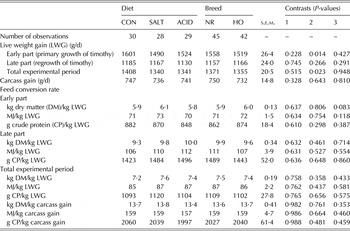
The average LWG of the bulls was 1538, 1161 and 1363 g/d during the early part, late part and total experimental period, respectively. Breed had no effect on LWG or carcass gain (741 g/d, on average) of the bulls (Table 3). During the early part of the experiment the LWG of CON bulls was 6% higher (P = 0·01) than that of SALT and ACID bulls but there was no difference between the SALT and ACID bulls.
Growth performance and feed conversion ratio of bulls

s.e.m., standard error of the mean; CON, timothy silage without additives (600 g/kg DM), rolled barley (385 g/kg DM) and mineral-vitamin mixture (15 g/kg DM); SALT, timothy silage with sodium benzoate, potassium sorbate and sodium nitrate-based additive (600 g/kg DM), rolled barley (385 g/kg DM) and mineral-vitamin mixture (15 g/kg DM); ACID, timothy silage with a mixture of mostly formic acid and propionic acid-based additive (600 g/kg DM), rolled barley (385 g/kg DM) and mineral-vitamin mixture (15 g/kg DM); NR, Nordic Red; HO, Holstein.
Orthogonal contrasts, 1, NR v. HO; 2, CON v. additives (SALT + ACID); 3, SALT v. ACID.
There were no treatment differences in LWG during the late part of the experiment. During the total experimental period the LWG of CON bulls was 5% higher (P < 0·05) compared with bulls fed additive-treated silages but there were no treatment differences in the carcass gain among treatments. There were no differences in feed, energy or CP conversion rates among treatments (Table 3).
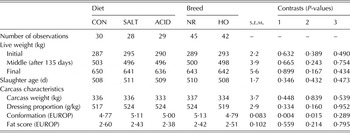
The slaughter age and final LW of the bulls were on average 509 days and 642 kg, respectively (Table 4). There were no treatment differences in the slaughter age or final LW. The average carcass weight and dressing proportion was 335 kg and 522 g/kg, respectively, and there were no differences among treatments. Carcass conformation score of SALT and ACID bulls was 6% higher compared with CON bulls but there was no difference between SALT and ACID bulls. There were no differences in carcass fat score among the additive treatments (Table 4). The conformation score of the NR bulls was 7% higher compared with the HO bulls (P < 0·01) but there was no difference in carcass fat score between breeds.
Live weights and carcass characteristics of bulls

s.e.m., standard error of the mean; CON, timothy silage without additives (600 g/kg DM), rolled barley (385 g/kg DM) and mineral-vitamin mixture (15 g/kg DM); SALT, timothy silage with sodium benzoate, potassium sorbate and sodium nitrate based additive (600 g/kg DM), rolled barley (385 g/kg DM) and mineral-vitamin mixture (15 g/kg DM); ACID, timothy silage with a mixture of mostly formic acid and propionic acid-based additive (600 g/kg DM), rolled barley (385 g/kg DM) and mineral-vitamin mixture (15 g/kg DM); NR, Nordic Red; HO, Holstein.
Orthogonal contrasts, 1, NR v. HO; 2, CON v. additives (SALT + ACID); 3, SALT v. ACID.
Conformation: (1, poorest; 15, excellent).
Fat score: (1, leanest; 5, fattest).
DISCUSSION
Effects of breed
There were only minor differences between NR and HOL breeds, and no interactions between breed and additive treatment, so breed effects are discussed very briefly. Earlier, based on on-farm data sets, Huuskonen (Reference Huuskonen2014) observed that the conformation score of NR bulls was 14% higher compared with HO bulls, which is in line with the present feeding trial and previous research using NR and HO heifers (Huuskonen et al. Reference Huuskonen, Pesonen, Kämäräinen and Kauppinen2013b ). Contrary to previous observations by Huuskonen (Reference Huuskonen2014) there was no significant difference in LWG and carcass fat score between NR and HO bulls in the present study. Huuskonen (Reference Huuskonen2014) reported that the carcass gain of NR bulls was slightly lower and carcass fat score slightly higher than those of HO bulls.
Effects of silage additive treatments on fermentation quality of silages
In the present experiment, the CON silages had good fermentation quality showing relatively low pH, restricted amount of fermentation products and low amount of ammonium-N. Increasing DM content by pre-wilting has been shown to restrict the extent of fermentation (Heikkilä et al. Reference Heikkilä, Saarisalo, Taimisto and Jaakkola2010; Jaakkola et al. Reference Jaakkola, Saarisalo and Heikkilä2010; Seppälä et al. Reference Seppälä, Heikkilä, Mäki and Rinne2016), which reduces the possibility of manipulating fermentation by silage additives. In line with the current trial, Heikkilä et al. (Reference Heikkilä, Saarisalo, Taimisto and Jaakkola2010) concluded that wilting grass to DM content >300 g/kg supports achievement of relatively good fermentation quality even without the use of silage additives. However, Knicky & Spörndly (Reference Knicky and Spörndly2009, Reference Knicky and Spörndly2011) showed that a mixture of sodium benzoate, potassium sorbate and sodium nitrate (same as the SALT treatment in the current study) improved silage quality of both high and low DM crops efficiently.
Huhtanen et al. (Reference Huhtanen, Jaakkola and Nousiainen2013) concluded that a high application rate of formic acid restricts fermentation, resulting in lower content of total acids (lactic acid plus VFA) and ammonia N, and higher content of residual WSC in silage as compared with extensively fermented untreated silage. This is in line with the present experiment, and especially looking at the primary growth. Also, Seppälä et al. (Reference Seppälä, Heikkilä, Mäki and Rinne2016) observed that the total amount of fermentation acids (lactic acid plus VFA) was lower in acid-treated silages compared with untreated silage. However, this was observed only in the low DM (217–230 g DM/kg) and not in the high DM (504–573 g DM/kg) silages (Seppälä et al. Reference Seppälä, Heikkilä, Mäki and Rinne2016). Between those DM concentrations, Seppälä et al. (Reference Seppälä, Tsitko, Ervasti, Miettinen, Salakka and Rinne2013) showed that formic acid can still restrict fermentation when the silage DM is as high as 340–360 g/kg.
Both the tested additives are used not only to improve fermentation quality but also to improve aerobic stability. Blends of formic acid and propionic acid as well as mixtures of sodium benzoate and potassium sorbate have been shown to improve aerobic stability of silages (Knicky & Spörndly Reference Knicky and Spörndly2009; Heikkilä et al. Reference Heikkilä, Saarisalo, Taimisto and Jaakkola2010; Rinne et al. Reference Rinne, Kuoppala, Mäki, Seppälä, Jalava and Rajčáková2016). In the present trial, round bales were fed on the day of opening, which minimizes aerobic challenge. In other trials, high DM silage ensiled in round bales without additive started to heat as early as 2 (Heikkilä et al. Reference Heikkilä, Saarisalo, Taimisto and Jaakkola2010) or 4 (Jaakkola et al. Reference Jaakkola, Saarisalo and Heikkilä2010) days after opening. Target aerobic stability of at least 7 days is the practical recommendation (Wilkinson & Davies Reference Wilkinson and Davies2013).
Effects of silage additive treatments on animal performance
There is no clear explanation for the decreased feed intake of bulls fed with additive treated silages during the early part of the feeding experiment. Although the primary growth of the ACID treatment had slightly higher DMI index compared with CON silage, the total DMI of CON bulls was higher compared with the bulls receiving ACID treated silage. Theoretically, the higher propionic acid concentration of ACID silage could partly explain the lower DMI. Huuskonen et al. (Reference Huuskonen, Huhtanen and Joki-Tokola2013a ) observed that the concentration of propionic acid in silage had a much stronger influence on silage DMI than other VFAs when modelling factors affecting voluntary feed intake of growing cattle. This is in agreement with earlier studies in dairy cows (Huhtanen et al. Reference Huhtanen, Khalili, Nousiainen, Rinne, Jaakkola, Heikkilä and Nousiainen2002) and growing cattle (Krizsan & Randby Reference Krizsan and Randby2007). However, it seems more likely that these earlier results describe the process of secondary fermentation rather than indicating a causal effect of propionic acid on DMI (Krizsan & Randby Reference Krizsan and Randby2007); also Huhtanen et al. (Reference Huhtanen, Khalili, Nousiainen, Rinne, Jaakkola, Heikkilä and Nousiainen2002) considered it improbable that the small concentrations of propionic acid found in silage would directly influence intake. In addition, there was no corresponding difference in intake during the late part of the present feeding experiment although also ACID silage from the regrowth had a higher propionic acid concentration compared with CON silage.
During the total experimental period, there were no differences in feed intake between the untreated and treated treatments. This disagrees with findings of Keady & Steen (Reference Keady and Steen1995), O'Kiely & Moloney (Reference O'Kiely and Moloney1994), Agnew & Carson (Reference Agnew and Carson2000) and Winters et al. (Reference Winters, Fychan and Jones2001). For example, Agnew & Carson (Reference Agnew and Carson2000) concluded that the additive treatment increased silage DMI of steers by 21% compared with untreated silage. Winters et al. (Reference Winters, Fychan and Jones2001) observed that silage DMI increased 13 and 11% with formic acid and inoculant treated silages, respectively, compared with untreated control silage. Distinctions between the present study and those earlier observations could be due to differences in silage DM content. Low DM silages (167–230 g DM/kg) were used in all experiments mentioned above, and therefore additive treatments clearly improved fermentation quality of the silages studied.
Higher daily DMI of CON bulls during the early part of the experiment compared with SALT and ACID bulls was reflected as larger daily ME and nutrient intake. Observed difference in ME intake is probably a crucial explanation for the improved LWG of CON bulls compared with bulls fed with the treated silages.
In spite of the improved LWG of CON bulls, there were no differences in carcass gain among treatments. Previous results comparing untreated and treated silages in the diets of growing cattle are slightly conflicting. Agnew & Carson (Reference Agnew and Carson2000) reported that additive treatment increased LWG and carcass gain when cattle received no concentrate supplementation. However, there was no increase in carcass gain with supplement levels above 1·5 kg/d, even though silage DMI was increased by the additive at each level of concentrate supplementation. O'Kiely & Moloney (Reference O'Kiely and Moloney1994) observed that both additives used in experiment 1 (formic acid and acid-complex) increased silage DMI and daily LWG; however, in their experiment 2, additives had no significant effects on overall LWG. Keady & Steen (Reference Keady and Steen1994) concluded that estimated carcass gain was increased significantly by formic acid treatment compared with the untreated control but there was no significant difference in daily LWG. Distinctions between the present study and earlier observations could be due to, for example, differences in silage DM content, fermentation quality and concentrate feeding strategies used. In some previous experiments the reported values of silage fermentation indicate that those silages were both extensively and poorly fermented in contrast to the present study. In addition, silages were often fed as sole feeds or with clearly lower concentrate allowances compared with the present experiment. The significance of silage fermentation quality is highlighted if it is fed as a sole feed.
Consistent with the present study, Agnew & Carson (Reference Agnew and Carson2000) reported that animals offered the additive-treated silage had a higher conformation grade than those offered untreated silages. However, that observation by Agnew & Carson (Reference Agnew and Carson2000) was probably due to the higher carcass weight of the animals offered the treated silage because, in general, carcass conformation improves with higher carcass weight (Kempster et al. Reference Kempster, Cook and Southgate1988; Keane & Allen Reference Keane and Allen1998). Jaakkola et al. (Reference Jaakkola, Kaunisto and Huhtanen2006) showed that restricting silage fermentation by use of formic acid increased microbial protein synthesis in the rumen. Nevertheless, in a meta-analysis additional protein was not shown to have an effect on carcass conformation (Huuskonen et al. Reference Huuskonen, Huhtanen and Joki-Tokola2014). In contrast to the present experiment, O'Kiely & Moloney (Reference O'Kiely and Moloney1994) observed no effects of additive treatment on carcass conformation score when animals were slaughtered without differences in carcass weights.
Contrary to the hypothesis, the use of silage additives did not increase feed intake of the bulls. Furthermore, there were no differences in carcass gain or feed conversion among the additive treatments. However, the use of additives improved carcass conformation. The experiment demonstrated that there was only little benefit from silage additives in animal performance when silage was successfully ensiled in round bales at DM concentration of 350–400 g/kg. The NR bulls had superior carcass conformation compared with the HO bulls. As hypothesized, there were no interactions between silage additive treatments and breed on intake, growth performance and carcass characteristics.
This study was partially funded by the Centre for Economic Development, Transport and the Environment for Northern Ostrobothnia, Ab Hanson & Möhring and Eastman Chemical Company. The authors thank Lauri Jauhiainen for advice on statistical analysis. We wish also to express our gratitude to Jarkko Kekkonen and his personnel for technical assistance and their excellent care of the experimental animals.