INTRODUCTION
The diagnosis of primary malignant glioma (PMG) brings about enormous change for patients and their families. They must negotiate changes in: the patient's cognitive and physical function, their role in the family, employment and financial issues, and their focus on everyday events. Simultaneously they embark on a series of decisions around treatments, balancing the benefits and morbidities of each.
The needs of patients and carers over this time of change, particularly immediately after diagnosis, have been well documented (Moore et al., Reference Moore, Collins and Brand2013; Ford et al., Reference Ford, Catt, Chalmers and Fallowfield2012). They include the need for clear and consistent information in the domains of disease and treatment (Halkett et al., Reference Halkett, Lobb, Oldham and Nowak2010), medication management (Arber et al., Reference Arber, Faithfull, Plaskota, Lucas and de Vries2010a), prognosis (Lobb et al., Reference Halkett, Lobb, Oldham and Nowak2011), financial resources (Bradley et al., Reference Bradley, Sherwood and Donovan2007), effective navigation of the health system and resources such as access to support groups (Arber et al., Reference Arber, Hutson, Guerrero, Wilson, Lucas and Faithfull2010b). Furthermore, patients and family carers wish for this information to be emergent, specific and changing over time, according to the changing status of the patient (McConigley et al., Reference McConigley, Halkett, Lobb and Nowak2010). Carers describe needs for specific information to support their role which may differ from that required by the patient (Seyama & Kanda, Reference Seyama and Kanda2010).
The challenges facing the patient with PMG and their carer are significant according to the perspectives of patients and carers (Schubart et al., Reference Schubart, Kinzie and Farace2008; Collins et al., Reference McConigley, Halkett, Lobb and Nowak2013). However, the perceptions of health care professionals (HCPs) working with those living with PMG has been less apparent in the literature. It is likely that HCPs can offer a broad perspective upon issues facing this cohort, and in particular, recognise overall patterns of need, system related gaps and potential solutions to address these needs and gaps.
The aim of this study, therefore, was to understand and document the unique perspective of HCPs in relation to the supportive and palliative care needs of patients with PMG and their carers, with a view to developing a model of care for this group.
METHODS
This study was conducted at two major metropolitan hospitals and one community palliative care service in Victoria, Australia. It is part of a larger study to develop a model of supportive and palliative care for patients with PMG and their carers, which also includes the views of patients (unpublished data) and carers (Collins et al., Reference Collins, Lethborg and Brand2013). An expert advisory group was appointed to provide oversight, including methodological review and confirmation of final themes in the present study. The institutional review boards approved the study.
Australian Neuro-oncology System of Care
In Australia, this group of patients is primarily managed through neuro-surgery, medical and radiation oncology units in the specialised tertiary acute hospital setting. Supplementary support and advice is available in the community through patients' general practitioners or the local palliative care service. Provision of community palliative care and hospice support differs by region, but due to resources, is often limited to patients with a short prognosis. Patients are able to access both cancer-directed therapies and palliative care services concurrently.
Participants
We invited medical, nursing and allied health staff actively engaged in providing care for this patient group and working across different sites of care provision (acute tertiary hospital, inpatient palliative care unit and community based care) to participate in this study. Purposive and additional theoretical sampling (Draucker et al., Reference Draucker, Martsolf, Ross and Rusk2007) ensured adequate representation across all disciplines involved in care (physicians, nurses-specialist and generalist, social workers, pastoral care workers, physiotherapy, occupational therapy), and according to treatment approach (neurosurgery, radiation and medical oncology, palliative care, psychiatry, general practice).
Procedure
Informed consent and number of years of practice was obtained from all participants. This was followed by a semi-structured focus group or interview, which was guided by a question prompt list available on request from the corresponding author. Questions were exploratory in nature, eliciting HCP views and perceptions of current supportive and palliative care services and facilitators/barriers to providing care. Focus groups with 4–6 people were facilitated by two members of the investigator group (JP, AC). Consistent with the qualitative approach (Glaser, Reference Glaser1992), data collection and analysis were undertaken simultaneously and further theoretical sampling (Draucker et al., Reference Draucker, Martsolf, Ross and Rusk2007) allowed for clarification of emerging themes in additional interviews with relevant informants. All focus groups and interviews were recorded, transcribed, checked for accuracy and de-identified to ensure participants were identifiable only by speciality.
Data Analysis
The complete cohort was thematically analysed using a constant comparative method influenced by grounded theory (Glaser, Reference Glaser1965). Analysis was separately undertaken by three investigators (AC, JP, GM) and compared for inter-rater reliability. Agreement between reviewers was reached for all components of analysis. When a repetition of themes occurred and no new themes were found, the cohort was considered complete.
RESULTS
Participant Characteristics
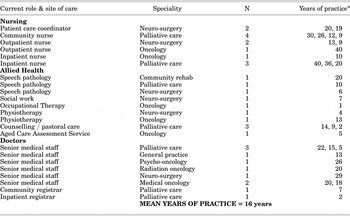
A total of 35 out of 39 (90%) invited HCPs from a variety of disciplines and health care settings participated (Table 1), indicating the high level of interest among the HCPs caring for this patient group. Six focus groups and 6 interviews were conducted, including 13 nurses (mean experience 22 years), 11 medical staff (mean experience 17 years) and 11 allied health (mean experience 8 years).
Characteristics of health care professionals

a Years of practice in a role that involves caring for patients with primary malignant glioma
Overview of findings
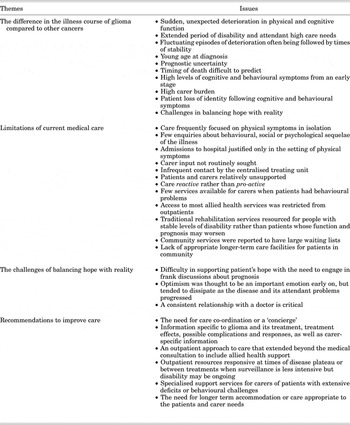
A series of broad themes emerged from the discussions including: The difference in the illness course of glioma compared to other cancers; Limitations of current medical care; Challenges in balancing hope with reality of the illness; and Recommendations to improve care. Table 2 offers a summary of the issues raised under each theme which are expanded on and demonstrated by quotes from HCPs.
Themes and issues arising from health care professional interviews

The Difference in the Illness Course of Glioma Compared to Other Cancers
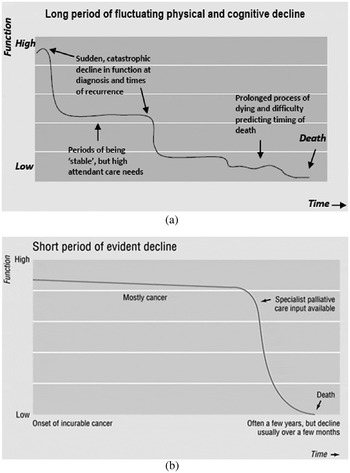
Participants reported a variety of differences of a glioma disease trajectory from the trajectory of other cancers (Fig. 1a). The main reason for this perception included the significant decline in physical and cognitive function that patients with PMG live with for long periods, which was reported to be unlike other classic cancer trajectories. HCPs reported the glioma trajectory was typically punctuated by sudden change – with both diagnosis and times of recurrence being sudden and catastrophic. They described prognostic uncertainty with fluctuating episodes of deterioration often being followed by times of stability. The process of dying was reported to be prolonged, and timing of death often more difficult to predict.
“It's like you've just hit a bus, you've gone off to work in the morning and your whole life has changed that evening.” Palliative care nurse
“It's a cancer where patients lose function early, so they have a long period of being disabled.” Palliative care doctor
“Because this starts in the brain, there can be a number of different features: personality changes, motor changes, speech changes… And more subtle things- impulse control, memory problems.” Medical oncologist
Illness trajectories A. The glioma illness trajectory (reported by health care professionals) B. The classic cancer trajectory (adapted from Murray et al., Reference Murray, Kendall, Boyd and Sheikh2005). With permission from BMJ Publishing Group Ltd.

HCPs reported that patients with PMG often had a poor prognosis, and tended to include younger people who frequently had an extended period of disability and attendant high care needs following diagnosis. The cognitive and behavioural symptoms were said to exacerbate the distress associated with both living with PMG as well as caring for someone with it. HCPs reported the impact of patient loss of identity following such changes. Patients were noted to lose the ability to plan for the future and to prepare for their death, early in the illness.
“There's no spontaneous little conversations and the humour is different. The intimacy of that former relationship being lost is one of the great tragedies.” Psychiatrist
“I think the big difference compared to other cancers and general malignancies – is the loss of person.” Medical oncologist
“By the time they die they bear no resemblance to what they were like when they were well.” Palliative care doctor
Limitations of Current Medical Care
Participants outlined a series of limitations in the current system of care which were largely based around diagnostic and disease-related physical sequelae rather than patient or carer reported need. For patients in the community, HCP consultation was often available only with doctors in response to physical symptoms and available treatments. Specific enquiry around behavioural, social or psychological sequelae was frequently not undertaken, and carer input not routinely sought. Similarly an admission to hospital was said to be justified only in the setting of physical aspects of the disease, that is, patients required a ‘medical’ reason for admission.
The medical staff said, ‘Well, why are you admitting her?’ ‘Well she's not safe [at home].’ ‘Well, that's not a medical reason.” Cancer support nurse
Participants felt that care is concentrated around large hospital centres and tended to involve episodes of time-intensive treatment. These episodes were then punctuated by long periods of “surveillance” where care was primarily based in the community with infrequent contact by the centralised unit. During these times, patients and carers were felt to be relatively unsupported, responding to needs expressed, but not frequently anticipating or planning for problems that may arise. In this way care was reactive to problems rather than pro-active.
“If it's not portrayed to me as a problem, I don't think of it as a problem.” Medical oncologist
There were significant gaps noted in the services available for patients and their carers in the setting of behavioural problems. Few responses were available either at home or in hospital for patients with personality change or aggression. HCPs noted the particular difficulty for carers of these patients to manage these changes and to find support in relation to this aspect of PMG. Access to most allied health services for support with non-medical aspects of care was restricted to the outpatient hospital (as opposed to community) setting. Traditional rehabilitation services, often working with people with stable levels of disability, were seen as unresponsive to these patients whose goals frequently changed as their function and prognosis worsened.
“There are limited supports available, and if they do have challenging behaviour, there's not an awful lot you can do about it.” Medical oncologist
“Because they're glioma patients, they are not offered rehabilitation.” Neuroscience care coordinator
For patients requiring inpatient care, the attention to all aspects of care, namely, nursing, behavioural, psychosocial and spiritual, was reported to be well addressed by palliative care services. However these services felt constrained in being able to provide such care longer term, and therefore screened patients carefully prior to admission to ensure only those seemingly close to death were admitted.
“It's an awful situation where you kind of hope that their tumour grows to the extent that they can be moved to the hospice, because that's really the best place to manage them.” Medical oncologist
The Challenges of Balancing Hope with Reality
Participants, particularly the physicians, discussed the difficulty of managing patients’ hopes and maintaining hope with the need to engage in frank discussions about prognosis. Patients were reported to focus upon the immediate concerns, current symptoms, treatment regimes, planning for the next investigations; rather than wishing to consider the larger picture of their illness and its implications. For doctors, it was easy to concur with the approach taken by patients, and more time consuming and emotionally difficult to broach a challenge to this approach.
“For us, it's easy to concentrate on the treatment aspects; we're comfortable with that. You know, we'll try this and we'll try that and if that doesn't work we'll try this. Easy, you know?” Neurosurgeon
Yet as the illness unfolds, HCPs reported that the focus changes and whilst optimism was thought to be an important emotion early on, this tended to dissipate as the disease and its attendant problems progressed. A consistent relationship with a doctor and discussions that unfolded over time, as events evolved, was seen as critical if negotiating meaningfully with hope.
“I suppose part of my job, as I see it, is to change what people hope for; everyone needs some hope, whether it's getting through a Christmas, as opposed to an overseas trip – that's just not going to happen. You've just got to change what they hope for.” Radiation oncologist
“At diagnosis we're pretty optimistic and positive – ‘I'm sure I can help you and this is what we're going to do’ – but I think once it is recurrent disease, the games up.” Medication oncologist
While survival was the basis for much of the literature informing treatment, HCPs expressed concern at the quality of survival for a number of patients and the psychological fallout for patients following treatment.
“Survival with GBMs is such a dodgy end-point – it says nothing about their quality of life, how much time is independent, well, out of hospital, able to communicate, and not have incontinence and all the rest of it. I'm not so sure we're doing everything we can to maximise the quality of life while patients still have reasonable neurological function – that part of their lives is taken with the anxiety of ‘is the treatment working?’ rather than, ‘my time is limited, what's on my bucket list’.” Radiation oncologist
Recommendations to Improve Care
Participants made a series of recommendations to improve the care of patients with glioma, and of their families. These recommendations included the need for care co-ordination or a ‘concierge’, namely, a consistent person to assist navigation of services both within and without the hospital. This person would assist in anticipating problems, enlisting further support, ensuring consistent information and appropriate follow up was provided to patients and carers.
“I think people need to identify with a particular person – they need as much security and support as possible… Having the same person doing it means the same information is being conveyed.” Neuro-surgeon
Information would cover the glioma and its treatment, treatment effects, possible complications and responses, as well as carer-specific information. Currently palliative care services were playing the role of care co-ordination but only for those patients who were considered appropriate for palliative care referral.
An outpatient approach to care that extended beyond the medical consultation to include allied health support was considered necessary since patients spent most of the time in the community and frequently had needs for support and equipment that was currently unfunded. Such outpatient resources would remain responsive at times of disease plateau or between treatment when follow-up is less intensive but disability may be ongoing.
The need for specialised support for carers who were looking after patients with extensive deficits or behavioural challenges was stressed. A formal neuro-psychology assessment was suggested for longer term survivors to aid understanding of patient abilities, and assist carers by providing specific strategies which may enable them to better manage the patient.
The need for longer term accommodation or care appropriate to the patients' needs was also recommended. For those who stabilised as an inpatient, transfer to longer term residential care (usually nursing homes) was undertaken, but caused substantial distress to carers who believed palliative care units were the most suitable place of care. However nursing homes were felt to be unsuitable since patients were characteristically young, had partners requiring support and sometimes complex symptoms.
“Often you're looking at 8 months of a lingering illness, where the patient is increasingly bed–bound and has behavioural disturbance. That's too long for an acute pal care service, and it doesn't fit with a nursing home because they're often young people.” Psychiatrist
An appropriate care facility in this setting was conceptualised as a ‘step-down’ or a less acute palliative care unit suitable for younger patients, where nursing and some psychosocial input was provided. This was linked to the need for respite services for carers, both in an institutional setting and in the home, such that carers may continue providing care.
“Respite care; that would be my number one priority, and more of a roll-out of the day hospice idea with greater allied health input and less medical input.” Radiation oncologist
“The [respite] waiting lists are 12, 18 months long and the patient dies before they actually get it.” Palliative care nurse
DISCUSSION
This study is novel as it reports on the detailed needs of the PMG patient group as considered by experienced HCPs representing a wide spectrum of sites of care delivery, disciplines and specialties. The findings are important since they offer accumulated experiences of many patients who are diagnosed with a relatively rare cancer. The views of these experienced HCPs are rich and steeped in their collective observations of many encounters.
While there were different perspectives represented, there was marked commonality in the views expressed, particularly the depth of concern felt for patients and families living with PMG and its complex care needs. This was reflected in descriptions of the devastation associated with diagnosis, the difficulty of providing care in the presence of behavioural disturbance and the resulting gaps in current systems of care.
The unique glioma illness trajectory described by the HCPs in this study (Fig. 1a) has implications for planning appropriate care for patients with PMG, as it differs to the well-described classic cancer trajectory (Murray et al., Reference Murray, Kendall, Boyd and Sheikh2005), where physical changes are more gradual and often partly resolve after treatment, until the evident final decline (Fig. 1b). These differences may be summarised as (1) Early cognitive decline with attendant consequences; (2) Behavioural changes, including impulsivity and aggression; (3) Acute, unexpected and devastating deterioration of function; (4) Profound burden of caring including social, physical, behavioural aspects, and often with a changed relationship; and (5) Prolonged disability and prolonged dying.
Recommendations to Improve Care
(1) Proactive Approach Not Reactive
There is a need to move from a reactive approach to care, which waits for problems to present themselves with the inherent delays and costs associated, to a proactive approach that anticipates problems and details the possible responses available. Some HCPs expressed concerns that a proactive response would be time intensive since problems highlighted may not ultimately develop. Others however indicated that overall time may be saved as patients and carers are supported earlier, and indeed some distress avoided.
An important component of this proactive care delivery would include provision of information, given routinely to patients and their carers at critical, pre-defined points in the illness trajectory to ensure relevance to the issues that may be arising. This could be undertaken by the designated care coordination person, who would effectively become the driver of a proactive approach to care, acting as a nominated contact and triaging enquiries appropriately. In this way, a proactive model of care could be undertaken without creating a substantial additional workload for clinicians.
(2) Family Centred, Not Only Patient Focus
The data in this study suggest that for patients with PMG, the focus of care should be broadened, to shift from being solely patient-centred, to expand and include the informal carer. This would herald a substantial shift in the way care is conceptualised, where the rational patient is considered the centre of decision making. Whilst the patient remains fundamental and central, the clinician's gaze must also encompass the needs of carers in order for the patient-carer relationship to be fully realised. This means that the clinician must consider psychosocial issues equally important alongside physical symptoms, with particular recognition of what support the carer may need to enable the patient to function in the community.
(3) Expanding Goals of Care Beyond the Medical
The consideration of issues beyond medical problems, including clinicians' engagement with patients' hopes requires a further shift in care approach. It was clear that clinicians showed great compassion in wishing to do ‘the right thing’ when addressing hope, but were uncertain and hesitant. A focus on the medical aspects of PMG is understandable, and seemingly supported by patients, at least according to their clinicians. Yet the current model of focusing on ‘what patients want to know now’ is inadequate, as evident in the multiple limitations of care outlined. Such a focus avoids psychosocial concerns for which there may not be easy solutions, and avoids opening up questions around hope and prognosis that often require additional time to address.
The proactive provision of information which details possibilities, options and supports may create an opportunity to better manage patient hope. Such information implicitly raises negative aspects of the disease, but will do so in a safe, supportive environment. Indeed not mentioning negative outcomes does not provide insurance against their occurrence. Another solution may be the development of routine care practices, which ensure responses happen at a particular juncture of the illness. This might mean that, for example, all patients are referred to palliative care services at first recurrence or all patients with frontal tumours have a psychologist review. These responses therefore happen routinely, so that patients' care needs are not missed, but nor are they highlighted as having greater need, or more likely to die rapidly.
Finally, clinicians must be prepared to undertake active listening, through open-ended questions, and a willingness to sit with uncertainty that, over time, hope may be re-focused. Support should focus equally on anti-cancer treatment and psychosocial support as required throughout the illness. The conversations clinicians undertake could improve by granting such issues equal consideration.
Strengths and limitations
While the views of HCPs were rich and considered, they are necessarily influenced by their training, professional background, and the pressures and imperatives of their work environment. As such, they do not provide the whole picture. However they are important stakeholders and profoundly influential in the illness experience of patients, and bring together the perspective of many patients and carers. They can therefore offer reflections upon an overall system of care that may not be available to individual patients or their carers. Future work should seek to use these data alongside patient and carer perspectives to provide an overall recommended approach to supportive and palliative care.
CONCLUSIONS
This qualitative study reveals the concern that HCPs hold for patients with glioma and their carers who must navigate a system of care which has many short comings. Despite the range of disciplines, specialties and care settings, there was surprising commonality of the concerns around current care, and the creative solutions to improve patient care. While some solutions are practical and relatively easily negotiated, others require HCPs to re-consider fundamental ways in which they provide care, including their willingness to engage in enhanced communication with patients and families.
Acknowledgements
This study was funded by the Victorian Cancer Agency of the Victorian State Government Department of Health (Translational Cancer Research Grant EO109_29). We would like to acknowledge the time and expertise of the study advisory group who ensured the methodology, results, and interpretation of findings were clinically grounded: Ros Aylot, Amanda Bolleter, Dr Di Clifton, Dr Jeremy Couper, Dr Michael Dally, Prof Mark Rosenthal, Dr Peter Sherwen, and Jane Staker. All authors declare that they have no conflicts of interest.