Introduction
Chickpea is an important food legume crop grown in the Indian sub-continent, Western Asia, Northern Africa and Southern Europe (Torutaeva et al., Reference Torutaeva, Asanaliev, Prieto-Linde, Zborowska, Ortiz, Bryngelsson and Garkava Gustavsson2014; Yadav et al., Reference Yadav, Shah and Mod2019). India holds 72% of the geographical area of chickpea and produces around 70.0% (9.38 million tons) of total world production (Gediya et al., Reference Gediya, Patel, Parmar, Patel and Raheva2018). Chickpea crop productivity is poor and insufficient to meet the protein requirement of the vegetarian human population (Aghaali et al., Reference Aghaali, Ghadmizadeh, Mandoulakani and Bernousi2014; Talekar et al., Reference Talekar, Lohithaswa and Viswanatha2017a). Low productivity is due to the narrow genetic base of the improved varieties combined with their vulnerability to drought and debilitating diseases (Bharadwaj et al., Reference Bharadwaj, Srivastava, Chauhan, Satyavathi, Kumar, Faruqui, Yadav, Rizvi and Kumar2011; Varhney et al., Reference Varshney, Song, Saxena, Azam, Yu, Sharpe, Cannon, Baek, Rosen, Taran, Millan, Zhang, Ramsay, Iwata, Wang, Nelson, Farmer, Gaur, Soderlund, Varma, Xu, Bharti, He, Winter, Zhao, Hane, Garcia, Condie, Upadhyaya, Luo, Thudi, Gowda, Singh, Lichtenzveig, Gali, Rubio, Nadarajan, Dolezel, Bansal, Xu, Edwards, Zhang, Kahl, Gil, Singh, Datta, Jackson, Wang and Cook2013). Chickpea breeding programmes must therefore concentrate on enhancing crop's genetic yield potential with defence against significant abiotic and biotic stresses (Farahani et al., Reference Farahani, Maleki, Mehrabi, Kanouni, Scheben, Batley and Talebi2019). This requires a clear understanding of the magnitude and pattern of genetic variations present in wild and domesticated accessions (Rubenstein et al., Reference Rubenstein, Heisey, Shoemaker, Sullivan and Frisvold2005). To identify and select suitable parents with useful genes and to use them in hybridization programmes (Dwevedi and Gaibriyal, Reference Dwevedi and Gaibriyal2009; Keneni et al., Reference Keneni, Bekele, Imtiaz, Dagne, Getu and Assefa2011; Farahani et al., Reference Farahani, Maleki, Mehrabi, Kanouni, Scheben, Batley and Talebi2019), it is hence imperative to extensively characterize a large pool of diverse germplasm accessions. The significance of phenotypic characterization in determining the genetic diversity, clustering pattern and effectiveness of selection among chickpea genotypes (Dwevedi and Gaibriyal, Reference Dwevedi and Gaibriyal2009; Keneni et al., Reference Keneni, Bekele, Imtiaz, Dagne, Getu and Assefa2011; Sewak et al., Reference Sewak, Iquebal, Singh and Solanki2012; Talebi and Rokhzadi, Reference Talebi and Rokhzadi2013; Malik et al., Reference Malik, Shabbir, Zubir, Iqbal and Ali2014; Gediya et al., Reference Gediya, Patel, Parmar, Patel and Raheva2018; Yadav et al., Reference Yadav, Shah and Mod2019) has been highlighted in several earlier studies. Nevertheless, most research used a limited number of genotypes to classify potentially truly divergent accessions. Different researchers have strongly asserted the usefulness of multivariate analysis (Murty and Arunachalam, Reference Murty and Arunachalam1966; Kumar and Arora, Reference Kumar and Arora1992; Jeena and Arora, Reference Jeena and Arora2002; Sabouri et al., Reference Sabouri, Rabiei and Fazialipour2008; Golkar et al., Reference Golkar, Arzani and Rezaei2011; Chakravorty et al., Reference Chakravorty, Ghosh and Sahu2013; Coutinho et al., Reference Coutinho, Rafael, Filipe Bittencourt, Farias, Bruzi and Guimaraes2019; Fawad et al., Reference Fawad, Yilmaz, Chaudhary, Nadeem, Rabbani, Arslan, Nawaz, Habyarimana and Baloch2020).
Achieving yield gains requires the use of genetically diverse parents which vary in economically important component traits. The use of ‘discriminant function’ helps to explain the degree to which genetic improvement can be accomplished in yield by considering a combination of characters (Fisher, Reference Fisher1936). This technique exploits the genetic correlation in a better way among several traits to construct a ‘selection index’ which combines information on all independent variables (Smith, Reference Smith1936). Therefore, selection based on such an index has been found to be more effective than straight selection for yield alone (Hasan and Deb, Reference Hasan and Deb2014). It has also been suggested that the multiple trait selection criteria improve selection efficiency with the increase in the number of characters taken to construct the selection index (Deb and Khaleque, Reference Deb and Khaleque2007; Ferdous et al., Reference Ferdous, Samsuddin, Hasan and Bhuiyan2010; Sarker et al., Reference Sarker, Samad, Azad and Deb2013; Parmar, Reference Parmar2018). Considering this, the present study was conducted with the aims of (i) quantifying the genetic divergence and clustering pattern of 529 chickpea genotypes and (ii) identifying some promising accessions for their further utilization in the chickpea hybridization programme.
Materials and methods
A total of 529 chickpea genotypes collected from different national institutes including National Bureau of Plant Genetic Resources, New Delhi; Jawaharlal Nehru Krishi Vishwa Vidyalaya, Jabalpur (Madhya Pradesh); Agricultural Research Station, Durgapur (Rajasthan) and International Centre for Research in Semi-Arid Tropics (ICRISAT), Hyderabad, were grown during Rabi season (winter) of 2012–13 in a simple lattice design (23 × 23) with two replications in K-Farm Block of the Zonal Agricultural Research Station, University of Agricultural Sciences, GKVK, Bengaluru. Each genotype was grown in 3 m single row with a spacing of 30 cm between rows and 10 cm between plants. The crop was raised as per the University recommended package of practices. Seven agronomic traits viz., days to 50% flowering – DFF (X 1), plant height in centimetre – PH (X 2), number of branches per plant – BPP (X 3), pods per plant – PPP (X 4), pods per branch – PPB (X 5), 100-seed weight in grams – TW (X 6) and seed yield per plant in grams – SYP (X 7) were recorded on five randomly tagged plants.
Statistical analysis
The mean values of seven traits from five plants were computed for each entry, for the estimation of genetic diversity. The principal component analysis (PCA) and hierarchical clustering were worked out using GenStat (version 15.1) software. The Ward's minimum variance method was applied for hierarchical clustering analysis (Ward, Reference Ward1963). The same set of 529 genotypes was used and 127 different selection indices were formulated using discriminant function analysis based on various combinations of seven characters. The seed yield (X 7) was considered as a dependent variable, while other traits as independent variables. The expected genetic advance (GA) based on the composition of characters that were included for the formulation of the various selection indices was calculated as per the formula of Robinson et al. (Reference Robinson, Comstock and Harvey1951).

where z/P is the selection differential in standard units whose value was taken as 2.06 at 5% selection intensity in the present study; b 1, b 2, b 3 … bn – discriminant coefficients attached to characters; n – 1, 2, 3… and g 1y, g 2y, g 3y, … gny are the genotypic covariances between the characters under indirect selection (1, 2, 3 to n) and those under direct selection (y). The relative efficiency (RE) of each selection index formulated was evaluated by comparing with seed yield alone which is considered as 100% efficient. The RE was calculated as RE (%) = [(GA of particular selection index/GA by straight selection based on seed yield alone) × 100] (Brim et al., Reference Brim, Johnson and Cockerham1959). Further, the best selection index having maximum RE among 127 indices was chosen and applied for the selection of best genotypes based on index scores.
Results
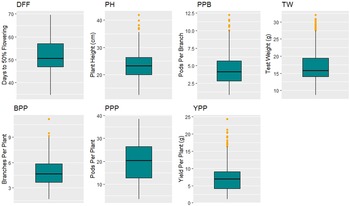
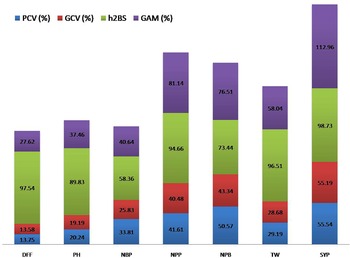
Analysis of variance revealed a wide range of variation for all the traits within the evaluated material (Fig. 1; online Supplementary Table S1). Among the seven agronomic traits, PPP exhibited the highest significant variability followed by DFF. The accessions ICC-16347 and ICCV 96030 were earliest to flower in barely 34.5 days, whereas IC 269064 was very late with 69.5 days. SYP ranged from 1.08 to 24.36 g with IC 269025 producing the bottom yield, while GAG 0733 recorded maximum yield. The released variety BG 2094 registered minimum PPP, whereas the accession IC 268955 recorded maximum PPP. The accessions with the lowest and highest values in another key characteristic were TW, IC 269139 and FLIP 06-19C. Phenotypic and genotypic coefficient of variation (PCV and GCV) estimates were high (Fig. 2) for SYP (55.54 and 55.19%) followed by PPB (50.57 and 43.34%), PPP (41.61 and 40.48%), BPP (33.81 and 25.83%) and TW (29.19 and 28.18%). Nevertheless, moderate PCV and GCV were recorded for PH (20.24 and 19.19%) and DFF (13.75 and 13.58%). Heritability in broad sense (Robinson et al., Reference Robinson, Comstock and Harvey1949) ranged from 58.36% for BPP to 98.73% for SYP; it had been high for all the traits except BPP which documented moderate values. Further, genetic advance as percent of mean (GAM) was also high for all the variables (Johnson et al., Reference Johnson, Robinson and Comstock1955) under the study which ranged from 27.62% for DFF to 112.96% for SYP.
Box plots showing the range of seven morphological traits in chickpea.

Genetic variability parameters for seven agronomic traits in chickpea.

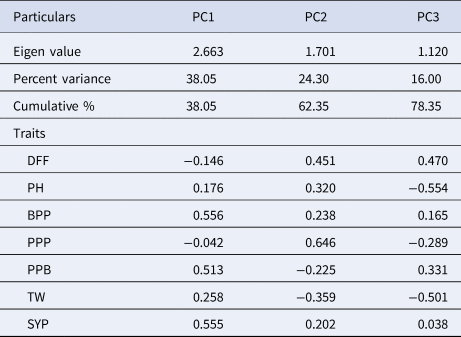
The PCA revealed remarkable differences between average vectors (Table 1). Seven principal components (PCs) axes were observed from the data (online Supplementary Fig. S1). The biological implication of PCs may be estimated from the contribution of various variables to every PC according to the Eigenvectors. It also identified the traits that contribute maximum to the overall variation within a group of entries. A trait with a coefficient over 1.0 was considered as an important trait based on a large contribution to the overall variation (Adebisi et al., Reference Adebisi, Okelola, Ajala, Kehinde, Daniel and Ajani2013). The PC1 which is the most important component explained 38.05% of total variation and exhibited positive contribution with PH, BPP, PPB, TW and SYP. The traits BPP, PPB and SYP contributed to maximum variation. The PC2 accounted for 24.30% of total variation and traits with major contributions in this component were DFF and PPP. The third PC explained 16.00% of total variation and mainly contributed by DFF.
Eigen values, contribution of variability and component loading of morphoagronomic traits in chickpea

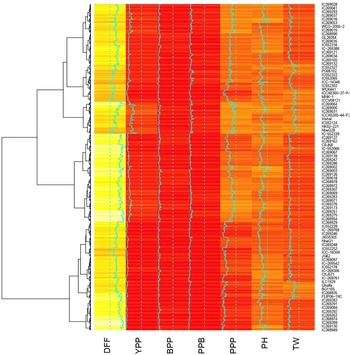
The clustering analysis conducted on PCs grouped 529 chickpea accessions into 10 clusters with 56 accessions in cluster 1 (C1), 94 in cluster 2 (C2), 38 in cluster 3 (C3), 37 in cluster 4 (C4), 112 in cluster 5 (C5), 45 in cluster 6 (C6), 52 in cluster 7 (C7), 29 in cluster 8 (C), 28 in cluster 9 (C9) and 38 in cluster 10 (online Supplementary Table S2). The maximum cluster mean for YPP was observed in C8 followed by C7, while C6 included the genotypes with low YPP (Fig. 3). The higher contribution of PPB, PPP and TW has lead in realizing maximum YPP in C7 and C8. Although highest mean TW was observed in cluster C9; lower cluster means for BPP, PPB and PPP have led to realization of lower mean YPP in C9. The cluster C7 represented exclusively the high-yielding released varieties such as PG 01103, CSJK 46, CSJK 42, JAKI 9218, PG 00110, GJ 0107, PG 9937, JSC 61, Vishal, Phule 9801 and PG 06102 that flower relatively early with a cluster mean of 47.20 days, with second highest cluster mean of 27.60 for PPP and 26.20 for TW. Nevertheless, C8 included the highest yielding genotype GAG 0733 (24.36 g per plant) followed by IC 268988 (21.24 g), IC 269031 (20.59 g) and IC 269033 (20.45 g). Cluster 5 includes the genotypes that take lowest number of days to flowering. Clusters C9 and C10 constituted both released varieties and elite genotypes with a mixed group of early and late flowering types having high PPP and TW.
Heat map indicating the clustering pattern of 529 germplasm lines of chickpea.

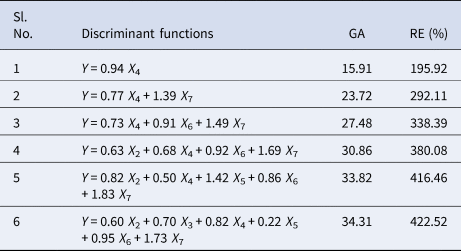
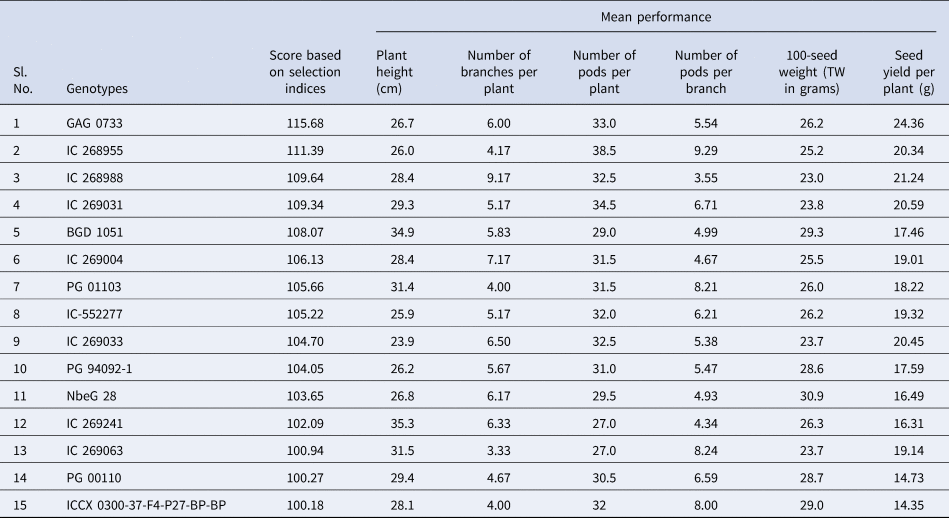
Simultaneous improvement of several characters is ultimately the major aim of any plant breeding programme. Selection for the character of economic significance such as seed yield requires the formulation of selection index using discriminant function analysis based on different component characters to direct efficient selection of this trait by a breeder. A rapid improvement of seed yield in chickpea is possible with the help of this selection index. Among 127 selection indices formulated, higher RE (422.52%) coupled with high GA (34.31%) was exhibited (Table 2) by the combination involving six characters viz., PH (X 2), BPP (X 3), NPP (X 4), PPB (X 5), TW (X 6) and SYP (X 7). Among single characters, PPP (X 4) was highly efficient with RE of 195.92 and a high GA of 15.91% compared to the direct selection based on SYP (X 7). Among two-character combinations, maximum RE (292.11) was observed for the combination of PPP (X 4) and SYP (X 7) with high GA (23.72%). However, in the case of three character combinations, the combination involving PPP (X 4), TW (X 6) and SYP (X 7) recorded higher RE (338.39) coupled with high GA (27.48%). PH (X 2), PPP (X 4), TW (X 6) and SYP (X 7) manifested high RE (380.08) combined with high GA (30.86%) for four trait combinations, while PH (X 2), PPP (X 4), PPB (X 5), TW (X 6) and SYP (X 7) revealed high RE (416.46%) with the high GA of 33.82% among five trait combinations. The best selection index (X 2 + X 3 + X 4 + X 5 + X 6 + X 7) was applied to all 529 genotypes to score the accessions for seed yield (online Supplementary Fig. S2). Fifteen genotypes were selected as promising genotypes based on the index score >100 which could produce higher seed yield (Table 3). The genotype GAG 0733 manifested a 115.68 index score that produced the highest SYP (24.36 g) followed by IC 268955, IC 268988 and IC 269031 whose scores were 111.39, 109.64 and 109.34, respectively, with a yield of 20.34, 21.24 and 20.59 g.
Discriminant functions, their genetic advance and relative efficiency over straight selection for seed yield in chickpea germplasm lines

The mean performance of top 15 genotypes selected based on score obtained by application of best selection index in 529 germplasm lines of chickpea

Best selection index applied, Y = 0.60 X 2 + 0.70 X 3 + 0.82 X 4 + 0.22 X 5 + 0.95 X 6 + 1.73 X 7.
Relative efficiency of selection index = 422.52%.
Genetic advance of selection index = 34.31.
Discussion
High variability among genotypes was observed for all quantitative traits. The high variability for DFF indicated genotypes belonged to different maturity groups which could be used as a basis for selecting desirable traits. Low influence of environment on the expression of the characters was evident due to the least difference between GCV and PCV estimates indicating the significant role of genetic factors causing variability in these characters (Sewak et al., Reference Sewak, Iquebal, Singh and Solanki2012). High heritability coupled with high GAM for all traits revealed the control of additive gene action, and selection would be more effective in genetic improvement of these traits (Borate et al., Reference Borate, Dalvi and Jadhav2010; Talekar et al., Reference Talekar, Viswanatha and Lohithaswa2017b). Although the GAM was high for DFF, PH, BPP and TW, relatively low values suggested the considerable environmental influence on these traits.
PCA was carried out to get a better insight into variance sources among chickpea genotypes. The results demonstrated that different characters contributed differently to the total variation as shown by their Eigenvectors as well as their weights and loading on the different principal axes. PCA also helps to identify the minimum number of traits that can explain the maximum percentage of the total variation. Various studies delineated diversely concerning the number of traits that contribute maximum together to the total genetic variation. Farshadfar and Farshadfar (Reference Farshadfar and Farshadfar2008) presented the existence of 63.0% of the total variation that was described by five PCs in 360 chickpea landraces and lines. The first four PCs explained 82.7% of total variation (Talebi and Rokhzadi, Reference Talebi and Rokhzadi2013) in 40 chickpea landraces and 75.15% in 94 international safflower accessions panel (Fawad et al., Reference Fawad, Yilmaz, Chaudhary, Nadeem, Rabbani, Arslan, Nawaz, Habyarimana and Baloch2020). In our study, the first three PCs elucidated 78.35% variation among 529 accessions. The results agree with those of previous researchers who reported that the first three PCs accounted for 86.34% of the total variation in rice (Adebisi et al., Reference Adebisi, Okelola, Ajala, Kehinde, Daniel and Ajani2013); 69.69% variation in 25 chickpea genotypes (Sharifi et al., Reference Sharifi, Astereki and Pouresmael2018) and several other studies (Upadhyaya et al., Reference Upadhyaya, Dwivedi, Gowda and Singh2007; Sewak et al., Reference Sewak, Iquebal, Singh and Solanki2012; Malik et al., Reference Malik, Shabbir, Zubir, Iqbal and Ali2014) which indicated that first three PCs were the most important in reflecting the variation patterns among genotypes and the traits that greatly correlated with these could be used in discriminating samples. The traits BPP, PPB and SYP had maximum variation in PC1 and PPP in PC2 which would contribute greatly to the discrimination among the genotypes. Seed yield per plant exhibited the highest variation in PC1 (Farshadfar and Farshadfar, Reference Farshadfar and Farshadfar2008; Adebisi et al., Reference Adebisi, Okelola, Ajala, Kehinde, Daniel and Ajani2013); PPP and seed yield in PC2 and PC3, respectively (Upadhyaya et al., Reference Upadhyaya, Dwivedi, Gowda and Singh2007) and seed yield and PPP in PC2 (Sharifi et al., Reference Sharifi, Astereki and Pouresmael2018) proving the importance of these traits.
Characterization of genetic diversity existing in crop species is a prerequisite for successful crop improvement programmes (Bharadwaj et al., Reference Bharadwaj, Srivastava, Chauhan, Satyavathi, Kumar, Faruqui, Yadav, Rizvi and Kumar2011). Information on the nature and extent of genetic divergence would help to select the right parents for hybridization (Farahani et al., Reference Farahani, Maleki, Mehrabi, Kanouni, Scheben, Batley and Talebi2019). The clustering pattern indicated that the accessions originating from different geographical regions grouped together. This none parallelism may be attributed to genetic drift and intense natural and human selection for diverse adaptive gene complexes in different environments resulting in greater genotypical diversity rather than geographic distances (Murty and Arunachalam, Reference Murty and Arunachalam1966; Keneni et al., Reference Keneni, Bekele, Imtiaz, Dagne, Getu and Assefa2011). For breeding high-yielding early maturing cultivars with more PPP and higher 100-seed weights, the genotypes from early flowering in cluster 5 could be crossed with highest yielding accessions (GAG 0733, IC 268988, IC 269031, IC 269033 and IC 268955) in cluster 8. Genotypes that occur in the more distant clusters can serve as good sources of divergent genes that are very essential for breeding in order to obtain good transgressive segregants.
To select genotypes with high seed yield among 529 germplasm lines of chickpea, 127 discriminant functions were computed with different sets of characters, and the efficiency of each index was compared with direct selection for seed yield per plant and other combination of characters. Among these, higher RE coupled with high GA exhibited by the six-character combination of PH (X 2), BPP (X 3), PPP (X 4), PPB (X 5), TW (X 6) and SYP (X 7) suggested that more emphasis on these traits is needed to enhance the seed yield in chickpea. Similar results of increased efficiency by the inclusion of different combinations of component characters along with seed yield in formulating selection indices were reported by Nagaraja et al. (Reference Nagaraja, Nehru and Manjunath1999) in horse gram, Nandi et al. (Reference Nandi, Tripatly and Hencha1999) in French bean, Sable et al. (Reference Sable, Narkhede, Wakode and Lande2003) in chickpea, Deb and Khaleque (Reference Deb and Khaleque2007) in chickpea, Patel et al. (Reference Patel, Pithia, Vachhani and Bhatiya2007) in mungbean, Hasan and Deb (Reference Hasan and Deb2014) and Samad et al. (Reference Samad, Sarker and Deb2014) in chickpea. Though this six trait combination realized the highest RE and GA, it will be difficult for the breeder to select the genotype taking all these traits into consideration. Therefore, it is important to note that the priority must be given to PH (X 2), PPP (X 4) and TW (X 6) traits along with SYP (X7) to achieve high genetic improvement as this combination also exhibited comparable RE and GA with that of six trait combinations. These indices can also be regarded as worthy criteria for selecting highly efficient genotypes. Gumber et al. (Reference Gumber, Singh, Rathore and Singh2000) also reported a significant combination of PPP and SYP traits to realize better RE and GA. The indices allowed the identification of superior cultivars GAG 0733, IC 268955, IC 268988 and IC 269031. The findings also confirmed earlier studies in which FLIP09-51C, FLIP06-97C and Aksu accessions that exhibited the best rank based on indices were determined as the good performing genotypes (Erdemci, Reference Erdemci2018).
Conclusion
The PCA using 529 genotypes identified branches per plant, pods per branch, pods per plant and seed yield per plant as the characters that mainly described the variation within the chickpea genotypes. The cluster analysis grouped the chickpea genotypes into 10 distinct clusters, exhibiting that hybridization of genotypes across clusters may lead to transgressive segregants for the specified traits. Both PCA and selection indices highlighted the importance that must be attached to BPP, PPP and TW traits while breeding for high SYP. Furthermore, both these techniques have individually identified the same genotypes GAG 0733, IC 268988 and IC 269031 as the best performing genotypes reflecting on these two techniques as being equally efficient in the identification of superior cultivars.
Supplementary material
The supplementary material for this article can be found at https://doi.org/10.1017/S1479262123000242
Acknowledgements
The authors express their gratitude to Dr Santosh Khadakabhavi, Corn Breeder, Bisco BioSciences, Pvt. Ltd, Hyderabad for helping in the analysis of experimental data; Dr R. K. Gupta, Former Team Leader, Borlaug Institute for South Asia, New Delhi; Dr G. K. Naidu, Assistant Professor, University of Agricultural Sciences, Dharwad; and Dr Ravikumar Hosamani, Assistant Professor, University of Agricultural Sciences, Dharwad for editing the manuscript.
Competing interests
None.